Overview
Strengthening a claim is a critical rhetorical skill tested extensively on the ACT English section. This concept involves selecting evidence, examples, or supporting details that most effectively reinforce an author's argument or main point within a passage. Unlike grammar-focused questions, strengthening a claim questions assess a student's ability to evaluate the logical relationship between ideas and determine which information best supports a writer's purpose.
On the ACT, these questions typically appear 3-5 times per test and are part of the broader Rhetorical Skills category, which accounts for approximately 35% of the English section. Students must demonstrate not only reading comprehension but also critical thinking skills to identify which piece of information—whether a statistic, example, quotation, or descriptive detail—most powerfully bolsters the author's position. These questions often present four options that may all seem relevant, requiring careful analysis to determine which choice provides the most direct, specific, and compelling support.
Understanding ACT strengthening a claim questions connects directly to other rhetorical skills including organization, transitions, and purpose. When students master this concept, they develop a deeper appreciation for how effective writing builds persuasive arguments through strategic use of evidence. This skill extends beyond test-taking into academic writing, professional communication, and critical reading—making it one of the most practically valuable concepts tested on the ACT.
Learning Objectives
- [ ] Identify when strengthening a claim is being tested in ACT English passages
- [ ] Explain the core rule or strategy behind strengthening a claim
- [ ] Apply strengthening a claim to ACT-style questions accurately
- [ ] Distinguish between relevant and irrelevant supporting evidence
- [ ] Evaluate the relative strength of multiple pieces of supporting evidence
- [ ] Recognize the relationship between a claim and its most effective support
- [ ] Eliminate answer choices that weaken, distract from, or fail to address the claim
Prerequisites
- Basic reading comprehension: Understanding main ideas and supporting details is essential for identifying what claim needs strengthening
- Paragraph structure awareness: Recognizing topic sentences and supporting sentences helps locate claims within passages
- Logical reasoning fundamentals: The ability to assess cause-effect relationships and evaluate evidence quality underlies all strengthening questions
- Familiarity with rhetorical purpose: Understanding why authors write (to inform, persuade, entertain) provides context for evaluating supporting evidence
Why This Topic Matters
In academic and professional contexts, the ability to strengthen claims with appropriate evidence forms the foundation of persuasive writing, research papers, legal arguments, and business proposals. Students who master this skill become more effective writers and more critical readers, able to evaluate the strength of arguments they encounter in news articles, advertisements, and academic texts.
On the ACT specifically, strengthening a claim questions appear with high frequency—typically 3-5 questions per test, representing approximately 5-8% of the English section. These questions carry the same weight as grammar questions, making them crucial for achieving competitive scores. Students aiming for scores above 30 must demonstrate consistent accuracy on rhetorical skills questions, including those testing the ability to strengthen claims.
These questions commonly appear in several formats: asking students to choose the best supporting sentence to add to a paragraph, selecting the most relevant example to illustrate a point, determining which detail most effectively supports an argument, or identifying which piece of evidence best accomplishes the author's stated purpose. The passages span diverse topics including science, history, personal narratives, and cultural commentary, requiring students to apply their analytical skills across content areas without needing specialized subject knowledge.
Core Concepts
Understanding Claims and Evidence
A claim is an assertion, argument, or main point that an author makes within a passage. Claims can be explicit statements of opinion ("Solar energy represents the most promising renewable resource") or implicit positions suggested through the passage's overall message. To strengthen a claim means to provide supporting information that makes the assertion more convincing, credible, or well-founded.
Evidence encompasses any information used to support a claim, including:
- Statistical data and research findings
- Expert testimony and quotations
- Specific examples and case studies
- Historical facts and documented events
- Logical reasoning and explanations
- Descriptive details that illustrate a point
The relationship between claim and evidence follows a hierarchical structure: the claim represents the "what" (the point being made), while evidence provides the "why" or "how" (the reason to believe the claim or the demonstration of its validity).
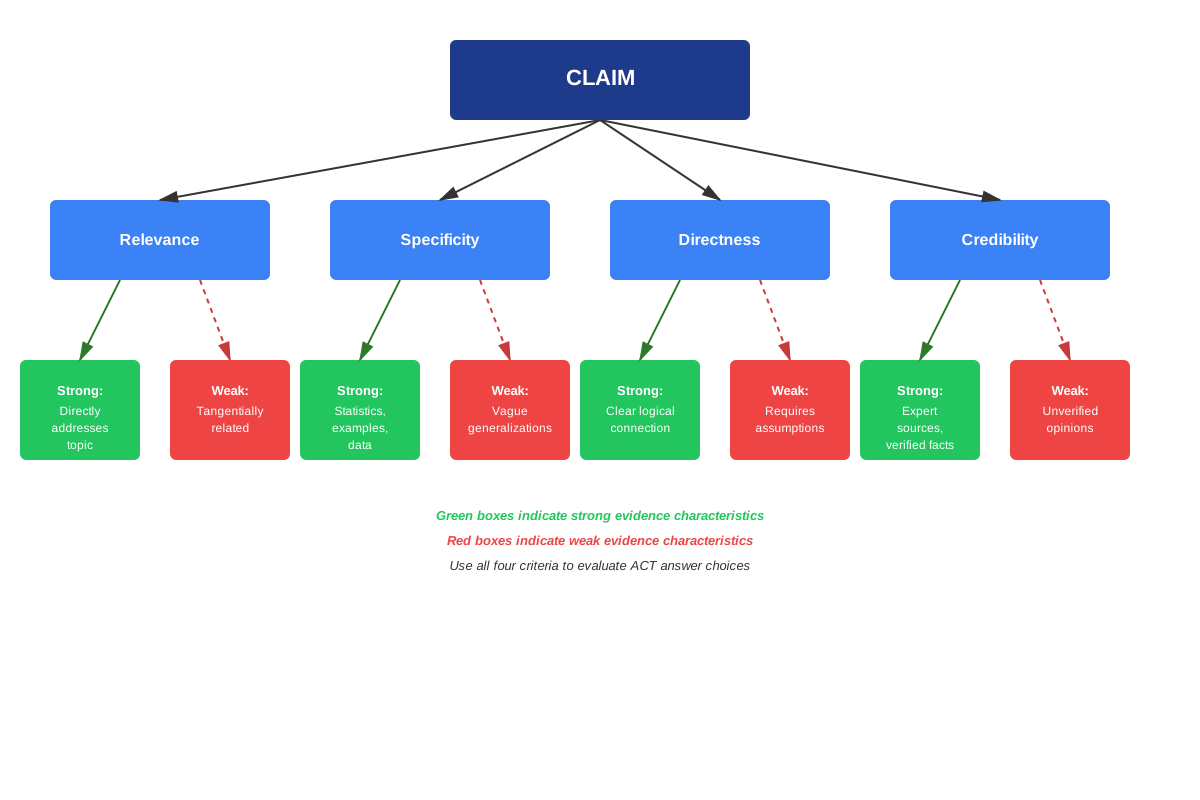
Characteristics of Strong Supporting Evidence
Effective evidence that strengthens a claim possesses several key qualities:
Relevance: The evidence must directly address the specific claim being made. Even factually accurate information fails to strengthen a claim if it discusses a tangential topic or addresses a different aspect of the subject.
Specificity: Concrete, detailed evidence strengthens claims more effectively than vague generalizations. Compare "Many people support this policy" (weak) with "A 2019 survey of 2,000 registered voters found 73% support for this policy" (strong).
Credibility: Evidence from authoritative sources, peer-reviewed research, or documented facts carries more weight than unsupported assertions or anecdotal observations.
Sufficiency: The evidence must be substantial enough to support the scope of the claim. Broad claims require more comprehensive evidence than narrow, limited assertions.
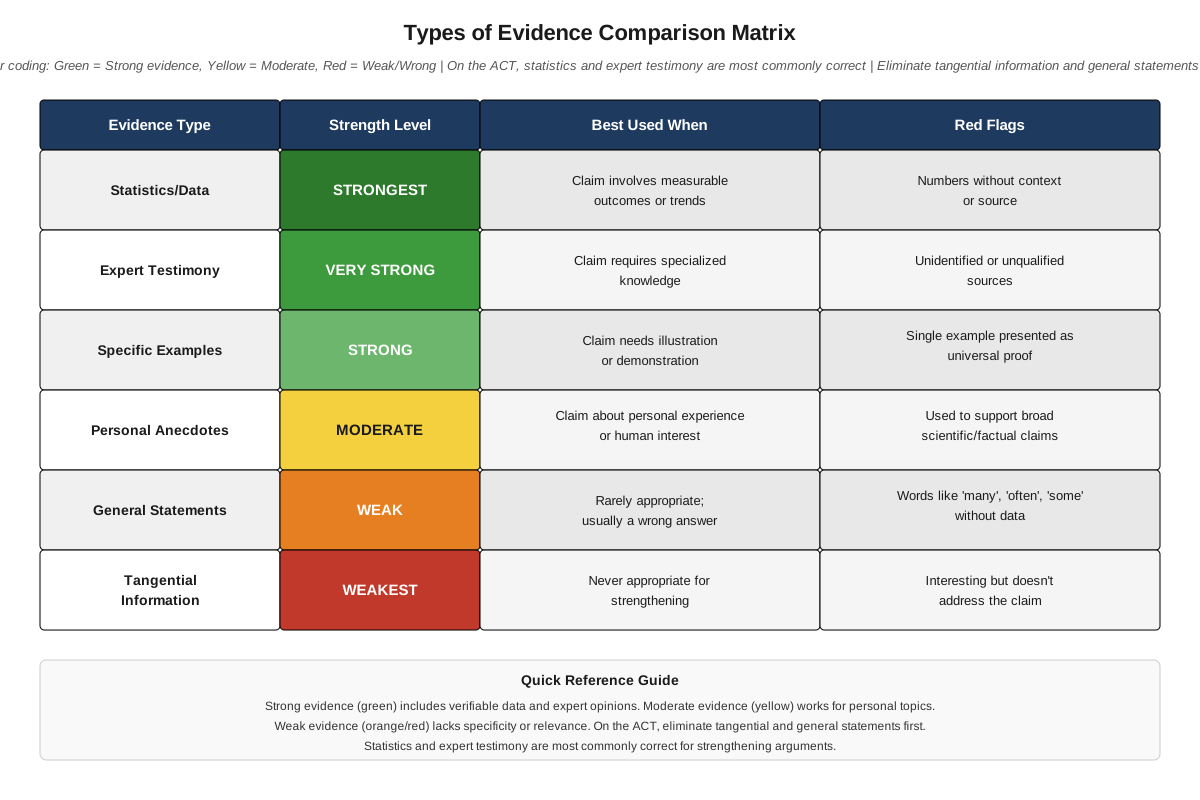
| Evidence Type | Strength Level | Best Used For |
|---|---|---|
| Specific statistics | High | Quantifiable claims, trends, comparisons |
| Expert quotations | High | Establishing credibility, specialized topics |
| Concrete examples | Medium-High | Illustrating abstract concepts, showing real-world application |
| Historical facts | Medium-High | Establishing precedent, showing patterns |
| General statements | Low | Rarely strengthens claims effectively |
| Personal opinions | Low | Insufficient for objective claims |
The ACT's Testing Approach
The ACT tests strengthening a claim through several question formats:
- Addition questions: "Which choice most effectively supports the statement made in the previous sentence?"
- Revision questions: "Which choice provides the most relevant detail at this point in the essay?"
- Purpose-driven questions: "Which choice best accomplishes the writer's goal of demonstrating the significance of this discovery?"
- Comparative questions: Implicitly asking students to compare four options and select the strongest support
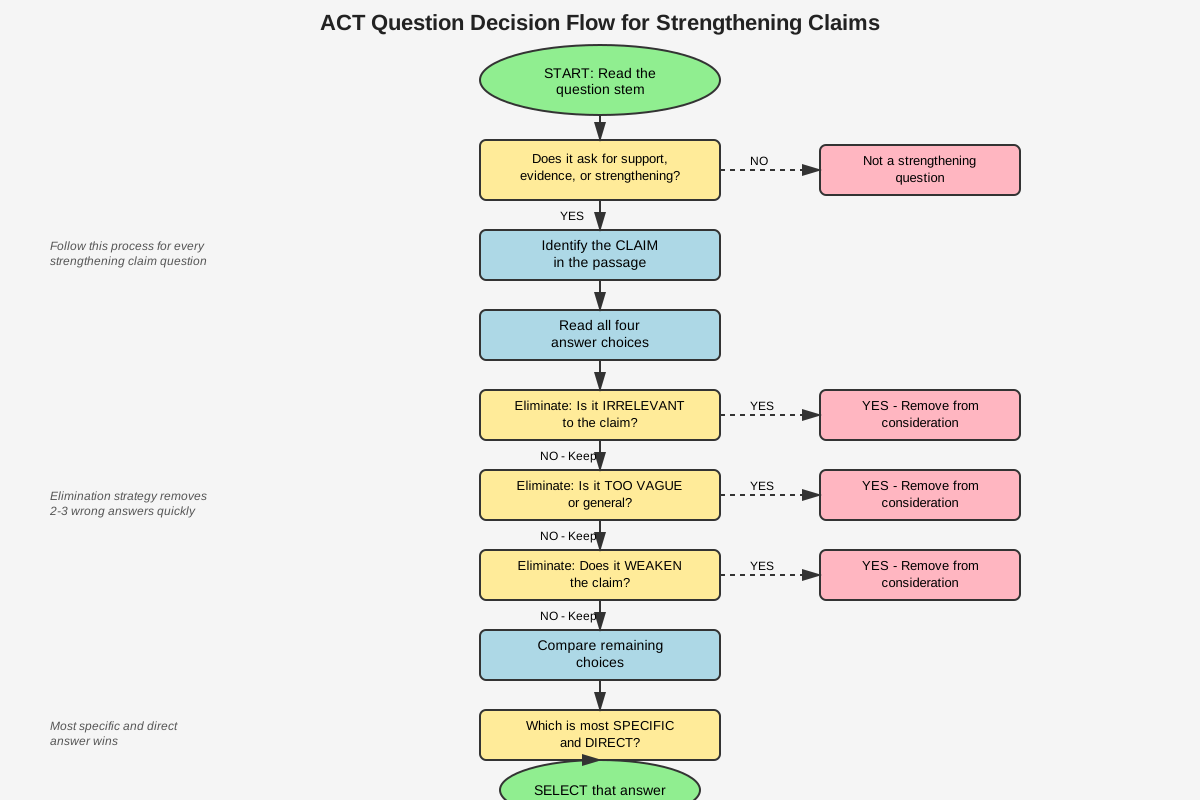
These questions require a two-step process:
- Identify the claim that needs support (often in the preceding sentence or paragraph's topic sentence)
- Evaluate which answer choice provides the most direct, specific, and relevant support for that particular claim
Common Evidence Patterns on the ACT
The test frequently presents answer choices that follow predictable patterns:
The strongest answer typically provides specific, relevant evidence directly supporting the claim. It often includes concrete details, numbers, names, or documented facts.
Weak distractors may be factually accurate but irrelevant to the specific claim, too general to provide meaningful support, or focused on a related but distinct topic.
Tempting wrong answers often seem related to the passage's general topic but fail to address the specific claim requiring support. These choices test whether students can distinguish between topical relevance and logical relevance.
Evaluating Evidence Strength
When multiple answer choices seem relevant, apply this hierarchy:
- Direct statistical support for quantifiable claims
- Specific examples that concretely illustrate the claim
- Expert testimony that validates the claim's accuracy
- Explanatory details that clarify how or why the claim is true
- General statements that restate without adding new support
The strongest evidence creates a clear logical connection: "Because [evidence], therefore [claim]." If this relationship doesn't hold, the evidence likely doesn't strengthen the claim effectively.
Concept Relationships
The skill of strengthening a claim builds directly on fundamental reading comprehension—students must first identify the main idea before they can evaluate supporting evidence. This concept connects intimately with paragraph organization, as understanding where topic sentences and supporting details typically appear helps students quickly locate the claim requiring support.
Strengthening a claim → relates to → Transitions and logical flow: Both skills require understanding how ideas connect within passages. While transitions show relationships between sentences, strengthening questions test whether the content of those sentences actually supports the argument.
Strengthening a claim → contrasts with → Deleting information: These represent opposite sides of revision—one adds support while the other removes unnecessary content. Both require evaluating relevance and purpose.
Strengthening a claim → builds toward → Author's purpose questions: Understanding how evidence supports claims enables students to grasp the author's overall rhetorical strategy and intended effect on readers.
Within the topic itself: Identifying the claim → enables → Evaluating evidence relevance → leads to → Selecting the strongest support. This sequential process must occur rapidly during the test, but understanding each step helps students develop systematic approaches to these questions.
High-Yield Facts
⭐ Strengthening a claim questions typically appear 3-5 times per ACT English test, making them high-frequency question types
⭐ The strongest evidence is both relevant to the specific claim AND provides concrete, specific details rather than general statements
⭐ Always identify the exact claim being made before evaluating answer choices—the claim is usually in the immediately preceding sentence
⭐ Statistical data and specific examples almost always strengthen claims more effectively than general observations or restatements
⭐ Answer choices that are factually accurate but discuss a different aspect of the topic are common wrong answers
- Evidence must directly address the claim's scope—broad claims need comprehensive evidence; narrow claims need specific examples
- Expert quotations strengthen claims about specialized or technical topics more effectively than general descriptions
- The phrase "most effectively" in questions signals that multiple answers may provide some support, but only one provides the strongest support
- Historical facts and documented events strengthen claims about patterns, precedents, or long-term trends
- Personal anecdotes rarely provide the strongest support for objective claims on the ACT, though they may support claims about personal experiences or subjective topics
Quick check — test yourself on Strengthening a claim so far.
Try Flashcards →Common Misconceptions
Misconception: Any factually accurate information strengthens a claim if it relates to the passage's general topic.
Correction: Evidence must specifically address the particular claim being made, not just the passage's overall subject. A passage about climate change might make a specific claim about solar panel efficiency—information about rising temperatures, while topically related, wouldn't strengthen that specific claim.
Misconception: Longer, more detailed answer choices always provide stronger support than shorter ones.
Correction: Brevity doesn't determine strength. A concise statistic often strengthens a claim more effectively than a lengthy but vague description. Evaluate content quality, not length.
Misconception: The correct answer will always introduce completely new information not mentioned elsewhere in the passage.
Correction: Strong supporting evidence may elaborate on ideas mentioned elsewhere, providing specific details that strengthen a claim. Repetition of concepts isn't inherently wrong if the new sentence adds concrete support.
Misconception: If an answer choice seems interesting or well-written, it probably strengthens the claim.
Correction: Engaging writing doesn't equal effective support. The ACT tests logical relationships, not stylistic preferences. Focus on whether the evidence directly supports the specific claim, regardless of how interesting it sounds.
Misconception: General statements that summarize the claim strengthen it by emphasizing its importance.
Correction: Restatement doesn't strengthen—it merely repeats. Effective evidence provides new information (data, examples, facts) that gives readers reason to believe the claim, not just another way of saying the same thing.
Misconception: The correct answer will always be the most technical or sophisticated-sounding option.
Correction: Complexity doesn't indicate correctness. Sometimes the strongest support is straightforward and clear. Evaluate logical relevance, not vocabulary level or sentence complexity.
Worked Examples
Example 1: Scientific Passage
Passage Context: "Coral reefs provide essential ecosystem services to coastal communities. [Question: Which choice most effectively supports the claim made in the previous sentence?]"
Answer Choices:
A) Coral reefs feature vibrant colors that attract tourists from around the world.
B) Scientists estimate that coral reefs provide food and income for over 500 million people globally.
C) The Great Barrier Reef stretches over 1,400 miles along Australia's coast.
D) Many coral species face threats from rising ocean temperatures.
Analysis:
First, identify the claim: Coral reefs provide essential ecosystem services to coastal communities. The key terms are "essential ecosystem services" and "coastal communities"—we need evidence that demonstrates how reefs serve these communities in important ways.
Evaluate each choice:
Choice A discusses tourism and aesthetic appeal. While tourism is an ecosystem service, this choice doesn't emphasize the "essential" nature or provide specific evidence of impact on coastal communities. It's somewhat relevant but not the strongest support.
Choice B provides specific statistical evidence (500 million people) and directly addresses ecosystem services (food and income) to coastal communities. This concrete data demonstrates the essential nature of the services by showing the massive scale of human dependence.
Choice C offers a factual detail about reef size but doesn't address ecosystem services or benefits to communities. This is topically related but logically irrelevant to the specific claim.
Choice D discusses threats to reefs, which relates to the passage topic but doesn't support the claim about services provided. This might be relevant elsewhere in the passage but doesn't strengthen this particular claim.
Correct Answer: B
This choice provides specific, quantifiable evidence that directly demonstrates the essential nature of ecosystem services to coastal communities. The statistic (500 million people) and the specific services mentioned (food and income) create a clear logical connection to the claim.
Example 2: Historical Passage
Passage Context: "The invention of the printing press revolutionized information distribution in 15th-century Europe. [Question: Which choice provides the most specific support for the statement in the previous sentence?]"
Answer Choices:
A) Johannes Gutenberg developed the printing press around 1440 in Mainz, Germany.
B) Before the printing press, books were extremely expensive and rare.
C) By 1500, printing presses had produced approximately 20 million books—more than all European scribes had created in the previous thousand years.
D) The printing press used movable type, which allowed for faster book production.
Analysis:
The claim states that the printing press "revolutionized information distribution." The word "revolutionized" suggests dramatic, transformative change. We need evidence that demonstrates the magnitude and revolutionary nature of this impact.
Choice A provides historical context about who invented the press and when, but doesn't demonstrate revolutionary impact on information distribution. This is background information, not supporting evidence for the claim about revolutionary change.
Choice B describes conditions before the printing press, which provides context but doesn't directly demonstrate the revolutionary change that occurred after its invention. This sets up a contrast but doesn't complete it with evidence of transformation.
Choice C offers specific, comparative statistical evidence showing the dramatic increase in book production (20 million in 50 years versus the previous 1,000 years of manual copying). This quantifiable comparison directly demonstrates revolutionary change in information distribution scale.
Choice D explains the mechanism (movable type) that enabled faster production, but doesn't provide concrete evidence of the revolutionary impact. This describes how it worked rather than demonstrating the transformative effect.
Correct Answer: C
This choice provides the most specific, quantifiable evidence of revolutionary change. The dramatic statistical comparison (20 million books in 50 years versus the previous millennium) concretely demonstrates the transformative impact on information distribution, directly supporting the claim's assertion of revolution.
Exam Strategy
When approaching strengthening a claim questions on the ACT, follow this systematic process:
Step 1: Identify the claim (15-20 seconds)
Read the sentence immediately before the question, as this typically contains the claim requiring support. Underline or mentally note the key assertion being made. Pay special attention to the scope and specific focus of the claim.
Step 2: Predict what type of evidence would strengthen this claim (5-10 seconds)
Before reading answer choices, briefly consider what kind of support would be most effective. Does the claim need statistical proof? A concrete example? Expert validation? This prediction helps you recognize the correct answer more quickly.
Step 3: Eliminate clearly irrelevant choices (10-15 seconds)
Quickly eliminate options that discuss different topics or fail to address the specific claim, even if they relate to the passage's general subject. This often eliminates 1-2 choices immediately.
Step 4: Compare remaining choices for specificity and directness (15-20 seconds)
Among relevant options, select the choice that provides the most concrete, specific, and direct support. Look for numbers, names, documented facts, and clear logical connections to the claim.
Exam Tip: Watch for trigger phrases like "most effectively supports," "best accomplishes the writer's goal," "most relevant detail," and "provides the most specific information." These signal strengthening questions.
Time Management: Allocate approximately 45-60 seconds per strengthening question. These questions require more reading and analysis than many grammar questions but shouldn't consume excessive time. If you're uncertain after one minute, make your best choice and move forward.
Common Trigger Words in Questions:
- "Most effectively supports"
- "Best strengthens"
- "Most relevant"
- "Most specific"
- "Best accomplishes the writer's goal"
- "Provides the clearest evidence"
Process of Elimination Tips:
- Eliminate choices that are off-topic, even if factually accurate
- Eliminate vague generalizations when specific evidence is available
- Eliminate choices that merely restate the claim without adding new support
- Eliminate choices that discuss related but distinct aspects of the topic
- Between two relevant choices, select the more specific and concrete option
Memory Techniques
DIRECT Mnemonic for evaluating evidence strength:
Directly addresses the specific claim (not just the general topic)
Includes concrete details (numbers, names, facts)
Relevant to the claim's exact scope and focus
Evidence is new information (not just restatement)
Credible and authoritative when possible
Ties logically to the claim (because evidence → therefore claim)
Visualization Strategy: Picture the claim as a table that needs support. Each piece of evidence is a potential table leg. The strongest evidence provides the most stable, direct support—positioned right under the table's center. Weak evidence is like a leg placed off to the side or at an angle—it might touch the table but doesn't provide effective support.
The "Because-Therefore" Test: For any answer choice, try inserting it into this structure: "Because [answer choice], therefore [claim]." If this creates a logical, clear connection, the evidence likely strengthens the claim. If the connection feels forced or indirect, it's probably not the strongest choice.
Specificity Spectrum: Remember that evidence exists on a spectrum from general to specific. On the ACT, more specific almost always wins:
- General statement < Broad example < Specific example < Statistical data < Comparative statistical data
Summary
Strengthening a claim represents a crucial rhetorical skill tested frequently on the ACT English section, requiring students to identify which evidence most effectively supports an author's assertion. Success on these questions depends on a two-step process: first, precisely identifying the specific claim being made (usually in the immediately preceding sentence), and second, evaluating which answer choice provides the most relevant, specific, and direct support for that particular claim. The strongest evidence typically includes concrete details such as statistics, specific examples, expert testimony, or documented facts rather than vague generalizations or restatements of the claim. Students must distinguish between topical relevance (relating to the passage's general subject) and logical relevance (directly supporting the specific claim). Common wrong answers include factually accurate information that discusses tangential topics, general statements that fail to add new support, and interesting but irrelevant details. Mastering this skill requires understanding the hierarchical relationship between claims and evidence, recognizing that effective support creates a clear "because-therefore" logical connection, and consistently applying systematic evaluation strategies during timed test conditions.
Key Takeaways
- Strengthening a claim questions appear 3-5 times per ACT English test and require identifying which evidence most effectively supports a specific assertion
- Always identify the exact claim before evaluating answer choices—it's typically in the immediately preceding sentence
- The strongest evidence is both relevant to the specific claim AND provides concrete, specific details rather than general statements
- Statistical data, specific examples, and expert testimony typically strengthen claims more effectively than vague generalizations or restatements
- Factually accurate information that discusses a different aspect of the topic represents a common wrong answer type
- Apply the "because-therefore" test: strong evidence creates a clear logical connection where "because [evidence], therefore [claim]" makes sense
- Eliminate choices that are off-topic, too general, or merely restate the claim without adding new supporting information
Related Topics
Author's Purpose and Rhetorical Strategy: Understanding how evidence strengthens claims builds directly toward analyzing an author's overall rhetorical approach and intended effect on readers. Mastering strengthening questions provides the foundation for evaluating whether entire passages accomplish their stated purposes.
Adding and Deleting Information: These revision questions require similar analytical skills—evaluating whether information contributes meaningfully to the passage. Strengthening questions focus specifically on supporting claims, while addition/deletion questions address broader relevance and purpose.
Transitions and Logical Flow: Both skills require understanding relationships between ideas. While transition questions test the words that connect sentences, strengthening questions test whether the content of those sentences actually supports the argument being built.
Organization and Paragraph Structure: Recognizing how paragraphs are organized (topic sentence followed by supporting details) helps students quickly locate claims and evaluate where supporting evidence should appear.
Practice CTA
Now that you understand the core strategies for strengthening a claim, it's time to apply these concepts to actual ACT-style questions. The practice questions and flashcards will help you internalize the systematic approach outlined in this guide, building the speed and accuracy you need for test day. Remember: these questions reward careful analysis of the specific claim being made and methodical evaluation of evidence strength. Each practice question you complete strengthens your ability to recognize patterns and make confident decisions under timed conditions. Start practicing now to transform these strategies into automatic skills!
Sign up free to keep reading
Create a free AnvayaPrep account to finish this ACT guide on Strengthening a claim — plus flashcards and practice questions.