Overview
Supporting an argument is one of the most frequently tested rhetorical skills on the ACT English section. This topic evaluates a student's ability to determine whether a piece of evidence, detail, or example effectively strengthens a writer's claim or thesis. Unlike grammar questions that focus on sentence structure and mechanics, ACT supporting an argument questions assess reading comprehension, logical reasoning, and the ability to evaluate the relevance and effectiveness of supporting details within a passage.
On the ACT, approximately 15-20% of English questions fall under the rhetorical skills category, and supporting an argument questions constitute a significant portion of these. These questions typically ask students to select the best evidence to support a claim, determine whether a sentence should be added or deleted based on its relevance, or evaluate whether a passage accomplishes a stated goal. Mastering this skill is essential not only for achieving a high ACT English score but also for developing critical thinking abilities that extend to college-level writing and analysis.
This topic connects directly to other rhetorical skills tested on the ACT, including organization, transitions, and purpose. Understanding how to support an argument requires recognizing the main idea of a passage, identifying the author's purpose, and evaluating how individual sentences contribute to the overall coherence and persuasiveness of the text. Students who excel at supporting an argument questions demonstrate sophisticated reading comprehension and can distinguish between relevant, compelling evidence and tangential or weak details.
Learning Objectives
- [ ] Identify when Supporting an argument is being tested
- [ ] Explain the core rule or strategy behind Supporting an argument
- [ ] Apply Supporting an argument to ACT-style questions accurately
- [ ] Distinguish between relevant and irrelevant supporting details in a passage
- [ ] Evaluate the strength and specificity of evidence in relation to a claim
- [ ] Determine whether adding or deleting a sentence enhances or weakens an argument
- [ ] Recognize the relationship between supporting details and the author's overall purpose
Prerequisites
- Main idea identification: Understanding the central claim or thesis of a passage is essential because supporting details must align with and strengthen this main idea
- Reading comprehension: The ability to understand what a passage is arguing and what each sentence contributes is foundational to evaluating support
- Logical reasoning: Recognizing cause-and-effect relationships and understanding how evidence connects to claims enables effective evaluation of argument support
- Purpose and audience awareness: Knowing why an author is writing and for whom helps determine what types of support are most appropriate and effective
Why This Topic Matters
In academic and professional contexts, the ability to support arguments with relevant, compelling evidence is fundamental to persuasive writing, critical analysis, and effective communication. Whether constructing a research paper, evaluating sources, or making business decisions, individuals must constantly assess whether evidence truly supports a claim or merely provides tangential information. This skill extends beyond English class into every discipline that requires analytical thinking.
On the ACT English section, supporting an argument questions appear in approximately 8-12 questions per test, making them one of the highest-yield rhetorical skills to master. These questions typically appear in two formats: questions asking whether a sentence should be added or deleted (often with "yes/yes/no/no" answer choices), and questions asking which choice best supports a specific claim or accomplishes a stated goal. The passages that contain these questions span various genres, including personal narratives, informative essays, and persuasive arguments about science, history, arts, and social issues.
Common question stems include: "Which choice provides the most relevant detail?" "Should the writer add this sentence?" "Given that all choices are true, which provides the most effective support?" and "Does this essay accomplish the writer's goal?" Recognizing these patterns helps students quickly identify when supporting an argument skills are being tested and apply the appropriate strategies.
Core Concepts
The Principle of Relevance
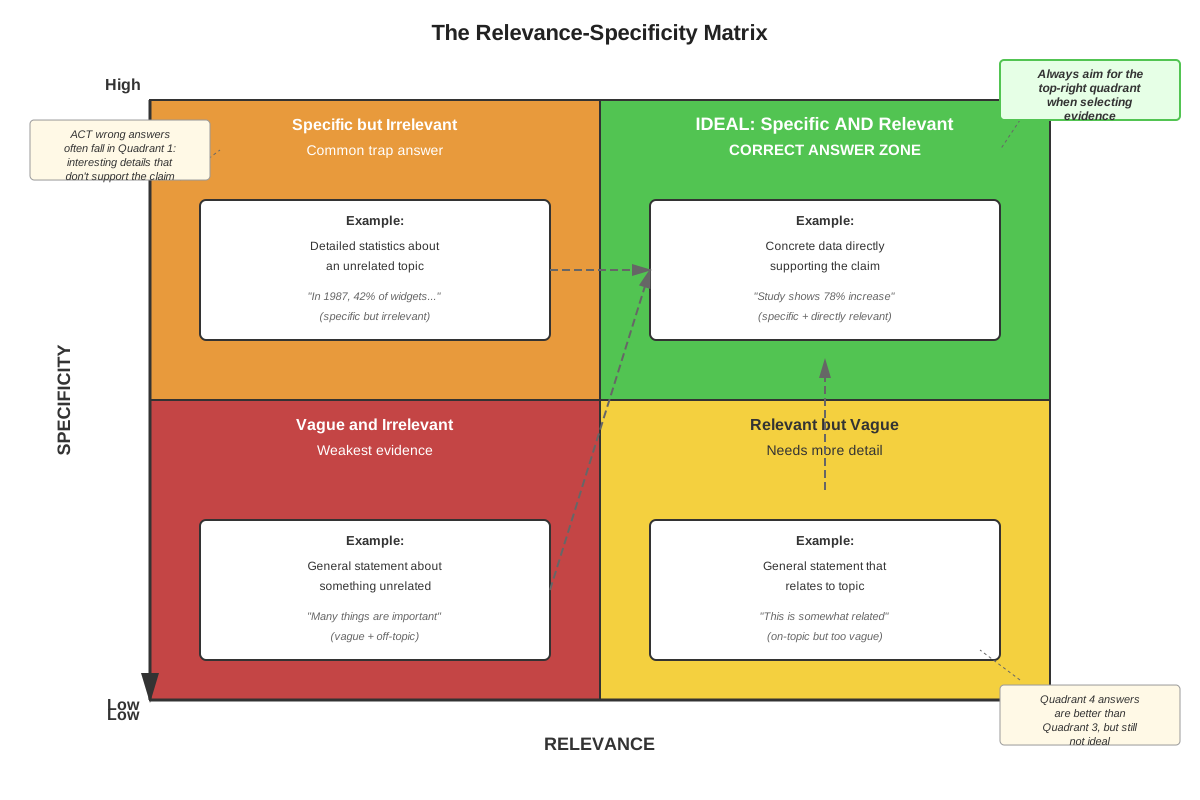
The foundation of supporting an argument is relevance—the degree to which a piece of evidence directly relates to and strengthens the claim being made. On the ACT, the correct answer to supporting an argument questions almost always provides information that is specifically connected to the topic at hand, rather than general, tangential, or only loosely related information.
Relevance operates on a spectrum. The most effective supporting details are those that directly address the specific claim in the sentence or paragraph. For example, if a passage argues that "solar panels have become more affordable for homeowners," relevant support would include specific data about price decreases, not general information about how solar panels work or their environmental benefits (though these might be relevant to different claims).
Specificity and Concrete Evidence
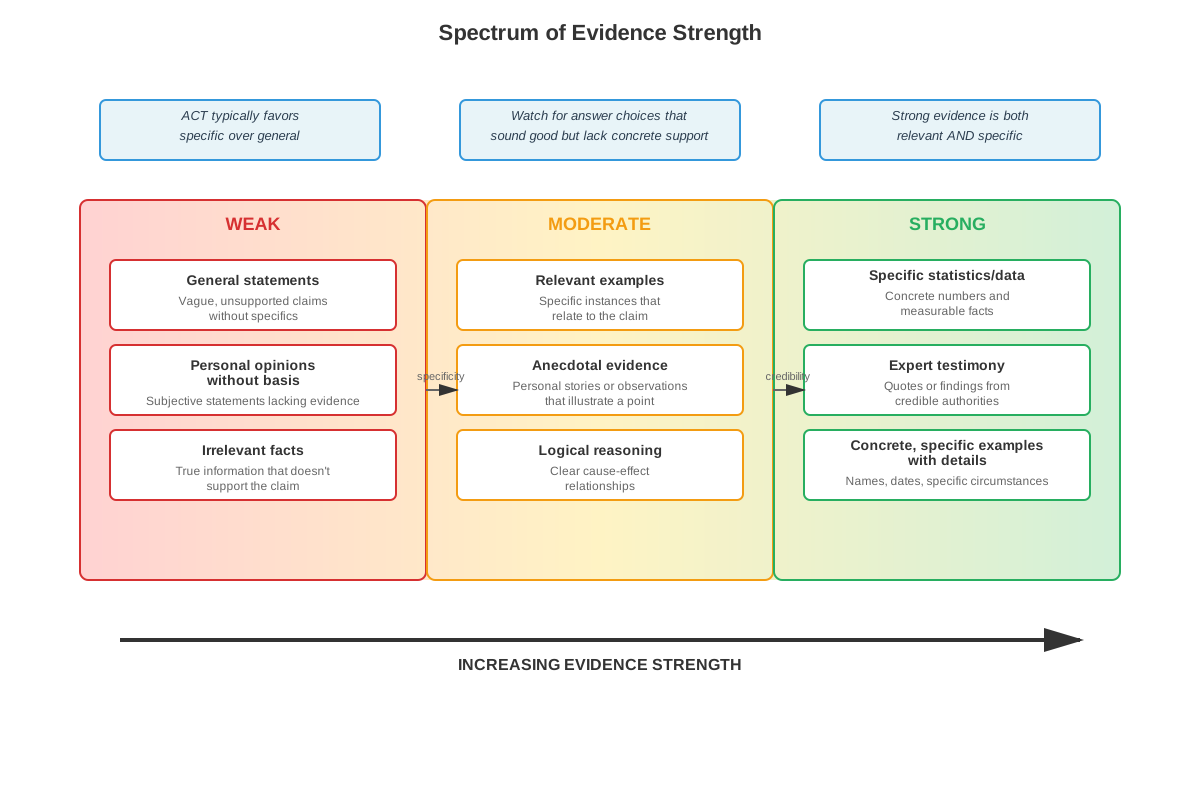
Strong supporting details are specific rather than vague or general. The ACT consistently rewards answer choices that provide concrete examples, precise data, or detailed illustrations over those that offer broad generalizations or abstract statements. This principle reflects effective writing practices: specific evidence is more persuasive and memorable than general claims.
Consider the difference between these two supporting statements for a claim about a musician's influence:
- Vague: "Many musicians were influenced by her work."
- Specific: "Three Grammy-winning artists cited her 1987 album as their primary inspiration."
The second statement provides measurable, concrete evidence that can be verified and visualized, making it more compelling support.
The Add/Delete Decision Framework
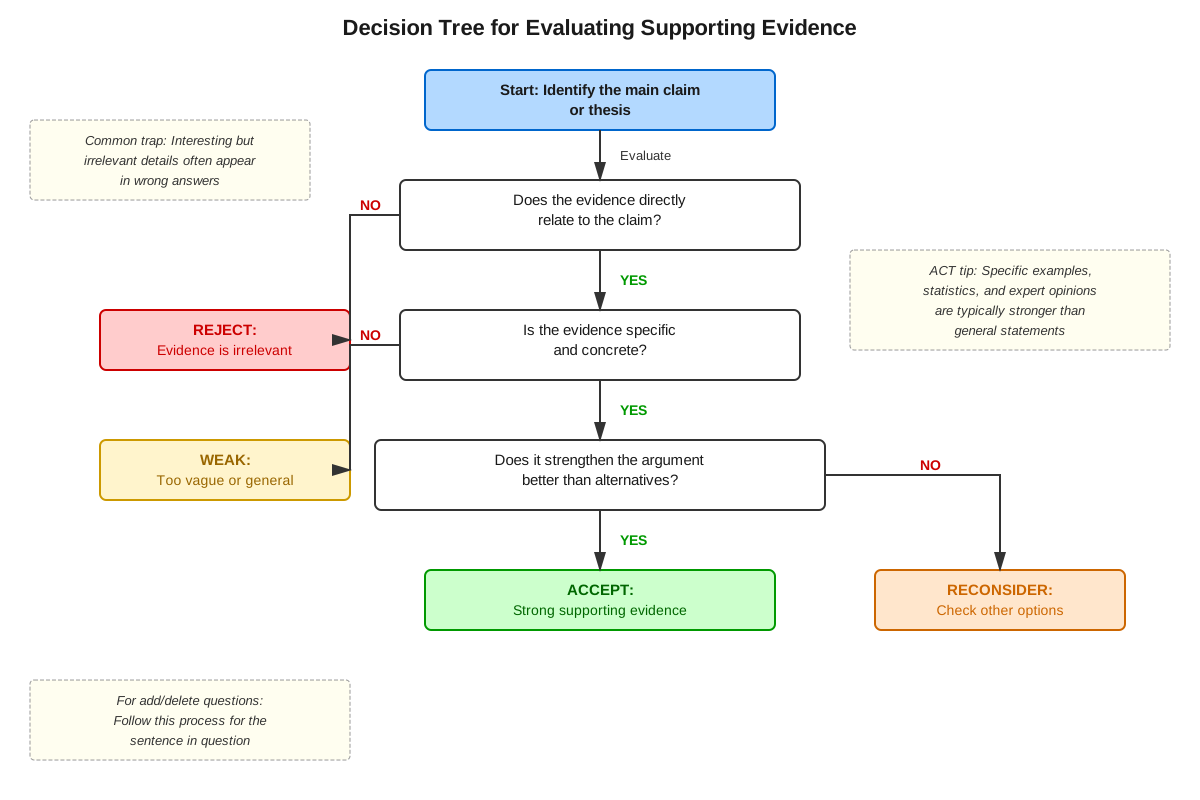
Many supporting an argument questions ask whether a sentence should be added to or deleted from a passage. These questions follow a predictable structure with four answer choices: two "yes" options with different reasons, and two "no" options with different reasons. The decision process involves two steps:
- Determine yes or no: Does the sentence support the paragraph's focus and add relevant information, or does it distract from the main point?
- Select the correct reasoning: Among the two "yes" or two "no" options, which reason accurately describes why the sentence should or shouldn't be included?
The correct reasoning must be factually accurate about what the sentence does. For example, if a "yes" option claims the sentence "provides statistical evidence," but the sentence contains no statistics, that option is incorrect even if "yes" is the right decision.
Alignment with Purpose and Tone
Supporting details must align with the author's purpose and the passage's tone. A humorous anecdote might effectively support a point in a lighthearted personal narrative but would be inappropriate in a serious scientific argument. Similarly, emotional appeals work well in persuasive writing but may be out of place in objective, informative passages.
The ACT tests this concept by including answer choices that might be interesting or true but don't match the passage's style or purpose. Students must consider not just whether information is relevant but whether it fits the context in which it appears.
The "Given That All Choices Are True" Qualifier
A distinctive feature of ACT supporting an argument questions is the phrase "Given that all choices are true, which..." This qualifier signals that students should not evaluate the factual accuracy of the options but rather their effectiveness in supporting the argument. All four choices might be accurate statements, but only one provides the most relevant, specific, and effective support for the particular claim being made.
This phrasing emphasizes that supporting an argument is about strategic selection of evidence, not about truth versus falsehood. Writers must choose from many true facts to include only those that best advance their argument.
Evaluating Goal Accomplishment
Some supporting an argument questions appear at the end of a passage and ask whether the essay accomplishes a stated goal, such as "explaining the process of photosynthesis" or "describing the author's relationship with her grandmother." These questions require students to:
- Identify the stated goal clearly
- Review the passage's actual content and focus
- Determine whether the passage primarily addresses the stated goal or focuses on something else
- Select the answer choice that accurately describes the match or mismatch
The correct answer often hinges on understanding the difference between what the passage mentions briefly versus what it emphasizes throughout.
Concept Relationships
The concepts within supporting an argument are hierarchically related. Relevance serves as the overarching principle that governs all other considerations. Within relevance, specificity and alignment with purpose function as two key criteria for evaluating whether evidence effectively supports a claim. The add/delete framework and goal accomplishment evaluation represent specific question formats that apply these underlying principles.
Supporting an argument connects to prerequisite topics in essential ways. Main idea identification provides the foundation: students must first understand what claim is being made before they can evaluate whether evidence supports it. Reading comprehension enables students to understand both the passage's content and what each answer choice actually says. Logical reasoning allows students to trace the connection between evidence and claim.
This topic also relates forward to other rhetorical skills. Organization questions often involve determining whether a sentence belongs in a paragraph based partly on whether it supports that paragraph's focus. Transitions must connect supporting details logically to the claims they support. Purpose questions require understanding how supporting details collectively accomplish the author's goals.
The relationship map flows as follows: Main Idea → Relevance Evaluation → Specificity Assessment → Purpose Alignment → Effective Support Selection → Coherent Argument.
High-Yield Facts
- ⭐ Supporting an argument questions often include the phrase "Given that all choices are true, which..." signaling that all options are factually accurate but differ in relevance
- ⭐ The most effective supporting details are specific and concrete rather than vague or general
- ⭐ Add/delete questions require two decisions: yes or no, then selecting the correct reasoning from two options
- ⭐ Relevant support directly addresses the specific claim being made, not just the general topic
- ⭐ The correct reasoning in add/delete questions must be factually accurate about what the sentence actually does
- Supporting details must match the passage's tone and purpose, not just provide true information
- Questions asking if an essay accomplishes a goal require comparing the stated goal to the passage's actual focus
- Tangential information, even if interesting or true, weakens rather than strengthens an argument
- The most common wrong answers provide information that is too general, off-topic, or repetitive
- Supporting an argument questions typically appear 8-12 times per ACT English test
- Evidence that provides examples, data, or specific illustrations is generally stronger than abstract statements
- A sentence should be deleted if it interrupts the logical flow or introduces irrelevant information
- The best support often includes measurable details, proper nouns, or concrete imagery
- Supporting details should advance the argument forward rather than merely restating what's already been said
- Context matters: what counts as good support depends on the specific claim and the passage's overall purpose
Quick check — test yourself on Supporting an argument so far.
Try Flashcards →Common Misconceptions
Misconception: All true statements provide good support for an argument.
Correction: Truth and relevance are different qualities. A statement can be completely accurate but still fail to support a specific claim if it doesn't directly relate to that claim. The ACT specifically tests this distinction with the "Given that all choices are true" phrasing.
Misconception: Longer, more detailed answer choices are always better support.
Correction: Length doesn't equal effectiveness. A concise, specific detail that directly addresses the claim is superior to a lengthy tangent. The ACT often includes verbose wrong answers that sound impressive but don't actually support the argument.
Misconception: If a sentence is well-written and interesting, it should be added to the passage.
Correction: Quality writing and relevance are separate considerations. A beautifully crafted sentence that introduces off-topic information disrupts the passage's coherence and should be deleted. The ACT tests whether students can prioritize relevance over stylistic appeal.
Misconception: Supporting details should always agree with or prove the claim.
Correction: While support often reinforces a claim, effective support can also include relevant counterarguments that the author then addresses, contextual information that explains why the claim matters, or qualifications that make the claim more precise. The key is relevance, not just agreement.
Misconception: In add/delete questions, if you choose "yes" or "no" correctly, you'll get the question right even if you pick the wrong reasoning.
Correction: Both parts must be correct. The ACT awards no partial credit. Students must select both the correct decision (yes or no) and the accurate reasoning. Many students lose points by choosing the right decision but wrong reasoning.
Misconception: General background information always provides good support.
Correction: Background information is only effective support when it's necessary for understanding the specific claim. Often, the ACT includes answer choices with general background that, while related to the topic, doesn't support the particular point being made in that location.
Worked Examples
Example 1: Choosing the Most Effective Support
Passage Context: The paragraph discusses how the invention of the printing press revolutionized access to information in 15th-century Europe.
Question: Given that all choices are true, which provides the most specific and relevant support for the claim that the printing press increased access to books?
A) The printing press was invented by Johannes Gutenberg in Mainz, Germany.
B) Before the printing press, books were copied by hand, a process that took months and made books extremely expensive.
C) The printing press used movable type, which could be rearranged to print different pages.
D) Many historians consider the printing press one of the most important inventions in human history.
Analysis:
First, identify the specific claim: the printing press increased access to books. The correct answer must explain how or why access increased.
- Choice A: Provides factual information about the inventor and location but doesn't explain how access increased. This is background information, not support for the specific claim. Eliminate.
- Choice B: Explains the previous situation (hand-copying took months and was expensive), which provides context for understanding why the printing press increased access. By showing that books were previously scarce and costly, this choice implicitly supports the claim that the printing press improved access. However, it focuses on the "before" rather than the "after." Possible, but check other options.
- Choice C: Describes how the printing press worked (movable type) but doesn't connect this mechanism to increased access. This is relevant to understanding the technology but doesn't support the specific claim about access. Eliminate.
- Choice D: Offers a general evaluation of the printing press's importance but provides no specific information about access to books. This is too vague and doesn't support the particular claim. Eliminate.
Correct Answer: B
While Choice B describes the situation before the printing press rather than after, it provides the most relevant support for understanding why the printing press increased access. By establishing that hand-copying made books scarce and expensive, it creates the logical foundation for understanding how the printing press (which was faster and cheaper) increased access. This example illustrates that effective support sometimes provides necessary context rather than direct proof.
Example 2: Add/Delete Decision
Passage Context: The paragraph describes Maria Martinez, a Pueblo potter who revived traditional black pottery techniques in the early 20th century.
Proposed Sentence: "Pottery has been created by human civilizations for thousands of years, with the earliest known ceramic objects dating back to 29,000 BCE."
Question: Should the writer add this sentence at this point in the essay?
A) Yes, because it provides important historical context for understanding Martinez's work.
B) Yes, because it establishes pottery as an ancient art form.
C) No, because it distracts from the paragraph's focus on Martinez's specific contributions.
D) No, because it contradicts information presented earlier in the passage.
Analysis:
Step 1: Decide Yes or No
The paragraph focuses specifically on Maria Martinez and her revival of black pottery techniques. The proposed sentence provides very general information about pottery throughout human history. While this information is true and related to pottery, it doesn't help readers understand Martinez's specific contributions or the black pottery techniques she revived. The sentence would interrupt the paragraph's focus. Decision: No
Step 2: Select the Correct Reasoning
Now evaluate only the two "No" options:
- Choice C: States the sentence "distracts from the paragraph's focus on Martinez's specific contributions." This accurately describes why the sentence shouldn't be added—it's too general and shifts attention away from the specific subject. This reasoning is accurate.
- Choice D: Claims the sentence "contradicts information presented earlier." Check whether this is true. The sentence states pottery dates back thousands of years, which doesn't contradict anything about Martinez working in the 20th century. These facts can coexist without contradiction. This reasoning is inaccurate.
Correct Answer: C
This example demonstrates the two-step process for add/delete questions. Even if a student correctly determines the sentence shouldn't be added, selecting the wrong reasoning (Choice D) would result in an incorrect answer. The reasoning must accurately describe what the sentence does or doesn't do.
Exam Strategy
When approaching supporting an argument questions on the ACT, follow this systematic process:
Step 1: Identify the Question Type
Recognize supporting an argument questions by their distinctive phrasings:
- "Given that all choices are true, which..."
- "Should the writer add/delete this sentence?"
- "Which choice most effectively supports..."
- "Does this essay accomplish the writer's goal?"
Step 2: Locate the Specific Claim
Before evaluating answer choices, identify exactly what claim needs support. Read the sentence or paragraph carefully to determine the specific point being made, not just the general topic. Underline or mentally note the key claim.
Step 3: Apply the Relevance Test
For each answer choice, ask: "Does this directly relate to and strengthen the specific claim?" Eliminate choices that are off-topic, too general, or only loosely connected to the claim.
Step 4: Compare Specificity
Among relevant options, choose the most specific and concrete. Look for proper nouns, numbers, examples, or detailed descriptions rather than vague generalizations.
Step 5: For Add/Delete Questions, Use the Two-Step Process
First, decide yes or no based on relevance and focus. Then, evaluate only the two options that match your decision, selecting the reasoning that accurately describes what the sentence does.
Step 6: Watch for Common Traps
The ACT frequently includes wrong answers that:
- Provide true but irrelevant information
- Offer general background when specific support is needed
- Sound sophisticated but don't address the claim
- Repeat information already stated in the passage
- Introduce new topics that distract from the focus
Time Management: Supporting an argument questions typically require 30-45 seconds each. If you find yourself spending more than a minute, make your best choice and move on. These questions reward careful reading but don't require extensive analysis.
Exam Tip: When you see "Given that all choices are true," immediately shift your focus from evaluating truth to evaluating relevance and specificity. This phrase is your signal that the question tests argument support, not factual accuracy.
Memory Techniques
SPECIFIC Acronym for Effective Support:
- Supports the exact claim, not just the general topic
- Provides concrete details, not vague generalizations
- Enhances understanding of the specific point
- Connects directly to what's being argued
- Includes measurable or observable information
- Fits the passage's purpose and tone
- Is more detailed than other options
- Clarifies rather than confuses the argument
The Two-Question Method for Add/Delete:
- "Does it fit?" (Yes or No)
- "Why is that true?" (Select accurate reasoning)
Visualize a puzzle: the sentence is a puzzle piece. First, determine if it fits the picture (yes or no). Then, explain why it fits or doesn't fit (the reasoning).
The Zoom Lens Visualization:
Picture a camera lens zooming in from wide to narrow:
- Wide: General topic (too broad for good support)
- Medium: Related information (better, but check if it's specific enough)
- Narrow: Specific claim being made (this is what needs support)
The best supporting detail operates at the "narrow" level, directly addressing the specific claim rather than the general topic.
The "So What?" Test:
After reading a potential supporting detail, ask "So what? How does this help prove or explain the claim?" If you can't immediately answer this question, the detail probably isn't relevant support.
Summary
Supporting an argument on the ACT English section requires students to evaluate whether evidence effectively strengthens a specific claim. The fundamental principle is relevance: the best supporting details directly address the particular point being made rather than just relating to the general topic. Effective support is specific and concrete, providing examples, data, or detailed illustrations rather than vague generalizations. When approaching these questions, students must first identify the exact claim that needs support, then evaluate each option's relevance and specificity. Add/delete questions require a two-step process: determining whether the sentence should be included based on relevance, then selecting reasoning that accurately describes what the sentence does. The phrase "Given that all choices are true" signals that students should focus on effectiveness rather than accuracy. Common wrong answers include true but irrelevant information, overly general background, and details that don't match the passage's purpose or tone. Mastering this skill requires careful reading, logical reasoning, and the ability to distinguish between what's interesting and what's actually supportive of the argument being made.
Key Takeaways
- Supporting an argument questions test relevance and specificity, not just whether information is true or well-written
- The phrase "Given that all choices are true" signals that all options are accurate but differ in how effectively they support the claim
- Always identify the specific claim being made before evaluating supporting details—relevance depends on the particular point, not just the general topic
- In add/delete questions, both the decision (yes/no) and the reasoning must be correct to earn credit
- The most effective support is concrete and specific, including examples, data, proper nouns, or detailed descriptions
- Supporting details must align with the passage's purpose and tone, not just provide related information
- Common wrong answers include tangential information, overly general background, and repetitive details that don't advance the argument
Related Topics
Organization and Paragraph Structure: Understanding how paragraphs are organized around main ideas helps students recognize what types of support belong in each section. Mastering supporting an argument provides the foundation for evaluating whether sentences are logically placed.
Transitions and Logical Flow: Effective transitions connect supporting details to the claims they support. Students who understand argument support can better evaluate whether transitional phrases accurately reflect the logical relationships between ideas.
Purpose and Audience: Recognizing the author's purpose and intended audience helps determine what types of support are most appropriate. This topic builds on supporting an argument skills by considering the broader rhetorical context.
Main Ideas and Topic Sentences: Identifying main ideas is prerequisite knowledge for supporting an argument, but deeper study of how topic sentences function helps students understand what each paragraph needs to accomplish and what support is required.
Practice CTA
Now that you understand the principles of supporting an argument, it's time to apply these strategies to ACT-style questions. The practice questions and flashcards will help you recognize question patterns, avoid common traps, and build the speed and accuracy needed for test day. Remember: supporting an argument is one of the highest-yield skills on the ACT English section, appearing in approximately 8-12 questions per test. Every question you master in this area directly improves your score. Approach the practice with confidence—you now have the framework to evaluate evidence like an expert test-taker!
Sign up free to keep reading
Create a free AnvayaPrep account to finish this ACT guide on Supporting an argument — plus flashcards and practice questions.