Overview
Complete sentence recognition is one of the most fundamental and frequently tested skills on the ACT English section. This topic requires students to distinguish between complete sentences (independent clauses) and sentence fragments or run-on sentences. Mastery of this concept is essential because approximately 15-20% of ACT English questions directly or indirectly test sentence structure, making it one of the highest-yield areas for score improvement.
The ability to recognize complete sentences forms the foundation for understanding more complex grammatical structures tested on the ACT, including comma splices, semicolon usage, and subordination. When students can quickly identify whether a group of words forms a complete thought with both a subject and a predicate, they can efficiently eliminate incorrect answer choices and avoid common traps that test writers deliberately include. This skill becomes particularly crucial when dealing with lengthy, complex passages where sentence boundaries may be obscured by descriptive phrases, dependent clauses, or coordinating conjunctions.
ACT complete sentence recognition connects directly to broader concepts in sentence structure, punctuation, and rhetorical skills. Understanding what constitutes a complete sentence enables students to make informed decisions about where sentences should begin and end, how to properly join independent clauses, and when fragments might be acceptable for stylistic purposes. This foundational knowledge supports success across multiple question types, from identifying errors in underlined portions to selecting the most effective revision for a passage segment.
Learning Objectives
- [ ] Identify when Complete sentence recognition is being tested
- [ ] Explain the core rule or strategy behind Complete sentence recognition
- [ ] Apply Complete sentence recognition to ACT-style questions accurately
- [ ] Distinguish between independent clauses, dependent clauses, and phrases in context
- [ ] Recognize and correct common sentence boundary errors (fragments, run-ons, comma splices)
- [ ] Evaluate whether punctuation appropriately separates or connects complete sentences
- [ ] Determine when sentence fragments are intentionally used for rhetorical effect
Prerequisites
- Subject-verb agreement: Understanding subjects and verbs is essential because complete sentences must contain both elements working together grammatically
- Parts of speech identification: Recognizing nouns, verbs, adjectives, adverbs, and conjunctions enables accurate analysis of sentence components
- Basic clause structure: Familiarity with how words group together into meaningful units helps distinguish between complete and incomplete thoughts
- Punctuation fundamentals: Knowledge of periods, commas, and semicolons provides context for understanding how sentences are separated or joined
Why This Topic Matters
Complete sentence recognition represents a critical gateway skill for academic writing and professional communication. In college coursework, students must construct clear, grammatically correct sentences to convey complex ideas effectively. Employers consistently rank written communication among the most valued professional skills, and the ability to write complete, coherent sentences forms the foundation of that competency. Beyond practical applications, this skill demonstrates logical thinking—the capacity to express a complete thought with all necessary components.
On the ACT English section, sentence structure questions appear in approximately 18-22 questions per test, with complete sentence recognition forming the basis for many of these items. Questions may directly ask students to identify fragments or run-ons, or they may test this concept indirectly through punctuation choices. The ACT frequently embeds sentence structure issues within longer passages where students must recognize that what appears to be a single sentence is actually two independent clauses incorrectly joined, or that what seems like a complete sentence is missing a crucial element.
Common manifestations on the exam include: underlined portions at sentence boundaries where students must choose appropriate punctuation; questions asking whether a period, comma, semicolon, or no punctuation is correct; and revision questions where one answer choice creates a fragment while others maintain sentence completeness. The test writers deliberately create distractors that "sound right" when read quickly but violate fundamental sentence structure rules. Students who can systematically identify subjects and predicates, recognize dependent clause markers, and understand sentence boundaries gain a significant advantage in both speed and accuracy.
Core Concepts
The Complete Sentence Definition
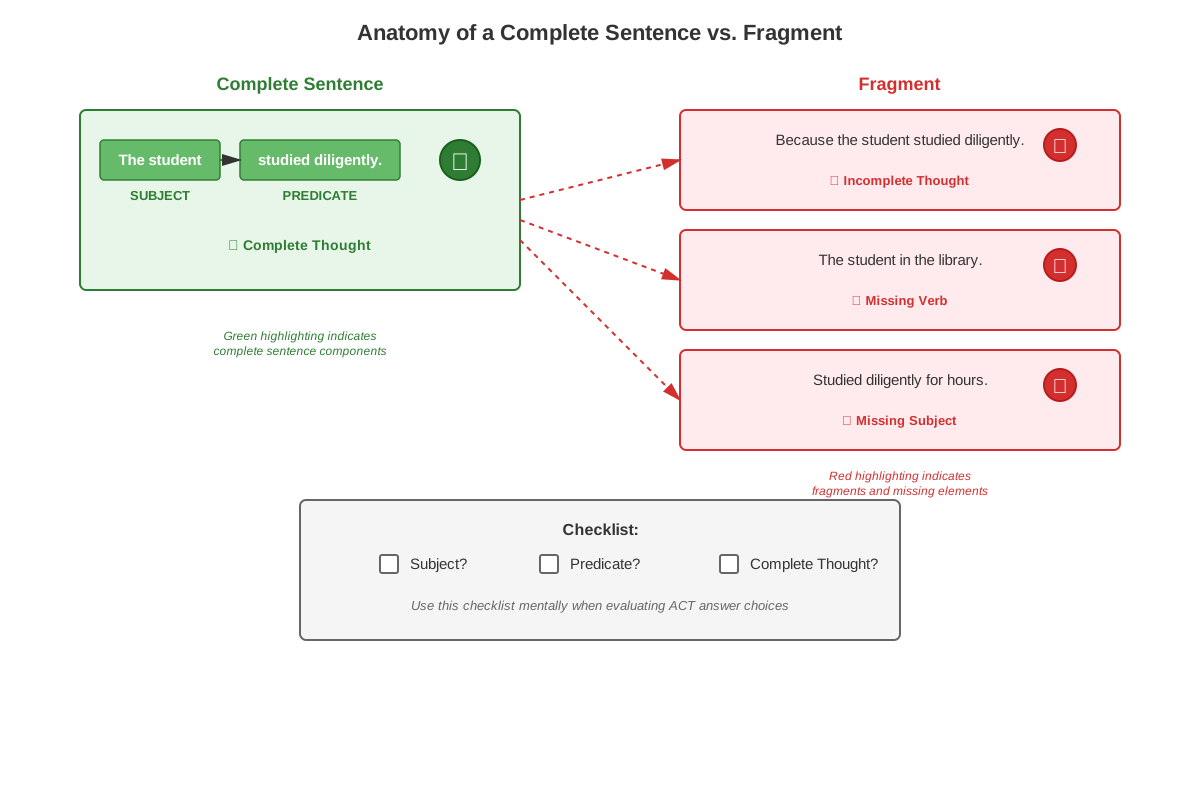
A complete sentence (also called an independent clause) must contain three essential elements: a subject, a predicate (verb), and a complete thought. The subject identifies who or what the sentence is about, the predicate expresses action or state of being, and the complete thought means the sentence can stand alone without requiring additional information to make sense. For example, "The student studied" contains a subject (student), a predicate (studied), and expresses a complete thought—we understand what happened without needing more information.
The complete thought requirement distinguishes sentences from fragments that may have subjects and verbs but remain dependent on additional information. Consider "Because the student studied"—this contains both a subject and verb but does not express a complete thought. The subordinating conjunction "because" creates dependency, leaving readers waiting for the consequence or result. This becomes an independent clause only when completed: "Because the student studied, she passed the exam."
Identifying Subjects and Predicates
The subject of a sentence performs the action or is described by the predicate. Subjects can be simple (one noun or pronoun), compound (two or more nouns joined by conjunctions), or complex (nouns with modifying phrases). To identify the subject, ask "Who or what is performing the action?" or "Who or what is being described?" In the sentence "The tall building with the blue windows dominates the skyline," the subject is "building"—not "windows," which appears in a prepositional phrase modifying the subject.
The predicate includes the verb and all words that complete its meaning. Simple predicates consist of just the verb, while complete predicates include the verb plus objects, complements, and modifiers. In "The committee reviewed the proposal carefully," the simple predicate is "reviewed," while the complete predicate is "reviewed the proposal carefully." ACT questions often test whether students can identify the true verb versus verbals (gerunds, participles, infinitives) that cannot function as sentence predicates.
Sentence Fragments
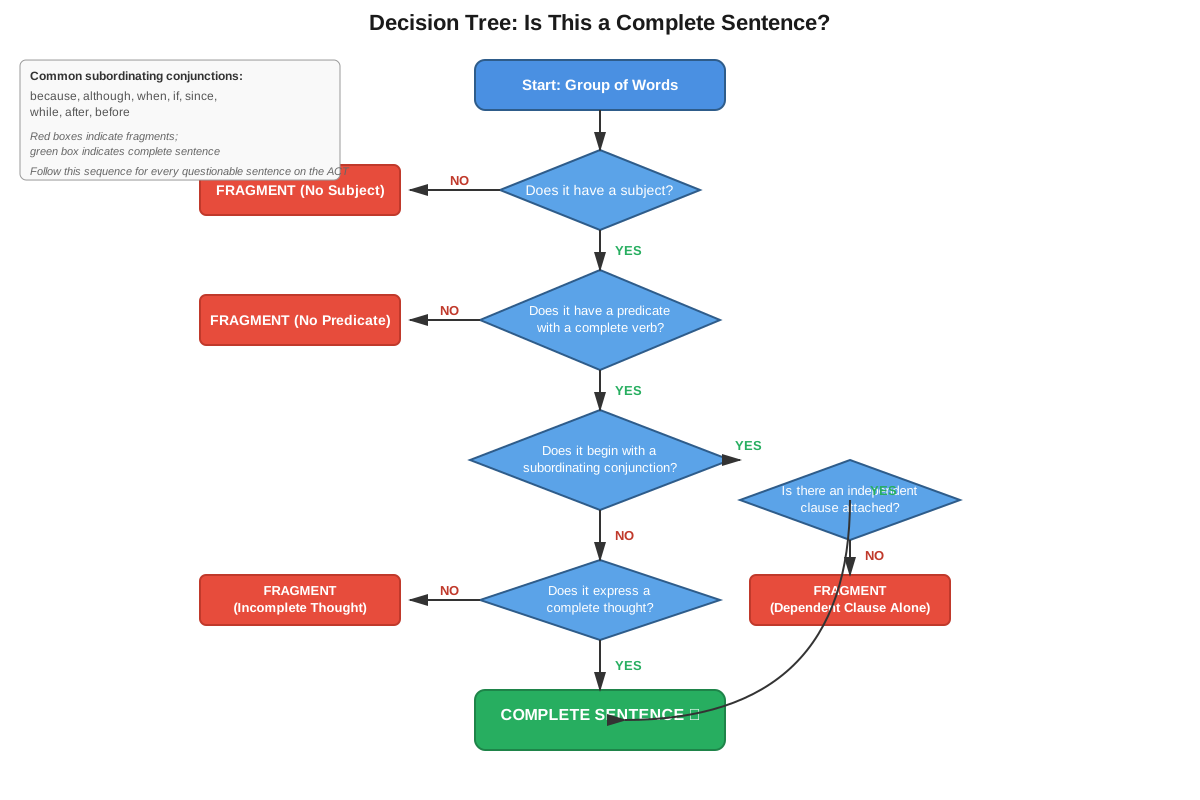
A sentence fragment is an incomplete sentence masquerading as a complete one. Fragments occur in three primary ways: missing subject, missing predicate, or incomplete thought (dependent clause standing alone). The ACT frequently tests fragments created by dependent clauses, where subordinating conjunctions or relative pronouns create dependency. Common subordinating conjunctions include: although, because, since, when, while, if, unless, until, after, before, as, and whereas.
| Fragment Type | Example | Correction |
|---|---|---|
| Missing Subject | "Ran quickly to the store." | "She ran quickly to the store." |
| Missing Predicate | "The dog in the backyard." | "The dog in the backyard barked." |
| Dependent Clause Alone | "When the rain stopped." | "When the rain stopped, we went outside." |
| Phrase Fragment | "Running through the park." | "Running through the park, I saw my friend." |
Run-On Sentences and Comma Splices
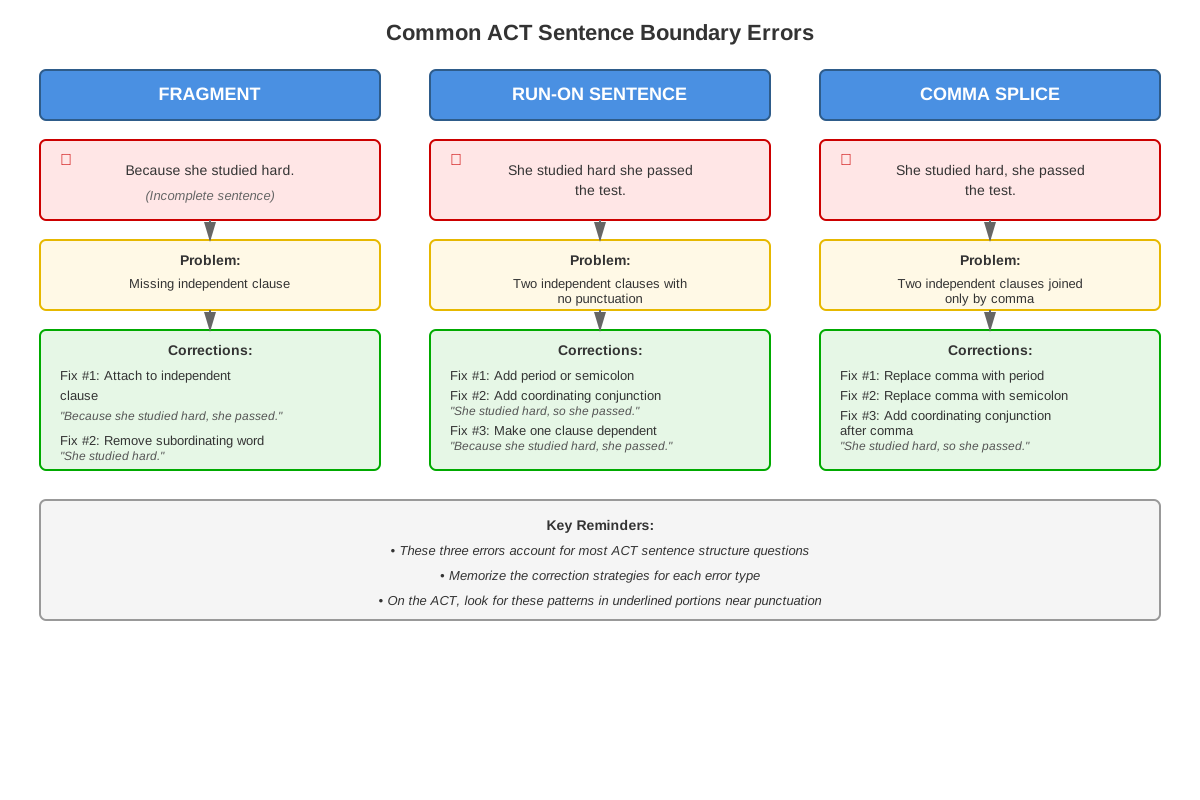
A run-on sentence occurs when two or more independent clauses are joined without appropriate punctuation or conjunctions. The most common type is the comma splice, where two independent clauses are connected with only a comma. For example: "The experiment failed, the scientists tried again" incorrectly joins two complete sentences with just a comma. This error appears frequently on the ACT because it sounds acceptable when read aloud but violates written English conventions.
Correcting run-ons requires one of four strategies: (1) separate into two sentences with a period, (2) join with a semicolon if closely related, (3) join with a comma plus coordinating conjunction (FANBOYS: for, and, nor, but, or, yet, so), or (4) subordinate one clause by adding a dependent marker. The choice depends on the relationship between ideas and the surrounding context.
Coordinating Conjunctions and Independent Clauses
When joining two independent clauses with a coordinating conjunction (FANBOYS), a comma must precede the conjunction. This pattern—comma + coordinating conjunction—creates a compound sentence. "The student studied diligently, and she earned an excellent grade" correctly joins two independent clauses. However, if the conjunction joins elements that are not both independent clauses, no comma is needed: "The student studied diligently and earned an excellent grade" (here "earned an excellent grade" lacks a subject, making it part of a compound predicate, not a second independent clause).
The ACT frequently tests whether students can distinguish between compound sentences (two independent clauses joined) and sentences with compound elements (compound subjects, compound verbs, compound objects). This distinction determines whether a comma is appropriate before the conjunction.
Semicolons and Independent Clauses
Semicolons function as strong connectors between closely related independent clauses. They indicate a relationship closer than separate sentences but without the explicit connection provided by coordinating conjunctions. "The research was groundbreaking; it changed the entire field" uses a semicolon to join related ideas. Both clauses before and after the semicolon must be independent—capable of standing alone as complete sentences.
A common ACT trap involves using semicolons incorrectly with dependent clauses or phrases. "The research was groundbreaking; which changed the entire field" is incorrect because "which changed the entire field" is a dependent clause, not an independent clause. Similarly, semicolons cannot join an independent clause to a phrase: "The research was groundbreaking; changing the entire field" is incorrect.
Dependent Clause Markers
Subordinating conjunctions and relative pronouns create dependent clauses that cannot stand alone as sentences. Subordinating conjunctions (although, because, since, when, while, if, unless, until, after, before, as, whereas, though) introduce adverbial clauses that modify verbs, adjectives, or other adverbs. Relative pronouns (who, whom, whose, which, that) introduce adjective clauses that modify nouns.
When a dependent clause begins a sentence, it must be followed by a comma and then an independent clause: "Although the weather was poor, the game continued." When the dependent clause follows the independent clause, typically no comma is needed: "The game continued although the weather was poor." The ACT tests whether students recognize that dependent clauses cannot stand alone and must be attached to independent clauses.
Concept Relationships
Complete sentence recognition serves as the foundation for understanding sentence structure hierarchy. At the base level, identifying subjects and predicates enables recognition of independent clauses. This recognition then supports understanding of how clauses combine: independent clause + independent clause = compound sentence (requiring appropriate punctuation or conjunctions); independent clause + dependent clause = complex sentence (requiring appropriate subordination and punctuation).
The relationship flows as follows: Subject identification + Predicate identification → Independent clause recognition → Fragment detection (missing elements or incomplete thoughts) and Run-on detection (improperly joined independent clauses) → Punctuation decisions (periods, semicolons, commas with conjunctions) → Sentence boundary determination.
This topic connects directly to prerequisite knowledge of parts of speech—without recognizing verbs, students cannot identify predicates; without recognizing nouns and pronouns, students cannot identify subjects. It also connects forward to more advanced topics like parallelism (which requires understanding what elements are being paralleled within or across sentences), modifier placement (which requires knowing what constitutes the main clause being modified), and rhetorical effectiveness (which requires understanding how sentence boundaries affect emphasis and flow).
Quick check — test yourself on Complete sentence recognition so far.
Try Flashcards →High-Yield Facts
⭐ A complete sentence must have a subject, a predicate, and express a complete thought that can stand alone
⭐ Comma splices (two independent clauses joined with only a comma) are always incorrect on the ACT
⭐ Subordinating conjunctions (because, although, when, while, if, since, etc.) create dependent clauses that cannot stand alone
⭐ Semicolons can only join two independent clauses; they cannot join an independent clause to a dependent clause or phrase
⭐ When a coordinating conjunction (FANBOYS) joins two independent clauses, a comma must precede the conjunction
- Dependent clauses beginning sentences must be followed by a comma before the independent clause
- Relative pronouns (who, which, that) create dependent clauses that modify nouns
- A group of words with a subject and verb but beginning with a subordinating conjunction is a fragment if standing alone
- Periods and semicolons are interchangeable only when joining independent clauses that are closely related in meaning
- Verbals (gerunds, participles, infinitives) cannot serve as the main predicate of a sentence
- The word "however" is a conjunctive adverb, not a coordinating conjunction, and cannot join independent clauses with only a comma
- Fragments are occasionally acceptable in published writing for stylistic effect, but the ACT generally treats them as errors unless clearly intentional
- Compound predicates (two verbs sharing one subject) do not require a comma before the coordinating conjunction
- Appositive phrases and participial phrases are not independent clauses and cannot stand alone as sentences
- The presence of a subject and verb does not guarantee a complete sentence if the clause begins with a dependent marker
Common Misconceptions
Misconception: Any group of words with a subject and verb is a complete sentence → Correction: The clause must also express a complete thought and not begin with a subordinating conjunction or relative pronoun that creates dependency. "When the bell rang" has a subject (bell) and verb (rang) but is a fragment because "when" creates an incomplete thought.
Misconception: Long groups of words are always complete sentences, while short groups are fragments → Correction: Length does not determine completeness. "She ran" is a complete sentence with just two words, while "The student who studied all night in the library preparing for the comprehensive examination covering all the material from the entire semester" is a fragment despite its length because it lacks a main verb for the subject "student."
Misconception: Commas can join any two related sentences → Correction: Commas alone cannot join independent clauses. A comma must be accompanied by a coordinating conjunction (FANBOYS), or the clauses must be separated by a period, semicolon, or dash. Using only a comma creates a comma splice.
Misconception: "However" can join two independent clauses with a comma like "but" does → Correction: "However" is a conjunctive adverb, not a coordinating conjunction. It cannot join independent clauses with only a comma. Correct patterns include: "Sentence one. However, sentence two" or "Sentence one; however, sentence two."
Misconception: Semicolons and commas are interchangeable → Correction: Semicolons join independent clauses or separate complex items in a list. Commas have numerous functions but cannot join independent clauses without a coordinating conjunction. The two punctuation marks serve different grammatical purposes.
Misconception: Starting a sentence with "because" or "although" is always wrong → Correction: Sentences can begin with subordinating conjunctions if the dependent clause is followed by an independent clause: "Because it rained, the game was cancelled" is correct. The error occurs only when the dependent clause stands alone without an independent clause.
Misconception: If you can pause while reading, a comma is appropriate → Correction: Commas follow grammatical rules, not speech patterns. While pauses sometimes align with commas, many pauses do not require commas, and some commas appear where speakers do not pause. Grammatical structure, not oral reading, determines comma placement.
Worked Examples
Example 1: Identifying and Correcting a Fragment
Original passage: "The research team collected data from three different sources. Including surveys, interviews, and direct observations. The results were surprising."
Analysis: The second "sentence" is a fragment. Let's apply the complete sentence test:
- Does it have a subject? No clear subject performing an action
- Does it have a predicate? "Including" is a participle (verbal), not a main verb
- Does it express a complete thought? No—it's a phrase modifying "sources" from the previous sentence
The word "including" signals that this is a participial phrase, not an independent clause. This phrase should be attached to the previous sentence because it provides additional information about "three different sources."
Correction options:
- Join to previous sentence: "The research team collected data from three different sources, including surveys, interviews, and direct observations."
- Make it a complete sentence: "These sources included surveys, interviews, and direct observations."
- Use a dash for emphasis: "The research team collected data from three different sources—surveys, interviews, and direct observations."
ACT application: On the exam, you might see this as an underlined portion with answer choices:
- A. sources. Including
- B. sources, including
- C. sources; including
- D. sources including
Choice B is correct because it properly attaches the modifying phrase to the independent clause with a comma.
Example 2: Distinguishing Comma Splices from Correct Sentences
Original passage: "The experiment yielded unexpected results, the scientists decided to repeat the procedure."
Analysis: Let's test each clause independently:
- "The experiment yielded unexpected results" → Has subject (experiment), predicate (yielded), complete thought ✓ Independent clause
- "the scientists decided to repeat the procedure" → Has subject (scientists), predicate (decided), complete thought ✓ Independent clause
Two independent clauses joined with only a comma = comma splice (error).
Correction options:
- Period: "The experiment yielded unexpected results. The scientists decided to repeat the procedure."
- Semicolon: "The experiment yielded unexpected results; the scientists decided to repeat the procedure."
- Comma + coordinating conjunction: "The experiment yielded unexpected results, so the scientists decided to repeat the procedure."
- Subordination: "Because the experiment yielded unexpected results, the scientists decided to repeat the procedure."
ACT application: The test might present this with answer choices:
- A. results, the scientists
- B. results; the scientists
- C. results, so the scientists
- D. results. The scientists
Choices B, C, and D are all grammatically correct. The "best" answer depends on context and the relationship between ideas. If showing cause-and-effect, C is clearest. If the ideas are closely related but the relationship is obvious, B works well. If treating them as separate thoughts, D is appropriate. Choice A (the original) is always wrong.
Exam Strategy
When approaching ACT questions testing complete sentence recognition, follow this systematic process:
Step 1: Identify sentence boundaries in the underlined portion and surrounding text. Look for periods, semicolons, and coordinating conjunctions with commas—these typically mark boundaries between independent clauses.
Step 2: Test each potential sentence by asking three questions: (1) Is there a subject? (2) Is there a predicate (main verb, not a verbal)? (3) Does it express a complete thought? If the answer to any question is "no," you have a fragment.
Step 3: Check for dependent clause markers at the beginning of clauses. Words like "because," "although," "when," "which," and "that" signal dependent clauses that cannot stand alone. If a dependent clause stands alone, it's a fragment requiring correction.
Step 4: Examine punctuation between clauses. If two independent clauses are joined, they need either (a) a period, (b) a semicolon, (c) a comma + FANBOYS conjunction, or (d) a dash. Only a comma = comma splice (error). No punctuation = run-on (error).
Exam Tip: When you see an underlined period, comma, or semicolon, immediately check whether independent clauses appear on both sides. This quick test eliminates wrong answers rapidly.
Trigger words and phrases that signal complete sentence recognition questions:
- Underlined punctuation at potential sentence boundaries
- Answer choices that differ only in punctuation (period vs. comma vs. semicolon)
- Questions asking about "sentence structure" or "grammatical correctness"
- Subordinating conjunctions (because, although, when, while, since, if, unless)
- Coordinating conjunctions (FANBOYS)
- Conjunctive adverbs (however, therefore, moreover, nevertheless)
Process of elimination strategy:
- Eliminate any choice that creates a fragment (dependent clause standing alone)
- Eliminate any choice that creates a comma splice (two independent clauses joined with only a comma)
- Eliminate any choice that uses a semicolon incorrectly (before a dependent clause or phrase)
- Among remaining choices, select the one that best fits the context and relationship between ideas
Time allocation: Complete sentence recognition questions should take 15-30 seconds each. If you can quickly identify subjects and predicates, these become some of the fastest points on the test. Practice the systematic approach until it becomes automatic, allowing you to spend saved time on more complex rhetorical skills questions.
Memory Techniques
FANBOYS acronym for coordinating conjunctions: For, And, Nor, But, Or, Yet, So. Remember: these are the ONLY words that can join two independent clauses with a comma.
"AAAWWUBBIS" mnemonic for common subordinating conjunctions: After, Although, As, When, While, Until, Because, Before, If, Since. Any clause beginning with these words is dependent and cannot stand alone.
The "Can it stand alone?" test: Visualize each potential sentence standing by itself on a blank page. If it would make sense to a reader with no other context, it's complete. If it leaves the reader waiting for more information, it's a fragment.
The "Two-Finger Rule": When checking if a semicolon is correct, place one finger on the clause before it and one finger on the clause after it. If both fingers are on complete sentences that could stand alone, the semicolon works. If either finger is on a fragment, the semicolon is wrong.
"Comma + FANBOYS = Bridge": Visualize two islands (independent clauses) that need a bridge to connect them. The bridge has two parts: a comma (the foundation) and a FANBOYS conjunction (the roadway). You need both parts for the bridge to work.
The "Verbal Trap" reminder: Remember "ING-TRAP"—words ending in -ing are often participles (verbals), not main verbs. "The student studying" is not a complete sentence because "studying" is a participle, not a predicate. You need a helping verb ("The student was studying") or a different main verb ("The student studied").
Summary
Complete sentence recognition is a foundational skill for ACT English success, requiring students to identify whether groups of words contain the three essential elements: a subject, a predicate, and a complete thought. The most common errors tested are sentence fragments (incomplete thoughts, often dependent clauses standing alone) and run-on sentences (particularly comma splices, where two independent clauses are incorrectly joined with only a comma). Mastery requires understanding that subordinating conjunctions and relative pronouns create dependent clauses that cannot stand alone, while coordinating conjunctions (FANBOYS) can join independent clauses only when accompanied by a comma. Semicolons serve as strong connectors between independent clauses but cannot join independent clauses to dependent clauses or phrases. Success on these questions comes from systematically identifying subjects and predicates, recognizing dependent clause markers, and understanding the punctuation rules that govern sentence boundaries. Students who can quickly apply the "can it stand alone?" test and recognize the patterns of fragments, comma splices, and proper clause joining will efficiently answer 15-20% of ACT English questions correctly.
Key Takeaways
- A complete sentence requires three elements: subject, predicate, and complete thought that can stand independently
- Comma splices (two independent clauses joined with only a comma) are always incorrect; use a period, semicolon, or comma + FANBOYS conjunction instead
- Subordinating conjunctions (because, although, when, while, if, since) create dependent clauses that cannot stand alone as sentences
- Semicolons can only join two independent clauses; they cannot connect independent clauses to dependent clauses or phrases
- When coordinating conjunctions (FANBOYS) join two independent clauses, a comma must precede the conjunction
- Fragments often result from dependent clauses standing alone or from phrases with verbals (gerunds, participles, infinitives) instead of main verbs
- Systematic identification of subjects and predicates enables quick, accurate recognition of sentence completeness and boundary errors
Related Topics
Comma Usage and Punctuation Rules: Building on complete sentence recognition, this topic explores the full range of comma functions, including separating introductory elements, setting off nonessential clauses, and creating series. Understanding sentence boundaries is prerequisite to knowing where commas are appropriate.
Subordination and Coordination: This advanced topic examines how to effectively combine ideas using dependent and independent clauses, building directly on the foundation of recognizing which clauses can stand alone and which cannot.
Modifier Placement: Proper modifier placement requires understanding what constitutes the main clause being modified versus introductory or interrupting elements, making complete sentence recognition essential prerequisite knowledge.
Parallelism: Identifying parallel structures within and across sentences requires first understanding sentence boundaries and the elements being paralleled, whether phrases within a sentence or structures across multiple sentences.
Rhetorical Skills and Sentence Effectiveness: Advanced questions about sentence structure, transitions, and organization build on the foundation of recognizing complete sentences and understanding how independent and dependent clauses create meaning and emphasis.
Practice CTA
Now that you understand the principles of complete sentence recognition, it's time to apply this knowledge! Work through the practice questions to test your ability to identify fragments, comma splices, and properly constructed sentences under timed conditions. Use the flashcards to reinforce your recognition of subordinating conjunctions, coordinating conjunctions, and the rules governing sentence boundaries. Remember: these questions represent some of the most reliable points on the ACT English section—master this skill, and you'll see immediate score improvement. Every practice question you complete strengthens your pattern recognition and speeds up your response time on test day. You've got this!
Sign up free to keep reading
Create a free AnvayaPrep account to finish this ACT guide on Complete sentence recognition — plus flashcards and practice questions.