Overview
Nonessential clauses represent one of the most frequently tested punctuation and sentence structure concepts on the ACT English section. These clauses—also called nonrestrictive clauses—provide additional information about a noun or subject but can be removed from the sentence without changing its fundamental meaning or grammatical structure. Understanding how to identify and properly punctuate nonessential clauses is crucial for success on the ACT, as questions testing this concept appear in virtually every English section, often multiple times per test.
The ACT tests nonessential clauses primarily through punctuation questions, asking students to determine whether commas, dashes, or parentheses should set off certain phrases or clauses. These questions assess whether students can distinguish between information that is essential to the sentence's meaning (and therefore should not be set off with punctuation) and information that is supplementary (and therefore must be set off). Mastering this distinction requires understanding both grammatical structure and semantic meaning—the relationship between what words say and what they mean.
ACT nonessential clauses questions connect to broader concepts in sentence structure, including restrictive clauses, appositive phrases, parenthetical elements, and punctuation rules. This topic builds upon foundational knowledge of independent and dependent clauses while serving as a gateway to more sophisticated understanding of how writers control emphasis, clarity, and flow in their prose. Students who master nonessential clauses gain a significant advantage on the ACT English section, as this knowledge applies to approximately 10-15% of all questions on the test.
Learning Objectives
- [ ] Identify when Nonessential clauses is being tested
- [ ] Explain the core rule or strategy behind Nonessential clauses
- [ ] Apply Nonessential clauses to ACT-style questions accurately
- [ ] Distinguish between essential (restrictive) and nonessential (nonrestrictive) clauses in complex sentences
- [ ] Select appropriate punctuation marks (commas, dashes, parentheses) to set off nonessential elements
- [ ] Recognize common ACT patterns and trigger phrases that signal nonessential clause questions
- [ ] Evaluate whether removing a clause changes the fundamental meaning of a sentence
Prerequisites
- Independent and dependent clauses: Understanding clause structure is essential because nonessential clauses are typically dependent clauses that modify nouns or provide additional information about the main clause.
- Basic comma rules: Students must know fundamental comma usage to understand when commas are required versus optional versus incorrect around clauses.
- Relative pronouns (who, which, that): These pronouns often introduce both essential and nonessential clauses, and distinguishing their usage is critical for ACT questions.
- Sentence meaning and context: Determining whether information is essential requires understanding what the sentence is trying to communicate and what information is necessary to that communication.
Why This Topic Matters
In real-world writing, nonessential clauses allow writers to add descriptive detail, provide context, and create sophisticated sentence structures without losing clarity. Professional writers, journalists, and academics use nonessential clauses to pack more information into their prose while maintaining readability. Understanding how to punctuate these elements correctly ensures that readers can distinguish between core information and supplementary details.
On the ACT English section, nonessential clause questions appear with remarkable frequency—typically 3-5 questions per test, making this one of the highest-yield topics in the entire English curriculum. These questions usually appear in two formats: (1) punctuation questions asking whether commas, dashes, or parentheses should surround a phrase or clause, and (2) word choice questions asking whether to use "which" or "that" to introduce a clause. The ACT particularly favors testing nonessential clauses in the middle of sentences, where students must recognize that both opening and closing punctuation marks are required.
Common ACT passage scenarios include biographical information about people (where the person's profession or achievement is set off as nonessential), dates and locations (which are typically nonessential), and descriptive phrases that elaborate on nouns. The test writers deliberately create answer choices where only one option correctly punctuates the nonessential element, making this knowledge directly translatable to points on test day.
Core Concepts
Definition and Function of Nonessential Clauses
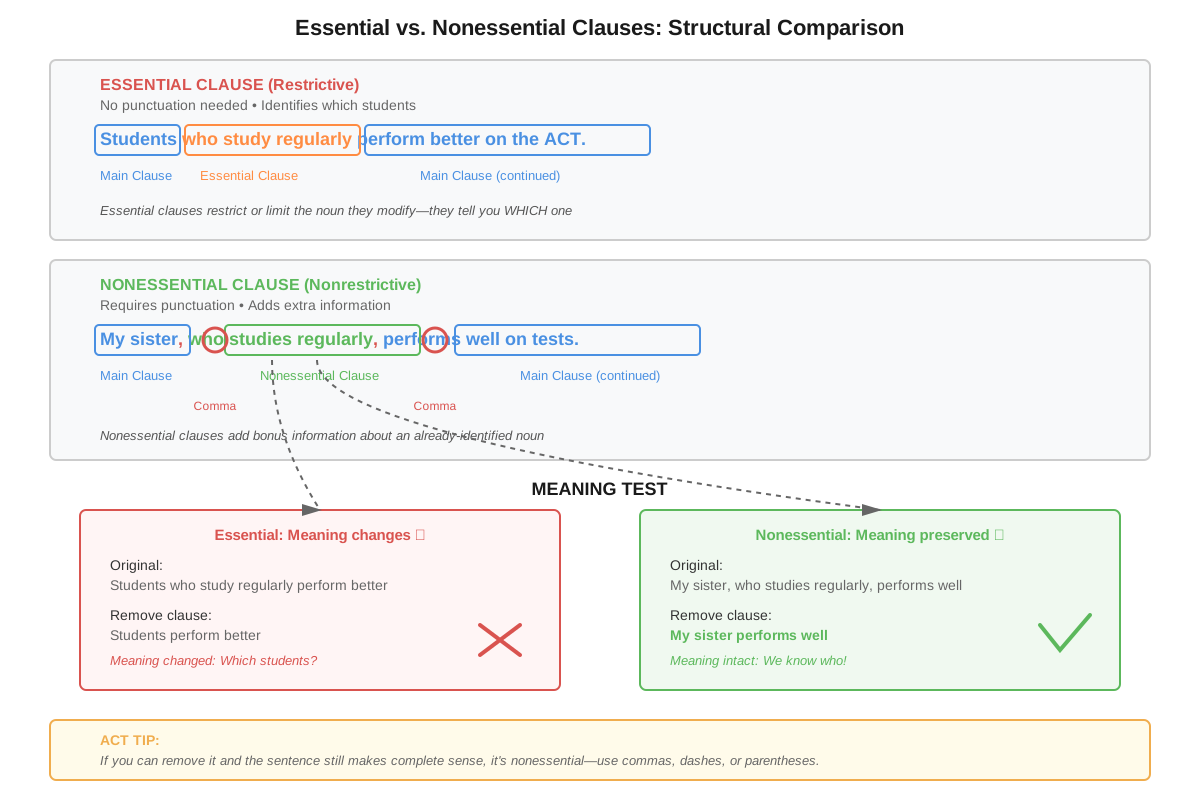
A nonessential clause (also called a nonrestrictive clause) is a dependent clause that provides additional information about a noun but is not necessary to identify which specific noun is being discussed. The clause adds descriptive detail, context, or interesting facts, but the sentence retains its core meaning without it. Nonessential clauses must be set off from the rest of the sentence with punctuation—typically commas, but sometimes dashes or parentheses.
Consider this example: "My sister, who lives in Chicago, is visiting next week." The clause "who lives in Chicago" is nonessential because it provides extra information about the sister but isn't needed to identify which sister is being discussed. The sentence "My sister is visiting next week" communicates the fundamental message. The nonessential clause is set off with commas on both sides because it appears in the middle of the sentence.
Essential vs. Nonessential: The Critical Distinction
The difference between essential and nonessential clauses hinges on whether the information is necessary to identify the specific noun being discussed. Essential clauses (also called restrictive clauses) are required to specify which particular person, place, or thing the sentence refers to, and they should NOT be set off with commas.
| Feature | Essential Clause | Nonessential Clause |
|---|---|---|
| Function | Identifies which specific noun | Adds extra information about an already-identified noun |
| Punctuation | No commas | Commas, dashes, or parentheses required |
| Relative pronoun | "That" or "who" | "Which" or "who" |
| Removability | Cannot remove without losing essential meaning | Can remove without changing core meaning |
| Example | Students who study regularly perform better. | My oldest student, who studies regularly, got a perfect score. |
In the essential example, "who study regularly" is necessary because the sentence is making a claim specifically about students who have this characteristic, not all students. In the nonessential example, "who studies regularly" provides additional information about an already-identified person (my oldest student), but the core message is "My oldest student got a perfect score."
Punctuation Rules for Nonessential Clauses
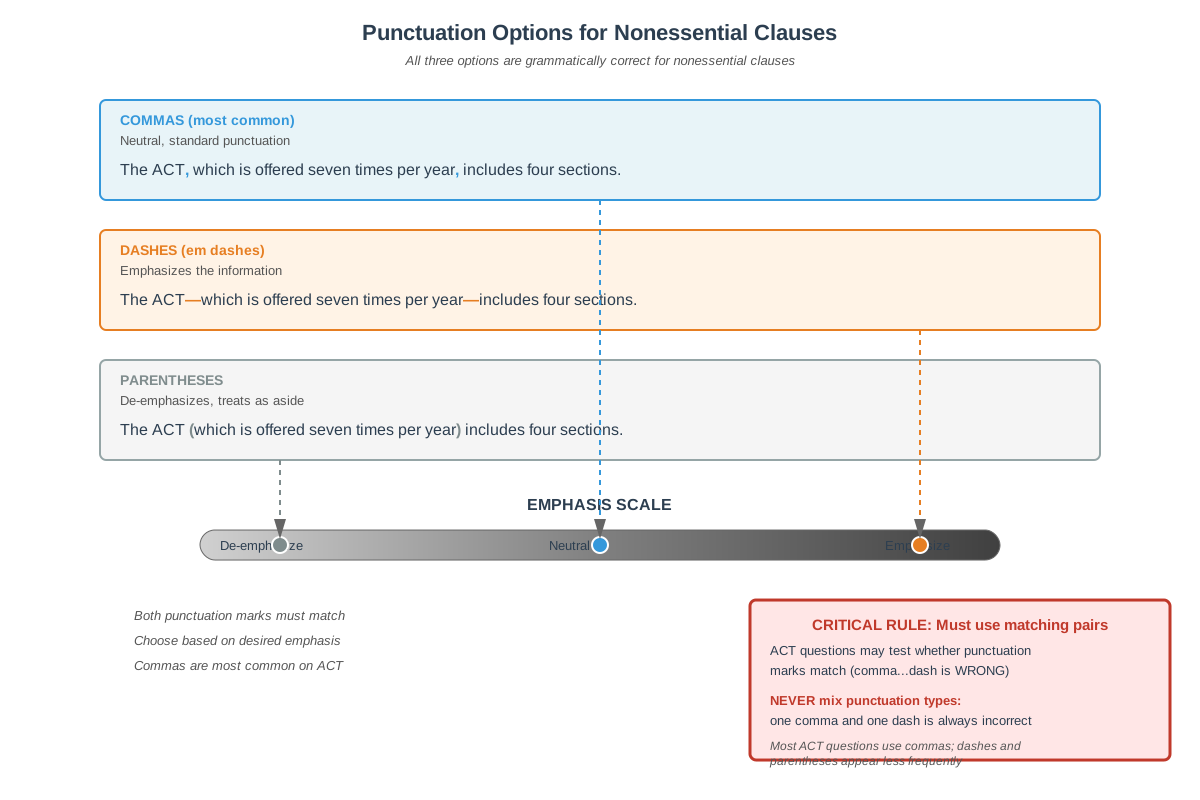
Nonessential clauses require symmetrical punctuation—if the clause appears in the middle of a sentence, it must have the same punctuation mark on both sides. This is one of the most commonly tested aspects on the ACT.
Comma pairs: The most common punctuation for nonessential clauses. Both commas must be present if the clause is in the middle of the sentence.
- Correct: "The novel, which was published in 1925, became a classic."
- Incorrect: "The novel, which was published in 1925 became a classic." (missing second comma)
Dash pairs: Dashes can replace commas to set off nonessential clauses, often when the writer wants to create emphasis or when the nonessential clause itself contains commas.
- Correct: "The author—who had written three previous novels—finally achieved success."
Parentheses: Less common on the ACT but grammatically correct for nonessential information that is truly supplementary or tangential.
- Correct: "The experiment (which took three years to complete) yielded surprising results."
Critical rule: You cannot mix punctuation types. Using a comma on one side and a dash on the other is always incorrect.
Relative Pronouns: "Which" vs. "That"
The ACT frequently tests the distinction between "which" and "that" when introducing clauses. While this rule has some flexibility in casual writing, the ACT follows the traditional grammar rule:
- "That" introduces essential clauses (no commas)
- "Which" introduces nonessential clauses (with commas)
Examples:
- "The car that is parked outside belongs to my neighbor." (Essential—specifying which car)
- "My car, which is parked outside, needs new tires." (Nonessential—adding information about an already-identified car)
Special Cases and Nuances
Proper nouns and unique identifiers: When a noun is already fully identified (like a proper name or a unique relationship), any additional information is typically nonessential.
- "Abraham Lincoln, who was the 16th president, delivered the Gettysburg Address." (The name already identifies the person uniquely)
Appositives: Noun phrases that rename or describe another noun function like nonessential clauses and follow the same punctuation rules.
- "My friend Sarah, a talented musician, performed last night." (The appositive "a talented musician" is nonessential)
Context-dependent essentiality: Sometimes whether a clause is essential depends on context. If you have multiple sisters, "My sister who lives in Chicago" (no commas) specifies which one. If you have only one sister, "My sister, who lives in Chicago," (with commas) adds extra information about an already-identified person.
Concept Relationships
The concept of nonessential clauses sits at the intersection of multiple grammatical principles. Understanding dependent clauses is the foundation, as nonessential clauses are a specific type of dependent clause that modifies nouns. This knowledge connects directly to relative pronouns (who, which, that), which typically introduce these clauses and signal whether they are essential or nonessential.
The relationship flows as follows: Clause structure → Relative pronouns → Essential vs. nonessential distinction → Punctuation rules → Sentence meaning and clarity
Nonessential clauses also connect to appositive phrases, which function similarly by providing additional information about nouns and requiring the same punctuation treatment. Both concepts relate to the broader principle of parenthetical elements—any information that interrupts the main flow of a sentence to add supplementary details.
The punctuation rules for nonessential clauses reinforce general comma usage principles, particularly the concept of using commas in pairs to set off interrupting elements. This connects to other comma rules like setting off introductory phrases and separating items in a series, all of which involve using commas to clarify sentence structure and meaning.
Finally, mastering nonessential clauses enhances understanding of sentence variety and sophistication. Writers use nonessential clauses to combine simple sentences into more complex structures, which relates to concepts of sentence combining and avoiding choppy writing—both tested on the ACT.
High-Yield Facts
⭐ Nonessential clauses must be set off with punctuation on BOTH sides when they appear in the middle of a sentence—the ACT frequently tests whether students include both punctuation marks.
⭐ If you can remove a clause from a sentence and the core meaning remains intact, the clause is nonessential and requires punctuation.
⭐ "Which" introduces nonessential clauses (with commas); "that" introduces essential clauses (no commas)—this is one of the most tested distinctions on the ACT.
⭐ When a noun is already fully identified (proper name, unique relationship, or specific context), additional information about it is typically nonessential.
⭐ Symmetrical punctuation is required: comma-comma, dash-dash, or parenthesis-parenthesis. Mixing types (comma-dash) is always wrong.
- Nonessential clauses beginning with "who" can refer to people in both essential and nonessential contexts; context determines punctuation.
- Dates, locations, and ages are typically nonessential when they provide additional information about an already-identified noun.
- The ACT will never accept an answer choice that sets off an essential clause with commas or leaves a nonessential clause unpunctuated.
- Nonessential clauses can appear at the beginning, middle, or end of sentences, but middle placement is most commonly tested.
- If removing a clause makes the sentence unclear or changes who/what is being discussed, the clause is essential.
- Appositives (noun phrases that rename nouns) follow the same essential/nonessential rules as clauses.
- The phrase "such as" typically introduces nonessential information and should be preceded by a comma.
- Nonessential clauses often begin with relative pronouns (who, which, whose) or subordinating conjunctions (although, because, since) when providing additional information.
Quick check — test yourself on Nonessential clauses so far.
Try Flashcards →Common Misconceptions
Misconception: All clauses beginning with "which" are nonessential and need commas.
Correction: While "which" typically introduces nonessential clauses in formal writing, the key is whether the information is necessary to identify the noun. The ACT follows the traditional rule that "which" = nonessential (with commas) and "that" = essential (no commas), but always verify by testing whether the sentence meaning changes without the clause.
Misconception: If a clause appears at the end of a sentence, it doesn't need any punctuation before it.
Correction: Nonessential clauses at the end of sentences still require punctuation (typically a comma) before them. Example: "I called my brother, who lives in Seattle." The comma is necessary because the clause is nonessential.
Misconception: Short clauses don't need to be set off with punctuation.
Correction: Length is irrelevant to whether a clause is essential or nonessential. Even a two-word nonessential element requires punctuation. Example: "My car, a sedan, is reliable." The appositive "a sedan" is short but still nonessential and requires commas.
Misconception: You can use just one comma to set off a nonessential clause in the middle of a sentence if it "sounds right."
Correction: Nonessential clauses in the middle of sentences always require punctuation on both sides. Using only one comma is grammatically incorrect and will never be the right answer on the ACT. The punctuation must be symmetrical.
Misconception: All information about a person's profession, age, or location is nonessential.
Correction: Whether such information is essential depends on context. "The teacher who teaches chemistry is absent" (essential—specifying which teacher) vs. "Mr. Johnson, who teaches chemistry, is absent" (nonessential—the name already identifies the person). Context determines essentiality.
Misconception: Dashes and parentheses can be used interchangeably with commas in all situations.
Correction: While dashes and parentheses can set off nonessential clauses, they create different emphasis and tone. The ACT typically tests whether punctuation is present and symmetrical rather than which type to use, but dashes emphasize while parentheses de-emphasize. Commas are neutral and most common.
Worked Examples
Example 1: Identifying and Punctuating a Nonessential Clause
Question: Which of the following correctly punctuates the sentence?
"My grandmother who immigrated from Ireland in 1952 told me stories about her childhood."
A. NO CHANGE
B. grandmother, who immigrated from Ireland in 1952 told me
C. grandmother, who immigrated from Ireland in 1952, told me
D. grandmother who immigrated from Ireland in 1952, told me
Solution Process:
Step 1: Identify the clause in question: "who immigrated from Ireland in 1952"
Step 2: Determine if the clause is essential or nonessential. Ask: "Does this clause identify which grandmother, or does it provide additional information about an already-identified person?" Since the sentence says "my grandmother" (a unique relationship—you have only one grandmother in this context), the person is already identified. The clause provides additional information, making it nonessential.
Step 3: Apply the punctuation rule. Nonessential clauses in the middle of sentences require punctuation on both sides. The clause must be set off with commas.
Step 4: Evaluate the answer choices:
- Choice A: No punctuation—incorrect for a nonessential clause
- Choice B: Comma before but not after—violates the symmetrical punctuation rule
- Choice C: Commas on both sides—correct!
- Choice D: Comma only after—violates the symmetrical punctuation rule
Answer: C
This question demonstrates the most common ACT pattern: testing whether students recognize that nonessential clauses require punctuation on both sides. The test makers deliberately include choices with only one comma to catch students who don't apply the complete rule.
Example 2: Essential vs. Nonessential Distinction
Question: Which version is correct?
"Students that study regularly tend to perform better on standardized tests."
A. NO CHANGE
B. Students, that study regularly,
C. Students who study regularly
D. Students, who study regularly,
Solution Process:
Step 1: Identify what the sentence is claiming. The sentence makes a statement about a specific subset of students—those who study regularly—not about all students.
Step 2: Determine essentiality. Ask: "Is the clause necessary to identify which students the sentence is discussing?" Yes—the sentence is specifically about students with the characteristic of studying regularly. Without this clause, "Students tend to perform better" would make a different claim (about all students). Therefore, the clause is essential.
Step 3: Apply the punctuation rule. Essential clauses should NOT be set off with commas.
Step 4: Consider the relative pronoun. For essential clauses referring to people, both "that" and "who" are acceptable, though "who" is preferred for people in formal writing.
Step 5: Evaluate the answer choices:
- Choice A: "that" with no commas—grammatically correct for an essential clause
- Choice B: Commas around the clause—incorrect because the clause is essential
- Choice C: "who" with no commas—also correct and slightly more formal
- Choice D: Commas around the clause—incorrect because the clause is essential
Answer: A or C (Both are grammatically correct; the ACT would typically present these in separate questions or make one clearly better through context)
This example illustrates how context determines whether a clause is essential. The same grammatical structure could be nonessential in a different sentence: "My students, who study regularly, all passed the exam" (if you're a teacher referring to your specific group of students, the clause becomes nonessential additional information).
Exam Strategy
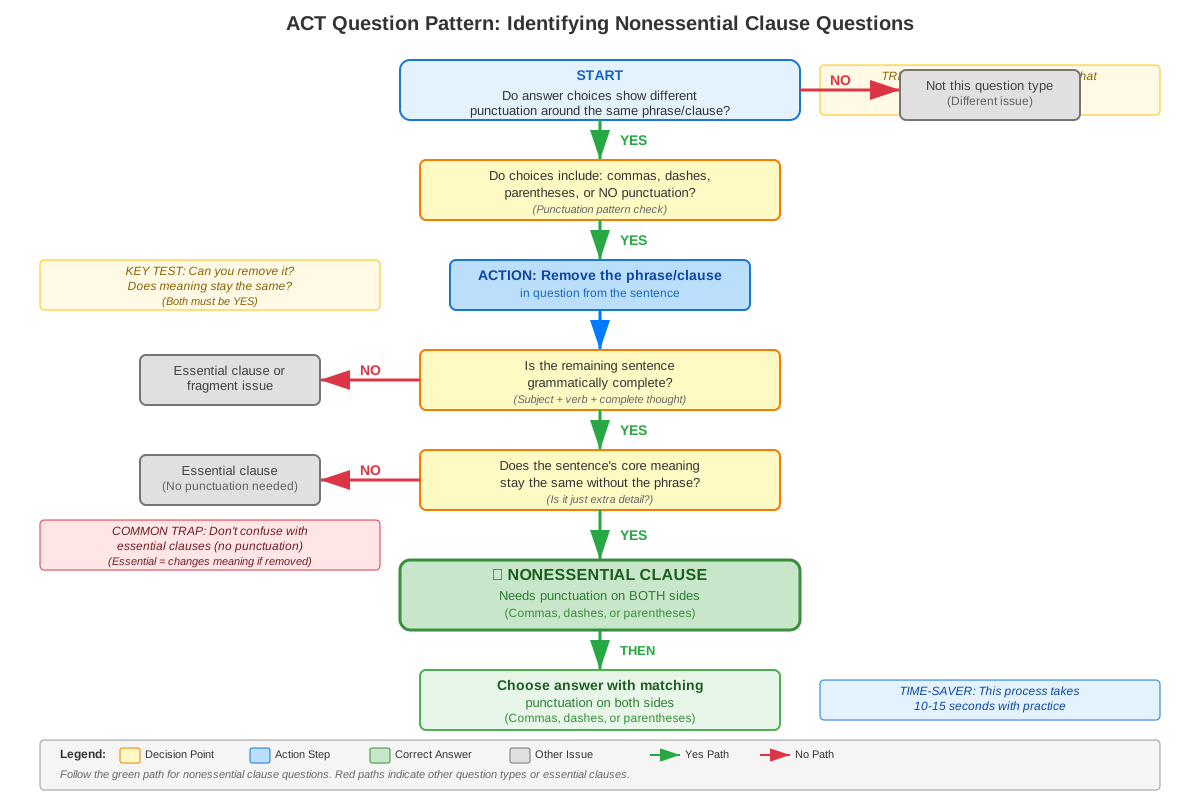
When approaching ACT questions testing nonessential clauses, follow this systematic process:
Step 1: Identify the clause or phrase in question. Look for relative pronouns (who, which, that) or descriptive phrases that provide information about a noun. The ACT will typically underline the punctuation around these elements or offer different punctuation options in the answer choices.
Step 2: Apply the removal test. Mentally remove the clause from the sentence and read what remains. If the core meaning stays intact and the sentence still makes sense, the clause is nonessential and requires punctuation. If the meaning changes significantly or becomes unclear, the clause is essential and should not be set off.
Step 3: Check for symmetrical punctuation. If the clause is in the middle of the sentence and is nonessential, verify that punctuation appears on BOTH sides. Immediately eliminate any answer choices with only one punctuation mark.
Step 4: Verify the relative pronoun. If the question involves choosing between "which" and "that," remember: "which" = nonessential (with commas), "that" = essential (no commas).
Exam Tip: The ACT loves to test nonessential clauses by offering four answer choices with different punctuation patterns. Often, three choices will have asymmetrical punctuation (comma on only one side) or no punctuation at all. The correct answer will have symmetrical punctuation for nonessential clauses or no punctuation for essential clauses.
Trigger words and phrases to watch for:
- "who," "which," "whose" (often introduce clauses that may be nonessential)
- Proper names followed by descriptive information
- Dates, ages, and locations that provide additional context
- Appositives (noun phrases that rename or describe)
- Phrases beginning with "such as" or "including"
Process of elimination tips:
- Immediately eliminate choices that use only one comma to set off a mid-sentence clause
- Eliminate choices that mix punctuation types (comma-dash or dash-comma)
- Eliminate choices that set off essential clauses with commas
- Eliminate choices that fail to punctuate nonessential clauses
Time allocation: These questions should take 15-20 seconds once you've mastered the concept. The removal test can be performed quickly, and the punctuation rules are straightforward. Don't overthink—if the clause can be removed without changing the core meaning, it needs punctuation on both sides.
Memory Techniques
The "Cover-Up" Technique: Physically cover the clause in question with your finger or pencil. Read the sentence without it. If the sentence still communicates its main point, the clause is nonessential and needs punctuation. This kinesthetic approach helps cement the removal test.
The "WHICH = COMMAS" Mnemonic: Remember that "WHICH" and "COMMAS" both have six letters. When you see "which," think commas. When you see "that," think no commas.
The "Sandwich Rule": Visualize nonessential clauses as the filling in a sandwich—they need "bread" (punctuation) on both sides. If you see only one piece of bread, the sandwich is incomplete, and the answer is wrong.
The "Name Game": When you see a proper name followed by descriptive information, remember: "Names are already known, so descriptions need commas." Example: "Shakespeare, who wrote Hamlet, lived in England." The name identifies the person, so additional information is nonessential.
The "Essential = Specific" Acronym: Both "essential" and "specific" start with 's' (when you spell out "essential"). Essential clauses specify which particular noun you're discussing. If the clause specifies, it's essential (no commas).
Visualization Strategy: Picture nonessential clauses as "bonus information" in a video game—nice to have but not required to complete the level. Essential clauses are like "required items"—you can't proceed without them. This gaming metaphor helps students remember the functional difference.
Summary
Nonessential clauses provide additional information about nouns but can be removed from sentences without changing their core meaning. These clauses must be set off with symmetrical punctuation—typically commas on both sides when they appear in the middle of sentences. The ACT tests this concept frequently, focusing on whether students can distinguish between essential clauses (which identify specific nouns and require no punctuation) and nonessential clauses (which add supplementary information and require punctuation). The key strategy is the removal test: if removing the clause leaves the sentence's fundamental meaning intact, the clause is nonessential and needs punctuation. Students must also master the "which" versus "that" distinction, remembering that "which" introduces nonessential clauses with commas while "that" introduces essential clauses without commas. Success on these questions requires recognizing that nonessential clauses in the middle of sentences always need punctuation on both sides—never just one side—and that the punctuation must be symmetrical (comma-comma, dash-dash, or parenthesis-parenthesis). This high-yield topic appears multiple times on every ACT English section and directly translates to points when students apply the systematic approach of identifying the clause, testing its essentiality, and verifying symmetrical punctuation.
Key Takeaways
- Nonessential clauses add extra information but can be removed without changing a sentence's core meaning; they must be set off with punctuation on both sides
- Use the removal test to determine essentiality: remove the clause and see if the fundamental meaning remains intact
- "Which" introduces nonessential clauses (with commas); "that" introduces essential clauses (no commas)
- Symmetrical punctuation is mandatory for nonessential clauses in the middle of sentences—comma-comma, dash-dash, or parenthesis-parenthesis
- When a noun is already fully identified (proper name, unique relationship), additional information about it is typically nonessential
- Essential clauses specify which particular noun is being discussed and should never be set off with commas
- The ACT frequently tests whether students include both punctuation marks around mid-sentence nonessential clauses—missing one comma is always incorrect
Related Topics
Essential (Restrictive) Clauses: Understanding the counterpart to nonessential clauses deepens comprehension of how clauses function to either identify or describe nouns. Mastering both types enables students to handle any clause-related question on the ACT.
Appositive Phrases: These noun phrases that rename or describe other nouns follow the same essential/nonessential rules as clauses. Students who understand nonessential clauses can easily transfer this knowledge to appositives.
Parenthetical Elements: This broader category includes nonessential clauses, transitional phrases, and other interrupting elements. Understanding how all parenthetical elements require punctuation creates a comprehensive framework for sentence structure.
Comma Usage Rules: Nonessential clauses represent just one application of comma rules. Exploring other comma uses (introductory elements, coordinating conjunctions, items in a series) builds complete punctuation mastery.
Relative Pronouns and Pronoun Reference: Deepening knowledge of how relative pronouns function and refer back to antecedents enhances understanding of both essential and nonessential clauses.
Practice CTA
Now that you've mastered the core concepts of nonessential clauses, it's time to put your knowledge into action! Work through the practice questions to reinforce your understanding and build the speed and accuracy you need for test day. Each practice question is designed to mirror actual ACT patterns, giving you authentic preparation. Review the flashcards to cement the key rules and distinctions in your memory. Remember: nonessential clause questions appear multiple times on every ACT English section, so mastering this topic will directly boost your score. You've got this—let's turn this knowledge into points!
Sign up free to keep reading
Create a free AnvayaPrep account to finish this ACT guide on Nonessential clauses — plus flashcards and practice questions.