Overview
Parenthetical information refers to words, phrases, or clauses that provide additional, non-essential information within a sentence. On the ACT English test, questions about parenthetical elements are among the most frequently tested punctuation concepts. These elements can be removed from a sentence without destroying its grammatical structure or core meaning. Understanding how to properly punctuate parenthetical information is crucial because it appears in approximately 10-15% of all ACT English questions, making it one of the highest-yield topics for score improvement.
The ACT tests parenthetical information primarily through punctuation questions, asking students to identify whether commas, dashes, or parentheses are used correctly to set off non-essential information. Students must recognize that parenthetical elements require punctuation on both sides when they appear in the middle of a sentence—a rule that trips up many test-takers who correctly punctuate one side but forget the other. Mastery of this concept directly impacts performance on questions involving sentence structure, punctuation, and clarity.
This topic connects fundamentally to broader concepts in sentence structure, including independent and dependent clauses, restrictive versus non-restrictive elements, and the hierarchy of punctuation marks. Students who master parenthetical information gain a powerful tool for quickly eliminating incorrect answer choices and confidently selecting correct punctuation patterns. The skills developed here also support understanding of more complex sentence structures and contribute to overall writing clarity—both essential for achieving top scores on the ACT English section.
Learning Objectives
- [ ] Identify when parenthetical information is being tested in ACT questions
- [ ] Explain the core rule or strategy behind ACT parenthetical information
- [ ] Apply parenthetical information concepts to ACT-style questions accurately
- [ ] Distinguish between essential and non-essential information in complex sentences
- [ ] Recognize and correct punctuation errors involving parenthetical elements
- [ ] Evaluate which punctuation marks (commas, dashes, or parentheses) are appropriate for different contexts
- [ ] Identify incomplete punctuation pairs that create sentence structure errors
Prerequisites
- Independent and dependent clauses: Understanding clause types is essential because parenthetical information can be either type, and recognizing the main clause helps identify what's parenthetical
- Basic comma rules: Foundational comma knowledge provides the baseline for understanding when commas set off non-essential elements versus when they serve other functions
- Subject-verb agreement: Identifying the true subject and verb requires the ability to mentally remove parenthetical information that may separate them
- Sentence fragments: Recognizing complete sentences helps determine whether parenthetical information has been properly integrated or has created a fragment
Why This Topic Matters
Parenthetical information questions appear with remarkable consistency on every ACT English test, typically comprising 3-5 questions per exam. This frequency makes the topic one of the most reliable point-earning opportunities for prepared students. Unlike some grammar concepts that appear sporadically, parenthetical punctuation is virtually guaranteed to be tested, making it an exceptionally high-yield study focus.
In real-world writing, the ability to incorporate additional information smoothly without disrupting sentence flow is a hallmark of sophisticated communication. Professional writing across all fields—from scientific research papers to business reports to journalism—relies heavily on parenthetical elements to provide context, clarification, and supporting details. Students who master this concept not only improve their ACT scores but also enhance their ability to write clearly and effectively in college and career contexts.
On the ACT, parenthetical information appears in several predictable patterns: questions may ask students to identify correct punctuation for appositives (noun phrases that rename another noun), relative clauses beginning with "which" or "who," transitional phrases, or explanatory asides. The test frequently presents answer choices that use different punctuation marks (commas versus dashes versus parentheses) or that punctuate only one side of a parenthetical element. Recognizing these patterns allows students to work quickly and confidently, saving valuable time for more challenging questions.
Core Concepts
Definition and Function of Parenthetical Information
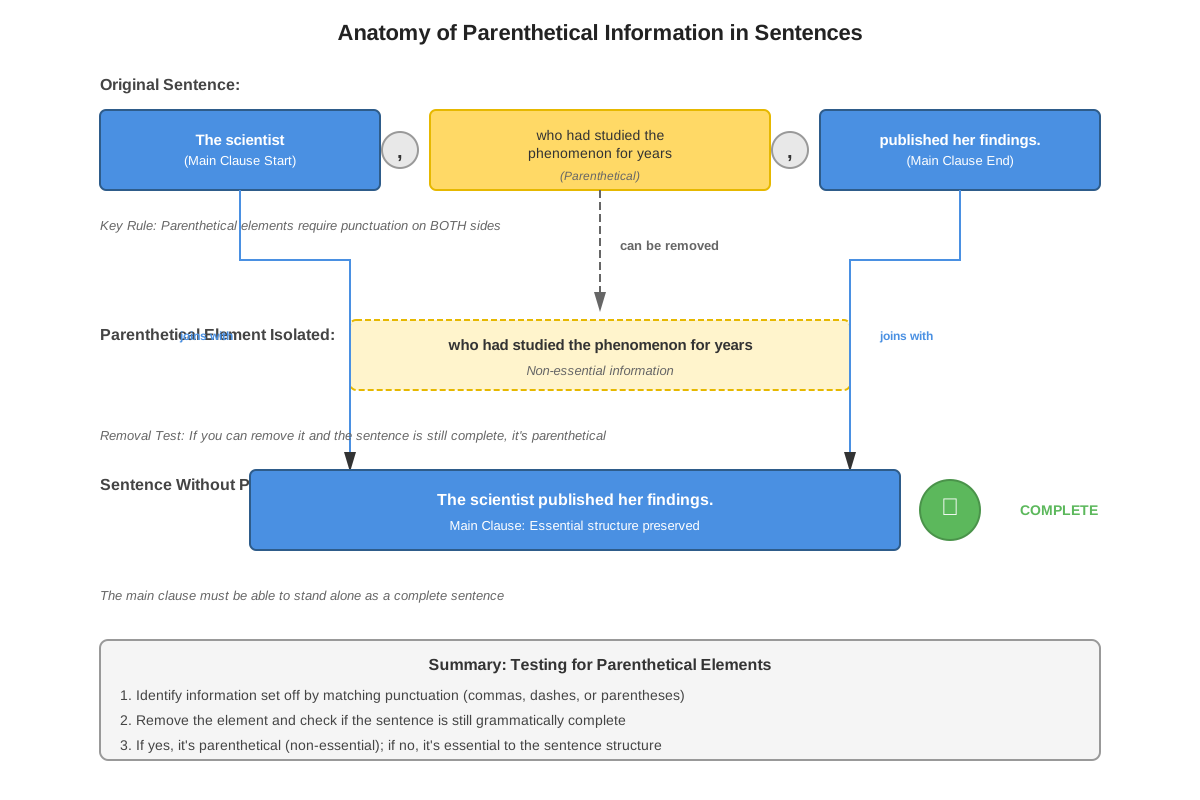
Parenthetical information (also called non-essential, non-restrictive, or parenthetical elements) consists of words, phrases, or clauses that add extra information to a sentence but are not necessary for the sentence's basic meaning or grammatical completeness. The defining characteristic is that these elements can be removed entirely, and the remaining sentence will still be grammatically correct and convey its primary message.
Consider this example: "My sister, who lives in Chicago, is visiting next week." The phrase "who lives in Chicago" is parenthetical because removing it yields a complete, meaningful sentence: "My sister is visiting next week." The parenthetical element adds interesting detail but isn't essential to identify which sister or to understand the basic statement.
The function of parenthetical information is to provide additional context, description, explanation, or commentary without interrupting the main flow of the sentence. This allows writers to pack more information into sentences while maintaining clarity and readability.
The Fundamental Rule: Matching Punctuation Pairs
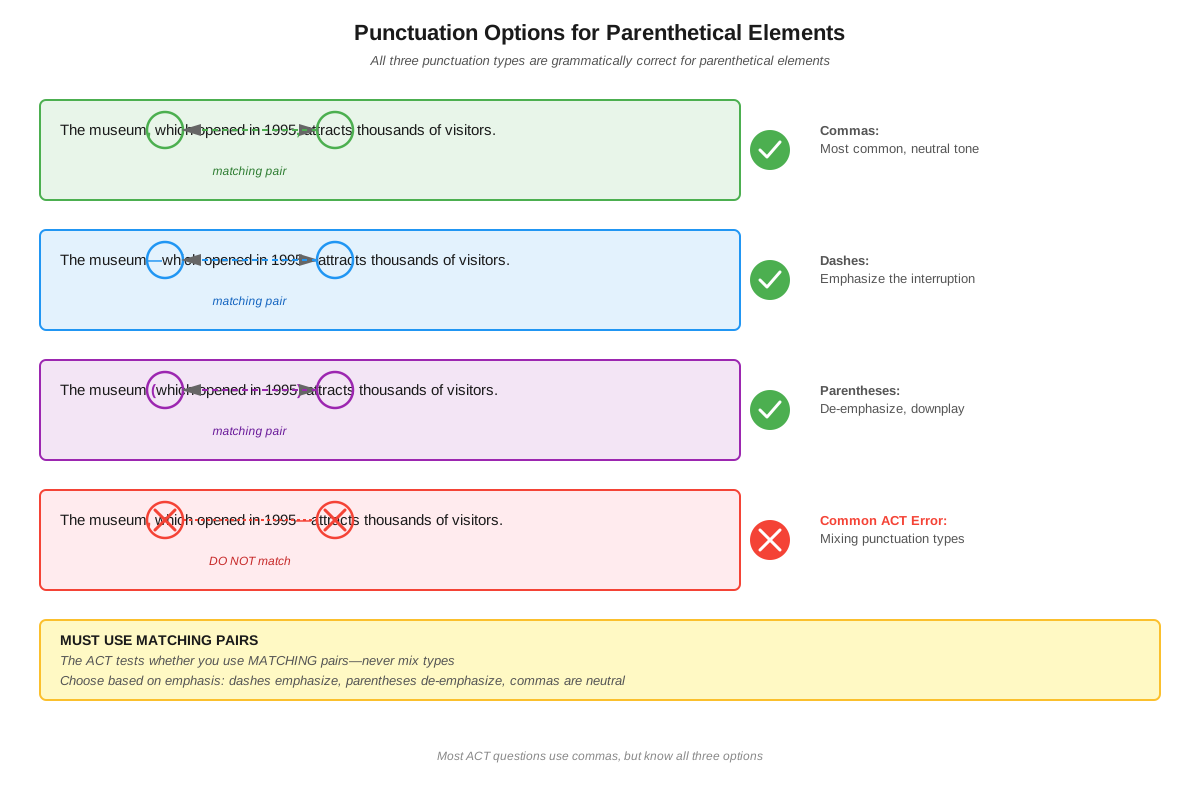
The most critical rule for ACT parenthetical information is that parenthetical elements in the middle of a sentence must be set off with matching punctuation on both sides. This is the single most tested aspect of parenthetical information on the ACT. Students must use the same punctuation mark to open and close the parenthetical element.
Valid punctuation pairs include:
- Comma + Comma: "The museum, which opened in 1995, attracts thousands of visitors."
- Dash + Dash: "The museum—which opened in 1995—attracts thousands of visitors."
- Parenthesis + Parenthesis: "The museum (which opened in 1995) attracts thousands of visitors."
Invalid combinations that frequently appear as wrong answers:
- Comma + Dash: "The museum, which opened in 1995—attracts thousands of visitors." ❌
- Dash + Comma: "The museum—which opened in 1995, attracts thousands of visitors." ❌
- Single punctuation mark: "The museum, which opened in 1995 attracts thousands of visitors." ❌
Identifying Parenthetical Elements: The Removal Test
The most reliable method for identifying parenthetical information is the removal test. Read the sentence and mentally remove the suspected parenthetical element. If the sentence remains grammatically complete and the core meaning is intact, the element is parenthetical and requires punctuation on both sides.
Example: "The scientist, Dr. Maria Rodriguez, published her findings last month."
Apply the removal test: "The scientist published her findings last month."
Result: The sentence is complete and meaningful, confirming that "Dr. Maria Rodriguez" is parenthetical (specifically, an appositive) and correctly punctuated with commas on both sides.
Types of Parenthetical Elements
| Type | Description | Example |
|---|---|---|
| Appositives | Noun phrases that rename or identify another noun | "My friend, an experienced pilot, flew us to the island." |
| Non-restrictive relative clauses | Clauses beginning with which, who, whom, whose that add extra information | "The book, which was published in 2020, became a bestseller." |
| Transitional phrases | Words or phrases that show relationships between ideas | "The results, however, were inconclusive." |
| Explanatory phrases | Additional details or clarifications | "The concert, scheduled for Saturday, was postponed." |
| Descriptive phrases | Extra descriptive information | "The house, painted bright yellow, stood out on the street." |
Choosing Between Commas, Dashes, and Parentheses
While all three punctuation marks can set off parenthetical information, they convey different levels of emphasis and integration:
Commas are the default choice and most common on the ACT. They integrate the parenthetical information smoothly into the sentence flow without drawing special attention to it. Use commas when the parenthetical information is standard additional detail.
Dashes create emphasis and draw attention to the parenthetical information. They signal a stronger break in thought than commas and suggest the information is particularly noteworthy or surprising. Dashes also work well when the parenthetical element itself contains commas, preventing confusion.
Parentheses minimize the importance of the enclosed information, suggesting it's truly optional or supplementary. They create the strongest separation from the main sentence. Parentheses are less common on the ACT but appear occasionally, especially for citations, dates, or technical clarifications.
Essential vs. Non-Essential Information
Understanding the distinction between essential (restrictive) and non-essential (non-restrictive) information is crucial for correct punctuation. Essential information identifies or restricts the noun it modifies and cannot be removed without changing the sentence's meaning. Essential elements do NOT receive punctuation.
Compare these sentences:
- "Students who study regularly perform better on tests." (Essential—identifies which students)
- "My brother, who studies regularly, performs better on tests." (Non-essential—adds extra information about an already-identified person)
In the first sentence, "who study regularly" is essential because it specifies which students perform better—not all students, only those who study regularly. Removing this clause would change the meaning fundamentally.
In the second sentence, "who studies regularly" is non-essential because "my brother" already identifies a specific person. The clause adds interesting information but doesn't restrict or identify which brother (assuming the speaker has only one brother or the context makes it clear).
Parenthetical Elements at Sentence Boundaries
When parenthetical information appears at the beginning or end of a sentence, it requires only one punctuation mark because the sentence boundary (capital letter or period) serves as the other boundary.
Beginning: "However, the experiment yielded unexpected results."
End: "The experiment yielded unexpected results, however."
The ACT occasionally tests whether students incorrectly add punctuation at the sentence boundary, creating errors like: "However, the experiment yielded unexpected results." (This is correct, but watch for wrong answers that add unnecessary punctuation.)
Concept Relationships
The concept of parenthetical information serves as a central hub connecting multiple aspects of sentence structure and punctuation. At its foundation, identifying parenthetical elements requires understanding independent clauses → because students must recognize the main clause that remains after removing the parenthetical information. This connects directly to sentence fragments → since incorrectly punctuating or removing essential information can create incomplete sentences.
The distinction between essential and non-essential information links to relative clauses → which can be either restrictive (essential) or non-restrictive (parenthetical). This relationship extends to comma usage → where commas serve multiple functions, and students must distinguish between commas setting off parenthetical elements versus commas in compound sentences or series.
Parenthetical information also connects to subject-verb agreement → because parenthetical elements often separate subjects from verbs, and students must identify the true subject by mentally removing the intervening parenthetical phrase. For example: "The box of chocolates, which was a gift from my aunt, was delicious." The subject is "box" (singular), not "chocolates," and the parenthetical phrase "which was a gift from my aunt" must be ignored when determining agreement.
Finally, mastery of parenthetical punctuation supports understanding of sentence variety and style → as writers use parenthetical elements to create more sophisticated, information-rich sentences without sacrificing clarity. This connects to broader rhetorical skills tested on the ACT, where students evaluate whether information should be added, deleted, or repositioned.
Quick check — test yourself on Parenthetical information so far.
Try Flashcards →High-Yield Facts
⭐ Parenthetical information in the middle of a sentence MUST have matching punctuation on both sides (comma-comma, dash-dash, or parenthesis-parenthesis).
⭐ The removal test is the most reliable method: if you can remove the element and the sentence remains complete and meaningful, it's parenthetical.
⭐ Non-restrictive relative clauses beginning with "which" are almost always parenthetical and require commas, while "that" clauses are typically essential and do not.
⭐ Appositives (noun phrases that rename another noun) are parenthetical and must be set off with punctuation on both sides.
⭐ Transitional words and phrases like "however," "therefore," "in fact," and "for example" are parenthetical when they appear mid-sentence.
- Parenthetical elements at the beginning or end of a sentence need only one punctuation mark because the sentence boundary serves as the other boundary.
- Mixing punctuation marks (comma with dash, for example) is always incorrect on the ACT.
- When a parenthetical element contains internal commas, dashes are often the clearest choice to avoid confusion.
- Essential information that identifies or restricts meaning should NOT be set off with punctuation.
- The phrase "such as" typically introduces parenthetical examples that require punctuation.
- Parenthetical information can be a single word, a phrase, or an entire clause—length doesn't determine whether it's parenthetical.
- On the ACT, if three answer choices use different punctuation marks but all punctuate both sides correctly, they're usually all grammatically correct, and the question is testing style or emphasis.
Common Misconceptions
Misconception: All information between commas is parenthetical and can be removed.
Correction: Not all comma-enclosed information is parenthetical. Commas serve many functions, including separating items in a series, joining independent clauses with coordinating conjunctions, and setting off introductory elements. Always apply the removal test to verify that the sentence remains complete and meaningful.
Misconception: Parenthetical information only needs punctuation on one side if it's at the beginning or end of the sentence.
Correction: This is partially true but often misapplied. Parenthetical information at the very beginning or very end needs only one punctuation mark because the sentence boundary (capital letter or period) provides the other boundary. However, information in the middle of a sentence always needs punctuation on both sides, even if it's close to the beginning or end.
Misconception: "Which" and "that" are interchangeable in relative clauses.
Correction: "Which" typically introduces non-restrictive (parenthetical) clauses and requires commas, while "that" introduces restrictive (essential) clauses and does not use commas. Example: "The car that is parked outside is mine" (essential—identifies which car) versus "My car, which is parked outside, is blue" (non-essential—adds extra information).
Misconception: Longer phrases are more likely to be parenthetical than shorter ones.
Correction: Length has no bearing on whether information is parenthetical. A single word like "however" can be parenthetical, while a long phrase might be essential to the sentence's meaning. The determining factor is whether the information can be removed while maintaining grammatical completeness and core meaning.
Misconception: If you see dashes in the answer choices, they're probably wrong because commas are more common.
Correction: While commas are indeed more common for parenthetical elements, dashes are grammatically correct and sometimes preferable, especially when the parenthetical element contains internal commas or when emphasis is desired. Don't automatically eliminate dashes—evaluate whether they're used correctly as a matching pair.
Misconception: Parentheses are rarely correct on the ACT, so avoid them.
Correction: While parentheses appear less frequently than commas or dashes, they are sometimes the correct answer, particularly for supplementary information like dates, citations, or technical details. Evaluate all punctuation options based on correct usage, not frequency.
Worked Examples
Example 1: Identifying and Correcting Parenthetical Punctuation
Question: Which of the following correctly punctuates the sentence?
The research team, led by Dr. Sarah Chen discovered a new species of butterfly in the Amazon rainforest.
A. NO CHANGE
B. team led by Dr. Sarah Chen,
C. team, led by Dr. Sarah Chen,
D. team—led by Dr. Sarah Chen,
Solution:
Step 1: Identify potential parenthetical information. The phrase "led by Dr. Sarah Chen" appears to provide additional information about the research team.
Step 2: Apply the removal test. Remove "led by Dr. Sarah Chen" and read: "The research team discovered a new species of butterfly in the Amazon rainforest." This sentence is complete and meaningful, confirming that "led by Dr. Sarah Chen" is parenthetical.
Step 3: Check punctuation requirements. Since the parenthetical element appears in the middle of the sentence, it must have matching punctuation on both sides.
Step 4: Evaluate each answer choice:
- A (NO CHANGE): Has a comma before but no comma after—incorrect (missing closing punctuation)
- B: Has no punctuation before and a comma after—incorrect (missing opening punctuation)
- C: Has commas on both sides—correct (matching punctuation pair)
- D: Has a dash before and a comma after—incorrect (mismatched punctuation)
Answer: C
This question demonstrates the most common error pattern on ACT parenthetical information questions: punctuating only one side of the parenthetical element. The correct answer uses matching commas to properly set off the non-essential phrase.
Example 2: Essential vs. Non-Essential Information
Question: Which version is correctly punctuated?
F. My sister who lives in Boston is visiting next week.
G. My sister, who lives in Boston is visiting next week.
H. My sister, who lives in Boston, is visiting next week.
J. My sister who lives in Boston, is visiting next week.
Solution:
Step 1: Determine whether "who lives in Boston" is essential or non-essential. This requires context. If the speaker has only one sister, the phrase is non-essential (it adds extra information but doesn't identify which sister). If the speaker has multiple sisters, the phrase might be essential (it identifies which sister).
Step 2: On the ACT, when context is ambiguous, the test typically treats such phrases as non-essential, especially with singular family members ("my sister," "my brother," "my mother") where the possessive pronoun suggests a specific, already-identified person.
Step 3: If "who lives in Boston" is non-essential, it requires punctuation on both sides.
Step 4: Evaluate each answer choice:
- F: No punctuation—treats the clause as essential
- G: Comma before but not after—incorrect (incomplete punctuation)
- H: Commas on both sides—correct for non-essential interpretation
- J: Comma after but not before—incorrect (incomplete punctuation)
Answer: H
This example illustrates the importance of recognizing when information is truly parenthetical. The phrase "who lives in Boston" adds interesting detail but isn't necessary to identify which sister is visiting, making it non-essential and requiring commas on both sides. This question type frequently appears on the ACT, testing whether students can distinguish between restrictive and non-restrictive relative clauses.
Exam Strategy
When approaching ACT parenthetical information questions, follow this systematic process to maximize accuracy and speed:
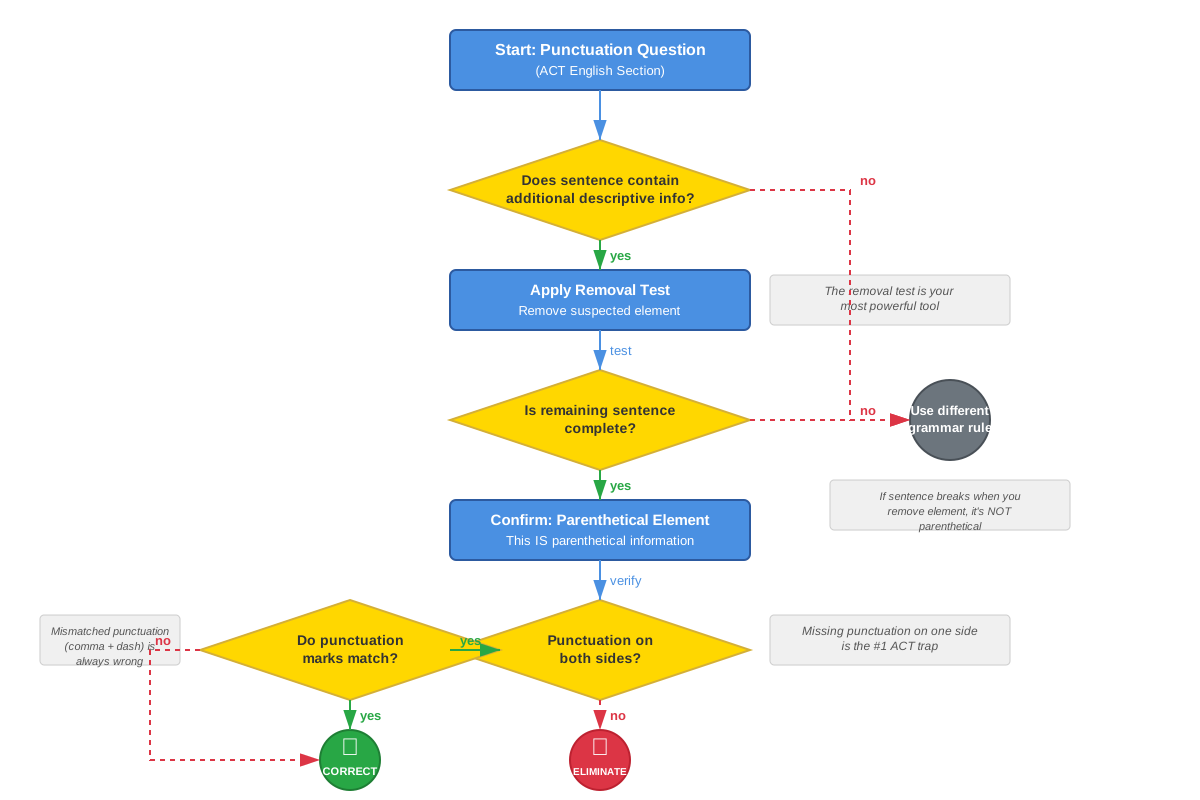
Step 1: Scan for punctuation patterns. Look for commas, dashes, or parentheses in the underlined portion and surrounding text. Questions about parenthetical information almost always involve these marks.
Step 2: Identify the suspected parenthetical element. Look for phrases or clauses that appear to provide additional information, especially appositives, relative clauses beginning with "which" or "who," and transitional phrases.
Step 3: Apply the removal test. Mentally remove the suspected parenthetical element and read the remaining sentence. If it's complete and meaningful, the element is parenthetical and needs punctuation on both sides (if in the middle of the sentence).
Step 4: Check for matching punctuation. Verify that the same punctuation mark appears on both sides of the parenthetical element. Immediately eliminate any answer choices with mismatched punctuation or punctuation on only one side.
Step 5: If multiple answers have correct punctuation, consider style. When all remaining choices are grammatically correct but use different punctuation marks (commas vs. dashes vs. parentheses), the question is testing stylistic appropriateness. Choose based on emphasis: commas for standard integration, dashes for emphasis, parentheses for de-emphasis.
Exam Tip: The ACT loves to test incomplete punctuation pairs. If you see a comma before a parenthetical element, immediately check whether there's a comma after it. This single check can help you eliminate 2-3 wrong answers in seconds.
Trigger words and phrases to watch for:
- "which" (usually introduces non-restrictive clauses requiring commas)
- "however," "therefore," "for example," "in fact" (transitional phrases that are parenthetical mid-sentence)
- Noun phrases immediately following another noun (likely appositives)
- Descriptive phrases beginning with past participles like "located," "founded," "established"
Time allocation: Parenthetical information questions should take 15-30 seconds each. They're typically straightforward once you've identified the parenthetical element and checked for matching punctuation. If you're spending more than 30 seconds, you may be overthinking—trust the removal test and move on.
Process of elimination strategy: Start by eliminating answers with obvious punctuation errors (mismatched pairs, punctuation on only one side). This often leaves you with 1-2 viable options, making the final choice much easier.
Memory Techniques
The PAIR Principle: Parenthetical elements Always Insist on Requiring matching punctuation on both sides when in the middle of a sentence. Visualize a pair of bookends holding books—both bookends are necessary.
The Removal Rhyme: "Take it out, check it out—if the sentence stands, it's parenthetical, no doubt!" This simple rhyme reinforces the removal test as your primary identification strategy.
The Three P's of Punctuation Choice:
- Plain integration = Commas
- Powerful emphasis = Dashes
- Playing down importance = Parentheses
The "Which" Comma Trick: Remember "Which needs a comma, that does not" by visualizing the word "which" with a comma tail: "which," The comma is built into your mental image of the word.
The Sandwich Visualization: Picture parenthetical information as the filling in a sandwich. Just as a sandwich needs two slices of bread (one on top, one on bottom), parenthetical information needs two punctuation marks (one before, one after). A sandwich with only one slice of bread doesn't work—neither does parenthetical information with only one punctuation mark.
The MATCH Acronym for checking your work:
- Middle of sentence?
- Apply removal test
- Two punctuation marks?
- Consistent type?
- Hooray, it's correct!
Summary
Parenthetical information represents one of the most reliable and high-yield topics on the ACT English test, appearing in 3-5 questions per exam. The fundamental principle is straightforward: non-essential information that can be removed without destroying sentence completeness or core meaning must be set off with matching punctuation on both sides when it appears in the middle of a sentence. The removal test—mentally removing the suspected element and checking whether the sentence remains complete—is the most reliable identification method. Common parenthetical elements include appositives, non-restrictive relative clauses beginning with "which," transitional phrases, and explanatory details. The most frequently tested error involves punctuating only one side of a parenthetical element or using mismatched punctuation marks. Students who master this concept gain a significant advantage because these questions are highly predictable and can be answered quickly and confidently, freeing up time for more challenging questions while securing easy points toward a top score.
Key Takeaways
- Parenthetical information must have matching punctuation on both sides when in the middle of a sentence (comma-comma, dash-dash, or parenthesis-parenthesis)
- Use the removal test to identify parenthetical elements: if removing the element leaves a complete, meaningful sentence, it's parenthetical
- Non-restrictive relative clauses beginning with "which" are almost always parenthetical and require commas, while "that" clauses are typically essential
- The most common ACT error is punctuating only one side of a parenthetical element—always check both sides
- Appositives (noun phrases that rename another noun) are parenthetical and must be set off with punctuation
- Parenthetical elements at the beginning or end of a sentence need only one punctuation mark because the sentence boundary serves as the other boundary
- When multiple answers are grammatically correct but use different punctuation marks, choose based on emphasis: commas for standard integration, dashes for emphasis, parentheses for de-emphasis
Related Topics
Restrictive vs. Non-Restrictive Clauses: This topic expands on the essential versus non-essential distinction, providing deeper understanding of when information should and shouldn't be set off with punctuation. Mastering parenthetical information provides the foundation for this more nuanced concept.
Comma Usage: Comprehensive study of all comma rules builds on parenthetical punctuation, as commas serve multiple functions in sentences. Understanding parenthetical commas helps distinguish them from commas in compound sentences, series, and introductory elements.
Dash and Colon Usage: Advanced punctuation study explores when dashes and colons are appropriate, building on the foundation of using dashes for parenthetical elements. This topic extends your punctuation toolkit for more sophisticated sentence construction.
Sentence Structure and Variety: Understanding how to incorporate parenthetical information effectively contributes to creating varied, sophisticated sentences—a skill tested in the rhetorical skills portion of ACT English.
Subject-Verb Agreement with Intervening Phrases: This topic directly applies parenthetical information concepts, as students must identify and ignore parenthetical elements that separate subjects from verbs to determine correct agreement.
Practice CTA
Now that you've mastered the core concepts of parenthetical information, it's time to put your knowledge into action! Complete the practice questions to reinforce these principles and build the speed and confidence you need for test day. Each practice question is designed to mirror actual ACT patterns, giving you authentic preparation. Review the flashcards to cement the key rules and trigger words in your memory. Remember: parenthetical information questions are among the most predictable and high-yield on the ACT—mastering this topic means securing easy points and boosting your score. You've got this!
Sign up free to keep reading
Create a free AnvayaPrep account to finish this ACT guide on Parenthetical information — plus flashcards and practice questions.