Overview
Sentence interruption is one of the most frequently tested punctuation and sentence structure concepts on the ACT English section. This topic examines how writers insert additional information—such as clarifying details, examples, or parenthetical remarks—into the middle of sentences without disrupting the grammatical flow. Understanding sentence interruption is crucial because the ACT consistently includes 3-5 questions per test that require students to identify whether interruptive elements are correctly punctuated with commas, dashes, or parentheses.
Mastering ACT sentence interruption questions directly impacts your ability to score in the upper ranges of the English section. These questions test your understanding of how sentences maintain their structural integrity even when additional information is inserted. The core principle is simple yet powerful: if you remove the interrupting element, the remaining sentence must still be grammatically complete and logical. This concept bridges multiple areas of English grammar, including comma usage, dash application, parenthetical expressions, and overall sentence coherence.
Sentence interruption connects to broader ACT English concepts including punctuation rules, sentence structure, and rhetorical skills. It requires students to recognize the boundaries of interruptive phrases and clauses, distinguish essential from nonessential information, and apply appropriate punctuation marks consistently. Students who master this topic gain a significant advantage because these questions often appear straightforward but contain subtle traps that catch unprepared test-takers. The ability to quickly identify and correctly punctuate interruptions saves valuable time and boosts accuracy across multiple question types.
Learning Objectives
- [ ] Identify when sentence interruption is being tested in ACT English passages
- [ ] Explain the core rule or strategy behind sentence interruption punctuation
- [ ] Apply sentence interruption rules to ACT-style questions accurately
- [ ] Distinguish between essential and nonessential interruptive elements
- [ ] Recognize when commas, dashes, or parentheses are appropriate for interruptions
- [ ] Verify sentence completeness by mentally removing interruptive phrases
- [ ] Identify and correct mismatched punctuation around interruptions
Prerequisites
- Basic comma rules: Understanding fundamental comma usage is essential because commas are the most common punctuation marks used to set off interruptions
- Independent and dependent clauses: Recognizing complete sentences helps determine whether removing an interruption leaves a grammatically sound sentence
- Parts of speech: Identifying nouns, verbs, and modifiers enables students to understand what elements can be interrupted and what constitutes an interruption
- Phrase and clause identification: Distinguishing between phrases and clauses helps determine the boundaries of interruptive elements
Why This Topic Matters
Sentence interruption appears with remarkable consistency on every ACT English test, making it one of the highest-yield topics for focused study. Research on ACT question patterns reveals that approximately 8-12% of all English questions involve some aspect of interruption punctuation, whether directly testing comma pairs, dash pairs, or parentheses, or indirectly through sentence structure questions where interruptions affect clarity.
In real-world writing, the ability to incorporate additional information smoothly into sentences is fundamental to sophisticated communication. Professional writing across all fields—from scientific research papers to business reports to journalism—relies heavily on interruptive elements to provide context, clarification, and nuance without creating choppy, disconnected sentences. Students who master this skill not only improve their ACT scores but also enhance their own writing clarity and sophistication.
On the ACT, sentence interruption questions typically appear in several predictable formats: direct punctuation questions where answer choices differ only in punctuation marks around a phrase; sentence structure questions where the interruption affects overall coherence; and rhetorical skills questions where the placement or punctuation of an interruption impacts meaning. The test writers frequently place these questions in passages about science, history, or personal narratives, where additional explanatory information naturally occurs. Recognizing the patterns allows students to approach these questions systematically rather than relying on intuition, which often fails under time pressure.
Core Concepts
The Fundamental Rule of Sentence Interruption
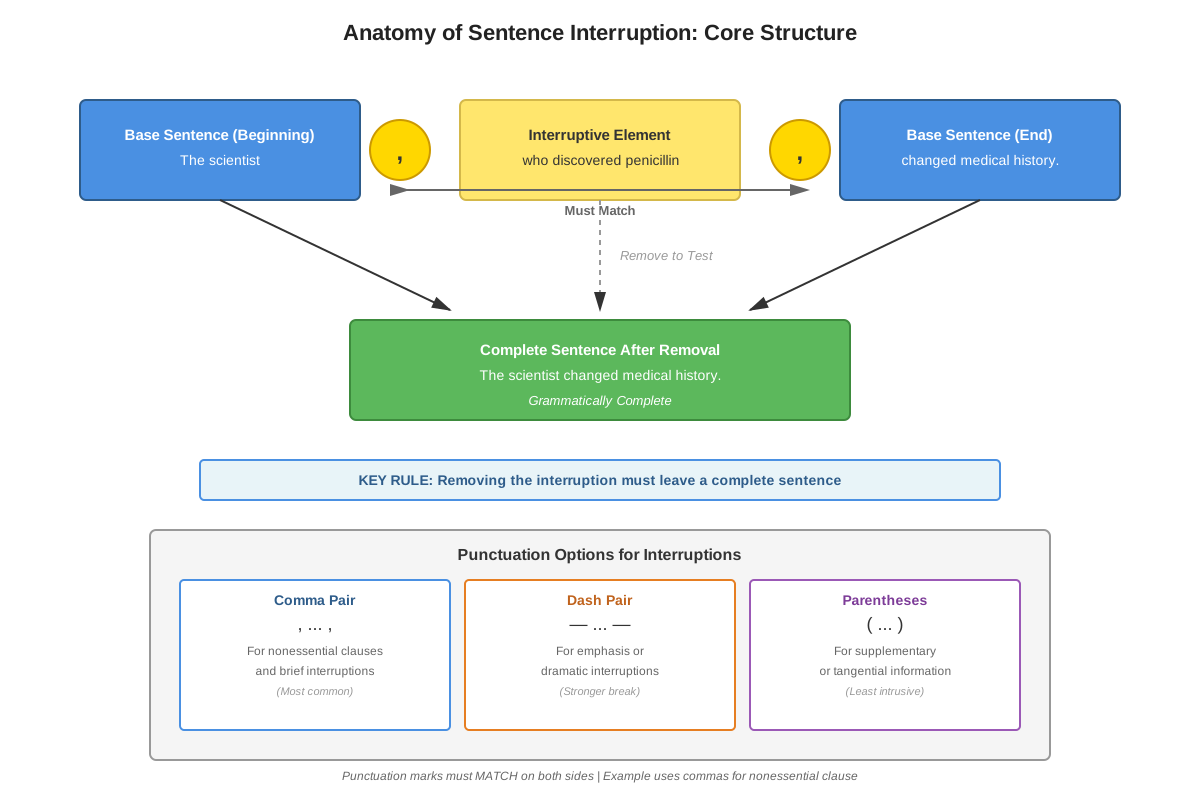
The cornerstone principle of sentence interruption is the "removal test": any interruptive element can be removed from a sentence, and what remains must form a complete, grammatically correct sentence. This rule applies universally, regardless of which punctuation marks are used to set off the interruption. When a phrase or clause interrupts the main flow of a sentence, it must be clearly marked on both sides with matching punctuation.
Consider this example: "The scientist, who had studied marine biology for decades, discovered a new species." If we remove the interruption "who had studied marine biology for decades," we get "The scientist discovered a new species"—a complete sentence. This confirms that the phrase is indeed an interruption and must be set off with matching punctuation on both sides.
Types of Punctuation for Interruptions
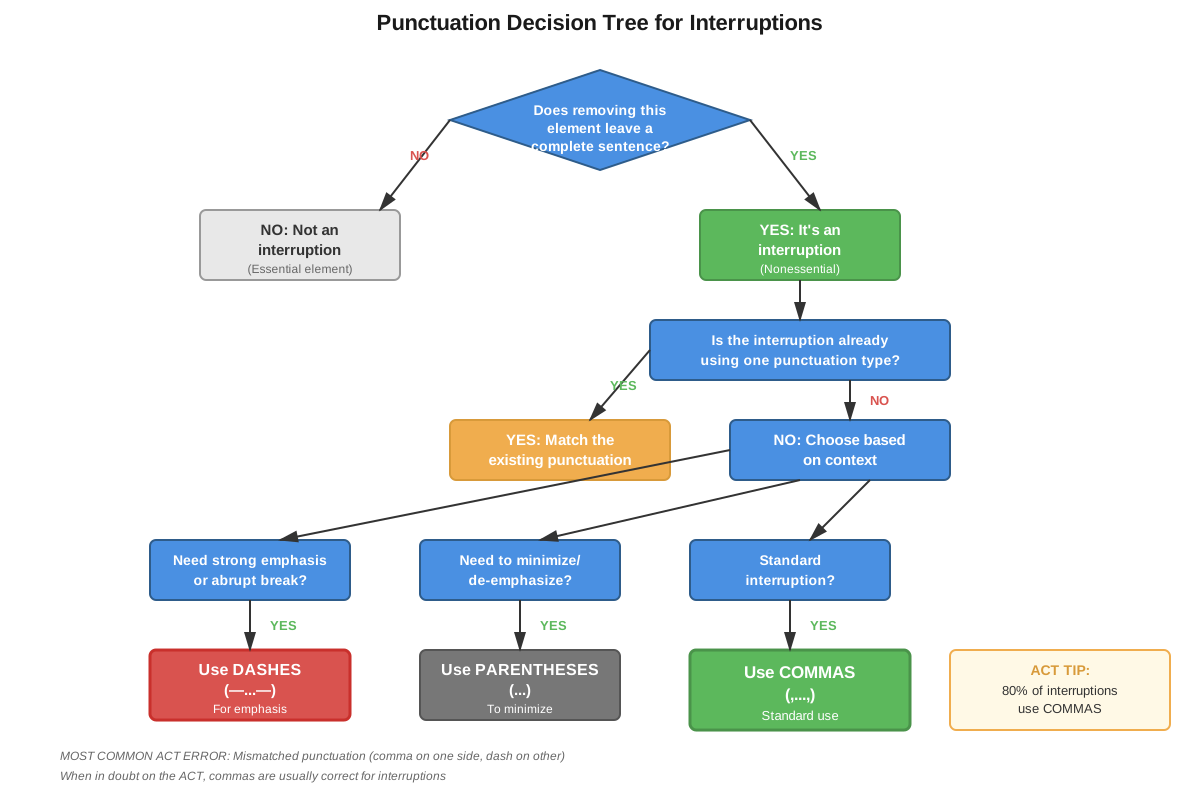
Three punctuation options can set off interruptive elements: commas, dashes, and parentheses. The critical rule is consistency—whatever punctuation mark begins the interruption must also end it. You cannot start with a comma and end with a dash, or begin with a dash and end with a parenthesis.
| Punctuation Type | Usage | Emphasis Level | Example |
|---|---|---|---|
| Commas | Standard interruptions, nonessential clauses | Neutral | The book, which won several awards, sold millions of copies. |
| Dashes | Dramatic interruptions, strong emphasis | High | The discovery—completely unexpected by the research team—changed everything. |
| Parentheses | Supplementary information, de-emphasis | Low | The conference (held annually since 1995) attracts thousands of attendees. |
Commas are the most common choice for interruptions and work well for standard nonessential information. They integrate the interruption smoothly without drawing special attention to it. The ACT tests comma pairs more frequently than any other interruption punctuation.
Dashes create a more dramatic pause and emphasize the interrupted information. They signal to readers that the information is important or surprising. On the ACT, dash questions often test whether students recognize that both dashes must be present—a common error is using only one dash.
Parentheses minimize the importance of the interruption, suggesting that the information is supplementary or optional. While less common on the ACT than commas or dashes, parentheses questions do appear, particularly in science passages where technical details or dates are provided as additional context.
Identifying Interruptive Elements
Recognizing what constitutes an interruption is crucial for ACT success. Interruptive elements typically include:
- Nonessential relative clauses: Clauses beginning with "which," "who," or "whom" that provide additional information about a noun but aren't necessary to identify it
- Appositives: Noun phrases that rename or describe another noun
- Transitional phrases: Expressions like "however," "therefore," "in fact," or "for example" when they appear mid-sentence
- Parenthetical remarks: Comments or asides that add context but aren't grammatically essential
- Descriptive phrases: Adjective phrases or participial phrases that modify nouns
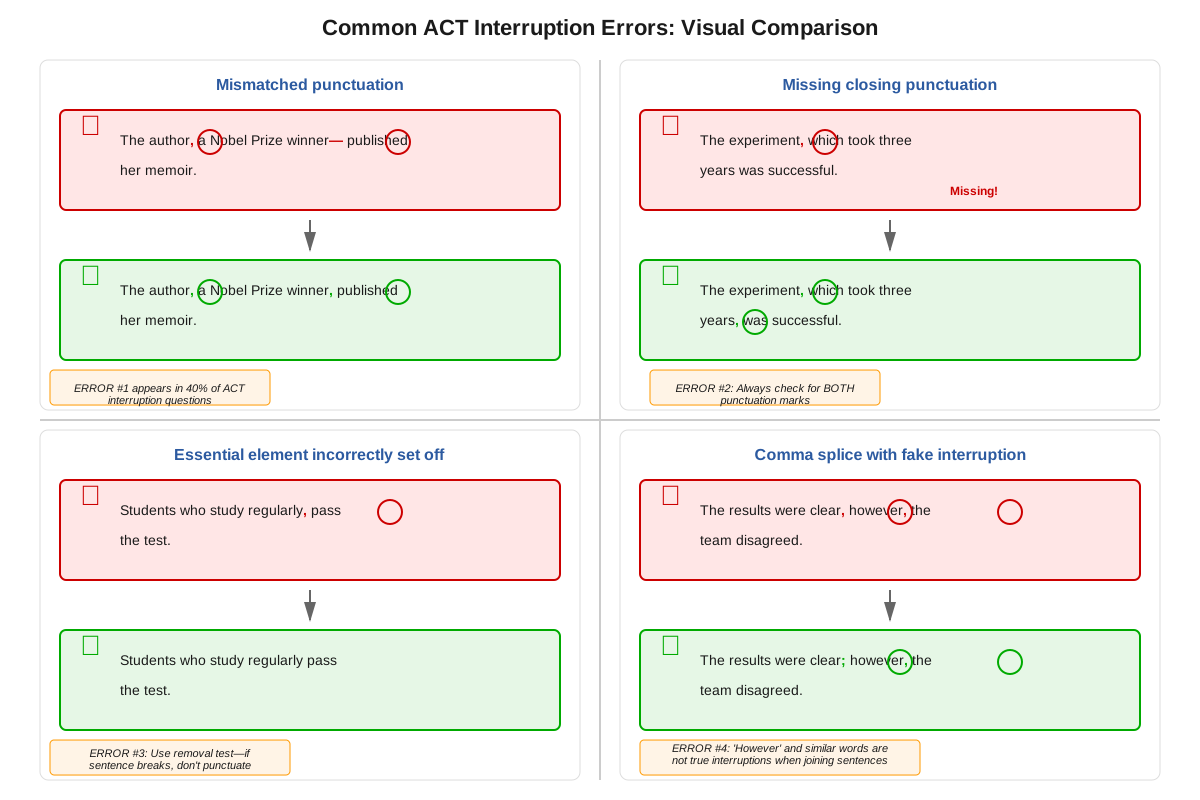
The key distinction is between essential and nonessential information. Essential information (restrictive clauses) cannot be removed without changing the sentence's meaning and should NOT be set off with punctuation. Nonessential information (nonrestrictive clauses) can be removed, and MUST be set off with matching punctuation.
Example of essential information: "Students who study regularly perform better on tests." (The clause "who study regularly" is essential because it specifies which students perform better—removing it changes the meaning.)
Example of nonessential information: "My sister, who studies regularly, performs better on tests." (The clause "who studies regularly" is nonessential because "my sister" already identifies the person—the clause just adds extra information.)
The Matching Punctuation Principle
The ACT frequently tests whether students recognize that interruptions require matching punctuation on both sides. This is perhaps the most commonly violated rule in student writing and therefore a high-yield testing point. When an interruption begins with a comma, it must end with a comma. When it begins with a dash, it must end with a dash.
Common ACT trap: Presenting answer choices where the opening punctuation differs from the closing punctuation, such as starting with a comma and ending with a dash. These are always incorrect.
Position and Placement of Interruptions
Interruptive elements can appear at various positions within a sentence:
- Mid-sentence interruptions: The most common type, appearing between the subject and verb, or between the verb and object
- End-of-sentence interruptions: Technically not interruptions but additional information set off at the end (requires only opening punctuation)
- Beginning-of-sentence interruptions: Introductory elements that are set off before the main clause begins
The ACT primarily tests mid-sentence interruptions because these require punctuation on both sides, creating more opportunities for error and testing.
Concept Relationships
Sentence interruption connects directly to several fundamental grammar concepts. The relationship flows as follows:
Sentence Structure → Independent Clauses → Sentence Interruption → Punctuation Rules
Understanding complete sentences (independent clauses) is prerequisite to recognizing interruptions because the removal test requires identifying whether the remaining sentence is complete. This connects to comma rules, as commas serve multiple functions in English, and distinguishing between commas that set off interruptions versus commas that separate items or join clauses is essential.
Sentence interruption also relates to restrictive versus nonrestrictive clauses. Nonrestrictive clauses are a specific type of interruption, and understanding this relationship helps students determine when punctuation is required. The concept further connects to appositive phrases, which are always nonessential and therefore always require punctuation to set them off.
The relationship extends to rhetorical skills on the ACT because the choice to include or exclude interruptive information affects sentence clarity, conciseness, and emphasis. Questions about whether to add or delete information often involve interruptive elements, requiring students to understand both the grammatical rules and the rhetorical effects.
Finally, sentence interruption connects to parallelism and modifier placement because interruptions can sometimes obscure whether elements are parallel or whether modifiers are correctly positioned. Recognizing and mentally removing interruptions helps clarify these relationships.
High-Yield Facts
⭐ Any interruptive element must be set off with matching punctuation on both sides—commas with commas, dashes with dashes, parentheses with parentheses.
⭐ The removal test is foolproof: remove the interruption, and the remaining sentence must be grammatically complete.
⭐ Nonessential relative clauses beginning with "which" are always interruptions and require punctuation; essential clauses beginning with "that" never require punctuation.
⭐ If you can remove a phrase or clause without changing the core meaning of the sentence, it's an interruption and needs punctuation.
⭐ The ACT will never accept mismatched punctuation (comma-dash, dash-parenthesis, etc.) around an interruption.
- Commas are the default choice for standard interruptions; dashes and parentheses serve specific stylistic purposes
- Appositives (noun phrases that rename another noun) are always nonessential and always require punctuation
- Transitional words like "however" and "therefore" in mid-sentence position are interruptions requiring punctuation
- The phrase "for example" when it appears mid-sentence is an interruption and needs commas or dashes on both sides
- Single dashes at the end of sentences are acceptable for emphasis, but mid-sentence interruptions require two dashes
- Parentheses are least common on the ACT but follow the same matching principle as commas and dashes
- Essential information that identifies which noun you're discussing should never be set off with punctuation
- The ACT often places interruptions between subjects and verbs to test whether students can identify the sentence's core structure
Quick check — test yourself on Sentence interruption so far.
Try Flashcards →Common Misconceptions
Misconception: Any phrase between commas is automatically correct. → Correction: The phrase must actually be nonessential information that can be removed without destroying the sentence's meaning or grammar. Some phrases between commas are incorrectly punctuated essential information, or the commas may be serving different functions (like separating items in a list).
Misconception: Dashes and commas are always interchangeable for interruptions. → Correction: While both can set off interruptions, they must be used consistently (both dashes or both commas), and they create different emphases. The ACT tests whether you use matching punctuation, not whether you choose the "best" option between commas and dashes.
Misconception: A single comma can set off an interruption if it's at the beginning or end of a sentence. → Correction: True interruptions in the middle of sentences require punctuation on both sides. If only one comma appears, either it's not an interruption, or the punctuation is incorrect.
Misconception: All relative clauses (clauses with "who," "which," "that") are interruptions. → Correction: Only nonessential relative clauses are interruptions. Essential clauses that identify which person or thing you're discussing are not interruptions and should not be set off with punctuation. The word "that" typically introduces essential clauses, while "which" typically introduces nonessential ones.
Misconception: Longer phrases are more likely to be interruptions than shorter ones. → Correction: Length doesn't determine whether something is an interruption. A single word like "however" can be an interruption, while a long phrase might be essential to the sentence's meaning. Apply the removal test regardless of length.
Misconception: If a sentence sounds right when you read it aloud, the punctuation is correct. → Correction: While reading aloud can help, it's unreliable for interruptions because natural speech patterns don't always align with grammatical punctuation rules. Use the removal test instead of relying on how something sounds.
Worked Examples
Example 1: Identifying and Correcting Interruption Punctuation
Question: Which of the following correctly punctuates the sentence?
The research team which had been working on the project for three years finally published their findings.
A. NO CHANGE
B. team, which had been working on the project for three years finally published
C. team, which had been working on the project for three years, finally published
D. team which had been working on the project for three years, finally published
Solution Process:
Step 1: Identify the potential interruption. The phrase "which had been working on the project for three years" appears to be additional information about the research team.
Step 2: Apply the removal test. Remove the phrase: "The research team finally published their findings." This is a complete, grammatically correct sentence, confirming that the phrase is indeed an interruption.
Step 3: Check for matching punctuation. Since the phrase is an interruption, it must have matching punctuation on both sides.
Step 4: Evaluate each answer choice:
- Choice A: No punctuation around the interruption—incorrect
- Choice B: Comma before the interruption but not after—incorrect (mismatched punctuation)
- Choice C: Commas on both sides of the interruption—correct
- Choice D: Comma only after the interruption—incorrect (mismatched punctuation)
Answer: C
Key Takeaway: This question directly tests the matching punctuation principle. The phrase beginning with "which" is a nonessential relative clause that provides additional information but isn't necessary to identify the research team. It must be set off with commas on both sides.
Example 2: Distinguishing Essential from Nonessential Information
Question: Which version is correctly punctuated?
Students who complete all homework assignments tend to perform better on exams.
A. NO CHANGE
B. Students, who complete all homework assignments, tend to perform better on exams.
C. Students, who complete all homework assignments tend to perform better on exams.
D. Students who complete all homework assignments, tend to perform better on exams.
Solution Process:
Step 1: Identify the clause. The phrase "who complete all homework assignments" describes students.
Step 2: Determine if the information is essential or nonessential. Ask: "Does this clause identify which students we're talking about, or does it just add extra information?" In this case, the clause specifies which students perform better—only those who complete homework, not all students. This makes it essential information.
Step 3: Apply the rule for essential information. Essential clauses should NOT be set off with punctuation because they're necessary to the sentence's meaning.
Step 4: Evaluate answer choices:
- Choice A: No punctuation around the essential clause—correct
- Choice B: Commas on both sides—incorrect (treats essential information as nonessential)
- Choice C: Comma before but not after—incorrect (mismatched and inappropriate)
- Choice D: Comma only after—incorrect (essential information shouldn't be set off)
Answer: A
Key Takeaway: Not every clause is an interruption. Essential information that identifies or restricts the meaning of a noun should never be set off with punctuation. The removal test helps: if removing the clause changes which students you're discussing (from "students who do homework" to "all students"), the clause is essential.
Exam Strategy
When approaching ACT sentence interruption questions, follow this systematic process:
Step 1: Identify potential interruptions. Look for phrases or clauses that appear between commas, dashes, or parentheses, or that could potentially be set off with punctuation. Common signals include relative pronouns (who, which, whom), transitional words (however, therefore, for example), and appositive phrases.
Step 2: Apply the removal test immediately. Mentally remove the suspected interruption and read the remaining sentence. If it's complete and makes sense, you've confirmed an interruption. If the sentence becomes incomplete or nonsensical, the phrase is essential and shouldn't be set off.
Step 3: Check for matching punctuation. Once you've confirmed an interruption, verify that the same punctuation mark appears on both sides. Eliminate any answer choices with mismatched punctuation immediately—these are always wrong.
Step 4: Verify the boundaries. Make sure the punctuation marks are placed at the exact beginning and end of the interruption, not in the middle of it or outside it. The ACT often includes trap answers where punctuation is placed one or two words off from where it should be.
Exam Tip: When answer choices differ only in punctuation placement around a phrase, you're almost certainly dealing with an interruption question. This is your trigger to apply the removal test.
Trigger words and phrases to watch for:
- "which" (usually introduces nonessential clauses)
- "however," "therefore," "moreover," "nevertheless" (mid-sentence transitions)
- "for example," "in fact," "of course" (parenthetical expressions)
- Phrases between the subject and verb of a sentence
- Appositives (noun phrases following another noun)
Process of elimination tips:
- Immediately eliminate any answer with mismatched punctuation (comma-dash, dash-parenthesis, etc.)
- Eliminate answers that use no punctuation around confirmed interruptions
- Eliminate answers that use only one punctuation mark around mid-sentence interruptions
- If "that" introduces the clause, it's likely essential—eliminate answers with punctuation around it
- If "which" introduces the clause, it's likely nonessential—eliminate answers without punctuation around it
Time allocation: Sentence interruption questions should take 15-20 seconds each once you've mastered the removal test. Don't overthink these—apply the systematic process and move on. If you're spending more than 30 seconds, make your best guess and flag the question for review if time permits.
Memory Techniques
The MATCH Acronym for interruption rules:
- Must be removable (removal test)
- Always use matching punctuation
- Test by removing the phrase
- Commas, dashes, or parentheses only
- Has to have punctuation on both sides
The "Sandwich Rule" Visualization: Think of an interruption as the filling in a sandwich. Just as a sandwich needs two pieces of bread (one on top, one on bottom), an interruption needs two punctuation marks (one before, one after). The bread slices must match—you wouldn't make a sandwich with a piece of white bread and a piece of rye. Similarly, your punctuation marks must match.
The "Which-That" Rhyme:
"Which needs a comma, that's a fact;
That needs no comma, and that's that!"
This helps remember that "which" clauses are typically nonessential (need commas), while "that" clauses are typically essential (no commas).
The Removal Test Mantra: Before answering any punctuation question, silently say: "Take it out—does it work?" This reminds you to apply the removal test consistently.
The Three Cs of Interruptions:
- Can be removed
- Consistent punctuation
- Complete sentence remains
Summary
Sentence interruption is a high-yield ACT English topic that tests whether students can identify nonessential information within sentences and punctuate it correctly. The fundamental principle is simple: interruptive elements must be set off with matching punctuation on both sides (commas with commas, dashes with dashes, or parentheses with parentheses), and removing the interruption must leave a grammatically complete sentence. The ACT tests this concept through direct punctuation questions, sentence structure questions, and rhetorical skills questions, making it essential for achieving a high English score. Students must distinguish between essential information (which should not be set off) and nonessential information (which must be set off), apply the removal test systematically, and recognize common interruptive elements like nonessential relative clauses, appositives, and transitional phrases. Mastering sentence interruption requires understanding both the grammatical rules and the strategic approach to quickly identify and correct these questions under time pressure.
Key Takeaways
- The removal test is the most reliable method: remove the interruption, and the remaining sentence must be complete and grammatically correct
- Matching punctuation is non-negotiable—commas with commas, dashes with dashes, parentheses with parentheses
- Nonessential information (can be removed without changing core meaning) requires punctuation; essential information (identifies which noun) does not
- "Which" typically introduces nonessential clauses requiring punctuation; "that" typically introduces essential clauses requiring no punctuation
- Mid-sentence interruptions always require punctuation on both sides—never just one side
- Apply the systematic four-step process: identify, remove, check matching, verify boundaries
- Sentence interruption questions appear 3-5 times per ACT English test, making this a high-priority topic for focused study
Related Topics
Comma Rules and Usage: Understanding all comma functions helps distinguish between commas that set off interruptions versus commas that separate items, join clauses, or follow introductory elements. Mastering sentence interruption provides a foundation for understanding comma usage more broadly.
Restrictive and Nonrestrictive Clauses: This topic explores the essential versus nonessential distinction in greater depth, examining how clauses modify nouns and when they require punctuation. Sentence interruption mastery makes this advanced topic more accessible.
Dash and Parenthesis Usage: While sentence interruption covers the basic rules for dashes and parentheses, a deeper study examines their rhetorical effects, when to choose one over another, and additional uses beyond setting off interruptions.
Appositive Phrases: Appositives are a specific type of interruption that renames or describes a noun. Understanding sentence interruption principles makes identifying and punctuating appositives straightforward.
Sentence Structure and Clarity: Advanced study of how interruptions affect sentence flow, readability, and emphasis connects grammatical correctness to rhetorical effectiveness—a key skill for the highest-level ACT questions.
Practice CTA
Now that you've mastered the core concepts of sentence interruption, it's time to put your knowledge into action! Complete the practice questions to reinforce these principles and build the speed and accuracy you need for test day. The flashcards will help you memorize the key rules and trigger words that signal interruption questions. Remember, sentence interruption appears on every ACT English test—your investment in mastering this topic will pay immediate dividends in your score. You've got this!
Sign up free to keep reading
Create a free AnvayaPrep account to finish this ACT guide on Sentence interruption — plus flashcards and practice questions.