Overview
Absolute value inequalities represent a critical algebraic concept that appears consistently on the ACT Math test. These inequalities combine two fundamental mathematical ideas: the concept of absolute value (distance from zero on a number line) and inequality relationships (greater than, less than, or their "or equal to" variants). Understanding how to solve and interpret absolute value inequalities is essential because they test multiple skills simultaneously—algebraic manipulation, number line reasoning, and logical thinking about solution sets.
On the ACT, ACT absolute value inequalities questions typically appear 1-3 times per test, making them a high-yield topic for focused study. These problems often serve as medium-difficulty questions that separate students scoring in the mid-20s from those achieving scores of 30 and above. The ACT tests this concept both directly (asking students to solve an inequality) and indirectly (requiring students to identify solution sets, interpret graphs, or work backwards from given solutions).
Mastering absolute value inequalities strengthens broader mathematical reasoning skills essential for success across the entire ACT Math section. This topic connects directly to linear inequalities, compound inequalities, graphing on number lines, and function analysis. Students who develop fluency with absolute value inequalities find themselves better equipped to handle questions involving distance, tolerance ranges, and piecewise functions—all of which appear regularly on the exam.
Learning Objectives
- [ ] Identify when absolute value inequalities is being tested in ACT questions
- [ ] Explain the core rule or strategy behind absolute value inequalities
- [ ] Apply absolute value inequalities to ACT-style questions accurately
- [ ] Convert absolute value inequalities into equivalent compound inequalities
- [ ] Determine whether an absolute value inequality requires "and" or "or" logic
- [ ] Graph solution sets of absolute value inequalities on number lines
- [ ] Verify solutions by testing values from the solution set
Prerequisites
- Basic absolute value understanding: Students must know that |x| represents the distance from zero, always yielding a non-negative result—this forms the foundation for understanding why absolute value inequalities split into two cases.
- Linear inequality solving: Proficiency with solving single-variable inequalities (including reversing inequality signs when multiplying/dividing by negatives) is essential since absolute value inequalities decompose into linear inequalities.
- Number line graphing: The ability to represent solutions on a number line helps visualize solution sets and distinguish between "and" versus "or" compound inequalities.
- Compound inequalities: Understanding how to work with statements connected by "and" or "or" is crucial because absolute value inequalities always translate into one of these forms.
Why This Topic Matters
Absolute value inequalities have significant real-world applications in fields requiring tolerance ranges and error margins. Engineers use them to specify acceptable manufacturing tolerances (a part must be 5 cm ± 0.2 cm), scientists employ them to express measurement uncertainty, and quality control specialists apply them to determine whether products meet specifications. In everyday contexts, absolute value inequalities describe situations like "the temperature must stay within 5 degrees of 68°F" or "your speed should be within 10 mph of the speed limit."
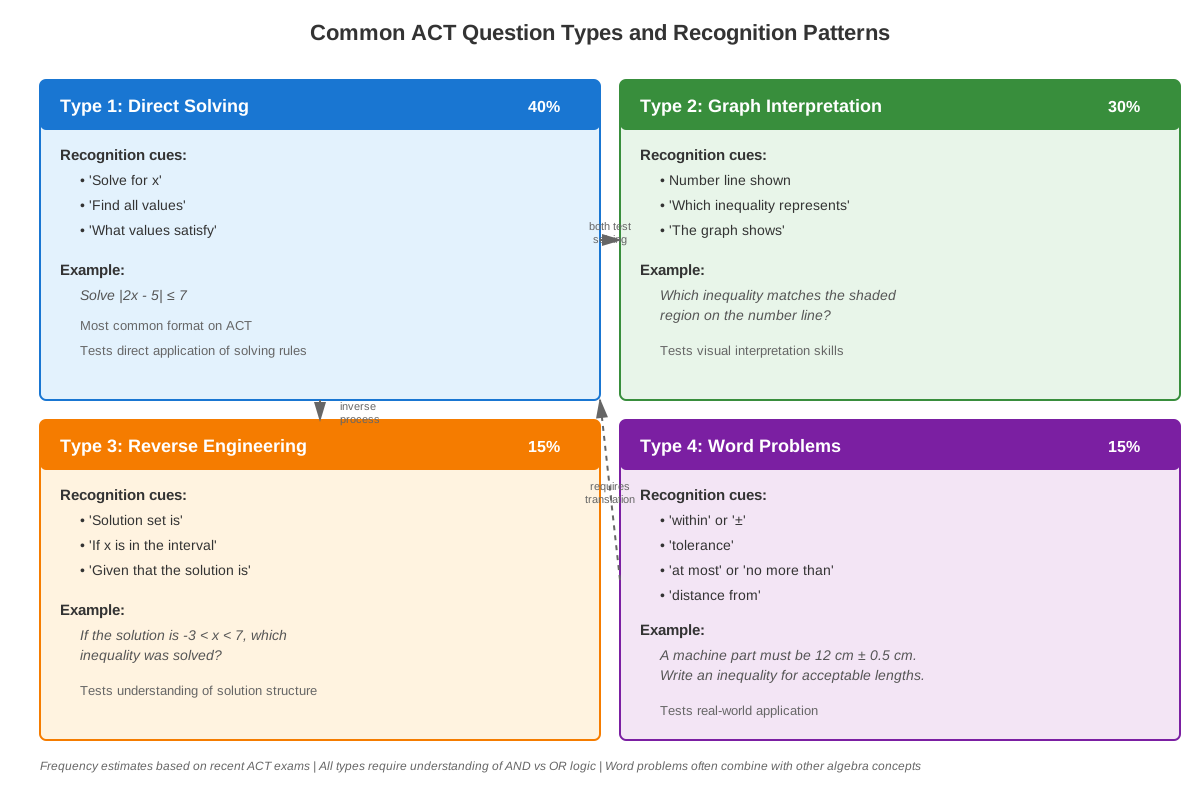
On the ACT Math test, absolute value inequalities appear with notable frequency—typically 1-3 questions per exam, representing approximately 2-5% of the 60 math questions. These questions most commonly appear in the Preparing for Higher Math category under the Algebra subcategory. The ACT tests this concept through multiple question formats: direct solving (find all x satisfying the inequality), solution set identification (which graph represents the solution), reverse engineering (given a solution set, determine the original inequality), and application problems (word problems requiring absolute value inequality setup).
The strategic importance of mastering this topic extends beyond the direct points it offers. Questions involving absolute value inequalities often appear in the middle-to-later portions of the test (questions 30-50), where they serve as discriminators between good and excellent scores. Students who can quickly recognize and solve these problems gain valuable time for more challenging questions, while those who struggle often spend excessive time or skip these high-value problems entirely.
Core Concepts
Understanding Absolute Value as Distance
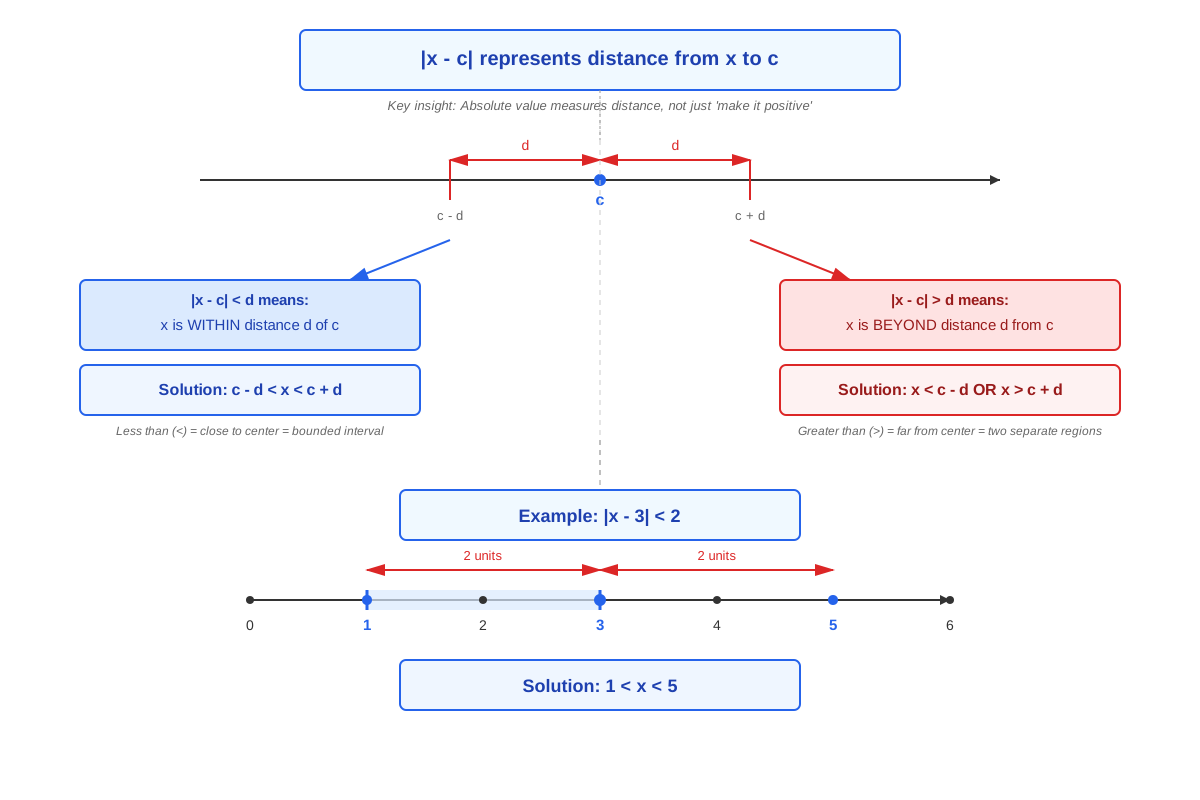
The absolute value of a number represents its distance from zero on the number line, regardless of direction. This distance interpretation is fundamental to solving absolute value inequalities. When we write |x| < 5, we're asking: "What values of x are less than 5 units away from zero?" This question has a clear geometric answer: all numbers between -5 and 5.
The distance interpretation extends to expressions like |x - 3|, which represents the distance between x and 3. Therefore, |x - 3| < 5 asks for all values within 5 units of 3, yielding solutions between -2 and 8.
The Two Types of Absolute Value Inequalities
Absolute value inequalities fall into two distinct categories, each requiring a different solution approach:
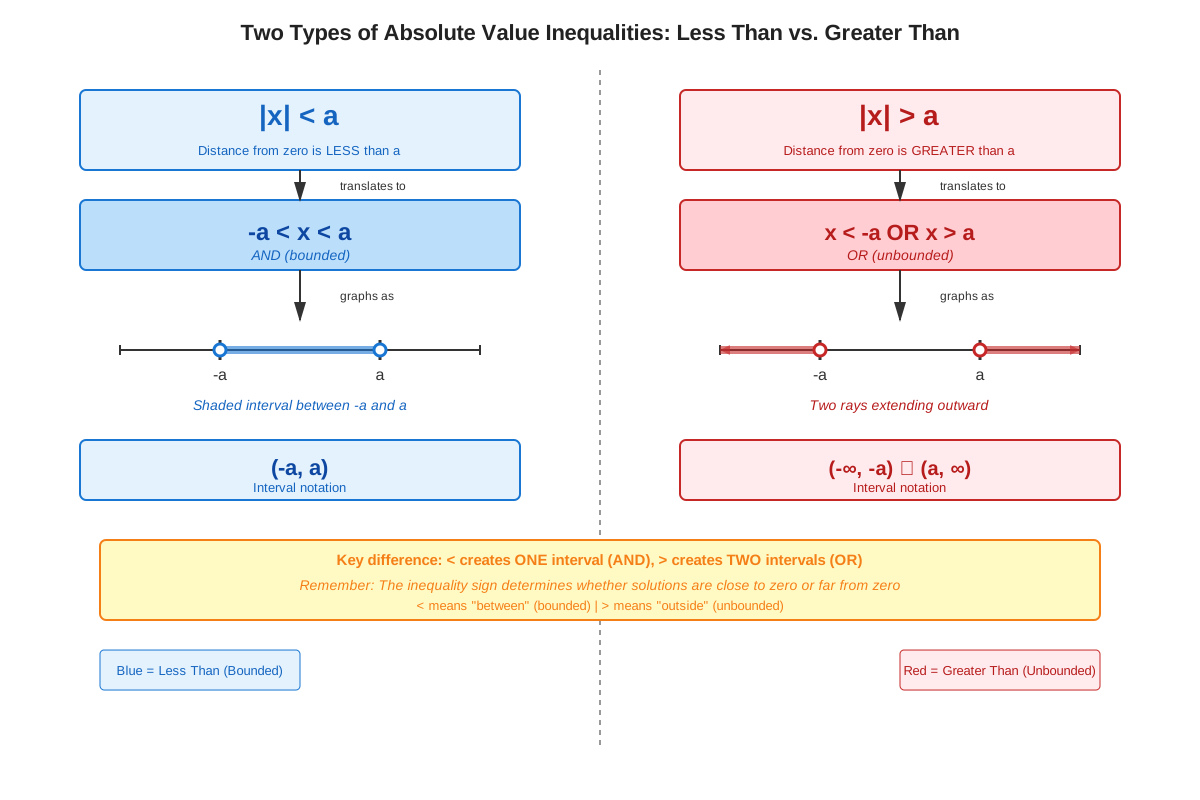
| Inequality Type | Form | Translates To | Logic Connector | Solution Set Shape | ||
|---|---|---|---|---|---|---|
| Less Than | \ | x\ | < a | -a < x < a | AND (intersection) | Single interval |
| Greater Than | \ | x\ | > a | x < -a OR x > a | OR (union) | Two separate intervals |
"Less than" inequalities (including ≤) describe values close to a reference point. The inequality |x| < 5 means x is within 5 units of zero, creating the compound inequality -5 < x < 5. This uses "and" logic because x must satisfy both conditions simultaneously.
"Greater than" inequalities (including ≥) describe values far from a reference point. The inequality |x| > 5 means x is more than 5 units from zero, creating the compound inequality x < -5 OR x > 5. This uses "or" logic because x only needs to satisfy one condition.
Step-by-Step Solution Process
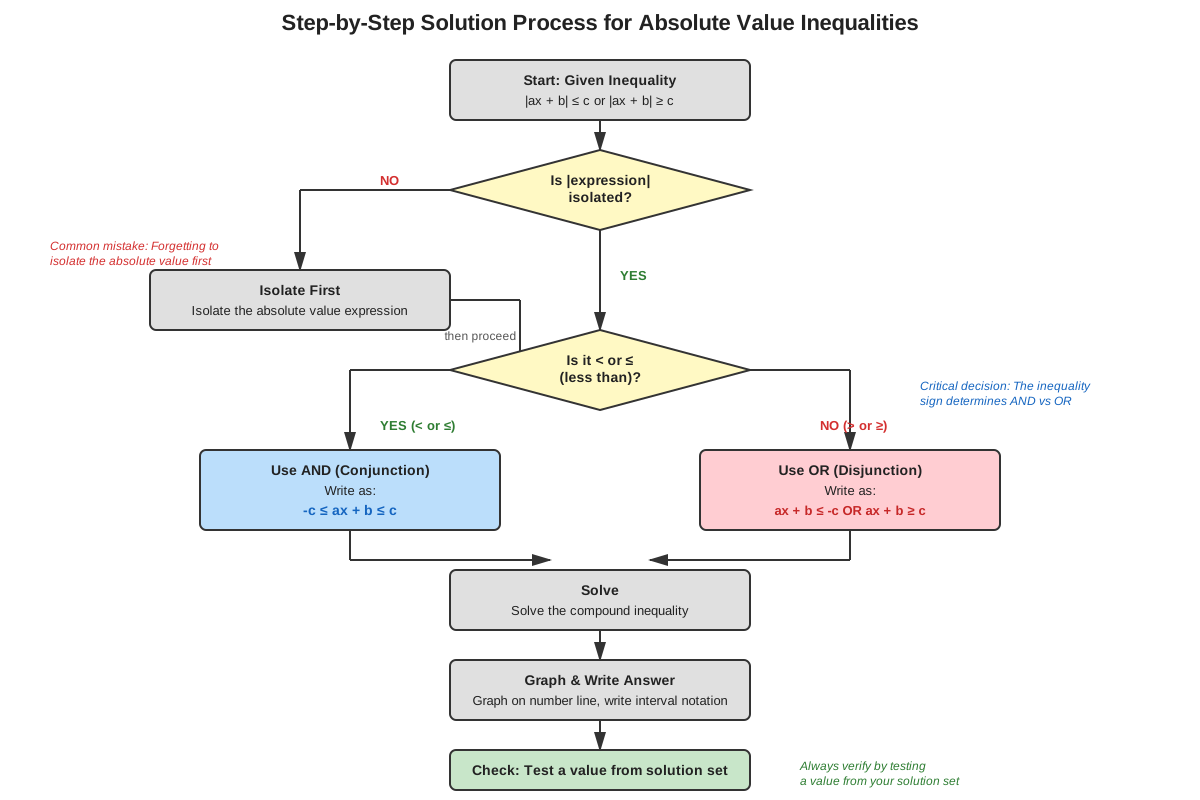
For |expression| < a (or ≤):
- Verify that a is positive (if a ≤ 0, special cases apply)
- Write the compound inequality: -a < expression < a
- Solve both inequalities simultaneously
- Express the solution as a single interval
For |expression| > a (or ≥):
- Verify that a is positive (if a ≤ 0, special cases apply)
- Write the compound inequality: expression < -a OR expression > a
- Solve each inequality separately
- Express the solution as two intervals (union)
Isolating the Absolute Value Expression
Before applying the standard rules, the absolute value expression must be isolated on one side of the inequality. This often requires algebraic manipulation:
- Add or subtract constants from both sides
- Multiply or divide both sides by positive constants
- Critical: If multiplying or dividing by a negative number, reverse the inequality sign
For example, to solve -2|x + 1| > -8:
- Divide both sides by -2 (reversing the inequality): |x + 1| < 4
- Now apply the standard "less than" rule: -4 < x + 1 < 4
- Solve: -5 < x < 3
Special Cases and Edge Conditions
When a = 0:
- |x| < 0 has no solution (absolute values are never negative)
- |x| ≤ 0 has solution x = 0 only
- |x| > 0 has solution: all real numbers except 0
- |x| ≥ 0 has solution: all real numbers
When a < 0:
- |x| < a (where a < 0) has no solution
- |x| > a (where a < 0) has solution: all real numbers
Graphing Solutions on Number Lines
Solution sets must be represented correctly on number lines:
- Open circles (○) indicate values NOT included (< or >)
- Closed circles (●) indicate values included (≤ or ≥)
- Shaded regions show all values in the solution set
- "And" solutions produce one continuous shaded region
- "Or" solutions produce two separate shaded regions
Working with Complex Expressions
When the absolute value contains a more complex expression like |2x - 3| or |4 - x|, the same rules apply, but algebraic manipulation becomes more involved. Always maintain the expression inside the absolute value as a unit until after converting to compound inequalities.
For |2x - 3| ≤ 7:
- Convert: -7 ≤ 2x - 3 ≤ 7
- Add 3 throughout: -4 ≤ 2x ≤ 10
- Divide by 2: -2 ≤ x ≤ 5
Concept Relationships
The concepts within absolute value inequalities build upon each other in a logical progression. Absolute value as distance serves as the foundational concept → which leads to → recognizing the two inequality types (less than vs. greater than) → which determines → the appropriate logical connector (and vs. or) → which guides → the solution process → resulting in → correct graphical representation.
Absolute value inequalities connect directly to prerequisite topics. Linear inequalities provide the algebraic manipulation skills needed once the absolute value is removed. Compound inequalities supply the logical framework for expressing solutions. Number line graphing offers the visual representation that helps verify solutions and answer graph-based questions.
This topic also bridges to more advanced concepts tested on the ACT. Understanding absolute value inequalities prepares students for piecewise functions (which often involve absolute value expressions), distance problems (which use absolute value to express "within x units"), and function transformations (where absolute value creates reflections and affects domain/range).
The relationship map: Basic Absolute Value → Absolute Value Equations → Absolute Value Inequalities → Compound Inequalities → Systems of Inequalities. Each level adds complexity while building on previous understanding.
High-Yield Facts
⭐ |x| < a translates to -a < x < a (single interval using "and" logic)
⭐ |x| > a translates to x < -a OR x > a (two intervals using "or" logic)
⭐ Always isolate the absolute value expression before converting to compound inequalities
⭐ When multiplying or dividing by a negative number, reverse the inequality sign
⭐ "Less than" inequalities produce one continuous interval; "greater than" inequalities produce two separate intervals
- The inequality |x - h| < k describes all values within k units of h
- If a ≤ 0, then |x| < a has no solution, but |x| > a includes all real numbers
- Open circles on number lines correspond to < or >, closed circles to ≤ or ≥
- The solution to |x| ≤ 0 is only x = 0 (the single point where absolute value equals zero)
- Absolute value inequalities can be verified by testing values from each region of the solution set
- The expression |ax + b| requires treating the entire expression as a unit until after conversion
- "And" solutions can be written as a single compound inequality; "or" solutions require separate statements
- The ACT often presents answer choices as graphs or interval notation rather than algebraic expressions
Quick check — test yourself on Absolute value inequalities so far.
Try Flashcards →Common Misconceptions
Misconception: All absolute value inequalities use "or" logic when splitting into two cases.
Correction: Only "greater than" inequalities (|x| > a) use "or" logic. "Less than" inequalities (|x| < a) use "and" logic, producing a single continuous interval. The inequality type determines the logical connector.
Misconception: The solution to |x| > 5 is -5 < x < 5.
Correction: This describes |x| < 5. The solution to |x| > 5 is x < -5 OR x > 5 (two separate regions). "Greater than" means farther from zero, not closer to zero.
Misconception: When solving |x + 3| < 7, you can simply remove the absolute value bars and solve x + 3 < 7.
Correction: Removing absolute value bars requires converting to a compound inequality first. The correct conversion is -7 < x + 3 < 7, which solves to -10 < x < 4. Ignoring the negative case loses half the solution.
Misconception: The inequality sign always stays the same when isolating the absolute value expression.
Correction: When multiplying or dividing both sides by a negative number, the inequality sign must be reversed. For example, -|x| > -3 becomes |x| < 3 after dividing by -1.
Misconception: |x| < -2 has solutions because you can just solve -2 < x < 2.
Correction: Absolute values are never negative, so |x| < -2 has no solution. The value a in |x| < a must be positive for solutions to exist. Always check whether the inequality is possible before solving.
Misconception: The solution to |2x - 4| > 6 is 2x - 4 < -6 AND 2x - 4 > 6.
Correction: "Greater than" inequalities use "or," not "and." The correct setup is 2x - 4 < -6 OR 2x - 4 > 6, which solves to x < -1 OR x > 5. Using "and" would incorrectly suggest x must satisfy both conditions simultaneously, which is impossible.
Worked Examples
Example 1: Less Than Inequality
Problem: Solve |3x + 2| ≤ 10 and graph the solution on a number line.
Solution:
Step 1: Identify the inequality type. This is a "less than or equal to" inequality, so it will produce a single interval using "and" logic.
Step 2: Convert to compound inequality. Since |3x + 2| ≤ 10, we write:
-10 ≤ 3x + 2 ≤ 10
Step 3: Solve the compound inequality by isolating x. Subtract 2 from all three parts:
-10 - 2 ≤ 3x ≤ 10 - 2
-12 ≤ 3x ≤ 8
Step 4: Divide all parts by 3:
-4 ≤ x ≤ 8/3
Step 5: Express the solution. The solution is all values from -4 to 8/3 (approximately 2.67), inclusive.
Step 6: Graph on a number line. Place closed circles at x = -4 and x = 8/3, then shade the entire region between them.
Verification: Test x = 0 (which should be in the solution set):
|3(0) + 2| = |2| = 2 ≤ 10 ✓
Test x = 5 (which should NOT be in the solution set):
|3(5) + 2| = |17| = 17 ≰ 10 ✓
This example demonstrates Learning Objective 2 (applying the core strategy) and Objective 4 (converting to compound inequalities).
Example 2: Greater Than Inequality with Isolation Required
Problem: Solve -2|x - 5| + 3 < -7 and express the solution in interval notation.
Solution:
Step 1: Isolate the absolute value expression. Subtract 3 from both sides:
-2|x - 5| < -10
Step 2: Divide both sides by -2. Critical: Reverse the inequality sign when dividing by a negative:
|x - 5| > 5
Step 3: Identify the inequality type. This is now a "greater than" inequality, so it will produce two separate intervals using "or" logic.
Step 4: Convert to compound inequality:
x - 5 < -5 OR x - 5 > 5
Step 5: Solve each inequality separately.
For x - 5 < -5:
x < 0
For x - 5 > 5:
x > 10
Step 6: Express the solution. The solution is x < 0 OR x > 10, which in interval notation is (-∞, 0) ∪ (10, ∞).
Step 7: Graph interpretation. On a number line, this would show two shaded regions: everything to the left of 0 (open circle) and everything to the right of 10 (open circle), with the region between 0 and 10 unshaded.
Verification: Test x = -3 (should be in solution set):
-2|-3 - 5| + 3 = -2(8) + 3 = -16 + 3 = -13 < -7 ✓
Test x = 5 (should NOT be in solution set):
-2|5 - 5| + 3 = -2(0) + 3 = 3 ≮ -7 ✓
This example demonstrates Learning Objectives 2, 3, and 5 (identifying the logical connector and applying the strategy to ACT-style questions).
Exam Strategy
When approaching absolute value inequality questions on the ACT, follow this systematic process:
Recognition Phase: Identify absolute value inequality questions by looking for the absolute value symbols (| |) combined with inequality signs (<, >, ≤, ≥). Watch for trigger phrases like "within," "at most," "at least," "no more than," or "no less than" in word problems—these often signal absolute value inequalities.
Classification Phase: Immediately determine whether the inequality is "less than" or "greater than" type. This single determination dictates your entire solution approach. Remember: "less than" = one interval (and), "greater than" = two intervals (or).
Isolation Phase: Before converting to compound inequalities, ensure the absolute value expression is completely isolated. Check whether you need to multiply or divide by negative numbers, which requires reversing the inequality sign. Many ACT questions deliberately include this step to test careful algebraic manipulation.
Conversion Phase: Apply the appropriate rule based on inequality type. Write out the compound inequality explicitly—don't try to solve it mentally, as this increases error risk.
Solution Phase: Solve the resulting compound inequality carefully. For "and" inequalities, perform operations on all parts simultaneously. For "or" inequalities, solve each part separately.
Answer Matching Phase: ACT questions often present answers as graphs, interval notation, or set notation rather than algebraic expressions. Be prepared to translate your solution into the required format. When answers are graphs, eliminate choices by checking boundary points and testing a value from each region.
Time-Saving Tip: If the question asks which graph represents the solution, you can often eliminate 2-3 answer choices immediately by determining whether the solution should be one interval or two intervals based on the inequality type.
Process of Elimination Strategies:
- Eliminate graphs showing the wrong number of intervals (one vs. two)
- Eliminate graphs with incorrect boundary points (open vs. closed circles)
- Eliminate solutions that include impossible values (like negative values when the context requires positive)
- Test the boundary values in the original inequality to verify whether they should be included
Time Allocation: Absolute value inequality questions should take 45-75 seconds on average. If you're exceeding 90 seconds, make your best educated guess and move on. These questions are worth the same single point as simpler questions, so time management is crucial.
Memory Techniques
The "LEGO" Mnemonic for inequality types:
- Less than = Everything in the middle (one interval)
- Greater than = Everything on the Outside (two intervals)
The "AND/OR" Rule:
- "Absolute value Near Destination" → Less than uses AND (values near the reference point)
- "Outside Range" → Greater than uses OR (values outside the reference point)
Visual Memory Aid: Picture absolute value as a "distance meter." When the meter reads "less than 5," you're in the zone (one continuous region). When it reads "greater than 5," you're outside the zone (two separate regions on either side).
The Sign Flip Reminder: Remember "Negative Division Reverses Direction" (NDRD). Whenever you divide or multiply by a negative number, the inequality arrow flips direction.
Boundary Point Memory: "Less than or Equal = Line Ends included" (closed circles). "Greater than or Less than = Gaps Left open" (open circles).
Summary
Absolute value inequalities combine the concept of distance from a reference point with inequality relationships, creating two distinct problem types that require different solution approaches. The fundamental distinction—whether the inequality is "less than" or "greater than"—determines everything about the solution process. "Less than" inequalities (|x| < a) translate to compound inequalities using "and" logic (-a < x < a), producing a single continuous interval of values close to the reference point. "Greater than" inequalities (|x| > a) translate to compound inequalities using "or" logic (x < -a OR x > a), producing two separate intervals representing values far from the reference point. Success on ACT questions requires isolating the absolute value expression first (remembering to reverse inequality signs when multiplying or dividing by negatives), correctly identifying the inequality type, applying the appropriate conversion rule, and solving the resulting compound inequality. The ability to translate solutions between algebraic, graphical, and interval notation forms is essential, as ACT questions frequently test this flexibility. Mastering these concepts provides a reliable framework for earning points on 1-3 questions per test while building algebraic reasoning skills applicable across the entire Math section.
Key Takeaways
- Absolute value inequalities split into two types: "less than" (producing one interval with "and" logic) and "greater than" (producing two intervals with "or" logic)
- Always isolate the absolute value expression before converting to compound inequalities, and reverse the inequality sign when multiplying or dividing by negative numbers
- |x| < a means -a < x < a (values within a units of zero); |x| > a means x < -a OR x > a (values more than a units from zero)
- Verify the sign of a before solving—if a ≤ 0, special cases apply (no solution for |x| < a, all real numbers for |x| > a)
- ACT questions often present answers as graphs or interval notation, requiring translation from algebraic solutions
- Test boundary points and values from each region to verify solutions and eliminate incorrect answer choices
- The inequality type (< vs. >) determines both the logical connector (and vs. or) and the shape of the solution set (one interval vs. two intervals)
Related Topics
Absolute Value Equations: Solving equations like |x - 3| = 7 provides the foundation for understanding absolute value inequalities. Mastering inequalities extends equation-solving skills to include ranges of solutions rather than discrete values.
Compound Inequalities: Understanding how to work with "and" and "or" compound inequalities without absolute value strengthens the skills needed for absolute value inequalities, where these logical connectors determine solution structure.
Graphing Inequalities on Number Lines: Visual representation skills developed through graphing support both solving and verifying absolute value inequalities, particularly when ACT questions present answer choices as graphs.
Piecewise Functions: Absolute value functions are special cases of piecewise functions, and understanding absolute value inequalities helps analyze where piecewise functions satisfy certain conditions.
Systems of Inequalities: The compound inequality skills developed through absolute value work prepare students for solving and graphing systems of linear inequalities, a more advanced topic that appears occasionally on the ACT.
Practice CTA
Now that you've mastered the core concepts of absolute value inequalities, it's time to cement your understanding through active practice. Work through the practice questions to apply these strategies to authentic ACT-style problems, and use the flashcards to reinforce the key rules and procedures until they become automatic. Remember: the difference between understanding a concept and scoring points on test day is practice. Each problem you solve strengthens your pattern recognition and builds the confidence you need to tackle these questions quickly and accurately under timed conditions. You've got this!
Sign up free to keep reading
Create a free AnvayaPrep account to finish this ACT guide on Absolute value inequalities — plus flashcards and practice questions.