Overview
Logarithm basics represent a critical mathematical concept that appears regularly on the ACT Math section, typically in 1-3 questions per exam. Logarithms are the inverse operations of exponentials, allowing students to solve equations where the variable appears in an exponent. Understanding logarithms is essential not only for direct logarithm questions but also for problems involving exponential growth, decay, and scientific notation. The ACT logarithm basics questions test fundamental properties, conversions between exponential and logarithmic forms, and the ability to evaluate simple logarithmic expressions.
On the ACT, logarithm questions typically appear in the Higher Math category, specifically within the Functions subcategory. These questions assess whether students can manipulate logarithmic expressions, apply logarithm properties, and recognize the relationship between logarithms and exponents. Most ACT logarithm problems focus on base-10 (common logarithms) and base-e (natural logarithms), though occasionally base-2 or other bases appear. The difficulty level ranges from straightforward conversions to multi-step problems requiring the application of multiple logarithm properties.
Logarithms connect directly to exponential functions, algebraic manipulation, and equation-solving strategies. They serve as a bridge between polynomial algebra and more advanced mathematical concepts, making them a high-yield topic for students aiming for scores above 28. Mastering logarithm basics enables students to tackle complex function problems, understand scientific applications, and develop stronger algebraic reasoning skills that benefit performance across multiple ACT Math domains.
Learning Objectives
- [ ] Identify when Logarithm basics is being tested
- [ ] Explain the core rule or strategy behind Logarithm basics
- [ ] Apply Logarithm basics to ACT-style questions accurately
- [ ] Convert between exponential and logarithmic forms fluently
- [ ] Evaluate logarithmic expressions without a calculator when possible
- [ ] Apply the three fundamental logarithm properties (product, quotient, and power rules) to simplify expressions
- [ ] Recognize common logarithm values and patterns that accelerate problem-solving
Prerequisites
- Exponent rules and properties: Logarithms are inverse operations of exponents, so understanding exponent manipulation (multiplication, division, power rules) is essential for working with logarithm properties
- Algebraic equation solving: Students must be comfortable isolating variables and performing multi-step algebraic manipulations to solve logarithmic equations
- Function notation and inverse functions: Recognizing that logarithms are functions and understanding the concept of inverse operations helps students grasp the relationship between exponential and logarithmic forms
- Basic calculator operations: While many logarithm problems test conceptual understanding, some require using the LOG or LN buttons on a calculator efficiently
Why This Topic Matters
Logarithms have extensive real-world applications in fields ranging from chemistry (pH calculations) to finance (compound interest), seismology (earthquake magnitude), and acoustics (decibel measurements). Scientists and engineers use logarithmic scales to represent data that spans many orders of magnitude, making logarithms indispensable for understanding exponential relationships in nature and technology.
On the ACT Math section, logarithm questions appear with moderate frequency—typically 1-3 questions per 60-question exam. These questions usually fall into several categories: converting between exponential and logarithmic forms, evaluating logarithmic expressions, applying logarithm properties to simplify expressions, and solving logarithmic equations. The questions often appear in positions 40-60 of the Math section, indicating their classification as medium to higher difficulty problems.
Understanding logarithms is particularly valuable because these questions often separate students scoring in the mid-20s from those achieving scores of 30 and above. Students who can quickly recognize logarithm patterns and apply properties efficiently gain a significant time advantage, allowing them to allocate more time to other challenging problems. Additionally, logarithm concepts frequently appear in combination with other topics such as exponential functions, function composition, and domain/range questions, making them a high-leverage area for score improvement.
Core Concepts
Definition and Fundamental Relationship
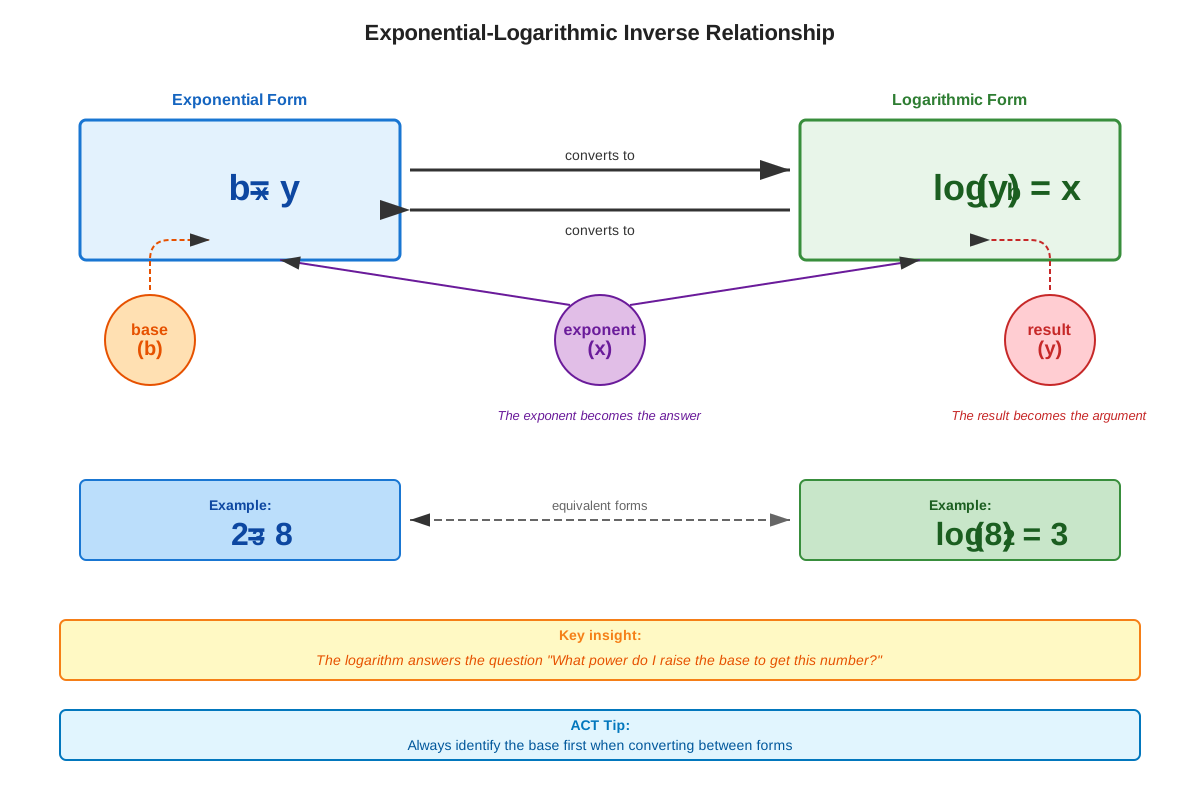
A logarithm answers the question: "To what power must we raise a base to obtain a specific number?" The logarithmic expression log_b(x) = y is equivalent to the exponential form b^y = x, where b is the base, x is the argument (the number we're taking the logarithm of), and y is the result (the exponent).
The fundamental relationship can be stated as:
log_b(x) = y ⟺ b^y = xThis equivalence is the cornerstone of all logarithm work on the ACT. Students must be able to convert fluently between these two forms. For example:
- log_2(8) = 3 because 2^3 = 8
- log_10(100) = 2 because 10^2 = 100
- log_5(1/25) = -2 because 5^(-2) = 1/25
Special Logarithm Types
The ACT primarily tests three types of logarithms:
| Logarithm Type | Notation | Base | Calculator Button |
|---|---|---|---|
| Common logarithm | log(x) or log_10(x) | 10 | LOG |
| Natural logarithm | ln(x) or log_e(x) | e ≈ 2.718 | LN |
| General logarithm | log_b(x) | Any positive number b ≠ 1 | Use change of base formula |
When no base is written (just "log"), it conventionally means base 10 on the ACT. The natural logarithm uses the mathematical constant e as its base and appears frequently in calculus-related contexts, though ACT questions typically keep natural logarithm problems at an algebraic level.
Essential Logarithm Properties
Three fundamental properties allow students to manipulate and simplify logarithmic expressions:
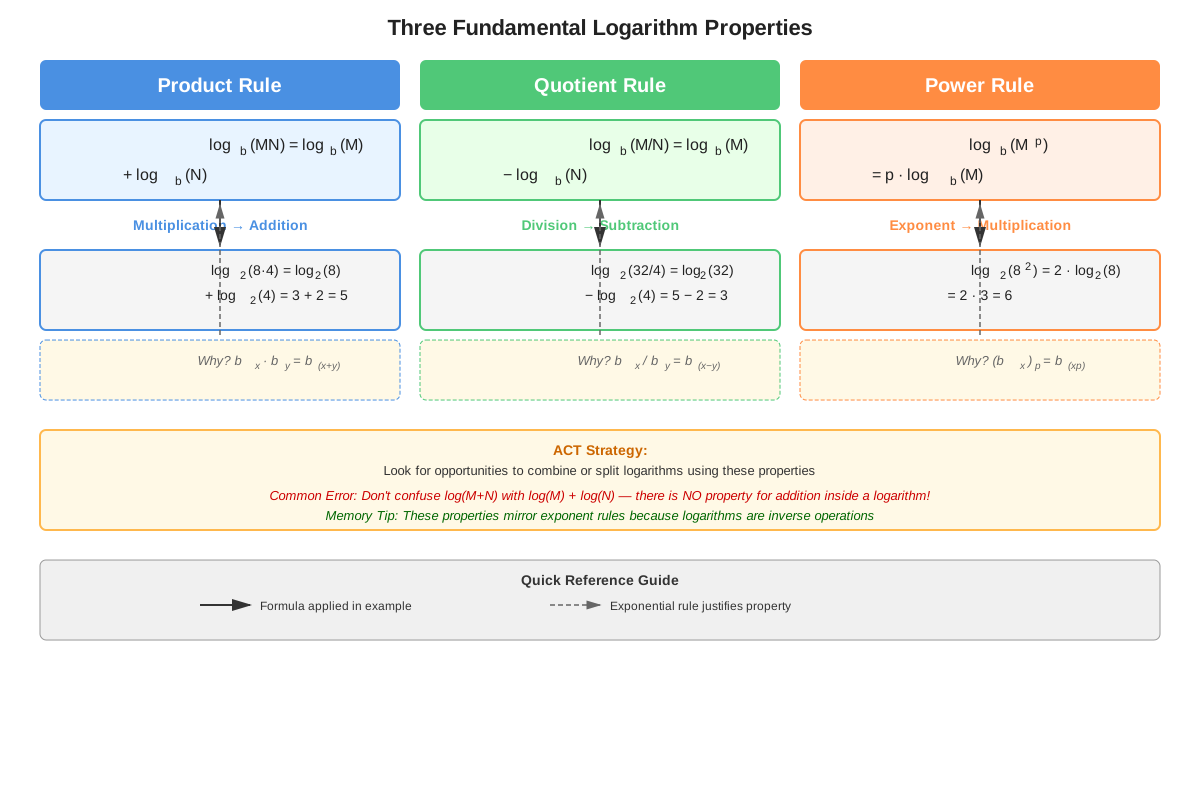
1. Product Rule: The logarithm of a product equals the sum of the logarithms
log_b(MN) = log_b(M) + log_b(N)2. Quotient Rule: The logarithm of a quotient equals the difference of the logarithms
log_b(M/N) = log_b(M) - log_b(N)3. Power Rule: The logarithm of a number raised to a power equals the power times the logarithm
log_b(M^p) = p · log_b(M)These properties derive directly from exponent rules and are tested extensively on the ACT. Students must recognize when to apply each property and, equally importantly, when to apply them in reverse to combine logarithmic expressions.
Special Logarithm Values
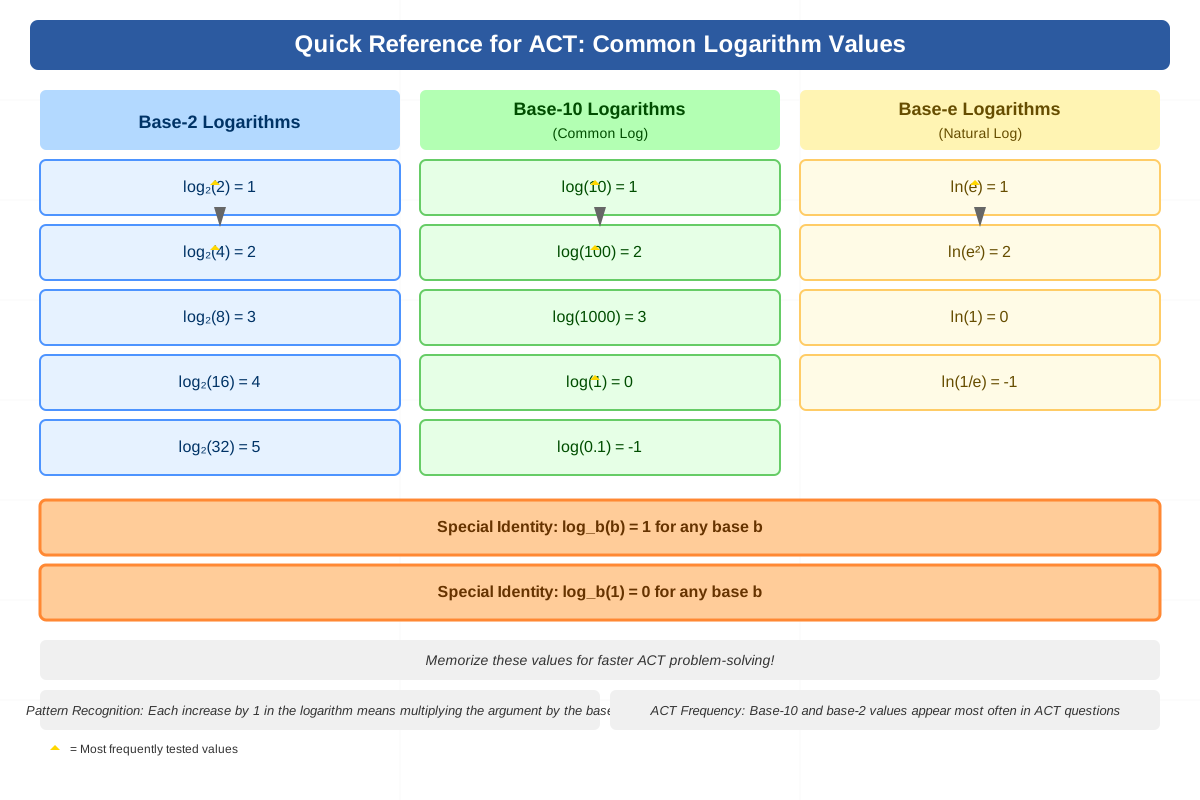
Certain logarithm values appear repeatedly on the ACT and should be memorized:
- log_b(1) = 0 for any base b (because b^0 = 1)
- log_b(b) = 1 for any base b (because b^1 = b)
- log_b(b^x) = x (the logarithm and exponential cancel)
- b^(log_b(x)) = x (applying the exponential undoes the logarithm)
These identity relationships are frequently tested, often in disguised forms within more complex expressions.
Change of Base Formula
When working with logarithms of bases not available on a calculator, the change of base formula converts any logarithm to a ratio of common or natural logarithms:
log_b(x) = log(x)/log(b) = ln(x)/ln(b)This formula is particularly useful for evaluating expressions like log_3(27) on a calculator or comparing logarithms with different bases.
Solving Logarithmic Equations
ACT questions often require solving equations containing logarithms. The general strategy involves:
- Isolate the logarithmic expression on one side of the equation
- Convert to exponential form using the fundamental relationship
- Solve the resulting equation using standard algebraic techniques
- Check solutions to ensure they don't create logarithms of negative numbers or zero (which are undefined)
The domain restriction is critical: logarithms are only defined for positive arguments. Any solution that produces log(0) or log(negative number) must be rejected as extraneous.
Concept Relationships
The concepts within logarithm basics form a hierarchical structure. The fundamental definition (the equivalence between logarithmic and exponential forms) serves as the foundation for all other concepts. From this definition flow the three logarithm properties (product, quotient, and power rules), which themselves derive from corresponding exponent rules. Understanding this connection reinforces both logarithm and exponent mastery.
The special logarithm values represent specific applications of the fundamental definition, while the change of base formula extends the practical applicability of logarithms beyond calculator-friendly bases. All these concepts converge when solving logarithmic equations, which requires integrating the definition, properties, and domain restrictions.
Relationship map:
- Exponent Rules → Fundamental Log Definition → Log Properties (Product, Quotient, Power)
- Fundamental Log Definition → Special Values (log_b(1), log_b(b), inverse relationships)
- Log Properties + Special Values → Simplifying Complex Expressions
- All Concepts → Solving Logarithmic Equations
- Change of Base Formula ← Fundamental Definition → enables calculator evaluation
Logarithms also connect to prerequisite topics: exponent rules provide the underlying logic for logarithm properties, algebraic manipulation skills enable equation-solving, and function concepts help students understand logarithms as inverse functions of exponentials. Moving forward, logarithm basics enable study of exponential growth/decay models, logarithmic scales, and more advanced function transformations.
High-Yield Facts
⭐ The fundamental relationship: log_b(x) = y is equivalent to b^y = x; this conversion is the most frequently tested concept
⭐ Product rule: log_b(MN) = log_b(M) + log_b(N); appears in approximately 40% of ACT logarithm questions
⭐ Power rule: log_b(M^p) = p · log_b(M); essential for simplifying expressions and solving equations
⭐ log_b(1) = 0 for any base b; this identity appears in multiple-choice distractors and correct answers
⭐ log_b(b) = 1 for any base b; frequently tested in combination with other properties
- Quotient rule: log_b(M/N) = log_b(M) - log_b(N); less common than product rule but still appears regularly
- Domain restriction: Logarithms are only defined for positive arguments; x must be greater than 0 in log_b(x)
- Change of base formula: log_b(x) = log(x)/log(b) enables calculator evaluation of any logarithm
- Inverse relationship: b^(log_b(x)) = x and log_b(b^x) = x; these cancellation properties simplify complex expressions
- Common logarithm: When no base is written, log(x) means log_10(x) on the ACT
- Natural logarithm: ln(x) means log_e(x) where e ≈ 2.718; appears in growth/decay contexts
- Negative logarithms: log_b(x) is negative when 0 < x < 1; this occurs when the argument is a fraction
Quick check — test yourself on Logarithm basics so far.
Try Flashcards →Common Misconceptions
Misconception: log_b(M + N) = log_b(M) + log_b(N) → Correction: There is no logarithm property for addition or subtraction of arguments. The product rule applies to multiplication, not addition: log_b(MN) = log_b(M) + log_b(N). The expression log_b(M + N) cannot be simplified further.
Misconception: log_b(M - N) = log_b(M) - log_b(N) → Correction: The quotient rule applies to division, not subtraction: log_b(M/N) = log_b(M) - log_b(N). The expression log_b(M - N) cannot be broken apart using logarithm properties.
Misconception: (log_b(M))^p = p · log_b(M) → Correction: The power rule applies when the argument is raised to a power, not when the entire logarithm is raised to a power: log_b(M^p) = p · log_b(M). The expression (log_b(M))^p means multiplying log_b(M) by itself p times and cannot be simplified using the power rule.
Misconception: log_b(x) is defined for all real numbers x → Correction: Logarithms are only defined for positive arguments. You cannot take the logarithm of zero or a negative number in the real number system. Always check that solutions to logarithmic equations result in positive arguments.
Misconception: log(x) and ln(x) are the same thing → Correction: log(x) refers to the common logarithm (base 10) while ln(x) refers to the natural logarithm (base e). They produce different values: log(100) = 2, but ln(100) ≈ 4.605. Use the appropriate calculator button for each.
Misconception: When solving log_b(x) = y, the answer is x = b/y → Correction: When converting from logarithmic to exponential form, the answer is x = b^y (b raised to the power y), not b divided by y. The logarithm asks "what power," and the answer involves exponentiation.
Worked Examples
Example 1: Converting Forms and Evaluating
Problem: If log_4(x) = 3, what is the value of x?
Solution:
Step 1: Recognize this as a logarithmic equation requiring conversion to exponential form.
Step 2: Apply the fundamental relationship: log_b(x) = y means b^y = x
In this case: log_4(x) = 3 means 4^3 = x
Step 3: Evaluate the exponential expression:
- 4^3 = 4 × 4 × 4 = 64
Step 4: Therefore, x = 64
Verification: Check by converting back: log_4(64) should equal 3. Since 4^3 = 64, this confirms log_4(64) = 3. ✓
Connection to learning objectives: This problem directly tests the ability to convert between exponential and logarithmic forms (Objective 4) and apply logarithm basics to ACT-style questions (Objective 3).
Example 2: Applying Multiple Properties
Problem: Simplify the expression: log_2(8) + log_2(4) - log_2(16)
Solution:
Step 1: Recognize that all logarithms share the same base (2), allowing us to apply logarithm properties.
Step 2: Option A - Apply properties first, then evaluate:
- Use the product rule: log_2(8) + log_2(4) = log_2(8 × 4) = log_2(32)
- Use the quotient rule: log_2(32) - log_2(16) = log_2(32/16) = log_2(2)
- Evaluate: log_2(2) = 1 (because 2^1 = 2)
Step 3: Option B - Evaluate each logarithm first, then combine:
- log_2(8) = 3 (because 2^3 = 8)
- log_2(4) = 2 (because 2^2 = 4)
- log_2(16) = 4 (because 2^4 = 16)
- Combine: 3 + 2 - 4 = 1
Step 4: Both methods yield the same answer: 1
ACT Strategy Note: On the actual exam, Option B (evaluating first) is often faster when the logarithms involve powers of the base. However, Option A (applying properties first) is essential when the arguments aren't simple powers or when variables are involved.
Connection to learning objectives: This problem demonstrates the core strategy of applying logarithm properties (Objective 2), specifically the product and quotient rules, and shows how to recognize common logarithm values (Objective 7).
Exam Strategy
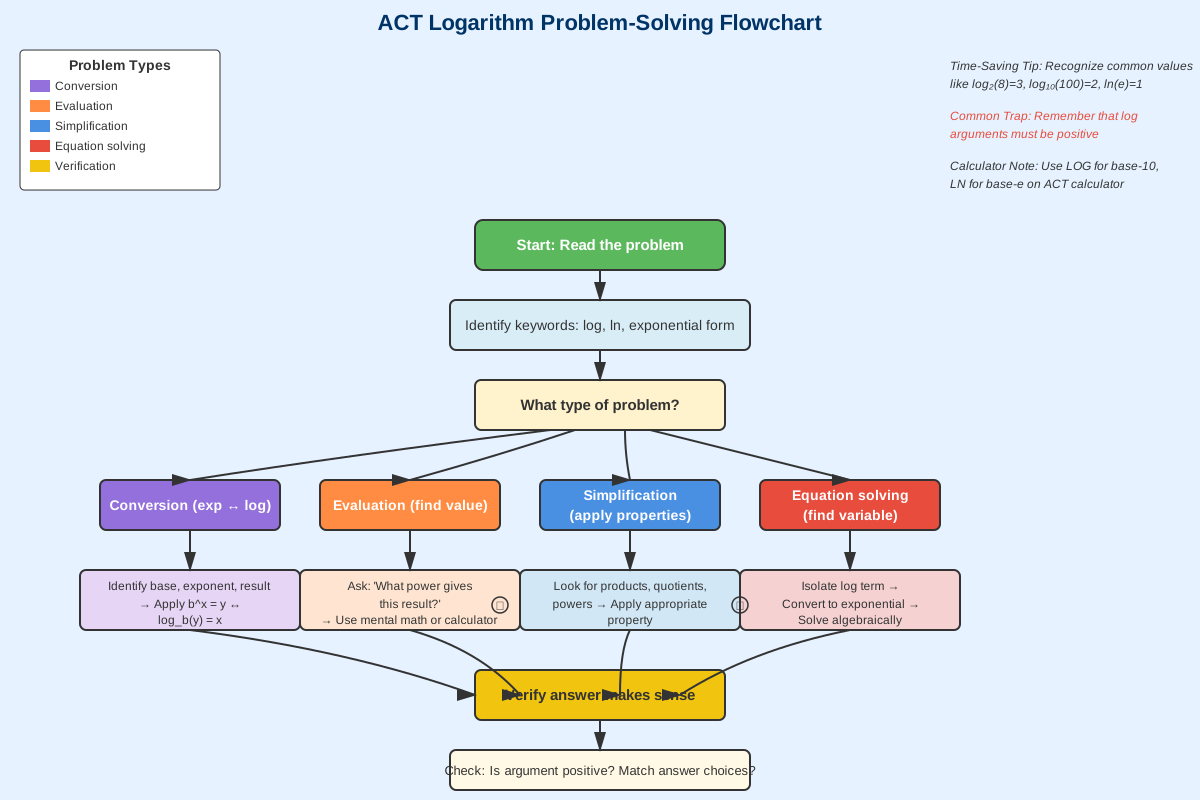
When approaching ACT logarithm questions, first identify the question type: Is it asking for conversion between forms, evaluation of an expression, simplification using properties, or solving an equation? This classification determines the appropriate strategy.
Trigger words and phrases that signal logarithm questions include:
- "log" or "ln" in the problem statement or answer choices
- "exponential form" or "logarithmic form"
- "simplify the expression" with logarithms present
- "solve for x" where x appears in an exponent or logarithm
- References to "base," "exponent," or "power" in logarithmic contexts
For conversion problems, immediately write down the fundamental relationship (log_b(x) = y ⟺ b^y = x) and identify which elements correspond to b, x, and y. This prevents confusion about which number goes where.
For simplification problems, scan for opportunities to apply the three main properties. Look for:
- Multiplication or division inside logarithms (product/quotient rules)
- Exponents on arguments (power rule)
- Logarithms with the same base that can be combined
- Special values like log_b(1) or log_b(b) that simplify to 0 or 1
Process of elimination tips:
- Eliminate any answer that violates domain restrictions (logarithms of negative numbers or zero)
- Eliminate answers that incorrectly apply properties (like treating log(M + N) as log(M) + log(N))
- When evaluating, eliminate answers that don't make sense given the magnitude (e.g., log_10(1000) must be 3, not 30 or 0.3)
- Check answer choices by substituting back into the original equation when time permits
Time allocation: Most ACT logarithm questions should take 45-90 seconds. If a problem requires more than 2 minutes, mark it and return later. Prioritize questions that involve straightforward conversion or evaluation over complex multi-step simplifications. Remember that logarithm questions typically appear in the latter half of the Math section, so manage time accordingly to ensure reaching these high-value problems.
Memory Techniques
MNEMONIC for the three main properties - "PQP":
- Product rule: log of a product = sum of logs
- Quotient rule: log of a quotient = difference of logs
- Power rule: log of a power = power times log
Visualization for the fundamental relationship: Picture a seesaw with "log_b(x) = y" on one side and "b^y = x" on the other. The base (b) stays in the same position (bottom left), while x and y swap roles. The base is always the "anchor" that doesn't move.
Acronym for special values - "BOB":
- Base to the zero = 1, so log_b(1) = 0
- One is the answer when log_b(b) = 1
- Base and exponent cancel: log_b(b^x) = x
Memory phrase for domain restrictions: "Logs Like Positive" - logarithms are only defined for positive arguments. This prevents the common error of accepting solutions that create undefined expressions.
Pattern recognition for common bases:
- Powers of 2: 2, 4, 8, 16, 32, 64, 128, 256...
- Powers of 3: 3, 9, 27, 81, 243...
- Powers of 10: 10, 100, 1000, 10000...
Memorizing these sequences helps quickly evaluate logarithms without a calculator.
Summary
Logarithm basics form an essential component of ACT Math preparation, testing students' understanding of the inverse relationship between logarithms and exponents. The fundamental concept—that log_b(x) = y is equivalent to b^y = x—serves as the foundation for all logarithm work. Students must master three core properties: the product rule (converting multiplication to addition), the quotient rule (converting division to subtraction), and the power rule (bringing exponents out front as coefficients). Special values like log_b(1) = 0 and log_b(b) = 1 appear frequently and should be memorized. The domain restriction that logarithms are only defined for positive arguments is critical when solving equations. ACT questions typically test conversion between forms, evaluation of expressions, application of properties for simplification, and solving logarithmic equations. Success requires fluent conversion between exponential and logarithmic forms, recognition of when to apply each property, and careful attention to domain restrictions that eliminate extraneous solutions.
Key Takeaways
- The fundamental relationship log_b(x) = y ⟺ b^y = x is the cornerstone of all logarithm problems; master conversion between these forms
- The three essential properties (product, quotient, and power rules) derive from exponent rules and enable simplification of complex logarithmic expressions
- Logarithms are only defined for positive arguments; always verify that solutions don't create log(0) or log(negative)
- Special values (log_b(1) = 0, log_b(b) = 1, log_b(b^x) = x) appear frequently and accelerate problem-solving when memorized
- Common logarithms (base 10) and natural logarithms (base e) are the most frequently tested on the ACT
- The change of base formula enables calculator evaluation of any logarithm by converting to base 10 or base e
- Logarithm questions typically appear in positions 40-60 of the ACT Math section and separate mid-20s scorers from 30+ scorers
Related Topics
Exponential Functions and Equations: Since logarithms are inverse functions of exponentials, mastering logarithm basics directly enables solving exponential equations where the variable appears in the exponent. This topic extends logarithm applications to growth and decay models.
Function Composition and Inverse Functions: Understanding how logarithmic and exponential functions compose to create identity functions (f(g(x)) = x) deepens comprehension of inverse relationships and prepares students for more advanced function questions.
Properties of Exponents: The three logarithm properties mirror exponent rules (product of powers, quotient of powers, power of a power). Strengthening exponent skills reinforces logarithm understanding and vice versa.
Graphing Logarithmic Functions: After mastering algebraic manipulation of logarithms, students can explore the graphical behavior of logarithmic functions, including domain, range, asymptotes, and transformations.
Systems of Equations with Logarithms: Advanced ACT questions occasionally combine logarithms with systems of equations, requiring integration of multiple algebraic skills.
Practice CTA
Now that you've mastered the core concepts of logarithm basics, it's time to solidify your understanding through active practice. Attempt the practice questions to test your ability to convert between forms, apply properties, and solve logarithmic equations under timed conditions. Use the flashcards to reinforce special values and properties until they become automatic. Remember, logarithm questions represent high-value opportunities on the ACT—students who can solve these problems quickly and accurately gain a significant competitive advantage. Your investment in mastering this topic will pay dividends not only in direct logarithm questions but also in exponential functions, scientific notation, and other related areas. You've got this!
Sign up free to keep reading
Create a free AnvayaPrep account to finish this ACT guide on Logarithm basics — plus flashcards and practice questions.