Overview
Quadratic equations represent one of the most frequently tested algebraic concepts on the ACT Math section, appearing in approximately 4-6 questions per exam. These equations, characterized by their highest power of two, form the foundation for understanding parabolic relationships and are essential for solving a wide variety of real-world problems involving area, projectile motion, and optimization. Mastery of quadratic equations is not merely about memorizing formulas—it requires understanding multiple solution methods, recognizing when each approach is most efficient, and applying strategic thinking under time pressure.
The ACT tests quadratic equations in diverse formats: students must solve equations set equal to zero, find roots or zeros of quadratic functions, determine the vertex of a parabola, factor expressions, apply the quadratic formula, and interpret the discriminant. Questions may appear as straightforward algebraic manipulations or embedded within word problems involving geometry, physics, or business contexts. The ability to quickly identify which solution method to employ—factoring, completing the square, or using the quadratic formula—often determines whether a student can solve these problems within the ACT's strict time constraints.
Understanding ACT quadratic equations connects directly to broader mathematical concepts including polynomial functions, graphing parabolas, systems of equations, and inequalities. This topic builds upon foundational algebra skills such as factoring, distributing, and combining like terms, while simultaneously preparing students for more advanced topics in precalculus and calculus. The strategic importance of this topic cannot be overstated: students who master quadratic equations gain confidence across multiple question types and significantly improve their overall Math section scores.
Learning Objectives
- [ ] Identify when Quadratic equations is being tested
- [ ] Explain the core rule or strategy behind Quadratic equations
- [ ] Apply Quadratic equations to ACT-style questions accurately
- [ ] Determine the most efficient solution method (factoring, quadratic formula, or completing the square) based on equation structure
- [ ] Interpret the discriminant to determine the nature and number of solutions without fully solving
- [ ] Convert between standard form, vertex form, and factored form of quadratic equations
- [ ] Solve word problems that require setting up and solving quadratic equations
Prerequisites
- Linear equations and inequalities: Quadratic equations extend linear concepts to second-degree polynomials, requiring similar algebraic manipulation skills
- Factoring techniques: Many quadratic equations are solved most efficiently through factoring, including greatest common factors, difference of squares, and trinomial factoring
- Order of operations and algebraic manipulation: Solving quadratic equations requires careful attention to mathematical operations and the ability to isolate variables
- Basic function notation: Understanding f(x) notation helps interpret quadratic functions and their solutions
- Square roots and exponents: The quadratic formula and completing the square both involve square root operations and understanding of squared terms
Why This Topic Matters
Quadratic equations model countless real-world phenomena where relationships are not linear. Engineers use them to calculate projectile trajectories, business analysts apply them to optimize profit functions, and architects employ them to design parabolic structures. The parabolic path of a basketball shot, the area of a rectangular garden with constrained perimeter, and the time it takes for an object to hit the ground all involve quadratic relationships. Understanding these equations provides essential problem-solving tools applicable far beyond the classroom.
On the ACT Math section, quadratic equations appear with remarkable consistency. Research indicates that 6-10% of all Math questions directly test quadratic concepts, making this one of the highest-yield topics for focused study. Questions appear across difficulty levels, from straightforward factoring problems worth quick points to complex word problems that challenge even high-scoring students. The ACT frequently tests quadratic equations through multiple question formats: solving for x when the equation equals zero, finding the vertex or axis of symmetry, determining the number of real solutions, and applying quadratics to geometric or physics contexts.
Common ACT question types include: identifying factors of quadratic expressions, solving equations using the quadratic formula, determining which values make an equation true, finding the maximum or minimum value of a quadratic function, and interpreting graphs of parabolas. The exam also tests whether students can recognize when a word problem requires setting up a quadratic equation, particularly in problems involving area, consecutive integers, or motion. Students who master this topic gain a significant strategic advantage, as these questions often appear in the middle-to-late sections where point values remain equal but difficulty increases.
Core Concepts
Standard Form of Quadratic Equations
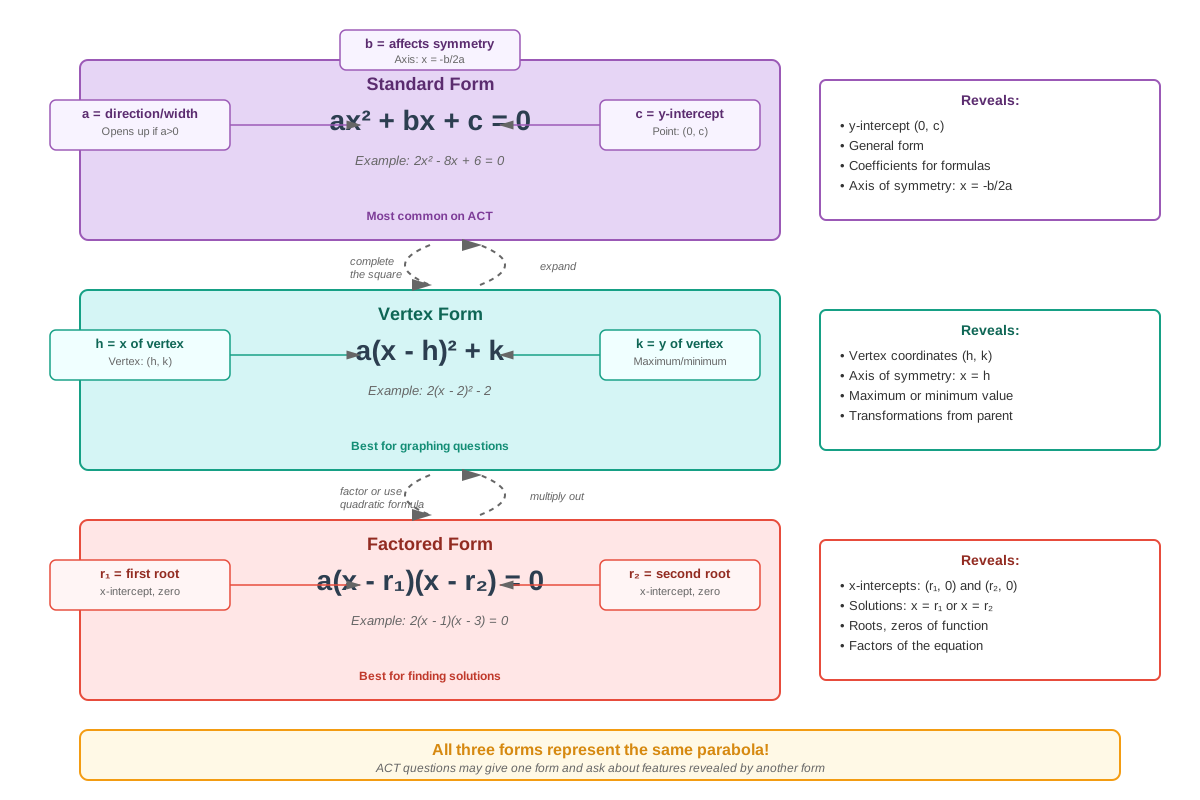
A quadratic equation is any equation that can be written in the form ax² + bx + c = 0, where a, b, and c are constants and a ≠ 0. This is called standard form. The coefficient a determines whether the parabola opens upward (a > 0) or downward (a < 0), while the coefficients b and c affect the position and shape of the graph. The restriction that a cannot equal zero is crucial—if a = 0, the equation becomes linear rather than quadratic.
Understanding standard form allows students to quickly identify the type of equation they're working with and select an appropriate solution strategy. For example, the equation 2x² - 5x + 3 = 0 has a = 2, b = -5, and c = 3. Recognizing these coefficients immediately enables students to apply the quadratic formula, attempt factoring, or analyze the discriminant.
The Zero Product Property
The zero product property states that if the product of two factors equals zero, then at least one of the factors must equal zero. This fundamental principle underlies the factoring method for solving quadratic equations. When a quadratic equation can be written as (x - p)(x - q) = 0, the solutions are x = p and x = q.
For example, if (x - 3)(x + 2) = 0, then either x - 3 = 0 or x + 2 = 0, yielding solutions x = 3 or x = -2. This property only works when one side of the equation equals zero, which is why the first step in solving quadratic equations is often to set the equation equal to zero by moving all terms to one side.
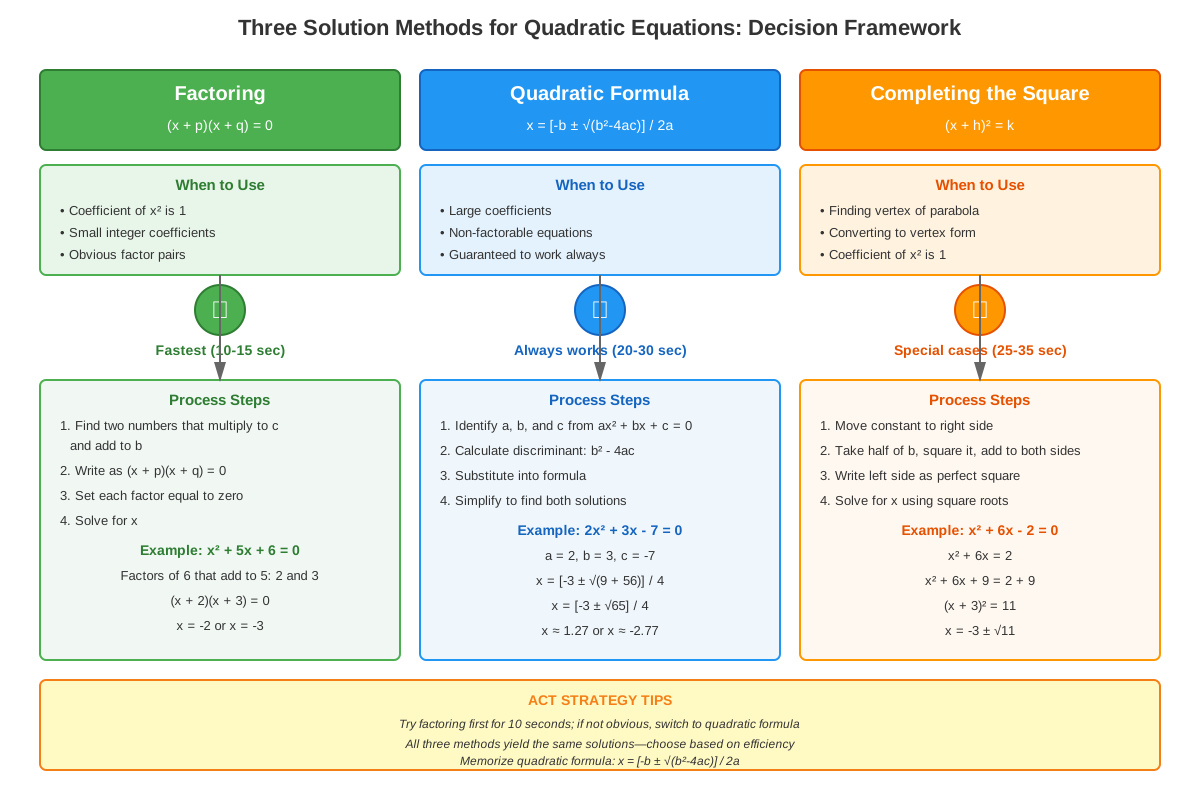
Factoring Method
Factoring represents the fastest solution method when applicable. To solve by factoring:
- Write the equation in standard form (ax² + bx + c = 0)
- Factor the quadratic expression into two binomials
- Apply the zero product property
- Solve each resulting linear equation
Common factoring patterns include:
| Pattern | Example | Factored Form |
|---|---|---|
| Simple trinomial | x² + 5x + 6 = 0 | (x + 2)(x + 3) = 0 |
| Difference of squares | x² - 9 = 0 | (x + 3)(x - 3) = 0 |
| Perfect square trinomial | x² + 6x + 9 = 0 | (x + 3)² = 0 |
| Leading coefficient ≠ 1 | 2x² + 7x + 3 = 0 | (2x + 1)(x + 3) = 0 |
The ACT frequently tests whether students can recognize factorable quadratics quickly. When the coefficients are small integers and the discriminant is a perfect square, factoring is typically the most efficient approach.
The Quadratic Formula
The quadratic formula provides a universal solution method that works for any quadratic equation. For ax² + bx + c = 0:
x = (-b ± √(b² - 4ac)) / (2a)This formula always produces the correct solutions, making it invaluable when factoring is difficult or impossible. The ± symbol indicates two solutions: one using addition and one using subtraction. To apply the quadratic formula:
- Identify coefficients a, b, and c from standard form
- Substitute these values into the formula
- Simplify under the square root (the discriminant)
- Complete the arithmetic to find both solutions
For example, solving 2x² + 3x - 5 = 0:
- a = 2, b = 3, c = -5
- x = (-3 ± √(9 - 4(2)(-5))) / (2(2))
- x = (-3 ± √(9 + 40)) / 4
- x = (-3 ± √49) / 4
- x = (-3 ± 7) / 4
- x = 4/4 = 1 or x = -10/4 = -2.5
The Discriminant
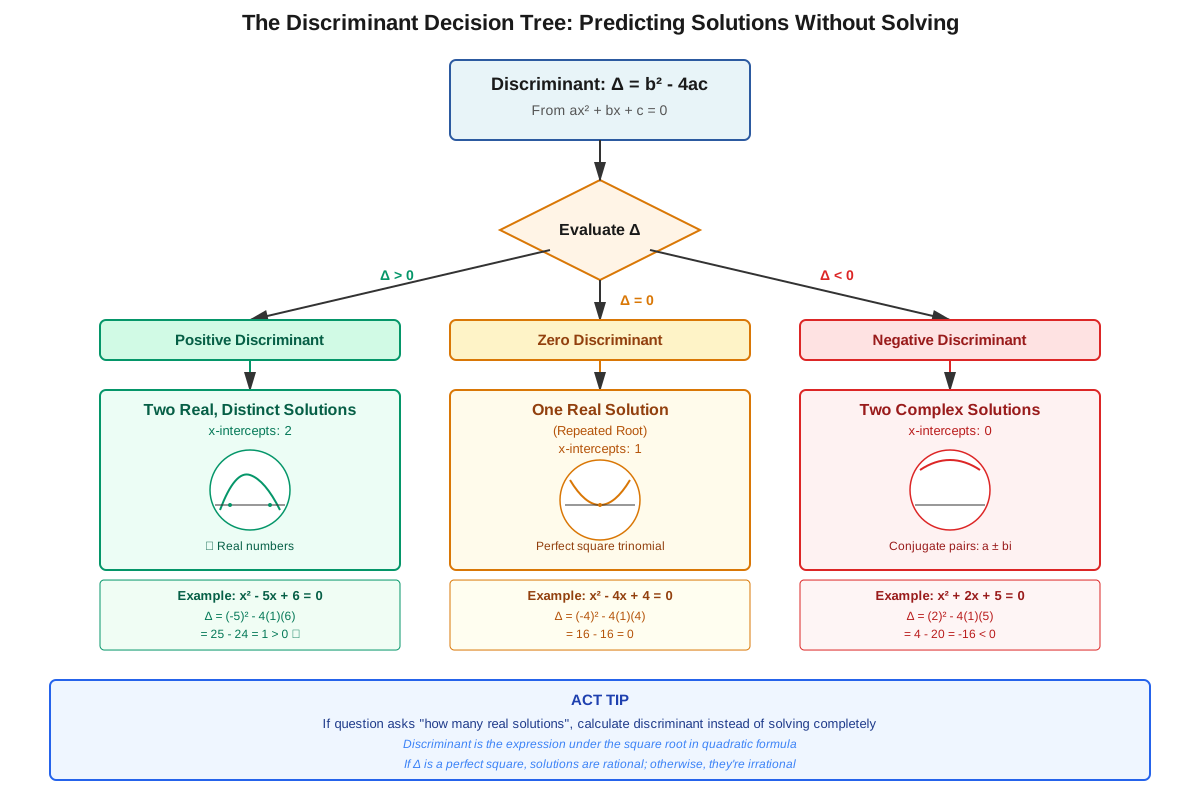
The discriminant is the expression b² - 4ac found under the square root in the quadratic formula. This value determines the nature and number of solutions without requiring complete calculation:
- b² - 4ac > 0: Two distinct real solutions (the parabola crosses the x-axis twice)
- b² - 4ac = 0: One repeated real solution (the parabola touches the x-axis at exactly one point—the vertex)
- b² - 4ac < 0: No real solutions (the parabola does not intersect the x-axis)
The ACT often asks students to determine how many real solutions an equation has, making discriminant analysis a valuable time-saving strategy. Rather than solving completely, students can calculate b² - 4ac and immediately determine the answer.
Completing the Square
Completing the square transforms a quadratic equation into vertex form, revealing the maximum or minimum value. While less commonly used for solving on the ACT, this method is essential for understanding parabola transformations. The process involves:
- Move the constant term to the right side
- If a ≠ 1, divide all terms by a
- Take half of the coefficient of x, square it, and add to both sides
- Factor the left side as a perfect square
- Solve by taking the square root of both sides
For x² + 6x + 2 = 0:
- x² + 6x = -2
- x² + 6x + 9 = -2 + 9
- (x + 3)² = 7
- x + 3 = ±√7
- x = -3 ± √7
Vertex Form and Graphical Interpretation
Quadratic equations can be expressed in vertex form: y = a(x - h)² + k, where (h, k) represents the vertex of the parabola. This form immediately reveals the maximum or minimum value of the function—a common ACT question type. The vertex represents the highest point when a < 0 or the lowest point when a > 0.
Converting from standard form to vertex form requires completing the square. The axis of symmetry, another frequently tested concept, is the vertical line x = h that passes through the vertex. For equations in standard form, the axis of symmetry can be found using x = -b/(2a).
Solutions, Roots, Zeros, and X-Intercepts
The ACT uses multiple terms interchangeably when referring to quadratic solutions:
- Solutions: Values of x that satisfy the equation
- Roots: Same as solutions
- Zeros: Values where the function equals zero
- X-intercepts: Points where the graph crosses the x-axis
All these terms refer to the same values. Recognizing this equivalence prevents confusion when questions use different terminology. If asked for "the zeros of f(x) = x² - 5x + 6," students should solve x² - 5x + 6 = 0 to find x = 2 and x = 3.
Concept Relationships
The concepts within quadratic equations form an interconnected system where each element reinforces the others. Standard form serves as the foundation, providing the structure from which all other concepts derive. The coefficients a, b, and c directly determine the discriminant (b² - 4ac), which in turn predicts the number and nature of solutions before any solving occurs.
The zero product property enables the factoring method, which represents the most efficient solution approach when the quadratic expression can be decomposed into binomial factors. When factoring proves difficult, the quadratic formula provides a universal alternative that always works, incorporating the discriminant within its structure. Completing the square bridges algebraic and graphical understanding by transforming equations into vertex form, revealing the parabola's maximum or minimum value.
Graphically, the solutions/roots/zeros/x-intercepts represent where the parabola crosses the x-axis, while the vertex indicates the turning point. The axis of symmetry divides the parabola into mirror images, passing through the vertex at x = -b/(2a). These graphical features connect directly to algebraic properties: the discriminant determines whether the parabola intersects the x-axis (positive discriminant), touches it at one point (zero discriminant), or misses it entirely (negative discriminant).
Relationship map: Standard Form (ax² + bx + c = 0) → Discriminant (b² - 4ac) → Number of Solutions → Quadratic Formula → Exact Solutions → Graphical Interpretation (x-intercepts) → Vertex Form → Maximum/Minimum Values → Real-World Applications
This topic builds upon prerequisite knowledge of factoring techniques and linear equations, extending these concepts to second-degree polynomials. Mastery of quadratic equations enables progression to polynomial functions, rational expressions, conic sections, and systems of nonlinear equations—all topics that appear on advanced standardized tests and in higher mathematics courses.
Quick check — test yourself on Quadratic equations so far.
Try Flashcards →High-Yield Facts
⭐ The quadratic formula x = (-b ± √(b² - 4ac)) / (2a) works for every quadratic equation in standard form ax² + bx + c = 0
⭐ The discriminant b² - 4ac determines the number of real solutions: positive = 2, zero = 1, negative = 0
⭐ Factoring is the fastest method when the quadratic has integer coefficients and factors easily
⭐ The axis of symmetry for any quadratic in standard form is x = -b/(2a)
⭐ The vertex form y = a(x - h)² + k immediately reveals the vertex at point (h, k)
- The zero product property only applies when one side of the equation equals zero
- Solutions, roots, zeros, and x-intercepts all refer to the same values
- When a > 0, the parabola opens upward and has a minimum value; when a < 0, it opens downward and has a maximum value
- A perfect square trinomial has a discriminant of zero and one repeated solution
- The sum of the roots equals -b/a and the product of the roots equals c/a (Vieta's formulas)
- Completing the square requires adding (b/2)² to both sides of the equation
- If a quadratic equation has no constant term (c = 0), x = 0 is always one solution
- The difference of squares pattern a² - b² = (a + b)(a - b) appears frequently on the ACT
- Word problems involving area often lead to quadratic equations
- The y-intercept of a quadratic function in standard form is always the point (0, c)
Common Misconceptions
Misconception: The quadratic formula only works for certain types of quadratic equations.
Correction: The quadratic formula works for every quadratic equation without exception. While factoring may be faster for some equations, the quadratic formula is a universal method that always produces correct solutions when applied properly.
Misconception: If the discriminant is negative, the equation has no solutions.
Correction: A negative discriminant means the equation has no real solutions, but it does have two complex solutions. On the ACT, which focuses on real numbers, "no real solutions" is the correct interpretation, but understanding that complex solutions exist demonstrates deeper mathematical knowledge.
Misconception: The ± symbol in the quadratic formula means "plus or minus either one," so students can choose which to use.
Correction: The ± symbol indicates that two separate calculations must be performed—one with addition and one with subtraction—yielding two distinct solutions. Both calculations are necessary to find all solutions.
Misconception: When factoring (x - 3)(x + 2) = 0, the solutions are x = -3 and x = 2.
Correction: The solutions are x = 3 and x = -2. Students must set each factor equal to zero and solve: x - 3 = 0 gives x = 3, and x + 2 = 0 gives x = -2. The signs flip when solving these simple equations.
Misconception: The vertex of a parabola is always the minimum value.
Correction: The vertex represents the minimum value only when the parabola opens upward (a > 0). When the parabola opens downward (a < 0), the vertex represents the maximum value. The vertex is always the turning point, but whether it's a maximum or minimum depends on the direction the parabola opens.
Misconception: Completing the square and the quadratic formula are completely different methods.
Correction: The quadratic formula is actually derived by completing the square on the general form ax² + bx + c = 0. Understanding this connection helps students see that these methods are related rather than separate techniques.
Misconception: If a quadratic equation doesn't have an x term (b = 0), it cannot be solved.
Correction: Equations like x² - 9 = 0 are often the easiest to solve. Simply isolate x² and take the square root of both sides, remembering to include both positive and negative roots: x² = 9, so x = ±3.
Worked Examples
Example 1: Multi-Method Problem
Problem: Solve the equation x² - 7x + 12 = 0 using two different methods and verify the solutions graphically.
Solution:
Method 1: Factoring
First, identify that this equation is in standard form with a = 1, b = -7, and c = 12. Since the leading coefficient is 1, look for two numbers that multiply to 12 and add to -7.
The numbers -3 and -4 satisfy these conditions: (-3)(-4) = 12 and (-3) + (-4) = -7.
Factor: x² - 7x + 12 = (x - 3)(x - 4) = 0
Apply the zero product property:
- x - 3 = 0, so x = 3
- x - 4 = 0, so x = 4
Method 2: Quadratic Formula
Using the same equation with a = 1, b = -7, c = 12:
x = (-b ± √(b² - 4ac)) / (2a)
x = (-(-7) ± √((-7)² - 4(1)(12))) / (2(1))
x = (7 ± √(49 - 48)) / 2
x = (7 ± √1) / 2
x = (7 ± 1) / 2
x = 8/2 = 4 or x = 6/2 = 3
Graphical Verification:
The solutions x = 3 and x = 4 represent the x-intercepts of the parabola y = x² - 7x + 12. Since a = 1 > 0, the parabola opens upward. The axis of symmetry is x = -b/(2a) = -(-7)/(2·1) = 3.5, which is exactly halfway between the two roots, confirming our solutions are correct.
Connection to Learning Objectives: This example demonstrates identifying when quadratic equations are being tested (standard form equation set to zero), explaining core strategies (factoring vs. quadratic formula), and applying these methods accurately to reach the same correct solutions.
Example 2: Word Problem Application
Problem: A rectangular garden has a length that is 4 feet longer than its width. If the area of the garden is 96 square feet, what are the dimensions of the garden?
Solution:
Step 1: Set up the equation
Let w = width of the garden in feet
Then w + 4 = length of the garden in feet
Area = length × width
96 = w(w + 4)
96 = w² + 4w
Rearrange to standard form:
w² + 4w - 96 = 0
Step 2: Check if factoring is feasible
Calculate the discriminant: b² - 4ac = (4)² - 4(1)(-96) = 16 + 384 = 400
Since 400 = 20², the discriminant is a perfect square, indicating the equation factors nicely.
Step 3: Factor
Need two numbers that multiply to -96 and add to 4. These numbers are 12 and -8.
w² + 4w - 96 = (w + 12)(w - 8) = 0
Step 4: Solve
w + 12 = 0 → w = -12
w - 8 = 0 → w = 8
Step 5: Interpret in context
Since width cannot be negative, w = 8 feet.
Therefore, length = w + 4 = 8 + 4 = 12 feet.
Step 6: Verify
Check: 8 × 12 = 96 ✓
The garden is 8 feet wide and 12 feet long.
Connection to Learning Objectives: This example shows how to identify when a word problem requires a quadratic equation (area problem with related dimensions), set up the equation properly, choose an efficient solution method (factoring after checking the discriminant), and interpret solutions in the problem context (rejecting the negative solution).
Exam Strategy
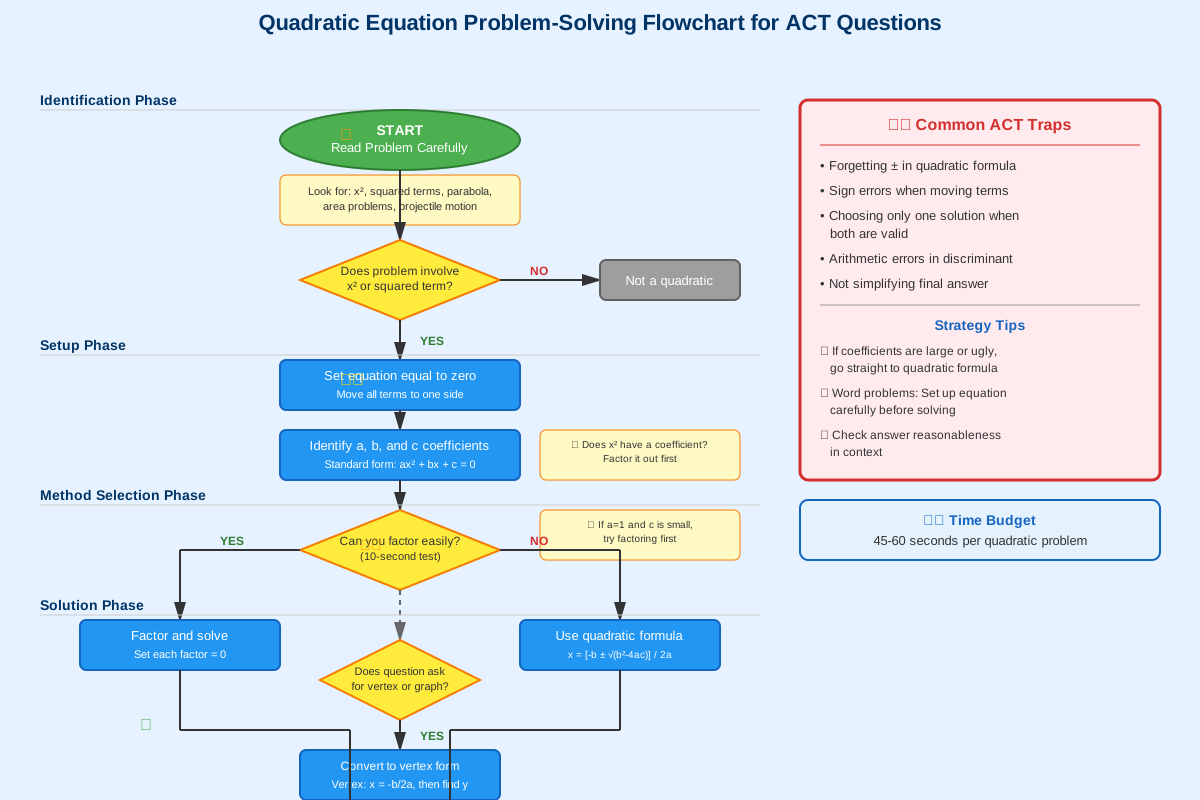
When approaching ACT quadratic equation questions, begin by identifying the question type. Look for trigger phrases such as "solve for x," "find the roots," "determine the zeros," "what are the x-intercepts," or "how many real solutions." These all indicate that solving a quadratic equation is required. Questions asking for "maximum value," "minimum value," or "vertex" require finding the vertex using x = -b/(2a) or converting to vertex form.
Strategic Decision Tree:
- Is the equation already in standard form? If not, rearrange it first by moving all terms to one side.
- Can you factor quickly? Spend no more than 10-15 seconds attempting to factor. If factors aren't immediately apparent, move to the quadratic formula.
- Is there a missing term? If b = 0 (no x term), isolate x² and take the square root. If c = 0 (no constant), factor out x immediately.
- Are you asked about the number of solutions? Calculate only the discriminant b² - 4ac rather than solving completely.
- Is the question asking for the vertex or maximum/minimum? Use x = -b/(2a) to find the x-coordinate, then substitute back to find the y-coordinate.
Process of Elimination Tips:
- If answer choices are given and you've found one solution, eliminate any choice that doesn't include it
- For "number of solutions" questions, calculate the discriminant and eliminate based on its sign
- If the question involves a real-world context (area, time, distance), eliminate negative solutions that don't make physical sense
- When answer choices show factored forms, multiply them out mentally to verify which matches the original equation
- For vertex questions, eliminate answers where the x-coordinate doesn't equal -b/(2a)
Time Allocation:
Straightforward factoring problems should take 30-45 seconds. Quadratic formula problems typically require 60-90 seconds. Word problems involving quadratic equations may take 90-120 seconds. If a problem is taking longer than two minutes, mark it for review and move on—the ACT rewards completing more questions over perfecting difficult ones.
Common Trigger Words:
- "Solve," "roots," "zeros," "solutions," "x-intercepts" → Solve the equation completely
- "How many real solutions" → Calculate discriminant only
- "Maximum," "minimum," "vertex," "highest point," "lowest point" → Find vertex
- "Factor," "factored form" → Use factoring method
- "Area," "consecutive integers," "projectile," "profit" → Set up quadratic equation from word problem
Memory Techniques
Quadratic Formula Mnemonic: "Negative Boy, Plus or Minus Square Root, Boy Squared Minus Four Alfred Charlie, All Over Two Alfred"
This translates to: x = (-b ± √(b² - 4ac)) / (2a)
Discriminant Decision Rhyme:
- "Positive discriminant, two solutions you'll see"
- "Zero discriminant, one solution's the key"
- "Negative discriminant, no real solutions for me"
Factoring Pattern Visualization: Picture a "factor tree" where the product of the outer branches equals c and the sum equals b. For x² + 5x + 6, visualize branches showing 2 and 3 (product = 6, sum = 5).
Vertex Form Memory: Remember "Vertex Form Has Koordinates" → y = a(x - h)² + k where vertex is (h, k)
Axis of Symmetry Acronym: "NBA" → Negative B over A (x = -b/a, though the actual formula is -b/(2a), remembering "NBA" helps recall that b and a are involved with a negative sign)
Zero Product Property: Visualize a multiplication table where any number times zero equals zero. If a product equals zero, at least one factor must be zero—there's no other way to get zero from multiplication.
Summary
Quadratic equations represent second-degree polynomial equations in the form ax² + bx + c = 0, where a ≠ 0. Mastering this topic requires understanding three primary solution methods: factoring (fastest when applicable), the quadratic formula (universal method), and completing the square (useful for vertex form). The discriminant b² - 4ac determines the number of real solutions without complete calculation: positive yields two solutions, zero yields one, and negative yields none. The ACT tests quadratic equations through direct solving, graphical interpretation, word problems, and analysis of parabola properties including vertex, axis of symmetry, and maximum/minimum values. Strategic approach selection—quickly assessing whether to factor or apply the formula—separates efficient test-takers from those who struggle with time management. Understanding the connections between algebraic solutions and graphical features enables students to verify answers and approach problems from multiple angles. Success requires recognizing the various terms used for solutions (roots, zeros, x-intercepts), avoiding common sign errors when factoring, and interpreting solutions within problem contexts to eliminate extraneous answers.
Key Takeaways
- Quadratic equations in standard form ax² + bx + c = 0 can be solved by factoring, quadratic formula, or completing the square—choose the method based on equation structure and time constraints
- The discriminant b² - 4ac instantly reveals the number of real solutions: positive = 2, zero = 1, negative = 0
- The quadratic formula x = (-b ± √(b² - 4ac)) / (2a) works universally for all quadratic equations
- The vertex of a parabola occurs at x = -b/(2a) and represents the maximum (when a < 0) or minimum (when a > 0) value
- Factoring is the fastest method when the quadratic has integer coefficients and factors easily—spend 10-15 seconds attempting it before switching to the formula
- Solutions, roots, zeros, and x-intercepts all refer to the same values—the points where the parabola crosses the x-axis
- Word problems involving area, consecutive integers, or projectile motion frequently require setting up and solving quadratic equations
Related Topics
Polynomial Functions: Quadratic equations serve as the foundation for understanding higher-degree polynomials. Mastering quadratics enables progression to cubic, quartic, and general polynomial functions, including end behavior, turning points, and the Fundamental Theorem of Algebra.
Systems of Equations: Quadratic equations extend to systems involving both linear and quadratic equations, requiring substitution or elimination methods combined with quadratic solving techniques. These appear on advanced ACT questions and in precalculus courses.
Inequalities: Quadratic inequalities (ax² + bx + c > 0) require finding solutions and testing intervals, building directly on quadratic equation solving skills while adding graphical interpretation of regions above or below the parabola.
Conic Sections: Parabolas represent one of four conic sections (along with circles, ellipses, and hyperbolas). Understanding quadratic equations in vertex form provides the foundation for analyzing parabolic properties in analytic geometry.
Rational Expressions: Simplifying, adding, and solving rational expressions often requires factoring quadratic expressions in numerators and denominators, making quadratic mastery essential for rational function manipulation.
Practice CTA
Now that you've mastered the core concepts, solution methods, and strategic approaches for quadratic equations, it's time to solidify your understanding through active practice. Attempt the practice questions designed specifically for this topic, focusing on applying the decision tree for method selection and timing yourself to build speed. Use the flashcards to reinforce the quadratic formula, discriminant interpretations, and key factoring patterns until they become automatic. Remember: understanding the concepts is the first step, but achieving ACT excellence requires repeated application under test-like conditions. Each practice problem you solve strengthens your pattern recognition and builds the confidence needed to tackle any quadratic equation the ACT presents. You've got this—start practicing now!
Sign up free to keep reading
Create a free AnvayaPrep account to finish this ACT guide on Quadratic equations — plus flashcards and practice questions.