Overview
Solving for a variable is one of the most fundamental and frequently tested skills on the ACT Math section. This algebraic technique involves manipulating equations to isolate a specific variable on one side of the equation, allowing you to determine its value or express it in terms of other variables. Mastery of this skill is absolutely essential because it appears not only in straightforward algebra questions but also underlies geometry problems, coordinate geometry, trigonometry, and even some advanced mathematics questions on the exam.
The ACT consistently includes 8-12 questions per test that directly require solving for a variable, and many additional questions incorporate this skill as an intermediate step. Whether you're working with linear equations, quadratic expressions, literal equations (formulas), or systems of equations, the ability to efficiently and accurately isolate variables determines your success on a significant portion of the Math section. Questions testing this concept range from simple one-step equations to complex multi-step problems involving fractions, radicals, and multiple variables.
Understanding how to solve for a variable connects to virtually every other algebraic concept you'll encounter. It builds directly on your knowledge of arithmetic operations and inverse operations, while serving as the foundation for functions, inequalities, and equation systems. This topic also bridges pure algebra with applied mathematics—you'll use these techniques when working with geometric formulas, calculating slopes and intercepts in coordinate geometry, and manipulating trigonometric identities. The strategic approach you develop here will accelerate your problem-solving across the entire Math section.
Learning Objectives
- [ ] Identify when solving for a variable is being tested in ACT questions
- [ ] Explain the core rule or strategy behind solving for a variable
- [ ] Apply solving for a variable to ACT-style questions accurately
- [ ] Execute multi-step algebraic manipulations while maintaining equation balance
- [ ] Solve literal equations by isolating a specified variable in terms of other variables
- [ ] Recognize and avoid common algebraic errors when performing inverse operations
- [ ] Determine the most efficient solution pathway for complex equations
Prerequisites
- Basic arithmetic operations: Addition, subtraction, multiplication, and division form the foundation for all algebraic manipulations
- Order of operations (PEMDAS): Understanding operation hierarchy is essential for correctly simplifying expressions and determining which steps to perform first
- Properties of equality: Knowing that performing the same operation on both sides maintains equation balance is the fundamental principle underlying all variable isolation
- Inverse operations: Recognizing that addition/subtraction and multiplication/division are inverse pairs enables you to "undo" operations systematically
- Fraction operations: Many ACT equations involve fractional coefficients or require clearing denominators, making fraction fluency critical
Why This Topic Matters
ACT solving for a variable appears in approximately 15-20% of all Math section questions, making it one of the highest-yield topics for test preparation. Beyond direct "solve for x" questions, this skill serves as a prerequisite step in problems involving functions, coordinate geometry, systems of equations, and word problems. Students who can quickly and accurately isolate variables gain significant time advantages, allowing them to tackle more challenging problems with confidence.
In real-world applications, solving for variables enables professionals across fields to manipulate formulas and equations. Engineers rearrange physics formulas to calculate unknown quantities, financial analysts solve for interest rates or time periods in investment equations, and scientists isolate variables in experimental relationships. The logical thinking developed through this practice—identifying what you know, what you need, and the steps to bridge that gap—transfers to problem-solving in countless contexts beyond mathematics.
On the ACT, this topic appears in multiple question formats: straightforward algebraic equations, literal equations asking you to solve for one variable in terms of others, word problems requiring equation setup and solution, and geometry problems where you must solve for missing measurements. Questions may involve linear equations, quadratic equations (often solvable by factoring), equations with fractions or decimals, equations with variables on both sides, and formulas from geometry or other mathematical domains. The test writers frequently combine variable isolation with other skills, creating multi-step problems that assess your ability to execute complex solution sequences accurately.
Core Concepts
The Fundamental Principle: Maintaining Equation Balance
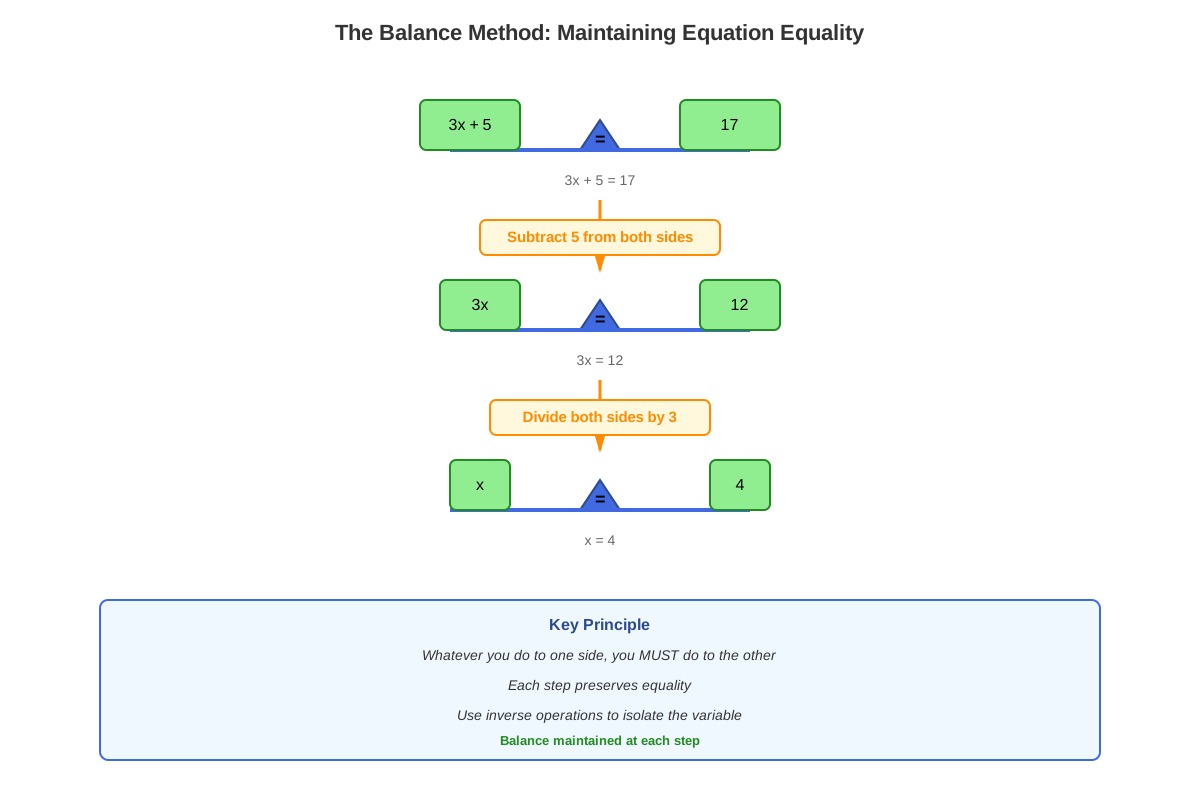
The cornerstone of solving for a variable is the principle of equation balance. An equation states that two expressions are equal; whatever operation you perform on one side must be performed on the other side to maintain this equality. Think of an equation as a balanced scale—adding weight to one side requires adding equal weight to the other side to keep it balanced.
This principle allows you to systematically "undo" operations that have been applied to your target variable. If a variable has been multiplied by 3, you can divide both sides by 3. If 7 has been added to your variable, you can subtract 7 from both sides. The key is performing inverse operations in the reverse order of the original operations.
One-Step Equations
The simplest form involves a single operation separating the variable from isolation:
- Addition/Subtraction equations: x + 5 = 12 (subtract 5 from both sides)
- Multiplication/Division equations: 3x = 15 (divide both sides by 3)
These require identifying the single operation affecting the variable and applying its inverse to both sides.
Multi-Step Equations
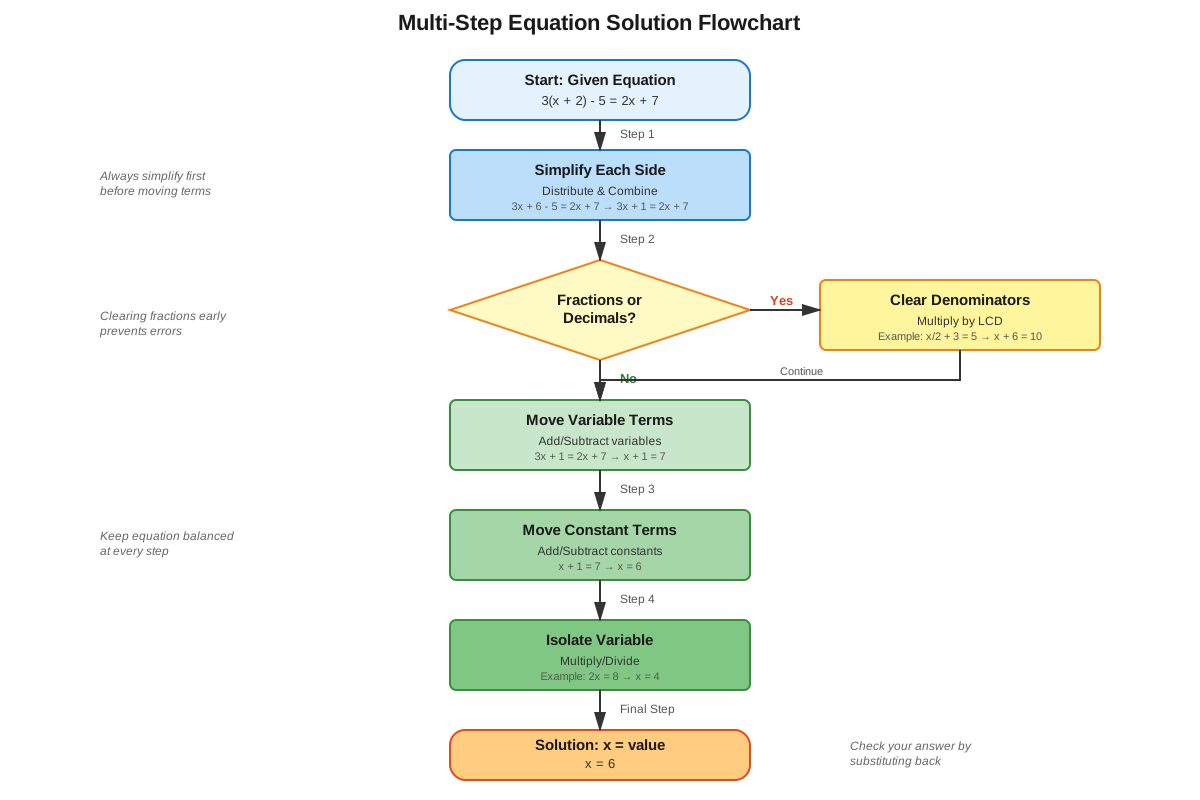
Most ACT questions involve multiple operations, requiring a systematic approach:
- Simplify both sides (combine like terms, distribute)
- Eliminate variable terms from one side (move all variable terms to one side using addition/subtraction)
- Eliminate constant terms from the variable side (isolate the variable term)
- Eliminate coefficients (divide or multiply to get the variable alone)
For example, solving 3(x - 4) + 7 = 2x + 11:
- Distribute: 3x - 12 + 7 = 2x + 11
- Combine like terms: 3x - 5 = 2x + 11
- Subtract 2x: x - 5 = 11
- Add 5: x = 16
Equations with Variables on Both Sides
When variables appear on both sides of an equation, consolidate them on one side before proceeding:
For 5x - 8 = 3x + 10:
- Subtract 3x from both sides: 2x - 8 = 10
- Add 8 to both sides: 2x = 18
- Divide by 2: x = 9
The strategic choice of which side to consolidate variables on can simplify calculations—generally, move variables to the side with the larger coefficient to avoid negative coefficients.
Equations with Fractions
Fractional equations can be solved by two approaches:
Method 1: Clear denominators first by multiplying both sides by the least common denominator (LCD):
For (x/3) + (x/4) = 14:
- LCD is 12
- Multiply everything by 12: 4x + 3x = 168
- Combine: 7x = 168
- Divide: x = 24
Method 2: Work with fractions throughout, using fraction operations at each step. This method works well when denominators are simple or when only one fraction is present.
Literal Equations and Formula Manipulation
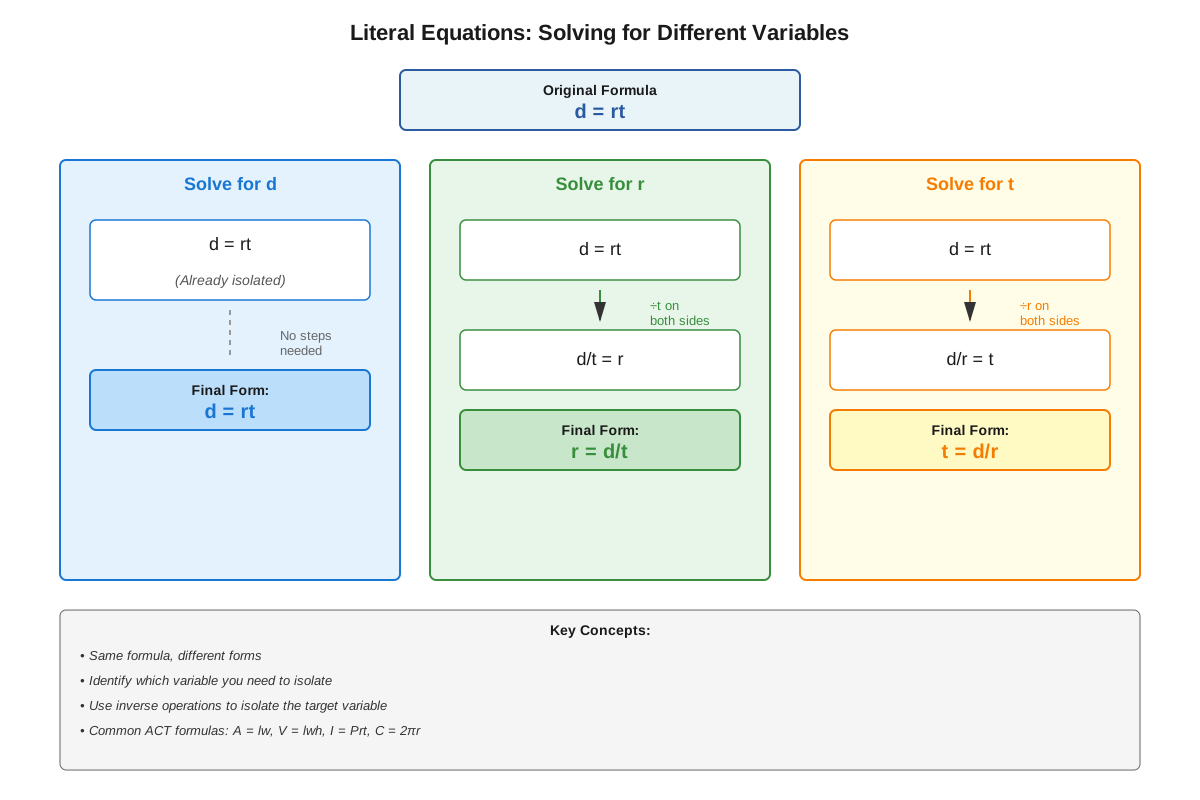
Literal equations contain multiple variables, and you're asked to solve for one variable in terms of the others. This skill is crucial for geometry formulas and scientific equations on the ACT.
The process is identical to solving for numerical values, but your final answer contains variables:
Solve for h in the equation A = (1/2)bh:
- Multiply both sides by 2: 2A = bh
- Divide both sides by b: (2A)/b = h
Common ACT formulas requiring manipulation:
- Distance: d = rt (solve for r or t)
- Area formulas: A = πr², A = lw, A = (1/2)bh
- Perimeter formulas: P = 2l + 2w
- Temperature conversion: F = (9/5)C + 32
Equations with Absolute Value
Absolute value equations require considering both positive and negative cases:
For |x - 3| = 7:
- Case 1: x - 3 = 7, so x = 10
- Case 2: x - 3 = -7, so x = -4
Both solutions must be checked in the original equation.
Special Cases
No solution: Some equations have no value that satisfies them (e.g., x + 3 = x + 5 simplifies to 3 = 5, which is false).
Infinite solutions: Some equations are true for all values (e.g., 2(x + 3) = 2x + 6 simplifies to an identity).
Zero in the denominator: When solving equations with variables in denominators, solutions that make any denominator zero must be excluded.
Concept Relationships
The concepts within solving for a variable build sequentially: one-step equations establish the fundamental principle of inverse operations → multi-step equations combine multiple inverse operations in proper sequence → equations with variables on both sides require consolidating like terms before applying the multi-step process → fractional equations add the technique of clearing denominators → literal equations apply all previous techniques while working with variable expressions rather than numbers.
This topic connects backward to prerequisite knowledge: order of operations determines the sequence for simplifying expressions before solving, properties of equality justify each manipulation step, and inverse operations provide the mechanism for isolating variables. It connects forward to more advanced topics: systems of equations require solving for variables in multiple equations simultaneously, quadratic equations extend solving techniques to second-degree polynomials, functions involve solving equations like f(x) = k for x, and inequalities use similar techniques with modified rules for multiplication/division by negatives.
The relationship map: Basic Operations → Inverse Operations → One-Step Equations → Multi-Step Equations → Variables on Both Sides → Fractional Equations → Literal Equations → Systems of Equations and Advanced Applications.
High-Yield Facts
⭐ Whatever operation you perform on one side of an equation must be performed on the other side to maintain equality
⭐ The general sequence for solving multi-step equations is: simplify, consolidate variables, isolate the variable term, eliminate coefficients
⭐ When solving literal equations, treat all other variables as constants and apply the same techniques used for numerical equations
⭐ To eliminate a fraction, multiply both sides by the denominator; to clear all fractions, multiply by the LCD of all denominators
⭐ When variables appear on both sides, move all variable terms to one side and all constants to the other before solving
- Distributing before combining like terms prevents errors in multi-step equations
- Division by zero is undefined; any solution that creates a zero denominator must be rejected
- Absolute value equations typically yield two solutions that must both be verified
- Checking your solution by substituting back into the original equation catches calculation errors
- When solving for a variable in a formula, the final answer should have that variable isolated on one side with all other terms on the opposite side
- Equations with no solution simplify to false statements (like 0 = 5), while equations with infinite solutions simplify to identities (like 5 = 5)
- Multiplying or dividing both sides by a negative number does not change the equation's solutions (though it does affect inequalities)
Quick check — test yourself on Solving for a variable so far.
Try Flashcards →Common Misconceptions
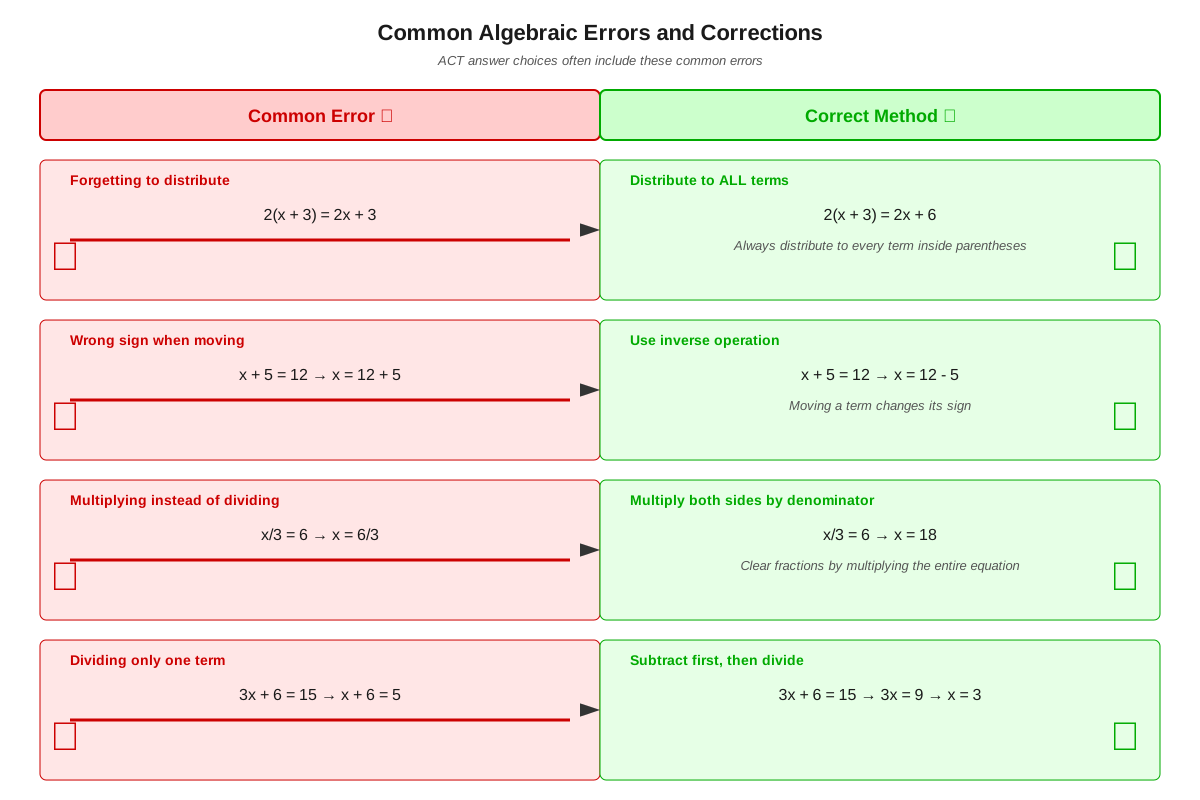
Misconception: You can add or subtract different values from each side of an equation as long as you're "balancing" things out. → Correction: You must perform the exact same operation with the exact same value on both sides. The equation 5 = 5 remains true if you add 3 to both sides (8 = 8), but not if you add 3 to one side and 2 to the other (8 ≠ 7).
Misconception: When solving 2x + 3 = 11, you should divide everything by 2 first. → Correction: Follow the proper sequence: eliminate constants from the variable side first (subtract 3 to get 2x = 8), then eliminate coefficients (divide by 2 to get x = 4). Working in the wrong order creates unnecessary fractions and increases error risk.
Misconception: In the equation x/5 = 10, you should subtract 5 from both sides. → Correction: The operation connecting x and 5 is division, not subtraction. The inverse of division is multiplication, so multiply both sides by 5 to get x = 50.
Misconception: When solving for h in A = (1/2)bh, you can just "move" the (1/2)b to the other side. → Correction: Variables don't simply "move"—you must perform inverse operations. Since h is multiplied by (1/2)b, divide both sides by (1/2)b (or multiply by its reciprocal 2/b) to get h = 2A/b.
Misconception: The equation 3(x + 2) = 3x + 6 has solution x = 0. → Correction: This equation simplifies to 3x + 6 = 3x + 6, which is true for all values of x (infinite solutions), not just x = 0. When variables cancel completely, check whether the remaining statement is always true (infinite solutions) or always false (no solution).
Misconception: In equations with fractions, you can ignore denominators and just solve the numerators. → Correction: Denominators are essential parts of the equation. You must either clear them by multiplying by the LCD or carefully perform operations that account for them at each step.
Misconception: When you have |x| = -5, the solutions are x = 5 and x = -5. → Correction: Absolute value represents distance from zero and is always non-negative. The equation |x| = -5 has no solution because absolute value can never equal a negative number.
Worked Examples
Example 1: Multi-Step Equation with Distribution and Variables on Both Sides
Problem: Solve for x: 4(2x - 3) - 5 = 3(x + 2) + 2x
Solution:
Step 1: Distribute on both sides
- Left side: 4(2x - 3) - 5 = 8x - 12 - 5 = 8x - 17
- Right side: 3(x + 2) + 2x = 3x + 6 + 2x = 5x + 6
- Equation becomes: 8x - 17 = 5x + 6
Step 2: Move variable terms to one side (subtract 5x from both sides)
- 8x - 5x - 17 = 5x - 5x + 6
- 3x - 17 = 6
Step 3: Isolate the variable term (add 17 to both sides)
- 3x - 17 + 17 = 6 + 17
- 3x = 23
Step 4: Eliminate the coefficient (divide both sides by 3)
- x = 23/3
Step 5: Check by substituting back into the original equation
- Left: 4(2(23/3) - 3) - 5 = 4(46/3 - 9/3) - 5 = 4(37/3) - 5 = 148/3 - 15/3 = 133/3
- Right: 3(23/3 + 2) + 2(23/3) = 3(29/3) + 46/3 = 87/3 + 46/3 = 133/3 ✓
Connection to Learning Objectives: This example demonstrates applying solving for a variable to ACT-style questions accurately, executing multi-step algebraic manipulations while maintaining equation balance, and determining the most efficient solution pathway.
Example 2: Literal Equation (Formula Manipulation)
Problem: The formula for the surface area of a cylinder is S = 2πr² + 2πrh. Solve for h in terms of S, r, and π.
Solution:
Step 1: Identify the goal—isolate h on one side
Step 2: Subtract the term without h from both sides
- S - 2πr² = 2πr² + 2πrh - 2πr²
- S - 2πr² = 2πrh
Step 3: Divide both sides by the coefficient of h (which is 2πr)
- (S - 2πr²)/(2πr) = (2πrh)/(2πr)
- (S - 2πr²)/(2πr) = h
Step 4: Rewrite with h on the left (conventional form)
- h = (S - 2πr²)/(2πr)
Alternative form (factoring the numerator):
- h = S/(2πr) - r
Connection to Learning Objectives: This example shows how to solve literal equations by isolating a specified variable in terms of other variables, a common ACT question type that tests whether students can manipulate formulas rather than just plug in numbers.
Exam Strategy
When approaching ACT solving for a variable questions, first identify what the question is asking—are you solving for a numerical value or expressing one variable in terms of others? Read carefully to determine which variable to isolate.
Trigger words and phrases that signal this topic:
- "Solve for x"
- "What is the value of..."
- "Express h in terms of..."
- "If [equation], then x = ?"
- "Which of the following is equivalent to x?"
- "Isolate the variable..."
Strategic approach:
- Scan for complexity: Quickly assess whether the equation involves distribution, fractions, or variables on both sides to mentally prepare your solution sequence
- Simplify first: Before attempting to isolate the variable, combine like terms and distribute to reduce the equation to its simplest form
- Choose your side strategically: When variables appear on both sides, consolidate them on the side with the larger coefficient to avoid negative coefficients
- Clear fractions early: If multiple fractions appear, multiply by the LCD immediately to work with integers
- Work vertically: Write each step on a new line, maintaining the equals sign in the same column to track your work and catch errors
Process of elimination tips:
- Substitute the answer choices back into the original equation when solving for numerical values—this often proves faster than algebraic manipulation, especially for complex equations
- Eliminate answers that would create undefined expressions (zero denominators) or violate constraints
- For literal equations, eliminate choices with incorrect units or dimensions
- Check extreme cases: if the equation should work for x = 0 or x = 1, test whether answer choices satisfy these conditions
Time allocation: Straightforward one- or two-step equations should take 15-30 seconds. Multi-step equations with distribution or fractions warrant 45-60 seconds. Complex literal equations may require 60-90 seconds. If you exceed these times, consider using answer choice substitution or moving on and returning later.
Exam Tip: On the ACT, approximately 30% of algebra questions can be solved faster by substituting answer choices than by traditional algebraic manipulation. Since answers are arranged in ascending or descending order, start with choice C—if it's too large or too small, you can eliminate multiple choices at once.
Memory Techniques
SADMEP - The reverse of PEMDAS for solving equations:
- Subtraction/Addition (eliminate constants from the variable side)
- Division/Multiplication (eliminate coefficients)
- Multiplication/Division (clear fractions if needed)
- Exponents (deal with squared terms, etc.)
- Parentheses (distribute first when simplifying)
"Do Unto Both Sides" - Remember that equation balance requires performing identical operations on both sides. Visualize a balance scale tipping if you add weight to only one side.
"Opposite Operations" - Create a mental pairing:
- Addition ↔ Subtraction
- Multiplication ↔ Division
- Squaring ↔ Square root
- Exponentiation ↔ Logarithm
The "Unwrapping" Metaphor - Think of the variable as a gift wrapped in layers. Each operation is a layer of wrapping paper. To reach the gift (isolate the variable), unwrap in reverse order: the outermost layer (last operation applied) comes off first.
Fraction Elimination Chant: "LCD sets fractions free" - When you see multiple fractions, immediately identify the LCD and multiply through to eliminate denominators.
Literal Equation Reminder: "Letters are just numbers in disguise" - Treat other variables as if they were numbers when solving for your target variable.
Summary
Solving for a variable is the foundational algebraic skill that underlies 15-20% of ACT Math questions and serves as a prerequisite step in countless others. The core principle is maintaining equation balance by performing identical operations on both sides, using inverse operations to systematically "undo" what has been done to the variable. Success requires mastering a strategic sequence: simplify both sides, consolidate variable terms on one side, isolate the variable term by eliminating constants, then eliminate coefficients. This process applies whether solving for numerical values or manipulating literal equations to express one variable in terms of others. Common question types include multi-step equations with distribution, equations with variables on both sides, fractional equations requiring clearing denominators, and formula manipulation. Avoiding common errors—such as performing different operations on each side, working in the wrong sequence, or misidentifying inverse operations—is as important as knowing the correct procedures. Strategic test-taking approaches, including answer choice substitution and efficient fraction handling, can significantly reduce solution time on the ACT.
Key Takeaways
- Equation balance is sacred: Whatever operation you perform on one side must be performed identically on the other side to maintain equality
- Follow the strategic sequence: Simplify → consolidate variables → isolate variable term → eliminate coefficient, working in reverse order of operations
- Master literal equations: Treat other variables as constants and apply the same techniques used for numerical equations to manipulate formulas
- Clear fractions efficiently: Multiply by the LCD to eliminate all denominators at once, converting to integer equations that are easier to solve
- Verify your solutions: Substitute answers back into the original equation to catch calculation errors and identify extraneous solutions
- Use answer choice substitution strategically: On the ACT, testing answer choices often proves faster than algebraic manipulation for complex equations
- Recognize special cases: Equations may have no solution (false statement), infinite solutions (identity), or restricted solutions (excluded values that create zero denominators)
Related Topics
Systems of Equations: Building on single-variable solving, systems require isolating variables in multiple equations simultaneously using substitution or elimination methods. Mastering solving for a variable makes systems approachable.
Quadratic Equations: These second-degree equations extend solving techniques to include factoring, completing the square, and the quadratic formula, all of which rely on the variable isolation principles learned here.
Inequalities: Solving inequalities uses nearly identical techniques to solving equations, with the critical addition that multiplying or dividing by negative numbers reverses the inequality sign.
Functions: Understanding functions requires solving equations like f(x) = k for x, and finding inverse functions involves solving for the input variable in terms of the output.
Rational Equations: These equations with variables in denominators require the fraction-clearing techniques learned here, plus careful attention to excluded values.
Practice CTA
Now that you've mastered the core concepts and strategies for solving for a variable, it's time to cement your understanding through practice. The ACT rewards accuracy and speed, both of which develop through deliberate practice with exam-style questions. Work through the practice problems to apply these techniques, challenge yourself with the flashcards to reinforce key concepts, and track your progress as you build confidence in this high-yield topic. Remember: every equation you solve correctly brings you closer to your target score. You've got the tools—now put them to work!
Sign up free to keep reading
Create a free AnvayaPrep account to finish this ACT guide on Solving for a variable — plus flashcards and practice questions.