Overview
Systems of inequalities represent one of the most practical and frequently tested algebraic concepts on the ACT Math test. Unlike single inequalities that describe one constraint, a system of inequalities involves two or more inequalities working together to define a region of possible solutions. On the ACT, these problems typically appear as graphical representations where students must identify solution regions, or as word problems requiring students to translate real-world constraints into mathematical inequalities and determine which values satisfy all conditions simultaneously.
Understanding ACT systems of inequalities is essential because these questions integrate multiple mathematical skills: graphing linear equations, understanding coordinate planes, interpreting shaded regions, and applying logical reasoning to determine which points satisfy multiple conditions. The ACT frequently presents these problems in contexts involving budgets, time constraints, resource allocation, or physical boundaries—making them both mathematically rigorous and practically relevant. Students who master this topic gain approximately 2-3 guaranteed points on the exam, as these questions appear with reliable frequency.
This topic builds directly upon foundational algebra skills including solving single-variable inequalities, graphing linear equations, understanding slope-intercept form, and working with coordinate geometry. Systems of inequalities also connect forward to optimization problems, linear programming concepts tested in higher mathematics, and practical problem-solving scenarios that appear throughout the ACT Math section. The ability to visualize multiple constraints simultaneously and identify feasible solution regions represents a critical thinking skill that extends beyond this specific topic into broader mathematical reasoning.
Learning Objectives
- [ ] Identify when Systems of inequalities is being tested in ACT questions
- [ ] Explain the core rule or strategy behind Systems of inequalities
- [ ] Apply Systems of inequalities to ACT-style questions accurately
- [ ] Graph systems of inequalities on a coordinate plane and identify the solution region
- [ ] Determine whether a given point satisfies a system of inequalities algebraically
- [ ] Translate word problems involving multiple constraints into systems of inequalities
- [ ] Distinguish between solid and dashed boundary lines based on inequality symbols
Prerequisites
- Single-variable inequalities: Understanding how to solve and graph inequalities like x > 3 or 2x + 5 ≤ 11 provides the foundation for working with two-variable inequalities
- Linear equations and graphing: The ability to graph lines using slope-intercept form (y = mx + b) is essential since inequality boundaries are linear equations
- Coordinate plane fundamentals: Familiarity with plotting points, identifying quadrants, and understanding x and y coordinates enables interpretation of solution regions
- Inequality symbols and notation: Knowing the meaning of <, >, ≤, ≥ and how they differ is crucial for determining whether boundary lines are included in solutions
- Substitution and evaluation: The skill of substituting values into expressions to check if they satisfy conditions is necessary for verifying solutions
Why This Topic Matters
Systems of inequalities appear in countless real-world applications that make them particularly relevant for the ACT's emphasis on practical mathematics. Businesses use systems of inequalities to determine optimal production levels given constraints on resources, time, and budget. Engineers apply them to define safe operating parameters for machinery. Urban planners use them to establish zoning regulations and building codes. Financial advisors employ systems of inequalities to model investment portfolios that must satisfy multiple risk and return requirements. This practical applicability makes systems of inequalities a favorite topic for ACT test writers who want to assess mathematical reasoning in realistic contexts.
On the ACT Math test, systems of inequalities questions appear approximately 2-3 times per exam, representing roughly 3-5% of the 60 math questions. These problems most commonly appear in two formats: graphical questions showing shaded regions where students must identify the correct system, and word problems requiring students to set up and solve systems based on described constraints. The difficulty level ranges from medium to challenging, with straightforward graphing questions appearing in the middle portion of the test and complex application problems appearing in the final third.
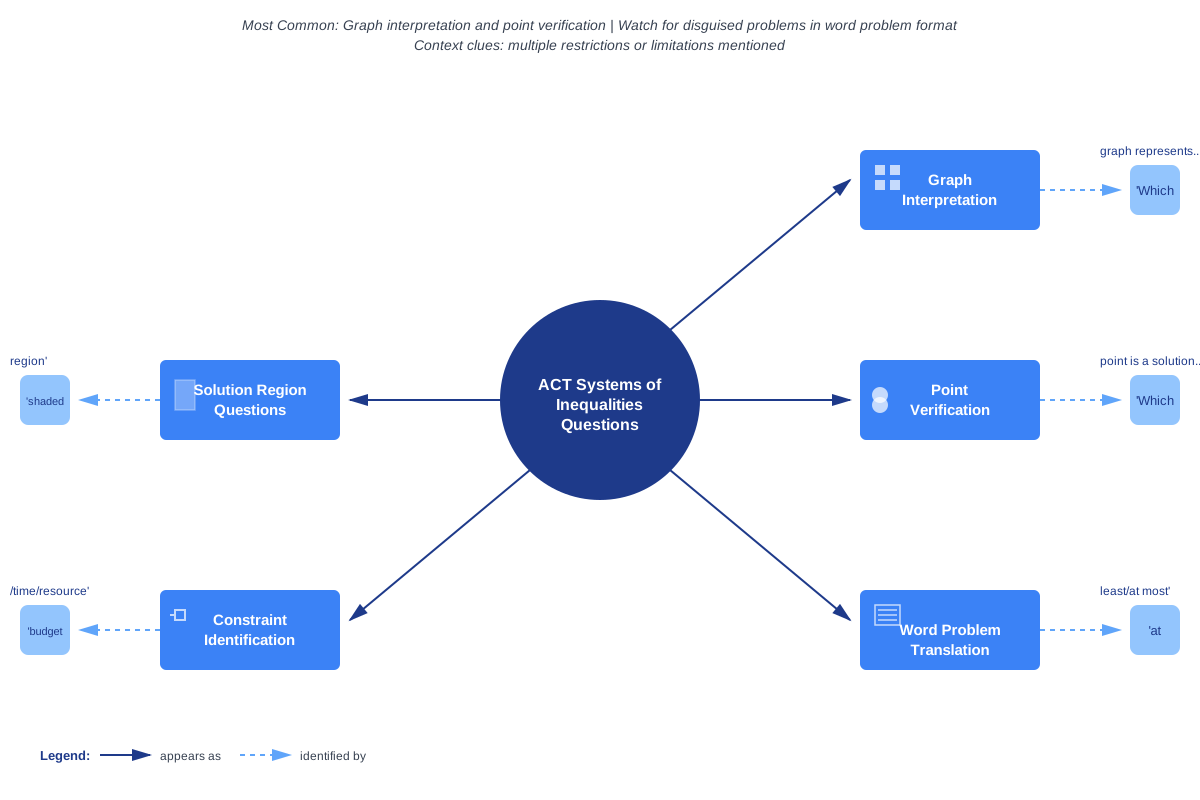
The ACT frequently embeds systems of inequalities within scenarios involving budgets ("You have $50 to spend on items costing $3 and $5"), time management ("You have 10 hours to complete tasks taking 2 and 3 hours each"), or physical constraints ("A truck can carry no more than 5000 pounds and 200 cubic feet"). Questions may ask students to identify which ordered pairs satisfy the system, determine the maximum or minimum value of an expression within the feasible region, or select the graph that correctly represents given constraints. Recognition of these question types enables efficient problem-solving and accurate point identification.
Core Concepts
Definition and Components
A system of inequalities consists of two or more inequalities that must be satisfied simultaneously. Each inequality in the system represents a constraint or condition, and the solution to the system is the set of all ordered pairs (x, y) that make every inequality in the system true. Unlike systems of equations that typically have a single point solution (or no solution, or infinitely many solutions along a line), systems of inequalities have solution regions—entire areas of the coordinate plane where all conditions are met.
Each inequality in a system can be written in various forms, but the most useful for graphing is the slope-intercept form: y < mx + b, y > mx + b, y ≤ mx + b, or y ≥ mx + b. The boundary line for each inequality is the equation y = mx + b, and the inequality symbol determines which side of the line contains solutions and whether the line itself is included.
Graphing Individual Inequalities
To graph a single inequality in two variables, follow these systematic steps:
- Convert to slope-intercept form if necessary, isolating y on one side of the inequality
- Graph the boundary line y = mx + b using the slope and y-intercept
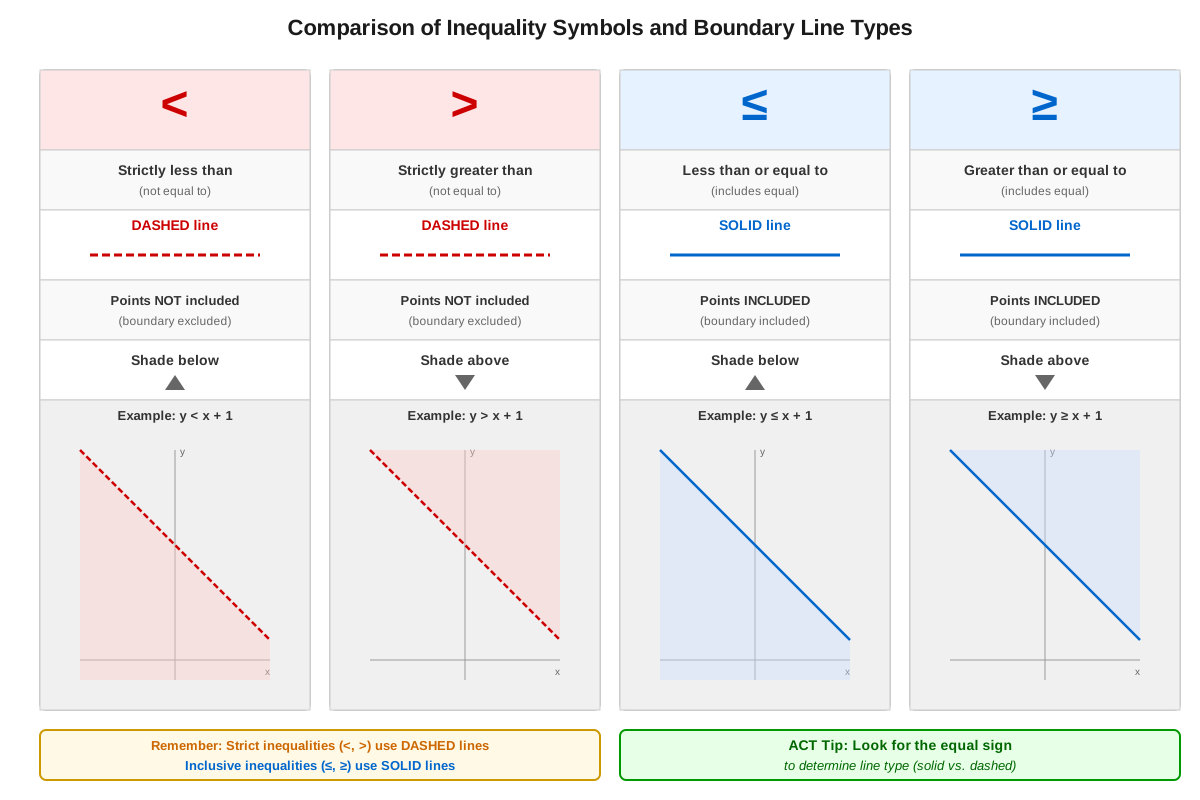
- Determine line style: Use a solid line for ≤ or ≥ (boundary included), dashed line for < or > (boundary excluded)
- Identify the solution region: Shade above the line for y > or y ≥, shade below for y < or y ≤
- Verify with a test point: Choose a point not on the line (often the origin if convenient) and check if it satisfies the inequality
For example, to graph y ≥ 2x - 3:
- The boundary line is y = 2x - 3 (slope = 2, y-intercept = -3)
- Use a solid line because the inequality includes "equal to"
- Shade above the line because y is greater than or equal to the expression
- Test point (0, 0): Is 0 ≥ 2(0) - 3? Is 0 ≥ -3? Yes, so (0, 0) is in the solution region
Special Cases and Vertical/Horizontal Lines
Some inequalities produce vertical or horizontal boundary lines that require special attention:
- Vertical lines (x = k): Inequalities like x > 3 or x ≤ -2 create vertical boundaries. For x > 3, shade to the right; for x < 3, shade to the left.
- Horizontal lines (y = k): Inequalities like y ≤ 5 or y > -1 create horizontal boundaries. For y > -1, shade above; for y < -1, shade below.
These special cases frequently appear on the ACT because they test whether students truly understand the meaning of inequalities rather than just following memorized graphing procedures.
Solving Systems of Inequalities Graphically
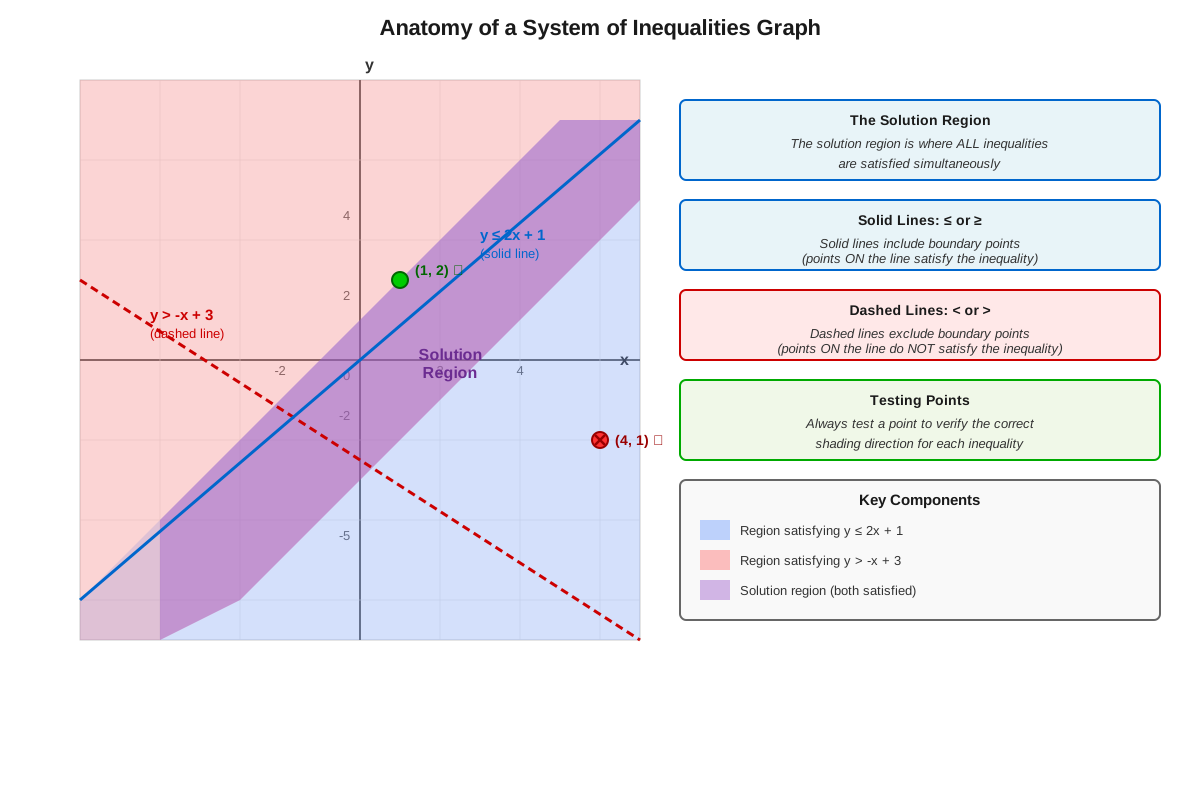
When working with a system of two or more inequalities, the solution region is the intersection of all individual solution regions—the area where all shaded regions overlap. The graphical approach involves:
- Graph each inequality separately on the same coordinate plane
- Use different shading patterns or colors to distinguish each inequality's region
- Identify the overlap region where all shadings intersect
- This overlap region represents all points that satisfy every inequality in the system
The boundary of the solution region consists of portions of the boundary lines from the individual inequalities. Points on solid boundary lines that border the solution region are included in the solution set, while points on dashed boundary lines are not.
Testing Points Algebraically
The ACT frequently asks whether specific points satisfy a system of inequalities. To test a point (a, b) algebraically:
- Substitute x = a and y = b into each inequality
- Evaluate whether each resulting statement is true
- The point is a solution only if it satisfies ALL inequalities in the system
For example, to test if (2, 5) satisfies the system:
- y > x + 1
- y ≤ -2x + 10
Check first inequality: 5 > 2 + 1 → 5 > 3 ✓ True
Check second inequality: 5 ≤ -2(2) + 10 → 5 ≤ 6 ✓ True
Since both are true, (2, 5) is a solution to the system.
Translating Word Problems
ACT word problems involving systems of inequalities typically describe multiple constraints that must be satisfied simultaneously. Key translation strategies include:
| Phrase | Mathematical Translation |
|---|---|
| "at most," "no more than," "maximum" | ≤ |
| "at least," "no less than," "minimum" | ≥ |
| "more than," "greater than" | > |
| "less than," "fewer than" | < |
| "combined," "total," "sum" | Addition |
| "each," "per" | Multiplication coefficient |
For example: "A student works at two jobs. Job A pays $12 per hour and Job B pays $15 per hour. The student must earn at least $180 per week but can work no more than 20 hours total."
Let x = hours at Job A, y = hours at Job B
- Earnings constraint: 12x + 15y ≥ 180
- Time constraint: x + y ≤ 20
- Non-negativity: x ≥ 0, y ≥ 0
Solution Region Characteristics
The solution region for a system of linear inequalities has specific geometric properties:
- The region is always a polygon (possibly unbounded) or empty
- Vertices (corner points) occur where boundary lines intersect
- The region is convex, meaning any line segment connecting two points in the region lies entirely within the region
- If the system has no solution, the inequalities are inconsistent and their individual regions don't overlap
Understanding these properties helps students quickly eliminate incorrect answer choices on multiple-choice questions and verify their graphical solutions.
Concept Relationships
The concepts within systems of inequalities build upon each other in a logical progression. Single inequality graphing forms the foundation, as students must master graphing one inequality before combining multiple inequalities. This skill leads directly to identifying solution regions, which requires understanding that solutions exist on one side of a boundary line. The ability to identify solution regions then enables graphing systems, where multiple regions must be overlaid and their intersection found.
Algebraic testing of points connects to graphing by providing a verification method—students can check whether their graphical solution is correct by testing points that appear to be in the solution region. This algebraic approach also stands alone as a problem-solving strategy when graphs aren't provided or when precise verification is needed.
Word problem translation integrates all previous concepts by requiring students to first convert verbal descriptions into mathematical inequalities, then solve the resulting system either graphically or algebraically. This represents the highest level of mastery, as it demands both conceptual understanding and practical application.
The relationship map flows as follows:
Linear equations and graphing → Single inequality graphing → Identifying solution regions → Graphing systems of inequalities → Finding intersection regions → Algebraic verification → Word problem applications
Systems of inequalities also connect to prerequisite topics: coordinate plane fundamentals provide the framework for all graphing work, slope-intercept form enables efficient boundary line graphing, and solving single-variable inequalities develops the logical reasoning needed for two-variable systems.
Looking forward, systems of inequalities connect to linear programming (finding optimal solutions within constraint regions), absolute value inequalities (which create V-shaped boundary regions), and systems of equations (which find specific intersection points rather than regions). The reasoning skills developed here also apply to quadratic inequalities and other advanced topics.
Quick check — test yourself on Systems of inequalities so far.
Try Flashcards →High-Yield Facts
⭐ The solution to a system of inequalities is the intersection (overlap) of all individual solution regions, not their union.
⭐ Use a solid boundary line for ≤ or ≥ inequalities; use a dashed line for < or > inequalities.
⭐ For y > mx + b or y ≥ mx + b, shade above the line; for y < mx + b or y ≤ mx + b, shade below the line.
⭐ A point satisfies a system only if it satisfies every single inequality in the system—one false inequality means the point is not a solution.
⭐ When testing whether a point is in the solution region, the origin (0, 0) is the easiest test point unless it lies on a boundary line.
- Vertical line inequalities (x > k or x < k) divide the plane into left and right regions, not upper and lower regions.
- Horizontal line inequalities (y > k or y < k) divide the plane into upper and lower regions, not left and right regions.
- If an inequality is multiplied or divided by a negative number, the inequality symbol must be reversed.
- The solution region for a system may be bounded (enclosed) or unbounded (extending infinitely in one or more directions).
- Corner points (vertices) of the solution region occur where boundary lines intersect and are found by solving systems of equations.
- Non-negativity constraints (x ≥ 0, y ≥ 0) restrict solutions to the first quadrant, which is common in real-world applications.
- An empty solution region (no overlap) indicates the system has no solution and the constraints are inconsistent.
- The phrase "at most" translates to ≤, while "at least" translates to ≥—these are among the most commonly confused translations.
Common Misconceptions
Misconception: The solution to a system of inequalities is where the boundary lines intersect.
Correction: The solution is the entire region where all shaded areas overlap, not just intersection points. Systems of inequalities have infinitely many solutions forming a region, unlike systems of equations which typically have point solutions.
Misconception: When graphing y < 2x + 3, shade below the line and use a solid line.
Correction: The line should be dashed (not solid) because the inequality is strictly less than (<), not less than or equal to (≤). The boundary line itself is not included in the solution set for strict inequalities.
Misconception: If a point satisfies one inequality in a system, it's a solution to the system.
Correction: A point must satisfy ALL inequalities simultaneously to be a solution to the system. Even if a point satisfies three out of four inequalities, it is not a solution to the system.
Misconception: For the inequality x > 5, shade above the vertical line x = 5.
Correction: For vertical line inequalities, "greater than" means to the right (larger x-values), not above. Shade to the right of the line x = 5. The terms "above" and "below" only apply to horizontal lines or non-vertical boundaries.
Misconception: When solving 3x - 2y > 6 for y, the result is y > (3x - 6)/2.
Correction: When dividing or multiplying an inequality by a negative number, the inequality symbol must reverse. Solving for y: -2y > -3x + 6, then y < (3x - 6)/2. The symbol flips from > to < when dividing by -2.
Misconception: The solution region is always bounded (enclosed) by the boundary lines.
Correction: Many systems have unbounded solution regions that extend infinitely in one or more directions. For example, the system y > x and y > -x has a solution region that extends infinitely upward.
Misconception: Testing one point is sufficient to determine the entire solution region.
Correction: While testing one point can verify which side of a single boundary line contains solutions, for systems with multiple inequalities, you should test a point from the suspected solution region to confirm it satisfies all inequalities, or graph each inequality to find the intersection.
Worked Examples
Example 1: Graphical Identification
Problem: Which system of inequalities is represented by the shaded region shown? The graph shows a region bounded by a solid line passing through (0, 2) and (3, 0), with shading below this line, and a dashed line passing through (0, -1) with slope 1, with shading above this line. The solution region is where both shadings overlap.
Solution:
Step 1: Identify the first boundary line (solid line through (0, 2) and (3, 0)).
- Slope: m = (0 - 2)/(3 - 0) = -2/3
- Y-intercept: b = 2
- Equation: y = -2x/3 + 2
Since the line is solid and shading is below, the inequality is: y ≤ -2x/3 + 2
Step 2: Identify the second boundary line (dashed line through (0, -1) with slope 1).
- Slope: m = 1
- Y-intercept: b = -1
- Equation: y = x - 1
Since the line is dashed and shading is above, the inequality is: y > x - 1
Step 3: Write the system.
The system is:
- y ≤ -2x/3 + 2
- y > x - 1
Step 4: Verify with a test point.
The point (1, 0) appears to be in the solution region.
- Check first inequality: 0 ≤ -2(1)/3 + 2 → 0 ≤ 4/3 ✓
- Check second inequality: 0 > 1 - 1 → 0 > 0 ✗
Wait—this suggests (1, 0) is NOT in the solution region. Let me try (0, 0):
- Check first inequality: 0 ≤ -2(0)/3 + 2 → 0 ≤ 2 ✓
- Check second inequality: 0 > 0 - 1 → 0 > -1 ✓
The point (0, 0) satisfies both inequalities, confirming our system is correct.
Connection to Learning Objectives: This example demonstrates identifying when systems of inequalities are being tested (graphical representation), explaining the core strategy (finding boundary equations and determining inequality directions from shading and line style), and applying the concept accurately.
Example 2: Word Problem Application
Problem: A bakery makes cookies and brownies. Each batch of cookies requires 2 cups of flour and 1 hour of oven time. Each batch of brownies requires 3 cups of flour and 2 hours of oven time. The bakery has 24 cups of flour and 14 hours of oven time available. Write a system of inequalities representing the constraints, and determine whether making 6 batches of cookies and 3 batches of brownies is feasible.
Solution:
Step 1: Define variables.
Let x = number of batches of cookies
Let y = number of batches of brownies
Step 2: Translate constraints into inequalities.
Flour constraint: Each batch of cookies uses 2 cups, each batch of brownies uses 3 cups, total available is 24 cups.
2x + 3y ≤ 24
Oven time constraint: Each batch of cookies uses 1 hour, each batch of brownies uses 2 hours, total available is 14 hours.
x + 2y ≤ 14
Non-negativity constraints: Cannot make negative batches.
x ≥ 0
y ≥ 0
Step 3: Write the complete system.
- 2x + 3y ≤ 24
- x + 2y ≤ 14
- x ≥ 0
- y ≥ 0
Step 4: Test whether (6, 3) is feasible.
Substitute x = 6 and y = 3 into each inequality:
Flour: 2(6) + 3(3) ≤ 24 → 12 + 9 ≤ 24 → 21 ≤ 24 ✓
Oven time: 6 + 2(3) ≤ 14 → 6 + 6 ≤ 14 → 12 ≤ 14 ✓
Non-negativity: 6 ≥ 0 ✓ and 3 ≥ 0 ✓
Answer: Yes, making 6 batches of cookies and 3 batches of brownies is feasible because this point satisfies all constraints in the system.
Connection to Learning Objectives: This example shows how to identify systems of inequalities in word problems, apply the core strategy of translating constraints into mathematical form, and accurately determine whether specific values satisfy the system—all key ACT skills.
Exam Strategy
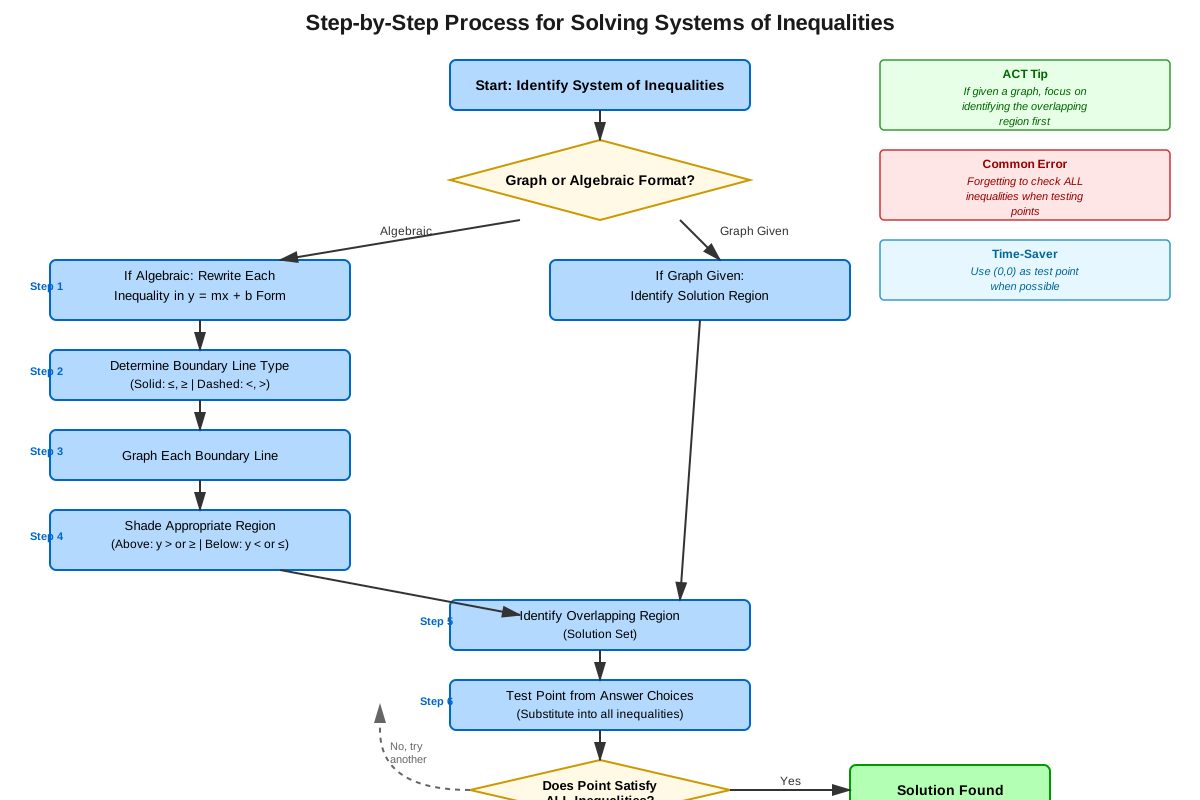
When approaching ACT questions on systems of inequalities, begin by identifying the question type: graphical interpretation, algebraic verification, or word problem translation. Each type requires a slightly different approach, but all benefit from systematic thinking.
Trigger words and phrases that signal systems of inequalities include: "shaded region," "satisfies both," "all constraints," "feasible," "at most," "at least," "no more than," "no less than," "maximum," "minimum," "combined total," and "simultaneously." When you see these phrases, immediately think about multiple conditions that must all be true.
For graphical questions, use this approach:
- Identify each boundary line by finding its equation (use two points to calculate slope and y-intercept)
- Determine whether each line is solid (≤ or ≥) or dashed (< or >)
- Identify which side of each line is shaded
- Write the inequality for each boundary
- Verify by testing a point that appears to be in the solution region
For algebraic verification questions (testing whether a point satisfies a system):
- Write down the point clearly
- Substitute into each inequality one at a time
- Evaluate each inequality completely before moving to the next
- Mark each as true or false
- The point is a solution only if ALL inequalities are true
For word problems:
- Define variables clearly (write them down!)
- Identify each constraint in the problem
- Translate each constraint into an inequality
- Don't forget non-negativity constraints when they make sense contextually
- Answer the specific question asked (feasibility, maximum value, etc.)
Process-of-elimination tips: On graphical questions, eliminate answer choices with incorrect line styles (solid vs. dashed) first—this often eliminates 2-3 options immediately. Next, check the direction of shading for one inequality; this typically eliminates 1-2 more options. For algebraic questions, if a point fails even one inequality, eliminate that answer choice immediately without checking the others.
Time allocation: Most systems of inequalities questions should take 45-60 seconds. If you're spending more than 90 seconds, you may be overcomplicating the problem. Graphical questions are typically faster (30-45 seconds) than word problems (60-90 seconds). If a question seems to require extensive calculation, look for a shortcut—the ACT rarely requires tedious arithmetic.
Exam Tip: When graphing is required, sketch quickly but accurately. You don't need perfect precision, but your sketch should clearly show which regions overlap. Use arrows to indicate unbounded regions and mark test points directly on your diagram.
Memory Techniques
SOLID mnemonic for remembering when to use solid vs. dashed lines:
- Solid lines for
- Or equal to
- Lines that are
- Included (≤ or ≥)
- Dashed for strict inequalities (< or >)
ABOVE/BELOW visualization: Picture the inequality symbol as an arrow pointing to the shading direction. For y > mx + b, the > symbol points up (shade above). For y < mx + b, the < symbol points down (shade below). This works because the "open" side of the symbol shows where y values are larger.
OVERLAP acronym for solving systems graphically:
- Orient yourself to the coordinate plane
- Verify each boundary line equation
- Establish line style (solid or dashed)
- Recognize shading direction for each inequality
- Locate the intersection region
- Assess whether the region is bounded
- Prove with a test point
Translation memory aid: "At MOST means LESS than or equal" and "At LEAST means GREATER than or equal." Remember: MOST and LESS both have 4 letters; LEAST and GREATER both have 6+ letters.
Vertical/Horizontal rule: For x inequalities, think "x-axis is horizontal, so x inequalities create vertical lines." For y inequalities, think "y-axis is vertical, so y inequalities create horizontal lines." This seems backward but helps prevent confusion.
Summary
Systems of inequalities represent multiple constraints that must be satisfied simultaneously, with solutions forming regions rather than single points. Mastery requires three interconnected skills: graphing individual inequalities with correct boundary lines (solid for ≤ or ≥, dashed for < or >) and appropriate shading (above for >, below for <), identifying solution regions as the intersection where all individual regions overlap, and translating word problems into mathematical inequalities using key phrases like "at most" (≤) and "at least" (≥). The ACT tests this topic through graphical interpretation questions, algebraic verification of specific points, and real-world application problems involving constraints. Success depends on systematic approaches: for graphical questions, identify each boundary line and its properties; for algebraic questions, test each inequality separately and require all to be true; for word problems, define variables clearly and translate each constraint methodically. Understanding that solutions must satisfy every inequality simultaneously—not just one or some—is fundamental to avoiding the most common errors on these high-yield ACT questions.
Key Takeaways
- The solution to a system of inequalities is the intersection (overlap) of all individual solution regions where every inequality is satisfied simultaneously
- Boundary line style depends on the inequality symbol: solid lines for ≤ or ≥ (boundary included), dashed lines for < or > (boundary excluded)
- Shading direction for y inequalities: above the line for y > or y ≥, below the line for y < or y ≤
- A point is a solution only if it satisfies ALL inequalities in the system—test each inequality separately and verify all are true
- Word problem translation requires identifying constraint phrases: "at most" means ≤, "at least" means ≥, "more than" means >, "less than" means <
- Vertical line inequalities (x > k or x < k) create left/right regions; horizontal line inequalities (y > k or y < k) create upper/lower regions
- Always verify solutions by testing a point from the suspected solution region in all inequalities of the system
Related Topics
Linear Programming: Building on systems of inequalities, linear programming finds optimal solutions (maximum or minimum values) within feasible regions defined by constraint inequalities. This topic extends the graphical and algebraic skills developed here to optimization problems.
Absolute Value Inequalities: These create V-shaped or inverted V-shaped boundary regions and require understanding how to graph and solve inequalities involving absolute value expressions, combining absolute value concepts with inequality reasoning.
Systems of Equations: While systems of equations find specific point solutions where lines intersect, they share solution methods (substitution, elimination) and graphical interpretation skills with systems of inequalities. Understanding both topics together provides comprehensive system-solving abilities.
Quadratic Inequalities: These involve parabolic boundaries rather than linear boundaries, requiring students to extend their understanding of solution regions to curved boundaries and regions above or below parabolas.
Piecewise Functions: These functions have different definitions on different intervals, often defined using inequalities to specify domains. Understanding systems of inequalities helps interpret and graph piecewise functions.
Practice CTA
Now that you've mastered the core concepts of systems of inequalities, it's time to solidify your understanding through active practice. Attempt the practice questions to apply these strategies to ACT-style problems, and use the flashcards to reinforce key facts and common question patterns. Remember: systems of inequalities questions are high-yield points on the ACT—consistent practice with these problem types will build both speed and accuracy. Each practice problem you complete strengthens your pattern recognition and deepens your conceptual understanding. You've got this!
Sign up free to keep reading
Create a free AnvayaPrep account to finish this ACT guide on Systems of inequalities — plus flashcards and practice questions.