Overview
The x-intercept is one of the most fundamental concepts in coordinate geometry and appears frequently throughout the ACT Math section. An x-intercept represents the point(s) where a graph crosses the x-axis, which occurs when the y-coordinate equals zero. Understanding x-intercepts is crucial not only for graphing functions but also for solving equations, analyzing quadratic functions, and interpreting real-world scenarios presented in word problems.
On the ACT, x-intercept questions appear in multiple forms: direct identification from graphs, algebraic calculation from equations, interpretation of zeros or roots, and application to real-world contexts. The concept connects deeply to solving equations, factoring polynomials, and understanding function behavior. Mastering x-intercepts provides the foundation for more advanced topics like systems of equations, polynomial functions, and rational expressions.
The ACT x-intercept questions typically test whether students can move fluidly between graphical and algebraic representations. Students must recognize that finding an x-intercept algebraically means setting y = 0 and solving for x, while graphically it means identifying where the curve touches or crosses the horizontal axis. This dual understanding—both visual and computational—is what separates high-scoring students from those who struggle with coordinate geometry questions.
Learning Objectives
- [ ] Identify when X-intercept is being tested in ACT questions
- [ ] Explain the core rule or strategy behind X-intercept
- [ ] Apply X-intercept to ACT-style questions accurately
- [ ] Convert between graphical and algebraic representations of x-intercepts
- [ ] Determine the number of x-intercepts from equations without graphing
- [ ] Interpret x-intercepts in real-world application problems
- [ ] Distinguish between x-intercepts, y-intercepts, and other key features of functions
Prerequisites
- Coordinate plane basics: Understanding ordered pairs (x, y) and how to plot points is essential because x-intercepts are specific points on the coordinate plane
- Solving linear equations: The ability to isolate variables and solve for x is required since finding x-intercepts involves setting y = 0 and solving
- Basic function notation: Familiarity with f(x) notation helps because x-intercepts occur where f(x) = 0
- Graphing fundamentals: Recognizing the x-axis and y-axis orientation is necessary for identifying intercepts visually
- Zero product property: Understanding that if ab = 0 then a = 0 or b = 0 is crucial for finding x-intercepts of factored equations
Why This Topic Matters
In real-world applications, x-intercepts represent critical transition points. In business, an x-intercept might show the break-even point where profit equals zero. In physics, it could represent when an object returns to ground level. In economics, x-intercepts can indicate where supply equals demand or where revenue equals cost. These practical applications make x-intercepts one of the most useful mathematical concepts beyond the classroom.
On the ACT Math section, x-intercept questions appear in approximately 3-5 questions per test, making them high-yield content for score improvement. These questions typically appear in the Preparing for Higher Math category, specifically within the Algebra subcategory. The ACT tests x-intercepts through direct graphing questions, algebraic manipulation problems, word problems requiring interpretation, and questions involving quadratic functions and their properties.
Common question formats include: identifying x-intercepts from a given graph, finding x-intercepts algebraically from an equation, determining how many x-intercepts a function has, interpreting what an x-intercept means in a word problem context, and using x-intercepts to write equations. The concept also appears indirectly in questions about roots, zeros, solutions, and factors of polynomials—all terms that are mathematically equivalent to x-intercepts in appropriate contexts.
Core Concepts
Definition and Fundamental Understanding
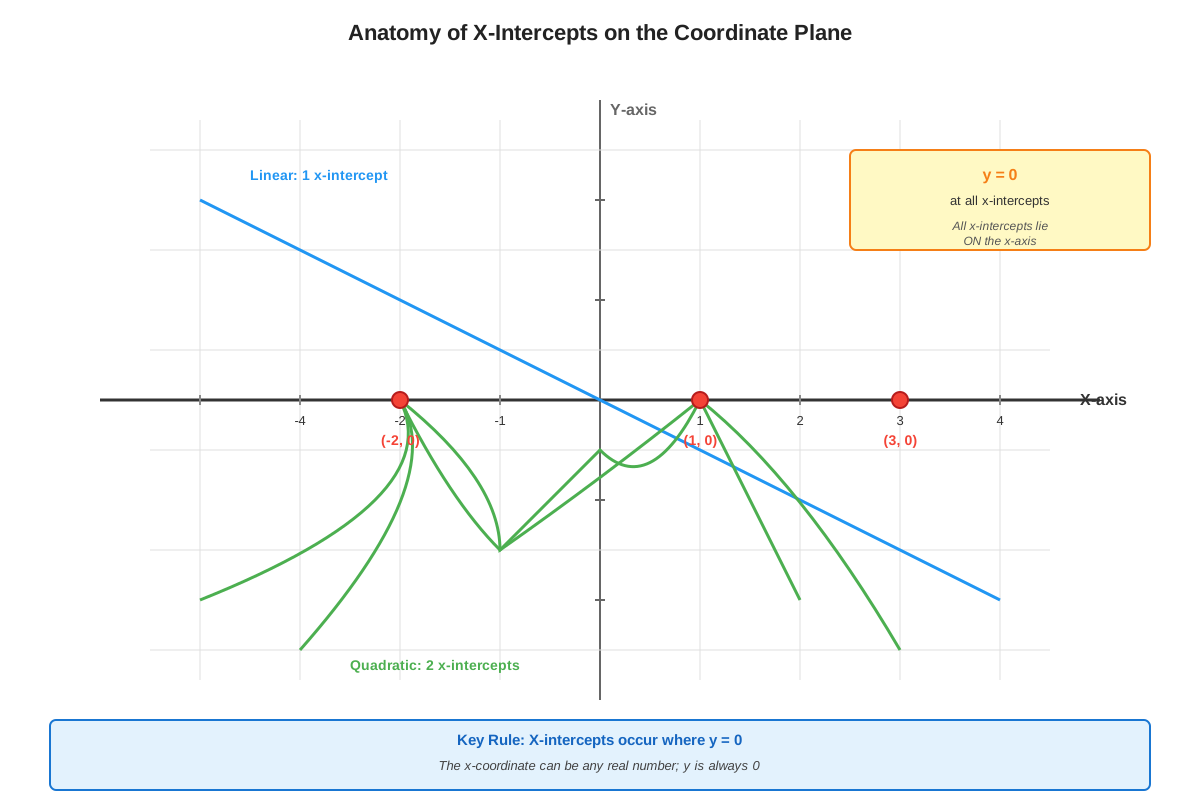
The x-intercept of a function or relation is the x-coordinate of any point where the graph intersects the x-axis. At these points, the y-coordinate is always zero because the x-axis is defined by the equation y = 0. An x-intercept can be expressed as an ordered pair (a, 0) where a is the x-intercept value, or simply as the value a itself. For example, if a parabola crosses the x-axis at x = 3 and x = -2, the x-intercepts are 3 and -2, or the points (3, 0) and (-2, 0).
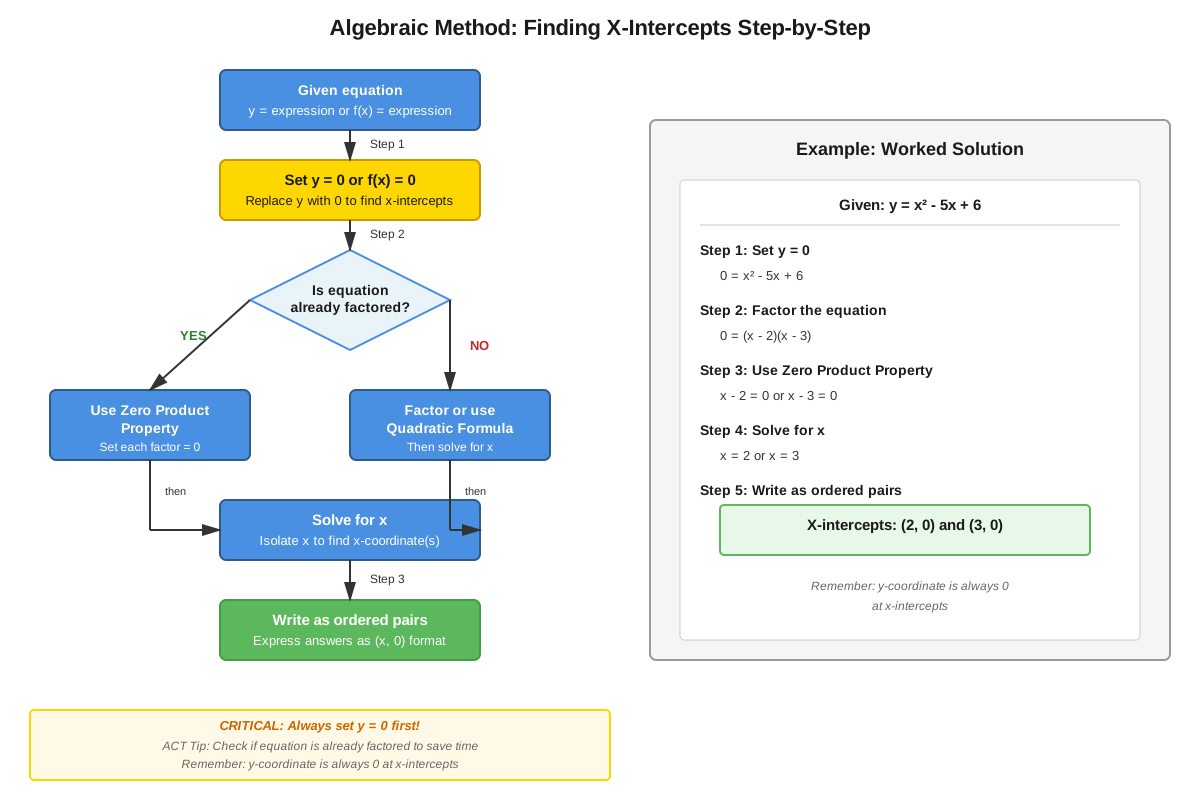
The terms zeros, roots, and solutions are closely related to x-intercepts. When we say "find the zeros of f(x)," we mean find the x-values where f(x) = 0, which are precisely the x-intercepts of the graph. Similarly, the roots of an equation like x² - 5x + 6 = 0 are the x-intercepts of the function y = x² - 5x + 6.
Algebraic Method for Finding X-Intercepts
To find x-intercepts algebraically, follow this systematic process:
- Set y = 0 (or f(x) = 0 if using function notation)
- Solve the resulting equation for x
- Express the answer as ordered pairs or as x-values depending on what the question asks
For a linear equation like y = 2x - 6:
- Set y = 0: 0 = 2x - 6
- Solve: 2x = 6, so x = 3
- The x-intercept is 3, or the point (3, 0)
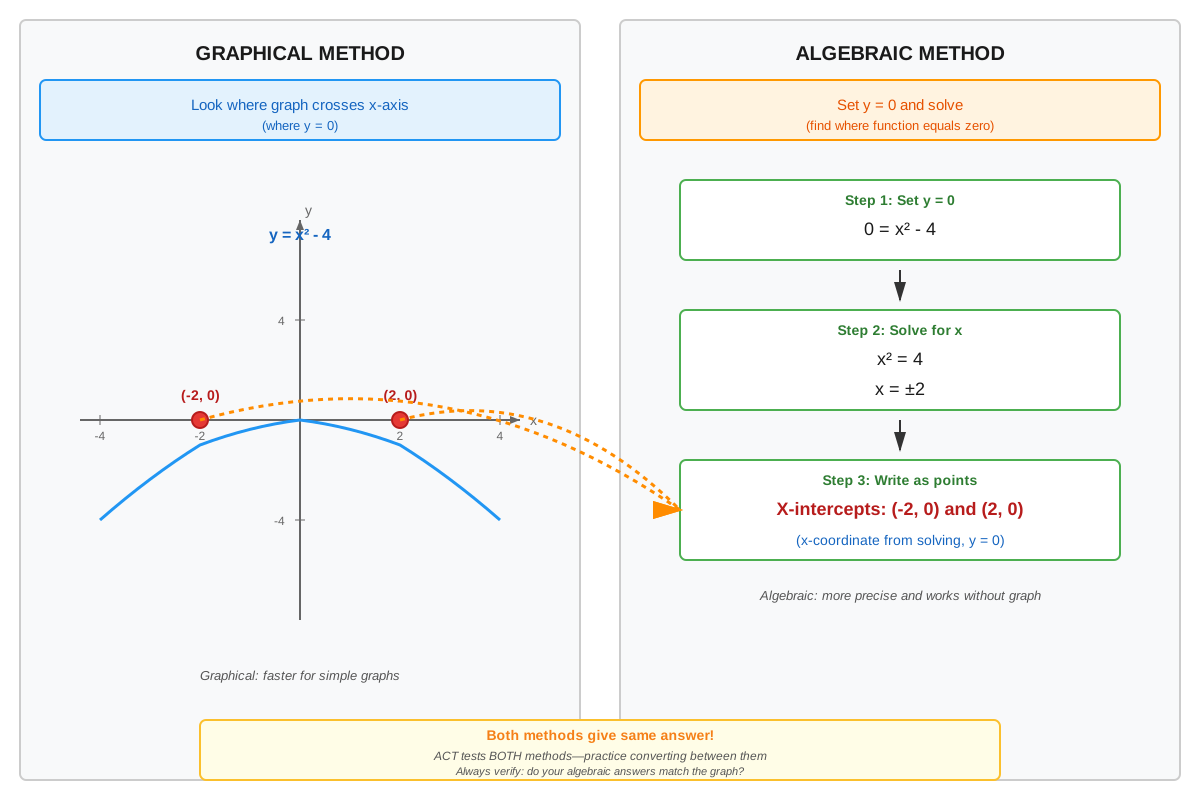
For a quadratic equation like y = x² - 4:
- Set y = 0: 0 = x² - 4
- Factor: 0 = (x + 2)(x - 2)
- Apply zero product property: x = -2 or x = 2
- The x-intercepts are -2 and 2, or the points (-2, 0) and (2, 0)
Number of X-Intercepts
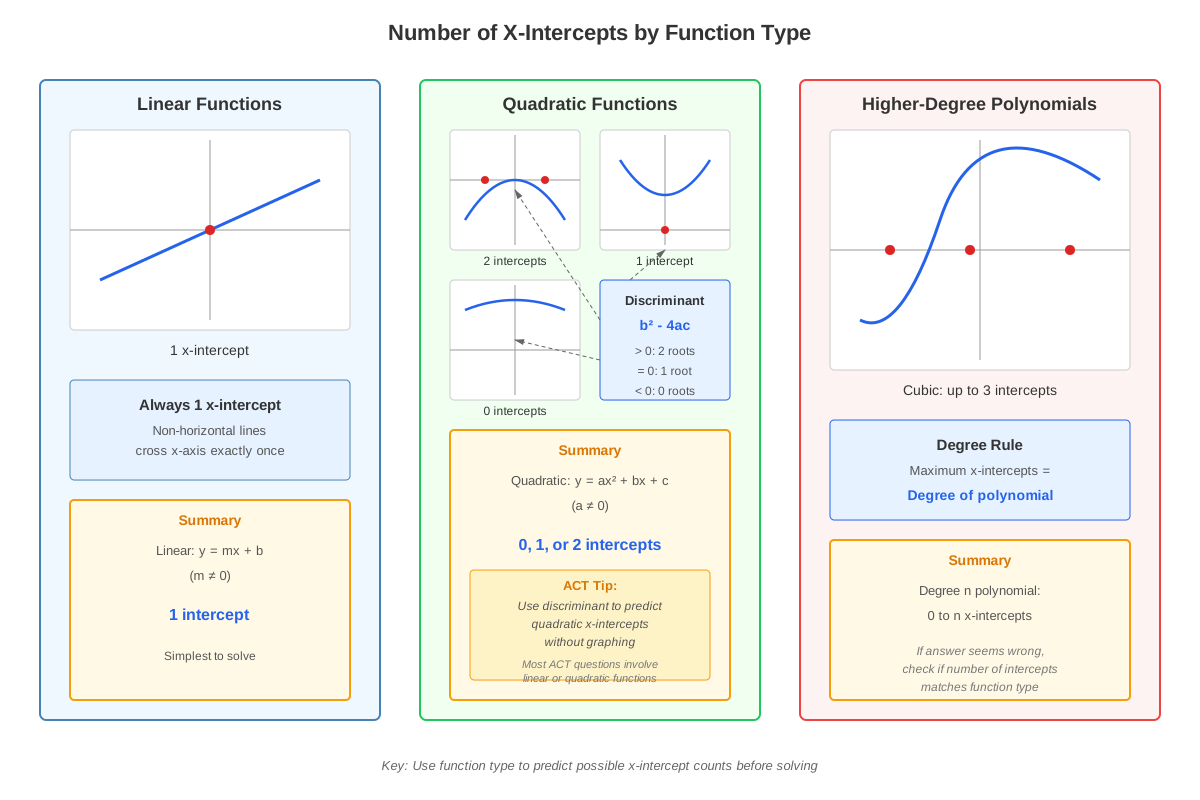
Different types of functions have different possibilities for the number of x-intercepts:
| Function Type | Possible Number of X-Intercepts | Notes |
|---|---|---|
| Linear (non-horizontal) | Exactly 1 | Exception: horizontal line y = c (where c ≠ 0) has 0 x-intercepts |
| Quadratic | 0, 1, or 2 | Determined by discriminant b² - 4ac |
| Cubic | 1, 2, or 3 | Must have at least one real x-intercept |
| Absolute value | 0, 1, or 2 | Depends on vertical shift |
| Circle | 0, 1, or 2 | Depends on position relative to x-axis |
For quadratic functions in the form y = ax² + bx + c, the discriminant (b² - 4ac) determines the number of x-intercepts:
- If b² - 4ac > 0: two distinct x-intercepts
- If b² - 4ac = 0: exactly one x-intercept (the parabola touches the x-axis at its vertex)
- If b² - 4ac < 0: no x-intercepts (the parabola doesn't reach the x-axis)
Graphical Identification
When identifying x-intercepts from a graph, look for points where the curve crosses or touches the x-axis. Key observations:
- Crossing: The graph passes through the x-axis, changing from positive to negative y-values or vice versa
- Touching: The graph touches the x-axis at exactly one point and bounces back (occurs at repeated roots)
- Multiple intercepts: Count each distinct point where the graph meets the x-axis
- No intercepts: The entire graph lies above or below the x-axis
Always read the x-coordinate carefully from the graph, paying attention to the scale of the axes. ACT graphs may use scales other than 1 unit per tick mark.
X-Intercepts in Factored Form
When a quadratic or polynomial is given in factored form, the x-intercepts can be identified immediately using the zero product property. For example:
- y = (x - 3)(x + 5) has x-intercepts at x = 3 and x = -5
- y = x(x - 7) has x-intercepts at x = 0 and x = 7
- y = (x + 2)² has one x-intercept at x = -2 (a repeated root)
Notice that if (x - a) is a factor, then x = a is an x-intercept. The sign inside the parentheses is opposite to the x-intercept value.
X-Intercepts vs. Y-Intercepts
Understanding the distinction between x-intercepts and y-intercepts prevents common errors:
| Feature | X-Intercept | Y-Intercept |
|---|---|---|
| Definition | Where graph crosses x-axis | Where graph crosses y-axis |
| Y-coordinate | Always 0 | Can be any value |
| X-coordinate | Can be any value | Always 0 |
| To find algebraically | Set y = 0, solve for x | Set x = 0, solve for y |
| Ordered pair form | (a, 0) | (0, b) |
Concept Relationships
The x-intercept concept serves as a central hub connecting multiple algebraic ideas. Solving equations → leads to → finding x-intercepts: when we solve an equation like 2x - 8 = 0, we're finding where the line y = 2x - 8 crosses the x-axis. This connection makes x-intercepts a visual representation of equation solutions.
Factoring → enables → quick x-intercept identification: when a quadratic is factored as y = (x - r₁)(x - r₂), the x-intercepts r₁ and r₂ are immediately visible. Conversely, knowing the x-intercepts allows us to write a factored form of the equation.
The discriminant → determines → number of x-intercepts: for quadratics, b² - 4ac tells us whether the parabola will cross the x-axis twice, once, or not at all. This connects quadratic formula concepts to graphical behavior.
X-intercepts → combine with → y-intercepts and vertex → to create → complete function graphs: these key features work together to define the shape and position of a function. Understanding all three allows for accurate sketching and interpretation.
Symmetry concepts → relate to → x-intercept positions: for parabolas, the axis of symmetry passes through the midpoint of the two x-intercepts (when they exist). This relationship helps verify calculations and estimate values.
Quick check — test yourself on X-intercept so far.
Try Flashcards →High-Yield Facts
⭐ The x-intercept occurs where y = 0 or f(x) = 0—this is the fundamental definition and the starting point for all algebraic calculations.
⭐ To find x-intercepts algebraically, always set y = 0 first, then solve the resulting equation for x.
⭐ X-intercepts, zeros, roots, and solutions are equivalent terms in the context of finding where a function equals zero.
⭐ A quadratic function can have 0, 1, or 2 x-intercepts, determined by the discriminant b² - 4ac.
⭐ In factored form y = (x - a)(x - b), the x-intercepts are x = a and x = b—note the sign change from the factored form.
- Linear functions (except horizontal lines) always have exactly one x-intercept.
- The x-coordinate of an x-intercept can be positive, negative, or zero.
- A function can have multiple x-intercepts but at most one y-intercept (to pass the vertical line test).
- When a graph touches but doesn't cross the x-axis, that x-intercept corresponds to a repeated root in the equation.
- The x-intercept of y = mx + b is found by solving 0 = mx + b, giving x = -b/m.
- For absolute value functions y = |x - h| + k, x-intercepts exist only when k ≤ 0.
- The sum of the x-intercepts of y = x² + bx + c equals -b (from Vieta's formulas).
Common Misconceptions
Misconception: The x-intercept is a y-value. → Correction: The x-intercept is an x-value (or a point with y-coordinate 0). When asked for "the x-intercept," provide the x-coordinate, not the y-coordinate.
Misconception: To find the x-intercept, set x = 0. → Correction: To find the x-intercept, set y = 0 (or f(x) = 0). Setting x = 0 finds the y-intercept instead. This is one of the most common errors on the ACT.
Misconception: All functions have at least one x-intercept. → Correction: Many functions have no x-intercepts. For example, y = x² + 5 never crosses the x-axis because it's always positive. Similarly, y = 3 (a horizontal line above the x-axis) has no x-intercept.
Misconception: If y = (x + 3)(x + 5), the x-intercepts are 3 and 5. → Correction: The x-intercepts are -3 and -5. When the factored form shows (x + a), the x-intercept is -a, not a. Use the zero product property: (x + 3) = 0 means x = -3.
Misconception: The x-intercept and the zero of a function are different things. → Correction: These terms refer to the same concept. The zeros of a function are the x-values where the function equals zero, which are precisely the x-coordinates of the x-intercepts.
Misconception: A parabola always has two x-intercepts. → Correction: A parabola can have two, one, or zero x-intercepts depending on its vertical position. A parabola opening upward with vertex above the x-axis has no x-intercepts.
Misconception: The x-intercept is where two lines cross. → Correction: The x-intercept is where a graph crosses the x-axis specifically. Where two lines cross each other is called the point of intersection, which is a different concept.
Worked Examples
Example 1: Finding X-Intercepts Algebraically from a Quadratic
Problem: Find all x-intercepts of the function f(x) = 2x² - 8x + 6.
Solution:
Step 1: Set f(x) = 0 to find where the function crosses the x-axis.
0 = 2x² - 8x + 6Step 2: Factor out the common factor of 2 to simplify.
0 = 2(x² - 4x + 3)Step 3: Factor the quadratic expression.
0 = 2(x - 3)(x - 1)Step 4: Apply the zero product property. Since 2 ≠ 0, we need:
(x - 3) = 0 or (x - 1) = 0Step 5: Solve each equation.
x = 3 or x = 1Answer: The x-intercepts are x = 1 and x = 3, or the points (1, 0) and (3, 0).
Connection to learning objectives: This example demonstrates applying the core strategy (setting y = 0) and shows the algebraic process for finding x-intercepts accurately, addressing objectives 2 and 3.
Example 2: Interpreting X-Intercepts in a Real-World Context
Problem: A company's profit in thousands of dollars is modeled by P(t) = -2t² + 12t - 10, where t is the number of years since 2020. What do the x-intercepts of this function represent, and when do they occur?
Solution:
Step 1: Understand what the x-intercept means in context. Since P(t) represents profit and t represents time, an x-intercept occurs when P(t) = 0, meaning zero profit (break-even point).
Step 2: Set P(t) = 0 and solve.
0 = -2t² + 12t - 10Step 3: Factor out -2.
0 = -2(t² - 6t + 5)Step 4: Factor the quadratic.
0 = -2(t - 5)(t - 1)Step 5: Apply zero product property.
t = 5 or t = 1Step 6: Interpret in context. Since t represents years since 2020:
- t = 1 corresponds to 2021
- t = 5 corresponds to 2025
Answer: The x-intercepts represent the break-even points when the company has zero profit. These occur at t = 1 year (2021) and t = 5 years (2025). Between these times (from 2021 to 2025), the company is profitable, and outside this interval, the company operates at a loss.
Connection to learning objectives: This example shows how to identify when x-intercepts are being tested in word problems and how to interpret them in real-world contexts, addressing objectives 1 and 6.
Exam Strategy
When approaching ACT questions about x-intercepts, first identify the question format. If given a graph, locate where the curve crosses the x-axis and read the x-coordinate carefully, checking the scale. If given an equation, immediately set y = 0 or f(x) = 0 and solve algebraically. If the equation is already factored, use the zero product property directly without expanding.
Trigger words and phrases that indicate x-intercept questions include: "zeros of the function," "roots of the equation," "solutions to the equation," "where the graph crosses the x-axis," "where f(x) = 0," "x-values when y = 0," and "break-even point" in word problems. Any time you see these phrases, think x-intercept.
For process of elimination, remember these principles:
- Eliminate any answer choice that gives a y-value when asked for an x-intercept
- If the question shows a graph with the function entirely above or below the x-axis, eliminate choices that claim x-intercepts exist
- For quadratic equations, calculate the discriminant quickly to eliminate impossible numbers of x-intercepts
- If you can test answer choices by substitution, plug them into the equation with y = 0 to verify
Time allocation: Simple x-intercept questions (reading from a graph or solving a linear equation) should take 30-45 seconds. Quadratic x-intercept problems requiring factoring should take 60-90 seconds. Word problems involving interpretation may take up to 2 minutes. If a problem requires the quadratic formula and complex calculations, consider whether you can eliminate answers or estimate first.
Quick verification technique: After finding x-intercepts algebraically, do a quick reasonableness check. For a parabola, the axis of symmetry should be exactly between the two x-intercepts. For any function, substitute your answer back into the equation with y = 0 to verify it works.
Memory Techniques
Mnemonic for finding x-intercepts: "X marks the spot where Y is not" — remember that x-intercepts occur where y = 0.
Mnemonic for intercept confusion: "X-intercept: Y is Zero" (XYZ in alphabetical order) — this helps remember to set y = 0 when finding x-intercepts.
Visual memory technique: Picture the x-axis as a horizontal line cutting through a graph. The x-intercepts are where the graph is "cut" by this line. Visualize the graph touching or crossing this horizontal barrier.
Factored form memory aid: "Opposite signs" — in factored form (x - a), the x-intercept is the opposite sign of what appears in the parentheses. If you see (x - 5), the intercept is +5; if you see (x + 3), the intercept is -3.
Discriminant memory: "Positive = 2, Zero = 1, Negative = None" — the sign of b² - 4ac tells you the number of x-intercepts for a quadratic: positive discriminant gives 2 intercepts, zero gives 1, negative gives none.
Summary
The x-intercept represents where a graph crosses the x-axis and is found by setting y = 0 and solving for x. This concept appears frequently on the ACT in various forms including direct calculation, graphical identification, and real-world interpretation. Understanding that x-intercepts are equivalent to zeros, roots, and solutions is crucial for recognizing when this concept is being tested. Linear functions have exactly one x-intercept (unless horizontal), while quadratic functions can have zero, one, or two x-intercepts depending on the discriminant. The ability to move between algebraic and graphical representations—solving equations to find intercepts and reading intercepts from graphs—is essential for ACT success. Factored form provides immediate access to x-intercepts through the zero product property, making it a powerful tool for quick solutions.
Key Takeaways
- The x-intercept is the x-coordinate where a graph crosses the x-axis; at this point, y always equals 0
- To find x-intercepts algebraically, set y = 0 (or f(x) = 0) and solve for x
- X-intercepts, zeros, roots, and solutions all refer to the same concept in appropriate contexts
- Quadratic functions can have 0, 1, or 2 x-intercepts, determined by the discriminant b² - 4ac
- In factored form y = (x - a)(x - b), the x-intercepts are x = a and x = b (note the sign change)
- Always distinguish between x-intercepts (where y = 0) and y-intercepts (where x = 0)
- X-intercepts have important real-world interpretations such as break-even points, ground level, and equilibrium positions
Related Topics
Y-intercepts: Understanding y-intercepts complements x-intercept knowledge and together they provide key points for graphing functions. Mastering x-intercepts makes learning y-intercepts straightforward since the process is parallel.
Quadratic Formula: This provides an alternative method for finding x-intercepts when factoring is difficult. Strong x-intercept understanding makes the quadratic formula more meaningful since you understand what the solutions represent graphically.
Vertex Form of Quadratics: The vertex and x-intercepts together define the complete shape of a parabola. Understanding x-intercepts helps you work with vertex form more effectively.
Systems of Equations: The solution to a system is where two graphs intersect, which extends the concept of intercepts to intersections between any two functions, not just with the axes.
Polynomial Functions: Higher-degree polynomials can have multiple x-intercepts, and understanding the fundamental concept with linear and quadratic functions prepares you for more complex polynomial behavior.
Practice CTA
Now that you've mastered the concept of x-intercepts, it's time to solidify your understanding through practice! Work through the practice questions to test your ability to find x-intercepts algebraically, identify them graphically, and interpret them in context. Use the flashcards to reinforce the key definitions and strategies. Remember, x-intercepts appear on nearly every ACT Math section, so investing time in practice now will pay dividends on test day. You've got this!
Sign up free to keep reading
Create a free AnvayaPrep account to finish this ACT guide on X-intercept — plus flashcards and practice questions.