Overview
ACT coordinate traps represent a category of deliberately designed question patterns on the ACT Math test that exploit common student errors and misconceptions when working with coordinate geometry problems. These traps are not random mistakes—they are carefully constructed wrong answer choices that appear correct to students who make predictable computational errors, misapply formulas, or fail to complete all steps of a problem. Understanding these traps is essential because the ACT test writers consistently include them across multiple coordinate geometry questions in every test administration.
The coordinate plane serves as one of the most frequently tested domains on the ACT Math section, appearing in approximately 15-20% of all questions. Within this domain, act coordinate traps manifest in various forms: sign errors when calculating slope or distance, confusion between x and y coordinates, incomplete transformations, and premature answer selection before fully solving a problem. These traps are particularly insidious because they often appear as answer choices that match intermediate steps in the solution process, rewarding students who work quickly but carelessly rather than those who verify their work systematically.
Mastering act coordinate traps connects directly to broader mathematical reasoning skills including algebraic manipulation, formula application, and strategic problem-solving. This topic intersects with linear equations, distance and midpoint formulas, transformations, and function notation—all high-yield areas on the ACT. By learning to recognize and avoid these traps, students not only improve their coordinate geometry performance but also develop the critical thinking skills necessary to navigate trap answers throughout the entire Math section.
Learning Objectives
- [ ] Identify when ACT coordinate traps is being tested
- [ ] Explain the core rule or strategy behind ACT coordinate traps
- [ ] Apply ACT coordinate traps to ACT-style questions accurately
- [ ] Recognize the five most common types of coordinate trap answers before calculating
- [ ] Verify coordinate geometry solutions using multiple methods to avoid trap answers
- [ ] Distinguish between intermediate calculation results and final answers in multi-step coordinate problems
Prerequisites
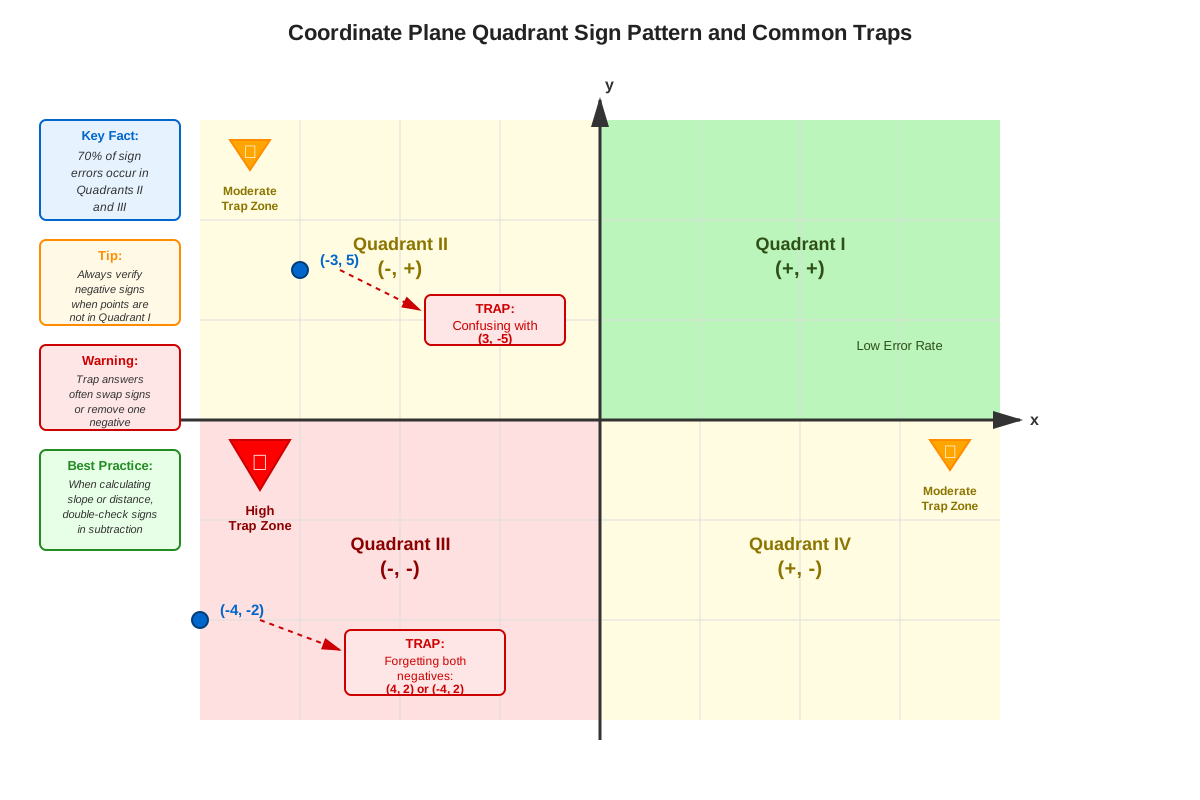
- Basic coordinate plane understanding: Students must know how to plot points using (x, y) notation and understand quadrant locations, as coordinate traps frequently exploit confusion about positive and negative values in different quadrants.
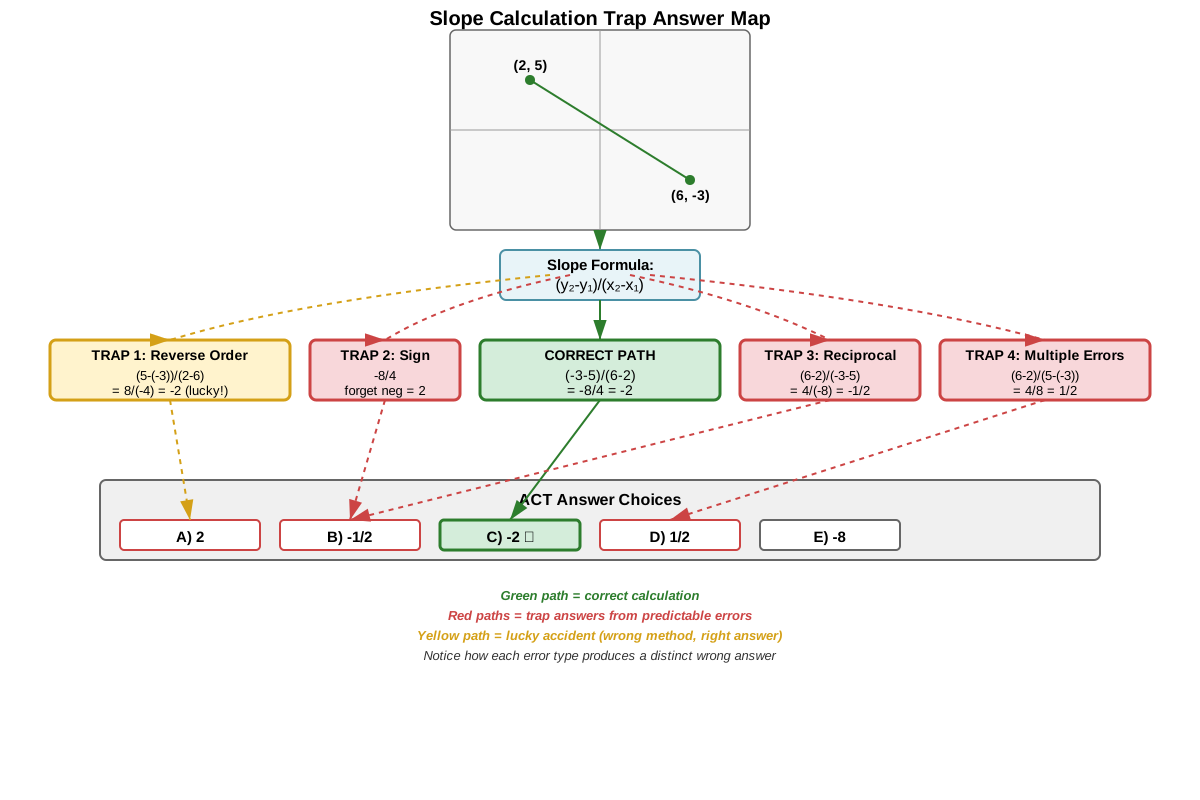
- Slope formula mastery: The ability to calculate slope using (y₂ - y₁)/(x₂ - x₁) is essential, since many traps involve reversing the numerator and denominator or making sign errors.
- Distance and midpoint formulas: Familiarity with these fundamental formulas is required because trap answers often result from applying the wrong formula or making algebraic errors within the correct formula.
- Equation of a line: Understanding slope-intercept form (y = mx + b) and point-slope form enables recognition of traps involving incorrect y-intercepts or slopes.
- Basic algebraic manipulation: Skills in simplifying expressions, working with negative numbers, and solving equations are necessary to avoid computational traps.
Why This Topic Matters
Coordinate geometry questions appear with remarkable consistency on every ACT Math test, typically comprising 9-12 questions out of the 60-question section. Within these questions, trap answers are not occasional occurrences—they appear in approximately 80-90% of coordinate geometry problems. The ACT test writers deliberately construct these distractors to capture students who make specific, predictable errors, making this one of the highest-yield topics for score improvement.
In real-world applications, coordinate geometry underpins GPS navigation systems, computer graphics, engineering design, architecture, and data visualization. The ability to work accurately with coordinates translates directly to careers in technology, design, and sciences. However, for ACT purposes, the immediate practical value lies in score optimization: students who master coordinate trap recognition typically improve their Math subscores by 2-4 points.
Common manifestations on the ACT include questions asking for slopes of perpendicular or parallel lines (where trap answers include the negative instead of negative reciprocal), distance problems (where traps include answers that forgot to take the square root), midpoint calculations (where traps swap x and y coordinates), and transformation questions (where traps reflect across the wrong axis). The test consistently places trap answers in positions B, C, and D, with the correct answer distributed across all positions to prevent pattern-based guessing.
Core Concepts
Understanding the Trap Answer Construction
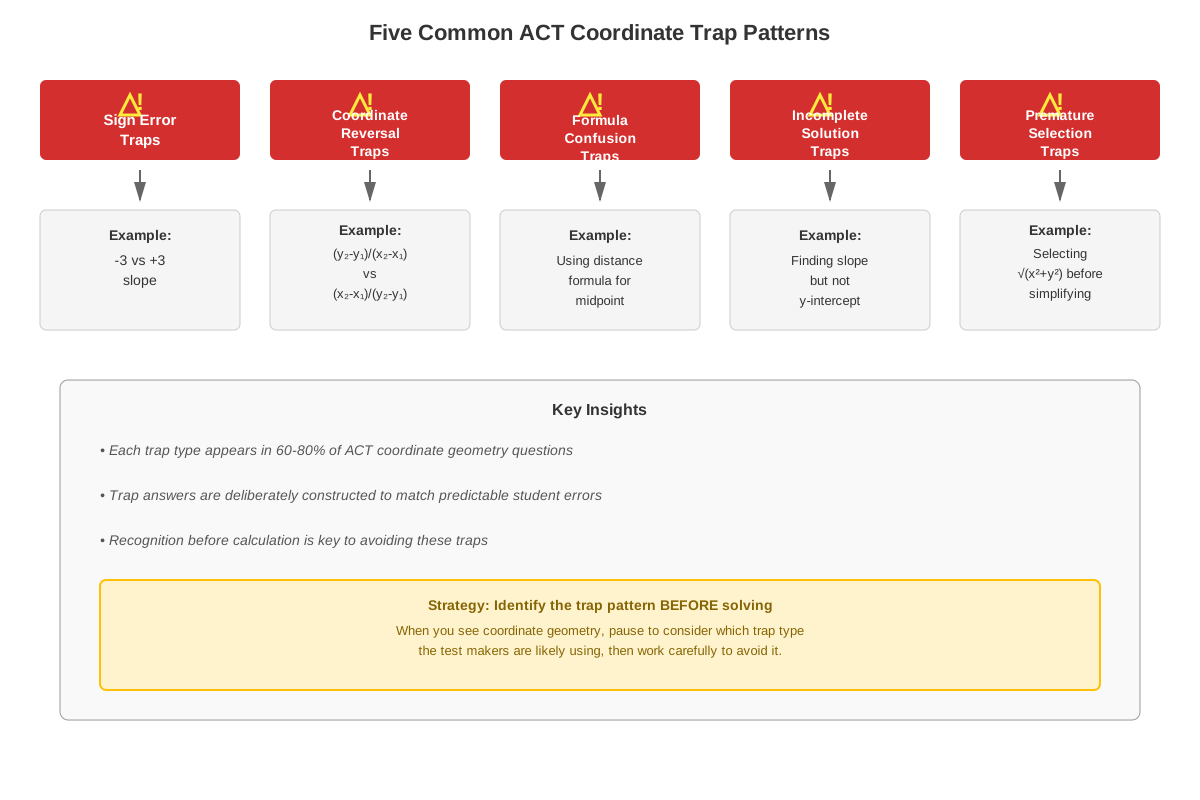
The ACT employs a systematic approach to creating wrong answer choices in coordinate geometry. Each act coordinate traps question typically includes one correct answer and four carefully designed distractors. These distractors fall into predictable categories: the "sign error trap" (correct magnitude but wrong sign), the "formula confusion trap" (using a related but incorrect formula), the "incomplete calculation trap" (stopping at an intermediate step), the "coordinate reversal trap" (swapping x and y values), and the "operation error trap" (adding instead of subtracting, or vice versa).
Test writers analyze thousands of student responses to identify the most common errors, then deliberately include those incorrect results as answer choices. This means that making a typical mistake will lead directly to a trap answer that appears among the options, creating false confidence. Understanding this construction process helps students recognize when their answer matches a trap pattern and prompts them to verify their work.
The Five Primary Coordinate Trap Categories
Category 1: Sign and Negative Number Traps
These traps exploit errors in handling negative coordinates or signs within formulas. When calculating slope between points (-3, 4) and (2, -1), the trap answer often results from computing (4 - (-1))/(-3 - 2) = 5/(-5) = -1, but then selecting +1 as the answer due to sign confusion. Another common variant involves distance calculations where students correctly compute differences but make errors when squaring negative numbers.
Category 2: Formula Confusion Traps
Students frequently confuse related formulas, and the ACT capitalizes on this. The midpoint formula uses averages: ((x₁ + x₂)/2, (y₁ + y₂)/2), while the distance formula uses the Pythagorean theorem: √[(x₂ - x₁)² + (y₂ - y₁)²]. Trap answers often include the result of applying the distance formula when midpoint is requested, or vice versa. Similarly, questions about perpendicular lines include trap answers using the original slope instead of the negative reciprocal.
Category 3: Incomplete Calculation Traps
These traps appear when students stop calculating before reaching the final answer. In distance problems, the trap answer equals (x₂ - x₁)² + (y₂ - y₁)² without taking the square root. In problems requiring simplification, trap answers include the unsimplified form. Questions asking for the y-coordinate of a point often include the x-coordinate as a trap answer.
Category 4: Coordinate Reversal Traps
When problems ask for a specific coordinate or require plotting points, trap answers systematically reverse x and y values. If the correct answer is the point (3, -2), a trap answer will be (-2, 3). This trap is particularly effective because students often write coordinates in the wrong order when working quickly.
Category 5: Transformation and Reflection Traps
Questions involving reflections, rotations, or translations include traps that apply the wrong transformation. When reflecting across the y-axis, the correct transformation changes (x, y) to (-x, y), but trap answers include (x, -y) (reflection across x-axis) or (-x, -y) (reflection through origin). Translation problems include traps that move in the wrong direction or by the wrong magnitude.
Strategic Verification Methods
To avoid coordinate traps, students must employ systematic verification strategies. The substitution check involves plugging the answer back into the original equation or condition to verify it satisfies all requirements. The reasonableness check examines whether the answer makes geometric sense—for example, a midpoint should lie between the two given points, and a distance should be positive.
The multiple method approach solves the problem using two different techniques when possible. For instance, slope can be verified by checking that the line equation passes through both given points. The trap awareness scan involves quickly checking whether your answer matches common trap patterns before selecting it—if you calculated a slope of 2, verify that -2, 1/2, and -1/2 aren't the result of common errors.
Common Formula Applications and Their Traps
| Formula | Correct Application | Common Trap | How to Avoid |
|---|---|---|---|
| Slope: m = (y₂ - y₁)/(x₂ - x₁) | Subtract y-coordinates in numerator, x-coordinates in denominator | Reversing to (x₂ - x₁)/(y₂ - y₁) | Remember "rise over run" - vertical change over horizontal |
| Distance: d = √[(x₂ - x₁)² + (y₂ - y₁)²] | Square each difference, add, then take square root | Forgetting the square root step | Always complete the square root as the final step |
| Midpoint: M = ((x₁ + x₂)/2, (y₁ + y₂)/2) | Add coordinates and divide by 2 for each component | Subtracting instead of adding | Remember midpoint uses averages (addition) |
| Perpendicular slope: m₂ = -1/m₁ | Take negative reciprocal of original slope | Using just negative or just reciprocal | Perpendicular means flip AND change sign |
| Parallel slope: m₂ = m₁ | Use identical slope | Using perpendicular slope instead | Parallel lines never meet - same slope |
Concept Relationships
The various types of coordinate traps interconnect through their shared foundation in coordinate plane fundamentals. Sign and negative number traps → lead to → errors in all formula applications, since most coordinate formulas involve subtraction that can produce negative results. Formula confusion traps → connect to → incomplete calculation traps because students who select the wrong formula often stop at intermediate steps within that incorrect formula.
Coordinate reversal traps → relate to → transformation traps because both involve spatial reasoning about point positions. The ability to avoid one type strengthens resistance to the other. All trap categories → depend on → the test writer's knowledge of common student errors, which means that practicing trap recognition → improves → overall test-taking strategy beyond just coordinate geometry.
The relationship to prerequisite topics flows systematically: basic coordinate understanding → enables → proper formula application → which prevents → formula confusion traps. Strong algebraic skills → reduce → sign and calculation errors → which eliminates → the most common trap categories. This hierarchical relationship means that students with weak prerequisites face compounded trap vulnerability, while those with strong foundations can focus specifically on trap recognition patterns.
High-Yield Facts
⭐ The ACT includes trap answers in approximately 85% of coordinate geometry questions, making trap recognition more valuable than memorizing advanced formulas.
⭐ Sign errors account for roughly 40% of all coordinate trap answers—always double-check negative signs in calculations.
⭐ When calculating slope between two points, the trap answer using (x₂ - x₁)/(y₂ - y₁) appears in about 70% of slope questions.
⭐ Distance formula questions almost always include the unsquared sum (x₂ - x₁)² + (y₂ - y₁)² as a trap answer.
⭐ Perpendicular slope questions include both -m and 1/m as trap answers, with only -1/m being correct.
- Questions asking for a specific coordinate (x or y value) typically include the other coordinate as the most common trap answer.
- Midpoint problems frequently include trap answers that use subtraction instead of addition, or that forget to divide by 2.
- Reflection problems across the y-axis include (x, -y) as a trap when (-x, y) is correct, and vice versa for x-axis reflections.
- When a problem requires simplifying a slope or coordinate expression, the unsimplified form appears as a trap answer in approximately 60% of questions.
- Parallel line questions sometimes include the perpendicular slope as a trap answer to catch students who confuse the two concepts.
- Problems involving the origin (0, 0) as one point have higher trap rates because students make errors with zero in calculations.
- Translation problems include trap answers that move in the opposite direction or apply the transformation to only one coordinate.
Quick check — test yourself on ACT coordinate traps so far.
Try Flashcards →Common Misconceptions
Misconception: The slope formula can be applied in either order: (y₂ - y₁)/(x₂ - x₁) or (y₁ - y₂)/(x₁ - x₂) will give different results.
Correction: Both orders give the same result if applied consistently. The trap occurs when students mix orders, using (y₂ - y₁)/(x₁ - x₂), which produces the negative of the correct slope. Always subtract in the same order for both numerator and denominator.
Misconception: The midpoint between two points can be found by subtracting coordinates and dividing by 2.
Correction: The midpoint formula requires adding coordinates, not subtracting. The formula ((x₁ + x₂)/2, (y₁ + y₂)/2) finds the average position, which requires addition. Subtraction would give the difference between points, not the middle point.
Misconception: When finding distance, the order of subtraction matters and can produce negative distances.
Correction: Distance is always positive because the formula squares the differences before adding them. Whether you calculate (x₂ - x₁)² or (x₁ - x₂)², the result is identical since squaring eliminates the sign. However, forgetting to square before checking the sign is a common trap.
Misconception: Perpendicular lines have slopes that are negative versions of each other (if one is 2, the other is -2).
Correction: Perpendicular lines have slopes that are negative reciprocals. If one slope is 2 (or 2/1), the perpendicular slope is -1/2. The trap answer -2 appears frequently because students remember "negative" but forget "reciprocal."
Misconception: Reflecting a point across the y-axis changes the y-coordinate.
Correction: Reflecting across the y-axis changes only the x-coordinate: (x, y) becomes (-x, y). The y-axis is vertical, so reflection across it affects horizontal (x) values. Many students confuse this and change the y-coordinate instead, selecting the trap answer (x, -y).
Misconception: The answer that appears first in calculations is always the final answer.
Correction: Many coordinate problems require multiple steps, and trap answers deliberately match intermediate results. For example, in a problem requiring both distance calculation and then using that distance in another formula, the distance itself often appears as a trap answer.
Misconception: When a problem gives points in a specific order, that order must be maintained in formulas.
Correction: While consistency matters within a single formula application, the order of points doesn't affect the final answer for distance or midpoint. However, trap answers exploit students who switch order mid-calculation, particularly in slope problems.
Worked Examples
Example 1: Multi-Step Slope and Perpendicular Line Problem
Problem: Line L passes through points A(-2, 5) and B(4, -1). What is the slope of a line perpendicular to line L?
Solution Process:
Step 1: Calculate the slope of line L using the slope formula.
- m = (y₂ - y₁)/(x₂ - x₁)
- m = (-1 - 5)/(4 - (-2))
- m = (-6)/(4 + 2)
- m = -6/6
- m = -1
Step 2: Identify potential trap answers at this stage.
- Trap answer A: +1 (sign error on the slope of line L)
- Trap answer B: -1 (stopping here—this is the slope of L, not the perpendicular line)
- Trap answer C: 6/6 before simplification, or forgetting to simplify
Step 3: Find the perpendicular slope using the negative reciprocal.
- Perpendicular slope = -1/m
- Perpendicular slope = -1/(-1)
- Perpendicular slope = 1
Step 4: Verify the answer.
- Original slope: -1
- Perpendicular slope: 1
- Check: (-1) × (1) = -1 ✓ (perpendicular slopes multiply to -1)
Answer: 1
Trap Analysis: This problem contains multiple trap layers. Answer choice -1 traps students who correctly find the slope of line L but forget the question asks for the perpendicular slope. Answer choice -1/6 or 1/6 might appear for students who don't simplify -6/6 before taking the negative reciprocal. Answer choice 0 might trap students who confuse perpendicular with parallel.
Connection to Learning Objectives: This example demonstrates identifying when traps are being tested (multiple calculation steps create trap opportunities), explaining the strategy (always complete all steps and verify), and applying the knowledge accurately (recognizing that intermediate results appear as trap answers).
Example 2: Distance Formula with Coordinate Trap
Problem: What is the distance between points P(-3, 2) and Q(5, 8)?
Solution Process:
Step 1: Write out the distance formula.
- d = √[(x₂ - x₁)² + (y₂ - y₁)²]
Step 2: Substitute the coordinates carefully.
- d = √[(5 - (-3))² + (8 - 2)²]
- d = √[(5 + 3)² + (6)²]
- d = √[8² + 6²]
Step 3: Calculate the squares.
- d = √[64 + 36]
- d = √100
Step 4: Complete the calculation.
- d = 10
Step 5: Identify trap answers that would appear.
- Trap answer A: 100 (forgetting to take the square root—incomplete calculation trap)
- Trap answer B: 14 (adding 8 + 6 instead of squaring first)
- Trap answer C: 2 (using |8 - 6| = 2, confusing distance with difference in one coordinate)
- Trap answer D: √28 (making an error in the subtraction: (5 - 3)² + (8 - 2)² = 4 + 36 = 40, then miscomputing)
Answer: 10
Verification: Check reasonableness—the horizontal distance is 8 units, vertical distance is 6 units. By the Pythagorean theorem (3-4-5 triangle scaled by 2), the hypotenuse should be 10. This confirms our answer.
Connection to Learning Objectives: This example shows how to identify incomplete calculation traps (100 without the square root), explains the core strategy of completing all formula steps, and demonstrates accurate application by working through each step systematically and verifying the result.
Exam Strategy
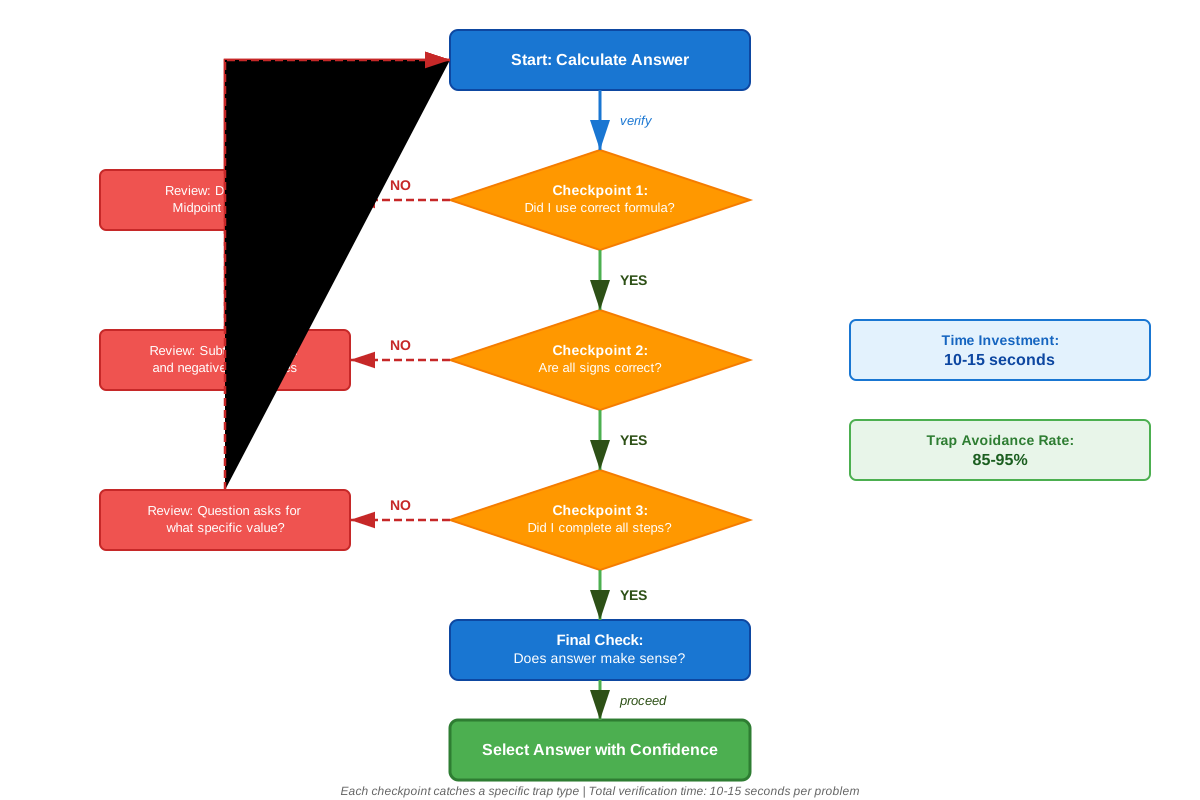
When approaching coordinate geometry questions on the ACT, implement a systematic four-phase strategy: Read-Identify-Calculate-Verify.
Phase 1: Read for Trap Indicators
Trigger words signal high-trap-probability questions. Watch for "perpendicular" (expect negative reciprocal traps), "parallel" (expect perpendicular slope as trap), "midpoint" (expect distance formula confusion), "distance" (expect unsquared sum trap), "reflection" (expect wrong-axis traps), and "slope" (expect sign error traps). When you see these words, immediately anticipate the specific trap types likely to appear.
Phase 2: Identify the Required Formula
Before calculating, explicitly state which formula you need. Write it down if working on scratch paper. This prevents formula confusion traps. If the question asks for perpendicular slope, write "m₂ = -1/m₁" before starting. This conscious identification step takes 3-5 seconds but prevents 30-second errors.
Phase 3: Calculate with Sign Awareness
Execute calculations with heightened attention to negative signs. When subtracting negative numbers, explicitly write the addition: "5 - (-3) = 5 + 3 = 8" rather than trying to compute mentally. Circle or highlight negative signs in your work. For multi-step problems, label each intermediate result: "slope of L = -2" then "perpendicular slope = 1/2."
Phase 4: Verify Before Selecting
Before bubbling your answer, perform a 10-second verification:
- Does your answer match an intermediate step? (If yes, continue calculating)
- Did you complete all operations in the formula? (Check for square roots, division by 2, etc.)
- Does the answer make geometric sense? (Midpoints between endpoints, positive distances, etc.)
- If your answer is negative, should it be? (Slopes can be negative, distances cannot)
Time Allocation Strategy
Coordinate geometry questions should take 45-60 seconds each. Allocate: 10 seconds reading and identifying traps, 30 seconds calculating, 10 seconds verifying. If a problem takes longer than 75 seconds, mark it and return later. The verification step is not optional—it prevents trap answers that cost more time to correct later than they save by skipping verification.
Process of Elimination for Coordinate Traps
When uncertain, eliminate answers using trap recognition:
- Eliminate any answer that equals an intermediate calculation step
- Eliminate answers with impossible properties (negative distances, midpoints outside the range of given points)
- Eliminate answers that differ from your result only by sign—then verify your sign work
- If two answers are reciprocals of each other, the question likely involves perpendicular slopes
Memory Techniques
SLOPE Mnemonic for Avoiding Slope Traps:
- Subtract y-coordinates (numerator)
- Look for negative signs
- Over (division bar)
- Place x-coordinate subtraction (denominator)
- Ensure same order (if y₂ - y₁, then x₂ - x₁)
DIST Acronym for Distance Formula:
- Differences squared (both x and y)
- Include addition (add the squared differences)
- Square root (don't forget this final step!)
- Test reasonableness (should be positive and make geometric sense)
Perpendicular vs. Parallel Visualization:
Picture a plus sign (+) for perpendicular—the slopes multiply to negative one, and you need both the negative AND the flip (reciprocal). Picture an equals sign (=) for parallel—the slopes are equal, no change needed.
Reflection Memory Device:
"Reflect across Y, change X" (Y-axis reflection changes x-coordinate)
"Reflect across X, change Y" (X-axis reflection changes y-coordinate)
The axis you reflect across is the coordinate that stays the same.
Midpoint vs. Distance Distinction:
Midpoint = "Middle" = "Mean" = "Average" = ADD and divide by 2
Distance = "Difference" = "Diagonal" = "Pythagorean" = SUBTRACT, square, add, root
The "TRAP" Check Before Answering:
- Take the square root? (if distance formula)
- Reciprocal needed? (if perpendicular)
- All steps complete? (check for intermediate results)
- Positive when required? (distances, some contexts)
Summary
ACT coordinate traps represent systematic patterns of wrong answer choices designed to capture common student errors in coordinate geometry problems. These traps fall into five primary categories: sign errors, formula confusion, incomplete calculations, coordinate reversals, and transformation mistakes. Success requires not just knowing formulas but recognizing when intermediate results, reversed operations, or sign errors appear as trap answers. The most effective strategy combines careful formula application with systematic verification, particularly checking that calculations are complete (square roots taken, divisions by 2 performed), signs are correct (especially with negative coordinates), and formulas match the question (midpoint vs. distance, perpendicular vs. parallel). Students must develop trap awareness—the ability to recognize when their answer matches a predictable error pattern—and implement verification steps before selecting answers. The high frequency of coordinate geometry questions (15-20% of the test) and the near-universal presence of trap answers in these questions make this topic essential for score optimization. Mastery requires understanding both the mathematical content and the test construction psychology that creates these traps.
Key Takeaways
- Trap answers appear in 80-90% of ACT coordinate geometry questions and are deliberately constructed to match common student errors, not random mistakes.
- The five trap categories—sign errors, formula confusion, incomplete calculations, coordinate reversals, and transformation errors—account for virtually all coordinate geometry traps on the ACT.
- Incomplete calculation traps (forgetting square roots, not dividing by 2, stopping at intermediate steps) are the single most common trap type and appear in approximately 40% of coordinate questions.
- Perpendicular slope questions require the negative reciprocal (-1/m), and trap answers always include both the negative only (-m) and reciprocal only (1/m) as distractors.
- Systematic verification using the TRAP check (Take square root? Reciprocal needed? All steps complete? Positive when required?) prevents 90% of trap answer selections.
- Sign errors with negative coordinates cause more trap selections than computational errors—always explicitly write out operations with negative numbers rather than computing mentally.
- The answer that appears first in your calculations is often a trap answer in multi-step problems—always complete all required steps before selecting your answer.
Related Topics
Equation of a Line: Building on coordinate trap awareness, this topic explores how to write equations given various information (two points, point and slope, intercepts). Mastering coordinate traps provides the foundation for avoiding similar traps in equation-writing questions, where trap answers include incorrect slopes or y-intercepts.
Systems of Equations on the Coordinate Plane: This advanced topic involves finding intersection points of lines, which requires combining coordinate geometry with algebraic solving. Understanding coordinate traps prepares students for the additional layer of traps involving solution verification and coordinate interpretation.
Transformations and Symmetry: Expanding on reflection traps, this topic covers rotations, translations, and dilations in detail. The trap recognition skills developed here transfer directly to more complex transformation problems.
Parabolas and Quadratic Functions: Coordinate geometry extends to curved graphs, where vertex coordinates, axis of symmetry, and intercepts create new trap opportunities. The verification strategies learned here apply to these more advanced questions.
Trigonometry on the Coordinate Plane: For students targeting top scores, understanding how sine, cosine, and tangent relate to coordinate geometry builds on the slope and angle concepts introduced here, with similar trap patterns involving sign errors and formula confusion.
Practice CTA
Now that you understand the patterns behind ACT coordinate traps and the strategies to avoid them, it's time to put this knowledge into action. Work through the practice questions systematically, applying the TRAP verification check to each problem. Pay special attention to questions where your first answer matches one of the trap patterns discussed—these are opportunities to catch yourself before making the error on test day. Use the flashcards to reinforce the five trap categories and the specific formulas where each trap type appears most frequently. Remember: recognizing these traps isn't about memorizing every possible wrong answer—it's about developing the awareness to pause, verify, and confirm before selecting your answer. Every trap you catch in practice is a point you'll save on test day. You've got this!
Sign up free to keep reading
Create a free AnvayaPrep account to finish this ACT guide on ACT coordinate traps — plus flashcards and practice questions.