Overview
The coordinate plane is one of the most fundamental and frequently tested concepts in ACT Math, appearing in approximately 15-20% of all math questions on the exam. This two-dimensional system, also known as the Cartesian plane, provides a framework for representing geometric figures, analyzing relationships between points, and solving algebraic problems visually. Mastery of the ACT coordinate plane is essential not only for direct coordinate geometry questions but also for understanding graphs of functions, systems of equations, and geometric transformations.
Understanding the coordinate plane serves as the foundation for multiple high-yield ACT topics including distance and midpoint formulas, slope calculations, equation of lines and circles, and graphical analysis of functions. Students who develop strong coordinate plane skills can quickly visualize problems, eliminate incorrect answer choices, and solve complex multi-step questions more efficiently. The coordinate plane bridges pure algebra and geometry, making it an indispensable tool for approximately 9-12 questions on every ACT Math section.
The coordinate plane's importance extends beyond isolated geometry problems—it appears in questions involving inequalities, absolute value functions, trigonometric graphs, and even some word problems that require spatial reasoning. Students who can fluently navigate the coordinate plane, identify key features of graphs, and translate between algebraic and geometric representations gain a significant advantage on test day. This guide provides comprehensive coverage of all coordinate plane concepts tested on the ACT, with particular emphasis on the question patterns and strategic approaches that lead to rapid, accurate solutions.
Learning Objectives
- [ ] Identify when Coordinate plane is being tested
- [ ] Explain the core rule or strategy behind Coordinate plane
- [ ] Apply Coordinate plane to ACT-style questions accurately
- [ ] Determine coordinates of points given geometric or algebraic constraints
- [ ] Analyze the relationship between algebraic equations and their graphical representations
- [ ] Calculate distances, midpoints, and slopes using coordinate plane formulas
- [ ] Identify transformations and symmetries of figures on the coordinate plane
Prerequisites
- Basic algebraic manipulation: Essential for working with coordinate equations and solving for unknown values in ordered pairs
- Understanding of positive and negative numbers: Required to navigate all four quadrants and interpret signed coordinates correctly
- Familiarity with geometric shapes: Necessary to recognize triangles, rectangles, circles, and other figures when plotted on the coordinate plane
- Basic graphing skills: Foundational for plotting points and understanding the relationship between x and y values
- Order of operations: Critical for evaluating coordinates and performing calculations with ordered pairs
Why This Topic Matters
The coordinate plane appears in real-world applications ranging from GPS navigation systems and computer graphics to architecture and engineering design. Any field requiring spatial reasoning or data visualization relies on coordinate systems. Understanding how to represent and manipulate information on a coordinate plane enables problem-solving in physics (position and velocity graphs), economics (supply and demand curves), and computer science (pixel positioning and game development).
On the ACT Math section, coordinate plane questions appear with remarkable consistency. Students can expect 9-12 questions directly involving coordinate geometry concepts, representing approximately 15-20% of the 60-question math section. These questions range from straightforward point identification (difficulty level 1-2) to complex problems involving multiple geometric concepts and algebraic reasoning (difficulty level 4-5). The coordinate plane also appears indirectly in function questions, inequality graphing, and transformation problems.
Common ACT question formats include: identifying coordinates of specific points on a graph; determining which graph represents a given equation; finding distances between points; calculating slopes of lines; identifying points of intersection; determining equations of lines passing through given points; analyzing geometric figures plotted on the plane; and interpreting transformations such as reflections, rotations, and translations. Questions often combine coordinate plane concepts with other topics, making this knowledge essential for maximizing overall math scores.
Core Concepts
Structure of the Coordinate Plane
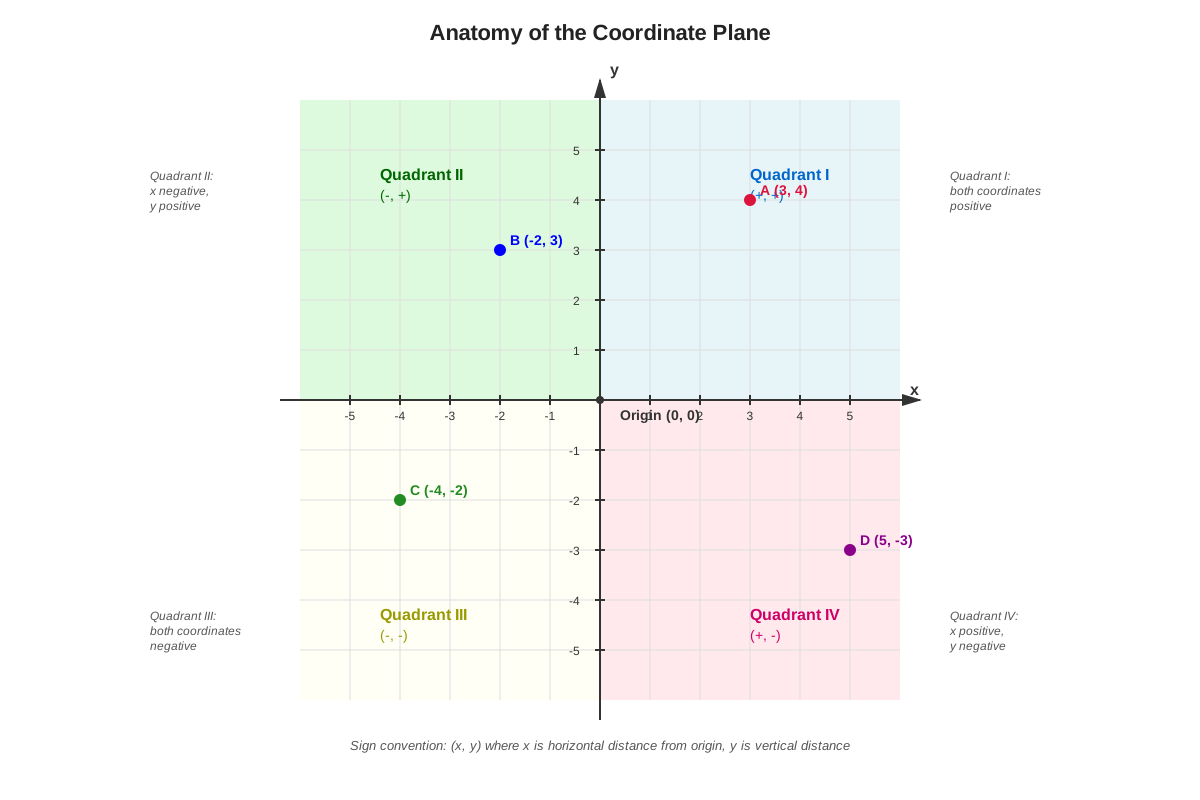
The coordinate plane consists of two perpendicular number lines that intersect at a point called the origin. The horizontal number line is the x-axis, and the vertical number line is the y-axis. These axes divide the plane into four regions called quadrants, numbered counterclockwise starting from the upper right: Quadrant I (both coordinates positive), Quadrant II (x negative, y positive), Quadrant III (both coordinates negative), and Quadrant IV (x positive, y negative).
Every point on the coordinate plane is identified by an ordered pair (x, y), where x represents the horizontal distance from the origin and y represents the vertical distance. The order matters critically: (3, 5) and (5, 3) represent completely different points. The x-coordinate is also called the abscissa, while the y-coordinate is called the ordinate, though these formal terms rarely appear on the ACT.
Plotting and Identifying Points
To plot a point (x, y), start at the origin, move x units horizontally (right if positive, left if negative), then move y units vertically (up if positive, down if negative). For example, to plot (-4, 3), move 4 units left and 3 units up. To identify coordinates of a plotted point, count the horizontal distance from the y-axis (this is x) and the vertical distance from the x-axis (this is y).
| Quadrant | x-coordinate | y-coordinate | Example Point |
|---|---|---|---|
| I | Positive | Positive | (3, 4) |
| II | Negative | Positive | (-2, 5) |
| III | Negative | Negative | (-6, -1) |
| IV | Positive | Negative | (7, -3) |
Distance Between Points
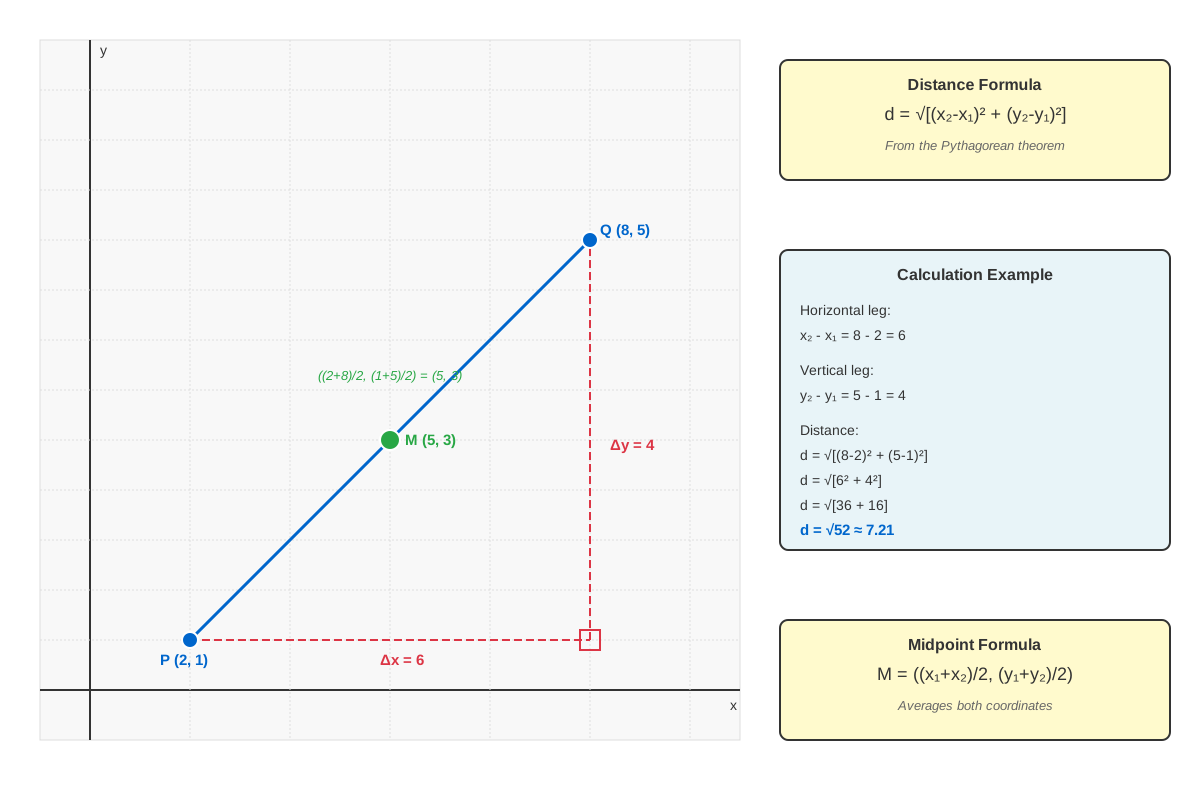
The distance formula calculates the straight-line distance between any two points on the coordinate plane. For points (x₁, y₁) and (x₂, y₂), the distance d is:
d = √[(x₂ - x₁)² + (y₂ - y₁)²]This formula derives directly from the Pythagorean theorem, treating the horizontal and vertical distances as legs of a right triangle. For example, the distance between (1, 2) and (4, 6) is √[(4-1)² + (6-2)²] = √[9 + 16] = √25 = 5.
Midpoint Formula
The midpoint of a line segment is the point exactly halfway between the endpoints. For points (x₁, y₁) and (x₂, y₂), the midpoint M is:
M = ((x₁ + x₂)/2, (y₁ + y₂)/2)Simply average the x-coordinates and average the y-coordinates separately. The midpoint of (2, 3) and (8, 11) is ((2+8)/2, (3+11)/2) = (5, 7).
Slope and Linear Relationships
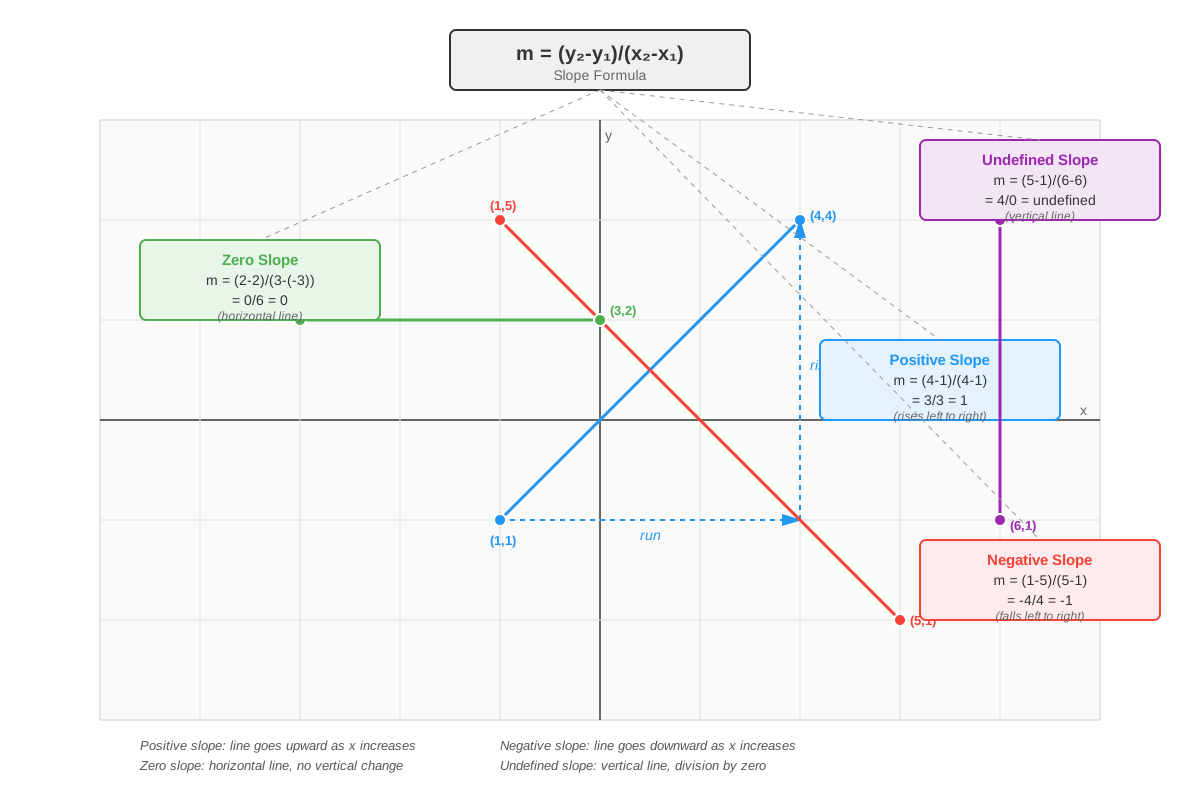
Slope measures the steepness and direction of a line, calculated as the ratio of vertical change to horizontal change. For points (x₁, y₁) and (x₂, y₂), slope m is:
m = (y₂ - y₁)/(x₂ - x₁)Positive slopes indicate lines rising from left to right; negative slopes indicate lines falling from left to right. A slope of zero indicates a horizontal line, while an undefined slope (division by zero) indicates a vertical line. Parallel lines have equal slopes, while perpendicular lines have slopes that are negative reciprocals (m₁ × m₂ = -1).
Equations of Lines
Lines on the coordinate plane can be expressed in multiple forms:
Slope-intercept form: y = mx + b, where m is slope and b is the y-intercept (where the line crosses the y-axis)
Point-slope form: y - y₁ = m(x - x₁), useful when you know a point and the slope
Standard form: Ax + By = C, where A, B, and C are integers
Converting between these forms is a common ACT skill. For example, the line through (2, 5) with slope 3 can be written as y - 5 = 3(x - 2), which simplifies to y = 3x - 1 in slope-intercept form.
Geometric Figures on the Coordinate Plane
Triangles, rectangles, circles, and other shapes can be analyzed using coordinate geometry. Key strategies include:
- Finding area: Use the coordinate-based area formula or break complex shapes into simpler components
- Determining perimeter: Calculate distances between consecutive vertices and sum them
- Identifying shape properties: Use slope to verify parallel or perpendicular sides, use distance to verify equal side lengths
- Locating centers: Use midpoint formulas to find centers of rectangles or diagonals
For example, a rectangle with vertices at (0, 0), (5, 0), (5, 3), and (0, 3) has width 5, height 3, and area 15 square units.
Reflections and Symmetry
Reflections across axes follow predictable patterns:
- Reflection across the x-axis: (x, y) → (x, -y)
- Reflection across the y-axis: (x, y) → (-x, y)
- Reflection across the origin: (x, y) → (-x, -y)
- Reflection across the line y = x: (x, y) → (y, x)
Understanding these transformations helps solve problems involving symmetry and geometric transformations quickly.
Concept Relationships
The coordinate plane serves as the foundational framework connecting multiple mathematical concepts. Ordered pairs → define → points on the plane → which form → geometric figures → whose properties can be analyzed using → distance, midpoint, and slope formulas. These formulas → enable calculation of → equations of lines → which can be graphed to → visualize algebraic relationships.
The coordinate plane connects directly to prerequisite knowledge of signed numbers (determining quadrants and calculating with negative coordinates) and basic geometry (recognizing shapes and their properties). It extends forward to more advanced topics including systems of equations (finding intersection points graphically), functions and their graphs (understanding domain, range, and transformations), conic sections (circles, parabolas, ellipses), and trigonometry (graphing sine and cosine functions).
Within coordinate geometry itself, concepts build hierarchically: understanding point location → enables → distance calculations → which support → circle equations (points equidistant from a center). Similarly, slope calculations → lead to → parallel and perpendicular line relationships → which inform → geometric proofs using coordinate methods. The midpoint formula → connects to → segment bisectors and geometric medians, while transformations → relate to → symmetry properties of functions and figures.
Quick check — test yourself on Coordinate plane so far.
Try Flashcards →High-Yield Facts
⭐ The origin has coordinates (0, 0) and is the intersection point of the x-axis and y-axis
⭐ In Quadrant I, both coordinates are positive; in Quadrant III, both are negative
⭐ The distance formula is d = √[(x₂ - x₁)² + (y₂ - y₁)²], derived from the Pythagorean theorem
⭐ The midpoint formula averages the x-coordinates and y-coordinates separately: ((x₁+x₂)/2, (y₁+y₂)/2)
⭐ Slope is calculated as rise over run: m = (y₂ - y₁)/(x₂ - x₁)
- Points on the x-axis have y-coordinate equal to zero; points on the y-axis have x-coordinate equal to zero
- Horizontal lines have slope of zero; vertical lines have undefined slope
- Parallel lines have equal slopes; perpendicular lines have slopes that are negative reciprocals
- The y-intercept is the y-coordinate where a line crosses the y-axis (found by setting x = 0)
- Reflecting a point across the x-axis changes the sign of the y-coordinate only
- The distance from any point to the origin is √(x² + y²)
- A circle with center (h, k) and radius r has equation (x - h)² + (y - k)² = r²
- The slope of a line through (x₁, y₁) and (x₂, y₂) equals the slope of any segment of that line
- If three points are collinear, the slope between any two pairs must be equal
- The area of a triangle with vertices at (x₁, y₁), (x₂, y₂), and (x₃, y₃) can be found using the coordinate formula: ½|x₁(y₂ - y₃) + x₂(y₃ - y₁) + x₃(y₁ - y₂)|
Common Misconceptions
Misconception: The coordinates (3, 5) and (5, 3) represent the same point.
Correction: Ordered pairs are position-dependent. The first number is always the x-coordinate (horizontal), and the second is always the y-coordinate (vertical). These points are in different locations—(3, 5) is 3 units right and 5 units up, while (5, 3) is 5 units right and 3 units up.
Misconception: Quadrant II is in the upper left, so both coordinates should be negative.
Correction: In Quadrant II, the x-coordinate is negative (left of the y-axis) but the y-coordinate is positive (above the x-axis). Only Quadrant III has both coordinates negative.
Misconception: The distance formula requires subtracting the smaller coordinate from the larger one.
Correction: The order of subtraction doesn't matter because the differences are squared, making them positive. (x₂ - x₁)² = (x₁ - x₂)², so you can subtract in either order.
Misconception: A line with a large slope is always longer than a line with a small slope.
Correction: Slope measures steepness (the ratio of vertical to horizontal change), not length. A line segment can have a very steep slope but be quite short, or have a gentle slope but be very long.
Misconception: The midpoint formula requires finding the distance first.
Correction: The midpoint formula is independent of distance—it simply averages the coordinates. You don't need to calculate distance to find the midpoint.
Misconception: Reflecting a point across the y-axis changes both coordinates' signs.
Correction: Reflection across the y-axis only changes the sign of the x-coordinate. The point (3, 4) reflected across the y-axis becomes (-3, 4), not (-3, -4).
Misconception: All lines have a defined slope.
Correction: Vertical lines have undefined slope because the denominator (x₂ - x₁) equals zero, and division by zero is undefined. Horizontal lines have slope zero, which is defined.
Misconception: If two lines intersect, they must be perpendicular.
Correction: Lines can intersect at any angle. Perpendicular lines are a special case where the angle of intersection is 90° and the slopes are negative reciprocals.
Worked Examples
Example 1: Multi-Step Coordinate Geometry Problem
Problem: Point A is located at (-2, 5) and point B is located at (4, -3). Find the distance between A and B, the midpoint of segment AB, and the slope of line AB.
Solution:
Step 1: Find the distance using the distance formula.
d = √[(x₂ - x₁)² + (y₂ - y₁)²]
d = √[(4 - (-2))² + (-3 - 5)²]
d = √[(4 + 2)² + (-8)²]
d = √[6² + 64]
d = √[36 + 64]
d = √100 = 10
The distance between A and B is 10 units.
Step 2: Find the midpoint using the midpoint formula.
M = ((x₁ + x₂)/2, (y₁ + y₂)/2)
M = ((-2 + 4)/2, (5 + (-3))/2)
M = (2/2, 2/2)
M = (1, 1)
The midpoint of segment AB is (1, 1).
Step 3: Find the slope using the slope formula.
m = (y₂ - y₁)/(x₂ - x₁)
m = (-3 - 5)/(4 - (-2))
m = -8/(4 + 2)
m = -8/6 = -4/3
The slope of line AB is -4/3.
Connection to Learning Objectives: This problem demonstrates the application of coordinate plane formulas to ACT-style questions, requiring accurate calculation with signed numbers and proper formula application—core skills for achieving mastery.
Example 2: Geometric Figure Analysis
Problem: A rectangle has vertices at A(1, 2), B(7, 2), C(7, 6), and D(1, 6). Verify that this is indeed a rectangle by checking that opposite sides are parallel and adjacent sides are perpendicular. Then find the area and perimeter.
Solution:
Step 1: Calculate slopes of all four sides.
Slope of AB: (2 - 2)/(7 - 1) = 0/6 = 0 (horizontal line)
Slope of BC: (6 - 2)/(7 - 7) = 4/0 = undefined (vertical line)
Slope of CD: (6 - 6)/(1 - 7) = 0/(-6) = 0 (horizontal line)
Slope of DA: (2 - 6)/(1 - 1) = -4/0 = undefined (vertical line)
Step 2: Verify rectangle properties.
AB and CD both have slope 0, so they are parallel (opposite sides).
BC and DA both have undefined slope, so they are parallel (opposite sides).
AB (slope 0) and BC (undefined slope) are perpendicular because horizontal and vertical lines always meet at 90°.
This confirms the figure is a rectangle.
Step 3: Calculate side lengths.
Length of AB: distance from (1, 2) to (7, 2) = √[(7-1)² + (2-2)²] = √36 = 6
Length of BC: distance from (7, 2) to (7, 6) = √[(7-7)² + (6-2)²] = √16 = 4
(Note: For horizontal or vertical segments, you can simply subtract coordinates: AB has length |7-1| = 6, BC has length |6-2| = 4)
Step 4: Calculate area and perimeter.
Area = length × width = 6 × 4 = 24 square units
Perimeter = 2(length + width) = 2(6 + 4) = 2(10) = 20 units
Connection to Learning Objectives: This example shows how to identify coordinate plane concepts being tested (geometric figures, slope, distance) and apply multiple strategies systematically to solve complex problems—essential skills for high ACT scores.
Exam Strategy
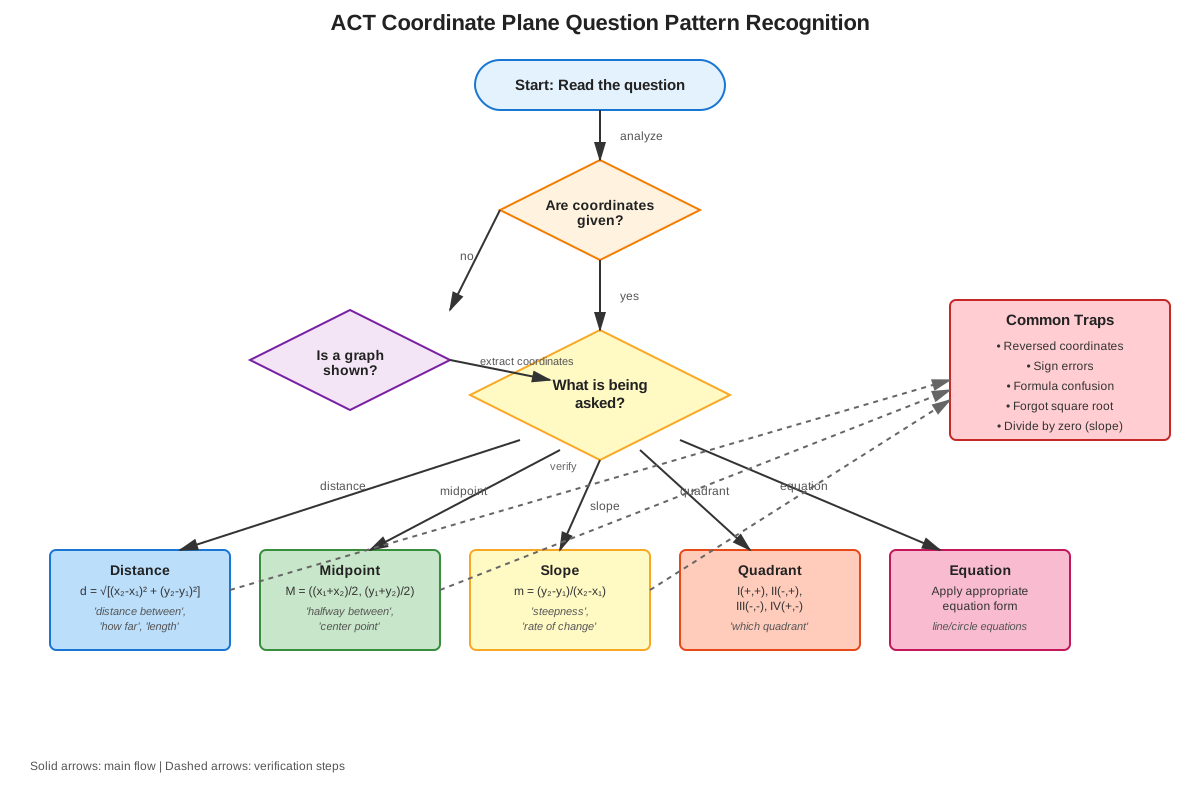
When approaching ACT coordinate plane questions, first identify what the question is asking: coordinates of a specific point, distance, midpoint, slope, equation of a line, or properties of a geometric figure. Look for trigger words such as "ordered pair," "distance between," "midpoint," "slope," "parallel," "perpendicular," "reflection," "x-intercept," "y-intercept," and "quadrant."
Strategic approach sequence:
- Draw a quick sketch if no graph is provided—visual representation prevents sign errors
- Label known points with their coordinates
- Identify which formula or concept applies
- Perform calculations carefully, watching signs of coordinates
- Check if your answer makes geometric sense (e.g., a distance should be positive)
For process of elimination, use these coordinate plane-specific strategies:
- Eliminate answer choices in the wrong quadrant when identifying points
- Eliminate distances that are smaller than either the horizontal or vertical distance alone
- Eliminate slopes with the wrong sign (positive vs. negative) based on line direction
- Eliminate equations that don't pass through given points by substituting coordinates
- Eliminate midpoints that aren't between the two given points
Time allocation: Simple point identification or slope calculation questions should take 30-45 seconds. Multi-step problems involving distance, midpoint, and additional calculations may require 60-90 seconds. If a problem requires more than 2 minutes, mark it and return later—coordinate plane questions rarely require complex reasoning, just careful calculation.
Common traps to avoid: Reversing x and y coordinates; forgetting to square before adding in the distance formula; forgetting to divide by 2 in the midpoint formula; sign errors when subtracting negative coordinates; confusing slope with distance; assuming all intersecting lines are perpendicular.
Exam Tip: When working with negative coordinates, write out the subtraction explicitly: (4 - (-2)) = (4 + 2) = 6. This prevents the most common source of errors on coordinate plane questions.
Memory Techniques
Quadrant Signs Mnemonic: "All Students Take Calculus" represents the signs in quadrants I, II, III, IV:
- All (Quadrant I): All positive (x positive, y positive)
- Students (Quadrant II): Sine positive (x negative, y positive)
- Take (Quadrant III): Tangent positive (x negative, y negative)
- Calculus (Quadrant IV): Cosine positive (x positive, y negative)
Distance Formula Memory: Think "Distance Differences Squared" → DDS → Differences of coordinates, squared, then square root.
Midpoint Formula Visualization: Picture a seesaw balanced at its center—the midpoint is the balance point, exactly halfway between the endpoints. To find halfway, you average.
Slope Direction Memory:
- Positive slope: "Going up as you go right" (like climbing uphill)
- Negative slope: "Going down as you go right" (like skiing downhill)
- Zero slope: "Horizontal = Zero effort to walk" (flat ground)
- Undefined slope: "Vertical = Undefined because you can't walk through a wall"
Reflection Rules Acronym: "X-axis flips Y" and "Y-axis flips X" → When reflecting across an axis, flip the coordinate that's NOT the axis name.
Perpendicular Slopes: "Perpendicular slopes are negative reciprocals" → Remember "flip and negate": if one slope is 2/3, the perpendicular slope is -3/2.
Summary
The coordinate plane is a two-dimensional system defined by perpendicular x and y axes that intersect at the origin (0, 0), dividing the plane into four quadrants with distinct sign patterns for coordinates. Every point is identified by an ordered pair (x, y), where order matters critically. Mastery of the coordinate plane requires fluency with three essential formulas: the distance formula √[(x₂-x₁)² + (y₂-y₁)²], the midpoint formula ((x₁+x₂)/2, (y₁+y₂)/2), and the slope formula (y₂-y₁)/(x₂-x₁). These formulas enable analysis of geometric figures, equations of lines, and transformations. Understanding quadrant sign patterns, recognizing parallel lines (equal slopes) and perpendicular lines (negative reciprocal slopes), and accurately plotting and identifying points are fundamental skills tested repeatedly on the ACT. Success requires careful attention to coordinate signs, systematic application of formulas, and the ability to translate between algebraic expressions and geometric representations on the coordinate plane.
Key Takeaways
- The coordinate plane consists of perpendicular x and y axes creating four quadrants with predictable sign patterns for coordinates
- The distance formula, midpoint formula, and slope formula are the three essential calculations for ACT coordinate plane questions
- Ordered pairs (x, y) are position-dependent—reversing the order creates a different point
- Slope indicates direction and steepness: positive slopes rise, negative slopes fall, zero slopes are horizontal, and undefined slopes are vertical
- Parallel lines have equal slopes; perpendicular lines have slopes that are negative reciprocals (product equals -1)
- Reflections across axes follow simple rules: x-axis reflection changes y-coordinate sign, y-axis reflection changes x-coordinate sign
- Visual sketching prevents sign errors and helps verify that calculated answers make geometric sense
Related Topics
Distance and Midpoint Applications: Building on basic coordinate plane skills, this topic explores more complex problems involving segment bisectors, geometric medians, and optimization problems requiring distance calculations.
Equations of Lines and Linear Functions: Mastery of the coordinate plane enables understanding of slope-intercept form, point-slope form, and standard form equations, as well as graphing linear relationships and finding equations from geometric information.
Circles on the Coordinate Plane: The coordinate plane provides the framework for understanding circle equations (x-h)² + (y-k)² = r², finding centers and radii, and solving problems involving tangent lines and points of intersection.
Transformations and Symmetry: Advanced coordinate geometry includes translations, rotations, dilations, and compositions of transformations, all building on fundamental coordinate plane understanding.
Systems of Equations and Inequalities: Graphical solutions to systems require plotting lines and regions on the coordinate plane and identifying intersection points or solution regions.
Practice CTA
Now that you've mastered the fundamental concepts of the coordinate plane, it's time to solidify your understanding through active practice. Attempt the practice questions to apply these formulas and strategies to ACT-style problems, and use the flashcards to reinforce the high-yield facts and formulas you'll need to recall quickly on test day. Remember, coordinate plane questions appear on every ACT Math section—your investment in mastering this topic will pay dividends across multiple questions and help you achieve your target score. Start practicing now to build the speed and accuracy that separate good scores from great ones!
Sign up free to keep reading
Create a free AnvayaPrep account to finish this ACT guide on Coordinate plane — plus flashcards and practice questions.