Overview
The axis of symmetry is a fundamental concept in coordinate geometry that appears frequently on the ACT Math test. This vertical line divides a parabola into two mirror-image halves, serving as a critical tool for understanding quadratic functions and their graphical representations. On the ACT, questions involving the axis of symmetry typically require students to identify this line from a graph, calculate it from an equation, or use it to determine other properties of parabolas such as vertex location or x-intercepts.
Understanding the axis of symmetry is essential because it connects algebraic and geometric representations of quadratic functions. When students master this concept, they can quickly solve problems involving parabolas, optimize quadratic expressions, and verify their answers through symmetry properties. The ACT axis of symmetry questions often appear in the context of coordinate geometry problems, function analysis, and real-world modeling scenarios where parabolic relationships exist.
This topic integrates seamlessly with broader mathematical concepts including quadratic functions, vertex form equations, factoring, and the quadratic formula. The axis of symmetry serves as a bridge between these algebraic techniques and their visual representations on the coordinate plane. Mastery of this concept enables students to approach multiple-choice questions more efficiently and provides a powerful checking mechanism for verifying solutions to quadratic problems.
Learning Objectives
- [ ] Identify when Axis of symmetry is being tested in ACT questions
- [ ] Explain the core rule or strategy behind Axis of symmetry
- [ ] Apply Axis of symmetry to ACT-style questions accurately
- [ ] Calculate the axis of symmetry from standard form, vertex form, and factored form equations
- [ ] Use the axis of symmetry to determine the x-coordinate of a parabola's vertex
- [ ] Apply symmetry properties to find corresponding points on a parabola
- [ ] Recognize the relationship between the axis of symmetry and the roots of a quadratic equation
Prerequisites
- Quadratic functions and equations: Understanding the general form y = ax² + bx + c is essential for applying the axis of symmetry formula
- Coordinate plane basics: Familiarity with plotting points and understanding x and y coordinates enables visualization of the axis of symmetry
- Vertical and horizontal lines: Recognizing that vertical lines have equations of the form x = k helps identify the axis of symmetry equation
- Basic algebraic manipulation: Skills in substitution and solving equations are necessary for finding and using the axis of symmetry
- Parabola properties: Knowledge that parabolas are U-shaped curves helps understand why symmetry exists
Why This Topic Matters
The axis of symmetry appears in approximately 2-4 questions per ACT Math test, making it a high-yield topic that directly impacts scores. These questions typically appear in the Coordinate Geometry and Functions categories, which together comprise roughly 20-25% of the entire Math section. Understanding this concept can quickly earn students multiple points, especially since axis of symmetry questions often serve as gateways to more complex multi-step problems.
In real-world applications, the axis of symmetry helps model projectile motion, optimize business profits, design architectural structures, and analyze physical phenomena. Engineers use this concept when designing parabolic reflectors for satellite dishes and headlights. Economists apply it when finding maximum profit or minimum cost points in quadratic cost functions. Athletes and coaches utilize parabolic trajectories to optimize throwing angles and distances.
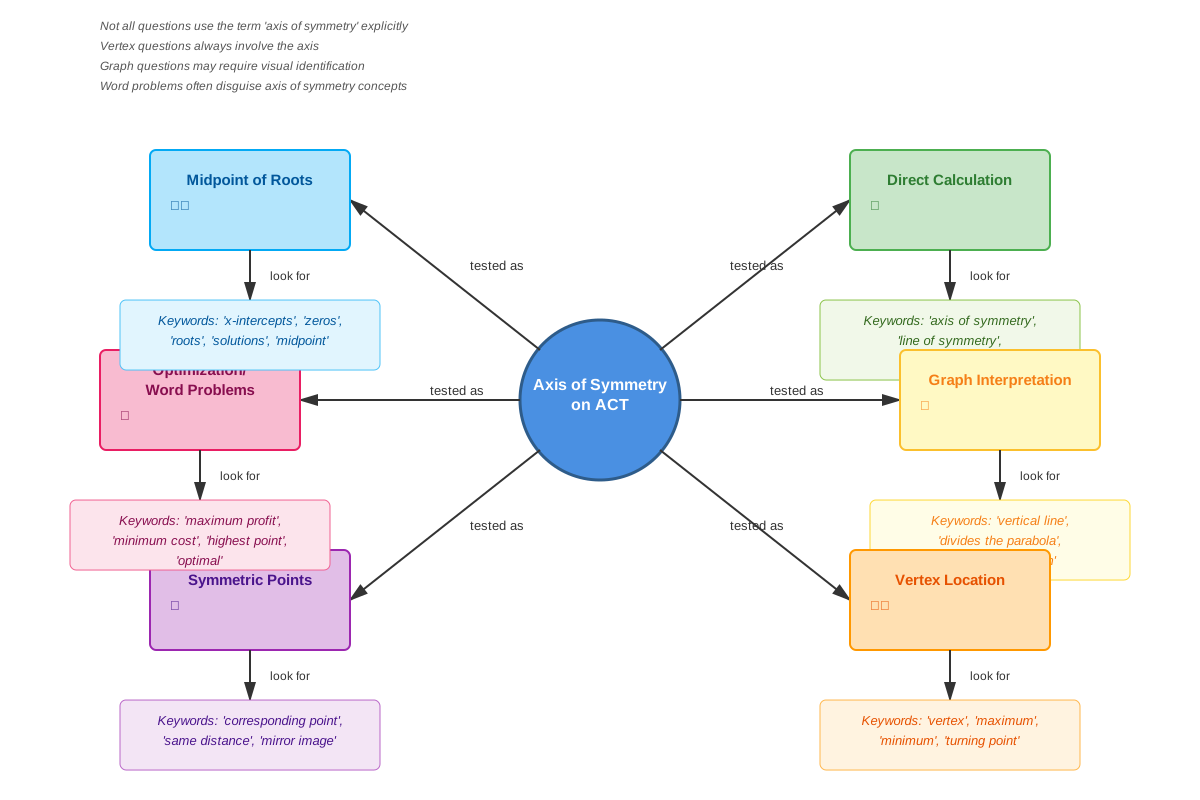
On the ACT, axis of symmetry questions commonly appear as: direct calculation problems asking for the equation of the axis; graph interpretation questions requiring identification of the symmetry line; word problems involving optimization where the axis represents the optimal value; and multi-step problems where finding the axis is an intermediate step toward determining the vertex, maximum/minimum value, or other parabola properties. Questions may present quadratic functions in standard form, vertex form, or factored form, requiring flexible application of the concept.
Core Concepts
Definition and Fundamental Properties
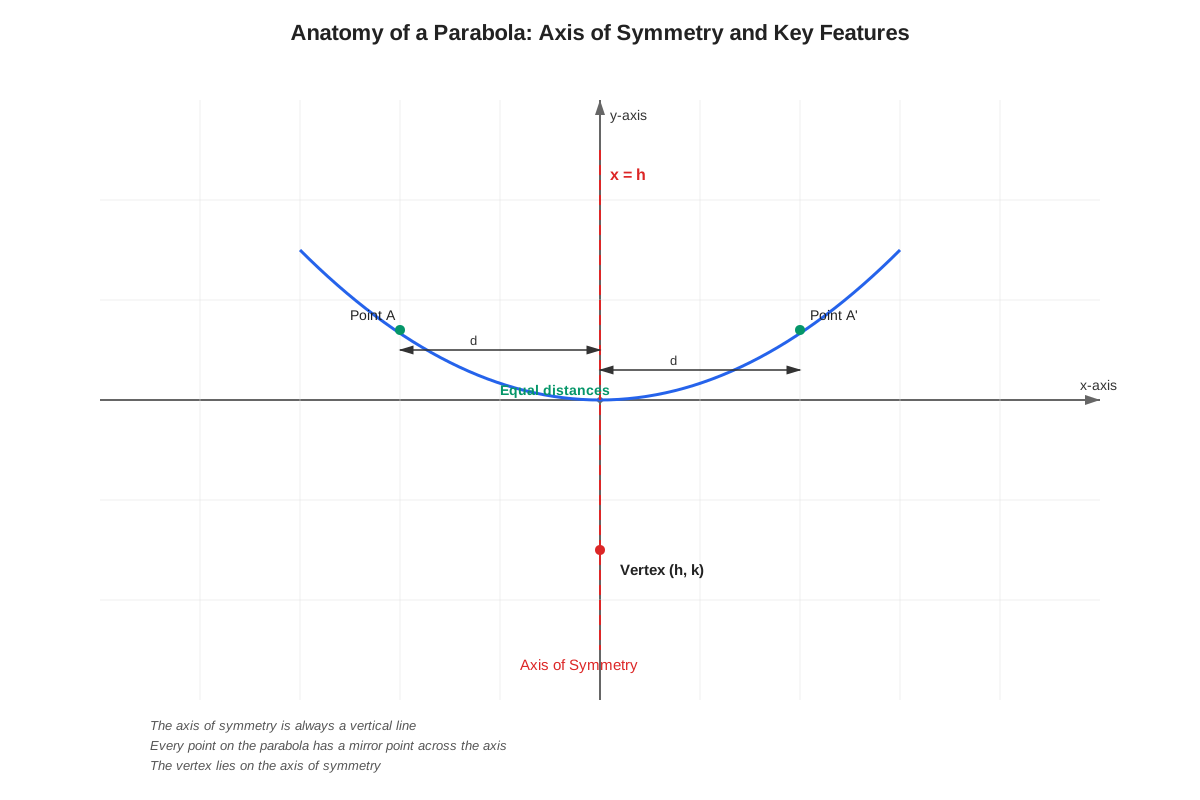
The axis of symmetry is a vertical line that divides a parabola into two congruent halves that are mirror images of each other. For any quadratic function, this line passes through the vertex of the parabola and has the equation x = h, where h is a constant. Every point on the parabola has a corresponding point on the opposite side of the axis at the same distance from the line.
The axis of symmetry possesses several key properties that make it invaluable for problem-solving. First, it is always a vertical line, never horizontal or diagonal. Second, it always passes through the vertex, which is the highest or lowest point on the parabola depending on whether it opens downward or upward. Third, if a parabola has x-intercepts (real roots), the axis of symmetry is located exactly halfway between them. Fourth, any horizontal line that intersects the parabola at two points will have those points equidistant from the axis of symmetry.
Formula for Standard Form
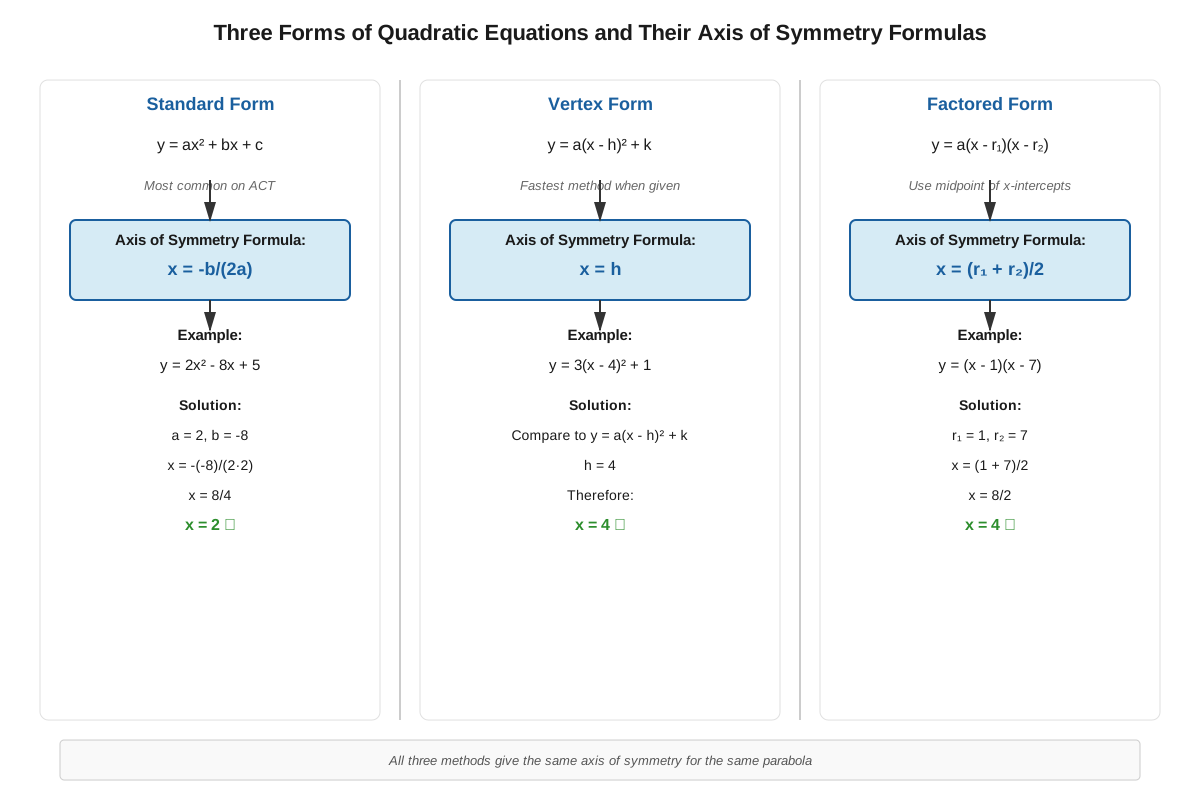
For a quadratic function written in standard form y = ax² + bx + c, the axis of symmetry has the equation:
x = -b/(2a)This formula is the most commonly tested on the ACT and must be memorized. The variables a and b come directly from the coefficients in the standard form equation. For example, in the function y = 2x² - 8x + 5, we have a = 2 and b = -8, so the axis of symmetry is:
x = -(-8)/(2·2) = 8/4 = 2The axis of symmetry is therefore the vertical line x = 2. This formula works regardless of whether the parabola opens upward (a > 0) or downward (a < 0).
Formula for Vertex Form
When a quadratic function is written in vertex form y = a(x - h)² + k, the axis of symmetry is simply:
x = hThe value h represents the x-coordinate of the vertex, and since the axis of symmetry passes through the vertex, this becomes the equation of the axis. For example, if y = 3(x - 5)² + 2, the axis of symmetry is x = 5. Students must be careful with the sign: the vertex form shows (x - h), so if the equation is y = 2(x + 4)² - 1, this is actually y = 2(x - (-4))² - 1, making h = -4 and the axis of symmetry x = -4.
Finding Axis from Factored Form
When a quadratic is presented in factored form y = a(x - r₁)(x - r₂), where r₁ and r₂ are the roots (x-intercepts), the axis of symmetry lies exactly halfway between the two roots:
x = (r₁ + r₂)/2For instance, if y = (x - 3)(x + 7), the roots are x = 3 and x = -7. The axis of symmetry is:
x = (3 + (-7))/2 = -4/2 = -2This method is particularly useful when the quadratic is already factored or when the x-intercepts are clearly visible on a graph.
Relationship to the Vertex
The axis of symmetry provides the x-coordinate of the vertex. Once the axis of symmetry x = h is found, the y-coordinate of the vertex can be determined by substituting h back into the original equation. For example, if y = x² - 6x + 11 has axis of symmetry x = 3 (using x = -b/(2a) = -(-6)/(2·1) = 3), then the vertex has coordinates (3, y) where:
y = (3)² - 6(3) + 11 = 9 - 18 + 11 = 2Therefore, the vertex is (3, 2). This two-step process is frequently tested on the ACT.
Using Symmetry to Find Points
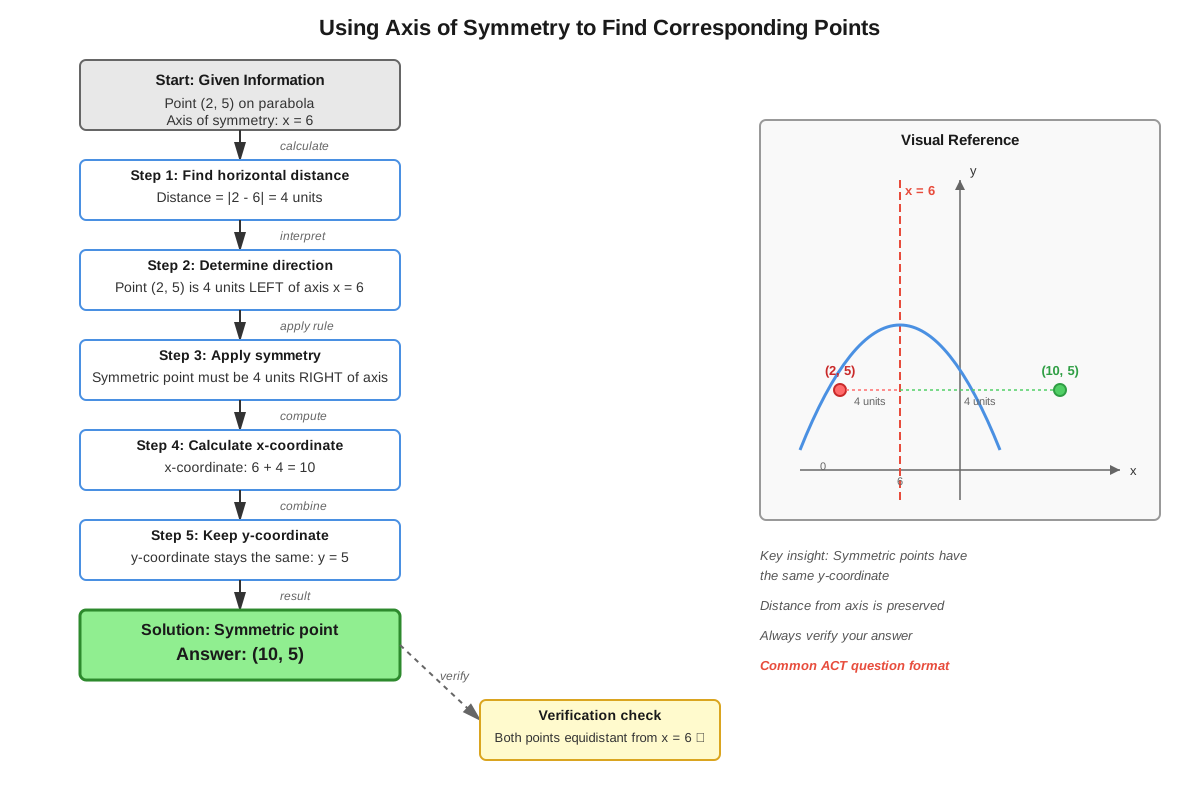
The symmetry property allows students to find corresponding points on a parabola. If a point (x₁, y) lies on the parabola and the axis of symmetry is x = h, then the point (2h - x₁, y) also lies on the parabola. The distance from x₁ to h equals the distance from h to 2h - x₁.
For example, if a parabola has axis of symmetry x = 4 and passes through the point (1, 5), then it must also pass through the point (7, 5) because 7 is the same distance from x = 4 as 1 is, just on the opposite side. This property is useful for checking answers and solving problems where partial information about the parabola is given.
Comparison of Methods
| Form of Equation | Axis of Symmetry Formula | Example | Axis |
|---|---|---|---|
| Standard: y = ax² + bx + c | x = -b/(2a) | y = 2x² - 12x + 7 | x = -(-12)/(2·2) = 3 |
| Vertex: y = a(x - h)² + k | x = h | y = -3(x + 2)² - 5 | x = -2 |
| Factored: y = a(x - r₁)(x - r₂) | x = (r₁ + r₂)/2 | y = (x - 1)(x - 9) | x = (1 + 9)/2 = 5 |
Concept Relationships
The axis of symmetry serves as a central connecting concept within quadratic functions. It directly determines the x-coordinate of the vertex, which in turn provides the maximum or minimum value of the function. The relationship flows: Standard Form → (apply formula) → Axis of Symmetry → (substitute back) → Vertex → Maximum/Minimum Value.
The axis of symmetry also connects to the roots of a quadratic equation. When a quadratic has two real roots, the axis of symmetry is positioned exactly at their midpoint: Roots/X-intercepts → (average) → Axis of Symmetry. Conversely, knowing the axis of symmetry and one root allows determination of the other root through the symmetry property.
The concept integrates with graphing skills, as the axis of symmetry provides a reference line for sketching parabolas. The relationship is: Axis of Symmetry + Vertex + Direction of Opening → Complete Graph. Additionally, the axis of symmetry connects to function transformations, as horizontal shifts of a parabola result in corresponding shifts of the axis of symmetry.
Understanding the axis of symmetry enhances comprehension of the discriminant and the nature of roots. When the discriminant is positive (two real roots), the axis lies between them. When it equals zero (one repeated root), the axis passes through that root. When negative (no real roots), the axis still exists and passes through the vertex, even though the parabola doesn't cross the x-axis.
Quick check — test yourself on Axis of symmetry so far.
Try Flashcards →High-Yield Facts
⭐ The axis of symmetry for y = ax² + bx + c is always x = -b/(2a)
⭐ The axis of symmetry is always a vertical line with equation x = constant
⭐ The axis of symmetry passes through the vertex of the parabola
⭐ The axis of symmetry is located exactly halfway between the two x-intercepts when they exist
⭐ For vertex form y = a(x - h)² + k, the axis of symmetry is x = h
- The axis of symmetry exists for every parabola, regardless of whether it has real roots
- Points equidistant from the axis of symmetry have the same y-value on the parabola
- The axis of symmetry is independent of the y-intercept (the value of c in standard form)
- Changing the value of a (vertical stretch/compression) does not change the axis of symmetry
- The axis of symmetry divides the parabola into two congruent halves
- If (p, q) is on the parabola with axis x = h, then (2h - p, q) is also on the parabola
- The axis of symmetry can be found from a graph by identifying the x-value of the vertex
Common Misconceptions
Misconception: The axis of symmetry is always x = 0 or passes through the origin.
Correction: The axis of symmetry can be any vertical line x = h where h is any real number. Its position depends entirely on the coefficients of the quadratic function, not on any default location.
Misconception: The axis of symmetry formula is x = b/(2a) (forgetting the negative sign).
Correction: The correct formula is x = -b/(2a). The negative sign is crucial and must be included. For y = x² + 4x + 1, the axis is x = -4/(2·1) = -2, not x = 2.
Misconception: The axis of symmetry is the same as the y-axis.
Correction: The axis of symmetry is parallel to the y-axis but is not necessarily the y-axis itself. It is only the y-axis when the axis of symmetry is x = 0, which occurs when b = 0 in standard form.
Misconception: For vertex form y = a(x + h)² + k, the axis of symmetry is x = h.
Correction: When the vertex form shows (x + h), this is actually (x - (-h)), so the axis of symmetry is x = -h. For y = 2(x + 3)² + 1, the axis is x = -3, not x = 3.
Misconception: The axis of symmetry changes when the parabola opens downward instead of upward.
Correction: The direction the parabola opens (determined by the sign of a) does not affect the location of the axis of symmetry. Both y = 2x² - 4x + 1 and y = -2x² + 4x - 1 have different axes of symmetry, but this is due to the different b values, not the sign of a.
Misconception: The axis of symmetry is a horizontal line.
Correction: For standard parabolas (quadratic functions of x), the axis of symmetry is always vertical. Horizontal axes of symmetry only occur for parabolas that open left or right, which are not functions and are rarely tested on the ACT.
Misconception: You need to find the vertex before you can find the axis of symmetry.
Correction: The axis of symmetry can be found directly from the equation using the appropriate formula. In fact, finding the axis of symmetry is often the first step in determining the vertex, not the other way around.
Worked Examples
Example 1: Finding Axis of Symmetry from Standard Form
Problem: What is the equation of the axis of symmetry for the parabola y = -3x² + 12x - 5?
Solution:
Step 1: Identify the form of the equation. This is standard form y = ax² + bx + c.
Step 2: Identify the coefficients. Here, a = -3, b = 12, and c = -5.
Step 3: Apply the axis of symmetry formula for standard form:
x = -b/(2a)Step 4: Substitute the values:
x = -(12)/(2·(-3)) = -12/(-6) = 2Step 5: Write the equation of the axis of symmetry: x = 2
Connection to Learning Objectives: This example demonstrates the core strategy of identifying the form of the equation and applying the appropriate formula, directly addressing the objective of applying axis of symmetry to ACT-style questions accurately.
Example 2: Using Axis of Symmetry to Find the Vertex and a Symmetric Point
Problem: A parabola has the equation y = x² - 8x + 10.
(a) Find the axis of symmetry.
(b) Find the vertex.
(c) If the point (2, -2) lies on the parabola, find another point on the parabola with the same y-coordinate.
Solution:
Part (a): Find the axis of symmetry
Step 1: Identify a = 1, b = -8, c = 10
Step 2: Apply the formula:
x = -(-8)/(2·1) = 8/2 = 4The axis of symmetry is x = 4.
Part (b): Find the vertex
Step 3: The x-coordinate of the vertex is 4 (from the axis of symmetry).
Step 4: Find the y-coordinate by substituting x = 4 into the original equation:
y = (4)² - 8(4) + 10 = 16 - 32 + 10 = -6The vertex is (4, -6).
Part (c): Find the symmetric point
Step 5: The point (2, -2) is 2 units to the left of the axis of symmetry x = 4 (since 4 - 2 = 2).
Step 6: The symmetric point must be 2 units to the right of the axis: 4 + 2 = 6.
Step 7: The symmetric point is (6, -2).
Verification: Check that (6, -2) satisfies the equation:
y = (6)² - 8(6) + 10 = 36 - 48 + 10 = -2 ✓Connection to Learning Objectives: This multi-part example shows how to use the axis of symmetry to determine the vertex and apply symmetry properties to find corresponding points, demonstrating mastery of multiple learning objectives in a single problem.
Exam Strategy
When approaching ACT questions involving the axis of symmetry, first scan the problem to identify what form the quadratic equation is presented in. If it's in standard form (y = ax² + bx + c), immediately prepare to use x = -b/(2a). If it's in vertex form, look for the h value. If roots or x-intercepts are given, plan to average them.
Trigger words and phrases that indicate axis of symmetry questions include: "line of symmetry," "vertical line through the vertex," "x-coordinate of the vertex," "midpoint between the roots," "divides the parabola equally," and "symmetric about the line." Questions asking for "the value of x where the maximum/minimum occurs" are also asking for the axis of symmetry.
For process of elimination, remember these key facts: the axis of symmetry must be a vertical line (eliminate any answer that isn't x = constant); it must pass through the vertex visible on a graph (eliminate answers that don't); if two x-intercepts are shown, the axis must be exactly between them (eliminate answers that aren't at the midpoint); and the axis cannot change based on the y-values of points on the parabola (eliminate answers that include y-coordinates).
Time allocation: Simple axis of symmetry calculations should take 30-45 seconds. If a problem requires finding the axis and then using it for additional calculations (like finding the vertex or a symmetric point), allocate 60-90 seconds. If you're stuck, remember that you can often work backward from answer choices by checking which x-value makes sense as a line of symmetry for the given information.
A powerful strategy is to sketch quickly when a graph isn't provided. Even a rough sketch showing the general shape and key points can help visualize where the axis of symmetry should be, providing a check against calculation errors. If the problem provides a graph, draw the axis of symmetry directly on it to visualize the solution.
Memory Techniques
Mnemonic for the standard form formula: "Negative Boy Twice Asked" helps remember x = -b/2a. The negative comes first, b is in the numerator, 2 times a is in the denominator.
Visualization strategy: Picture a parabola as a smile or frown with a mirror running vertically through its center. This mirror is the axis of symmetry. Any point on one side has a "reflection" on the other side at the same height.
Sign awareness acronym: "VHS" for Vertex form Has Same sign. In vertex form y = a(x - h)² + k, the axis is x = h, and the sign of h in the axis equation is the same as the sign you see when you rewrite (x + 3) as (x - (-3)).
Midpoint memory aid: Think "RAMS" - Roots Averaged Make Symmetry. When you have two roots, average them to get the axis of symmetry.
Formula connection: Remember that -b/(2a) is actually the x-coordinate from completing the square. If you forget the formula, you can always complete the square to find the vertex form, though this takes more time on the exam.
Summary
The axis of symmetry is a vertical line that divides a parabola into two mirror-image halves and passes through the vertex. For quadratic functions in standard form y = ax² + bx + c, the axis of symmetry is found using the formula x = -b/(2a), which is the most critical formula to memorize for ACT questions on this topic. In vertex form y = a(x - h)² + k, the axis is simply x = h, while for factored forms with roots r₁ and r₂, the axis is x = (r₁ + r₂)/2. The axis of symmetry provides the x-coordinate of the vertex and enables students to find corresponding points on the parabola using symmetry properties. This concept appears frequently on the ACT Math test in various contexts including direct calculation problems, graph interpretation, and optimization scenarios. Mastery requires understanding the formulas, recognizing which form of equation is presented, and applying the appropriate strategy efficiently.
Key Takeaways
- The axis of symmetry for y = ax² + bx + c is always x = -b/(2a) - memorize this formula
- The axis of symmetry is always a vertical line passing through the vertex of the parabola
- Every parabola has exactly one axis of symmetry, regardless of whether it has real roots
- The axis of symmetry lies exactly halfway between the two x-intercepts when they exist
- Points equidistant from the axis of symmetry have identical y-values on the parabola
- The axis of symmetry provides the x-coordinate of the vertex; substitute this value back into the equation to find the complete vertex
- Different forms of quadratic equations (standard, vertex, factored) require different approaches to finding the axis of symmetry
Related Topics
Vertex of a Parabola: Once the axis of symmetry is mastered, finding the complete vertex coordinates becomes straightforward. The vertex represents the maximum or minimum point of the quadratic function and is essential for optimization problems.
Quadratic Formula and Discriminant: Understanding how the axis of symmetry relates to the roots of a quadratic deepens comprehension of the quadratic formula and helps predict the nature of solutions based on the discriminant.
Transformations of Functions: The axis of symmetry shifts horizontally when parabolas undergo horizontal translations, connecting this topic to the broader study of function transformations.
Completing the Square: This algebraic technique converts standard form to vertex form, revealing why the axis of symmetry formula x = -b/(2a) works and providing an alternative method for finding it.
Optimization Problems: Real-world applications involving maximum profit, minimum cost, or optimal dimensions rely heavily on finding the axis of symmetry to identify the optimal value.
Practice CTA
Now that you've mastered the core concepts of axis of symmetry, it's time to solidify your understanding through practice. Work through the practice questions to test your ability to identify, calculate, and apply the axis of symmetry in various ACT-style scenarios. Use the flashcards to reinforce the key formulas and properties until they become automatic. Remember, the axis of symmetry appears on virtually every ACT Math test, so investing time in practice now will pay dividends on test day. You've got this!
Sign up free to keep reading
Create a free AnvayaPrep account to finish this ACT guide on Axis of symmetry — plus flashcards and practice questions.