Overview
Circles in coordinate plane represent one of the most frequently tested topics in ACT Math, appearing in approximately 2-3 questions per exam. This topic combines algebraic manipulation with geometric visualization, requiring students to understand how the equation of a circle relates to its graphical representation on the coordinate plane. Mastery of this concept is essential because it bridges pure algebra with coordinate geometry, two major content areas that together comprise roughly 45% of the ACT Math section.
Understanding ACT circles in coordinate plane involves recognizing the standard form equation, identifying key features like center and radius, and manipulating equations to solve for specific values. The ACT tests this topic through various question types: finding the center or radius from an equation, writing equations given geometric information, determining whether points lie on a circle, and calculating distances. Unlike some advanced mathematics courses that explore circles in depth, the ACT focuses on practical applications of the standard form equation and basic geometric properties.
This topic connects directly to distance formula, midpoint formula, and completing the square—all fundamental coordinate geometry skills. It also relates to broader concepts like transformations, symmetry, and the relationship between algebraic equations and geometric shapes. Students who master circles in the coordinate plane develop stronger spatial reasoning and equation manipulation skills that transfer to other ACT Math topics, including parabolas, ellipses, and systems of equations.
Learning Objectives
- [ ] Identify when Circles in coordinate plane is being tested
- [ ] Explain the core rule or strategy behind Circles in coordinate plane
- [ ] Apply Circles in coordinate plane to ACT-style questions accurately
- [ ] Convert between standard form and general form equations of circles
- [ ] Determine whether a given point lies on, inside, or outside a circle
- [ ] Calculate the radius and center coordinates from various forms of circle equations
- [ ] Write the equation of a circle given geometric information about center and radius
Prerequisites
- Distance formula: Essential for understanding how radius is calculated as the distance from center to any point on the circle
- Completing the square: Required to convert general form equations into standard form to identify center and radius
- Coordinate plane basics: Necessary for plotting points, understanding ordered pairs, and visualizing geometric relationships
- Basic algebraic manipulation: Needed for expanding, factoring, and rearranging circle equations
- Pythagorean theorem: Underlies the distance formula and helps verify radius calculations
Why This Topic Matters
Circles in the coordinate plane appear in real-world applications ranging from GPS technology (where circular ranges determine signal coverage) to architecture (where circular designs must be precisely specified) to physics (where circular motion is analyzed using coordinate systems). Engineers use circle equations to design everything from gears to satellite orbits, while computer graphics programmers use them to render curved objects on screens.
On the ACT Math section, circle problems typically appear 2-3 times per test, representing approximately 3-5% of all math questions. These questions usually fall into the "Integrating Essential Skills" or "Modeling" categories and are considered medium to medium-high difficulty. The ACT favors questions that test whether students can identify the center and radius from standard form, write equations given geometric information, or determine relationships between circles and points.
Common question formats include: providing an equation and asking for the radius; giving a center and radius and asking for the equation; presenting a word problem that requires modeling with a circle; asking whether specific points satisfy a circle equation; or requiring students to complete the square to transform an equation. The ACT rarely asks purely theoretical questions—instead, questions are embedded in practical contexts or require multi-step problem-solving that combines circle properties with other coordinate geometry concepts.
Core Concepts
Standard Form Equation of a Circle
The standard form equation of a circle is the most important formula for ACT success:
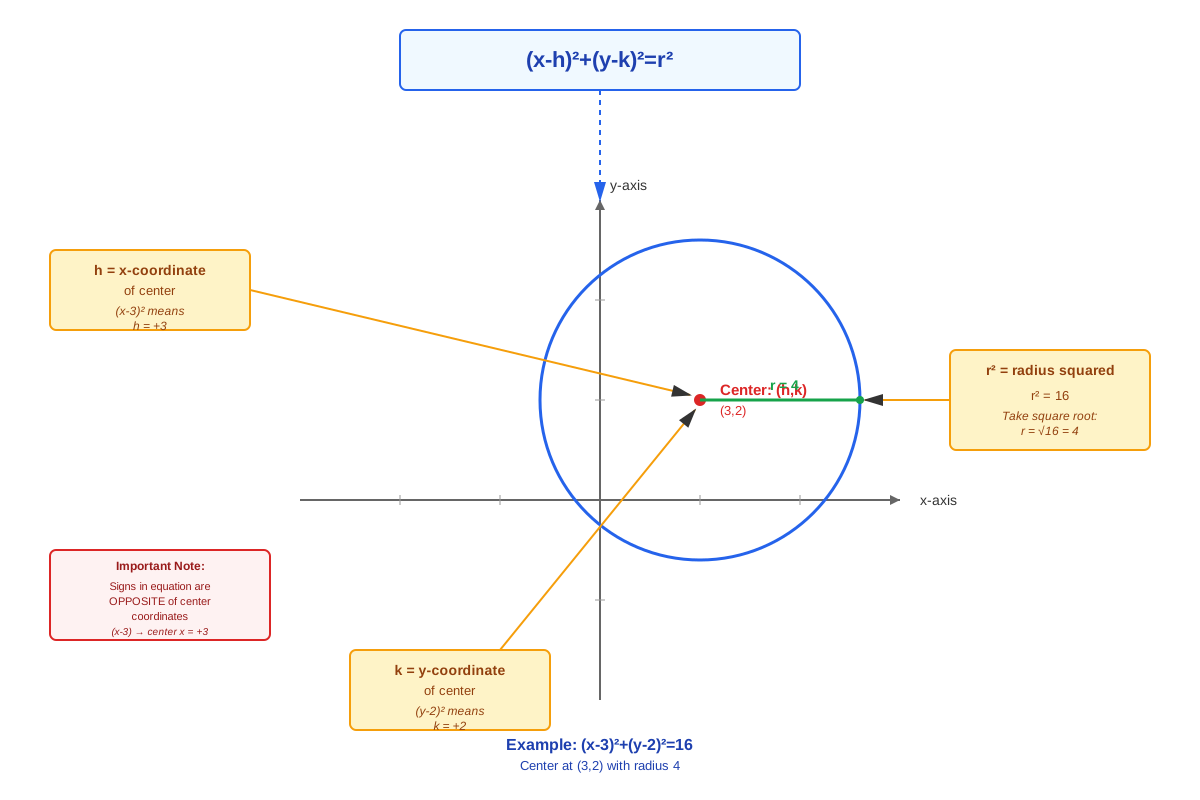
(x - h)² + (y - k)² = r²In this equation:
- (h, k) represents the center of the circle
- r represents the radius of the circle
- The equation states that every point (x, y) on the circle is exactly r units away from the center
The standard form directly shows the center coordinates and radius, making it the preferred form for quickly extracting information. Notice the subtraction signs: the center is at (h, k), not (-h, -k). This is a critical detail that causes frequent errors.
Example: The equation (x - 3)² + (y + 2)² = 25 represents a circle with:
- Center at (3, -2) — note that y + 2 means k = -2
- Radius of 5 — since r² = 25, therefore r = 5
Deriving the Standard Form
The standard form comes directly from the distance formula. If a circle has center (h, k) and radius r, then any point (x, y) on the circle must be exactly r units from the center:
√[(x - h)² + (y - k)²] = rSquaring both sides eliminates the square root and produces the standard form. This derivation explains why the equation has the structure it does and connects circles to the fundamental concept of distance in the coordinate plane.
General Form Equation
The general form of a circle equation appears when the standard form is expanded:
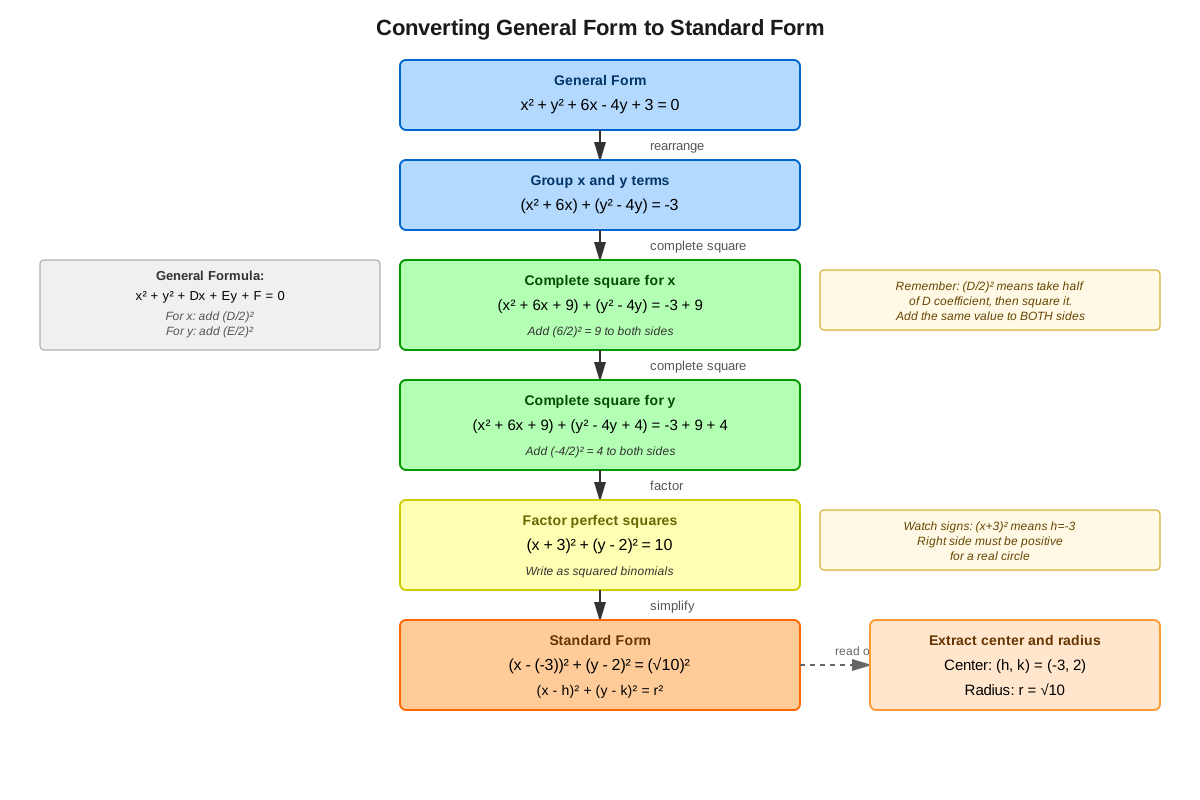
x² + y² + Dx + Ey + F = 0This form is less useful for immediately identifying the center and radius, but it frequently appears on the ACT because it requires students to demonstrate algebraic skill by converting it to standard form through completing the square.
Conversion process:
- Group x-terms and y-terms separately
- Move the constant to the right side
- Complete the square for x-terms
- Complete the square for y-terms
- Simplify to identify center and radius
Completing the Square for Circles
To convert from general form to standard form:
Step 1: Rearrange the equation so x-terms and y-terms are grouped:
x² + Dx + y² + Ey = -FStep 2: For the x-terms, take half of the coefficient of x, square it, and add to both sides:
- Coefficient of x is D
- Half of D is D/2
- Square it: (D/2)²
- Add (D/2)² to both sides
Step 3: Repeat for y-terms with coefficient E:
- Add (E/2)² to both sides
Step 4: Factor the perfect square trinomials:
(x + D/2)² + (y + E/2)² = -F + (D/2)² + (E/2)²Step 5: Identify center as (-D/2, -E/2) and radius as √[right side]
Finding the Radius
The radius can be determined in several ways:
- From standard form: Take the square root of the right side of the equation
- From center and a point on the circle: Use the distance formula between center and the point
- From diameter endpoints: Find the distance between endpoints and divide by 2
- From general form: After completing the square, the radius is √[constant on right side]
| Given Information | Method to Find Radius |
|---|---|
| Standard form equation | r = √(right side) |
| Center (h,k) and point (x₁,y₁) on circle | r = √[(x₁-h)² + (y₁-k)²] |
| Diameter endpoints (x₁,y₁) and (x₂,y₂) | r = ½√[(x₂-x₁)² + (y₂-y₁)²] |
| General form equation | Complete the square first |
Point-Circle Relationships
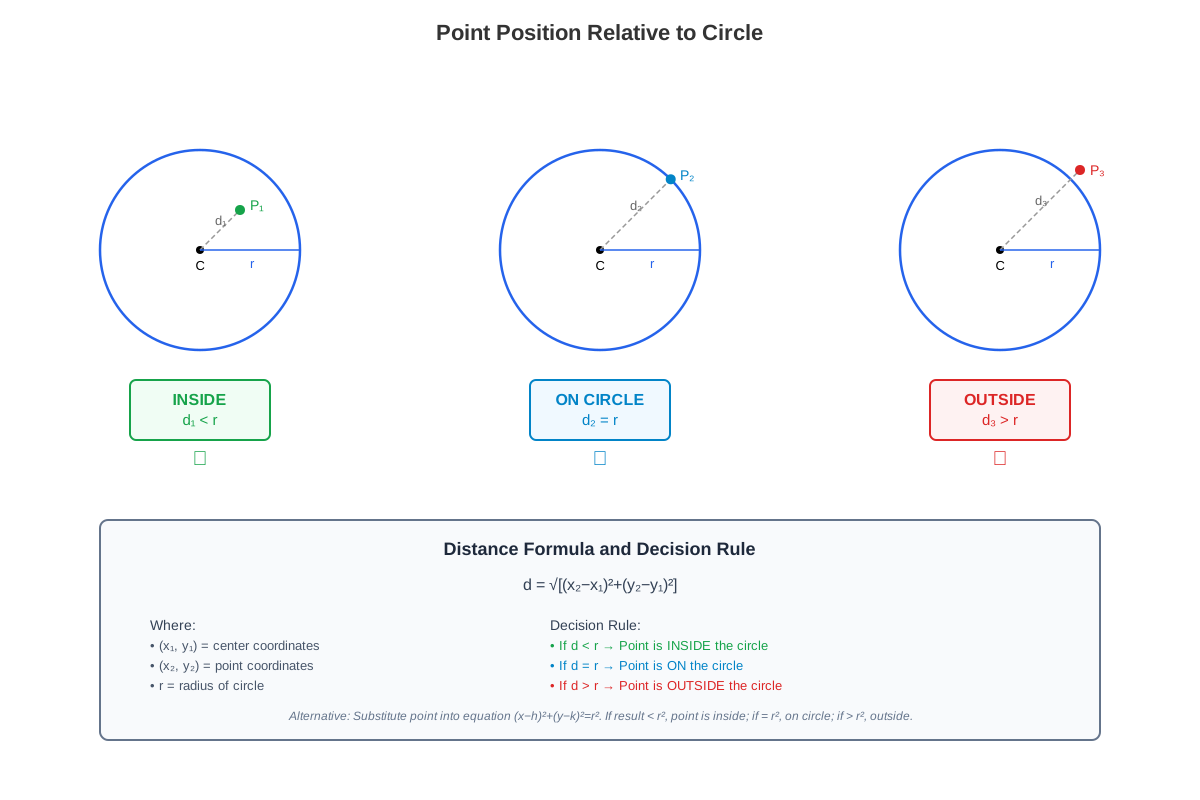
To determine whether a point (x₁, y₁) lies on, inside, or outside a circle with center (h, k) and radius r:
- Calculate the distance d from the point to the center: d = √[(x₁-h)² + (y₁-k)²]
- Compare d to r:
- If d = r, the point is on the circle
- If d < r, the point is inside the circle
- If d > r, the point is outside the circle
Alternatively, substitute the point's coordinates into the standard form equation:
- If (x₁ - h)² + (y₁ - k)² = r², the point is on the circle
- If (x₁ - h)² + (y₁ - k)² < r², the point is inside
- If (x₁ - h)² + (y₁ - k)² > r², the point is outside
Special Cases
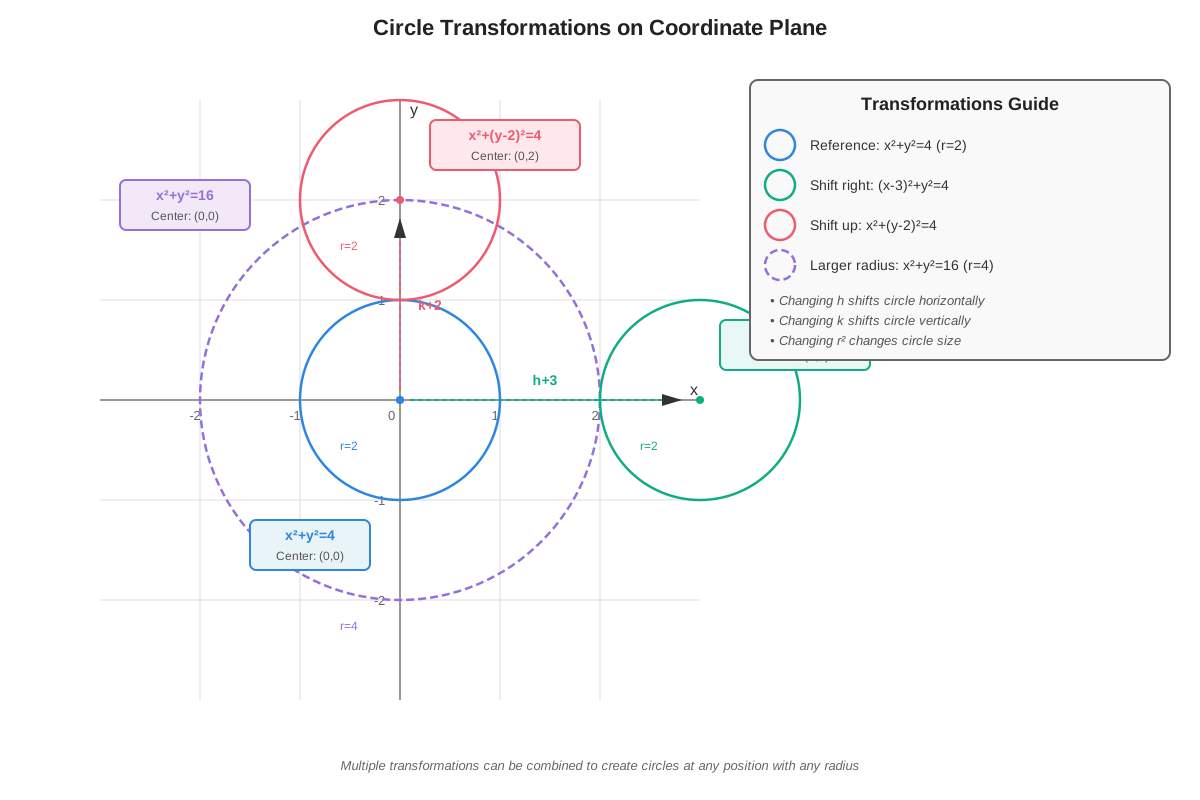
Circle centered at the origin: When the center is at (0, 0), the equation simplifies to:
x² + y² = r²This is the simplest form and appears frequently on the ACT because it's easy to work with and recognize.
Circle with diameter endpoints: If given the endpoints of a diameter at (x₁, y₁) and (x₂, y₂):
- The center is the midpoint: ((x₁+x₂)/2, (y₁+y₂)/2)
- The radius is half the diameter: ½√[(x₂-x₁)² + (y₂-y₁)²]
Concept Relationships
The standard form equation serves as the central concept, connecting to all other circle properties. Understanding standard form → enables quick identification of center and radius → which allows determination of whether points lie on the circle → which connects to distance formula applications.
Completing the square acts as the bridge between general form and standard form: general form equation → completing the square → standard form → center and radius identification. This algebraic skill is prerequisite knowledge that becomes applied knowledge in the context of circles.
The distance formula underlies everything: it generates the standard form equation, calculates radius from center and point, and determines point-circle relationships. Distance formula → circle equation derivation and distance formula → radius calculation represent parallel applications of the same fundamental concept.
Circles in the coordinate plane connect to other coordinate geometry topics: they share the distance formula with line segments, use the midpoint formula like line segments do, and represent a specific type of conic section alongside parabolas and ellipses. The skills developed here—converting between forms, extracting information from equations, and connecting algebra to geometry—transfer directly to these related topics.
High-Yield Facts
⭐ The standard form of a circle is (x - h)² + (y - k)² = r² where (h, k) is the center and r is the radius
⭐ To find the center from standard form, use the opposite signs: (x - 3)² means h = 3, and (y + 2)² means k = -2
⭐ The radius is found by taking the square root of the right side of the standard form equation
⭐ Completing the square is required to convert general form (x² + y² + Dx + Ey + F = 0) to standard form
⭐ A circle centered at the origin has the equation x² + y² = r²
- The general form contains x², y², x, y, and constant terms, but no xy term and both squared terms have coefficient 1
- To complete the square for x² + bx, add (b/2)² to create a perfect square trinomial
- The distance from any point on a circle to the center equals the radius exactly
- If a point (x₁, y₁) satisfies the circle equation, it lies on the circle; if the left side is less than r², it's inside; if greater, it's outside
- The diameter of a circle is twice the radius, and the center is the midpoint of any diameter
- When writing a circle equation, always square the radius value on the right side (r², not r)
- Expanding (x - h)² gives x² - 2hx + h², not x² - h²
Quick check — test yourself on Circles in coordinate plane so far.
Try Flashcards →Common Misconceptions
Misconception: The center of the circle (x - 3)² + (y - 4)² = 16 is at (-3, -4).
Correction: The center is at (3, 4). The standard form uses subtraction, so (x - h)² means the center's x-coordinate is h (positive 3), and (y - k)² means the center's y-coordinate is k (positive 4). The signs in the equation are opposite to the signs of the center coordinates.
Misconception: For the equation (x + 5)² + (y - 2)² = 9, the radius is 9.
Correction: The radius is 3, not 9. The right side of the standard form equation equals r², so you must take the square root to find r. Since r² = 9, then r = √9 = 3.
Misconception: The equation x² + y² + 6x - 8y + 9 = 0 is already in standard form.
Correction: This is general form, not standard form. Standard form requires perfect square binomials like (x - h)² and (y - k)². To convert this to standard form, you must complete the square for both x and y terms.
Misconception: When completing the square for x² + 6x, add 6² = 36 to both sides.
Correction: Take half of the coefficient first, then square. Half of 6 is 3, and 3² = 9, so add 9 to both sides. The formula is (b/2)², not b².
Misconception: A circle with center (2, -3) and radius 5 has the equation (x + 2)² + (y - 3)² = 5.
Correction: Two errors here. First, the center coordinates use opposite signs: (x - 2)² + (y + 3)². Second, the right side must be r², not r, so it should equal 25, not 5. The correct equation is (x - 2)² + (y + 3)² = 25.
Misconception: All equations with x² and y² represent circles.
Correction: Only equations where x² and y² have the same coefficient (typically 1) and no xy term represent circles. For example, 2x² + 3y² = 12 is an ellipse, not a circle, because the coefficients differ.
Misconception: The point (5, 0) lies on the circle x² + y² = 16 because 5 is close to 4.
Correction: Substitute the point into the equation: 5² + 0² = 25, which does not equal 16. The point does not lie on the circle. A point must satisfy the equation exactly to lie on the circle.
Worked Examples
Example 1: Converting General Form to Standard Form
Problem: Find the center and radius of the circle with equation x² + y² - 8x + 6y - 11 = 0.
Solution:
Step 1: Rearrange to group x-terms and y-terms, moving the constant to the right side:
x² - 8x + y² + 6y = 11Step 2: Complete the square for x-terms. The coefficient of x is -8.
- Half of -8 is -4
- (-4)² = 16
- Add 16 to both sides:
x² - 8x + 16 + y² + 6y = 11 + 16Step 3: Complete the square for y-terms. The coefficient of y is 6.
- Half of 6 is 3
- 3² = 9
- Add 9 to both sides:
x² - 8x + 16 + y² + 6y + 9 = 11 + 16 + 9Step 4: Factor the perfect square trinomials and simplify the right side:
(x - 4)² + (y + 3)² = 36Step 5: Identify the center and radius:
- Center: (4, -3) — remember to use opposite signs
- Radius: √36 = 6
Answer: The center is (4, -3) and the radius is 6.
Connection to learning objectives: This example demonstrates applying the core strategy of completing the square to convert between forms, a critical skill for ACT questions that present circles in general form.
Example 2: Writing an Equation and Testing a Point
Problem: A circle has its center at (-2, 5) and passes through the point (1, 9).
(a) Write the equation of the circle in standard form.
(b) Does the point (2, 5) lie on this circle?
Solution:
(a) Finding the equation:
Step 1: Identify the center: (h, k) = (-2, 5)
Step 2: Calculate the radius using the distance formula from center to the given point (1, 9):
r = √[(1 - (-2))² + (9 - 5)²]
r = √[(1 + 2)² + (4)²]
r = √[3² + 4²]
r = √[9 + 16]
r = √25
r = 5
Step 3: Write the standard form equation using (h, k) = (-2, 5) and r = 5:
(x - h)² + (y - k)² = r²
(x - (-2))² + (y - 5)² = 5²
(x + 2)² + (y - 5)² = 25
Answer for (a): The equation is (x + 2)² + (y - 5)² = 25
(b) Testing the point (2, 5):
Step 1: Substitute x = 2 and y = 5 into the equation:
(2 + 2)² + (5 - 5)² = 25
(4)² + (0)² = 25
16 + 0 = 25
16 = 25
Step 2: Since 16 ≠ 25, the equation is not satisfied.
Answer for (b): No, the point (2, 5) does not lie on the circle. It lies inside the circle because 16 < 25.
Connection to learning objectives: This example shows how to write equations from geometric information and determine point-circle relationships, both high-frequency ACT question types.
Exam Strategy
When approaching ACT questions on circles in the coordinate plane, first identify the form of the equation presented. If you see (x - h)² + (y - k)² = r², you can immediately extract the center and radius. If you see x² + y² + other terms = 0, recognize that you'll need to complete the square.
Trigger words and phrases that indicate circle problems include:
- "center at" or "centered at"
- "radius of" or "has radius"
- "equation of the circle"
- "lies on the circle"
- "distance from the center"
- "passes through the point"
Process-of-elimination tips:
- Eliminate answer choices where the radius is negative (radius must be positive)
- If given a center at (3, -2), eliminate equations with (x - 3)² and (y - 2)² or (x + 3)² and (y + 2)²—the signs must be opposite
- If the right side of an equation is negative, it cannot represent a real circle
- When testing points, eliminate choices that don't satisfy the equation when you substitute
Time allocation: Most circle problems should take 45-60 seconds. If you need to complete the square, allow up to 90 seconds. If a problem seems to require more than 2 minutes, you may be overcomplicating it—look for a shortcut or move on and return later.
Quick checks:
- Always verify that your radius is positive
- Double-check signs when identifying the center
- When completing the square, verify that you added the same value to both sides
- If time permits, substitute a known point back into your equation to verify
Common shortcuts:
- For circles centered at the origin, the equation is simply x² + y² = r²
- If given diameter endpoints, the center is the midpoint and radius is half the distance between endpoints
- To test whether a point is on a circle, substitution is often faster than calculating distance
Memory Techniques
Mnemonic for standard form: "Happy Kids Run" reminds you that standard form is (x - h)² + (y - k)² = r²
Sign rule: "Opposite Day"—the signs in the equation are opposite to the signs of the center coordinates. If you see (x - 3), the center's x-coordinate is +3. If you see (y + 4), the center's y-coordinate is -4.
Completing the square: "Half and Square"—take half of the linear coefficient, then square it. This two-step process prevents the common error of squaring the coefficient directly.
Radius reminder: "Square Root Right"—the radius is the square root of the right side of the standard form equation. Visualize taking the √ of the number on the right.
Visualization strategy: When given a circle equation, immediately sketch a rough coordinate plane and plot the center. Draw a circle with approximate radius. This visual reference helps verify whether your calculations make sense and can reveal errors (like a negative radius or misplaced center).
Acronym for conversion steps: "GRACES"
- Group x and y terms
- Rearrange constant to right side
- Add (b/2)² for x-terms
- Complete square for y-terms
- Express as perfect squares
- Simplify and identify center/radius
Summary
Circles in the coordinate plane are tested through their standard form equation (x - h)² + (y - k)² = r², where (h, k) represents the center and r represents the radius. Success on ACT questions requires recognizing that the center coordinates have opposite signs from what appears in the equation, that the radius is the square root of the right side, and that general form equations must be converted to standard form through completing the square. The key skill is moving fluidly between different representations: from equations to geometric properties (center and radius), from geometric information to equations, and from general form to standard form. Understanding point-circle relationships—whether points lie on, inside, or outside a circle—requires either substitution into the equation or distance calculation. These concepts appear in 2-3 questions per ACT exam and connect directly to distance formula, midpoint formula, and algebraic manipulation skills.
Key Takeaways
- The standard form (x - h)² + (y - k)² = r² immediately reveals center (h, k) and radius r = √(right side)
- Center coordinates have opposite signs from what appears in the equation: (x - 3) means h = +3, (y + 2) means k = -2
- Converting general form to standard form requires completing the square: add (coefficient/2)² for both x and y terms
- The radius must always be positive and equals the square root of r², not r² itself
- A point lies on a circle if substituting its coordinates makes the equation true; inside if left side < r²; outside if left side > r²
- Circles centered at the origin have the simplified equation x² + y² = r²
- The distance formula underlies all circle equations and connects center, radius, and points on the circle
Related Topics
Parabolas in the coordinate plane: After mastering circles, students can extend their understanding to parabolas, which also have standard form equations that reveal key features. The skills of converting between forms and extracting geometric information from equations transfer directly.
Distance and midpoint formulas: These foundational formulas are the building blocks for circle equations. Deeper exploration of distance formula applications strengthens circle problem-solving abilities.
Systems of equations: Circles often appear in systems with lines or other circles. Finding intersection points requires combining circle equations with linear equations or other circle equations.
Completing the square for quadratics: The algebraic technique used for circles is the same technique used to convert quadratic functions to vertex form, making this skill valuable across multiple ACT Math topics.
Conic sections: Circles are one type of conic section, along with ellipses, parabolas, and hyperbolas. Understanding circles provides the foundation for studying these related curves.
Practice CTA
Now that you've mastered the core concepts of circles in the coordinate plane, it's time to solidify your understanding through practice. Work through the practice questions to apply these strategies to ACT-style problems, and use the flashcards to reinforce the key formulas and concepts. Remember: the difference between knowing these concepts and scoring points on test day is practice. Each problem you solve builds the pattern recognition and confidence you need to tackle circle questions quickly and accurately. You've got this!
Sign up free to keep reading
Create a free AnvayaPrep account to finish this ACT guide on Circles in coordinate plane — plus flashcards and practice questions.