Overview
Coordinate geometry word problems represent a critical intersection of algebraic reasoning and spatial visualization on the ACT Math test. These problems embed coordinate plane concepts—such as distance, midpoint, slope, and equation of lines—within real-world scenarios or abstract situations that require students to translate verbal descriptions into mathematical relationships. Unlike straightforward computational questions, coordinate geometry word problems demand that test-takers identify relevant information, select appropriate formulas, and execute multi-step solutions while managing the cognitive load of interpreting context.
The ACT consistently features act coordinate geometry word problems that test whether students can move fluidly between verbal descriptions and mathematical representations. These questions might describe the location of landmarks on a map, the path of a moving object, the design of architectural features, or abstract geometric relationships. Success requires not just memorizing formulas, but developing the interpretive skills to recognize when distance formula applies versus when slope calculations are needed, or when finding a midpoint solves the problem most efficiently.
Mastery of this topic strengthens broader mathematical competencies essential for ACT success. Coordinate geometry word problems connect algebraic manipulation with geometric intuition, reinforcing skills in equation solving, function interpretation, and logical reasoning. These problems frequently appear in the higher-difficulty questions (numbers 40-60) on the ACT Math section, making them particularly valuable for students targeting scores above 28. Understanding how to decode and solve these problems efficiently can significantly impact overall performance and demonstrates the mathematical maturity that colleges seek.
Learning Objectives
- [ ] Identify when Coordinate geometry word problems is being tested
- [ ] Explain the core rule or strategy behind Coordinate geometry word problems
- [ ] Apply Coordinate geometry word problems to ACT-style questions accurately
- [ ] Translate verbal descriptions of geometric situations into coordinate plane representations
- [ ] Select the appropriate coordinate geometry formula (distance, midpoint, slope) based on problem context
- [ ] Synthesize multiple coordinate geometry concepts to solve multi-step word problems
- [ ] Verify solutions by checking whether answers satisfy the original problem constraints
Prerequisites
- Distance formula: Essential for calculating lengths between points, which frequently appears in word problems involving physical distances or geometric measurements
- Midpoint formula: Required when problems describe centers, averages, or halfway points between locations
- Slope formula and interpretation: Necessary for understanding rate of change, parallel/perpendicular relationships, and linear patterns in context
- Equation of a line (slope-intercept and point-slope forms): Needed when problems describe linear relationships or require finding specific points on paths
- Basic algebraic manipulation: Critical for solving equations that arise from setting up coordinate geometry relationships
- Pythagorean theorem: Often provides an alternative approach or verification method for distance calculations
Why This Topic Matters
Coordinate geometry word problems appear with remarkable consistency on every ACT Math test, typically comprising 3-5 questions per exam. These questions serve as discriminators between good and excellent scores because they assess mathematical reasoning rather than mere formula recall. The College Board research indicates that students who master contextual coordinate geometry problems demonstrate stronger overall problem-solving abilities and perform better on college-level mathematics courses.
In real-world applications, coordinate geometry provides the mathematical foundation for GPS navigation systems, computer graphics, architectural design, urban planning, and data visualization. When engineers design road systems, they use coordinate geometry to calculate optimal routes and distances. When data scientists create scatter plots to identify trends, they apply slope concepts to determine correlation strength. The skills developed through these word problems—translating situations into mathematical models—transfer directly to professional and academic contexts.
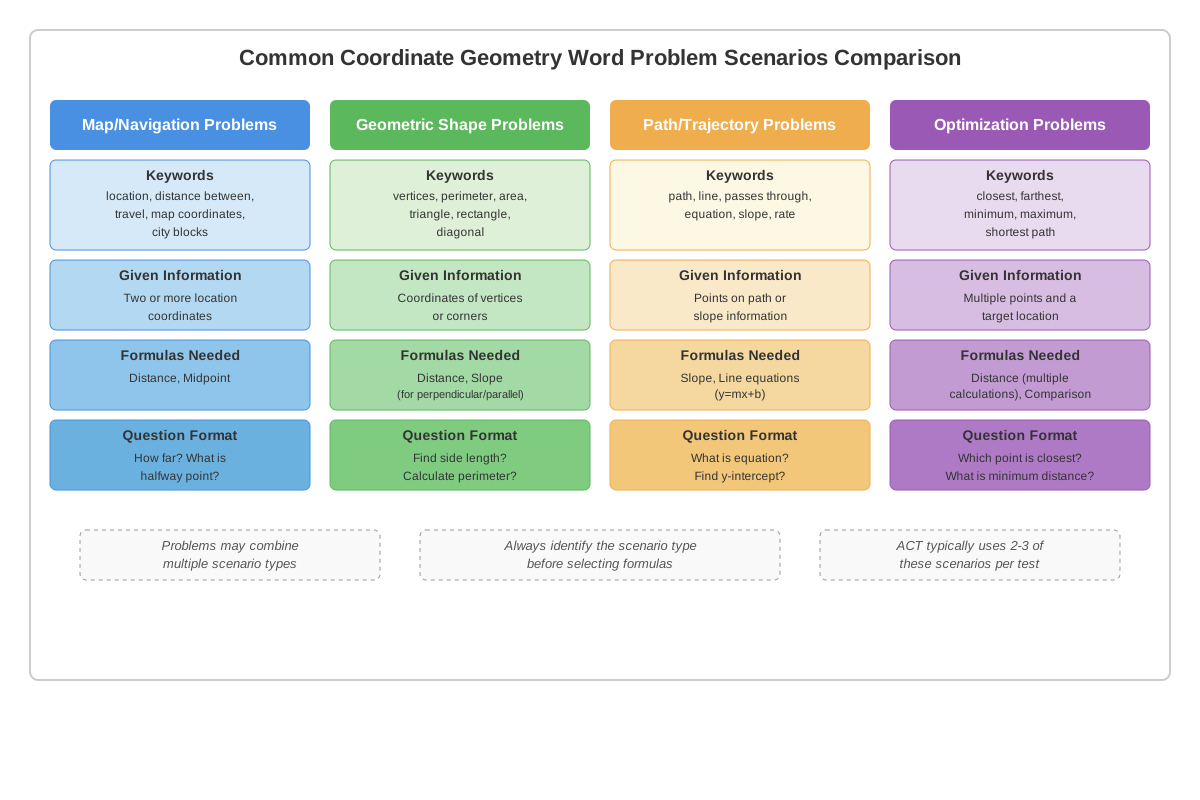
On the ACT specifically, coordinate geometry word problems commonly appear as:
- Map and navigation scenarios: Finding distances between cities or landmarks plotted on coordinate grids
- Geometric construction problems: Determining vertices of shapes given certain constraints
- Motion and path problems: Calculating where moving objects intersect or how far they travel
- Optimization questions: Finding points that minimize distance or satisfy multiple conditions
- Real-world measurement contexts: Surveying, construction, or design applications requiring coordinate calculations
Core Concepts
Translating Word Problems to Coordinate Representations
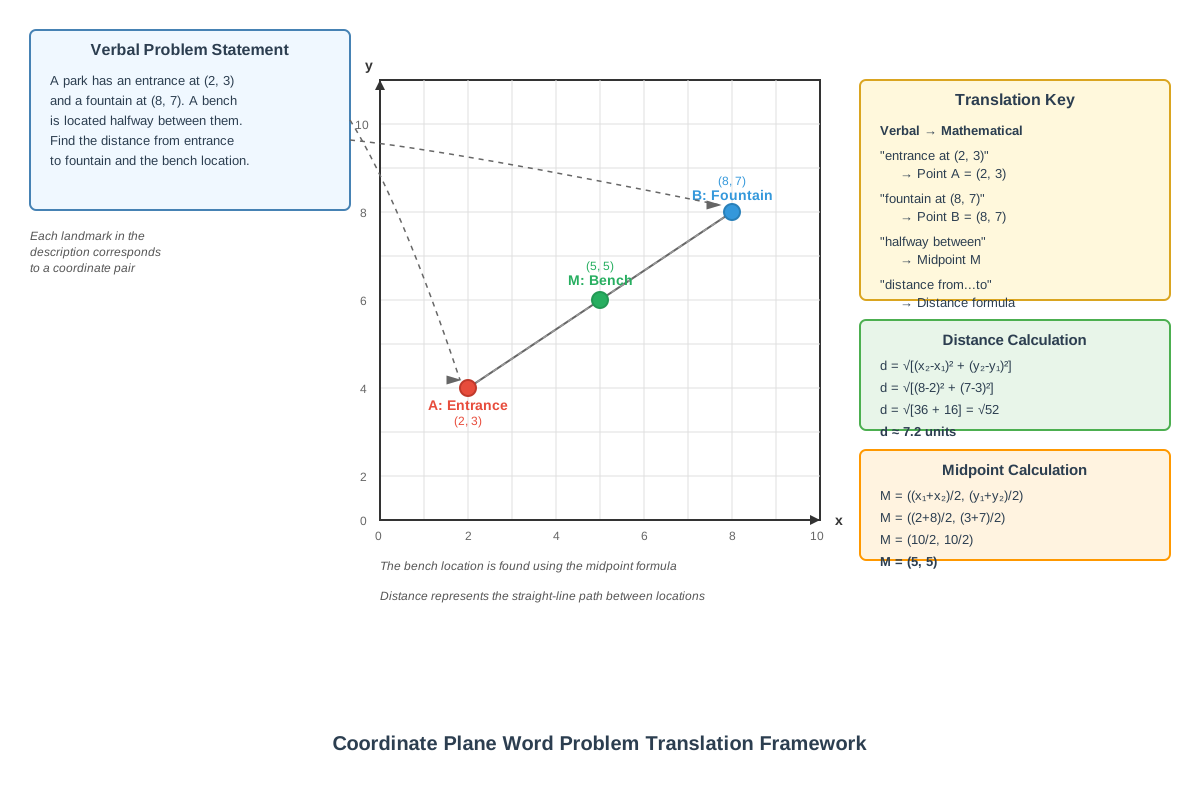
The fundamental skill in coordinate geometry word problems involves converting verbal descriptions into mathematical notation. This translation process requires identifying what information corresponds to coordinates, what relationships exist between points, and what the question ultimately asks you to find.
When approaching any word problem, first identify:
- Given points: Extract explicit coordinates mentioned in the problem
- Implied points: Determine coordinates that can be inferred from descriptions (e.g., "on the x-axis" means y = 0)
- Relationships: Identify connections between points (midpoint, distance, collinearity, perpendicularity)
- Target: Clarify exactly what the question asks for (a coordinate, a distance, a slope, an equation)
For example, if a problem states "Point A is 5 units directly above point B, which is located at (3, -2)," the translation process yields: B = (3, -2) and A = (3, 3) because "directly above" means same x-coordinate with y-value increased by 5.
Distance Formula Applications in Context
The distance formula, derived from the Pythagorean theorem, calculates the straight-line distance between two points:
d = √[(x₂ - x₁)² + (y₂ - y₁)²]In word problems, distance calculations appear when:
- Problems explicitly ask "how far" between locations
- Questions require finding the length of a line segment
- Scenarios involve radius calculations (distance from center to point on circle)
- Problems ask about perimeter of figures with vertices at given coordinates
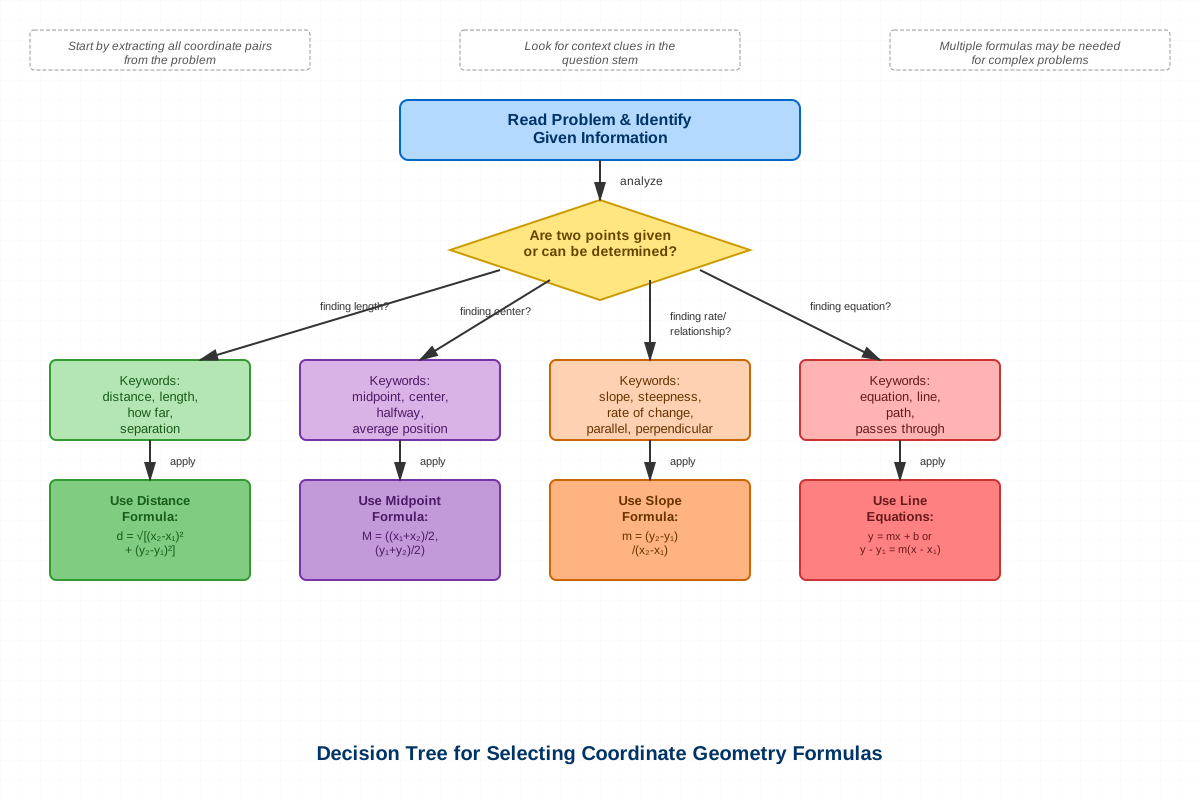
Key strategy: When a problem describes physical separation, movement between locations, or geometric measurements like radius or side length, the distance formula is likely needed. Watch for trigger phrases like "how far," "distance between," "length of," or "radius."
Midpoint Formula in Problem Contexts
The midpoint formula finds the point exactly halfway between two given points:
M = ((x₁ + x₂)/2, (y₁ + y₂)/2)Word problems requiring midpoint calculations typically involve:
- Finding centers of line segments or geometric figures
- Locating meeting points when two entities travel equal distances
- Determining average positions
- Identifying points of symmetry
Recognition pattern: Look for words like "halfway," "center," "middle," "bisects," "average position," or scenarios describing equal distances from two reference points.
Slope Interpretation and Applications
Slope represents the rate of change between two points and appears in word problems as:
m = (y₂ - y₁)/(x₂ - x₁)In contextual problems, slope interpretation varies:
| Context | Slope Meaning | Example |
|---|---|---|
| Physical incline | Steepness or grade | Road rising 3 feet for every 10 feet horizontal |
| Motion | Speed or velocity | Car traveling 60 miles per hour (change in distance/time) |
| Economics | Rate of change | Cost increasing $5 per item |
| Parallel lines | Equal slopes | Railroad tracks maintaining constant separation |
| Perpendicular lines | Negative reciprocal slopes | Intersecting roads at right angles |
Critical insight: Parallel lines have identical slopes; perpendicular lines have slopes that are negative reciprocals (m₁ × m₂ = -1). These relationships frequently appear in word problems involving geometric constructions or path intersections.
Multi-Step Problem Solving Strategies
Complex act coordinate geometry word problems often require combining multiple concepts. A systematic approach includes:
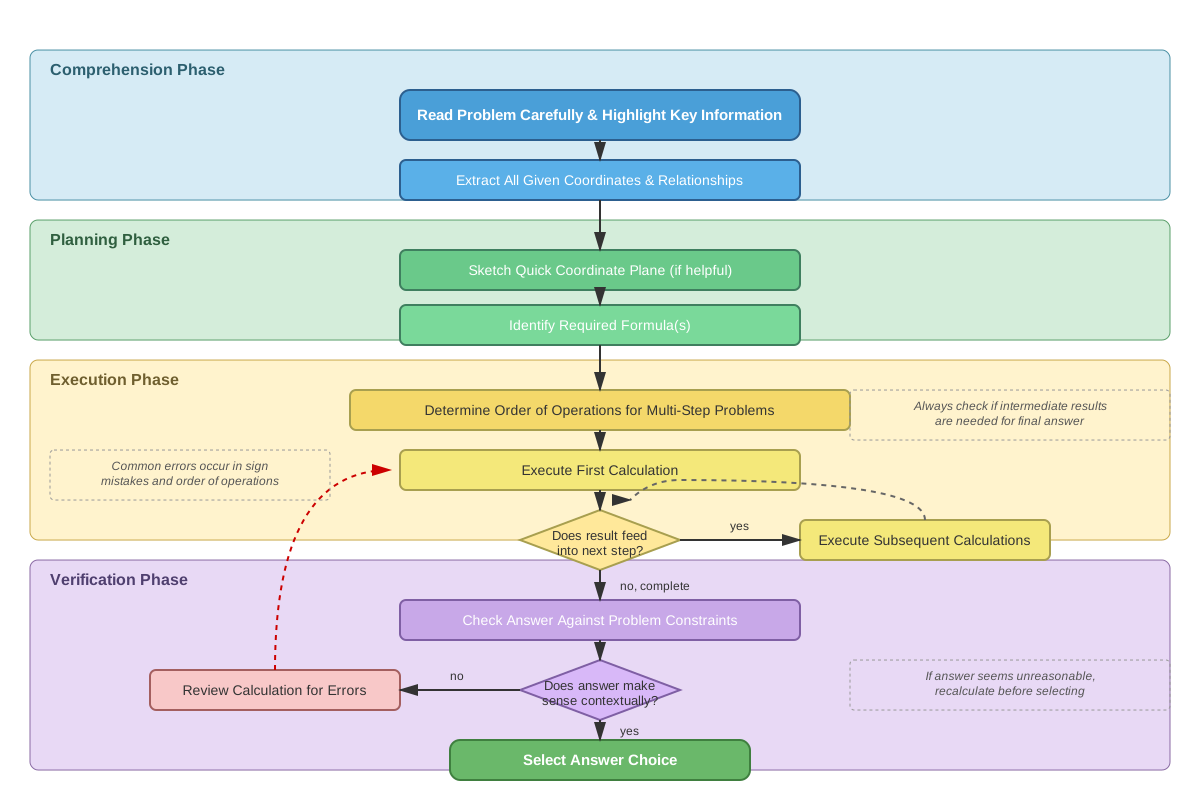
- Sketch the situation: Draw a rough coordinate plane with labeled points, even if not to scale
- List known information: Write out all given coordinates and relationships
- Identify the goal: Clearly state what needs to be found
- Determine the path: Select which formulas or concepts connect the known to the unknown
- Execute calculations: Perform computations carefully, showing work
- Verify reasonableness: Check if the answer makes sense in context
For instance, a problem might give two vertices of a rectangle and ask for the perimeter. This requires: (1) using properties of rectangles to find the other two vertices, (2) applying distance formula to find side lengths, and (3) calculating perimeter from those lengths.
Equation of Lines in Word Problems
When problems describe linear relationships or paths, finding the equation of a line becomes necessary. The two most useful forms are:
Slope-intercept form: y = mx + b (useful when y-intercept is known or easily found)
Point-slope form: y - y₁ = m(x - x₁) (useful when a point and slope are given)
Word problems might ask for:
- The equation representing a path or boundary
- A specific coordinate on a line satisfying certain conditions
- Where two paths (lines) intersect
- Whether a point lies on a particular line
Application tip: When a problem describes a linear relationship and asks "what is y when x = ..." or "where do these paths meet," you likely need to find and use a line equation.
Concept Relationships
The concepts within coordinate geometry word problems form an interconnected web where each skill reinforces others. Translation skills serve as the foundation—without accurately converting verbal descriptions to mathematical representations, no formula application will yield correct answers. This translation ability → enables → formula selection, where students identify whether distance, midpoint, slope, or line equations apply to the specific context.
Distance and midpoint formulas connect directly through their shared reliance on coordinate pairs. Both require identifying two points and performing calculations on their coordinates. Additionally, the distance formula → relates to → Pythagorean theorem as its geometric foundation, providing an alternative verification method.
Slope calculations → lead to → line equations, since slope is a required component of both slope-intercept and point-slope forms. Furthermore, slope interpretation → connects to → parallel and perpendicular line relationships, which frequently appear in construction and path problems.
Multi-step problem solving synthesizes all other concepts. A single word problem might require: translating the scenario → finding a midpoint → calculating slope from that midpoint to another point → determining if lines are perpendicular. This integration demonstrates why coordinate geometry word problems effectively assess mathematical maturity.
The prerequisite topics support these relationships: algebraic manipulation enables solving equations that arise from setting formulas equal or substituting values, while basic geometry knowledge helps visualize spatial relationships described verbally.
Quick check — test yourself on Coordinate geometry word problems so far.
Try Flashcards →High-Yield Facts
⭐ The distance formula d = √[(x₂ - x₁)² + (y₂ - y₁)²] calculates straight-line distance between any two points and is the most frequently tested formula in coordinate geometry word problems
⭐ Midpoint formula M = ((x₁ + x₂)/2, (y₁ + y₂)/2) finds the exact center point between two coordinates by averaging x-values and y-values separately
⭐ Parallel lines have identical slopes (m₁ = m₂), while perpendicular lines have slopes that are negative reciprocals (m₁ × m₂ = -1)
⭐ When a problem describes "directly above/below," the x-coordinates remain the same; "directly left/right" means y-coordinates stay constant
⭐ The slope formula m = (y₂ - y₁)/(x₂ - x₁) represents rate of change and can be interpreted as rise over run, steepness, or speed depending on context
- Points on the x-axis have y-coordinate of 0; points on the y-axis have x-coordinate of 0
- A horizontal line has slope m = 0; a vertical line has undefined slope
- The origin (0, 0) serves as a reference point that simplifies many calculations
- To find where a point lies on a line, substitute its coordinates into the line equation and verify the equation holds true
- Perimeter problems with coordinate vertices require calculating distance between consecutive vertices and summing all sides
- When finding the fourth vertex of a rectangle given three vertices, use the property that opposite sides are parallel and equal in length
- The distance from a point to the x-axis equals the absolute value of its y-coordinate; distance to y-axis equals absolute value of x-coordinate
Common Misconceptions
Misconception: The distance formula can be applied in any order without affecting the result, so (x₁ - x₂) is the same as (x₂ - x₁).
Correction: While the final distance is the same regardless of order (because squaring eliminates negative signs), consistency in applying the formula prevents errors. More importantly, this thinking fails when applied to slope, where order matters for determining positive versus negative slope.
Misconception: Midpoint only applies to horizontal or vertical line segments.
Correction: The midpoint formula works for any two points regardless of their orientation. The formula averages both coordinates independently, making it universally applicable to diagonal, horizontal, vertical, or any other positioned segments.
Misconception: When a problem mentions "perpendicular," simply flip the slope fraction.
Correction: Perpendicular slopes are negative reciprocals, requiring both flipping the fraction AND changing the sign. If one slope is 2/3, the perpendicular slope is -3/2, not 3/2. Missing the sign change is a common error that leads to incorrect answers.
Misconception: The distance formula always gives a positive result, so the square root can be ignored when comparing distances.
Correction: While distance is always positive, you cannot ignore the square root when the problem asks for an actual distance value. However, when comparing which of two distances is greater, you can compare the squared values without taking square roots, saving calculation time.
Misconception: If a word problem mentions coordinates, the distance formula must be used.
Correction: Not all coordinate geometry word problems require distance calculations. Some need midpoint, slope, or line equations. The key is identifying what relationship or value the problem actually asks for, not automatically applying the most familiar formula.
Worked Examples
Example 1: Multi-Step Distance and Midpoint Problem
Problem: On a coordinate plane, City A is located at point (2, 5) and City C is at point (14, 11). City B is located at the midpoint between A and C. A helicopter flies directly from City A to City B. What is the distance, in coordinate units, that the helicopter travels?
Solution:
Step 1: Identify what's given and what's needed
- Given: A = (2, 5), C = (14, 11)
- Need: Distance from A to B
- Key insight: Must first find B using midpoint formula
Step 2: Find coordinates of City B
Using midpoint formula: M = ((x₁ + x₂)/2, (y₁ + y₂)/2)
B = ((2 + 14)/2, (5 + 11)/2)
B = (16/2, 16/2)
B = (8, 8)
Step 3: Calculate distance from A to B
Using distance formula: d = √[(x₂ - x₁)² + (y₂ - y₁)²]
d = √[(8 - 2)² + (8 - 5)²]
d = √[6² + 3²]
d = √[36 + 9]
d = √45
d = √(9 × 5)
d = 3√5
Step 4: Verify reasonableness
The distance 3√5 ≈ 6.7 units makes sense because the horizontal distance is 6 and vertical distance is 3, so the straight-line distance should be between 6 and 9.
Answer: 3√5 or approximately 6.71 coordinate units
Connection to learning objectives: This problem demonstrates identifying when multiple coordinate geometry concepts are tested (midpoint then distance), applying formulas accurately in sequence, and verifying the solution's reasonableness.
Example 2: Perpendicular Lines in Context
Problem: A surveyor marks point P at coordinates (1, 4) and point Q at coordinates (7, 6). A property line runs through points P and Q. A second property line must run through point R at (4, 8) and be perpendicular to line PQ. What is the slope of the line through point R?
Solution:
Step 1: Understand the geometric relationship
- Line PQ has some slope m₁
- The line through R must be perpendicular to PQ
- Perpendicular lines have slopes that are negative reciprocals
Step 2: Calculate slope of line PQ
Using slope formula: m = (y₂ - y₁)/(x₂ - x₁)
m₁ = (6 - 4)/(7 - 1)
m₁ = 2/6
m₁ = 1/3
Step 3: Find perpendicular slope
For perpendicular lines: m₂ = -1/m₁
m₂ = -1/(1/3)
m₂ = -3
Step 4: Verify the relationship
Check: m₁ × m₂ = (1/3) × (-3) = -1 ✓
This confirms the slopes are perpendicular.
Answer: The slope of the line through point R is -3.
Connection to learning objectives: This problem requires recognizing when slope and perpendicular relationships are being tested, explaining the negative reciprocal rule, and applying it accurately to find the correct answer. The context of property lines demonstrates how coordinate geometry appears in real-world surveying applications.
Exam Strategy
When approaching coordinate geometry word problems on the ACT, implement a systematic strategy that maximizes accuracy while managing time effectively. The average ACT Math question should take approximately 60 seconds, but coordinate geometry word problems often require 90-120 seconds due to their multi-step nature.
Trigger words and phrases to recognize:
- "Distance between" or "how far" → distance formula
- "Halfway," "midpoint," "center" → midpoint formula
- "Perpendicular," "right angle" → negative reciprocal slopes
- "Parallel" → equal slopes
- "Directly above/below/left/right" → one coordinate stays constant
- "Path," "line," "travels along" → equation of a line
- "Rate of change," "steepness" → slope interpretation
Process-of-elimination strategies:
- Eliminate answers with wrong units or signs: If the problem asks for distance (always positive), eliminate negative answers immediately
- Check extreme values: If a midpoint is requested, it must have coordinates between the two given points; eliminate any answer outside this range
- Verify slope reasonableness: If a line clearly rises from left to right on a sketch, the slope must be positive; eliminate negative slopes
- Test answer choices: When finding coordinates, substitute answer choices back into given conditions to see which satisfies all requirements
Time allocation approach:
- Spend 15-20 seconds reading and translating the problem
- Allocate 10-15 seconds for a quick sketch if helpful
- Use 40-60 seconds for calculations
- Reserve 10-15 seconds for verification
Quick verification techniques:
- Reasonableness check: Does the numerical answer make sense given the context?
- Unit check: Are the units correct (distance in units, slope as ratio, coordinates as ordered pairs)?
- Substitution check: Can you plug your answer back into the original conditions?
- Estimation: Does your exact answer align with a rough mental estimate?
Exam Tip: If a problem seems to require extensive calculation, look for a shortcut. The ACT rarely requires tedious arithmetic—there's usually an elegant approach using properties or relationships.
Memory Techniques
DIMES - Formula Selection Mnemonic:
- Distance when measuring "how far"
- Intercept when finding where lines cross axes
- Midpoint for "halfway" or "center"
- Equal slopes mean parallel
- Slope for rate of change or steepness
Perpendicular Slopes Visualization:
Picture a plus sign (+). The horizontal line has slope 0, the vertical line has undefined slope. Now tilt the plus sign 45°: one line has slope 1, the other has slope -1. They're perpendicular and their slopes multiply to -1. This visual reinforces that perpendicular slopes are negative reciprocals.
Midpoint Memory Aid:
"Average the x's, average the y's" - The midpoint formula simply averages each coordinate separately, making it easy to remember without memorizing a complex formula.
Distance Formula Connection:
Remember "Pythagorean theorem in disguise." The distance formula is just a² + b² = c² rearranged, where a = (x₂ - x₁), b = (y₂ - y₁), and c = d. Visualizing the right triangle formed by the horizontal and vertical distances helps recall the formula structure.
Slope Sign Memory:
- Positive slope: Line goes "uphill" from left to right (like climbing UP a mountain)
- Negative slope: Line goes "downhill" from left to right (like skiing DOWN)
- Zero slope: Horizontal line (like the HORIZON)
- Undefined slope: Vertical line (stands UP straight)
Summary
Coordinate geometry word problems represent a critical ACT Math topic that tests the ability to translate verbal descriptions into mathematical relationships on the coordinate plane. Success requires mastering four core formulas—distance, midpoint, slope, and line equations—while developing the interpretive skills to recognize which formula applies to each context. These problems typically appear 3-5 times per ACT exam and serve as discriminators for higher scores because they assess mathematical reasoning beyond mere computation. The key to mastery lies in systematic problem-solving: carefully reading to identify given information, sketching the situation when helpful, selecting the appropriate formula based on trigger words, executing calculations accurately, and verifying that answers satisfy the original problem constraints. Students must recognize common contexts like map navigation, geometric construction, perpendicular and parallel relationships, and motion problems. By connecting coordinate geometry concepts to their geometric foundations and practicing translation between verbal and mathematical representations, students develop the flexibility needed to handle the diverse word problem formats that appear on the ACT.
Key Takeaways
- Coordinate geometry word problems require translating verbal descriptions into mathematical relationships using distance, midpoint, slope, and line equation formulas
- The distance formula √[(x₂ - x₁)² + (y₂ - y₁)²] appears most frequently and applies whenever problems ask "how far" or involve measuring lengths
- Perpendicular lines have slopes that are negative reciprocals (m₁ × m₂ = -1), while parallel lines have identical slopes
- Systematic problem-solving—identify given information, sketch when helpful, select appropriate formula, calculate, verify—maximizes accuracy
- Trigger words like "halfway," "perpendicular," "directly above," and "distance between" signal which coordinate geometry concept to apply
- Multi-step problems often require finding intermediate values (like midpoint) before calculating the final answer
- Quick verification through reasonableness checks, unit analysis, and substitution prevents careless errors and builds confidence
Related Topics
Systems of Linear Equations: Building on line equations from coordinate geometry, systems problems require finding intersection points of multiple lines, which directly applies the coordinate geometry skills of writing and solving line equations.
Circles in the Coordinate Plane: Extends distance formula concepts to circle equations (x - h)² + (y - k)² = r², where distance from center to any point on the circle equals the radius.
Transformations and Symmetry: Uses coordinate geometry to describe translations, reflections, and rotations of figures, requiring understanding of how coordinates change under various transformations.
Vectors and Parametric Equations: Advanced application of coordinate geometry that represents motion and direction using component form, building on slope and distance concepts.
Trigonometry in the Coordinate Plane: Connects angle measures to coordinate geometry through unit circle concepts and trigonometric functions defined using coordinates.
Practice CTA
Now that you've mastered the core concepts, formulas, and strategies for coordinate geometry word problems, it's time to solidify your understanding through active practice. The practice questions and flashcards have been specifically designed to mirror actual ACT question formats and difficulty levels. Work through each problem systematically, applying the translation and problem-solving strategies you've learned. Remember, every practice question you complete builds the pattern recognition and confidence needed for test day success. You've invested the time to understand the concepts—now demonstrate your mastery by applying them accurately and efficiently!
Sign up free to keep reading
Create a free AnvayaPrep account to finish this ACT guide on Coordinate geometry word problems — plus flashcards and practice questions.