Overview
Graph interpretation is one of the most frequently tested skills in the ACT Math section, appearing in approximately 10-15% of all questions. This skill requires students to extract quantitative information from visual representations including coordinate planes, line graphs, bar charts, scatter plots, and function graphs. Mastery of ACT graph interpretation goes beyond simply reading values; it demands the ability to identify trends, calculate slopes, determine intercepts, recognize transformations, and make predictions based on graphical data. Questions testing this skill often integrate multiple mathematical concepts, making graph interpretation a cornerstone competency that connects algebra, geometry, and data analysis.
The ACT consistently presents graphs in various contexts—from real-world scenarios involving distance-time relationships to abstract function transformations. Students must quickly decode visual information, translate between graphical and algebraic representations, and apply mathematical reasoning under time pressure. Unlike computational problems that follow predictable algorithms, graph interpretation questions require spatial reasoning and the ability to synthesize information from multiple sources simultaneously.
Understanding graph interpretation creates a foundation for success across the entire Coordinate Geometry unit and beyond. This skill directly supports work with linear equations, quadratic functions, systems of equations, and inequalities. Additionally, graph interpretation bridges pure mathematics with practical problem-solving, as many Science Reasoning section questions also require extracting data from graphs. Students who excel at graph interpretation gain a significant competitive advantage, as these questions often separate high scorers from average performers.
Learning Objectives
- [ ] Identify when Graph interpretation is being tested in ACT Math questions
- [ ] Explain the core rule or strategy behind Graph interpretation
- [ ] Apply Graph interpretation to ACT-style questions accurately
- [ ] Extract precise numerical values from coordinate planes and function graphs
- [ ] Determine slopes, intercepts, and equations from graphical representations
- [ ] Recognize and interpret transformations of functions shown graphically
- [ ] Analyze relationships between multiple graphs or data sets presented visually
Prerequisites
- Coordinate plane basics: Understanding x and y axes, quadrants, and ordered pairs is essential for locating points and reading graph values
- Linear equations: Knowledge of slope-intercept form (y = mx + b) enables translation between equations and their graphical representations
- Function notation: Familiarity with f(x) notation helps interpret function values and transformations shown on graphs
- Basic algebraic operations: Ability to solve simple equations supports calculating slopes, intercepts, and other derived values from graphs
Why This Topic Matters
Graph interpretation represents a critical real-world skill that extends far beyond standardized testing. In professional contexts, graphs communicate complex data efficiently—from business analytics and scientific research to medical diagnostics and economic forecasting. The ability to quickly extract meaningful information from visual data presentations is increasingly valuable in our data-driven society. Students who master graph interpretation develop analytical thinking skills that transfer to college coursework across disciplines, particularly in STEM fields, social sciences, and business programs.
On the ACT Math section, graph interpretation appears with remarkable consistency. Approximately 6-9 questions per test directly assess this skill, making it one of the highest-yield topics for focused study. These questions typically appear throughout the test rather than clustering in one section, and they range from straightforward point identification (difficulty level 1-2) to complex multi-step problems involving function transformations and systems of equations (difficulty level 4-5). The ACT frequently embeds graph interpretation within word problems, requiring students to first understand the context before analyzing the visual representation.
Common question formats include: identifying coordinates of specific points; determining where graphs intersect; calculating slopes from two points on a line; finding x or y-intercepts; determining the equation of a graphed line; identifying which equation matches a given graph; analyzing the behavior of functions (increasing/decreasing, maximum/minimum values); and interpreting transformations. The test also presents graphs in various scales and formats, sometimes using non-standard axes or requiring students to work with negative values, fractions, or large numbers. Questions may provide partial information algebraically and require students to use the graph to complete the solution, or vice versa.
Core Concepts
Reading Coordinates and Points
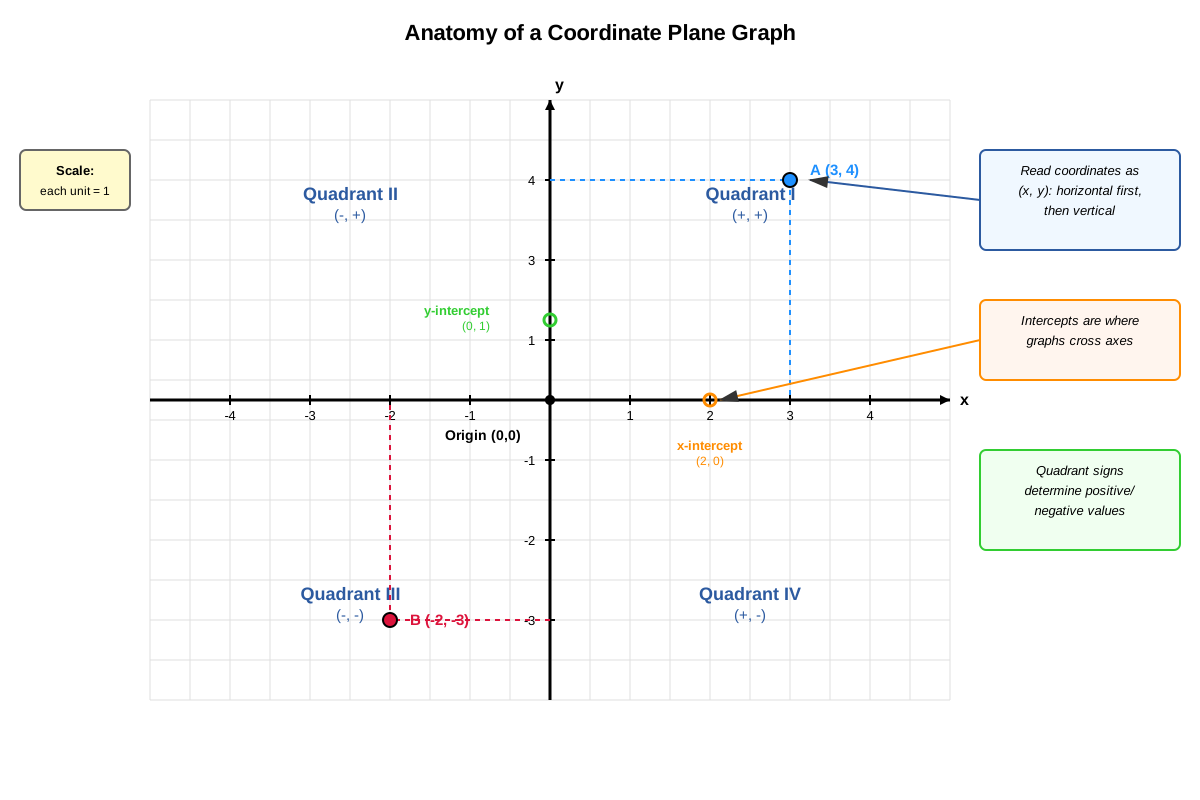
The foundation of graph interpretation begins with accurately reading coordinates from a coordinate plane. Every point on a graph is represented by an ordered pair (x, y), where the x-coordinate indicates horizontal position and the y-coordinate indicates vertical position. On the ACT, students must carefully note the scale of each axis, as graphs may use increments other than 1. For example, an axis might count by 2s, 5s, 10s, or even fractional values like 0.5.
When reading a point, always start from the origin (0, 0) and count along the x-axis first, then parallel to the y-axis. If a point falls between gridlines, estimate its position based on the scale. The ACT occasionally tests whether students can accurately estimate coordinates when points don't fall exactly on gridlines. Pay special attention to negative values—points in Quadrant II have negative x-coordinates, Quadrant III has both coordinates negative, and Quadrant IV has negative y-coordinates.
Slope Determination from Graphs
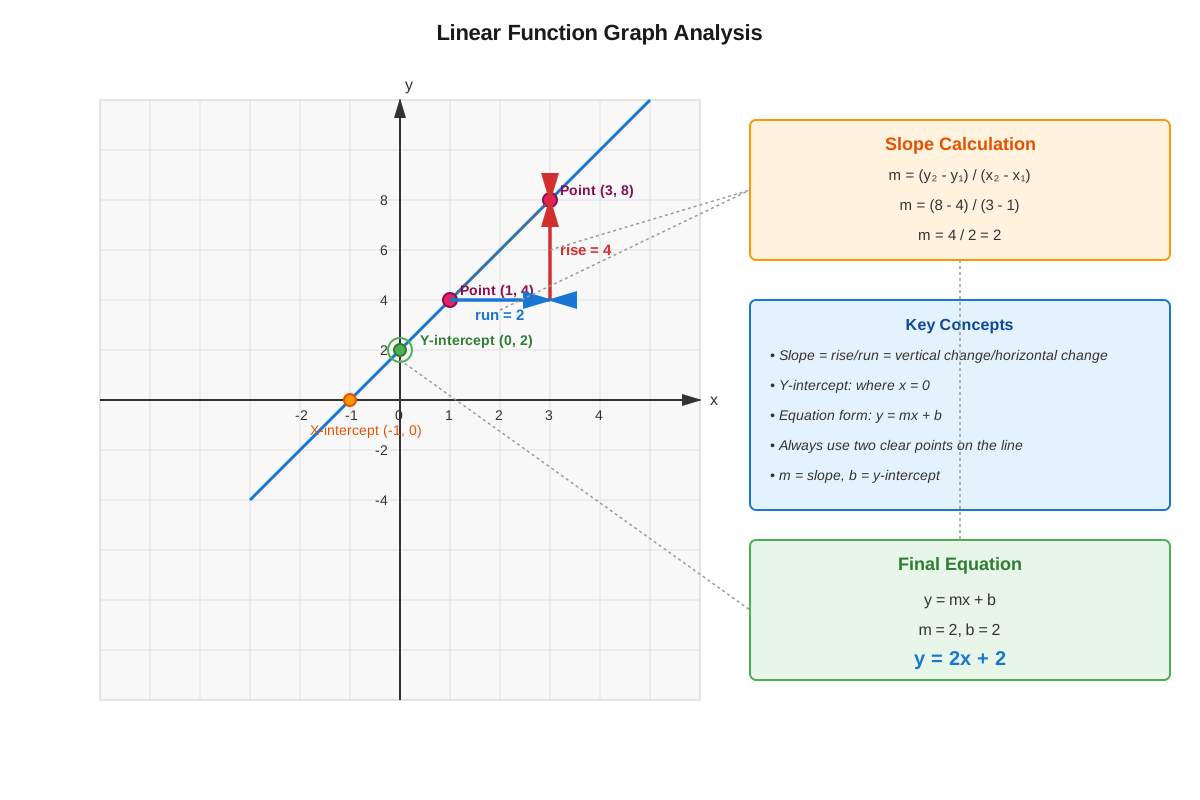
Slope represents the rate of change between two points and is calculated as the ratio of vertical change (rise) to horizontal change (run). The formula is:
slope = m = (y₂ - y₁)/(x₂ - x₁)When determining slope from a graph, identify two clear points where the line crosses grid intersections. This minimizes estimation errors. Count the vertical distance between these points (rise), then count the horizontal distance (run). Remember that slope is positive when the line rises from left to right, negative when it falls, zero for horizontal lines, and undefined for vertical lines.
The ACT frequently tests slope interpretation in context. A steeper line indicates a greater rate of change. In real-world problems, slope might represent speed (distance/time), cost per unit, or any rate of change. Students must be able to compare slopes of multiple lines and understand what different slopes mean in the problem context.
Intercepts and Their Significance
The x-intercept is where a graph crosses the x-axis (where y = 0), and the y-intercept is where it crosses the y-axis (where x = 0). These points carry special significance in many applications. The y-intercept often represents an initial value or starting point in real-world scenarios, while x-intercepts may represent solutions, break-even points, or zeros of functions.
To find intercepts from a graph, locate where the line or curve crosses each axis and read the coordinate value. For the y-intercept, read the y-value where x = 0. For x-intercepts, read the x-value(s) where y = 0. Some functions have multiple x-intercepts (like parabolas), while others may have none (like exponential functions that approach but never touch an axis).
Equation Identification from Graphs
A critical ACT graph interpretation skill involves matching graphs to their equations or determining an equation from a graph. For linear functions, use the slope-intercept form y = mx + b, where m is the slope and b is the y-intercept. Both values can be read directly from the graph.
For quadratic functions, identify the vertex, direction of opening (upward or downward), and x-intercepts if visible. The vertex form y = a(x - h)² + k is particularly useful, where (h, k) is the vertex. The sign of 'a' determines whether the parabola opens upward (positive) or downward (negative).
When multiple choice answers provide different equations, use strategic testing. Check the y-intercept first—this immediately eliminates incorrect options. Then verify the slope or another distinctive feature like a specific point the graph passes through.
Function Behavior Analysis
Graphs reveal important information about function behavior. Key characteristics include:
- Increasing intervals: where the function rises as x increases (positive slope)
- Decreasing intervals: where the function falls as x increases (negative slope)
- Maximum points: highest y-value in a region or overall
- Minimum points: lowest y-value in a region or overall
- Constant intervals: where the function maintains the same y-value (horizontal segments)
The ACT tests whether students can identify these features and describe them using interval notation or inequality statements. For example, "the function is increasing for x > 2" or "the maximum value occurs at x = -1."
Graph Transformations
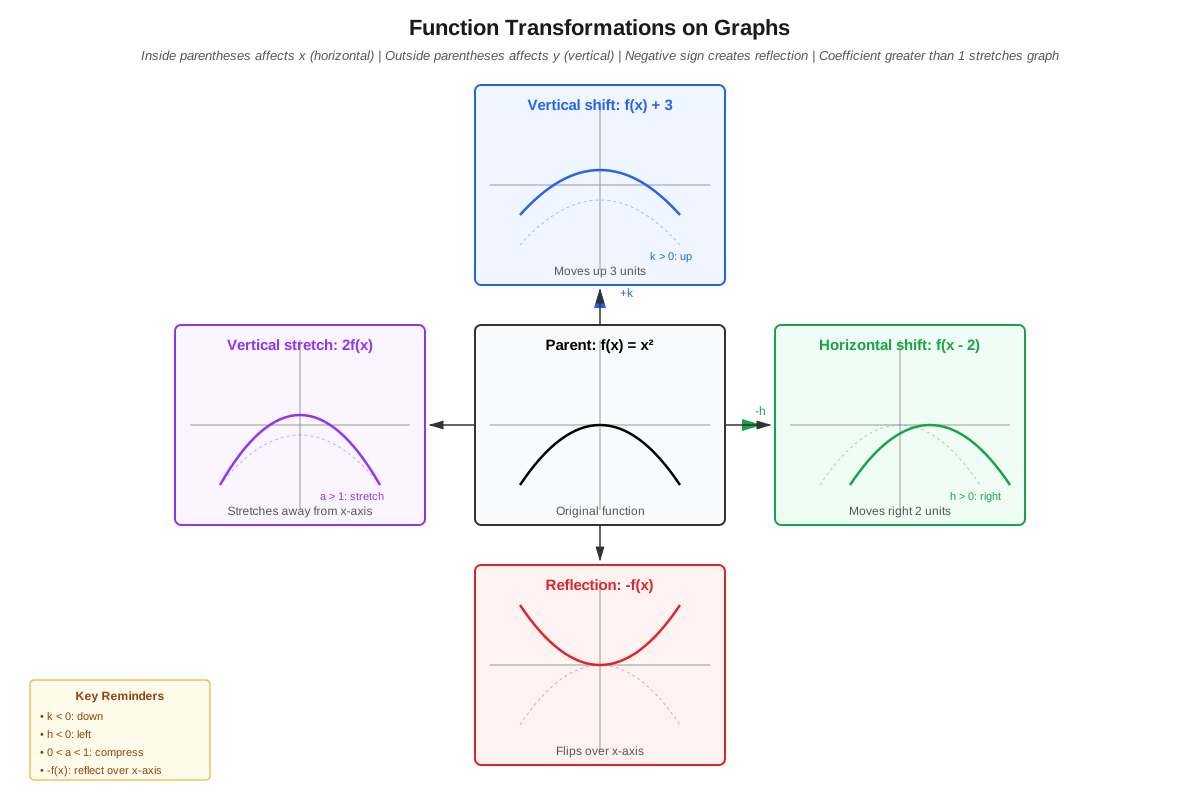
Understanding how algebraic changes affect graphs is essential. The basic transformations include:
| Transformation | Algebraic Form | Effect on Graph | ||
|---|---|---|---|---|
| Vertical shift | f(x) + k | Moves graph up k units (down if k negative) | ||
| Horizontal shift | f(x - h) | Moves graph right h units (left if h negative) | ||
| Vertical stretch | a·f(x), \ | a\ | > 1 | Stretches graph away from x-axis |
| Vertical compression | a·f(x), 0 < \ | a\ | < 1 | Compresses graph toward x-axis |
| Reflection over x-axis | -f(x) | Flips graph upside down | ||
| Reflection over y-axis | f(-x) | Flips graph left to right |
The ACT may show an original function and ask which transformation produces a given result, or provide a transformed graph and ask for its equation.
Multiple Graph Analysis
Some ACT questions present multiple graphs simultaneously—either multiple functions on one coordinate plane or separate graphs to compare. When analyzing multiple graphs, look for:
- Intersection points: where graphs cross, representing solutions to systems of equations
- Relative positions: which function has greater values in different intervals
- Parallel lines: same slope, different y-intercepts
- Perpendicular lines: slopes that are negative reciprocals
Intersection points are particularly important, as they represent values where two quantities are equal. The x-coordinate of an intersection point is the solution to the equation formed by setting the two functions equal.
Concept Relationships
Graph interpretation skills build hierarchically and interconnect extensively. The foundational skill of reading coordinates enables all other graph interpretation tasks. From coordinate reading, students progress to calculating slopes, which requires identifying two points and applying the slope formula. Slope understanding directly connects to determining equations, as slope is a key component of linear equations.
The relationship flows: Coordinate Reading → Slope Calculation → Intercept Identification → Equation Formation → Function Analysis → Transformation Recognition. Each skill depends on the previous ones while adding complexity.
Graph interpretation also connects bidirectionally with algebraic skills. Students must translate from graphs to equations (visual to symbolic) and from equations to graphs (symbolic to visual). This dual fluency is essential for ACT success. Additionally, graph interpretation supports systems of equations (finding intersection points), inequalities (shading regions), and function composition (analyzing combined transformations).
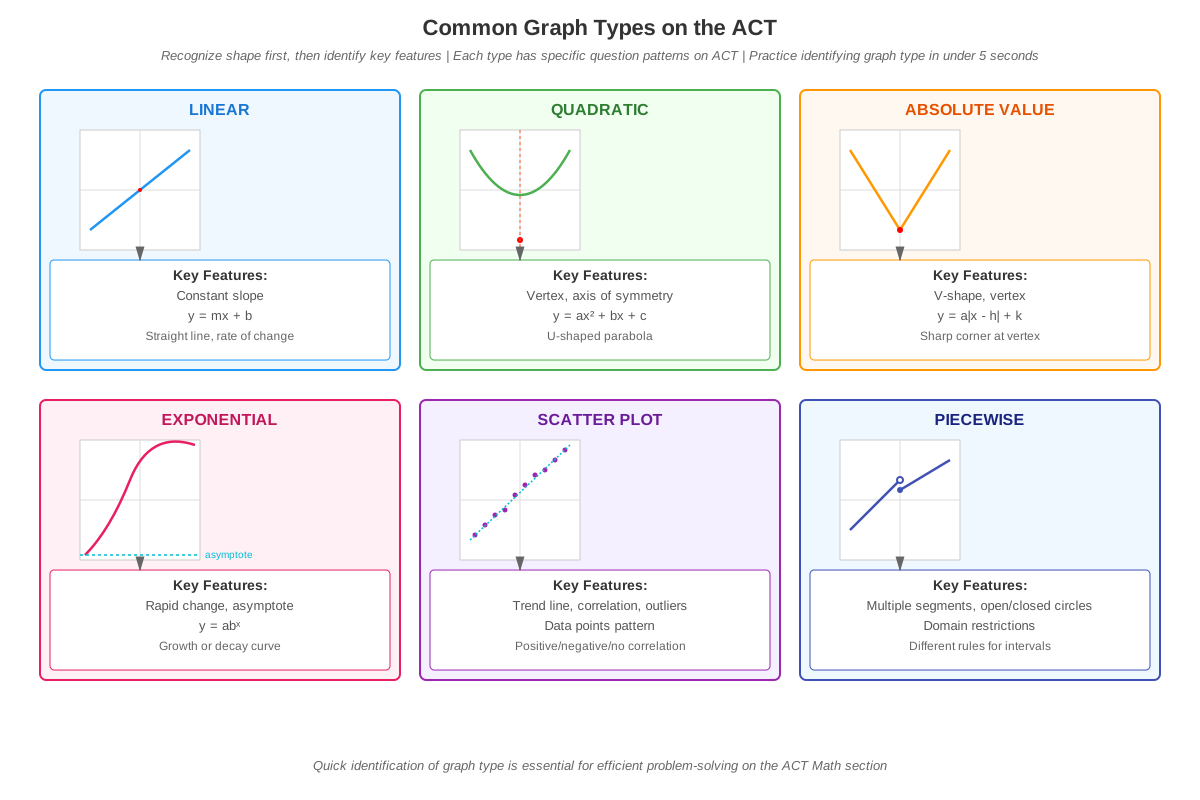
The prerequisite knowledge of coordinate planes provides the framework, while linear equations supply the algebraic foundation. Together, these enable the full spectrum of graph interpretation tasks. Advanced applications include analyzing quadratic functions (parabolas), absolute value functions (V-shapes), exponential functions (curves), and piecewise functions (multiple segments with different rules).
Quick check — test yourself on Graph interpretation so far.
Try Flashcards →High-Yield Facts
⭐ The slope of a line can be determined by selecting any two clear points on the line and calculating rise over run: (y₂ - y₁)/(x₂ - x₁)
⭐ The y-intercept is the y-coordinate where the graph crosses the y-axis (where x = 0)
⭐ Parallel lines have identical slopes but different y-intercepts
⭐ The x-coordinate of an intersection point represents the solution to a system of equations
⭐ A positive slope indicates a line rising from left to right; a negative slope indicates a line falling from left to right
- Horizontal lines have a slope of zero and equations of the form y = k
- Vertical lines have undefined slope and equations of the form x = k
- The steeper the line, the greater the absolute value of its slope
- In y = mx + b form, m represents slope and b represents the y-intercept
- Quadratic functions (parabolas) have either a maximum point (opening downward) or minimum point (opening upward)
- The vertex of a parabola is located at x = -b/(2a) when the equation is in standard form y = ax² + bx + c
- Transformations of f(x) + k shift the graph vertically, while f(x - h) shift horizontally
- The domain of a function shown on a graph includes all x-values for which the function is defined
- The range of a function includes all y-values that the function achieves
- Symmetry about the y-axis indicates an even function; symmetry about the origin indicates an odd function
Common Misconceptions
Misconception: The x-coordinate is always read vertically and the y-coordinate horizontally.
Correction: The x-coordinate represents horizontal position (read along the x-axis), while the y-coordinate represents vertical position (read along the y-axis). Always read x first, then y.
Misconception: Slope is calculated as (x₂ - x₁)/(y₂ - y₁).
Correction: Slope is rise over run, which means vertical change over horizontal change: (y₂ - y₁)/(x₂ - x₁). The y-values go in the numerator, x-values in the denominator.
Misconception: A steeper line always has a larger slope value.
Correction: A steeper line has a larger absolute value of slope, but the slope could be negative. A line with slope -5 is steeper than a line with slope 2, even though -5 < 2.
Misconception: The y-intercept is the point where the graph crosses the y-axis, so it's written as (0, b).
Correction: While the y-intercept occurs at the point (0, b), the y-intercept value itself is just the number b, not the ordered pair. In the equation y = mx + b, the b represents the y-intercept value.
Misconception: If two lines don't appear to intersect on the visible portion of the graph, they are parallel.
Correction: Lines may intersect outside the visible window of the graph. Only lines with identical slopes are truly parallel and will never intersect. Always check slopes rather than relying solely on visual appearance.
Misconception: In the transformation f(x - 3), the graph shifts left 3 units.
Correction: The transformation f(x - 3) shifts the graph RIGHT 3 units. This counterintuitive result occurs because we're replacing x with (x - 3), so we need x to be 3 units larger to get the same output. Think: "x needs to be 3 more, so move right."
Misconception: The maximum or minimum of a function is the x-coordinate where it occurs.
Correction: The maximum or minimum value of a function is the y-coordinate (the output value). The location where it occurs is the x-coordinate. For example, if a parabola has its vertex at (2, 5) and opens downward, the maximum value is 5, and it occurs at x = 2.
Worked Examples
Example 1: Comprehensive Line Analysis
Problem: A line passes through points A(-2, 5) and B(4, -1) on a coordinate plane. Determine: (a) the slope of the line, (b) the y-intercept, (c) the equation of the line in slope-intercept form, and (d) the x-intercept.
Solution:
(a) Finding the slope: Use the slope formula with points A(-2, 5) and B(4, -1).
m = (y₂ - y₁)/(x₂ - x₁) = (-1 - 5)/(4 - (-2)) = -6/6 = -1The slope is -1, indicating the line falls at a 45-degree angle from left to right.
(b) Finding the y-intercept: Use the slope-intercept form y = mx + b with the slope m = -1 and either point. Using point B(4, -1):
-1 = (-1)(4) + b
-1 = -4 + b
b = 3
The y-intercept is 3, meaning the line crosses the y-axis at (0, 3).
(c) Writing the equation: Substitute m = -1 and b = 3 into y = mx + b:
y = -x + 3(d) Finding the x-intercept: Set y = 0 and solve for x:
0 = -x + 3
x = 3
The x-intercept is 3, meaning the line crosses the x-axis at (3, 0).
Connection to learning objectives: This example demonstrates applying graph interpretation to extract multiple pieces of information from coordinate data, translating between graphical representation (points) and algebraic representation (equation).
Example 2: Function Transformation Analysis
Problem: The graph of f(x) = x² is transformed to create a new function g(x). The graph of g(x) has its vertex at (3, -2) and opens upward. What is the equation of g(x)?
Solution:
Step 1: Recognize that this involves transformations of the parent function f(x) = x², which has its vertex at (0, 0).
Step 2: The vertex has moved from (0, 0) to (3, -2). This represents:
- A horizontal shift right 3 units
- A vertical shift down 2 units
Step 3: Apply transformation rules. A horizontal shift right 3 units means replacing x with (x - 3). A vertical shift down 2 units means subtracting 2 from the entire function.
Step 4: Write the transformed equation using vertex form:
g(x) = (x - 3)² - 2Step 5: Verify by checking the vertex. When x = 3:
g(3) = (3 - 3)² - 2 = 0 - 2 = -2 ✓The vertex is indeed at (3, -2), and since the coefficient of the squared term is positive (1), the parabola opens upward as required.
Connection to learning objectives: This example shows how to identify transformations from graphical information and translate them into algebraic form, a key ACT graph interpretation skill. It also demonstrates the strategy of working with vertex form for quadratic functions.
Exam Strategy
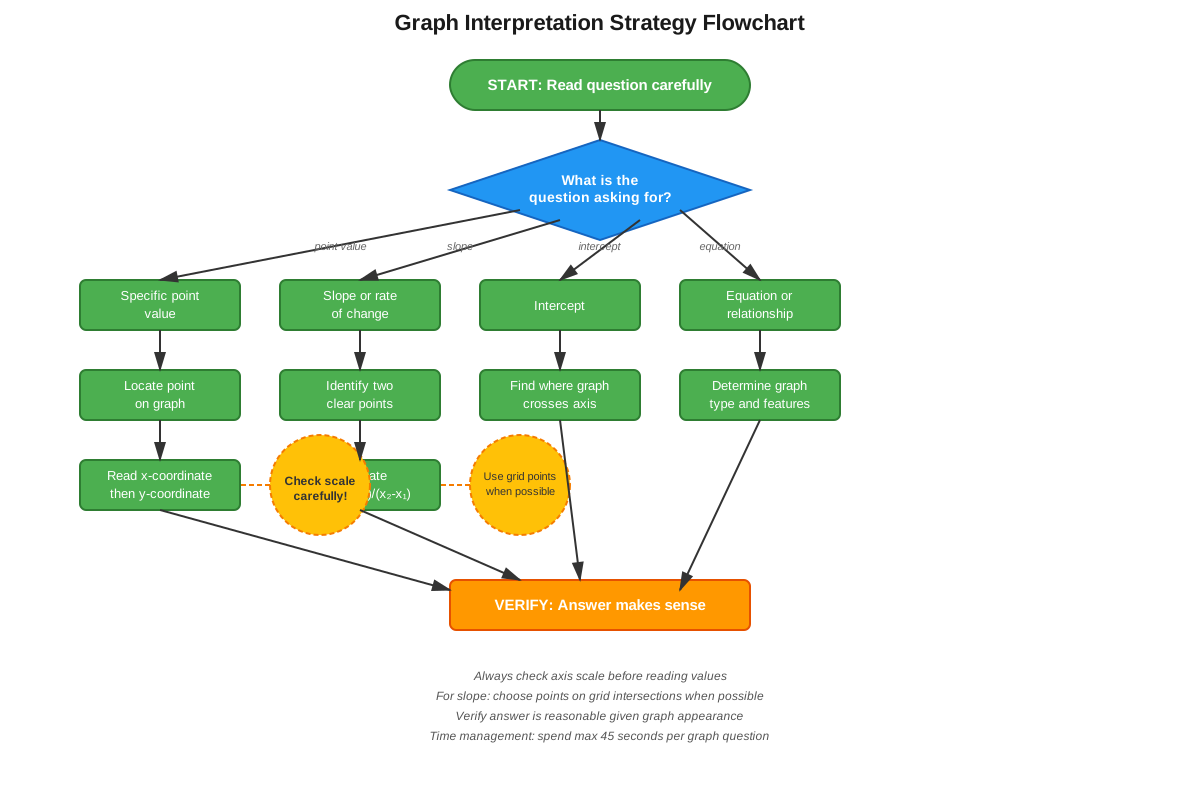
When approaching ACT graph interpretation questions, employ a systematic strategy to maximize accuracy and efficiency. First, invest 5-10 seconds examining the graph carefully before reading the question. Note the scale of both axes, identify any labeled points, and observe the general behavior of the function. This preview prevents errors caused by misreading scales or overlooking important features.
Trigger words and phrases that signal graph interpretation questions include: "according to the graph," "as shown in the figure," "the graph below shows," "at what point," "what is the slope," "where does the graph intersect," "which equation represents," and "the graph of f(x)." When you see these phrases, immediately shift to visual analysis mode.
For process of elimination, use these strategies:
- Check the y-intercept first when matching equations to graphs—this single value often eliminates 2-3 answer choices immediately
- Test a specific point from the graph in each equation—the correct equation must satisfy all visible points
- Verify the slope sign (positive/negative)—this eliminates options with incorrect direction
- For transformation questions, check one distinctive feature (like the vertex location) to eliminate impossible answers
Time allocation is critical. Simple point-reading questions should take 15-30 seconds. Slope calculation or intercept identification questions warrant 30-45 seconds. Complex multi-step problems involving equation determination or transformations may require 60-90 seconds. If a graph interpretation question exceeds 90 seconds, mark it for review and move on—these questions rarely require more time when approached correctly.
Strategic shortcuts include:
- For linear equations, you only need two pieces of information (slope and y-intercept, or two points)
- When graphs show intersection points clearly, read the coordinates directly rather than solving algebraically
- Use symmetry to your advantage—if a parabola is symmetric about x = 2, the vertex has x-coordinate 2
- Estimate when exact values aren't needed—if answer choices are spread apart, approximation suffices
Exam Tip: Always verify your answer makes sense by checking it against the graph. If you calculated a slope of 5 but the line appears nearly horizontal, you've made an error.
Memory Techniques
SLOPE Mnemonic: Subtract Lower from Other, Put Elevation over extension
- Subtract the y-coordinates (elevation/vertical)
- Put that over the subtracted x-coordinates (extension/horizontal)
- Formula: (y₂ - y₁)/(x₂ - x₁)
Intercept Memory Device: "Y-intercept is where You start" (the initial value when x = 0)
Transformation Direction: "Opposite Day for horizontal shifts"
- f(x - 3) moves RIGHT (opposite of the minus sign)
- f(x + 3) moves LEFT (opposite of the plus sign)
- But f(x) + 3 moves UP (same as the plus sign)
- And f(x) - 3 moves DOWN (same as the minus sign)
Slope Sign Visualization: Draw a simple face
- Positive slope = smile (happy, going up) /
- Negative slope = frown (sad, going down) \
- Zero slope = straight face (neutral, flat) —
- Undefined slope = surprised (vertical) |
Parallel and Perpendicular: "Parallel = Precisely the same slope" and "Perpendicular = Product of slopes is -1"
Vertex Form Memory: "Vertex form has Visible vertex coordinates"
- y = a(x - h)² + k, where vertex is (h, k)
- Remember: the h value has opposite sign in the equation
Summary
Graph interpretation is a foundational ACT Math skill that requires students to extract, analyze, and apply information from visual representations of mathematical relationships. Mastery involves reading coordinates accurately while accounting for axis scales, calculating slopes using the rise-over-run formula, identifying intercepts as the points where graphs cross axes, and translating between graphical and algebraic representations. Students must recognize function behavior including increasing/decreasing intervals and maximum/minimum values, understand how algebraic transformations affect graph position and shape, and analyze multiple graphs to find intersection points and compare relationships. Success on ACT graph interpretation questions demands careful attention to detail, systematic analysis of visual information, and the ability to connect graphical features to their algebraic meanings. The most critical skills include slope determination, equation identification from graphs, and recognizing transformations—these appear consistently across multiple question types and difficulty levels. Students who develop strong graph interpretation skills gain advantages throughout the Math section and build analytical capabilities that transfer to the Science Reasoning section and beyond.
Key Takeaways
- Graph interpretation appears in 10-15% of ACT Math questions, making it one of the highest-yield topics for focused study
- Always check axis scales carefully—ACT graphs frequently use non-standard increments that can lead to misreading values
- Slope equals rise over run: (y₂ - y₁)/(x₂ - x₁), with positive slopes rising left to right and negative slopes falling
- The y-intercept (b in y = mx + b) is where the graph crosses the y-axis, representing the initial value in many real-world contexts
- Intersection points of two graphs represent solutions to systems of equations, with the x-coordinate being the solution value
- Transformations follow specific rules: f(x) ± k shifts vertically, f(x ± h) shifts horizontally in the opposite direction of the sign
- Strategic elimination using y-intercepts and slope signs quickly narrows answer choices in equation-matching questions
Related Topics
Linear Equations and Inequalities: Mastering graph interpretation enables deeper understanding of how linear equations behave visually, including graphing inequalities with shaded regions and understanding solution sets geometrically.
Systems of Equations: Graph interpretation skills directly support solving systems by graphing, as intersection points represent simultaneous solutions. This visual approach often provides faster solutions than algebraic methods.
Quadratic Functions and Parabolas: Building on basic graph interpretation, students can analyze parabolic graphs to determine vertices, axes of symmetry, maximum/minimum values, and roots—all essential for advanced coordinate geometry.
Function Transformations: Advanced graph interpretation includes analyzing how parent functions (linear, quadratic, absolute value, exponential) transform through shifts, stretches, compressions, and reflections.
Data Analysis and Statistics: Graph interpretation skills transfer directly to analyzing scatter plots, identifying correlations, and understanding data distributions—topics that appear in both Math and Science Reasoning sections.
Practice CTA
Now that you've mastered the core concepts of graph interpretation, it's time to solidify your understanding through active practice. Complete the practice questions to test your ability to read graphs accurately, calculate slopes and intercepts, match equations to their graphical representations, and analyze function transformations. Use the flashcards to reinforce key formulas, transformation rules, and common graph features. Remember, graph interpretation is a skill that improves dramatically with practice—each question you work through builds pattern recognition and speed. The investment you make in practicing these skills will pay dividends across multiple ACT Math questions and give you confidence when approaching visual data. You've got this!
Sign up free to keep reading
Create a free AnvayaPrep account to finish this ACT guide on Graph interpretation — plus flashcards and practice questions.