Overview
Graphing inequalities is a fundamental skill in coordinate geometry that appears frequently on the ACT Math test. Unlike graphing equations, which produce lines or curves, graphing inequalities requires students to identify entire regions of the coordinate plane that satisfy a given condition. This topic combines algebraic manipulation with visual-spatial reasoning, making it a powerful test of mathematical maturity.
On the ACT, ACT graphing inequalities questions typically ask students to identify which graph corresponds to a given inequality, determine whether specific points satisfy an inequality, or select the inequality that matches a shaded region. These questions appear in approximately 2-3 problems per test and are considered medium difficulty because they require both computational accuracy and conceptual understanding. Students must recognize the difference between solid and dashed boundary lines, understand when to shade above versus below a line, and work confidently with systems of inequalities.
Mastering graphing inequalities connects directly to other coordinate geometry concepts including linear equations, slope-intercept form, and systems of equations. This topic also builds toward understanding linear programming, optimization problems, and constraint-based reasoning that appears in higher mathematics. The visual nature of inequality graphs makes this topic particularly valuable for developing the spatial reasoning skills that support success across multiple ACT Math domains.
Learning Objectives
- [ ] Identify when Graphing inequalities is being tested
- [ ] Explain the core rule or strategy behind Graphing inequalities
- [ ] Apply Graphing inequalities to ACT-style questions accurately
- [ ] Distinguish between solid and dashed boundary lines based on inequality symbols
- [ ] Determine the correct shading region for single-variable and two-variable inequalities
- [ ] Interpret graphs of systems of inequalities and identify solution regions
- [ ] Verify whether given points satisfy specific inequalities or systems
Prerequisites
- Linear equations in slope-intercept form (y = mx + b): Understanding how to graph lines is essential because the boundary of an inequality region is typically a line
- Coordinate plane basics: Students must be comfortable plotting points and understanding quadrants to visualize inequality solutions
- Algebraic manipulation: Solving for y and rearranging inequalities requires facility with algebraic operations while maintaining inequality direction
- Understanding inequality symbols (<, >, ≤, ≥): Knowing what these symbols mean numerically is foundational to translating them into graphical representations
Why This Topic Matters
In real-world applications, inequalities model constraints and limitations that are ubiquitous in practical problem-solving. Budget constraints (spending ≤ available funds), capacity limits (occupancy < maximum), minimum requirements (score ≥ passing threshold), and feasible regions in business optimization all rely on inequality reasoning. Engineers use systems of inequalities to define safe operating parameters, economists use them to model supply and demand constraints, and data scientists use them to establish decision boundaries in classification problems.
On the ACT Math test, graphing inequalities appears in approximately 4-6% of questions, translating to 2-3 problems per 60-question test. These questions most commonly appear in two formats: (1) multiple-choice questions showing four different graphs where students must identify which correctly represents a given inequality, and (2) questions providing a graph with a shaded region and asking students to select the corresponding inequality. Less frequently, questions may ask whether specific coordinate points satisfy a given inequality or system of inequalities.
The ACT particularly favors testing this topic because it efficiently assesses multiple competencies simultaneously: algebraic manipulation, visual-spatial reasoning, attention to detail (solid versus dashed lines), and logical thinking (determining which side of a boundary to shade). Questions often integrate this topic with other coordinate geometry concepts, making it a high-yield area for comprehensive review.
Core Concepts
Understanding Inequality Symbols and Boundary Lines
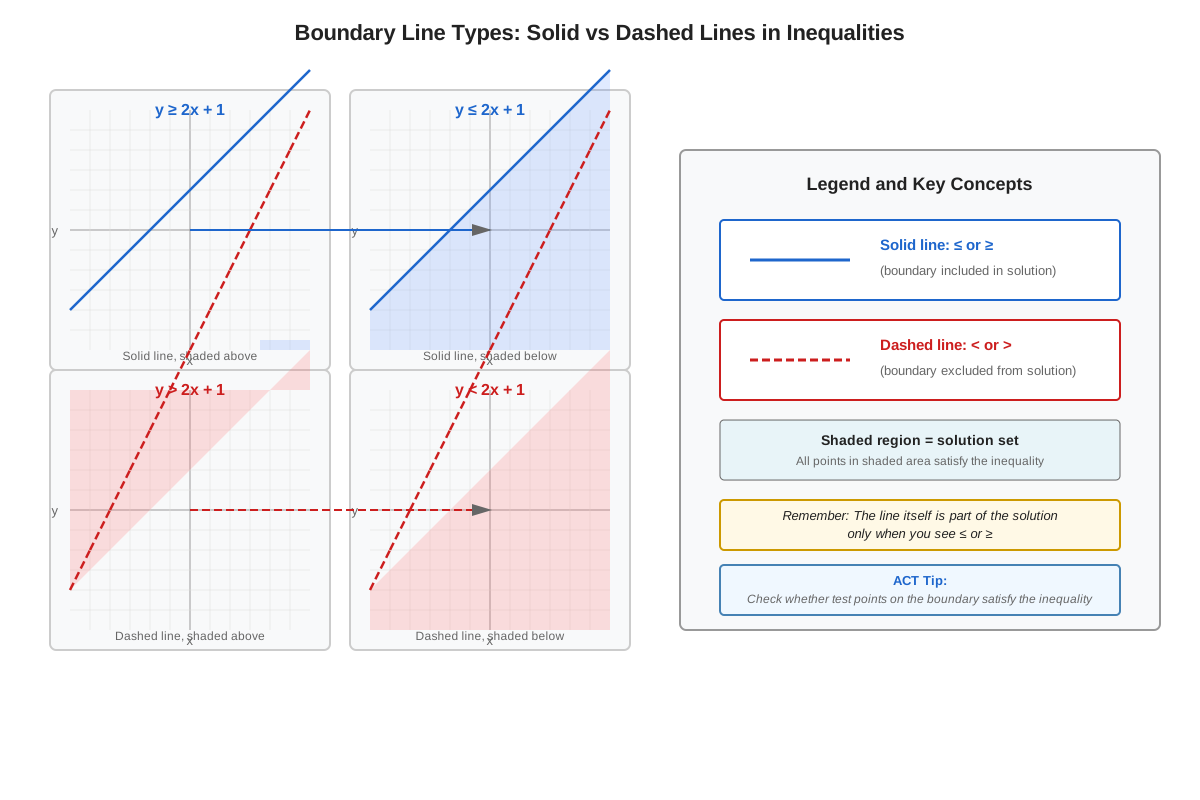
The foundation of graphing inequalities begins with understanding how inequality symbols translate to graphical features. The four primary inequality symbols each have specific graphical implications:
- < (less than) and > (greater than): These strict inequalities produce dashed or dotted boundary lines because points on the line itself do not satisfy the inequality
- ≤ (less than or equal to) and ≥ (greater than or equal to): These inclusive inequalities produce solid boundary lines because points on the line are part of the solution set
The boundary line itself is determined by replacing the inequality symbol with an equals sign. For example, the inequality y < 2x + 3 has the boundary line y = 2x + 3. This line divides the coordinate plane into two half-planes, only one of which contains the solutions to the inequality.
Determining the Shading Region
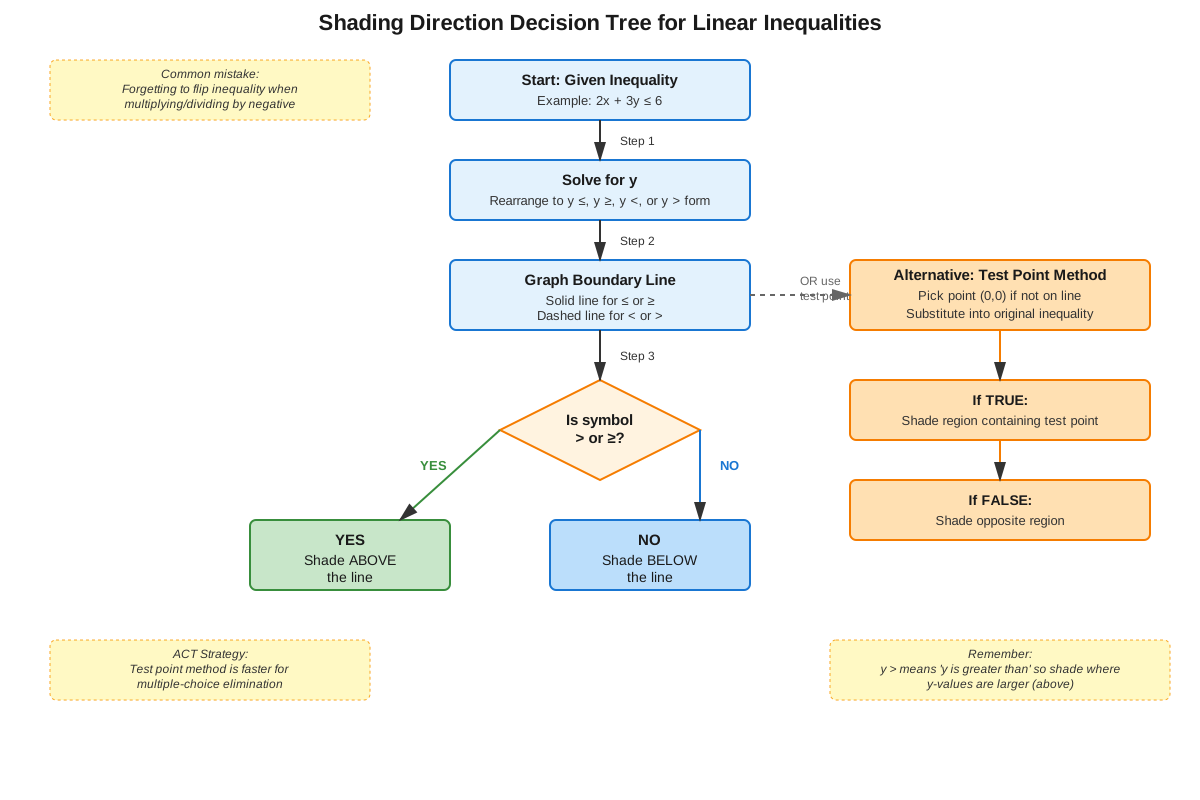
Once the boundary line is drawn, the critical step is determining which side of the line to shade. The shaded region represents all points (x, y) that satisfy the inequality. There are two reliable methods:
Method 1: Test Point Method
- Choose a test point not on the boundary line (the origin (0, 0) is usually easiest unless the line passes through it)
- Substitute the coordinates into the original inequality
- If the inequality is true, shade the region containing the test point
- If the inequality is false, shade the opposite region
Method 2: Algebraic Analysis (when the inequality is solved for y)
- If y < [expression] or y ≤ [expression]: Shade below the boundary line
- If y > [expression] or y ≥ [expression]: Shade above the boundary line
This second method is particularly efficient on timed tests like the ACT, but requires the inequality to be solved for y first.
Linear Inequalities in Two Variables
A linear inequality in two variables takes the form Ax + By < C (or with >, ≤, or ≥). The solution set is a half-plane region. The process for graphing follows these steps:
- Rewrite in slope-intercept form: Solve for y to get y < mx + b (or the appropriate inequality symbol)
- Remember: When dividing or multiplying both sides by a negative number, reverse the inequality symbol
- Graph the boundary line: Use y = mx + b, making it dashed for < or >, solid for ≤ or ≥
- Determine shading: Use either the test point method or the algebraic rule (shade below for <, above for >)
- Verify: Check that at least one point in the shaded region satisfies the original inequality
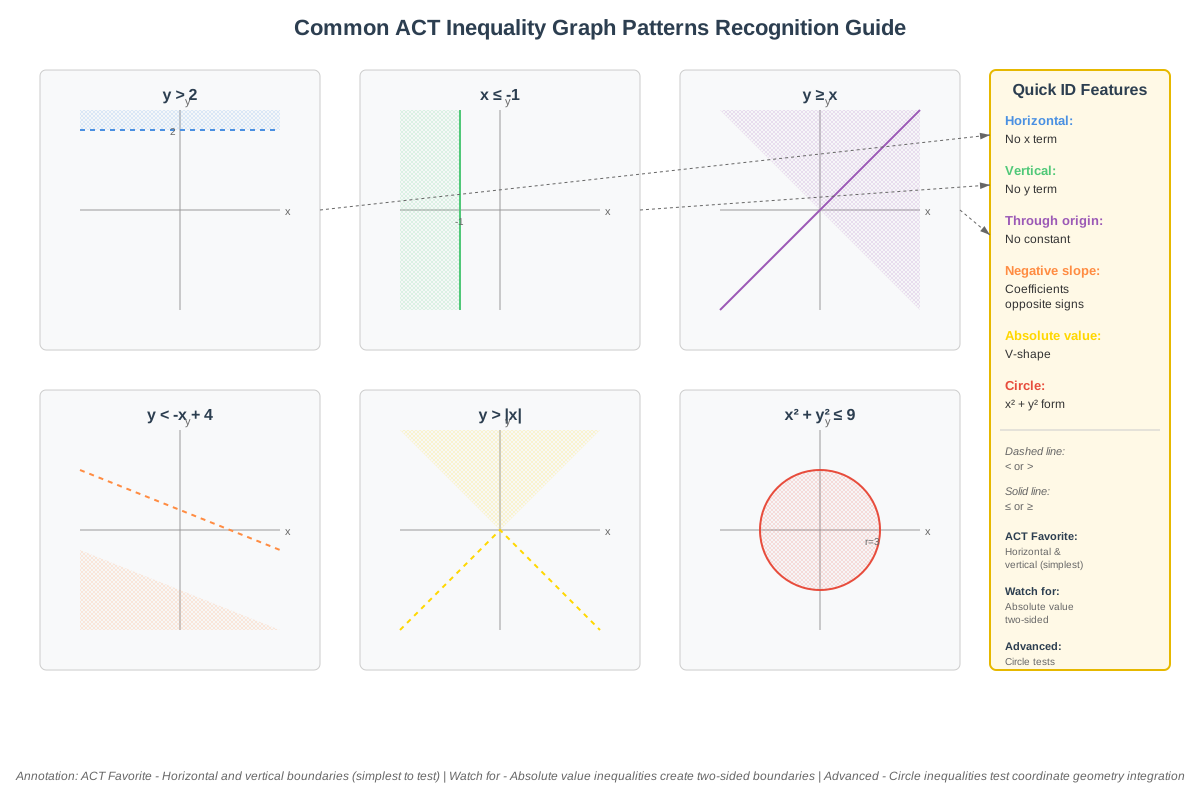
Vertical and Horizontal Boundary Lines
Special cases occur with vertical and horizontal lines:
| Inequality Type | Boundary Line | Shading Direction |
|---|---|---|
| x < a | Vertical line x = a (dashed) | Shade left (toward negative x) |
| x > a | Vertical line x = a (dashed) | Shade right (toward positive x) |
| x ≤ a | Vertical line x = a (solid) | Shade left (toward negative x) |
| x ≥ a | Vertical line x = a (solid) | Shade right (toward positive x) |
| y < b | Horizontal line y = b (dashed) | Shade below (toward negative y) |
| y > b | Horizontal line y = b (dashed) | Shade above (toward positive y) |
| y ≤ b | Horizontal line y = b (solid) | Shade below (toward negative y) |
| y ≥ b | Horizontal line y = b (solid) | Shade above (toward positive y) |
Systems of Inequalities
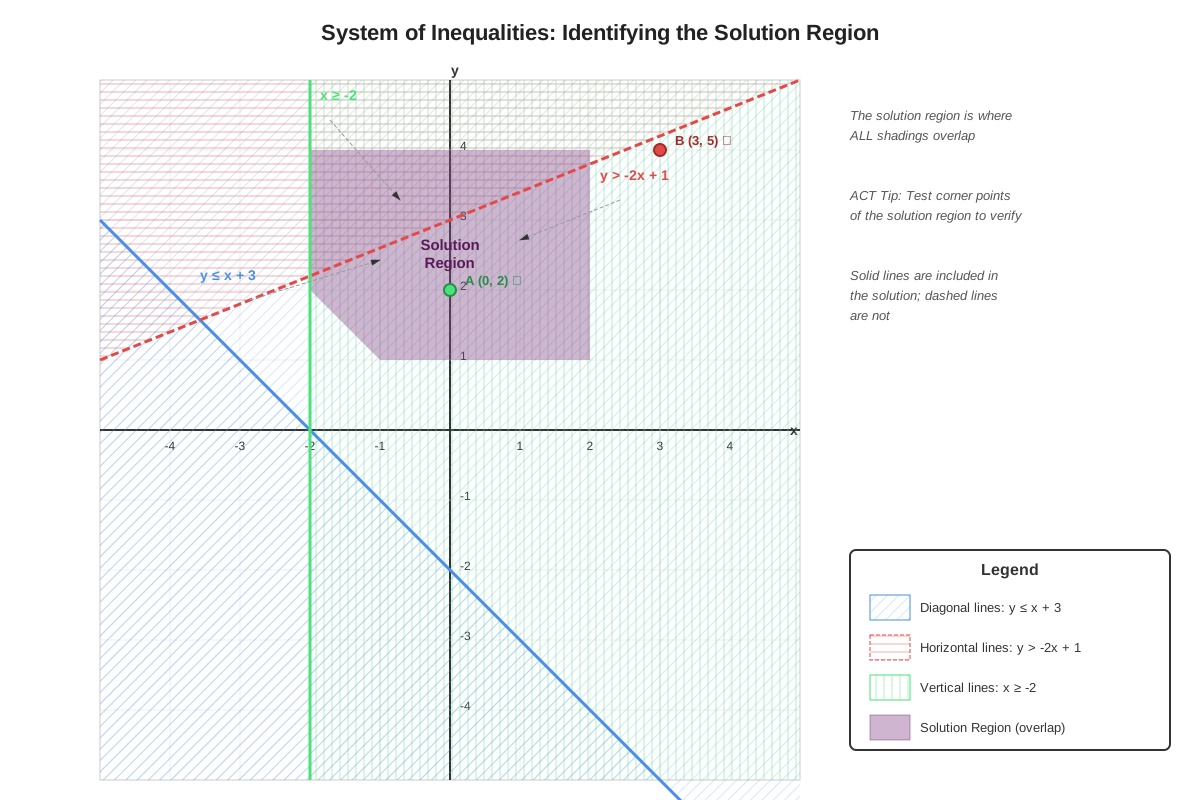
A system of inequalities consists of two or more inequalities that must be satisfied simultaneously. The solution region is the intersection (overlap) of all individual solution regions. To graph a system:
- Graph each inequality separately on the same coordinate plane
- Identify where all shaded regions overlap
- The overlapping region (which may be bounded or unbounded) represents the solution set
- Points on solid boundary lines within the overlap are included; points on dashed lines are not
Systems of inequalities frequently appear on the ACT in the context of constraint problems or when identifying feasible regions. The test may show a graph with multiple boundary lines and ask which system of inequalities produces the shaded region shown.
Reading Graphs to Write Inequalities
A reverse skill tested on the ACT is interpreting a graph to determine the corresponding inequality. When given a graph:
- Identify the boundary line: Determine its equation using slope and y-intercept or two points
- Check the line type: Solid line means ≤ or ≥; dashed line means < or >
- Determine the inequality direction:
- If shading is above the line, use > or ≥
- If shading is below the line, use < or ≤
- Write the inequality: Combine the boundary equation with the appropriate symbol
This skill requires strong understanding of linear equations and careful attention to visual details.
Concept Relationships
The concepts within graphing inequalities build sequentially and interdependently. Understanding inequality symbols → determines boundary line type (solid or dashed) → which affects whether boundary points are solutions. Simultaneously, solving the inequality for y → enables algebraic determination of shading → which is faster than the test point method for ACT timing.
The relationship to prerequisite topics is direct: Linear equations provide the foundation for boundary lines, while coordinate plane knowledge enables plotting and visualization. Algebraic manipulation skills ensure students can solve for y correctly, particularly when dividing by negative coefficients requires reversing inequality symbols.
Looking forward, graphing inequalities connects to systems of equations (the inequality version adds shading to the intersection concept), linear programming (finding optimal solutions within constraint regions), and absolute value inequalities (which produce two boundary lines and require union or intersection logic). The visual reasoning developed here also supports function transformations and domain/range restrictions.
The progression can be mapped as: Basic inequalities → Linear inequalities in two variables → Systems of inequalities → Optimization problems. Each level adds complexity while building on the same core principles of boundaries and regions.
High-Yield Facts
⭐ Solid boundary lines (drawn with a solid stroke) indicate ≤ or ≥ inequalities where points on the line are included in the solution set
⭐ Dashed boundary lines (drawn with a dotted or dashed stroke) indicate < or > inequalities where points on the line are excluded from the solution set
⭐ When an inequality is solved for y, y < [expression] means shade below the line, and y > [expression] means shade above the line
⭐ The test point (0, 0) is the most efficient choice for determining shading direction unless the boundary line passes through the origin
⭐ When multiplying or dividing both sides of an inequality by a negative number, the inequality symbol must be reversed
- The boundary line of any inequality is found by replacing the inequality symbol with an equals sign
- For vertical line inequalities (x < a or x > a), shade left for "less than" and right for "greater than"
- For horizontal line inequalities (y < b or y > b), shade below for "less than" and above for "greater than"
- In a system of inequalities, the solution region is where all individual shaded regions overlap (the intersection)
- A point satisfies an inequality if substituting its coordinates makes the inequality true
- The solution region of an inequality is always a half-plane (one side of the boundary line)
- ACT graphs typically show only a portion of the coordinate plane, but the shaded region extends infinitely in the indicated direction
Quick check — test yourself on Graphing inequalities so far.
Try Flashcards →Common Misconceptions
Misconception: All boundary lines should be drawn as solid lines → Correction: Boundary lines are solid only for ≤ and ≥ inequalities; they must be dashed for < and > inequalities because points on the line are not part of the solution set
Misconception: When solving for y, the inequality symbol never changes → Correction: The inequality symbol must be reversed when multiplying or dividing both sides by a negative number. For example, -2y < 6 becomes y > -3 (not y < -3)
Misconception: "Less than" always means shade below, regardless of the variable → Correction: The shading rule (below for <, above for >) only applies when the inequality is solved for y. For x < 3, you shade to the left, not below
Misconception: The test point method requires testing multiple points → Correction: Only one test point is needed. If that point satisfies the inequality, shade the region containing it; if not, shade the opposite region
Misconception: In a system of inequalities, the solution is the union (combination) of all shaded regions → Correction: The solution is the intersection (overlap) of all shaded regions—only points that satisfy all inequalities simultaneously are solutions
Misconception: The boundary line equation is the same as the inequality → Correction: The boundary line is found by replacing the inequality symbol with an equals sign. The inequality y < 2x + 1 has boundary line y = 2x + 1, but they represent different mathematical objects
Misconception: If a graph shows shading above a line, the inequality must be y > [expression] → Correction: While this is often true, the inequality could also be written in a different form. Always verify by checking the boundary equation and testing a point in the shaded region
Worked Examples
Example 1: Graphing a Linear Inequality
Problem: Graph the inequality 2x + 3y ≤ 12
Solution:
Step 1: Solve for y to get the inequality in slope-intercept form
- Start with: 2x + 3y ≤ 12
- Subtract 2x from both sides: 3y ≤ -2x + 12
- Divide both sides by 3: y ≤ (-2/3)x + 4
- Note: We divided by a positive number, so the inequality symbol stays the same
Step 2: Identify the boundary line
- The boundary line is y = (-2/3)x + 4
- This line has slope m = -2/3 and y-intercept b = 4
- Since the inequality is ≤ (less than or equal to), draw a solid line
Step 3: Determine the shading region
- The inequality is y ≤ (-2/3)x + 4, which means y is less than or equal to the expression
- Using the algebraic rule: shade below the line
- Verification using test point (0, 0): 2(0) + 3(0) ≤ 12 → 0 ≤ 12 ✓ (true)
- Since (0, 0) satisfies the inequality and is below the line, our shading is correct
Step 4: Final graph description
- Solid line passing through (0, 4) and (6, 0) with slope -2/3
- Entire region below and including the line is shaded
- Points like (0, 0), (3, 1), and (5, -2) are in the solution set
- Points like (0, 5) and (6, 2) are not in the solution set
Connection to Learning Objectives: This example demonstrates applying graphing inequalities to ACT-style questions by following the systematic process of solving for y, determining boundary line type, and identifying the correct shading region.
Example 2: Identifying an Inequality from a Graph
Problem: A graph shows a dashed line passing through points (0, -2) and (4, 0), with shading above the line. Which inequality does this graph represent?
Solution:
Step 1: Find the equation of the boundary line
- Calculate slope: m = (0 - (-2))/(4 - 0) = 2/4 = 1/2
- The y-intercept is -2 (the line passes through (0, -2))
- Boundary line equation: y = (1/2)x - 2
Step 2: Determine the inequality symbol
- The line is dashed, so the inequality is strict (< or >), not inclusive (≤ or ≥)
- The shading is above the line, so we use > (greater than)
- Preliminary inequality: y > (1/2)x - 2
Step 3: Verify with a test point
- Choose a point clearly in the shaded region, such as (0, 0)
- Test: 0 > (1/2)(0) - 2 → 0 > -2 ✓ (true)
- This confirms our inequality is correct
Step 4: Consider alternative forms
- The inequality could also be written as: (1/2)x - 2 < y
- Or in standard form: x - 2y < 4 (multiply both sides by 2, then rearrange)
- Or: -x + 2y > -4 (multiply by -2 and reverse the inequality)
- On the ACT, check which form matches the answer choices
Answer: y > (1/2)x - 2 (or equivalent forms)
Connection to Learning Objectives: This example demonstrates identifying when graphing inequalities is being tested (recognizing the graph format) and explaining the core strategy (working backward from graph to inequality by analyzing boundary line type and shading).
Exam Strategy
When approaching ACT graphing inequalities questions, begin by identifying the question type: Are you graphing a given inequality, or identifying an inequality from a graph? This determines your strategy.
For "graph the inequality" questions:
- Immediately solve for y if not already done (this takes 10-15 seconds but saves time later)
- Look at the inequality symbol first to determine line type before examining answer choices
- Eliminate answer choices with the wrong line type (solid vs. dashed) immediately
- Use the algebraic shading rule (below for <, above for >) rather than test points when possible
- If two choices remain, test the origin (0, 0) in the original inequality to determine shading
For "identify the inequality" questions:
- Determine the boundary line equation using two clear points on the line
- Check line type (solid or dashed) to narrow inequality symbols to two options
- Observe shading direction to select the correct symbol
- Verify your answer by testing one point from the shaded region
Trigger words and phrases to watch for:
- "Which graph represents..." → You're graphing a given inequality
- "Which inequality is shown..." → You're writing an inequality from a graph
- "Solution region" or "feasible region" → System of inequalities
- "Satisfies the inequality" → Point-testing question
- "Boundary line" → Focus on the line equation and whether it's included
Process of elimination tips:
- Eliminate any graph with the wrong line type first (this often removes 2 choices immediately)
- If the inequality has y >, eliminate any graph shaded below the line
- If the inequality has y <, eliminate any graph shaded above the line
- For systems, eliminate any graph where the shaded region doesn't overlap all individual regions
Time allocation: Budget 45-60 seconds for standard graphing inequality questions. If a question involves a system of inequalities or requires writing an inequality from a complex graph, allow up to 90 seconds. If you're spending more than 90 seconds, mark the question and return to it after completing easier problems.
Memory Techniques
Mnemonic for Line Type: "Equal gets Solid" → If the inequality includes "equal to" (≤ or ≥), the line is solid. If there's no equal sign (< or >), the line is dashed.
Mnemonic for Shading Direction: "Less is Low, Greater is Gain" → When solved for y, "less than" means shade low (below), and "greater than" means gain altitude (above).
Visualization Strategy: Picture the boundary line as a fence. A solid fence (solid line) includes the fence itself in your yard (solution region). A dashed fence (dashed line) means the fence belongs to your neighbor—you can't include it.
Acronym for Graphing Steps: "SBSD" → Solve for y, determine Boundary line, check Symbol for line type, determine Direction of shading.
Reversal Rule Memory: Think "Negative Flips" → When you multiply or divide by a negative number, the inequality symbol flips direction. Visualize a number line flipping over.
Test Point Trick: "Zero is Your Hero" → The origin (0, 0) is almost always the easiest test point because it makes calculations simple. Only avoid it if the boundary line passes through it.
Summary
Graphing inequalities on the ACT requires students to translate algebraic expressions into visual representations by determining boundary lines and shading regions. The fundamental distinction between solid lines (for ≤ and ≥) and dashed lines (for < and >) reflects whether boundary points are included in the solution set. When an inequality is solved for y, the shading rule is straightforward: shade below for "less than" and above for "greater than." The test point method, particularly using the origin (0, 0), provides a reliable verification strategy. Systems of inequalities require identifying the intersection of multiple shaded regions. Success on ACT questions demands both computational accuracy in manipulating inequalities and visual-spatial reasoning in interpreting graphs. Students must remember to reverse inequality symbols when multiplying or dividing by negative numbers and should practice working both directions: from inequality to graph and from graph to inequality. Mastering these skills ensures confident, rapid responses to the 2-3 graphing inequality questions that appear on each ACT Math test.
Key Takeaways
- Solid boundary lines indicate ≤ or ≥ (inclusive inequalities); dashed lines indicate < or > (strict inequalities)
- When solved for y, shade below the line for y < or y ≤, and above the line for y > or y ≥
- Always reverse the inequality symbol when multiplying or dividing both sides by a negative number
- The test point (0, 0) is the most efficient choice for determining shading direction unless the line passes through the origin
- For systems of inequalities, the solution region is where all individual shaded regions overlap (intersection, not union)
- ACT questions test both directions: graphing a given inequality and identifying an inequality from a graph
- Eliminate answer choices based on line type (solid vs. dashed) before considering shading direction to save time
Related Topics
Systems of Linear Equations: Understanding how to solve systems algebraically and graphically provides the foundation for systems of inequalities, where solution regions replace solution points.
Linear Programming: This advanced application uses systems of inequalities to define feasible regions and then optimizes objective functions—mastering graphing inequalities is essential preparation.
Absolute Value Inequalities: These create two boundary lines and require understanding union (OR) versus intersection (AND) logic, building on single-inequality graphing skills.
Quadratic Inequalities: Extending inequality graphing to parabolic boundaries requires the same principles of boundary determination and shading but with curved regions.
Piecewise Functions: Understanding how different rules apply to different regions of the coordinate plane connects to the regional thinking developed through inequality graphing.
Practice CTA
Now that you've mastered the core concepts of graphing inequalities, it's time to solidify your understanding through active practice. Attempt the practice questions to test your ability to identify boundary lines, determine shading regions, and work with systems of inequalities under timed conditions. Use the flashcards to reinforce the critical distinctions between solid and dashed lines, shading rules, and common ACT question formats. Remember: graphing inequalities appears on every ACT Math test, and consistent practice with these high-yield problems will build both speed and confidence. Each practice problem you complete strengthens the neural pathways that lead to automatic, accurate responses on test day!
Sign up free to keep reading
Create a free AnvayaPrep account to finish this ACT guide on Graphing inequalities — plus flashcards and practice questions.