Overview
Graphing lines is one of the most fundamental and frequently tested topics in the Coordinate Geometry section of the ACT Math test. This topic encompasses understanding how linear equations translate into visual representations on the coordinate plane, interpreting various forms of linear equations, and extracting meaningful information from graphs. Students who master graphing lines gain a powerful toolkit for solving not only direct graphing questions but also problems involving systems of equations, inequalities, and real-world modeling scenarios.
The ACT consistently includes 3-5 questions per test that directly assess line graphing skills, making this a high-yield topic for score improvement. These questions may ask students to identify the correct graph of a given equation, determine the equation from a graph, find intercepts, or analyze the relationship between parallel and perpendicular lines. Beyond direct applications, graphing lines serves as foundational knowledge for more complex coordinate geometry problems, including distance and midpoint calculations, geometric transformations, and optimization problems.
Understanding ACT graphing lines connects deeply to algebraic manipulation, function notation, and analytical reasoning—skills that permeate the entire Math section. The ability to quickly convert between different forms of linear equations (slope-intercept, point-slope, and standard form) and visualize their graphical representations enables students to solve problems more efficiently and verify answers through multiple approaches. This topic bridges pure algebra with geometric intuition, making it essential for achieving mastery across multiple ACT Math domains.
Learning Objectives
- [ ] Identify when Graphing lines is being tested in ACT Math questions
- [ ] Explain the core rule or strategy behind Graphing lines, including slope-intercept form and standard form
- [ ] Apply Graphing lines to ACT-style questions accurately and efficiently
- [ ] Convert fluently between different forms of linear equations (slope-intercept, point-slope, standard form)
- [ ] Determine the equation of a line from graphical information or two points
- [ ] Analyze relationships between parallel and perpendicular lines using slope
- [ ] Identify x-intercepts and y-intercepts from equations and graphs
Prerequisites
- Basic algebraic manipulation: Solving for variables and rearranging equations is essential for converting between different forms of linear equations
- Understanding of the coordinate plane: Knowledge of x and y axes, quadrants, and ordered pairs (x, y) provides the foundation for plotting points and lines
- Concept of slope: Recognizing slope as "rise over run" or rate of change enables interpretation of line steepness and direction
- Function notation: Familiarity with f(x) and y-intercept concepts helps in understanding slope-intercept form
- Fraction operations: Simplifying and working with fractional slopes is necessary for accurate calculations
Why This Topic Matters
Linear relationships appear throughout mathematics, science, economics, and everyday life. From calculating rates of change in physics to analyzing trends in business data, the ability to graph and interpret lines provides essential analytical tools. Understanding how distance changes over time, how costs relate to quantities, or how temperature varies with altitude all rely on linear modeling—skills directly tested through graphing lines questions.
On the ACT Math test, graphing lines appears in approximately 8-12% of questions, making it one of the most frequently tested coordinate geometry topics. Questions typically appear in multiple formats: identifying the correct graph from an equation, writing equations from graphs or verbal descriptions, finding intercepts, and analyzing parallel or perpendicular relationships. The ACT particularly favors questions that combine graphing with real-world contexts, such as interpreting the meaning of slope and intercepts in practical scenarios.
Common question types include: matching equations to graphs among four visual options, determining which equation represents a line passing through specific points, identifying lines with particular slopes or intercepts, and solving systems of equations graphically. The test also frequently presents questions where students must recognize that two lines are parallel (equal slopes) or perpendicular (negative reciprocal slopes). Understanding these patterns allows students to approach questions strategically and avoid time-consuming trial-and-error methods.
Core Concepts
Forms of Linear Equations
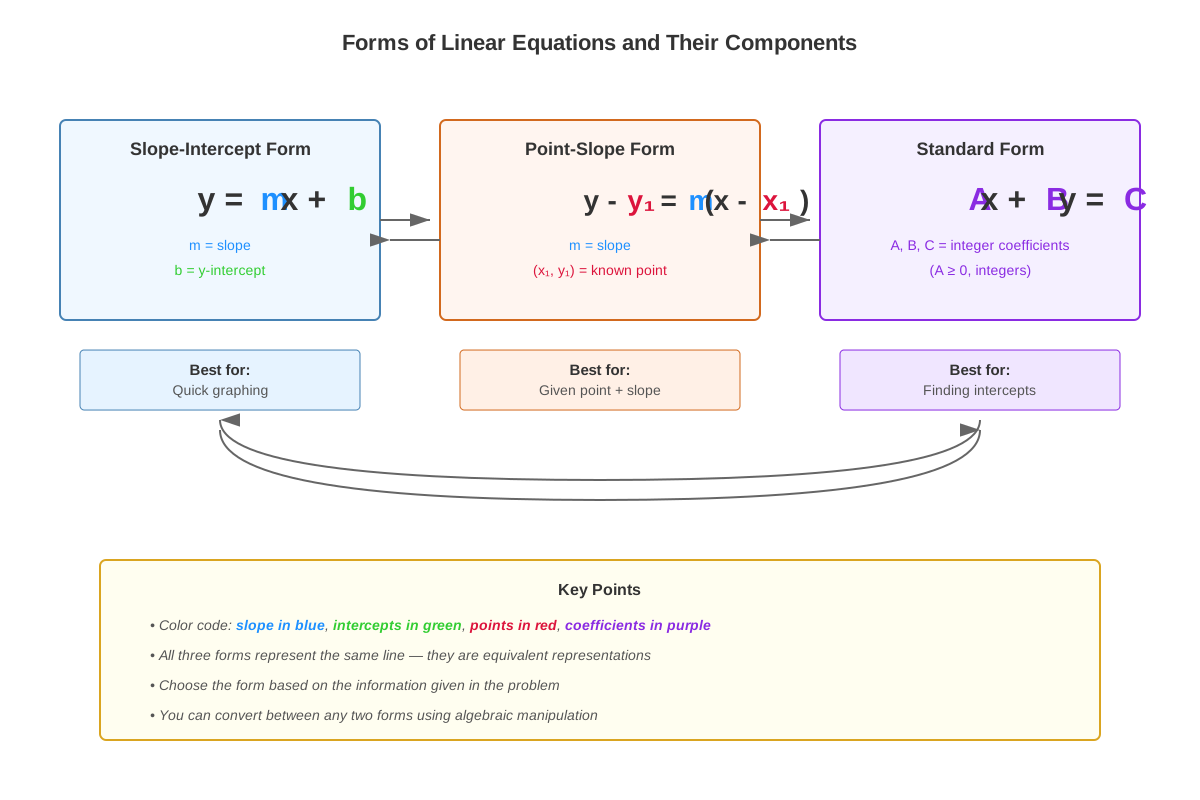
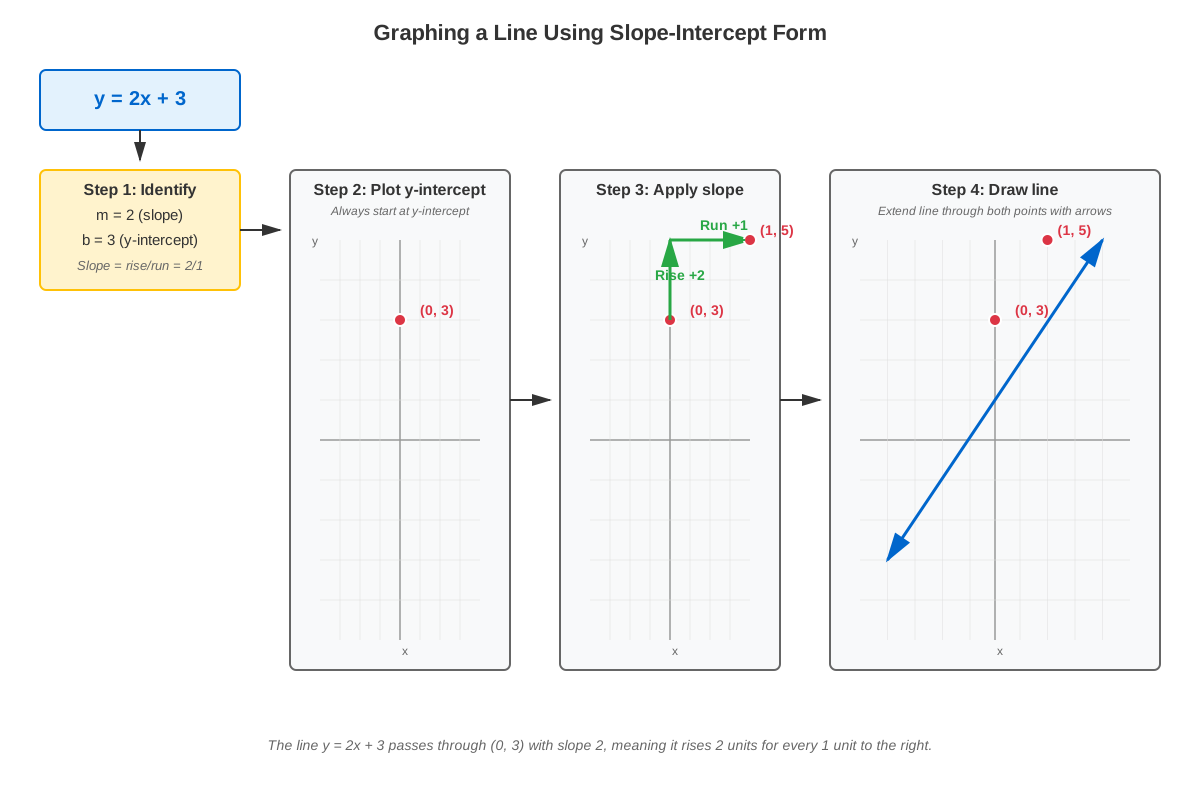
The slope-intercept form y = mx + b is the most commonly used representation on the ACT, where m represents the slope and b represents the y-intercept (the point where the line crosses the y-axis). This form immediately reveals two critical pieces of information: how steep the line is and where it intersects the vertical axis. For example, y = 3x + 2 has a slope of 3 (rising 3 units for every 1 unit moved right) and crosses the y-axis at (0, 2).
The point-slope form y - y₁ = m(x - x₁) proves particularly useful when given a point (x₁, y₁) and a slope m. This form directly incorporates a known point on the line, making it efficient for writing equations when the y-intercept isn't immediately known. For instance, if a line passes through (4, 7) with slope -2, the equation becomes y - 7 = -2(x - 4), which can be expanded and rearranged into slope-intercept form if needed.
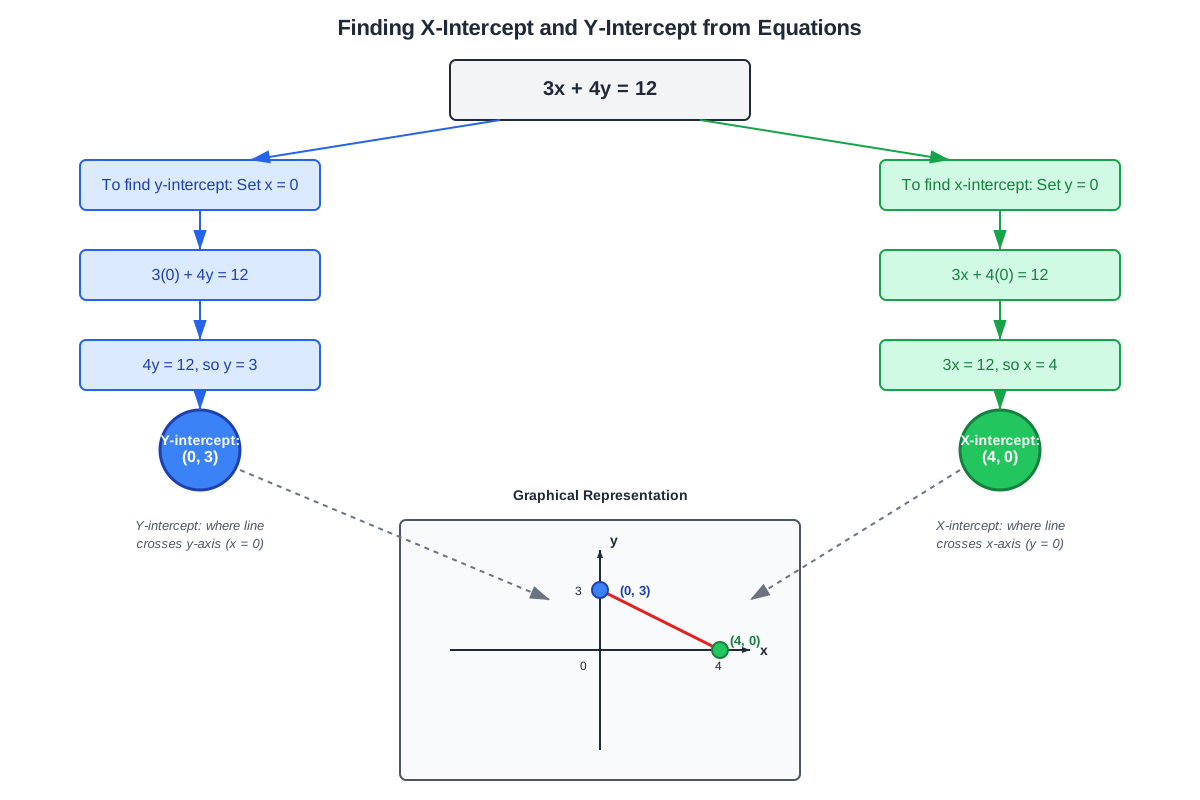
The standard form Ax + By = C, where A, B, and C are integers and A is typically positive, appears frequently on the ACT because it facilitates finding both intercepts quickly. To find the x-intercept, set y = 0 and solve for x; to find the y-intercept, set x = 0 and solve for y. For example, in 3x + 4y = 12, the x-intercept is (4, 0) and the y-intercept is (0, 3).
Slope: The Foundation of Line Behavior
Slope quantifies the steepness and direction of a line, calculated as m = (y₂ - y₁)/(x₂ - x₁) when given two points (x₁, y₁) and (x₂, y₂). Positive slopes indicate lines rising from left to right, while negative slopes indicate lines falling from left to right. A slope of zero produces a horizontal line (y = constant), and an undefined slope produces a vertical line (x = constant).
The magnitude of the slope indicates steepness: larger absolute values mean steeper lines. A slope of 5 is steeper than a slope of 2, and a slope of -3 is steeper than a slope of -1. Understanding this relationship helps students quickly eliminate incorrect graph options on multiple-choice questions.
| Slope Value | Line Orientation | Example Equation |
|---|---|---|
| Positive | Rising left to right | y = 2x + 1 |
| Negative | Falling left to right | y = -3x + 4 |
| Zero | Horizontal | y = 5 |
| Undefined | Vertical | x = -2 |
Intercepts: Where Lines Cross Axes
The x-intercept is the point where a line crosses the x-axis, occurring when y = 0. To find it algebraically, substitute 0 for y in the equation and solve for x. The y-intercept is where the line crosses the y-axis, occurring when x = 0. In slope-intercept form, the y-intercept is immediately visible as the constant term b.
Intercepts provide crucial information for graphing and are frequently tested on the ACT. Questions may ask which line has a specific y-intercept, or students may need to identify a graph where the x-intercept is positive while the y-intercept is negative. Understanding that intercepts represent the points where one coordinate equals zero streamlines problem-solving.
Parallel and Perpendicular Lines
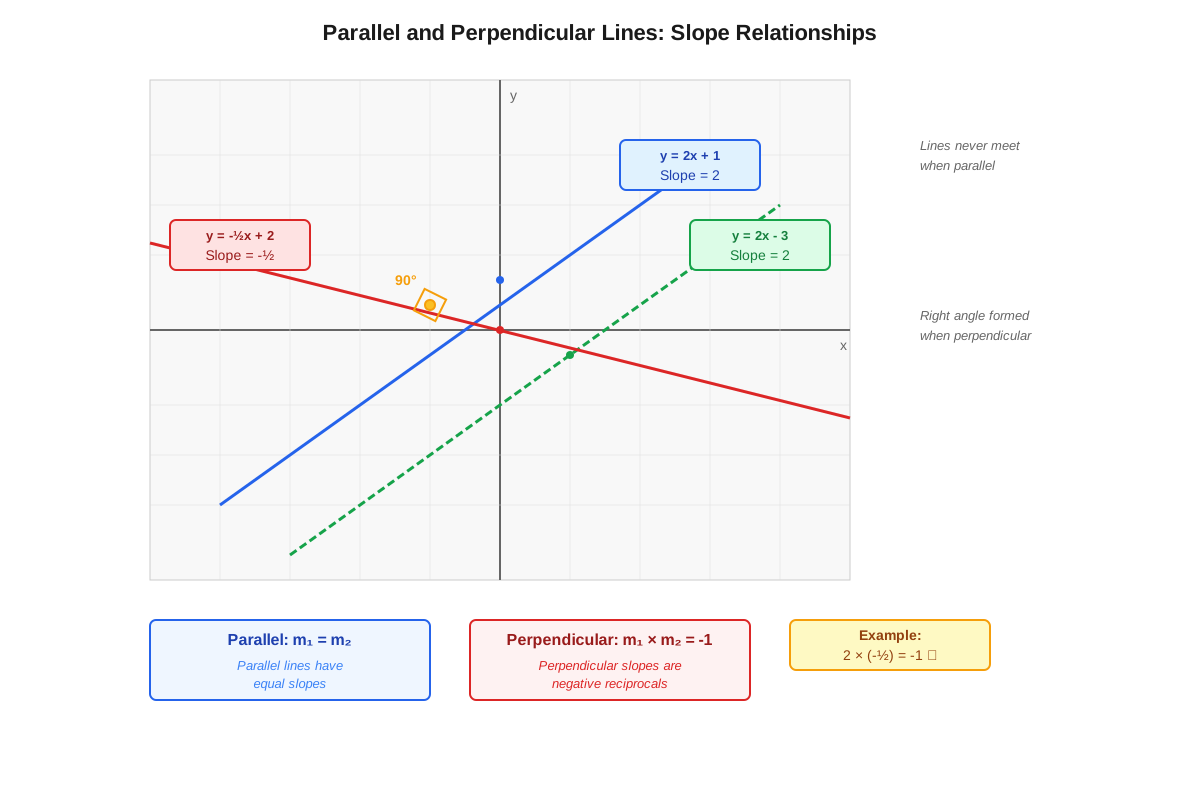
Parallel lines never intersect and have identical slopes. If two lines have equations y = 2x + 3 and y = 2x - 5, they are parallel because both have slope m = 2. The ACT frequently tests whether students can identify parallel lines by comparing slopes, even when equations are presented in different forms.
Perpendicular lines intersect at right angles (90 degrees) and have slopes that are negative reciprocals of each other. If one line has slope m, a perpendicular line has slope -1/m. For example, a line with slope 3/4 is perpendicular to a line with slope -4/3. This relationship is heavily tested, particularly in questions asking students to find the equation of a line perpendicular to a given line and passing through a specific point.
Graphing Techniques
To graph a line efficiently, students should identify the form of the equation and extract key information. For slope-intercept form, plot the y-intercept first, then use the slope to find additional points (rise over run). For standard form, find both intercepts and connect them with a straight line. When given two points, plot both points and draw a line through them, or calculate the slope and use point-slope form.
The ACT often presents graphs with specific scales, requiring careful attention to axis markings. A common error is misreading the scale, such as assuming each grid line represents 1 unit when it actually represents 2 or 5 units. Always check the axis labels before selecting an answer.
Concept Relationships
The various forms of linear equations are interconnected through algebraic manipulation. Slope-intercept form serves as the central hub, connecting to point-slope form through substitution of a specific point, and to standard form through rearrangement of terms. Understanding these conversions allows students to choose the most efficient form for each problem type.
Slope connects all forms of linear equations and determines the relationship between lines (parallel or perpendicular). The concept of slope flows directly into intercepts, as the y-intercept represents the output when the input is zero, and the x-intercept represents where the output equals zero. This relationship creates a conceptual map: Slope + Point → Point-Slope Form → Slope-Intercept Form → Standard Form → Intercepts.
The relationship between parallel and perpendicular lines depends entirely on slope comparison, creating a direct connection between slope calculation and geometric relationships. This concept extends to more advanced topics like systems of equations, where parallel lines have no solution (inconsistent system) and intersecting lines have exactly one solution.
Graphing techniques synthesize all other concepts, requiring students to integrate slope, intercepts, and equation forms into visual representations. The ability to move fluidly between algebraic and geometric representations—from equation to graph and graph to equation—represents mastery of this topic and enables success on the most challenging ACT questions.
Quick check — test yourself on Graphing lines so far.
Try Flashcards →High-Yield Facts
- ⭐ In slope-intercept form y = mx + b, m is the slope and b is the y-intercept
- ⭐ Parallel lines have equal slopes; perpendicular lines have slopes that are negative reciprocals
- ⭐ To find the x-intercept, set y = 0; to find the y-intercept, set x = 0
- ⭐ Slope is calculated as (y₂ - y₁)/(x₂ - x₁) or "rise over run"
- ⭐ A horizontal line has slope 0 and equation y = k; a vertical line has undefined slope and equation x = h
- Standard form Ax + By = C makes finding both intercepts straightforward
- Point-slope form y - y₁ = m(x - x₁) is most efficient when given a point and slope
- Positive slopes rise from left to right; negative slopes fall from left to right
- Larger absolute values of slope indicate steeper lines
- The slope represents the rate of change: how much y changes for each unit change in x
- Lines with the same y-intercept but different slopes intersect at the y-axis
- Converting from standard form to slope-intercept form requires solving for y
Common Misconceptions
Misconception: The slope formula can be applied in any order, so (x₂ - x₁)/(y₂ - y₁) is equivalent to (y₂ - y₁)/(x₂ - x₁).
Correction: Slope must always be calculated as change in y divided by change in x (rise over run). Reversing this produces the reciprocal of the slope, leading to incorrect answers.
Misconception: In the equation y = -3x + 5, the slope is 3.
Correction: The slope is -3, not 3. The negative sign is part of the slope value and indicates the line falls from left to right. Ignoring the sign is one of the most common errors on the ACT.
Misconception: Perpendicular lines have slopes that are opposite in sign but equal in magnitude (if one is 2, the other is -2).
Correction: Perpendicular lines have slopes that are negative reciprocals. If one slope is 2 (or 2/1), the perpendicular slope is -1/2, not -2. The relationship is m₁ × m₂ = -1.
Misconception: The x-intercept of a line is found by setting x = 0 in the equation.
Correction: The x-intercept is found by setting y = 0 and solving for x. The y-intercept is found by setting x = 0. Confusing these definitions leads to identifying the wrong intercept.
Misconception: A steeper line always has a larger slope value.
Correction: Steepness is determined by the absolute value of the slope. A line with slope -5 is steeper than a line with slope 2, even though -5 < 2. The negative sign indicates direction, not steepness.
Misconception: All lines have both an x-intercept and a y-intercept.
Correction: Horizontal lines (except y = 0) have no x-intercept, and vertical lines (except x = 0) have no y-intercept. Lines passing through the origin have both intercepts at (0, 0).
Worked Examples
Example 1: Finding the Equation from a Graph
Problem: A line passes through points (-2, 5) and (4, -1). What is the equation of the line in slope-intercept form?
Solution:
Step 1: Calculate the slope using the slope formula.
m = (y₂ - y₁)/(x₂ - x₁) = (-1 - 5)/(4 - (-2)) = -6/6 = -1Step 2: Use point-slope form with either point. Using (-2, 5):
y - 5 = -1(x - (-2))
y - 5 = -1(x + 2)
y - 5 = -x - 2
Step 3: Convert to slope-intercept form by solving for y:
y = -x - 2 + 5
y = -x + 3Answer: y = -x + 3
This problem demonstrates the complete process of moving from two points to slope-intercept form, addressing Learning Objective 3 (applying graphing lines to ACT-style questions). The systematic approach—calculate slope, use point-slope form, convert to slope-intercept form—provides a reliable method for any similar problem.
Example 2: Identifying Perpendicular Lines
Problem: Line k has equation 2x + 6y = 18. Which of the following equations represents a line perpendicular to line k?
A) y = -1/3x + 2
B) y = 3x - 4
C) y = -3x + 1
D) y = 1/3x + 5
E) 6x + 2y = 10
Solution:
Step 1: Convert line k to slope-intercept form to find its slope.
2x + 6y = 18
6y = -2x + 18
y = -1/3x + 3
The slope of line k is -1/3.
Step 2: Find the negative reciprocal for the perpendicular slope.
Perpendicular slope = -1/(-1/3) = 3Step 3: Identify which answer choice has slope 3.
- Choice A: slope = -1/3 (parallel, not perpendicular)
- Choice B: slope = 3 ✓
- Choice C: slope = -3
- Choice D: slope = 1/3
- Choice E: Convert to slope-intercept: 2y = -6x + 10, so y = -3x + 5 (slope = -3)
Answer: B
This example illustrates the critical skill of recognizing perpendicular relationships and demonstrates why converting to slope-intercept form is often the most efficient strategy. It addresses Learning Objective 2 (explaining core strategies) by showing how the negative reciprocal rule applies in practice.
Exam Strategy
When approaching graphing lines questions on the ACT, first identify what form the equation is in and what information the question asks for. If the question provides an equation and asks for a graph, extract the slope and y-intercept immediately and use them to eliminate wrong answers. If the question provides a graph and asks for an equation, identify the y-intercept first (it's visually obvious), then calculate the slope using two clear points on the line.
Trigger words and phrases that indicate graphing lines questions include: "slope," "y-intercept," "x-intercept," "passes through," "parallel to," "perpendicular to," "graph of the equation," "equation of the line," and "rate of change." When you see these phrases, immediately think about slope-intercept form and the relationships between slope, intercepts, and line orientation.
For process-of-elimination, use these strategies:
- If the question asks for a line with positive slope, eliminate any graphs or equations showing negative slope
- If a line must pass through a specific point, substitute that point into each answer choice and eliminate any that don't satisfy the equation
- For parallel lines, eliminate any answer with a different slope
- For perpendicular lines, eliminate any answer whose slope isn't the negative reciprocal
- Check the y-intercept first when matching equations to graphs—it's the easiest feature to verify visually
Time allocation: Most graphing lines questions should take 30-45 seconds. If a problem requires converting between forms, allow up to 60 seconds. If you find yourself spending more than 90 seconds, mark the question and return to it later. The ACT rewards efficient problem-solving, and graphing lines questions are designed to be solved quickly with the right approach.
ACT Tip: When graphs are presented as answer choices, check the y-intercept first, then the slope. This two-step verification eliminates wrong answers faster than trying to match the entire line at once.
Memory Techniques
Slope-Intercept Form Mnemonic: "Y = MX + B" can be remembered as "You Must Xamine Both" (both slope and intercept).
Parallel vs. Perpendicular: "Parallel = Precisely the same slope" and "Perpendicular = Product of slopes is -1" (multiply the slopes together to get -1).
Intercept Memory Device: "X-intercept: X-out the y (set y = 0)" and "Y-intercept: Yank out the x (set x = 0)".
Negative Reciprocal Visualization: Picture flipping a fraction upside down (reciprocal) and changing its sign (negative). If the slope is 3/4, flip it to 4/3, then change the sign to -4/3.
Slope Direction: "Positive slopes Point up" (from left to right) and "Negative slopes Nod down" (from left to right).
Standard Form Acronym: "ABC" for Ax + By = C helps remember the structure, where "Always Bring Constants" to the right side.
Summary
Graphing lines represents a cornerstone skill in ACT Math, combining algebraic manipulation with geometric visualization. Mastery requires fluency in three equation forms—slope-intercept (y = mx + b), point-slope (y - y₁ = m(x - x₁)), and standard form (Ax + By = C)—and the ability to convert between them efficiently. The slope determines line steepness and direction, while intercepts show where lines cross the axes. Parallel lines share identical slopes, while perpendicular lines have slopes that are negative reciprocals, with their product equaling -1. Success on ACT graphing lines questions depends on quickly identifying what information is given, choosing the most efficient form or strategy, and systematically eliminating wrong answers using slope and intercept analysis. Students who internalize these relationships and practice converting between algebraic and graphical representations will confidently handle the 3-5 questions per test that directly assess this high-yield topic.
Key Takeaways
- Slope-intercept form (y = mx + b) immediately reveals slope and y-intercept, making it the most useful form for graphing
- Calculate slope as (y₂ - y₁)/(x₂ - x₁), always maintaining the order of subtraction in numerator and denominator
- Parallel lines have equal slopes; perpendicular lines have slopes that multiply to -1 (negative reciprocals)
- Find x-intercepts by setting y = 0; find y-intercepts by setting x = 0
- Convert between forms strategically: use point-slope when given a point and slope, standard form when finding intercepts
- Positive slopes rise left to right; negative slopes fall left to right; steepness depends on absolute value
- Always verify answers by checking both slope and intercept when matching equations to graphs
Related Topics
Systems of Linear Equations: Building on graphing lines, systems involve finding where two or more lines intersect, requiring understanding of parallel lines (no solution) and perpendicular or intersecting lines (one solution). Mastering single-line graphing is essential before tackling systems.
Linear Inequalities: Graphing linear inequalities extends line graphing by adding shaded regions representing solution sets. The boundary line uses the same graphing techniques, with additional consideration for solid versus dashed lines and which side to shade.
Distance and Midpoint Formulas: These coordinate geometry topics use points on lines to calculate distances between points and find midpoints of line segments, requiring the same coordinate plane understanding developed through graphing lines.
Quadratic Functions: While more complex, quadratic functions build on the coordinate plane foundation established through linear graphing, extending concepts of intercepts and symmetry to parabolas.
Transformations: Understanding how changes to linear equations affect their graphs (translations, reflections, stretches) deepens comprehension of the relationship between algebraic and geometric representations.
Practice CTA
Now that you've mastered the core concepts of graphing lines, it's time to solidify your understanding through practice! Work through the practice questions to apply these strategies to ACT-style problems, and use the flashcards to reinforce key formulas and relationships. Remember, the ACT rewards both accuracy and speed—consistent practice with these high-yield concepts will build the confidence and efficiency you need to excel on test day. Every problem you solve strengthens your pattern recognition and deepens your mathematical intuition. You've got this!
Sign up free to keep reading
Create a free AnvayaPrep account to finish this ACT guide on Graphing lines — plus flashcards and practice questions.