Overview
Intercepts are fundamental points where a graph crosses or touches the coordinate axes, and they represent one of the most frequently tested concepts in ACT Math's Coordinate Geometry section. Understanding intercepts means knowing how to find where a line, parabola, or other function intersects the x-axis (x-intercepts) or y-axis (y-intercept). These special points provide critical information about equations, graphs, and real-world relationships modeled by mathematical functions.
On the ACT, intercepts appear in multiple question formats: you might be asked to identify intercepts from a graph, calculate them algebraically from an equation, or use them to write or verify equations. The concept bridges algebraic manipulation with visual interpretation, making it essential for success across various coordinate geometry problems. Questions involving intercepts often appear 2-3 times per ACT Math section, and understanding them unlocks your ability to tackle more complex problems involving systems of equations, quadratic functions, and function transformations.
Mastery of intercepts connects directly to broader mathematical concepts including solving equations, understanding function behavior, and analyzing graphs. When you find an x-intercept, you're essentially solving for when the output (y-value) equals zero—a skill that extends to finding roots, zeros, and solutions throughout algebra. Similarly, finding y-intercepts reinforces your understanding of function evaluation and initial conditions in applied problems. This topic serves as a gateway to more advanced coordinate geometry concepts and appears consistently across multiple ACT Math domains.
Learning Objectives
- [ ] Identify when Intercepts is being tested in ACT questions
- [ ] Explain the core rule or strategy behind finding and using Intercepts
- [ ] Apply Intercepts concepts to ACT-style questions accurately
- [ ] Calculate both x-intercepts and y-intercepts from equations in various forms
- [ ] Interpret the meaning of intercepts in context-based word problems
- [ ] Use intercepts to sketch graphs or verify equation accuracy
- [ ] Distinguish between functions with one, multiple, or no x-intercepts
Prerequisites
- Linear equations and solving for variables: Essential for isolating variables when finding intercepts algebraically
- Coordinate plane fundamentals: Understanding x and y axes, ordered pairs, and plotting points enables visualization of intercepts
- Substitution method: Required for setting x or y equal to zero when calculating intercepts
- Basic function notation: Helps interpret f(x) = 0 as equivalent to finding x-intercepts
- Graphing basics: Necessary for identifying intercepts visually and understanding their geometric meaning
Why This Topic Matters
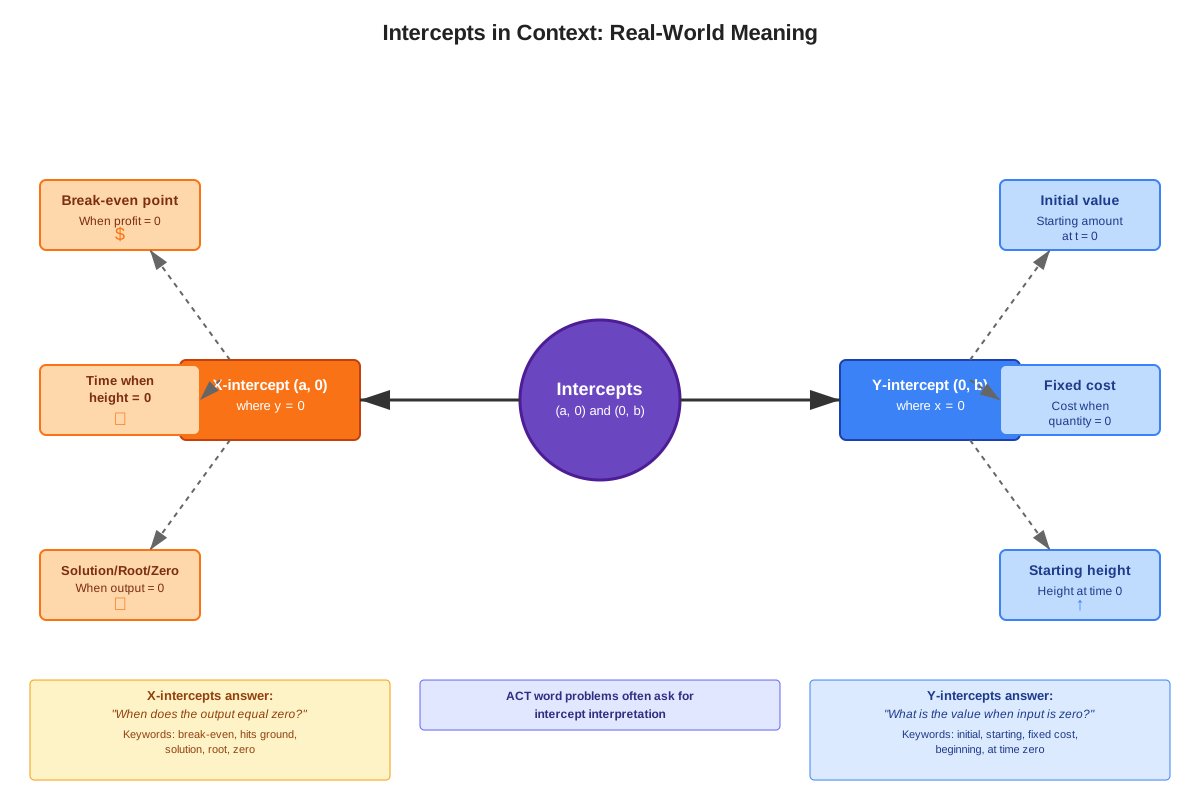
In real-world applications, intercepts carry significant practical meaning. The y-intercept often represents an initial value or starting condition—such as the initial cost before any items are purchased, the starting height of an object, or the base salary before commissions. X-intercepts frequently indicate break-even points in business (where profit equals zero), the time when an object hits the ground in physics problems, or the point where two quantities become equal in comparison scenarios.
On the ACT Math section, intercepts appear with remarkable consistency. Approximately 4-6% of all ACT Math questions directly test intercept concepts, translating to 2-4 questions per exam. These questions span multiple difficulty levels and appear in various formats: pure coordinate geometry problems, word problems requiring equation setup, and graph interpretation questions. The ACT particularly favors questions that combine intercepts with other concepts—such as finding intercepts of quadratic functions, using intercepts to determine equations, or interpreting intercepts in data-driven scenarios.
Common ACT question types include: identifying intercepts from a graph and selecting the correct ordered pair; calculating x-intercepts by setting y = 0 and solving; finding the y-intercept by evaluating when x = 0; using given intercepts to write an equation in slope-intercept or standard form; and interpreting what intercepts mean in word problems involving distance, cost, or time. The ACT also tests whether students understand that x-intercepts are points where y = 0 (not just x-values) and that graphs can have multiple x-intercepts but only one y-intercept for functions.
Core Concepts
Definition of Intercepts
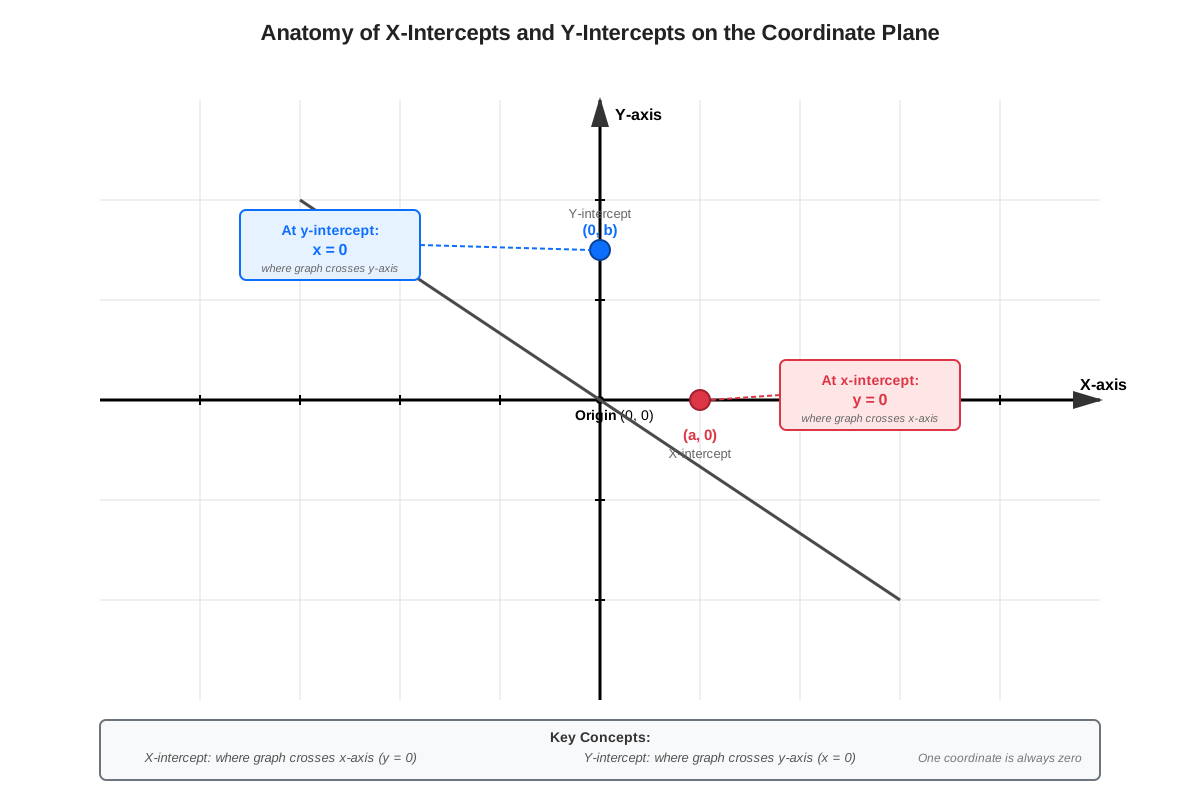
Intercepts are the points where a graph intersects the coordinate axes. There are two types of intercepts that appear on the ACT:
The x-intercept is the point where a graph crosses the x-axis. At this location, the y-coordinate always equals zero because the point lies on the x-axis itself. X-intercepts are written as ordered pairs in the form (a, 0), where 'a' represents the x-value where the crossing occurs. A graph may have zero, one, or multiple x-intercepts depending on the function type.
The y-intercept is the point where a graph crosses the y-axis. At this location, the x-coordinate always equals zero because the point lies on the y-axis. Y-intercepts are written as ordered pairs in the form (0, b), where 'b' represents the y-value where the crossing occurs. For functions (which pass the vertical line test), there can be at most one y-intercept, though relations may have multiple y-intercepts.
Finding X-Intercepts Algebraically
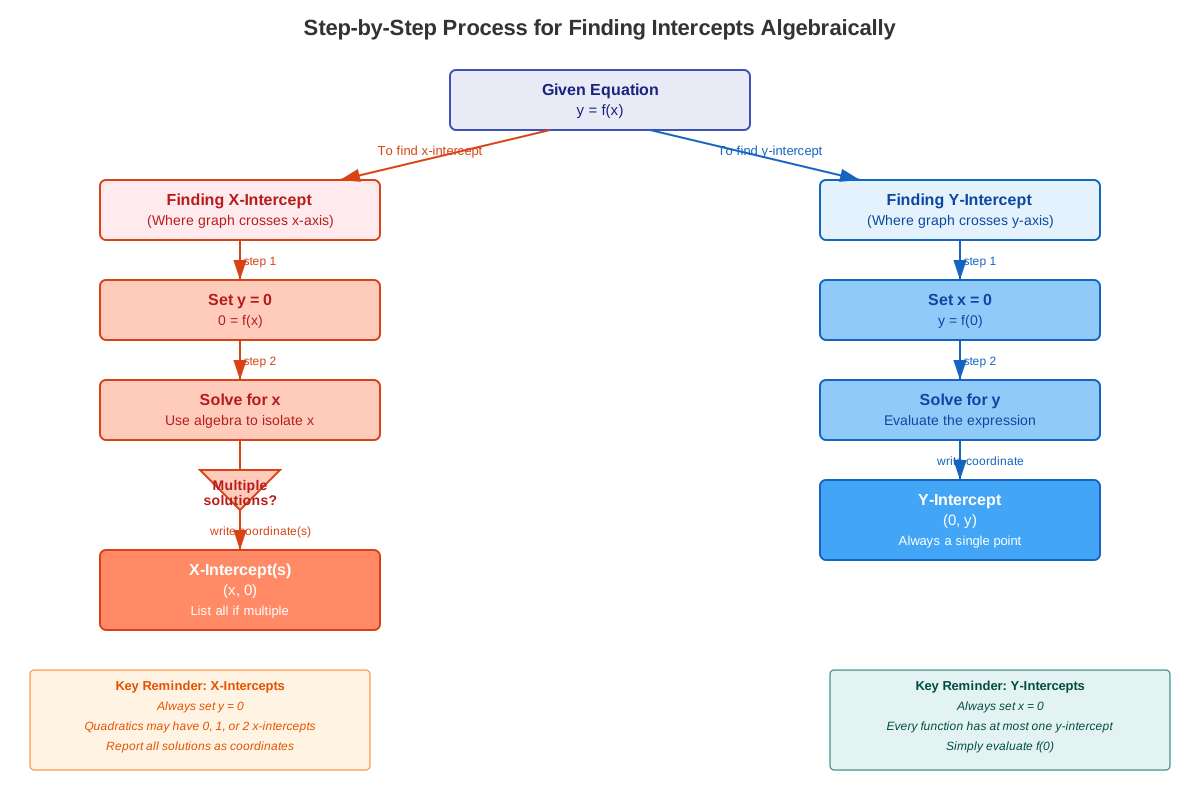
To find x-intercepts from an equation, follow this systematic process:
- Set y = 0 (or f(x) = 0 if using function notation)
- Solve the resulting equation for x
- Write the answer as an ordered pair (x, 0)
For linear equations like y = 2x - 6, set y = 0: 0 = 2x - 6, then solve: 2x = 6, so x = 3. The x-intercept is (3, 0).
For quadratic equations like y = x² - 5x + 6, set y = 0: 0 = x² - 5x + 6. Factor: 0 = (x - 2)(x - 3). Solve: x = 2 or x = 3. The x-intercepts are (2, 0) and (3, 0).
For equations in standard form like 3x + 4y = 12, set y = 0: 3x + 4(0) = 12, which gives 3x = 12, so x = 4. The x-intercept is (4, 0).
Finding Y-Intercepts Algebraically
To find y-intercepts from an equation, use this straightforward method:
- Set x = 0
- Solve the resulting equation for y
- Write the answer as an ordered pair (0, y)
For linear equations like y = 2x - 6, substitute x = 0: y = 2(0) - 6 = -6. The y-intercept is (0, -6).
For quadratic equations like y = x² - 5x + 6, substitute x = 0: y = (0)² - 5(0) + 6 = 6. The y-intercept is (0, 6).
For equations in standard form like 3x + 4y = 12, set x = 0: 3(0) + 4y = 12, which gives 4y = 12, so y = 3. The y-intercept is (0, 3).
Intercepts in Different Equation Forms
Different equation forms make finding intercepts easier or harder:
| Equation Form | Y-Intercept | X-Intercept |
|---|---|---|
| Slope-intercept: y = mx + b | Immediately visible as (0, b) | Requires solving: 0 = mx + b |
| Standard form: Ax + By = C | Requires solving: By = C | Requires solving: Ax = C |
| Point-slope: y - y₁ = m(x - x₁) | Requires substitution: x = 0 | Requires substitution: y = 0 |
| Factored form: y = a(x - p)(x - q) | Requires substitution: x = 0 | Immediately visible as (p, 0) and (q, 0) |
Identifying Intercepts from Graphs
When the ACT presents a graph, identifying intercepts requires careful visual analysis:
For x-intercepts: Look for all points where the graph touches or crosses the x-axis (the horizontal axis). Count carefully, as parabolas may have two x-intercepts, and some curves may have many. Remember that the y-coordinate is always 0 at these points.
For y-intercepts: Look for the single point where the graph crosses the y-axis (the vertical axis). Remember that the x-coordinate is always 0 at this point. If the graph doesn't cross the y-axis (rare on the ACT), there is no y-intercept.
Special Cases and Multiple Intercepts
Understanding special cases prevents errors on tricky ACT questions:
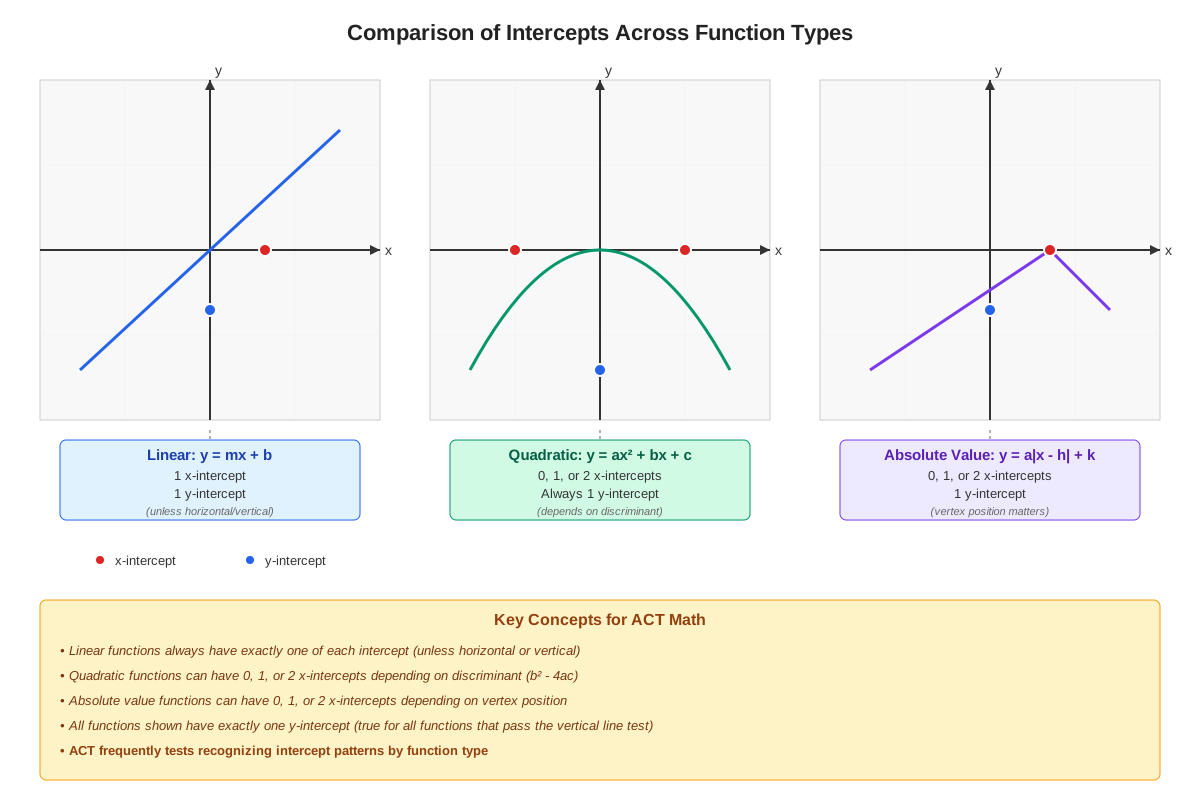
No x-intercepts: Some functions never cross the x-axis. For example, y = x² + 4 has no x-intercepts because x² + 4 is always positive. Setting y = 0 gives x² = -4, which has no real solutions.
One x-intercept: Linear functions (except horizontal lines) have exactly one x-intercept. Parabolas that touch but don't cross the x-axis (like y = x²) also have one x-intercept, technically called a "double root."
Two x-intercepts: Most parabolas that open upward or downward and cross the x-axis have two distinct x-intercepts.
No y-intercept: Vertical lines (like x = 5) have no y-intercept because they never cross the y-axis. These aren't functions, but they can appear on ACT graphs.
Using Intercepts to Write Equations
The ACT frequently asks students to determine equations from given intercepts:
Given two points including an intercept: Use the slope formula and point-slope form, then convert to the requested form.
Given both intercepts of a line: If x-intercept is (a, 0) and y-intercept is (0, b), the equation can be written as x/a + y/b = 1 (intercept form), or use the two points to find slope: m = (b - 0)/(0 - a) = -b/a.
Given x-intercepts of a parabola: If x-intercepts are (p, 0) and (q, 0), the equation can be written as y = a(x - p)(x - q), where 'a' determines the vertical stretch and direction.
Concept Relationships
The concept of intercepts connects internally through the relationship between algebraic and geometric representations. Finding x-intercepts algebraically (solving when y = 0) → corresponds to → identifying where graphs cross the x-axis visually. Similarly, finding y-intercepts algebraically (evaluating when x = 0) → corresponds to → locating where graphs cross the y-axis. Both types of intercepts together → provide → key information for sketching complete graphs and understanding function behavior.
Intercepts build directly on prerequisite knowledge: coordinate plane fundamentals → enable → visual identification of intercepts; solving linear equations → provides the tools for → calculating intercepts algebraically; substitution methods → are applied when → setting x or y equal to zero. The concept extends forward to more advanced topics: understanding intercepts → is essential for → graphing systems of equations (where solutions are intercepts of difference functions); intercepts → connect to → quadratic formula applications (x-intercepts are the roots); and intercepts → support → analyzing polynomial behavior and rational functions.
Within coordinate geometry, intercepts → relate to → slope calculations (using intercepts as two known points); intercepts → help determine → equations of lines and parabolas; and intercepts → provide → boundary information for domain and range analysis. The y-intercept specifically → appears as → the 'b' value in slope-intercept form (y = mx + b), creating a direct link between equation forms and graphical features.
Quick check — test yourself on Intercepts so far.
Try Flashcards →High-Yield Facts
⭐ The x-intercept always has a y-coordinate of 0, written as (x, 0)
⭐ The y-intercept always has an x-coordinate of 0, written as (0, y)
⭐ To find x-intercepts algebraically, set y = 0 and solve for x
⭐ To find y-intercepts algebraically, set x = 0 and solve for y
⭐ In slope-intercept form y = mx + b, the y-intercept is the point (0, b)
- A quadratic function can have 0, 1, or 2 x-intercepts, but at most 1 y-intercept
- X-intercepts are also called "roots," "zeros," or "solutions" of an equation
- Horizontal lines (y = k) have no x-intercept unless k = 0, but always have a y-intercept
- Vertical lines (x = h) have an x-intercept but no y-intercept
- In factored form y = a(x - p)(x - q), the x-intercepts are (p, 0) and (q, 0)
- The intercept form of a line is x/a + y/b = 1, where (a, 0) and (0, b) are the intercepts
- When a parabola has two x-intercepts, the vertex lies exactly halfway between them
Common Misconceptions
Misconception: The x-intercept is just a single number (the x-value).
Correction: The x-intercept is a complete ordered pair (x, 0). While we might say "the x-intercept is 3," the complete answer is the point (3, 0). The ACT often includes answer choices with just numbers to catch this error.
Misconception: To find the x-intercept, set x = 0.
Correction: This is backwards. To find the x-intercept, set y = 0 (because the point is on the x-axis where y equals zero). Setting x = 0 finds the y-intercept instead.
Misconception: Every function has both an x-intercept and a y-intercept.
Correction: Many functions lack one or both intercepts. For example, y = x² + 5 never crosses the x-axis (no x-intercept), and x = 3 (a vertical line) never crosses the y-axis (no y-intercept).
Misconception: A function can have multiple y-intercepts.
Correction: By definition, a function can have at most one y-intercept because it can only have one output for x = 0. If a graph has multiple y-intercepts, it fails the vertical line test and isn't a function (though it may be a relation).
Misconception: The y-intercept of y = 3x - 7 is -7.
Correction: The y-intercept is the point (0, -7), not just the number -7. While -7 is the y-coordinate of the y-intercept, the complete answer requires both coordinates.
Misconception: If a parabola touches the x-axis at one point, it has no x-intercepts.
Correction: A parabola that touches (is tangent to) the x-axis has one x-intercept, sometimes called a "double root." For example, y = (x - 2)² has one x-intercept at (2, 0).
Misconception: Intercepts and slopes are the same thing.
Correction: Intercepts are points (locations on the graph), while slope is a rate (the steepness of the line). They're related but distinct concepts. The slope describes how y changes relative to x, while intercepts describe where the graph crosses the axes.
Worked Examples
Example 1: Finding Intercepts from a Linear Equation
Problem: Find both intercepts of the line 2x - 3y = 12.
Solution:
Finding the x-intercept:
The x-intercept occurs where y = 0. Substitute y = 0 into the equation:
- 2x - 3(0) = 12
- 2x = 12
- x = 6
The x-intercept is (6, 0).
Finding the y-intercept:
The y-intercept occurs where x = 0. Substitute x = 0 into the equation:
- 2(0) - 3y = 12
- -3y = 12
- y = -4
The y-intercept is (0, -4).
Connection to learning objectives: This example demonstrates the core strategy of setting one variable to zero and solving for the other. It shows how to apply the intercept concept to standard form equations, which frequently appear on the ACT. The complete ordered pair format is emphasized to avoid the common misconception of reporting only the numerical value.
Example 2: Finding Intercepts from a Quadratic Equation
Problem: Find all intercepts of the parabola y = x² - 2x - 8.
Solution:
Finding the y-intercept:
Set x = 0:
- y = (0)² - 2(0) - 8
- y = -8
The y-intercept is (0, -8).
Finding the x-intercepts:
Set y = 0:
- 0 = x² - 2x - 8
Factor the quadratic:
- 0 = (x - 4)(x + 2)
Apply the zero product property:
- x - 4 = 0 or x + 2 = 0
- x = 4 or x = -2
The x-intercepts are (4, 0) and (-2, 0).
Verification: We can verify by checking that these points satisfy the original equation. For (4, 0): 0 = 4² - 2(4) - 8 = 16 - 8 - 8 = 0 ✓
Connection to learning objectives: This example shows how to handle multiple x-intercepts, which is common with quadratic functions on the ACT. It demonstrates the factoring technique and emphasizes that both x-intercepts must be expressed as complete ordered pairs. This type of problem tests whether students can identify when intercepts is being tested and apply the appropriate algebraic strategy.
Example 3: Using Intercepts in a Word Problem
Problem: A water tank contains 500 gallons initially. Water drains at a constant rate of 25 gallons per minute. The equation y = 500 - 25x represents the gallons remaining (y) after x minutes. What is the meaning of the x-intercept in this context?
Solution:
Finding the x-intercept:
Set y = 0 (when the tank is empty):
- 0 = 500 - 25x
- 25x = 500
- x = 20
The x-intercept is (20, 0).
Interpretation: The x-intercept represents the time when the tank becomes completely empty. After 20 minutes, there are 0 gallons remaining in the tank. This is the point where the graph crosses the x-axis.
Note on y-intercept: The y-intercept (0, 500) represents the initial amount of water before any draining occurs—500 gallons at time 0.
Connection to learning objectives: This example demonstrates how to interpret intercepts in real-world contexts, a high-yield ACT skill. It shows that x-intercepts often represent "when something reaches zero" in applied problems, while y-intercepts typically represent initial conditions or starting values.
Exam Strategy
When approaching ACT intercepts questions, begin by identifying what the question asks for: x-intercept, y-intercept, or both. Look for trigger phrases that signal intercept questions:
Trigger words and phrases:
- "Where does the graph cross the x-axis?" → x-intercept
- "Where does the line intersect the y-axis?" → y-intercept
- "What are the zeros of the function?" → x-intercepts
- "What is the initial value?" → often the y-intercept in word problems
- "At what point does [quantity] equal zero?" → x-intercept
- "Find the roots" → x-intercepts
Strategic approach:
- Determine what's given: Is the problem providing an equation, a graph, or a word problem scenario?
- Choose your method:
- If given an equation, use algebraic substitution (set x or y to 0)
- If given a graph, identify points where the curve crosses axes
- If given a word problem, first write an equation, then find intercepts
- Watch for answer choice formats: The ACT may present answers as ordered pairs (3, 0), single numbers (3), or descriptive statements. Read carefully to match the requested format.
- Use process of elimination:
- Eliminate answers where x-intercepts have non-zero y-coordinates
- Eliminate answers where y-intercepts have non-zero x-coordinates
- For linear equations, if you know the slope is positive and y-intercept is negative, the x-intercept must be positive
- Verify when time permits: Substitute your answer back into the original equation to confirm it produces the point (x, 0) or (0, y).
Time allocation: Intercept questions typically require 30-45 seconds for straightforward problems and up to 90 seconds for complex quadratics or word problems. If a problem requires extensive factoring or quadratic formula application, ensure you're not spending more than 90 seconds—consider strategic guessing if you're stuck.
Common trap answers: The ACT often includes the negative of the correct answer, the coordinate value without the ordered pair format, or the opposite intercept (y-intercept when asking for x-intercept). Always double-check which intercept the question requests.
Memory Techniques
Mnemonic for which variable to set to zero:
"X marks the spot where Y is not" — To find the x-intercept, set y = 0
"Y you ask? When X is absent" — To find the y-intercept, set x = 0
Visual memory technique:
Picture the coordinate plane as a plus sign (+). The horizontal line is the x-axis where y = 0. The vertical line is the y-axis where x = 0. When finding intercepts, you're looking for where the graph touches these lines.
Acronym for intercept problem steps - ZERO:
- Zero out the appropriate variable (x for y-intercept, y for x-intercept)
- Evaluate or solve the resulting equation
- Record as an ordered pair
- Order matters: (x, y) format always
Rhyme for remembering ordered pairs:
"X-intercept has Y as zero, (x, 0) makes you a hero"
"Y-intercept has X as zero, (0, y) is the way to go"
Factored form memory device:
In y = a(x - p)(x - q), the letters p and q come after x in the equation, and they give you the x-intercepts directly: (p, 0) and (q, 0). The pattern "x minus p" means "x-intercept at p."
Summary
Intercepts represent the fundamental points where graphs intersect coordinate axes, with x-intercepts occurring where y = 0 and y-intercepts occurring where x = 0. Mastering intercepts requires both algebraic skills (substituting zero and solving equations) and geometric understanding (identifying where graphs cross axes). The core strategy involves recognizing which intercept is requested, setting the appropriate variable to zero, solving for the remaining variable, and expressing the answer as a complete ordered pair. On the ACT, intercepts appear in multiple contexts: pure coordinate geometry problems, quadratic functions with multiple x-intercepts, linear equations in various forms, and word problems where intercepts carry real-world meaning. Success requires avoiding common pitfalls such as confusing which variable to set to zero, forgetting to express answers as ordered pairs, or assuming all functions have both types of intercepts. The concept connects deeply to equation-solving, graphing, and function analysis, making it a cornerstone skill for ACT Math success.
Key Takeaways
- X-intercepts are points (x, 0) found by setting y = 0; y-intercepts are points (0, y) found by setting x = 0
- Always express intercepts as complete ordered pairs unless the question specifically asks for only the x or y coordinate
- Quadratic functions can have 0, 1, or 2 x-intercepts, but functions have at most one y-intercept
- In slope-intercept form y = mx + b, the y-intercept (0, b) is immediately visible
- In factored form y = a(x - p)(x - q), the x-intercepts (p, 0) and (q, 0) are immediately visible
- Intercepts carry meaning in word problems: y-intercepts often represent initial values, while x-intercepts represent when quantities reach zero
- Verify your answers by substituting back into the original equation when time permits
Related Topics
Slope and Linear Equations: Understanding intercepts enhances your ability to write equations using slope-intercept form and to graph lines efficiently. The y-intercept is a key component of the slope-intercept equation y = mx + b.
Quadratic Functions and Parabolas: Intercepts are essential for graphing parabolas and understanding their behavior. The relationship between x-intercepts and the quadratic formula deepens your algebraic skills.
Systems of Equations: Solutions to systems can be found by identifying where graphs intersect, which extends the concept of intercepts to finding intersection points that aren't necessarily on the axes.
Function Transformations: Understanding how intercepts change when functions are shifted, stretched, or reflected builds on intercept knowledge and appears frequently in advanced ACT problems.
Polynomial Functions: Higher-degree polynomials can have multiple x-intercepts, and understanding intercepts provides the foundation for analyzing more complex polynomial behavior.
Practice CTA
Now that you've mastered the core concepts of intercepts, it's time to solidify your understanding through active practice. Work through the practice questions to apply these strategies to ACT-style problems, and use the flashcards to reinforce the key definitions and procedures. Remember, intercepts appear on virtually every ACT Math section—your investment in mastering this topic will pay dividends across multiple questions. Approach each practice problem systematically, identify which intercept is being tested, and verify your answers using the techniques you've learned. You've got this!
Sign up free to keep reading
Create a free AnvayaPrep account to finish this ACT guide on Intercepts — plus flashcards and practice questions.