Overview
Parabolas in coordinate plane represent one of the most frequently tested topics in ACT Math, appearing in approximately 2-4 questions per exam. A parabola is a U-shaped curve that represents the graph of a quadratic function, and understanding how to work with these curves in the coordinate plane is essential for success on the ACT. Students must be able to identify key features such as the vertex, axis of symmetry, direction of opening, and intercepts, as well as translate between different forms of quadratic equations.
The ACT tests parabolas through various question types: identifying the vertex from an equation, determining which equation matches a given graph, finding x-intercepts or y-intercepts, and understanding transformations. Questions may ask students to recognize how changes in the equation affect the graph's position and shape, or to work backward from graphical information to determine equation parameters. Mastery of ACT parabolas in coordinate plane requires both conceptual understanding and procedural fluency with algebraic manipulation.
This topic connects deeply to other coordinate geometry concepts including linear equations, distance and midpoint formulas, and systems of equations. Parabolas also bridge algebra and geometry, requiring students to visualize algebraic relationships spatially. The skills developed here—translating between equations and graphs, identifying key features, and understanding transformations—apply broadly across mathematics and appear in multiple ACT Math content areas.
Learning Objectives
- [ ] Identify when Parabolas in coordinate plane is being tested
- [ ] Explain the core rule or strategy behind Parabolas in coordinate plane
- [ ] Apply Parabolas in coordinate plane to ACT-style questions accurately
- [ ] Convert between standard form, vertex form, and factored form of quadratic equations
- [ ] Determine the vertex, axis of symmetry, and direction of opening from any form of a parabola equation
- [ ] Analyze how transformations affect parabola graphs and equations
- [ ] Solve problems involving parabola intercepts and points of intersection
Prerequisites
- Quadratic expressions and factoring: Essential for converting between forms and finding x-intercepts
- Coordinate plane basics: Understanding x and y coordinates enables plotting and interpreting parabola graphs
- Function notation: Parabolas are functions, requiring comfort with f(x) notation and evaluation
- Solving quadratic equations: Finding intercepts and specific points requires solving for x or y
- Basic transformations: Understanding shifts, reflections, and stretches provides foundation for parabola transformations
Why This Topic Matters
Parabolas appear throughout real-world applications including projectile motion (the path of a thrown ball), architecture (parabolic arches and satellite dishes), business (profit maximization models), and physics (reflecting properties of parabolic mirrors). Understanding parabolic relationships helps model situations where quantities change at non-constant rates, making this concept fundamental to applied mathematics and science.
On the ACT Math section, parabola questions typically appear 2-4 times per exam, representing approximately 3-7% of the 60 math questions. These questions most commonly test vertex identification (40% of parabola questions), graphing and matching equations to graphs (30%), finding intercepts (20%), and transformations (10%). The questions appear primarily in the Preparing for Higher Math category under Functions, though some overlap with Algebra.
Common question formats include: presenting a graph and asking which equation represents it; providing an equation and asking for the vertex coordinates; describing a transformation and asking for the new equation; asking for the number of x-intercepts; and word problems involving maximum or minimum values in context. Questions may also combine parabolas with other concepts, such as finding intersection points with lines or determining domain and range.
Core Concepts
Forms of Parabola Equations
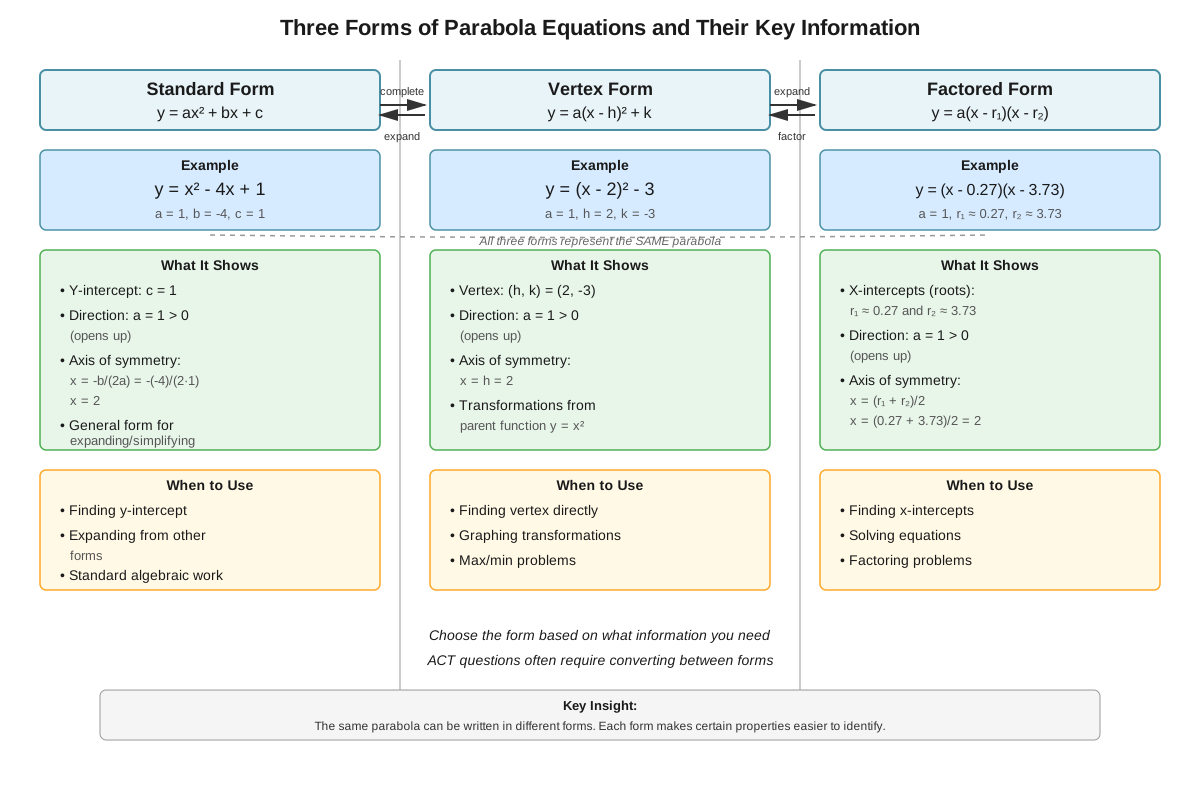
Parabolas can be expressed in three primary forms, each revealing different information:
Standard form: y = ax² + bx + c
- The coefficient a determines direction (a > 0 opens upward, a < 0 opens downward) and width
- The constant c represents the y-intercept (where the parabola crosses the y-axis)
- The vertex x-coordinate can be found using x = -b/(2a)
- This form is useful for quickly identifying the y-intercept
Vertex form: y = a(x - h)² + k
- The point (h, k) is the vertex of the parabola
- The coefficient a still determines direction and width
- The axis of symmetry is the vertical line x = h
- This form immediately reveals the maximum or minimum point
Factored form: y = a(x - p)(x - q)
- The values p and q are the x-intercepts (also called roots or zeros)
- The vertex x-coordinate is the midpoint: x = (p + q)/2
- This form is most useful when intercepts are needed
| Form | Equation | Best For | Key Feature |
|---|---|---|---|
| Standard | y = ax² + bx + c | Finding y-intercept | c is y-intercept |
| Vertex | y = a(x - h)² + k | Finding vertex | (h, k) is vertex |
| Factored | y = a(x - p)(x - q) | Finding x-intercepts | p and q are x-intercepts |
The Vertex and Axis of Symmetry
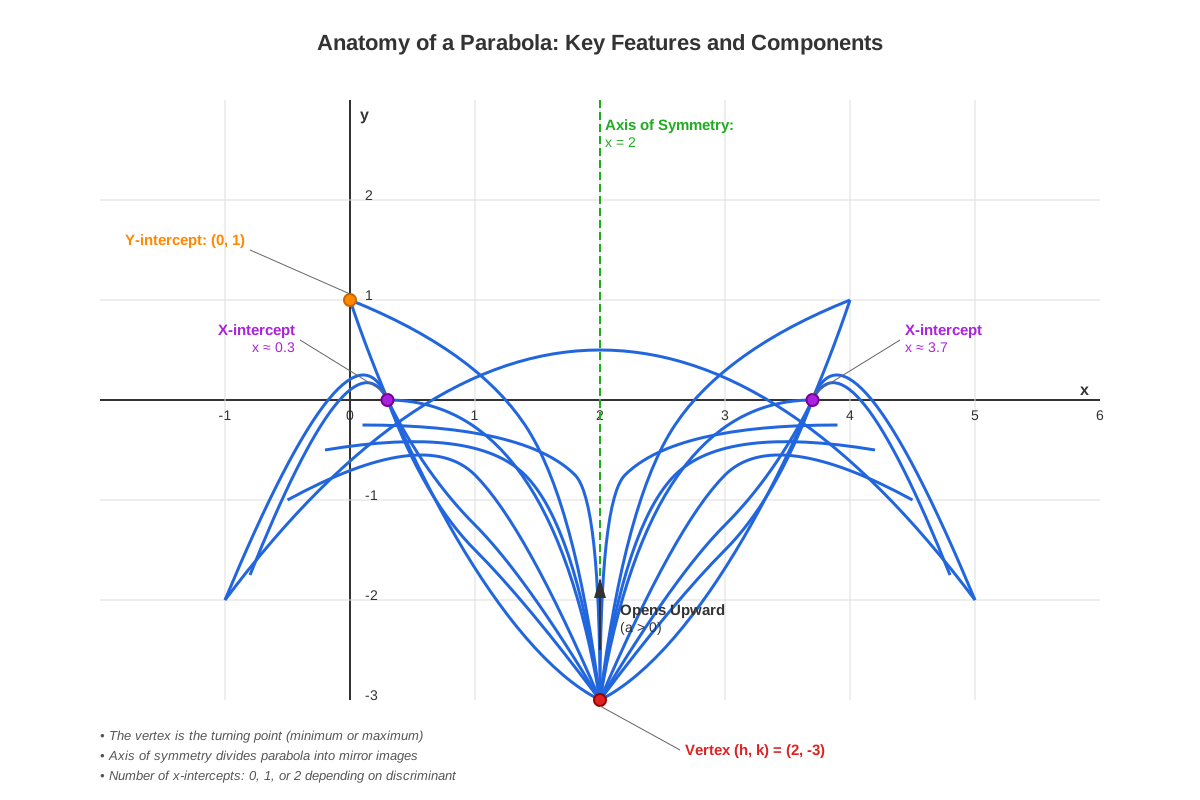
The vertex is the turning point of the parabola—either the minimum point (when opening upward) or maximum point (when opening downward). This point is crucial for ACT questions because it represents the extreme value of the quadratic function.
To find the vertex from standard form y = ax² + bx + c:
- Calculate the x-coordinate: x = -b/(2a)
- Substitute this x-value back into the equation to find y
- The vertex is (-b/(2a), y)
The axis of symmetry is a vertical line passing through the vertex, dividing the parabola into two mirror-image halves. Its equation is always x = h, where h is the x-coordinate of the vertex. Every point on the parabola has a corresponding point equidistant from this axis.
Direction and Width
The coefficient a in any form of the parabola equation controls two critical features:
Direction of opening:
- If a > 0, the parabola opens upward (U-shape), and the vertex is a minimum
- If a < 0, the parabola opens downward (∩-shape), and the vertex is a maximum
Width of the parabola:
- Larger |a| values create narrower parabolas (steeper curves)
- Smaller |a| values create wider parabolas (flatter curves)
- When |a| = 1, the parabola has "standard" width
- When |a| > 1, the parabola is vertically stretched (narrower)
- When 0 < |a| < 1, the parabola is vertically compressed (wider)
Intercepts
Y-intercept: The point where the parabola crosses the y-axis (where x = 0)
- In standard form y = ax² + bx + c, the y-intercept is simply (0, c)
- Every parabola has exactly one y-intercept
X-intercepts: The points where the parabola crosses the x-axis (where y = 0)
- Found by solving ax² + bx + c = 0
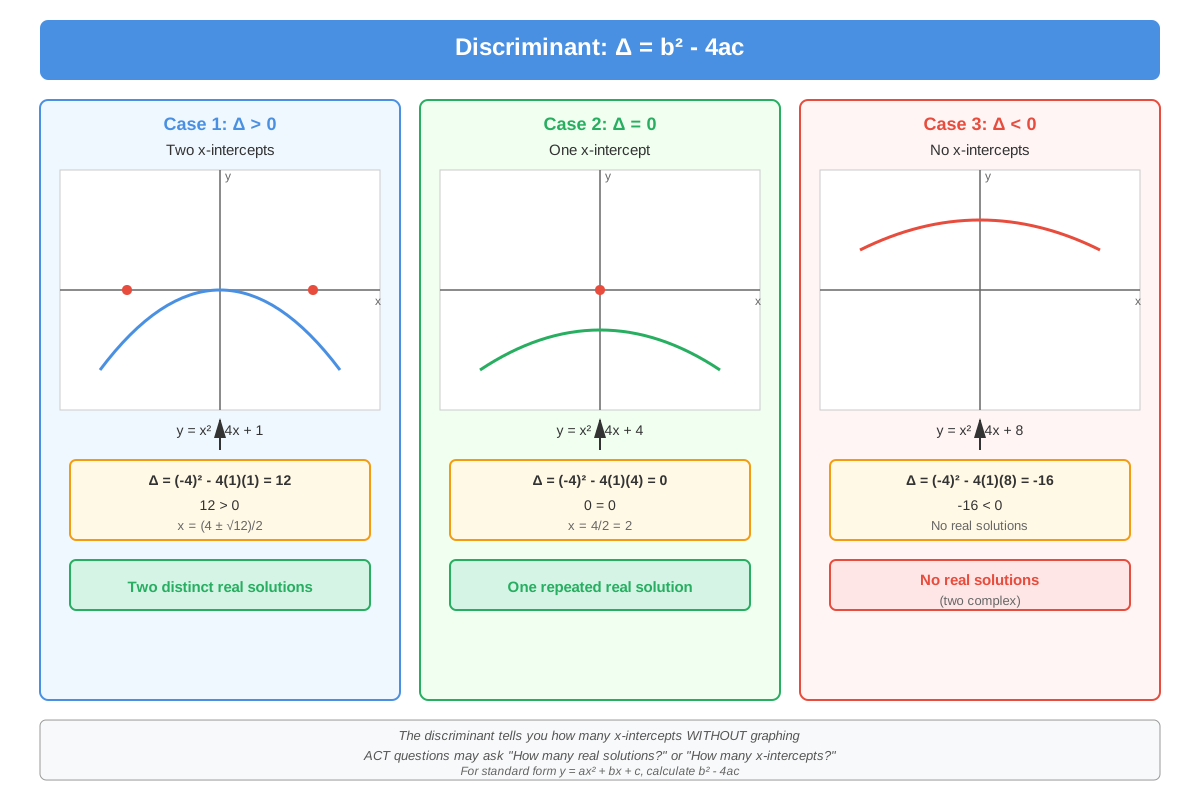
- A parabola can have 0, 1, or 2 x-intercepts depending on the discriminant b² - 4ac
- If b² - 4ac > 0: two x-intercepts
- If b² - 4ac = 0: one x-intercept (vertex touches x-axis)
- If b² - 4ac < 0: no x-intercepts (parabola doesn't cross x-axis)
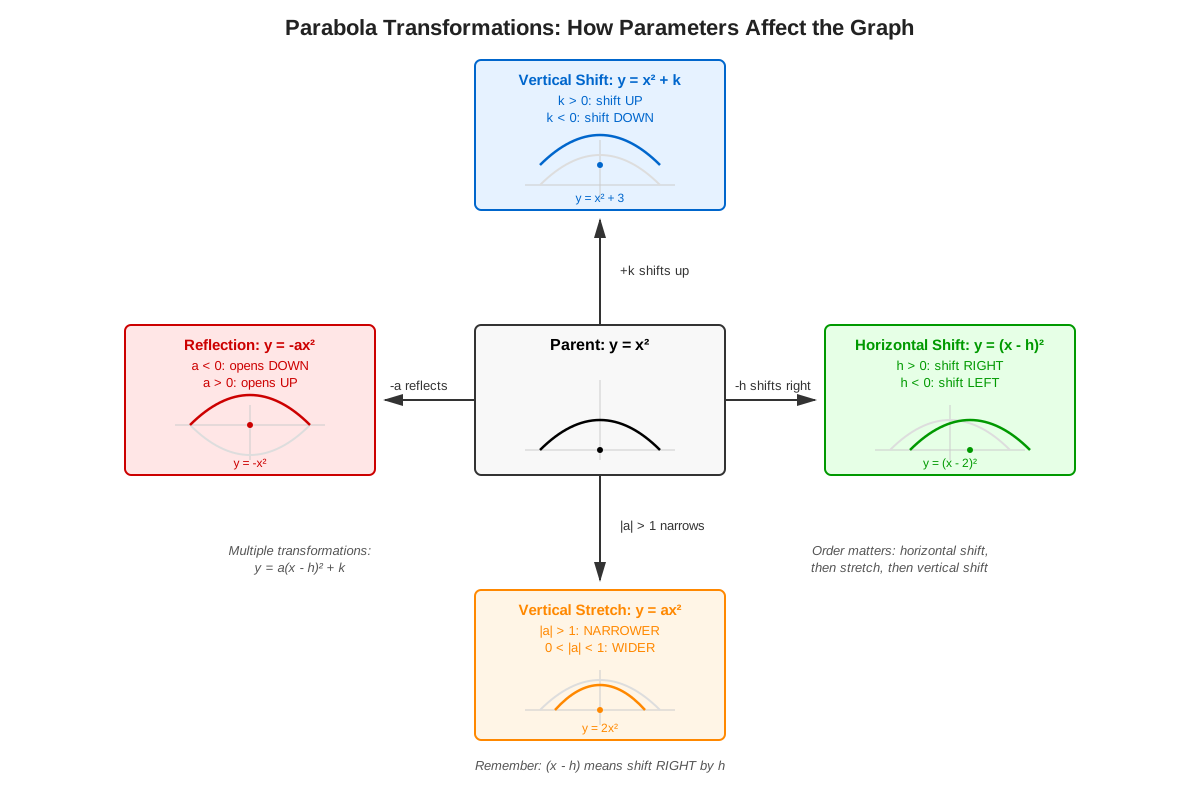
Transformations
Understanding how changes to the equation affect the graph is essential for ACT questions:
Vertical shifts: y = x² + k
- Adding k shifts the parabola up k units
- Subtracting k shifts the parabola down k units
Horizontal shifts: y = (x - h)²
- Replacing x with (x - h) shifts right h units
- Replacing x with (x + h) shifts left h units
- Note: the sign is opposite to what might be intuitive
Reflections: y = -x²
- Multiplying by -1 reflects the parabola across the x-axis
- Changes upward-opening to downward-opening and vice versa
Vertical stretches/compressions: y = ax²
- Multiplying by a > 1 stretches vertically (makes narrower)
- Multiplying by 0 < a < 1 compresses vertically (makes wider)
Concept Relationships
The three forms of parabola equations are interconnected through algebraic manipulation. Standard form can be converted to vertex form through completing the square, while vertex form can be expanded to standard form through distribution. Factored form connects to standard form through multiplication, and the relationship between x-intercepts in factored form and the vertex creates a bridge to vertex form through the midpoint formula.
The vertex serves as the central concept connecting multiple features: it lies on the axis of symmetry, represents the maximum or minimum value, and its x-coordinate is the midpoint between x-intercepts (when they exist). The coefficient a appears consistently across all forms, always controlling direction and width, creating a unifying thread through different representations.
Transformations build upon each other: a general parabola y = a(x - h)² + k represents the parent function y = x² after applying a vertical stretch/compression (factor a), horizontal shift (h units), and vertical shift (k units). This transformation sequence connects to the broader coordinate geometry concept of function transformations.
Relationship flow: Parent function y = x² → Apply transformations → Vertex form y = a(x - h)² + k → Expand → Standard form y = ax² + bx + c → Factor (when possible) → Factored form y = a(x - p)(x - q) → Identify intercepts and vertex → Complete understanding of parabola behavior
High-Yield Facts
⭐ The vertex form y = a(x - h)² + k immediately gives the vertex as (h, k)—this is the fastest way to identify the turning point
⭐ In standard form y = ax² + bx + c, the vertex x-coordinate is always x = -b/(2a)—memorize this formula
⭐ The sign of coefficient a determines direction: positive opens up, negative opens down—this appears in nearly every parabola question
⭐ The y-intercept in standard form is always the constant term c—simply read it from the equation
⭐ The axis of symmetry is always a vertical line x = h passing through the vertex—every parabola has exactly one
- The discriminant b² - 4ac determines the number of x-intercepts: positive means 2, zero means 1, negative means 0
- In factored form y = a(x - p)(x - q), the x-intercepts are p and q, and the vertex x-coordinate is (p + q)/2
- Larger |a| values create narrower parabolas; smaller |a| values create wider parabolas
- Horizontal shifts work opposite to intuition: (x - 3)² shifts RIGHT 3 units, (x + 3)² shifts LEFT 3 units
- When a parabola opens upward (a > 0), the vertex represents the minimum value; when it opens downward (a < 0), the vertex represents the maximum value
- All parabolas are symmetric about their axis of symmetry—points equidistant from this line have the same y-value
- The vertex lies exactly halfway between the x-intercepts (when they exist)
- Multiplying the entire equation by -1 reflects the parabola across the x-axis
- A parabola that passes through the origin has c = 0 in standard form
- The distance from the vertex to each x-intercept is equal (by symmetry)
Quick check — test yourself on Parabolas in coordinate plane so far.
Try Flashcards →Common Misconceptions
Misconception: In vertex form y = a(x - h)² + k, a positive h value shifts the parabola left.
Correction: The transformation works opposite to the sign—y = (x - 3)² shifts RIGHT 3 units, while y = (x + 3)² shifts LEFT 3 units. Think of it as "x must equal 3 to make the expression zero."
Misconception: The vertex is always on the x-axis.
Correction: The vertex can be anywhere in the coordinate plane. It only touches the x-axis when the parabola has exactly one x-intercept (discriminant equals zero). Most parabolas have vertices above or below the x-axis.
Misconception: A larger value of a always makes the parabola wider.
Correction: Larger absolute values of a make the parabola narrower (steeper), while smaller absolute values (between 0 and 1) make it wider. The relationship is inverse: |a| > 1 means narrow, 0 < |a| < 1 means wide.
Misconception: All parabolas have two x-intercepts.
Correction: Parabolas can have 0, 1, or 2 x-intercepts depending on their position. A parabola opening upward with vertex above the x-axis has no x-intercepts. One with vertex on the x-axis has exactly one x-intercept.
Misconception: The axis of symmetry is always the y-axis (x = 0).
Correction: The axis of symmetry is x = h, where h is the x-coordinate of the vertex. It's only x = 0 when the vertex lies on the y-axis. Most parabolas have axes of symmetry at other x-values.
Misconception: In standard form, b represents the vertex.
Correction: The coefficient b doesn't directly give any key feature. You must use the formula x = -b/(2a) to find the vertex x-coordinate. The b value affects the parabola's position but doesn't represent a specific point.
Misconception: Changing c in y = ax² + bx + c moves the parabola horizontally.
Correction: Changing c only shifts the parabola vertically. Horizontal shifts require changing the x-term, typically by replacing x with (x - h) in vertex form.
Worked Examples
Example 1: Finding Vertex and Graphing Features
Question: For the parabola y = 2x² - 8x + 3, find the vertex, axis of symmetry, y-intercept, and determine whether it opens upward or downward.
Solution:
Step 1: Identify the direction of opening.
Since a = 2 > 0, the parabola opens upward.
Step 2: Find the y-intercept.
In standard form y = ax² + bx + c, the y-intercept is c.
Y-intercept: (0, 3)
Step 3: Find the vertex x-coordinate using x = -b/(2a).
Here, a = 2 and b = -8
x = -(-8)/(2·2) = 8/4 = 2
Step 4: Find the vertex y-coordinate by substituting x = 2.
y = 2(2)² - 8(2) + 3
y = 2(4) - 16 + 3
y = 8 - 16 + 3 = -5
Vertex: (2, -5)
Step 5: Identify the axis of symmetry.
The axis of symmetry passes through the vertex at x = 2.
Axis of symmetry: x = 2
Answer: The parabola opens upward, has vertex (2, -5), axis of symmetry x = 2, and y-intercept (0, 3). Since it opens upward and the vertex is at y = -5, the minimum value is -5.
This example demonstrates the core strategy of using the standard form formula to find the vertex, which connects to Learning Objective 2 (explaining core strategies) and Objective 5 (determining key features from any form).
Example 2: Matching Equation to Graph
Question: Which equation represents a parabola with vertex at (3, -4) that opens downward?
A) y = -(x - 3)² - 4
B) y = -(x + 3)² - 4
C) y = (x - 3)² - 4
D) y = -(x - 3)² + 4
E) y = (x + 3)² + 4
Solution:
Step 1: Recall vertex form y = a(x - h)² + k where (h, k) is the vertex.
We need vertex (3, -4), so h = 3 and k = -4.
Step 2: Determine the sign of a.
Since the parabola opens downward, a must be negative.
Step 3: Write the vertex form with these values.
y = a(x - 3)² + (-4)
y = a(x - 3)² - 4
Since a is negative: y = -(x - 3)² - 4
Step 4: Check the answer choices.
Choice A matches exactly: y = -(x - 3)² - 4
Step 5: Verify by eliminating wrong answers.
- Choice B has (x + 3)², which gives vertex at (-3, -4)—wrong x-coordinate
- Choice C has positive a, so opens upward—wrong direction
- Choice D has k = +4, giving vertex at (3, 4)—wrong y-coordinate
- Choice E has wrong signs for both h and k, and opens upward
Answer: A
This example illustrates the ACT's common question format of matching equations to described features, connecting to Learning Objectives 1 (identifying when parabolas are tested) and 3 (applying to ACT-style questions).
Exam Strategy
When approaching ACT parabola questions, first identify what form the equation is in—this determines which features are immediately visible. If the equation is in vertex form, the vertex is given directly; if in standard form, plan to use x = -b/(2a); if in factored form, the x-intercepts are explicit. This initial classification saves time and prevents errors.
Trigger words and phrases that signal parabola questions include: "quadratic function," "maximum value," "minimum value," "vertex," "axis of symmetry," "U-shaped curve," "opens upward/downward," "x-intercepts," "zeros," "roots," and "turning point." Questions asking about "the highest point" or "lowest point" are asking for the vertex. References to "where the graph crosses the x-axis" indicate x-intercepts.
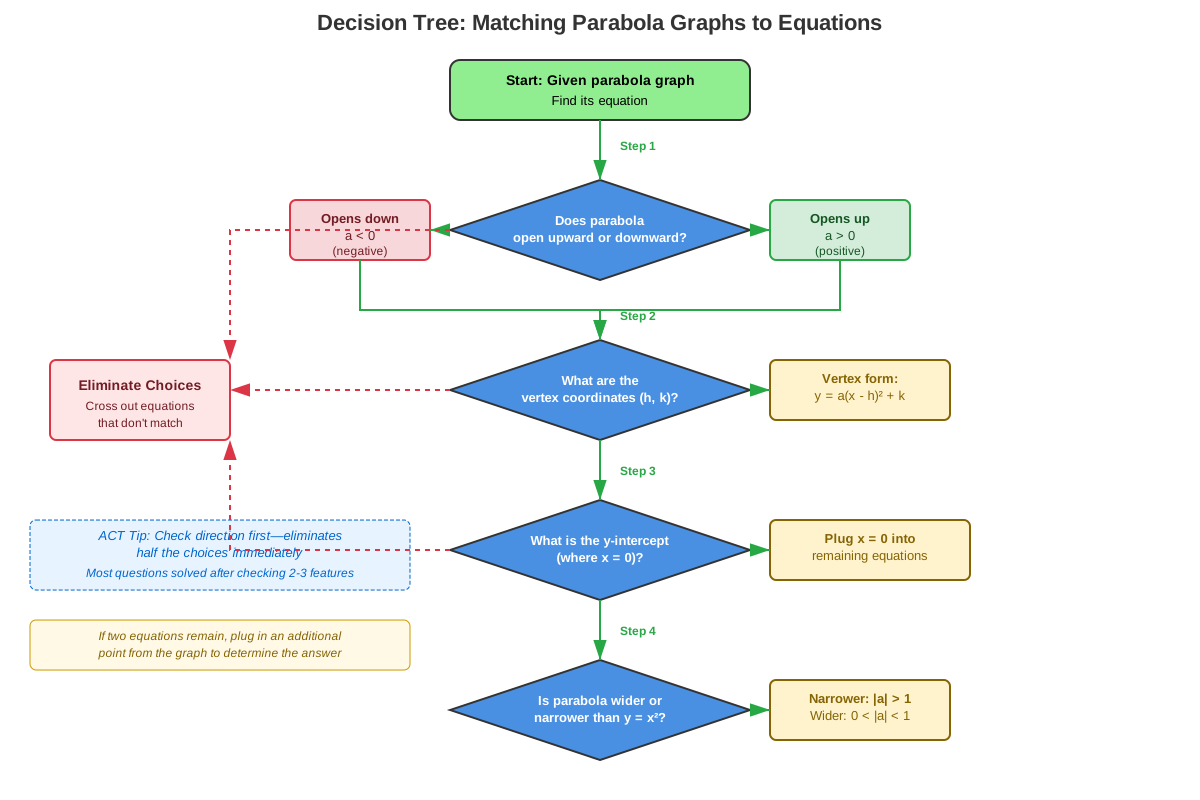
For graph-matching questions, use process of elimination efficiently:
- Check direction first (upward vs. downward)—eliminates half the choices
- Identify the vertex location—eliminates choices with wrong h or k values
- Verify the y-intercept if needed—provides final confirmation
When converting between forms, choose the most efficient path. To go from standard to vertex form, complete the square only if necessary—sometimes the question can be answered using x = -b/(2a) without full conversion. To go from vertex to standard form, expand carefully but recognize that many ACT questions don't require full expansion.
Time allocation: Most parabola questions should take 45-60 seconds. If a question requires completing the square or extensive algebraic manipulation, it may take 90 seconds. Don't spend more than 2 minutes on any single parabola question—if stuck, mark it and return later. Questions asking only for direction or y-intercept should take 20-30 seconds.
For word problems involving parabolas, translate the context into mathematical features: "maximum profit" means find the vertex of a downward-opening parabola; "hits the ground" means find x-intercepts; "initial height" means find the y-intercept. Set up the equation based on given information, then apply standard parabola techniques.
Memory Techniques
Vertex form mnemonic: "Vertex form Visibly shows (h, k)" — The vertex form y = a(x - h)² + k directly displays the vertex coordinates.
Direction mnemonic: "Positive Parabola Points Up" — When a is positive, the parabola opens upward like the letter U.
Horizontal shift memory trick: Think "opposite day" — In y = (x - h)², the sign is opposite to the shift direction. Negative h in the equation means positive (right) shift on the graph.
Vertex x-coordinate formula: Remember "Negative Boy Twice Away" for x = -b/(2a) — Negative b, divided by twice a.
Intercept acronym: Y-intercept is C (the constant in standard form), X-intercepts require Solving (setting y = 0 and solving the equation).
Visualization strategy: Always sketch a quick graph when working with parabolas. Draw the vertex, axis of symmetry, and direction of opening. This visual reference prevents sign errors and helps verify answers. Even a rough sketch showing whether the parabola opens up or down and where the vertex approximately lies can catch mistakes.
Width memory device: Think of |a| as "acceleration" — larger acceleration (larger |a|) means faster change, creating a steeper, narrower parabola. Smaller acceleration means gentler change, creating a wider parabola.
Summary
Parabolas in the coordinate plane represent quadratic functions graphically and appear frequently on the ACT Math section. Mastery requires understanding three equation forms—standard (y = ax² + bx + c), vertex (y = a(x - h)² + k), and factored (y = a(x - p)(x - q))—and knowing which features each reveals. The coefficient a determines both direction (positive opens up, negative opens down) and width (larger |a| means narrower). The vertex (h, k) is the turning point and represents the maximum or minimum value, found using x = -b/(2a) in standard form or read directly from vertex form. The axis of symmetry x = h divides the parabola into mirror images. Intercepts provide additional key points: the y-intercept is c in standard form, while x-intercepts are found by solving the quadratic equation or reading from factored form. Transformations follow predictable patterns, with horizontal shifts working opposite to the equation's sign. Success on ACT parabola questions requires quickly identifying equation forms, efficiently extracting key features, and matching equations to graphs or descriptions.
Key Takeaways
- The three forms of parabola equations each reveal different information: standard form shows y-intercept, vertex form shows vertex, and factored form shows x-intercepts
- The vertex formula x = -b/(2a) from standard form is essential for ACT questions and must be memorized
- The coefficient a controls both direction (sign) and width (magnitude)—positive opens up, negative opens down, larger |a| means narrower
- Vertex form y = a(x - h)² + k directly gives the vertex as (h, k), making it the fastest form for identifying the turning point
- Horizontal shifts work opposite to intuition: (x - h) shifts right, (x + h) shifts left
- The axis of symmetry is always x = h, where h is the vertex x-coordinate, and creates perfect symmetry in the parabola
- Process of elimination on graph-matching questions should start with direction, then vertex location, then intercepts
Related Topics
Quadratic Formula and Discriminant: Deepens understanding of x-intercepts and connects algebraic solutions to graphical features. The discriminant b² - 4ac determines how many times a parabola crosses the x-axis.
Systems of Equations with Parabolas: Extends parabola knowledge to finding intersection points between parabolas and lines or between two parabolas, requiring both graphical and algebraic reasoning.
Function Transformations: Generalizes the transformation concepts learned with parabolas to other function types including absolute value, exponential, and trigonometric functions.
Optimization Problems: Applies vertex concepts to real-world maximum and minimum problems in business, physics, and engineering contexts, showing practical applications of parabola properties.
Conic Sections: Places parabolas in the broader context of curves formed by intersecting planes with cones, connecting to circles, ellipses, and hyperbolas in advanced mathematics.
Practice CTA
Now that you've mastered the core concepts of parabolas in the coordinate plane, it's time to solidify your understanding through practice! Work through the practice questions to apply these strategies to ACT-style problems, and use the flashcards to reinforce key formulas and concepts. Remember, the difference between knowing these concepts and scoring points on test day is practice—each problem you solve builds the pattern recognition and speed you need for success. You've got this!
Sign up free to keep reading
Create a free AnvayaPrep account to finish this ACT guide on Parabolas in coordinate plane — plus flashcards and practice questions.