Overview
Perpendicular line equations represent one of the most frequently tested concepts in the Coordinate Geometry section of the ACT Math test. This topic requires students to understand the relationship between two lines that intersect at a 90-degree angle and to manipulate linear equations to find perpendicular lines through specific points. Mastery of this concept is essential because it appears in approximately 2-3 questions per ACT exam, making it a high-yield topic that can significantly impact your score.
The foundation of perpendicular line equations rests on a single critical relationship: when two non-vertical lines are perpendicular, their slopes are negative reciprocals of each other. This means if one line has a slope of m, the perpendicular line has a slope of -1/m. Understanding this relationship allows students to quickly identify perpendicular lines, write equations for perpendicular lines, and solve complex coordinate geometry problems that combine multiple concepts. The ACT frequently tests this concept by providing an equation for one line and asking students to find the equation of a perpendicular line passing through a given point.
ACT perpendicular line equations questions integrate seamlessly with other coordinate geometry concepts including slope-intercept form, point-slope form, parallel lines, and distance formulas. Success with perpendicular lines requires fluency in converting between different forms of linear equations and the ability to extract slope information quickly from various equation formats. This topic serves as a bridge between basic linear equations and more advanced geometric reasoning, making it a cornerstone concept for achieving scores in the upper ranges of the ACT Math section.
Learning Objectives
- [ ] Identify when Perpendicular line equations is being tested
- [ ] Explain the core rule or strategy behind Perpendicular line equations
- [ ] Apply Perpendicular line equations to ACT-style questions accurately
- [ ] Calculate the slope of a line perpendicular to a given line in under 10 seconds
- [ ] Write the equation of a perpendicular line through a specific point using point-slope form
- [ ] Determine whether two given lines are perpendicular by analyzing their equations
- [ ] Convert between slope-intercept, point-slope, and standard forms when working with perpendicular lines
Prerequisites
- Slope calculation from two points: Essential for determining the slope of the original line before finding its perpendicular counterpart
- Slope-intercept form (y = mx + b): The most common form for identifying slope quickly and writing final answers
- Point-slope form (y - y₁ = m(x - x₁)): The most efficient form for writing equations when given a point and slope
- Standard form (Ax + By = C): Necessary for extracting slope information when equations are presented in this format
- Negative reciprocals: Understanding how to flip a fraction and change its sign is the mathematical foundation of perpendicular slopes
- Substitution: Required for finding y-intercepts and verifying that points lie on lines
Why This Topic Matters
Perpendicular line equations appear in real-world applications across engineering, architecture, computer graphics, and navigation. Architects use perpendicular lines to ensure structural integrity when designing buildings with right angles. Computer programmers rely on perpendicular line calculations to create collision detection algorithms in video games. Civil engineers apply these concepts when designing road intersections and determining optimal drainage patterns. GPS navigation systems use perpendicular distance calculations to determine how far a vehicle has deviated from its intended route.
On the ACT Math test, perpendicular line equations appear in approximately 2-3 questions per exam, representing roughly 3-5% of the total Math section. These questions typically appear in positions 35-50 of the 60-question test, placing them in the medium to difficult range. The ACT tests this concept through several question formats: finding the equation of a perpendicular line through a given point (most common), determining whether two lines are perpendicular, finding the intersection point of perpendicular lines, and calculating distances using perpendicular relationships.
The ACT frequently embeds perpendicular line questions within word problems involving geometric figures, particularly rectangles, squares, and right triangles in the coordinate plane. Questions may ask students to find the equation of an altitude in a triangle, determine the perpendicular bisector of a line segment, or identify which answer choice represents a line perpendicular to a given line. The test writers favor questions that require multiple steps: extracting slope from a non-standard form, calculating the perpendicular slope, and then writing the equation using a given point.
Core Concepts
The Perpendicular Slope Rule
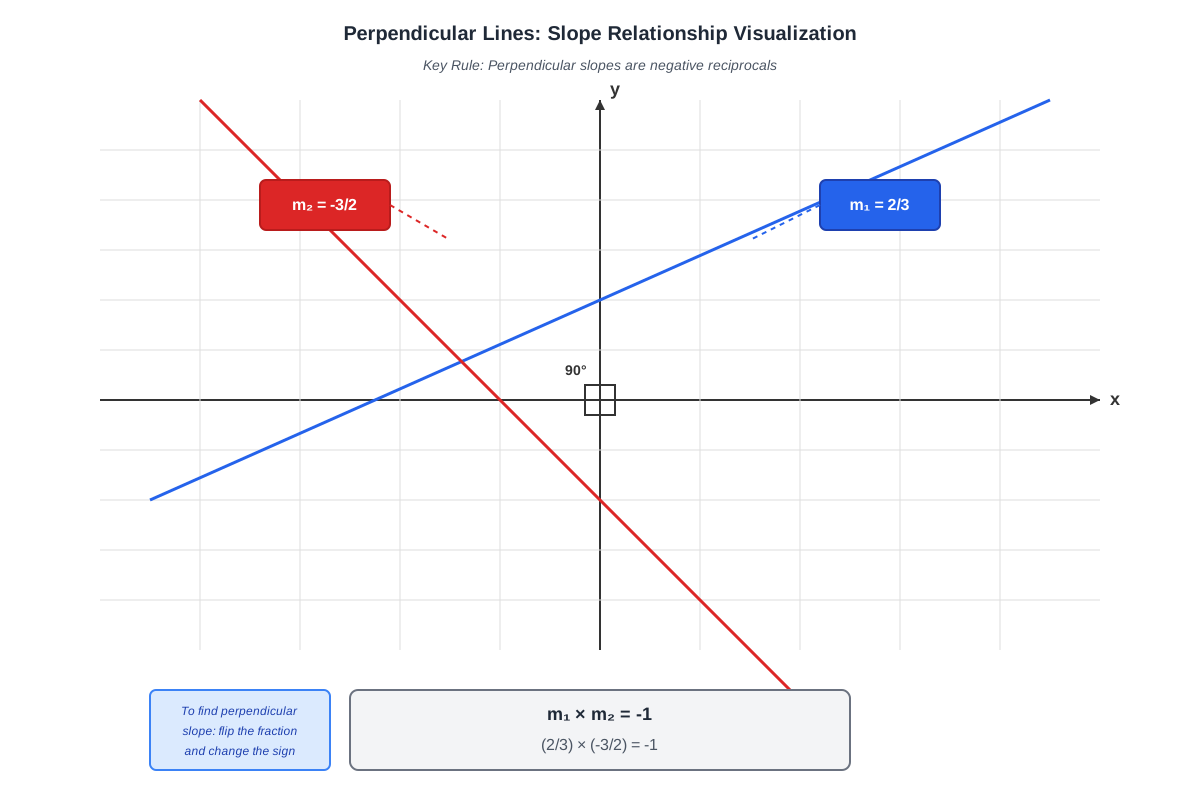
The fundamental principle governing perpendicular line equations states that two non-vertical lines are perpendicular if and only if the product of their slopes equals -1. Mathematically, if line 1 has slope m₁ and line 2 has slope m₂, then the lines are perpendicular when:
m₁ × m₂ = -1This relationship can be rearranged to show that m₂ = -1/m₁, revealing that perpendicular slopes are negative reciprocals of each other. To find the negative reciprocal of a slope:
- Take the reciprocal (flip the fraction)
- Change the sign (positive becomes negative, negative becomes positive)
For example, if a line has slope 3/4, the perpendicular slope is -4/3. If a line has slope -2 (which equals -2/1), the perpendicular slope is 1/2.
| Original Slope | Reciprocal | Negative Reciprocal (Perpendicular Slope) |
|---|---|---|
| 2/3 | 3/2 | -3/2 |
| -5/4 | -4/5 | 4/5 |
| 3 (or 3/1) | 1/3 | -1/3 |
| -1/2 | -2 | 2 |
| 1 | 1 | -1 |
Special Cases: Horizontal and Vertical Lines
Horizontal and vertical lines form a special perpendicular pair that doesn't follow the negative reciprocal rule in the traditional sense because vertical lines have undefined slope. However, the relationship is straightforward:
- Horizontal lines (form: y = k) have slope 0 and are perpendicular to vertical lines (form: x = h)
- Any horizontal line is perpendicular to any vertical line
- If asked for a line perpendicular to y = 5, the answer will be a vertical line: x = [some value]
- If asked for a line perpendicular to x = -3, the answer will be a horizontal line: y = [some value]
Extracting Slope from Different Equation Forms
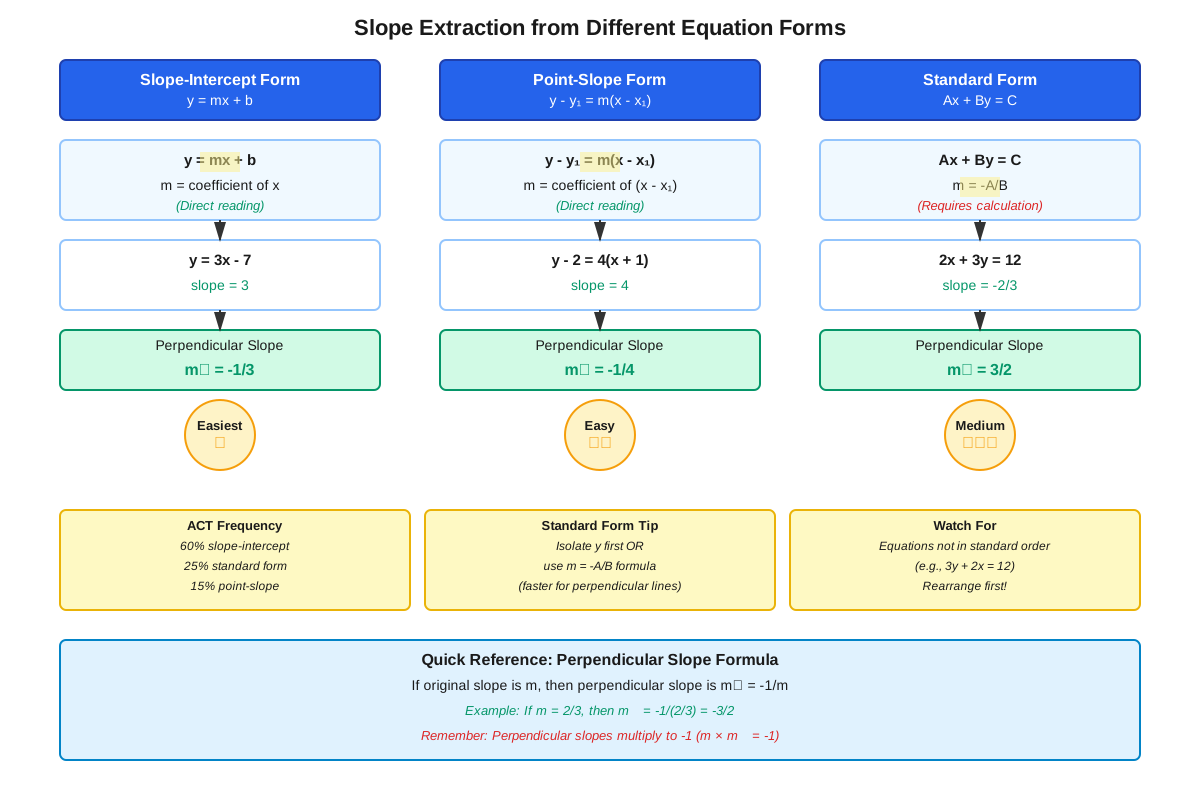
The ACT presents linear equations in multiple forms, and students must quickly extract slope information to find perpendicular lines:
Slope-Intercept Form (y = mx + b)
- Slope is the coefficient of x
- Example: y = 3x - 7 has slope 3, so perpendicular slope is -1/3
Point-Slope Form (y - y₁ = m(x - x₁))
- Slope is the coefficient of (x - x₁)
- Example: y - 2 = -4(x + 1) has slope -4, so perpendicular slope is 1/4
Standard Form (Ax + By = C)
- Slope equals -A/B
- Example: 2x + 3y = 12 has slope -2/3, so perpendicular slope is 3/2
- To find perpendicular slope from standard form: flip A and B, then change the sign of one
Two-Point Form
- Calculate slope using (y₂ - y₁)/(x₂ - x₁)
- Then find negative reciprocal
Writing Perpendicular Line Equations
Once the perpendicular slope is determined, writing the equation requires incorporating a specific point. The point-slope form is the most efficient approach:
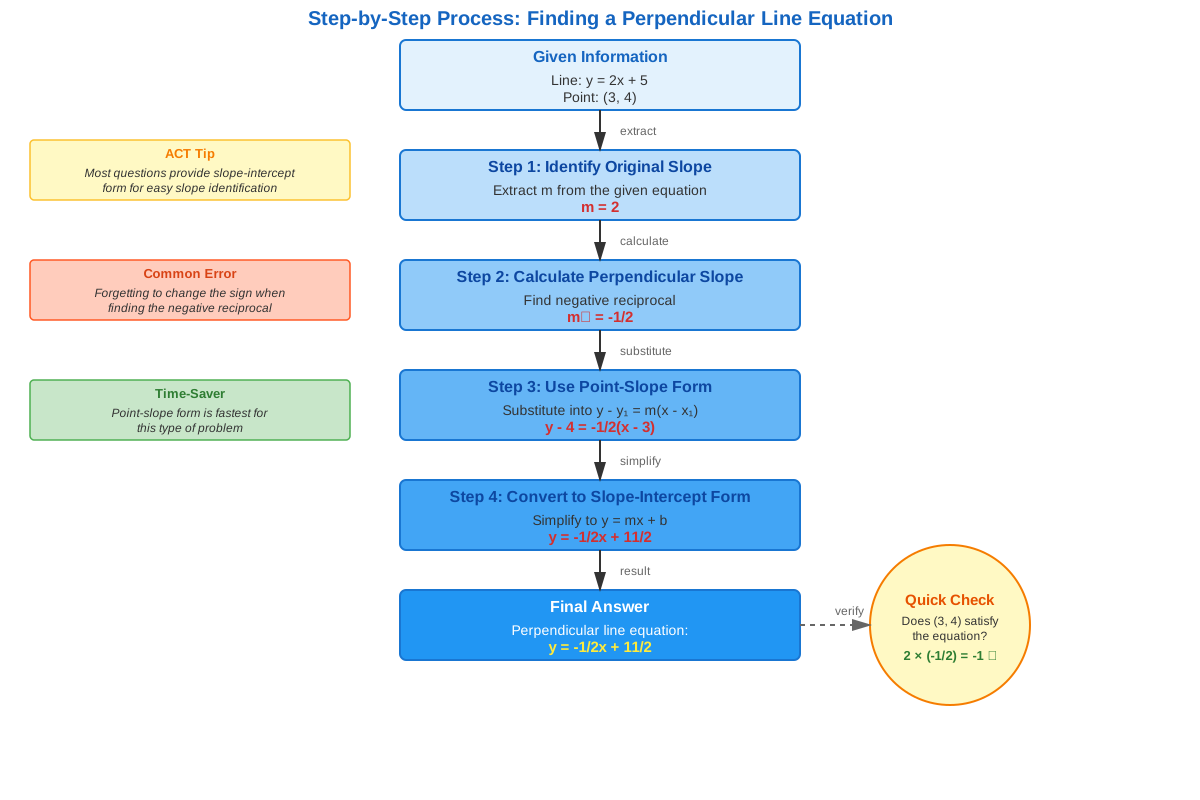
Step-by-step process:
- Identify the slope of the original line (m₁)
- Calculate the perpendicular slope: m₂ = -1/m₁
- Identify the point (x₁, y₁) through which the perpendicular line passes
- Substitute into point-slope form: y - y₁ = m₂(x - x₁)
- Simplify to slope-intercept form if required: solve for y
Example: Find the equation of the line perpendicular to y = 2x + 5 that passes through (4, 3).
- Original slope: m₁ = 2
- Perpendicular slope: m₂ = -1/2
- Point: (4, 3)
- Point-slope form: y - 3 = -1/2(x - 4)
- Slope-intercept form: y - 3 = -1/2x + 2, so y = -1/2x + 5
Verifying Perpendicularity
To verify whether two lines are perpendicular, extract both slopes and check if their product equals -1:
Method 1: Direct multiplication
- Find m₁ and m₂
- Calculate m₁ × m₂
- If the result equals -1, lines are perpendicular
Method 2: Negative reciprocal check
- Find m₁ and m₂
- Determine if m₂ = -1/m₁
- If true, lines are perpendicular
Common ACT Question Patterns
The ACT tests perpendicular lines through predictable patterns:
Pattern 1: Direct equation request
"What is the equation of the line perpendicular to y = 3x - 2 that passes through (1, 5)?"
Pattern 2: Multiple choice identification
"Which of the following lines is perpendicular to 2x - 4y = 8?"
Pattern 3: Geometric context
"In the xy-plane, line ℓ passes through points (0, 0) and (3, 4). What is the slope of any line perpendicular to line ℓ?"
Pattern 4: Word problems
"A road is represented by the equation y = 2/3x + 10. A perpendicular side street intersects the road at point (6, 14). What is the equation of the side street?"
Concept Relationships
The concept of perpendicular line equations builds directly upon fundamental slope concepts. Slope calculation → serves as the foundation for → identifying perpendicular relationships → which enables → writing perpendicular line equations. This linear progression means that any weakness in calculating slope will cascade into errors with perpendicular lines.
Perpendicular line equations share a parallel structure (no pun intended) with parallel line equations, where parallel lines have identical slopes rather than negative reciprocal slopes. The ACT frequently tests both concepts together, requiring students to distinguish between the two relationships. Both topics require fluency in converting between equation forms and using point-slope form efficiently.
The connection to distance formulas emerges when calculating the perpendicular distance from a point to a line, a concept that occasionally appears on the ACT. The shortest distance from a point to a line always occurs along a perpendicular segment, linking these two coordinate geometry topics. Similarly, midpoint formulas connect to perpendicular lines when finding perpendicular bisectors—lines that pass through the midpoint of a segment and are perpendicular to it.
Within geometric proofs and coordinate geometry problems, perpendicular lines help establish right triangles and rectangles in the coordinate plane. The ACT may present a quadrilateral and ask students to prove it's a rectangle by showing opposite sides are parallel and adjacent sides are perpendicular. This requires calculating multiple slopes and verifying both parallel and perpendicular relationships.
Quick check — test yourself on Perpendicular line equations so far.
Try Flashcards →High-Yield Facts
⭐ The slopes of perpendicular lines are negative reciprocals: if one slope is m, the other is -1/m
⭐ The product of perpendicular slopes always equals -1: m₁ × m₂ = -1
⭐ Horizontal lines (y = k) are perpendicular to vertical lines (x = h)
⭐ To find perpendicular slope from standard form Ax + By = C: the perpendicular slope is B/A (flip and change sign of one)
⭐ Point-slope form is the fastest method for writing perpendicular line equations: y - y₁ = m(x - x₁)
- A line with slope 0 (horizontal) is perpendicular to a line with undefined slope (vertical)
- If a line has slope 1, its perpendicular has slope -1
- Perpendicular lines form 90-degree angles at their intersection point
- The perpendicular bisector of a segment passes through the midpoint and has slope that is the negative reciprocal of the segment's slope
- Two lines with slopes that are reciprocals but not negative reciprocals are NOT perpendicular (common trap answer)
- When converting from standard form, always check your slope calculation: slope = -A/B, not A/B
- Perpendicular lines in the coordinate plane create right angles, which is the geometric definition of perpendicularity
Common Misconceptions
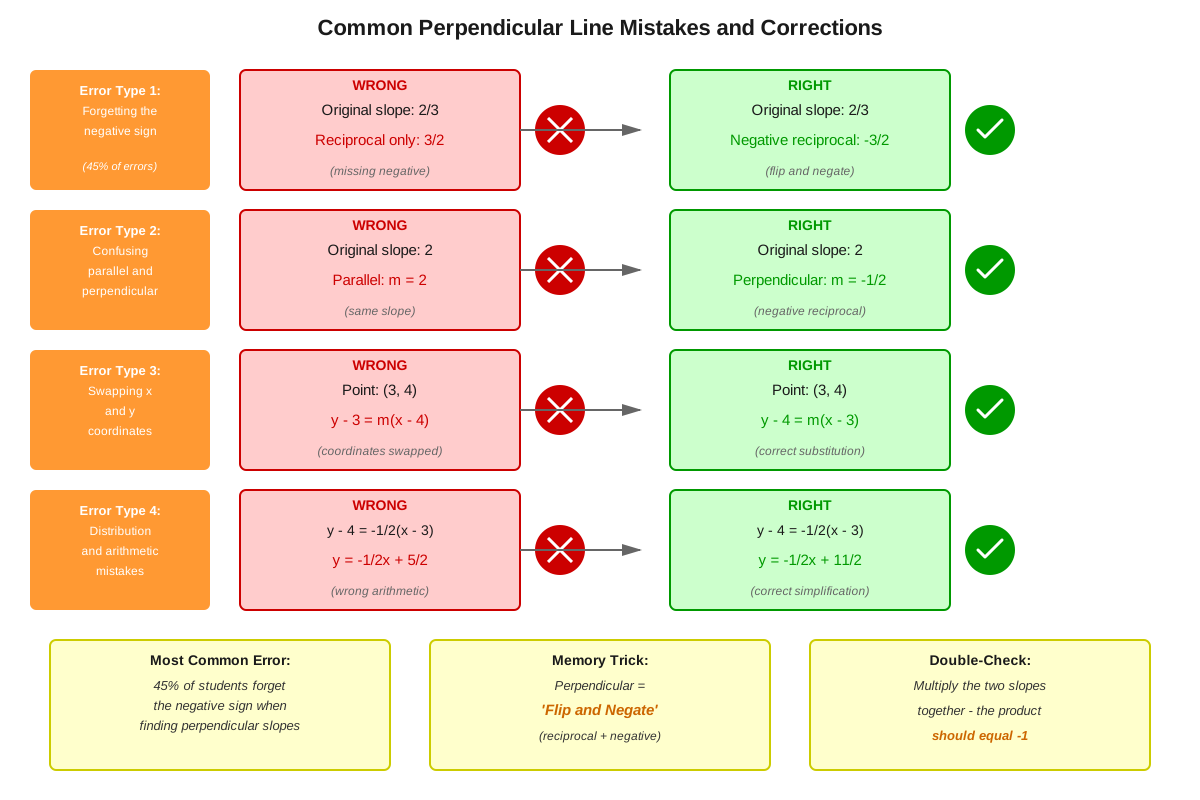
Misconception: Perpendicular slopes are simply the reciprocals of each other (forgetting the negative sign)
→ Correction: Perpendicular slopes must be NEGATIVE reciprocals. If one slope is 2/3, the perpendicular slope is -3/2, not 3/2. Always flip the fraction AND change the sign.
Misconception: The product of perpendicular slopes equals 1
→ Correction: The product of perpendicular slopes equals -1, not positive 1. This negative value reflects the sign change required in the negative reciprocal relationship.
Misconception: Parallel and perpendicular lines have the same relationship to the original line
→ Correction: Parallel lines have identical slopes (m₁ = m₂), while perpendicular lines have negative reciprocal slopes (m₁ × m₂ = -1). These are completely different relationships.
Misconception: When extracting slope from standard form Ax + By = C, the slope is A/B
→ Correction: The slope from standard form is -A/B (negative A divided by B). For example, 3x + 2y = 6 has slope -3/2, not 3/2.
Misconception: A line perpendicular to y = 5 would have equation y = -1/5
→ Correction: Since y = 5 is a horizontal line (slope 0), any perpendicular line must be vertical with equation x = k for some constant k. Horizontal and vertical lines are special perpendicular pairs.
Misconception: If two lines have slopes of 2 and -2, they are perpendicular
→ Correction: These lines are NOT perpendicular because -2 is not the negative reciprocal of 2. The negative reciprocal of 2 is -1/2. The slopes 2 and -2 are opposites, not negative reciprocals.
Misconception: You can use slope-intercept form directly when given a point and perpendicular slope
→ Correction: While you can eventually convert to slope-intercept form, point-slope form is more efficient when you have a point and a slope. Using y = mx + b requires an extra step to solve for b.
Worked Examples
Example 1: Finding a Perpendicular Line Equation
Problem: Line ℓ has equation 3x - 6y = 18. What is the equation, in slope-intercept form, of the line perpendicular to line ℓ that passes through point (2, -1)?
Solution:
Step 1: Extract the slope from the given equation (standard form)
- Given: 3x - 6y = 18
- Standard form is Ax + By = C, so A = 3, B = -6
- Slope = -A/B = -3/(-6) = 1/2
Step 2: Find the perpendicular slope
- Original slope: m₁ = 1/2
- Perpendicular slope: m₂ = -1/m₁ = -1/(1/2) = -2
Step 3: Use point-slope form with the given point (2, -1)
- y - y₁ = m(x - x₁)
- y - (-1) = -2(x - 2)
- y + 1 = -2(x - 2)
Step 4: Convert to slope-intercept form
- y + 1 = -2x + 4
- y = -2x + 3
Answer: y = -2x + 3
Connection to learning objectives: This problem demonstrates the complete process of identifying perpendicular line testing (objective 1), applying the negative reciprocal rule (objective 2), and accurately solving an ACT-style question (objective 3).
Example 2: Verifying Perpendicularity
Problem: Line m passes through points (-2, 5) and (4, 2). Line n has equation y = 2x + 7. Are lines m and n perpendicular?
Solution:
Step 1: Find the slope of line m using the two points
- Slope formula: m = (y₂ - y₁)/(x₂ - x₁)
- m = (2 - 5)/(4 - (-2))
- m = -3/6
- m = -1/2
Step 2: Identify the slope of line n
- Given: y = 2x + 7 (slope-intercept form)
- Slope of line n = 2
Step 3: Check if slopes are negative reciprocals
- Slope of m: -1/2
- Slope of n: 2 (which equals 2/1)
- Negative reciprocal of -1/2 is: -1/(-1/2) = 2 ✓
Step 4: Verify by multiplication
- (-1/2) × 2 = -1 ✓
Answer: Yes, lines m and n are perpendicular because their slopes are negative reciprocals and their product equals -1.
Connection to learning objectives: This example shows how to identify perpendicular relationships from different information formats (coordinates vs. equations) and verify the perpendicular relationship using multiple methods.
Exam Strategy
When approaching ACT perpendicular line equations questions, begin by identifying the format of the given equation. Spend 5-10 seconds determining whether you're working with slope-intercept, point-slope, or standard form, as this dictates your extraction method. Circle or underline the given point if one is provided—this is your anchor for writing the final equation.
Trigger words and phrases that signal perpendicular line questions include:
- "perpendicular to"
- "forms a right angle with"
- "intersects at 90 degrees"
- "perpendicular bisector"
- "altitude" (in triangle problems)
- "shortest distance" (implies perpendicular)
Use the two-step verification method to avoid careless errors: after finding your perpendicular slope, quickly multiply it by the original slope to confirm the product equals -1. This 3-second check catches the majority of sign errors and reciprocal mistakes.
For process of elimination, immediately eliminate answer choices that:
- Have the same slope as the original line (those are parallel, not perpendicular)
- Have slopes that are reciprocals but not negative reciprocals
- Don't pass through the given point (substitute the point's coordinates to verify)
- Have slopes that multiply with the original to give +1 instead of -1
Time allocation: Budget 45-60 seconds for straightforward perpendicular line questions and up to 90 seconds for multi-step problems involving geometric figures. If you're spending more than 90 seconds, mark the question and return to it after completing easier problems.
When answer choices are in different forms (some slope-intercept, some standard form), convert your answer to match the most common format in the choices, or convert all choices to slope-intercept form for easy comparison. The ACT occasionally uses this format variation to test whether students truly understand equation equivalence.
Exam Tip: If you forget whether perpendicular slopes are negative reciprocals or just reciprocals, quickly sketch perpendicular lines on your test booklet. Draw a line with positive slope going up-right, then draw a perpendicular line—it must go down-right (negative slope). This visual reminder confirms the negative sign is essential.
Memory Techniques
Mnemonic for Perpendicular Slopes: "Negative Reciprocals Produce Perpendiculars" (NRPP)
- Negative: change the sign
- Reciprocals: flip the fraction
- Produce: multiply to get
- Perpendiculars: -1
Visual Memory Aid: Picture a plus sign (+). The vertical and horizontal lines are perpendicular. The horizontal line has slope 0, and the vertical line has undefined slope (which you can think of as 1/0). This extreme case helps remember that perpendicular slopes are drastically different from each other.
Acronym for the Process: FERN
- Find the original slope
- Establish the perpendicular slope (negative reciprocal)
- Record the given point
- Note the equation using point-slope form
Rhyme for the Rule: "Flip the slope and change the sign, perpendicular lines work out fine!"
Finger Trick: Hold your index fingers perpendicular (forming an L or T shape). If your right finger points up-right (positive slope), your left finger must point down-right (negative slope). This physical reminder reinforces that perpendicular slopes have opposite signs.
Number Association: Remember that perpendicular slopes multiply to -1, not +1. Think: "perpendicular = negative one" (both start with letters in the second half of the alphabet, both involve negativity/opposition).
Summary
Perpendicular line equations represent a high-yield ACT Math topic centered on a single powerful relationship: perpendicular lines have slopes that are negative reciprocals of each other, meaning their product equals -1. Mastery requires the ability to quickly extract slope information from equations in any form (slope-intercept, point-slope, or standard form), calculate the negative reciprocal by flipping the fraction and changing the sign, and write the perpendicular line equation using point-slope form with a given point. Special attention must be paid to horizontal and vertical lines, which form perpendicular pairs despite the vertical line having undefined slope. The ACT tests this concept through direct equation-writing problems, verification questions, and geometric applications involving right angles, altitudes, and perpendicular bisectors. Success depends on avoiding common errors such as forgetting the negative sign in the negative reciprocal, confusing perpendicular with parallel relationships, and incorrectly extracting slope from standard form. Students who master the FERN process (Find, Establish, Record, Note) and consistently verify their perpendicular slopes through multiplication can confidently tackle these questions in under 60 seconds, securing valuable points in the medium-difficulty range of the ACT Math section.
Key Takeaways
- Perpendicular slopes are negative reciprocals: flip the fraction and change the sign
- The product of perpendicular slopes always equals -1 (use this to verify your answer)
- Point-slope form (y - y₁ = m(x - x₁)) is the most efficient method for writing perpendicular line equations
- Extract slope from standard form Ax + By = C using the formula m = -A/B
- Horizontal lines (y = k) and vertical lines (x = h) are always perpendicular to each other
- Perpendicular lines appear in 2-3 ACT questions per test, making this a high-yield topic
- Always verify that your perpendicular slope, when multiplied by the original slope, equals -1
Related Topics
Parallel Line Equations: After mastering perpendicular lines, parallel lines provide a complementary concept where slopes are identical rather than negative reciprocals. Understanding both relationships allows you to tackle comprehensive coordinate geometry problems involving quadrilaterals and complex figures.
Distance from a Point to a Line: This advanced topic uses perpendicular line concepts to calculate the shortest distance from a point to a line, requiring you to find the perpendicular line through the point, determine the intersection, and apply the distance formula.
Perpendicular Bisectors: Building on perpendicular lines, perpendicular bisectors combine midpoint calculations with perpendicular slope relationships, appearing in problems involving circles, triangles, and geometric constructions.
Systems of Linear Equations: Perpendicular lines often intersect, and finding their intersection point requires solving systems of equations—a natural extension that combines algebraic and geometric reasoning.
Coordinate Geometry Proofs: Advanced ACT problems may ask you to prove that a quadrilateral is a rectangle or square by demonstrating that sides are perpendicular, requiring multiple slope calculations and perpendicular verifications.
Practice CTA
Now that you've mastered the core concepts of perpendicular line equations, it's time to solidify your understanding through active practice. Attempt the practice questions designed specifically for this topic, focusing on applying the FERN process and verifying your perpendicular slopes through multiplication. Use the flashcards to drill the negative reciprocal relationship until it becomes automatic—speed and accuracy on these questions can significantly boost your ACT Math score. Remember, every perpendicular line question you encounter is an opportunity to demonstrate mastery of a high-yield concept that appears consistently on every ACT exam. You've got this!
Sign up free to keep reading
Create a free AnvayaPrep account to finish this ACT guide on Perpendicular line equations — plus flashcards and practice questions.