Overview
Parallel line equations represent one of the most frequently tested concepts in the Coordinate Geometry section of the ACT Math test. Understanding how to work with parallel lines requires synthesizing knowledge of slope, linear equations, and the coordinate plane into a cohesive problem-solving framework. On the ACT, students encounter parallel line questions in multiple formats: identifying parallel lines from equations, writing equations of lines parallel to a given line, and determining relationships between geometric figures using parallel line properties.
The fundamental principle underlying all ACT parallel line equations problems is deceptively simple: parallel lines have identical slopes but different y-intercepts. However, the ACT tests this concept through increasingly sophisticated question types that require students to manipulate equations in various forms (slope-intercept, point-slope, and standard form), work backward from given information, and apply algebraic reasoning under time pressure. Mastery of this topic directly impacts performance on approximately 2-3 questions per ACT Math section, making it a high-yield area for focused study.
Beyond its direct testing frequency, parallel line equations serve as a gateway concept connecting multiple areas of coordinate geometry. This topic builds upon foundational understanding of slope and linear equations while providing essential tools for analyzing perpendicular lines, geometric proofs on the coordinate plane, and systems of equations. Students who master parallel line equations develop stronger algebraic manipulation skills and geometric reasoning abilities that transfer to more complex ACT Math problems involving circles, parabolas, and three-dimensional geometry.
Learning Objectives
- [ ] Identify when Parallel line equations is being tested
- [ ] Explain the core rule or strategy behind Parallel line equations
- [ ] Apply Parallel line equations to ACT-style questions accurately
- [ ] Convert between different forms of linear equations to identify parallel relationships
- [ ] Write the equation of a line parallel to a given line passing through a specific point
- [ ] Determine whether two lines are parallel by comparing their slopes from any equation form
- [ ] Solve multi-step problems involving parallel lines in geometric contexts
Prerequisites
- Slope calculation: Understanding how to find slope from two points or from an equation is essential because parallel lines are defined by having equal slopes
- Linear equation forms: Familiarity with slope-intercept form (y = mx + b), point-slope form (y - y₁ = m(x - x₁)), and standard form (Ax + By = C) enables quick identification of slope values
- Coordinate plane basics: Knowledge of plotting points and understanding x and y coordinates provides the foundation for visualizing parallel line relationships
- Basic algebraic manipulation: Skills in solving for variables and rearranging equations are necessary for converting between equation forms
Why This Topic Matters
In real-world applications, parallel line concepts appear throughout engineering, architecture, computer graphics, and urban planning. Architects use parallel line equations to ensure structural elements remain equidistant, while computer programmers employ these principles in rendering graphics and designing user interfaces. Civil engineers apply parallel line mathematics when designing highway systems, railway tracks, and building foundations where maintaining consistent spacing is critical for safety and functionality.
On the ACT Math test, parallel line equations appear with remarkable consistency. Statistical analysis of released ACT exams reveals that 3-5% of all Math questions directly test parallel line concepts, translating to approximately 2-3 questions per 60-question Math section. These questions typically appear in positions 30-50 of the Math section, placing them in the medium to medium-hard difficulty range. The ACT favors certain question formats: approximately 40% ask students to identify which equation represents a line parallel to a given line, 35% require writing an equation of a parallel line through a specific point, and 25% embed parallel line concepts within geometric figures or word problems.
Common question presentations include: providing a linear equation and asking which answer choice represents a parallel line; giving a graph with one line and requesting the equation of a parallel line through a marked point; presenting a geometric figure (such as a parallelogram or trapezoid) on the coordinate plane and asking about properties of parallel sides; and embedding parallel line concepts within real-world scenarios involving rates, distances, or proportional relationships.
Core Concepts
The Fundamental Property of Parallel Lines
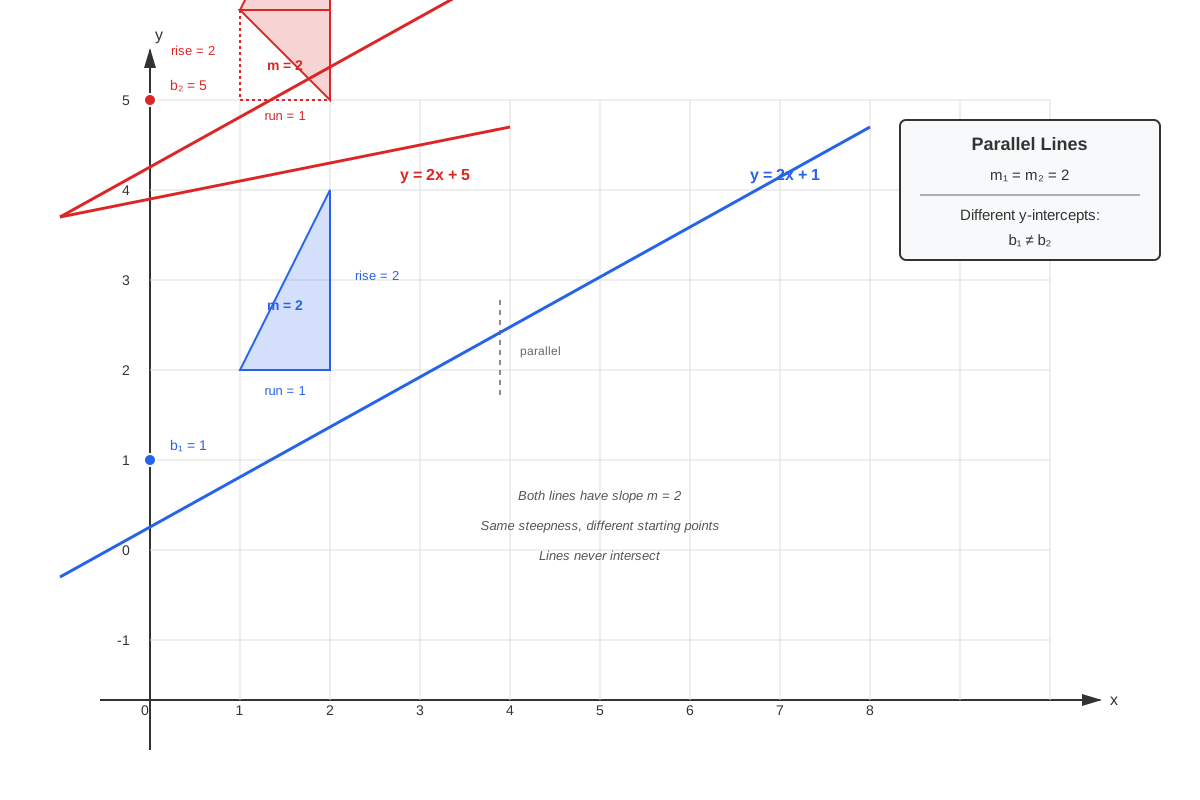
The defining characteristic of parallel lines is that they never intersect, no matter how far they extend in either direction. In coordinate geometry, this geometric property translates into a precise algebraic relationship: parallel lines have identical slopes. This slope equality is the cornerstone of all parallel line equation problems on the ACT.
When two lines are written in slope-intercept form (y = mx + b), where m represents the slope and b represents the y-intercept, the lines are parallel if and only if their m values are equal while their b values are different. If the b values were also equal, the lines would be identical (coincident), not merely parallel.
Identifying Slope from Different Equation Forms
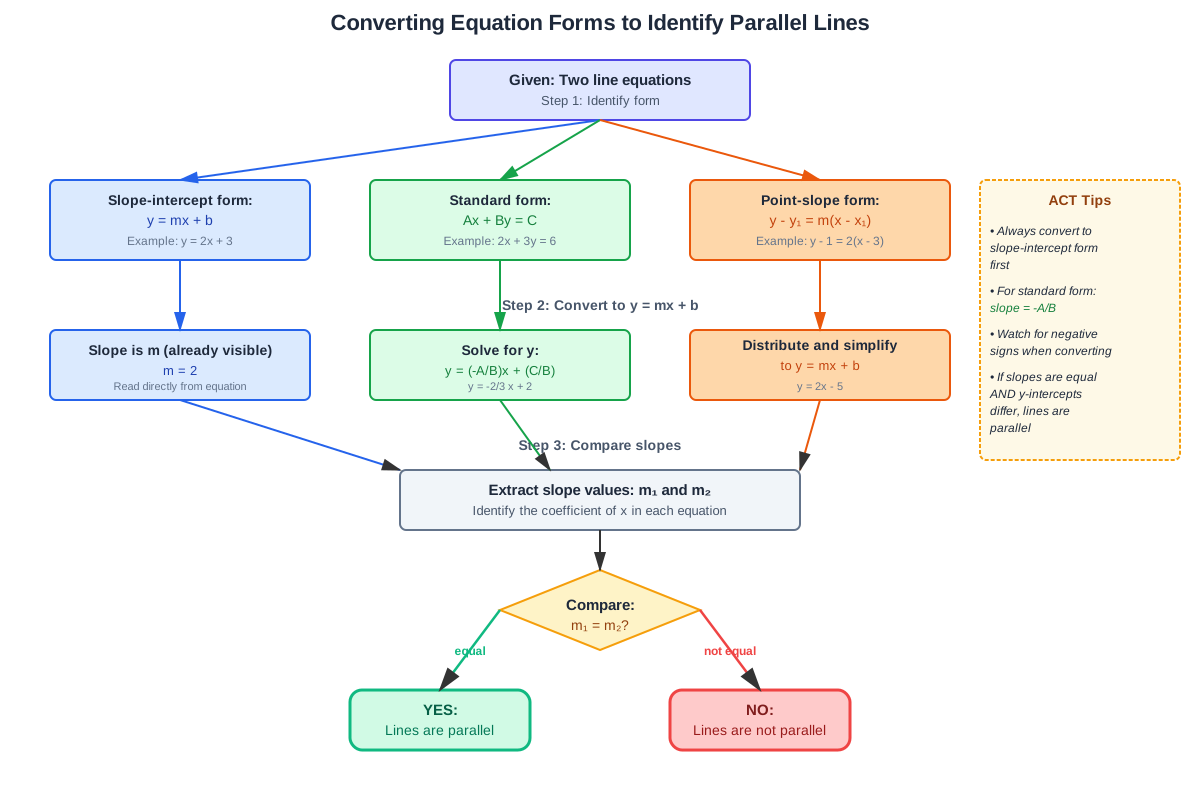
The ACT deliberately tests whether students can recognize parallel lines even when equations are presented in different forms. Understanding how to extract slope from any linear equation form is essential:
Slope-Intercept Form (y = mx + b): The slope is immediately visible as the coefficient of x. For example, in y = 3x + 7, the slope is 3.
Point-Slope Form (y - y₁ = m(x - x₁)): The slope m appears explicitly in the equation. In y - 2 = 5(x + 3), the slope is 5.
Standard Form (Ax + By = C): The slope must be calculated using the formula m = -A/B. For the equation 2x + 3y = 12, the slope is -2/3. This form requires an extra calculation step, which is precisely why the ACT uses it to increase question difficulty.
Writing Equations of Parallel Lines
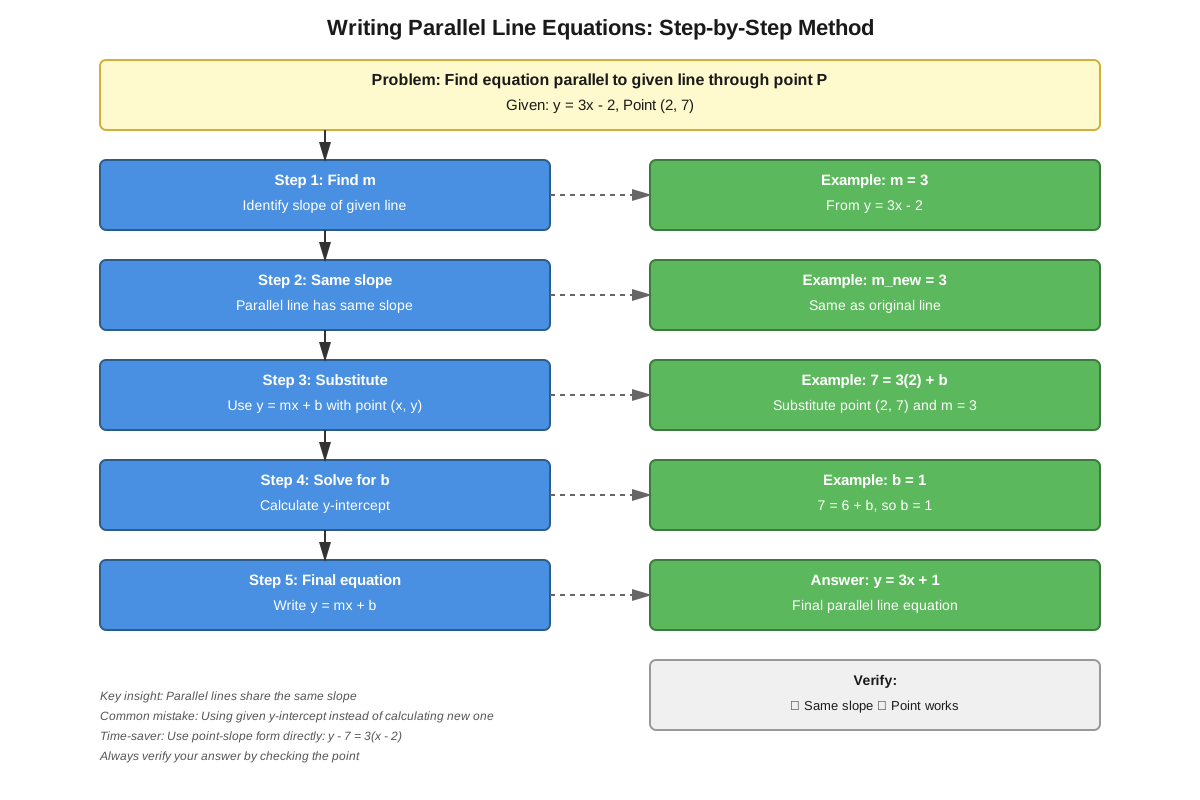
A high-frequency ACT question type provides a line equation and a point, then asks for the equation of a parallel line through that point. The systematic approach involves three steps:
- Extract the slope from the given line equation (converting to slope-intercept form if necessary)
- Use the same slope for the new parallel line (this is the parallel line property)
- Substitute the given point into the equation y = mx + b to solve for the new y-intercept b
For example, if asked to find the equation of a line parallel to y = 4x - 3 passing through the point (2, 5):
- The slope of the given line is 4
- The parallel line also has slope 4, so its equation is y = 4x + b
- Substituting (2, 5): 5 = 4(2) + b, which gives 5 = 8 + b, so b = -3
- Wait—this would give the same line! Let's recalculate: 5 = 4(2) + b means 5 = 8 + b, so b = -3. Actually, checking: does (2,5) lie on y = 4x - 3? If x = 2, then y = 4(2) - 3 = 5. Yes, so the point lies on the original line.
Let's use a different example: Find the equation parallel to y = 4x - 3 through point (1, 7):
- Slope is 4
- New equation: y = 4x + b
- Substitute: 7 = 4(1) + b, so 7 = 4 + b, giving b = 3
- Final equation: y = 4x + 3
Comparing Lines for Parallelism
When the ACT presents two equations and asks whether the lines are parallel, the most efficient strategy is to convert both equations to slope-intercept form and compare slopes. Consider these equations:
| Equation | Original Form | Slope-Intercept Form | Slope |
|---|---|---|---|
| 3x + 2y = 8 | Standard | y = -3/2 x + 4 | -3/2 |
| 6x + 4y = 12 | Standard | y = -3/2 x + 3 | -3/2 |
| 2x - 3y = 9 | Standard | y = 2/3 x - 3 | 2/3 |
The first two lines are parallel (same slope of -3/2), while the third line is not parallel to either of the first two.
Special Cases and Edge Cases
Horizontal Lines: All horizontal lines have slope 0 and take the form y = k (where k is a constant). All horizontal lines are parallel to each other except when they're identical. For example, y = 3 and y = -5 are parallel.
Vertical Lines: All vertical lines have undefined slope and take the form x = k. All vertical lines are parallel to each other. For example, x = 2 and x = -7 are parallel. The ACT occasionally includes vertical line questions to test whether students remember this special case.
Fractional and Negative Slopes: The ACT frequently uses fractional slopes (like 2/3 or -5/4) because they require more careful calculation and are more prone to arithmetic errors. When working with standard form equations, students must be particularly careful with negative signs when calculating m = -A/B.
Concept Relationships
The concept of parallel line equations sits at the intersection of multiple mathematical ideas, creating a web of interconnected knowledge. At its foundation, slope serves as the bridge between geometric intuition (lines that never meet) and algebraic representation (equal m values). Understanding slope calculation from two points or from an equation is the prerequisite that enables all parallel line work.
The relationship flows as follows: Coordinate plane basics → Slope concept → Linear equations → Parallel line equations → Perpendicular lines and Systems of equations. Each arrow represents a conceptual dependency where mastery of the earlier concept is necessary for understanding the later one.
Within the topic itself, the concepts connect hierarchically. The fundamental property (equal slopes) leads to the identification skill (recognizing parallel lines from equations), which then enables the construction skill (writing equations of parallel lines). These three skills combine when solving geometric problems involving parallel lines, such as finding the area of a parallelogram on the coordinate plane or determining whether a quadrilateral is a trapezoid.
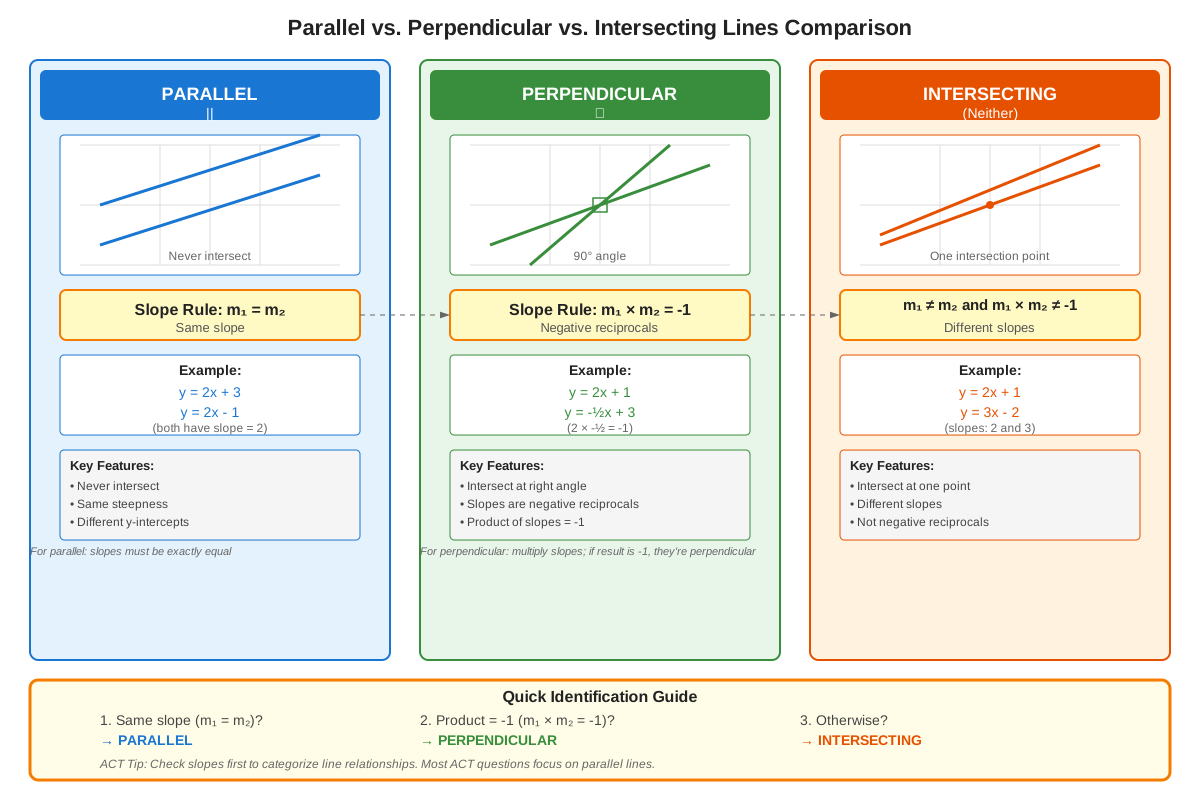
Parallel line equations also connect laterally to perpendicular line equations through the relationship between their slopes (perpendicular lines have slopes that are negative reciprocals). This connection frequently appears in ACT questions that ask about both parallel and perpendicular lines in the same problem, testing whether students can maintain clarity about which relationship applies.
Quick check — test yourself on Parallel line equations so far.
Try Flashcards →High-Yield Facts
⭐ Parallel lines have identical slopes but different y-intercepts—this is the single most important fact for all parallel line problems
⭐ To find slope from standard form Ax + By = C, use the formula m = -A/B—this calculation appears in approximately 40% of parallel line questions
⭐ All horizontal lines (y = k) are parallel to each other and have slope 0—the ACT tests this special case regularly
⭐ All vertical lines (x = k) are parallel to each other and have undefined slope—students often forget this case under time pressure
⭐ When writing the equation of a parallel line through a point, use the same slope and substitute the point to find the new y-intercept—this is the standard algorithm for construction problems
- Lines with equations y = mx + b₁ and y = mx + b₂ are parallel if b₁ ≠ b₂ (if b₁ = b₂, they're the same line)
- Converting to slope-intercept form is the fastest way to compare slopes of two lines
- The equation y - y₁ = m(x - x₁) is particularly useful for writing parallel line equations because you can directly substitute the slope and point
- Parallel lines maintain constant distance from each other at all points along their length
- In geometric figures like parallelograms and trapezoids, opposite or specific sides are parallel, which can be verified using slope calculations
Common Misconceptions
Misconception: Parallel lines must have the same y-intercept → Correction: Parallel lines must have the same slope but DIFFERENT y-intercepts. If both slope and y-intercept are identical, the lines are coincident (the same line), not parallel.
Misconception: When converting from standard form Ax + By = C, the slope is -B/A → Correction: The slope is -A/B (negative A divided by B). This sign error is one of the most common mistakes on the ACT and leads to selecting answer choices that represent perpendicular rather than parallel lines.
Misconception: Vertical lines have slope 0 → Correction: Vertical lines have undefined slope (or "no slope"), while horizontal lines have slope 0. This confusion causes students to incorrectly identify parallel relationships involving vertical lines.
Misconception: If two lines don't intersect on a graph shown on the ACT, they must be parallel → Correction: The graph window may not show the intersection point. Always calculate slopes algebraically rather than relying on visual appearance, especially since ACT graphs are not always drawn to scale.
Misconception: To write a parallel line equation, you need to use the same y-intercept as the original line → Correction: The y-intercept must be different (unless you want the same line). You find the new y-intercept by substituting the given point into y = mx + b after using the same slope m.
Misconception: Parallel lines can intersect at exactly one point → Correction: By definition, parallel lines never intersect. If two lines intersect at any point, they are not parallel. This is a fundamental geometric property that translates to the algebraic fact that parallel lines have the same slope.
Worked Examples
Example 1: Identifying Parallel Lines from Multiple Equations
Problem: Which of the following lines is parallel to the line 4x - 2y = 10?
A) y = 2x + 7
B) y = -2x + 3
C) 2x - y = 5
D) 4x + 2y = 8
E) y = 1/2 x - 3
Solution:
Step 1: Find the slope of the given line by converting to slope-intercept form.
Starting with 4x - 2y = 10, solve for y:
- Subtract 4x from both sides: -2y = -4x + 10
- Divide everything by -2: y = 2x - 5
- The slope is 2
Step 2: Check each answer choice for slope = 2.
Choice A: y = 2x + 7 has slope 2 ✓
Choice B: y = -2x + 3 has slope -2 ✗
Choice C: Convert 2x - y = 5 to slope-intercept form:
- Subtract 2x: -y = -2x + 5
- Multiply by -1: y = 2x - 5
- Slope is 2 ✓
Choice D: Convert 4x + 2y = 8:
- Subtract 4x: 2y = -4x + 8
- Divide by 2: y = -2x + 4
- Slope is -2 ✗
Choice E: y = 1/2 x - 3 has slope 1/2 ✗
Step 3: Both A and C have slope 2, so both are parallel to the original line. However, notice that choice C (y = 2x - 5) is actually identical to our converted form of the original equation, so it's the same line, not a parallel line. Choice A (y = 2x + 7) has the same slope but a different y-intercept, making it truly parallel.
Answer: A
Learning Objective Connection: This problem tests the ability to identify parallel line equations and extract slopes from different equation forms.
Example 2: Writing the Equation of a Parallel Line
Problem: Line k passes through the point (-3, 4) and is parallel to the line y = -3x + 1. What is the equation of line k in slope-intercept form?
Solution:
Step 1: Identify the slope of the given line.
The line y = -3x + 1 is in slope-intercept form, so the slope is -3.
Step 2: Use the same slope for the parallel line.
Line k has slope -3, so its equation is y = -3x + b (where b is unknown).
Step 3: Substitute the given point (-3, 4) to find b.
Using the point (-3, 4) where x = -3 and y = 4:
- 4 = -3(-3) + b
- 4 = 9 + b
- b = 4 - 9
- b = -5
Step 4: Write the final equation.
The equation of line k is y = -3x - 5.
Step 5: Verify (optional but recommended).
Check that the point (-3, 4) satisfies our equation:
- y = -3(-3) - 5 = 9 - 5 = 4 ✓
Answer: y = -3x - 5
Learning Objective Connection: This problem demonstrates the application of parallel line equations to construct new lines, requiring both understanding of the core rule (equal slopes) and algebraic manipulation skills.
Exam Strategy
When approaching ACT questions on parallel line equations, begin by identifying the question type. If the question asks "which line is parallel to," immediately focus on finding slopes. If it asks for "the equation of a line parallel to," prepare to use the three-step construction process (find slope, use same slope, substitute point).
Trigger words and phrases that signal parallel line questions include: "parallel to," "has the same slope as," "never intersects," "equidistant from," and in geometric contexts, "opposite sides of a parallelogram" or "bases of a trapezoid." When you see these phrases, immediately think about slope equality.
For process of elimination, use these strategies:
- Eliminate any answer choice with a different slope from the given line
- If the question involves a point, eliminate choices where substituting that point doesn't satisfy the equation
- For "which is parallel" questions, calculate the slope of the given line first, then eliminate all choices that don't match
- Watch for trap answers that give perpendicular lines (negative reciprocal slopes) rather than parallel lines
Time allocation: Parallel line questions should take 45-60 seconds on average. If you find yourself spending more than 90 seconds, you may be overcomplicating the problem. The most time-consuming step is usually converting from standard form to slope-intercept form, so practice this conversion until it becomes automatic. If pressed for time, you can sometimes eliminate wrong answers by checking just the sign of the slope without fully converting the equation.
Common ACT tricks to watch for:
- Presenting the original line in standard form to slow you down
- Including answer choices with perpendicular slopes (negative reciprocals)
- Using the same y-intercept as the original line in a trap answer
- Providing the equation of the original line itself as an answer choice
- Using fractional slopes that require careful arithmetic
Memory Techniques
Mnemonic for parallel lines: "Parallel means Precisely the same sloPe" (three P's to remember the key property)
Visual memory technique: Picture railroad tracks extending to the horizon—they never meet (parallel) and maintain the same angle relative to the ground (same slope). When you see a parallel line question, visualize these tracks.
Acronym for the construction process: SSP = "Same Slope, substitute Point"
Slope extraction formula memory: For standard form Ax + By = C, remember "Always Negate A" (slope = -A/B). The first letter of the numerator gets negated.
Horizontal vs. Vertical memory trick:
- Horizontal lines have Happy (zero) slope: y = k
- Vertical lines have Vague (undefined) slope: x = k
- The letter that appears in the equation (y or x) is the opposite of the line type
Parallel vs. Perpendicular distinction:
- ParALLel = ALL the same (same slope)
- PerPENdicular = PEN pals flip (negative reciprocal)
Summary
Parallel line equations represent a high-yield ACT Math topic that tests students' ability to connect geometric properties with algebraic representations. The fundamental principle—that parallel lines have identical slopes but different y-intercepts—serves as the foundation for all question types in this area. Success requires fluency in extracting slopes from multiple equation forms (slope-intercept, point-slope, and standard form), with particular attention to the standard form conversion using m = -A/B. The ACT tests this concept through identification questions (recognizing parallel lines from equations), construction questions (writing equations of parallel lines through given points), and application questions (using parallel line properties in geometric contexts). Students must avoid common pitfalls such as confusing parallel with perpendicular slopes, misremembering the standard form slope formula, and conflating horizontal lines (slope 0) with vertical lines (undefined slope). Mastery of parallel line equations requires both conceptual understanding and procedural fluency, as questions demand quick recognition of parallel relationships and efficient algebraic manipulation under time pressure.
Key Takeaways
- Parallel lines have identical slopes but different y-intercepts; this is the defining algebraic property tested on the ACT
- To find slope from standard form Ax + By = C, use m = -A/B (negative A divided by B)
- When writing a parallel line equation through a point, use the same slope and substitute the point to find the new y-intercept
- All horizontal lines (y = k) are parallel with slope 0; all vertical lines (x = k) are parallel with undefined slope
- Convert equations to slope-intercept form (y = mx + b) for fastest slope comparison
- Watch for trap answers that provide perpendicular lines (negative reciprocal slopes) instead of parallel lines
- Practice extracting slopes from all three equation forms until the process becomes automatic for efficient time management
Related Topics
Perpendicular Line Equations: After mastering parallel lines, students should study perpendicular lines, which have slopes that are negative reciprocals (if one line has slope m, a perpendicular line has slope -1/m). This topic frequently appears alongside parallel lines in ACT questions.
Systems of Linear Equations: Understanding parallel lines is essential for analyzing systems of equations, as parallel lines represent systems with no solution (inconsistent systems). This connection appears in both algebraic and graphical contexts.
Distance Formula and Parallel Lines: Advanced problems may ask about the distance between parallel lines or use parallel line properties to solve geometric problems involving distance calculations on the coordinate plane.
Geometric Figures on the Coordinate Plane: Parallel line concepts are fundamental for analyzing parallelograms, trapezoids, and other quadrilaterals positioned on coordinate axes, where verifying parallel sides requires slope calculations.
Linear Inequalities and Parallel Boundaries: In more advanced coordinate geometry, parallel lines serve as boundaries for systems of linear inequalities, extending the concept beyond simple equations.
Practice CTA
Now that you've mastered the core concepts of parallel line equations, it's time to solidify your understanding through active practice. Attempt the practice questions designed specifically for this topic, focusing on applying the strategies and techniques covered in this guide. Use the flashcards to reinforce the high-yield facts and formulas, particularly the standard form slope conversion and the properties of horizontal and vertical lines. Remember, the difference between understanding a concept and scoring points on test day lies in deliberate practice. Each problem you solve strengthens your pattern recognition and builds the automaticity needed to handle these questions efficiently under ACT time pressure. You've got this!
Sign up free to keep reading
Create a free AnvayaPrep account to finish this ACT guide on Parallel line equations — plus flashcards and practice questions.