Overview
Translations represent one of the fundamental transformations in coordinate geometry, a topic that appears consistently on the ACT Math test. A translation is a geometric transformation that moves every point of a figure the same distance in the same direction, creating a "slide" without rotation, reflection, or change in size. Understanding translations is essential for success on the ACT because these transformations appear in multiple question formats, from straightforward coordinate shifts to complex multi-step problems involving function transformations and geometric proofs.
On the ACT, ACT translations questions test a student's ability to visualize spatial relationships, manipulate algebraic expressions, and connect geometric and algebraic representations. These questions frequently appear in the coordinate geometry section but also integrate with function transformations, making them a bridge concept between algebra and geometry. Students who master translations gain a significant advantage because the underlying principles apply to numerous other topics, including reflections, rotations, and function graphing.
The beauty of translations lies in their predictability and consistency. Unlike rotations that require angle calculations or reflections that demand careful attention to orientation, translations follow a simple additive rule that applies universally. This makes them an accessible entry point into transformation geometry while simultaneously serving as a foundation for more complex composite transformations. Mastering this topic typically requires understanding both the geometric visualization and the algebraic notation, as ACT questions often require students to move fluidly between these two representations.
Learning Objectives
- [ ] Identify when Translations is being tested in ACT Math questions
- [ ] Explain the core rule or strategy behind Translations
- [ ] Apply Translations to ACT-style questions accurately
- [ ] Determine the coordinates of a translated point given a translation vector
- [ ] Write the algebraic rule for a translation given a geometric description
- [ ] Recognize how translations affect function graphs and equations
- [ ] Solve multi-step problems involving translations combined with other transformations
Prerequisites
- Coordinate plane basics: Understanding x and y coordinates is essential because translations are defined by changes to these values
- Plotting points: Students must be able to accurately locate and plot points on a coordinate grid to visualize translations
- Vector notation: Familiarity with ordered pairs and directional movement helps interpret translation instructions
- Function notation: Basic understanding of f(x) notation is necessary for function transformation problems
- Distance and direction: Recognizing positive/negative values as directional indicators (right/left, up/down) is fundamental
Why This Topic Matters
Translations appear in real-world applications ranging from computer graphics and animation to GPS navigation systems and architectural design. When a video game character moves across the screen, that movement is a translation. When architects create floor plans with repeated elements, they use translations to position identical features. Understanding translations provides the mathematical foundation for describing and predicting motion in two-dimensional space.
On the ACT Math test, translation questions appear with moderate to high frequency, typically comprising 2-4 questions per exam. These questions appear in various formats: direct coordinate transformation problems, function graph shifts, geometric proof questions, and word problems involving spatial relationships. The ACT particularly favors questions that combine translations with other concepts, such as finding the area of a translated figure or determining whether two figures are congruent after translation.
Common question formats include: identifying the new coordinates after a described translation, determining the translation rule that maps one figure onto another, recognizing translated graphs of functions, and solving problems where translations are described verbally rather than symbolically. The ACT also tests translations indirectly through questions about parallel lines (which can be viewed as translations of each other) and congruent figures (which may differ only by a translation).
Core Concepts
Definition and Basic Properties
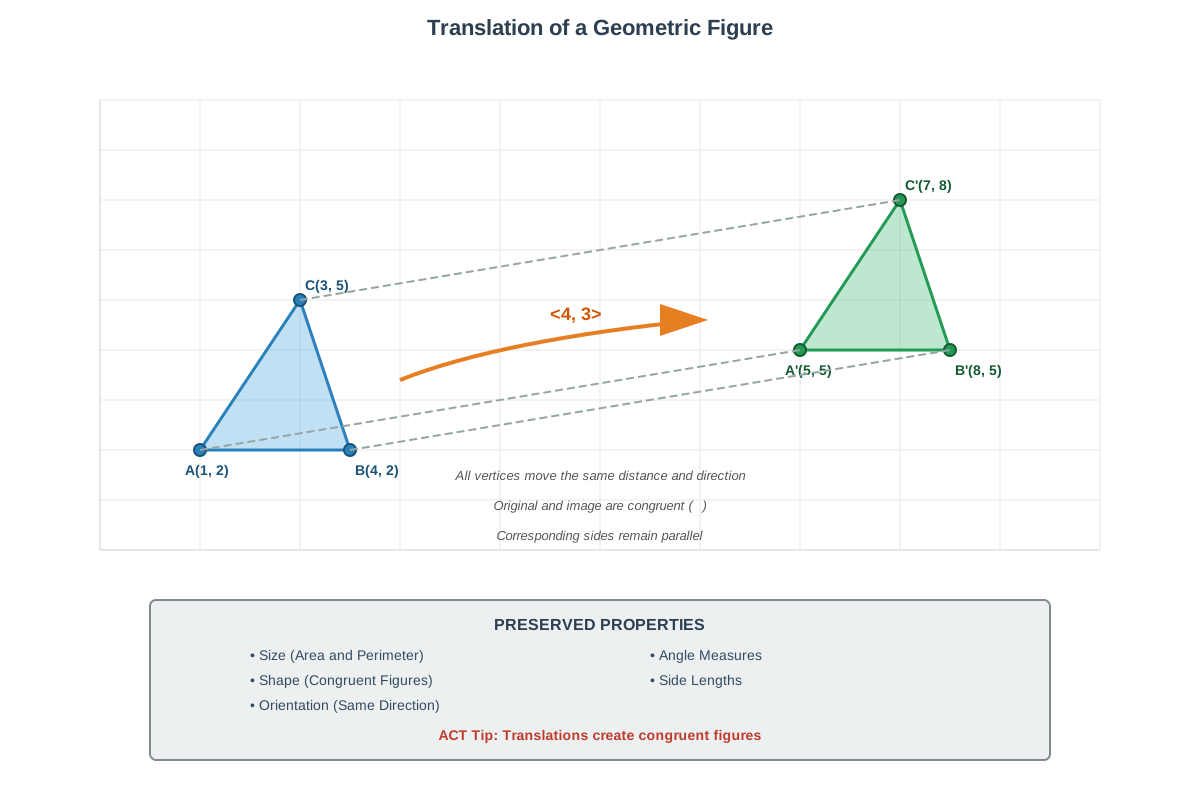
A translation is a transformation that slides every point of a figure the same distance in the same direction. The key characteristics that define a translation are:
- Preservation of distance: All lengths remain unchanged
- Preservation of angle measures: All angles remain unchanged
- Preservation of orientation: The figure maintains its original orientation (not flipped or rotated)
- Parallel movement: Every point moves along parallel paths
- Uniform displacement: Every point moves the same distance
These properties make translations an isometry (distance-preserving transformation), which means the original figure and its translated image are always congruent.
Translation Notation and Rules
Translations can be expressed in multiple ways, and ACT questions use all of these notations interchangeably:
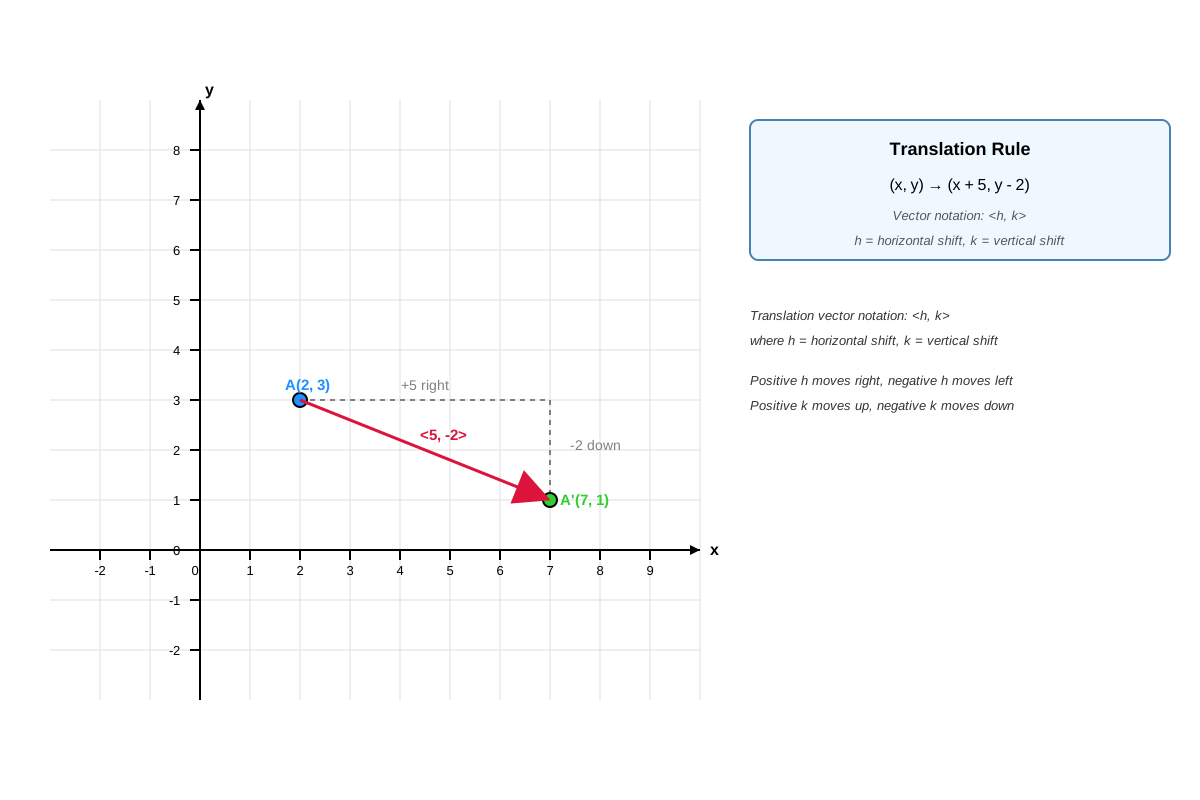
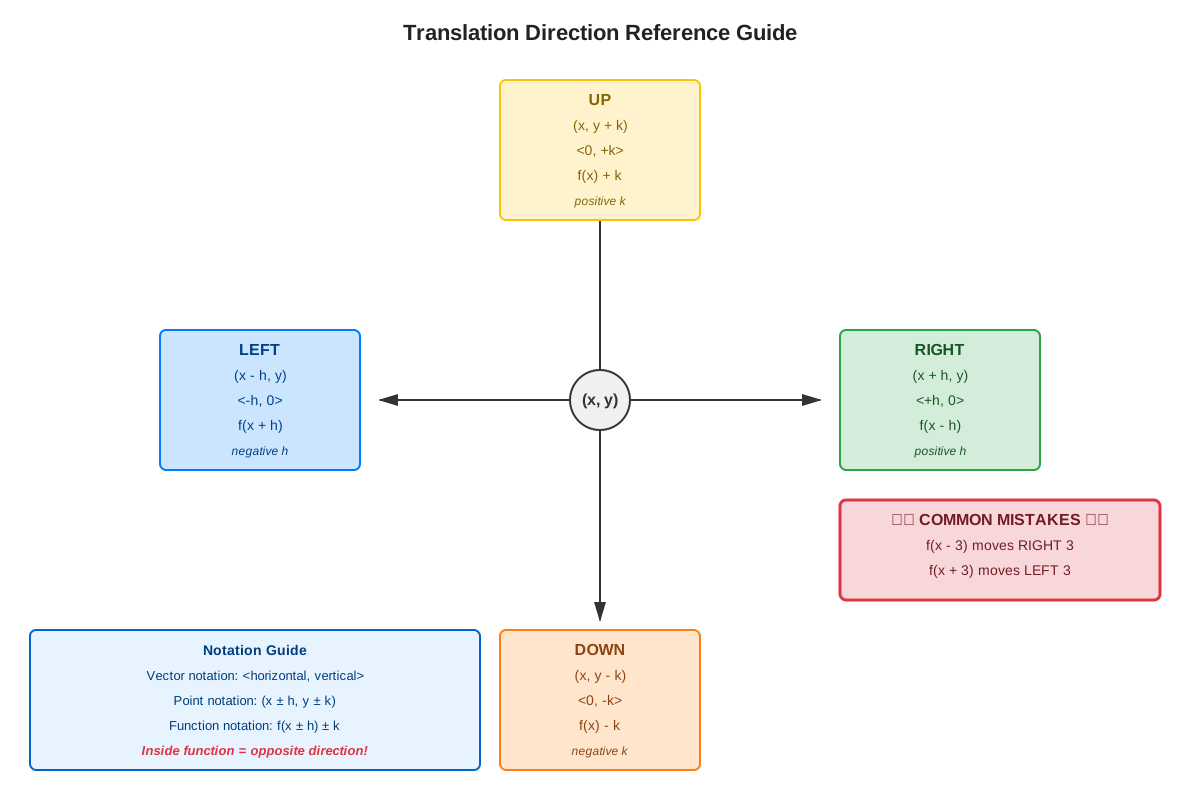
Vector notation: A translation can be described by a vector ⟨h, k⟩ or (h, k), where h represents horizontal movement and k represents vertical movement.
Coordinate rule: The algebraic rule for a translation is written as:
(x, y) → (x + h, y + k)Where:
- h is the horizontal shift (positive = right, negative = left)
- k is the vertical shift (positive = up, negative = down)
Verbal description: "Translate 3 units right and 5 units down" means h = 3 and k = -5.
| Notation Type | Example | Meaning |
|---|---|---|
| Vector | ⟨4, -2⟩ | Move 4 right, 2 down |
| Coordinate Rule | (x, y) → (x + 4, y - 2) | Add 4 to x, subtract 2 from y |
| Verbal | "4 units right, 2 units down" | Horizontal +4, Vertical -2 |
Translating Points
To translate a single point, apply the translation rule to its coordinates:
Process:
- Identify the original point coordinates (x, y)
- Identify the translation values h and k
- Calculate the new x-coordinate: x' = x + h
- Calculate the new y-coordinate: y' = y + k
- Write the image point as (x', y')
Example: Translate point A(2, 5) by the vector ⟨-3, 4⟩
- Original point: (2, 5)
- Translation: h = -3, k = 4
- New x-coordinate: 2 + (-3) = -1
- New y-coordinate: 5 + 4 = 9
- Image point: A'(-1, 9)
Translating Figures
When translating a polygon or other figure, translate each vertex individually using the same translation rule. The resulting figure will be congruent to the original and maintain all the same properties (side lengths, angle measures, parallel sides, etc.).
Key principle: If you know how one point moves, you know how every point moves because all points undergo identical translations.
Function Translations
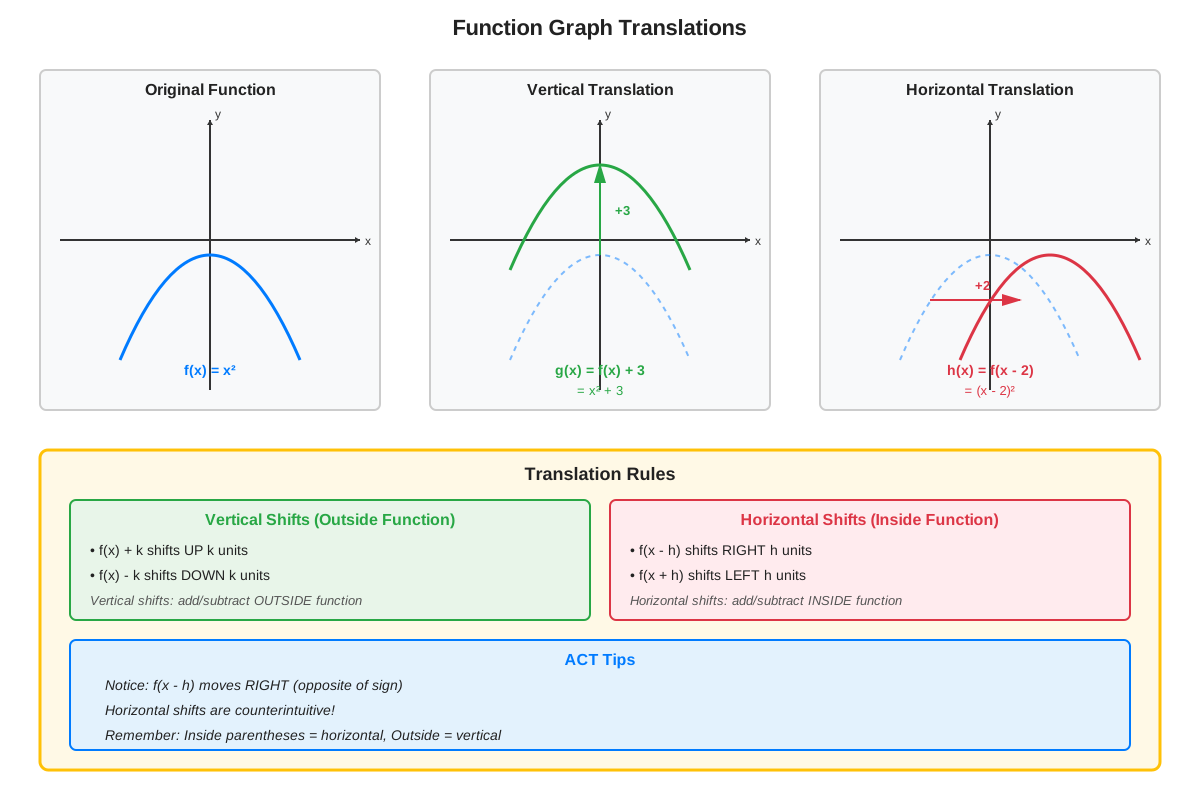
Translations also apply to function graphs, where they're often called shifts or transformations:
Horizontal translations:
- f(x - h) shifts the graph h units RIGHT
- f(x + h) shifts the graph h units LEFT
- Note: The sign appears opposite to the direction of movement
Vertical translations:
- f(x) + k shifts the graph k units UP
- f(x) - k shifts the graph k units DOWN
- Note: The sign matches the direction of movement
Combined translation: f(x - h) + k shifts the graph h units horizontally and k units vertically.
This is a frequent source of ACT questions because students must recognize that the algebraic manipulation corresponds to a geometric transformation.
Inverse Translations
Every translation has an inverse that "undoes" the original translation. If a translation moves a figure by ⟨h, k⟩, the inverse translation moves it by ⟨-h, -k⟩.
Application: This concept is useful for finding the original position of a figure when given only its translated image and the translation rule.
Composite Translations
When two translations are performed in sequence, the result is equivalent to a single translation. To find the combined effect:
Translation₁: ⟨h₁, k₁⟩
Translation₂: ⟨h₂, k₂⟩
Combined: ⟨h₁ + h₂, k₁ + k₂⟩
This additive property makes translations particularly straightforward compared to other transformations.
Concept Relationships
Within the topic of translations, the fundamental coordinate rule (x, y) → (x + h, y + k) serves as the foundation for all other concepts. This rule directly enables point translation, which extends naturally to figure translation by applying the same rule to multiple vertices. The concept of preservation properties (distance, angle, orientation) flows from the uniform nature of the translation rule and distinguishes translations from other transformations.
Function translations represent an application of the same underlying principle to a different context—instead of translating discrete points, we translate an entire continuous curve. The relationship between algebraic manipulation (f(x - h) + k) and geometric movement connects translations to broader algebra concepts.
Translations connect to prerequisite knowledge of the coordinate plane by building on the understanding that positions are defined by ordered pairs and that changes to these values produce predictable movements. The concept extends to related topics including reflections (which can be thought of as translations combined with flips), rotations (which involve both translation and angular movement), and congruence (since translations preserve all measurements).
Relationship map:
Coordinate Rule → Point Translation → Figure Translation → Congruence
Coordinate Rule → Function Notation → Function Translations → Graph Transformations
Translation Properties → Composite Translations → Inverse Translations
Quick check — test yourself on Translations so far.
Try Flashcards →High-Yield Facts
⭐ The translation rule (x, y) → (x + h, y + k) means add h to every x-coordinate and add k to every y-coordinate
⭐ Translations preserve distance, angle measures, and orientation—the image is always congruent to the original
⭐ For function translations, f(x - h) shifts RIGHT by h units (opposite sign), while f(x) + k shifts UP by k units (same sign)
⭐ Every point in a figure moves the same distance in the same direction during a translation
⭐ A translation vector ⟨h, k⟩ where h is positive means move right; h negative means move left; k positive means move up; k negative means move down
- Two consecutive translations ⟨h₁, k₁⟩ followed by ⟨h₂, k₂⟩ equal a single translation ⟨h₁ + h₂, k₁ + k₂⟩
- The inverse of translation ⟨h, k⟩ is translation ⟨-h, -k⟩
- Parallel lines remain parallel after translation because translations preserve angle relationships
- The midpoint of a segment and the midpoint of its translated image are related by the same translation
- If a figure is translated and then translated back by the inverse, it returns to its original position
- Translations do not change the area or perimeter of a figure
- The distance between corresponding points on the original and translated figures is constant for all points
Common Misconceptions
Misconception: When translating by ⟨3, -5⟩, students add 3 to y and subtract 5 from x, mixing up the coordinates.
Correction: The first number in a translation vector always applies to the x-coordinate (horizontal), and the second number always applies to the y-coordinate (vertical). ⟨3, -5⟩ means x + 3 and y - 5.
Misconception: For f(x - 3), students think the graph shifts left by 3 units because of the minus sign.
Correction: Function translations work opposite to intuition for horizontal shifts. f(x - 3) shifts RIGHT by 3 units. Think of it as "what x-value gives the same output as x = 0 did before?" The answer is x = 3, so the graph moved right.
Misconception: Students believe translations can change the size or shape of a figure.
Correction: Translations are rigid transformations (isometries) that preserve all distances and angles. The translated figure is always congruent to the original—same size, same shape, just in a different position.
Misconception: When asked to find the translation that maps point A to point B, students calculate B - A but write the answer as A - B.
Correction: To find the translation from A(x₁, y₁) to B(x₂, y₂), calculate ⟨x₂ - x₁, y₂ - y₁⟩. The destination coordinates minus the starting coordinates gives the translation vector.
Misconception: Students think that translating a figure changes which side is the "top" or "front."
Correction: Translations preserve orientation completely. If a triangle has vertices labeled clockwise as A, B, C, they remain clockwise as A', B', C' after translation. Only reflections change orientation.
Misconception: When combining translations, students multiply the vectors instead of adding them.
Correction: Composite translations use addition: ⟨h₁, k₁⟩ followed by ⟨h₂, k₂⟩ equals ⟨h₁ + h₂, k₁ + k₂⟩. Each component adds independently.
Worked Examples
Example 1: Multi-Step Point and Figure Translation
Problem: Triangle ABC has vertices A(1, 2), B(4, 2), and C(4, 6). The triangle is translated by the vector ⟨-3, 5⟩ to create triangle A'B'C'. What are the coordinates of vertex C', and what is the area of triangle A'B'C'?
Solution:
Step 1: Identify the translation rule
The vector ⟨-3, 5⟩ means h = -3 and k = 5
Translation rule: (x, y) → (x - 3, y + 5)
Step 2: Apply the rule to point C
Original point C: (4, 6)
New x-coordinate: 4 + (-3) = 4 - 3 = 1
New y-coordinate: 6 + 5 = 11
Therefore, C' = (1, 11)
Step 3: Determine the area of the translated triangle
Since translations preserve all measurements, the area of triangle A'B'C' equals the area of triangle ABC.
Calculate the area of triangle ABC:
- Base AB: from (1, 2) to (4, 2) has length 3 units
- Height: from B(4, 2) to C(4, 6) has length 4 units
- Area = ½ × base × height = ½ × 3 × 4 = 6 square units
Step 4: State the final answer
C' = (1, 11) and the area of triangle A'B'C' = 6 square units
Connection to learning objectives: This problem requires applying the translation rule to find new coordinates and understanding that translations preserve area, demonstrating mastery of both the mechanical process and the conceptual properties.
Example 2: Function Translation with Graph Interpretation
Problem: The graph of y = f(x) passes through the point (2, 5). If g(x) = f(x + 3) - 4, what point must the graph of y = g(x) pass through?
Solution:
Step 1: Analyze the transformation
g(x) = f(x + 3) - 4 represents two translations:
- f(x + 3): horizontal shift LEFT by 3 units (opposite sign)
- The "- 4": vertical shift DOWN by 4 units (same sign)
Step 2: Apply the translation to the known point
Original point on f(x): (2, 5)
Horizontal shift: x-coordinate moves left by 3: 2 - 3 = -1
Vertical shift: y-coordinate moves down by 4: 5 - 4 = 1
New point on g(x): (-1, 1)
Step 3: Verify the logic
When x = -1 in g(x):
g(-1) = f(-1 + 3) - 4 = f(2) - 4 = 5 - 4 = 1 ✓
Step 4: State the answer
The graph of y = g(x) passes through the point (-1, 1)
Connection to learning objectives: This problem tests the ability to recognize function translations in algebraic form and apply the transformation rules correctly, including the counterintuitive horizontal shift direction. It demonstrates how translations connect algebraic and geometric representations.
Exam Strategy
When approaching ACT translation questions, first identify the question type: Are you translating points, figures, or functions? Each requires slightly different approaches but uses the same underlying principles.
Trigger words and phrases that signal translation problems include:
- "Slide," "shift," or "move"
- "Translate by the vector"
- "Units right/left/up/down"
- "f(x - h) + k" or similar function notation
- "Maps point A to point B"
- "What are the new coordinates"
Process-of-elimination strategies:
- Check preservation properties: Eliminate any answer choice that changes the size, shape, or orientation of the figure
- Test with one point: If translating a figure, calculate the image of just one vertex and eliminate answers that don't match
- Verify direction: For function translations, eliminate answers that shift in the wrong direction (remember: f(x - h) goes RIGHT)
- Use sign logic: Positive h means right, negative h means left; positive k means up, negative k means down
Time allocation advice: Translation problems typically require 30-60 seconds. Don't spend time translating every vertex of a polygon if the question only asks about one point or a property that's preserved. Use the preservation properties to shortcut calculations when possible.
Step-by-step approach:
- Read carefully to identify h and k values (watch for sign errors)
- Write the translation rule explicitly: (x, y) → (x + h, y + k)
- Apply systematically to avoid arithmetic errors
- Double-check signs before selecting your answer
Exam Tip: When a question describes a translation verbally ("5 units right and 3 units down"), immediately convert it to vector notation ⟨5, -3⟩ to avoid confusion.
Memory Techniques
RHUL Mnemonic for function translations:
- Right: f(x - h) moves Right
- Horizontal: Horizontal shifts use (x ± h)
- Up: f(x) + k moves Up
- Left: f(x + h) moves Left
"Add to coordinates, add to position": When the translation rule shows (x + h, y + k), you're adding to the coordinates, which adds to the position. Positive values move right/up; negative values move left/down.
Visualization strategy: Picture a piece of paper sliding across a desk. The paper doesn't rotate, flip, or change size—it just slides. That's a translation. Every point on the paper moves the same direction and distance.
The "Opposite Rule" for functions: For horizontal function translations, the sign in the parentheses is opposite to the direction of movement. Create a mental image of "pushing" the graph: to push it right, you need to subtract inside the function.
Vector arrow drawing: When given a translation vector, draw a small arrow on your scratch work showing the direction and approximate distance. This visual reference prevents sign errors.
Summary
Translations are fundamental geometric transformations that move every point of a figure the same distance in the same direction, following the rule (x, y) → (x + h, y + k). These transformations preserve all distances, angles, and orientation, making the original and translated figures congruent. On the ACT, translations appear in coordinate geometry problems, function transformation questions, and geometric proofs. Success requires understanding both the mechanical process of applying translation rules and the conceptual properties that translations preserve. The key challenge for most students involves correctly interpreting signs (especially for function translations where f(x - h) shifts right) and converting between verbal descriptions, vector notation, and coordinate rules. Mastering translations provides a foundation for understanding all geometric transformations and connects algebraic manipulation to geometric visualization, making it a high-yield topic for ACT preparation.
Key Takeaways
- The translation rule (x, y) → (x + h, y + k) applies uniformly to every point: add h to x-coordinates and k to y-coordinates
- Translations preserve distance, angle measures, area, perimeter, and orientation—the image is always congruent to the original
- For function translations, f(x - h) shifts RIGHT (opposite sign) and f(x) + k shifts UP (same sign)
- Translation vectors ⟨h, k⟩ use positive values for right/up and negative values for left/down
- Composite translations add: ⟨h₁, k₁⟩ followed by ⟨h₂, k₂⟩ equals ⟨h₁ + h₂, k₁ + k₂⟩
- Every translation has an inverse ⟨-h, -k⟩ that returns the figure to its original position
- ACT questions test translations through direct coordinate problems, function graphs, and multi-step geometric reasoning
Related Topics
Reflections: After mastering translations, reflections introduce transformations that flip figures across lines, changing orientation while preserving distance and angle measures. Understanding translations first makes reflections easier because both are isometries.
Rotations: Rotations build on translation concepts by adding angular movement around a point. Many rotation problems can be solved by combining translations with angular transformations.
Composite Transformations: This advanced topic combines multiple transformations (translations, reflections, rotations) in sequence, requiring mastery of individual transformations first.
Function Transformations: Beyond simple translations, this topic includes stretches, compressions, and reflections of function graphs, all building on the foundation of understanding how algebraic changes affect geometric position.
Vectors: A deeper study of vectors extends translation concepts to include magnitude, direction, and vector operations, providing a more sophisticated framework for describing motion and position.
Practice CTA
Now that you've mastered the core concepts of translations, it's time to solidify your understanding through practice! Work through the practice questions to test your ability to apply translation rules under timed conditions, and use the flashcards to reinforce the key facts and formulas. Remember, translations appear frequently on the ACT, and the concepts you've learned here form the foundation for more advanced transformation problems. Every practice problem you complete builds your confidence and speed—two essential ingredients for ACT success. You've got this!
Sign up free to keep reading
Create a free AnvayaPrep account to finish this ACT guide on Translations — plus flashcards and practice questions.