Overview
Reflections are a fundamental transformation in coordinate geometry that appear regularly on the ACT Math test. A reflection creates a mirror image of a geometric figure across a line of reflection, preserving the size and shape of the original figure while changing its position and orientation. Understanding reflections is crucial for success on the ACT because these transformations appear in multiple question formats, from straightforward coordinate problems to complex multi-step geometry scenarios involving symmetry and transformations.
On the ACT, ACT reflections questions test a student's ability to visualize spatial relationships, apply transformation rules, and work with coordinate pairs systematically. These questions often integrate with other coordinate geometry concepts such as distance, midpoint, and slope, making reflections a high-yield topic that connects multiple mathematical domains. Students who master reflections gain a significant advantage because these problems can be solved quickly using memorized rules, allowing more time for challenging questions elsewhere on the exam.
The concept of reflections extends beyond isolated coordinate problems. ACT test writers frequently embed reflection concepts within questions about symmetry, function transformations, and geometric properties. A solid understanding of how points, lines, and shapes behave under reflection enables students to tackle questions involving even and odd functions, parabola properties, and geometric proofs. This topic serves as a bridge between algebraic and geometric thinking, reinforcing the interconnected nature of mathematics tested on the ACT.
Learning Objectives
- [ ] Identify when Reflections is being tested in ACT Math questions
- [ ] Explain the core rule or strategy behind Reflections across different axes and lines
- [ ] Apply Reflections to ACT-style questions accurately and efficiently
- [ ] Determine the coordinates of reflected points across the x-axis, y-axis, and line y = x
- [ ] Recognize reflection patterns in graphs of functions and geometric figures
- [ ] Solve multi-step problems involving reflections combined with other transformations
- [ ] Verify whether two figures are reflections of each other using coordinate analysis
Prerequisites
- Coordinate plane basics: Understanding the four quadrants, ordered pairs (x, y), and how to plot points is essential because reflections involve manipulating coordinate positions systematically.
- Distance formula: Knowing how to calculate distance between points helps verify that reflections preserve distances from the line of reflection.
- Midpoint formula: The midpoint concept is crucial because the line of reflection always passes through the midpoint of a segment connecting a point to its reflection.
- Basic function notation: Familiarity with f(x) notation aids in understanding how reflections transform function graphs.
- Properties of perpendicular lines: Reflections create perpendicular relationships between the line connecting a point to its image and the line of reflection.
Why This Topic Matters
Reflections represent one of the most practical applications of coordinate geometry in real-world contexts. Architects use reflection principles when designing symmetrical buildings, computer graphics programmers employ reflection algorithms to create realistic mirror effects in video games, and physicists apply reflection concepts when analyzing light behavior and optics. Understanding reflections develops spatial reasoning skills that extend far beyond mathematics into fields like engineering, design, and computer science.
On the ACT Math test, reflection questions appear with notable frequency—typically 1-3 questions per exam, representing approximately 2-5% of the 60-question Math section. These questions appear in various formats: direct coordinate transformation problems, graph interpretation questions, and complex multi-step scenarios involving multiple transformations. The ACT particularly favors questions that combine reflections with other concepts like distance, slope, or function properties, making this a high-yield topic for strategic preparation.
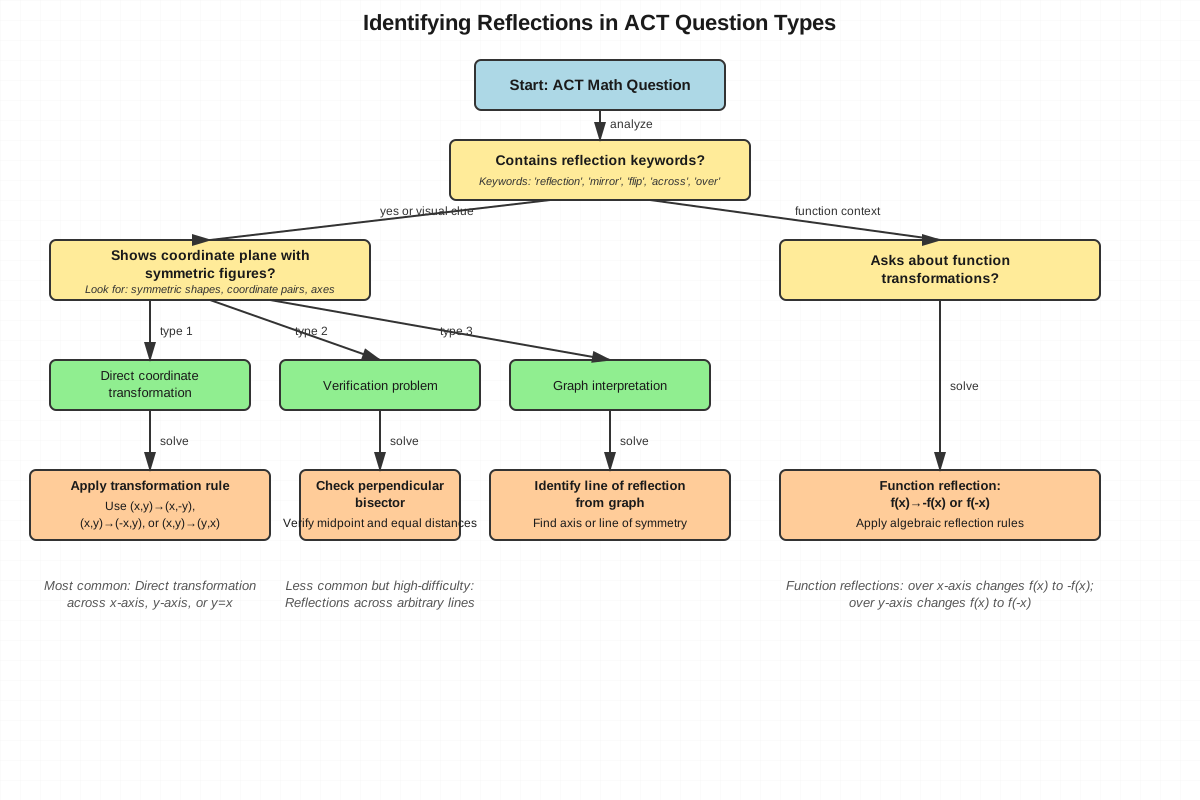
Common question formats include: identifying reflected coordinates given a point and line of reflection; determining which transformation was applied to a figure shown on a coordinate plane; finding the equation of a reflected function; and solving for unknown coordinates when given information about a reflection. The ACT also tests reflections indirectly through symmetry questions, asking students to identify lines of symmetry or determine whether a function is even (symmetric about the y-axis) or odd (symmetric about the origin).
Core Concepts
Definition and Properties of Reflections
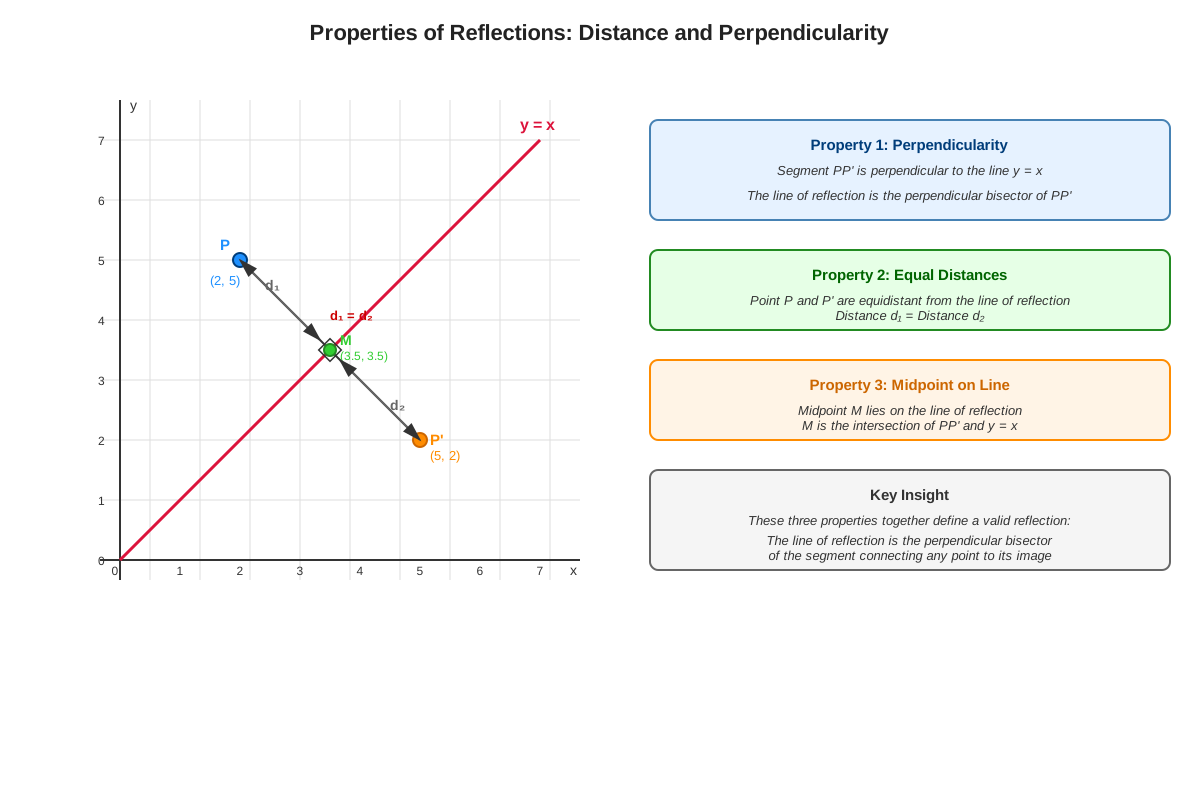
A reflection is a rigid transformation that flips a figure over a line called the line of reflection or axis of reflection. The reflected image is congruent to the original figure, meaning all distances, angles, and shapes are preserved. Every point on the original figure has a corresponding point on the reflected image such that the line of reflection is the perpendicular bisector of the segment connecting the original point to its image.
Key properties of reflections include:
- Distance preservation: The distance from any point to the line of reflection equals the distance from its reflected image to the line of reflection
- Orientation reversal: Reflections reverse the orientation of figures (clockwise becomes counterclockwise)
- Perpendicularity: The line segment connecting a point to its reflection is always perpendicular to the line of reflection
- Collinearity preservation: Points on a line remain on a line after reflection
Reflection Across the X-Axis
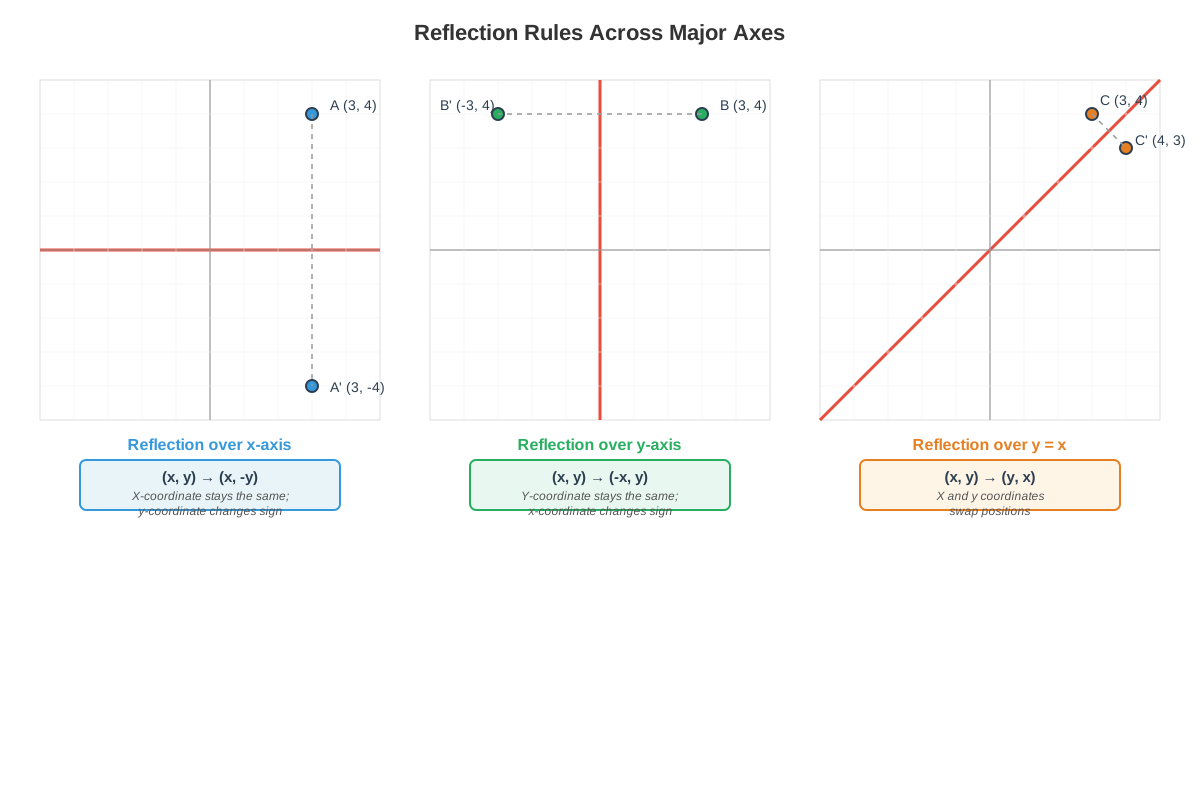
When reflecting a point across the x-axis, the x-coordinate remains unchanged while the y-coordinate changes sign. This is the most commonly tested reflection on the ACT.
Rule: (x, y) → (x, -y)
For example, the point (3, 5) reflected across the x-axis becomes (3, -5). The point (-2, -4) becomes (-2, 4). This transformation can be visualized as flipping the coordinate plane along the horizontal axis, causing points above the x-axis to move below it and vice versa.
When reflecting an entire function f(x) across the x-axis, the new function becomes -f(x). This means every y-value is negated, creating a vertical flip of the graph. If the original function passes through (2, 3), the reflected function passes through (2, -3).
Reflection Across the Y-Axis
Reflection across the y-axis negates the x-coordinate while preserving the y-coordinate. This transformation is equally important for ACT preparation.
Rule: (x, y) → (-x, y)
The point (4, 7) reflected across the y-axis becomes (-4, 7). The point (-3, -2) becomes (3, -2). This creates a horizontal flip, with points on the right side of the y-axis moving to the left side and vice versa.
For function transformations, reflecting f(x) across the y-axis produces f(-x). This means substituting -x for every x in the function. If f(x) = x² - 3x + 2, then the reflection across the y-axis is f(-x) = (-x)² - 3(-x) + 2 = x² + 3x + 2.
Reflection Across the Line y = x
Reflection across the line y = x (the diagonal line through the origin with slope 1) swaps the x and y coordinates.
Rule: (x, y) → (y, x)
The point (5, 2) becomes (2, 5) when reflected across y = x. The point (-3, 4) becomes (4, -3). This transformation is particularly important because it relates to inverse functions—the graph of f⁻¹(x) is the reflection of f(x) across the line y = x.
Reflection Across the Line y = -x
Reflection across the line y = -x (the diagonal line through the origin with slope -1) swaps coordinates and negates both.
Rule: (x, y) → (-y, -x)
The point (3, 5) becomes (-5, -3). The point (-2, 4) becomes (-4, 2). While less commonly tested than other reflections, this transformation occasionally appears in advanced ACT questions.
Reflection Across Arbitrary Lines
For reflections across vertical lines (x = a) or horizontal lines (y = b), the transformation follows a pattern based on distance from the line.
Reflection across x = a: (x, y) → (2a - x, y)
Reflection across y = b: (x, y) → (x, 2b - y)
For example, reflecting (5, 3) across the line x = 2 gives (2(2) - 5, 3) = (-1, 3). The point moves the same distance on the opposite side of the line x = 2.
Comparison Table of Common Reflections
| Line of Reflection | Transformation Rule | What Changes | What Stays Same | Example |
|---|---|---|---|---|
| x-axis | (x, y) → (x, -y) | y-coordinate sign | x-coordinate | (3, 4) → (3, -4) |
| y-axis | (x, y) → (-x, y) | x-coordinate sign | y-coordinate | (3, 4) → (-3, 4) |
| y = x | (x, y) → (y, x) | Coordinates swap | Neither individually | (3, 4) → (4, 3) |
| y = -x | (x, y) → (-y, -x) | Both coordinates | Neither | (3, 4) → (-4, -3) |
| Origin | (x, y) → (-x, -y) | Both signs | Neither | (3, 4) → (-3, -4) |
Note: Reflection through the origin is technically a 180° rotation, but produces the same result as two consecutive reflections across perpendicular axes.
Concept Relationships
Reflections connect intimately with other transformation concepts tested on the ACT. Understanding these relationships enables students to solve complex multi-step transformation problems efficiently.
Reflections → Symmetry: A figure has line symmetry if it can be reflected across a line onto itself. This connection appears frequently in ACT questions asking about properties of parabolas, circles, and regular polygons. Even functions exhibit y-axis symmetry (f(-x) = f(x)), while odd functions exhibit origin symmetry (f(-x) = -f(x)).
Reflections → Inverse Functions: The graphical relationship between a function and its inverse is a reflection across the line y = x. This concept bridges algebra and coordinate geometry, appearing in questions about function composition and inverse operations.
Reflections → Distance and Midpoint: The line of reflection is always the perpendicular bisector of the segment connecting a point to its image. This means the midpoint formula and distance formula can verify reflection accuracy. If P' is the reflection of P across line ℓ, then ℓ passes through the midpoint of PP' and is perpendicular to PP'.
Reflections → Other Transformations: Reflections combine with translations (slides), rotations (turns), and dilations (size changes) to create composite transformations. Two reflections across parallel lines produce a translation. Two reflections across intersecting lines produce a rotation. Understanding how reflections interact with other transformations is crucial for advanced ACT problems.
Coordinate Geometry → Reflections → Function Transformations: This progression shows how reflections serve as a bridge concept. Students first learn coordinate manipulation, then apply it to reflections, and finally use reflections to understand how function graphs transform.
High-Yield Facts
⭐ Reflection across the x-axis negates the y-coordinate: (x, y) → (x, -y) is the most frequently tested reflection rule on the ACT.
⭐ Reflection across the y-axis negates the x-coordinate: (x, y) → (-x, y) appears in approximately 40% of ACT reflection questions.
⭐ Reflection across y = x swaps coordinates: (x, y) → (y, x) is essential for understanding inverse functions.
⭐ Reflections preserve distance and angle measures: The reflected figure is always congruent to the original, never similar with different size.
⭐ The line of reflection is the perpendicular bisector: This property allows verification of reflection accuracy using midpoint and perpendicularity concepts.
- Reflecting twice across the same line returns the figure to its original position (reflections are self-inverse transformations).
- Reflecting across the origin changes both coordinate signs: (x, y) → (-x, -y), equivalent to 180° rotation.
- For reflection across vertical line x = a, use the formula (x, y) → (2a - x, y).
- For reflection across horizontal line y = b, use the formula (x, y) → (x, 2b - y).
- The composition of two reflections across perpendicular lines through the origin equals a 180° rotation about the origin.
- Even functions are symmetric about the y-axis, meaning f(x) = f(-x), which is a reflection property.
- Odd functions are symmetric about the origin, meaning f(-x) = -f(x), combining x-axis and y-axis reflections.
- When reflecting a line segment, only the endpoints need to be reflected; the reflected segment connects the reflected endpoints.
- Reflections reverse orientation: a clockwise-oriented triangle becomes counterclockwise after reflection.
- The distance from a point to the line of reflection equals the distance from the reflected point to the line of reflection.
Quick check — test yourself on Reflections so far.
Try Flashcards →Common Misconceptions
Misconception: Reflecting across the x-axis changes the x-coordinate.
Correction: Reflection across the x-axis only changes the y-coordinate sign. The x-coordinate remains identical. The point (5, 3) becomes (5, -3), not (-5, 3). Remember: x-axis reflection affects the y-value.
Misconception: Reflection across y = x negates both coordinates.
Correction: Reflection across y = x swaps the coordinates without changing signs (unless the swap itself creates a sign change in position). The point (3, 7) becomes (7, 3), not (-3, -7). Only swap, don't negate.
Misconception: All reflections preserve orientation.
Correction: Reflections reverse orientation. If you trace a triangle clockwise in the original figure, you'll trace it counterclockwise in the reflection. This distinguishes reflections from rotations and translations, which preserve orientation.
Misconception: Reflecting a point across the line y = 2 means moving it to y = 2.
Correction: Reflection across y = 2 means the point moves to the opposite side of the line y = 2, maintaining equal distance. If a point is at (3, 5), which is 3 units above y = 2, its reflection is at (3, -1), which is 3 units below y = 2. Use the formula (x, y) → (x, 2b - y) where b = 2.
Misconception: Reflection across the origin is the same as reflection across y = x.
Correction: These are different transformations. Reflection across the origin changes (x, y) to (-x, -y), while reflection across y = x changes (x, y) to (y, x). The point (2, 3) becomes (-2, -3) for origin reflection but (3, 2) for y = x reflection.
Misconception: When reflecting a function f(x) across the x-axis, the transformation is f(-x).
Correction: Reflecting f(x) across the x-axis produces -f(x), not f(-x). The transformation f(-x) represents reflection across the y-axis. For f(x) = x² + 2, reflection across the x-axis gives -f(x) = -x² - 2, while reflection across the y-axis gives f(-x) = (-x)² + 2 = x² + 2.
Misconception: Reflections can change the size of a figure.
Correction: Reflections are rigid transformations that preserve all distances and angles. The reflected figure is always congruent (identical in size and shape) to the original. Only dilations change size; reflections, rotations, and translations maintain size.
Misconception: The midpoint between a point and its reflection lies on the original point.
Correction: The midpoint between a point and its reflection always lies on the line of reflection, not on either point. For point (4, 6) reflected across the x-axis to (4, -6), the midpoint is (4, 0), which lies on the x-axis (the line of reflection).
Worked Examples
Example 1: Multi-Step Reflection Problem
Question: Point A is located at (3, -2). Point A is first reflected across the y-axis to create point B, then point B is reflected across the x-axis to create point C. What are the coordinates of point C?
Solution:
Step 1: Identify the starting point and first transformation.
- Starting point A: (3, -2)
- First transformation: reflection across the y-axis
- Rule for y-axis reflection: (x, y) → (-x, y)
Step 2: Apply the first reflection to find point B.
- A(3, -2) → B(-3, -2)
- The x-coordinate changes sign: 3 becomes -3
- The y-coordinate stays the same: -2 remains -2
Step 3: Identify the second transformation.
- Starting point B: (-3, -2)
- Second transformation: reflection across the x-axis
- Rule for x-axis reflection: (x, y) → (x, -y)
Step 4: Apply the second reflection to find point C.
- B(-3, -2) → C(-3, 2)
- The x-coordinate stays the same: -3 remains -3
- The y-coordinate changes sign: -2 becomes 2
Step 5: Verify the answer using the composite transformation.
- Reflecting across the y-axis then the x-axis is equivalent to reflecting across the origin
- Origin reflection rule: (x, y) → (-x, -y)
- A(3, -2) → C(-3, 2) ✓
Answer: Point C is located at (-3, 2).
Connection to Learning Objectives: This problem demonstrates the ability to apply reflections accurately (Objective 3) and recognize reflection patterns in multi-step transformations (Objective 6). Understanding that two consecutive reflections across perpendicular axes equals an origin reflection shows mastery of the core strategy (Objective 2).
Example 2: Reflection with Arbitrary Line
Question: Triangle PQR has vertices P(2, 1), Q(4, 1), and R(3, 4). If the triangle is reflected across the line x = 5, what are the coordinates of the reflected triangle P'Q'R'?
Solution:
Step 1: Identify the line of reflection and appropriate formula.
- Line of reflection: x = 5 (a vertical line)
- Formula for reflection across x = a: (x, y) → (2a - x, y)
- In this case, a = 5, so the formula becomes: (x, y) → (10 - x, y)
Step 2: Reflect point P(2, 1).
- Apply formula: (2, 1) → (10 - 2, 1) = (8, 1)
- P' = (8, 1)
- Verification: P is 3 units left of x = 5 (from x = 2 to x = 5), and P' is 3 units right of x = 5 (from x = 5 to x = 8) ✓
Step 3: Reflect point Q(4, 1).
- Apply formula: (4, 1) → (10 - 4, 1) = (6, 1)
- Q' = (6, 1)
- Verification: Q is 1 unit left of x = 5, and Q' is 1 unit right of x = 5 ✓
Step 4: Reflect point R(3, 4).
- Apply formula: (3, 4) → (10 - 3, 4) = (7, 4)
- R' = (7, 4)
- Verification: R is 2 units left of x = 5, and R' is 2 units right of x = 5 ✓
Step 5: Verify using the perpendicular bisector property.
- The midpoint of PP' should lie on x = 5: midpoint of (2, 1) and (8, 1) = ((2+8)/2, (1+1)/2) = (5, 1) ✓
- The line x = 5 passes through (5, 1), confirming our reflection is correct
Answer: The reflected triangle has vertices P'(8, 1), Q'(6, 1), and R'(7, 4).
Connection to Learning Objectives: This problem requires identifying when reflections are being tested (Objective 1), explaining the core rule for reflections across vertical lines (Objective 2), and applying the transformation accurately to multiple points (Objective 3). The verification step demonstrates understanding of the perpendicular bisector property, showing deep mastery of reflection concepts.
Exam Strategy
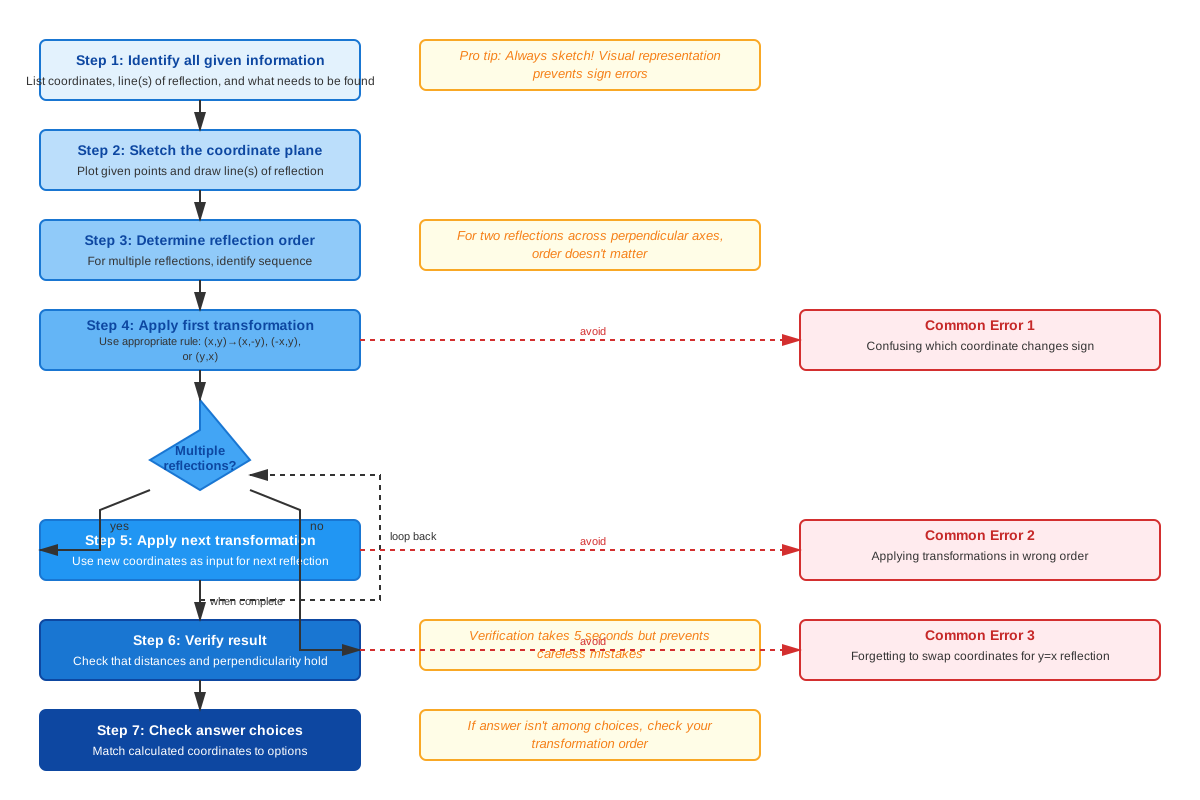
When approaching ACT reflections questions, follow this systematic process to maximize accuracy and efficiency:
Step 1: Identify the line of reflection. ACT questions always specify or imply the line of reflection. Look for phrases like "reflected across the x-axis," "mirrored over the y-axis," or "reflected across the line y = x." If a graph is provided, identify the line of symmetry visually.
Step 2: Recall the appropriate transformation rule. Immediately write down the rule before attempting calculations:
- x-axis: (x, y) → (x, -y)
- y-axis: (x, y) → (-x, y)
- y = x: (x, y) → (y, x)
- x = a: (x, y) → (2a - x, y)
- y = b: (x, y) → (x, 2b - y)
Step 3: Apply the rule systematically. Transform each coordinate carefully, checking your work as you go. For multiple points, create a small table to organize your work and prevent errors.
Step 4: Verify using geometric properties. If time permits, check that the distance from the original point to the line of reflection equals the distance from the reflected point to the line of reflection. This catches calculation errors.
Trigger words and phrases to watch for:
- "Reflected across" or "reflected over" → direct reflection problem
- "Mirror image" → reflection terminology
- "Line of symmetry" → may involve reflection concepts
- "Inverse function" → reflection across y = x
- "Even function" → y-axis symmetry (reflection property)
- "Odd function" → origin symmetry (double reflection)
Process-of-elimination tips:
- If reflecting across the x-axis, eliminate any answer choice where the x-coordinate changed
- If reflecting across the y-axis, eliminate any answer choice where the y-coordinate changed
- If the original point is in Quadrant I and you're reflecting across the x-axis, the answer must be in Quadrant IV
- For reflection across y = x, the x and y values must swap; eliminate choices where they don't
Time allocation advice: Straightforward reflection problems should take 30-45 seconds. Multi-step transformation problems may require 60-90 seconds. If a problem involves complex calculations with arbitrary lines, consider marking it for review and returning after completing easier questions. The ACT rewards efficient time management, and reflection problems are typically quick points when you know the rules.
Exam Tip: Draw a quick sketch on your test booklet when visualizing reflections. Even a rough coordinate plane with the line of reflection and a few key points can prevent sign errors and clarify the transformation.
Memory Techniques
Mnemonic for axis reflections: "X-axis changes Y, Y-axis changes X"
This simple phrase reminds you that reflecting across the x-axis changes the y-coordinate, while reflecting across the y-axis changes the x-coordinate. The axis name tells you which coordinate stays the same.
Visualization strategy for y = x: Imagine the line y = x as a mirror placed diagonally across your coordinate plane. When you reflect across this mirror, left becomes up and up becomes left—the coordinates swap positions. Picture the point (3, 7) sliding along a perpendicular path until it reaches (7, 3) on the opposite side of the mirror.
Acronym for reflection properties: "DAPPER"
- Distance preserved
- Angles preserved
- Perpendicular bisector property
- Position changes
- Equal distances from line
- Reverses orientation
Hand technique for sign changes: Hold your hands in front of you with palms facing each other. Your left hand represents negative values, your right hand represents positive values. When reflecting across the y-axis (vertical), your hands swap sides (x changes sign). When reflecting across the x-axis (horizontal), imagine flipping your hands up and down (y changes sign). This kinesthetic approach helps visual learners remember which coordinate changes.
Rhyme for y = x reflection: "Swap the pair, coordinates share"
This reminds you that reflection across y = x simply swaps the x and y values, with both coordinates "sharing" each other's original position.
Mental image for arbitrary lines: For reflections across x = a or y = b, visualize the line as a fence. Calculate how far your point is from the fence, then place the reflected point the same distance on the opposite side. The formula 2a - x (or 2b - y) automatically performs this "fence distance" calculation.
Summary
Reflections are rigid transformations that create mirror images of geometric figures across a line of reflection, preserving size and shape while changing position and orientation. Mastering reflections requires memorizing five core transformation rules: x-axis reflection negates the y-coordinate (x, y) → (x, -y), y-axis reflection negates the x-coordinate (x, y) → (-x, y), reflection across y = x swaps coordinates (x, y) → (y, x), and reflections across arbitrary vertical or horizontal lines use the formulas (x, y) → (2a - x, y) and (x, y) → (x, 2b - y) respectively. These transformations appear frequently on the ACT Math test in various contexts, including direct coordinate problems, function transformations, and multi-step scenarios combining multiple transformations. Success requires recognizing trigger words, applying the correct rule systematically, and verifying answers using the perpendicular bisector property. Understanding that reflections reverse orientation, preserve all distances and angles, and connect to concepts like symmetry and inverse functions enables students to tackle even complex ACT reflection problems with confidence and accuracy.
Key Takeaways
- Reflections are rigid transformations that preserve size, shape, distances, and angles while creating mirror images across a line of reflection
- The most tested reflection rules are x-axis (x, y) → (x, -y), y-axis (x, y) → (-x, y), and y = x (x, y) → (y, x)—memorize these three for instant recall
- The line of reflection is always the perpendicular bisector of the segment connecting any point to its reflected image, providing a verification method
- Reflections reverse orientation (clockwise becomes counterclockwise), distinguishing them from translations and rotations
- Function reflections follow specific patterns: -f(x) reflects across the x-axis, f(-x) reflects across the y-axis, and inverse functions are reflections across y = x
- Multi-step transformations can be simplified by recognizing that two reflections across perpendicular axes equal a reflection through their intersection point
- ACT reflection questions reward systematic application of memorized rules—write down the transformation formula before calculating to prevent errors
Related Topics
Translations (Slides): After mastering reflections, study translations, which shift figures without rotating or flipping them. Translations use the rule (x, y) → (x + h, y + k) and combine with reflections in composite transformation problems.
Rotations (Turns): Rotations turn figures around a point, typically the origin. Understanding that two reflections across intersecting lines equal a rotation helps connect these transformation concepts.
Dilations (Size Changes): Unlike reflections, dilations change the size of figures while maintaining shape. Learning dilations completes your understanding of all four major transformations tested on the ACT.
Function Transformations: Reflections of functions extend to vertical and horizontal shifts, stretches, and compressions. Mastering coordinate reflections provides the foundation for understanding how function graphs transform.
Symmetry: Line symmetry and rotational symmetry directly apply reflection concepts. Even and odd functions, parabola properties, and regular polygon characteristics all involve symmetry principles.
Inverse Functions: The graphical relationship between f(x) and f⁻¹(x) is a reflection across y = x, making reflections essential for understanding function composition and inverse operations.
Practice CTA
Now that you've mastered the core concepts of reflections, it's time to solidify your understanding through active practice. Attempt the practice questions to apply these transformation rules to ACT-style problems, and use the flashcards to drill the essential formulas until they become automatic. Remember, reflections are high-yield topics that appear on every ACT Math test—investing 15-20 minutes in focused practice now will pay dividends on test day. You've built a strong foundation; now prove your mastery by tackling real exam scenarios with confidence!
Sign up free to keep reading
Create a free AnvayaPrep account to finish this ACT guide on Reflections — plus flashcards and practice questions.