Overview
The slope formula is one of the most fundamental and frequently tested concepts in coordinate geometry on the ACT Math test. This formula allows students to calculate the steepness and direction of a line when given two points on that line. Understanding slope is not merely about memorizing a formula—it represents the rate of change between two variables and forms the foundation for understanding linear relationships, parallel and perpendicular lines, and graphical analysis.
On the ACT, slope questions appear in multiple forms: direct calculation problems, questions involving parallel or perpendicular lines, graphing scenarios, and real-world application problems involving rates of change. The ACT slope formula is tested both explicitly (where students must calculate slope directly) and implicitly (where slope knowledge is needed to solve more complex problems). Mastering this topic is essential because it appears in approximately 2-3 questions per ACT Math test, making it a high-yield area for score improvement.
The slope concept connects to numerous other mathematical topics including linear equations, systems of equations, functions, and even trigonometry. It serves as a bridge between algebraic manipulation and geometric visualization, requiring students to move fluidly between numerical calculations and graphical interpretations. A solid understanding of slope enables students to tackle more advanced coordinate geometry problems with confidence and efficiency.
Learning Objectives
- [ ] Identify when Slope formula is being tested in ACT questions
- [ ] Explain the core rule or strategy behind Slope formula
- [ ] Apply Slope formula to ACT-style questions accurately
- [ ] Calculate slope given two points with positive, negative, zero, and undefined values
- [ ] Determine relationships between lines (parallel, perpendicular) using slope
- [ ] Interpret slope in real-world contexts and word problems
- [ ] Recognize and avoid common calculation errors when working with negative coordinates
Prerequisites
- Coordinate plane basics: Understanding x and y coordinates is essential because the slope formula requires identifying and working with ordered pairs (x, y)
- Signed number operations: Proficiency with adding, subtracting, multiplying, and dividing positive and negative numbers is necessary for accurate slope calculations
- Fraction simplification: Many slope values are fractions that need to be reduced to simplest form for matching answer choices
- Basic graphing skills: Visualizing points on a coordinate plane helps verify whether calculated slopes are reasonable
Why This Topic Matters
In real-world applications, slope represents rate of change in countless scenarios: the grade of a road (rise over run), the speed of a vehicle (distance over time), the cost per item in economics, or the growth rate in scientific data. Engineers use slope to design ramps and roads, economists use it to analyze trends, and scientists use it to interpret experimental data. Understanding slope provides a mathematical framework for analyzing any situation where one quantity changes relative to another.
On the ACT Math test, slope-related questions appear with remarkable consistency. Approximately 4-6% of all ACT Math questions directly or indirectly test slope concepts, making it one of the most reliable topics for preparation. These questions typically appear in the coordinate geometry category, which comprises about 15% of the entire Math section. Slope questions range from straightforward calculation problems (difficulty level 2-3 out of 5) to more complex applications involving perpendicular lines or real-world scenarios (difficulty level 3-4 out of 5).
Common question formats include: calculating slope from two given points, identifying which line has the greatest or least slope from a graph, determining if lines are parallel or perpendicular using slope, finding a missing coordinate given a point and slope, and interpreting slope in word problems involving rates or trends. The ACT frequently embeds slope calculations within larger problems, requiring students to recognize when slope is the key to unlocking the solution.
Core Concepts
The Slope Formula Definition
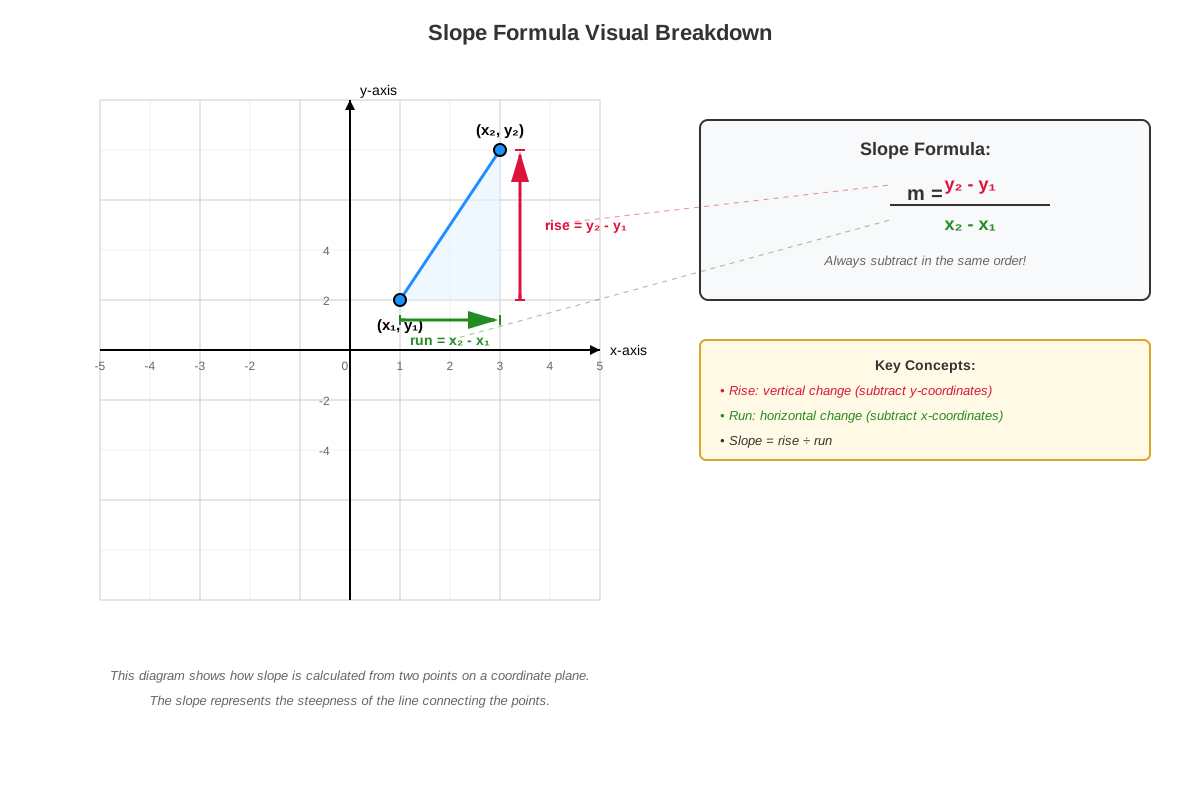
The slope formula calculates the steepness and direction of a line passing through two points. Given two points (x₁, y₁) and (x₂, y₂), the slope m is defined as:
m = (y₂ - y₁) / (x₂ - x₁)This formula represents "rise over run"—the vertical change divided by the horizontal change. The numerator (y₂ - y₁) represents how much the line rises or falls, while the denominator (x₂ - x₁) represents how much the line moves horizontally. The order of subtraction must be consistent: if you subtract y₁ from y₂ in the numerator, you must subtract x₁ from x₂ in the denominator.
Understanding Slope Values
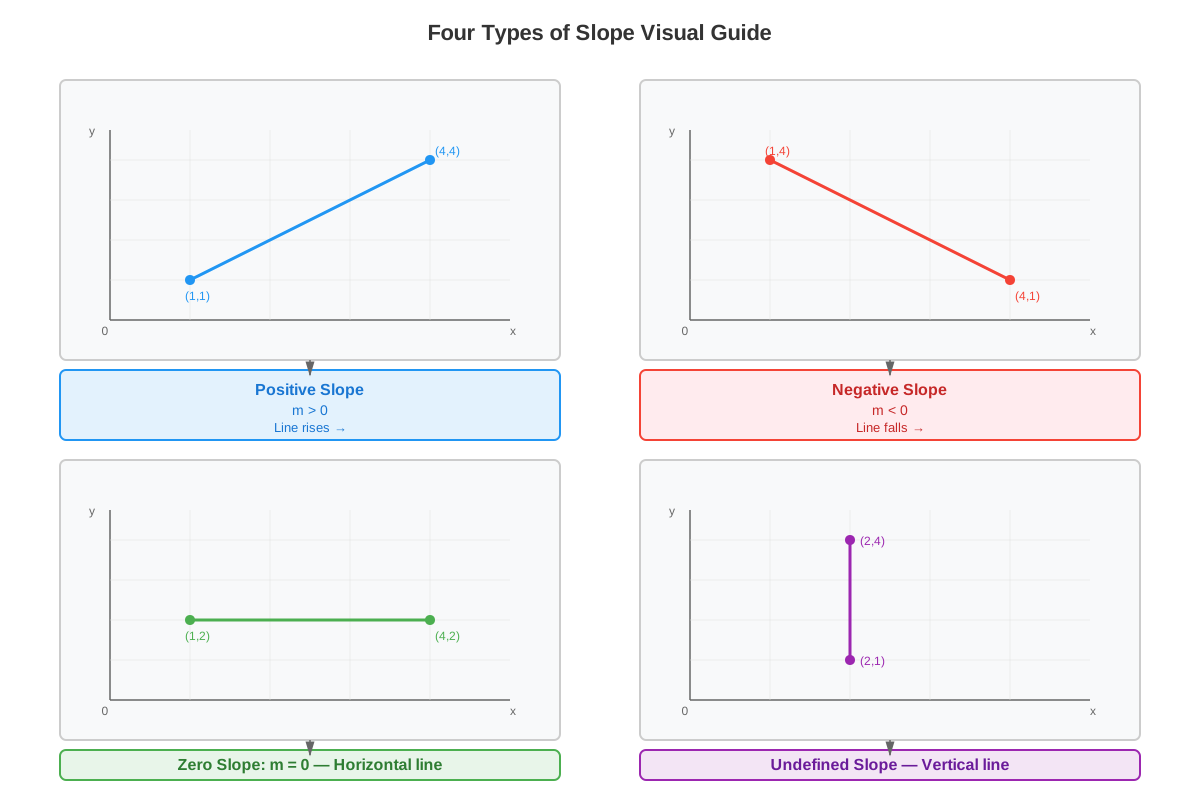
Slope values convey specific information about a line's behavior:
| Slope Value | Line Behavior | Visual Description |
|---|---|---|
| Positive (m > 0) | Line rises from left to right | Upward slant (/) |
| Negative (m < 0) | Line falls from left to right | Downward slant (\) |
| Zero (m = 0) | Horizontal line | Flat line (—) |
| Undefined | Vertical line | Straight up and down (│) |
A positive slope indicates that as x increases, y also increases. The larger the positive value, the steeper the upward slant. A negative slope indicates that as x increases, y decreases. The more negative the value (further from zero), the steeper the downward slant. A zero slope occurs when both points have the same y-coordinate, creating a horizontal line. An undefined slope occurs when both points have the same x-coordinate, creating a vertical line (division by zero in the formula).
Step-by-Step Calculation Process
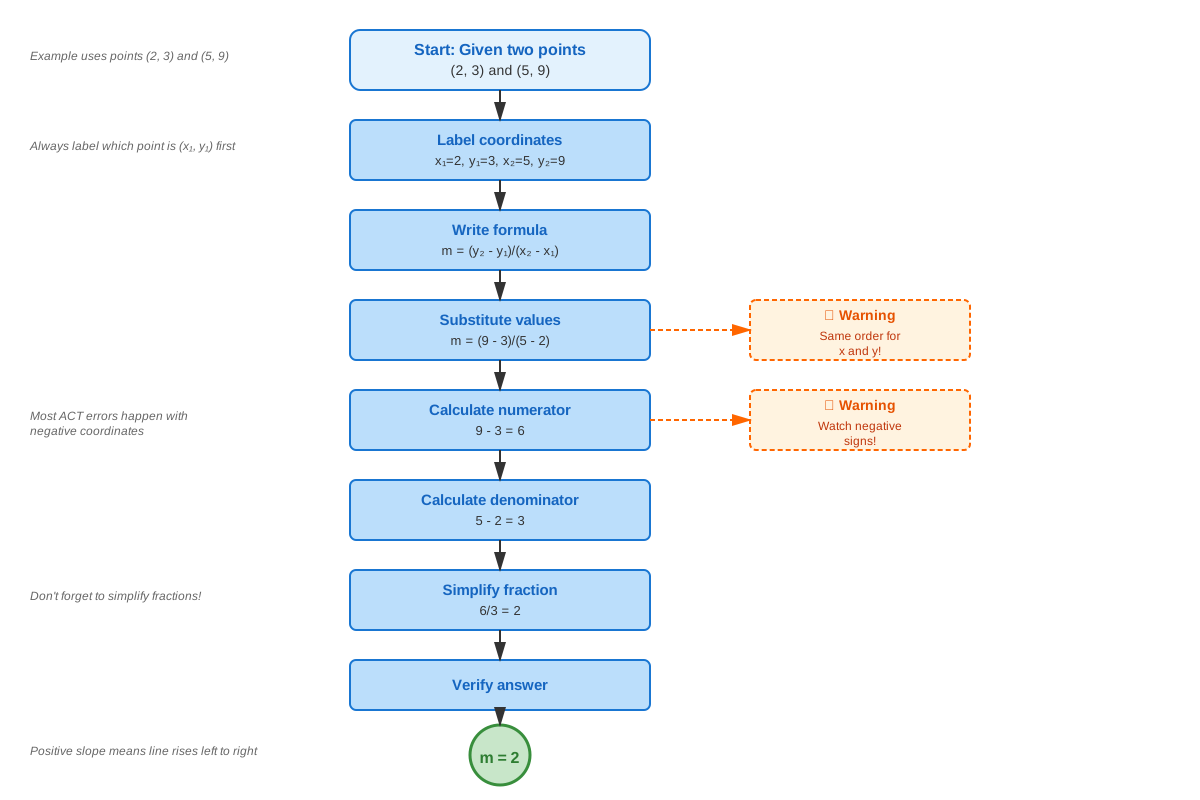
To calculate slope accurately every time, follow this systematic approach:
- Label the points: Identify which point is (x₁, y₁) and which is (x₂, y₂). While the choice is arbitrary, consistency is crucial.
- Calculate the vertical change: Subtract y₁ from y₂ to find the rise. Pay careful attention to negative signs.
- Calculate the horizontal change: Subtract x₁ from x₂ to find the run. Again, watch for negative values.
- Divide rise by run: Perform the division, simplifying the fraction if necessary.
- Verify reasonableness: Check if the sign (positive/negative) matches what you'd expect from the points' positions.
Parallel and Perpendicular Lines
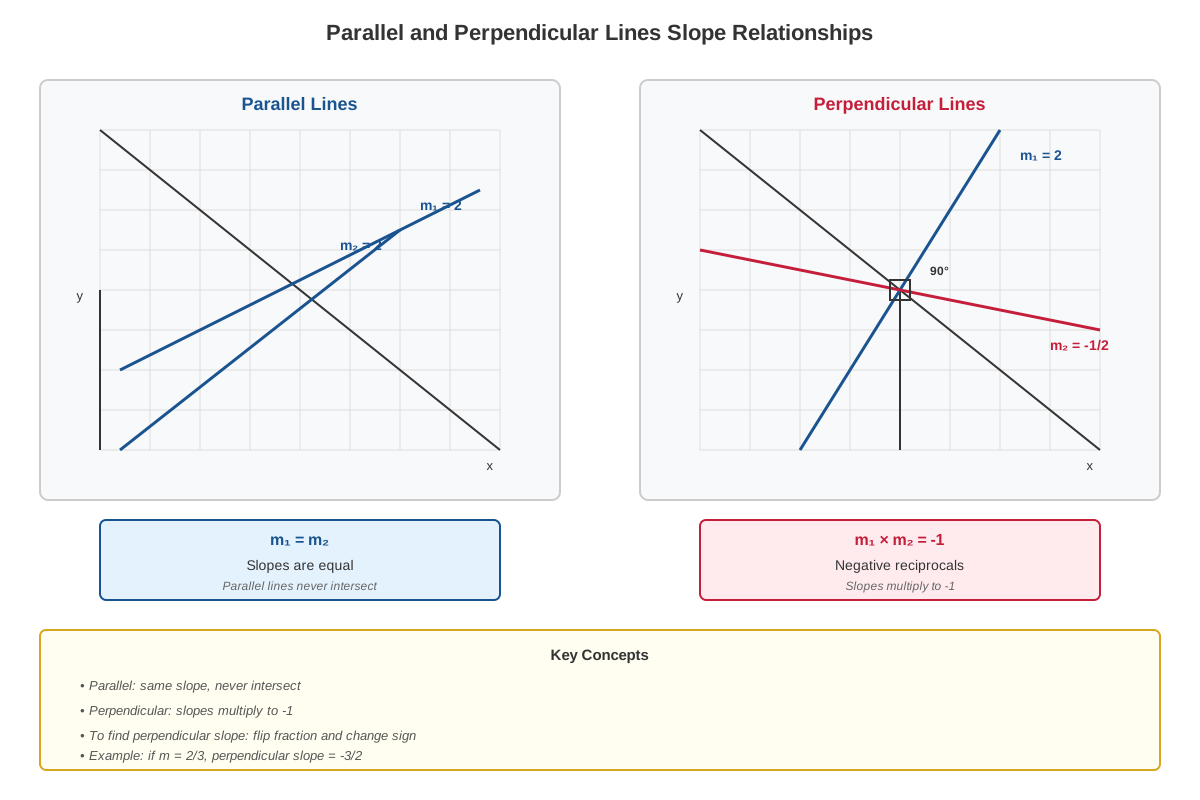
Slope relationships between lines reveal important geometric properties:
Parallel lines have identical slopes. If line 1 has slope m₁ and line 2 has slope m₂, the lines are parallel when m₁ = m₂. This makes intuitive sense: lines that never intersect must rise and run at the same rate.
Perpendicular lines have slopes that are negative reciprocals of each other. If m₁ and m₂ are slopes of perpendicular lines, then m₁ × m₂ = -1, or equivalently, m₂ = -1/m₁. For example, if one line has slope 2/3, a perpendicular line has slope -3/2. This relationship is frequently tested on the ACT.
Special Cases and Edge Scenarios
Several scenarios require special attention:
When coordinates are negative: Carefully track negative signs through the calculation. For points (-3, -5) and (2, 4), the calculation becomes: m = (4 - (-5)) / (2 - (-3)) = (4 + 5) / (2 + 3) = 9/5.
When points are in different quadrants: The slope formula works regardless of which quadrants contain the points. The key is accurate subtraction.
When slope is a whole number: If the denominator equals 1 after simplification, the slope is simply the numerator value. For example, slope = 6/1 = 6.
When working backwards: Sometimes the ACT provides the slope and one point, asking for another point's coordinates. Rearrange the formula to solve for the unknown coordinate.
Concept Relationships
The slope formula serves as a central hub connecting multiple coordinate geometry concepts. Understanding these relationships strengthens problem-solving ability and helps recognize when slope is the key to solving a problem.
Within slope concepts: The basic slope formula → leads to → understanding slope types (positive, negative, zero, undefined) → leads to → recognizing parallel lines (equal slopes) → leads to → identifying perpendicular lines (negative reciprocal slopes) → leads to → solving complex multi-step problems.
Connection to prerequisites: Coordinate plane knowledge provides the foundation for identifying points → signed number operations enable accurate calculation → fraction skills allow proper simplification → graphing ability helps verify answers visually.
Connection to related topics: Slope directly connects to linear equations (slope is the coefficient of x in y = mx + b form), graphing lines (slope determines the line's angle), systems of equations (parallel lines have no solution, perpendicular lines often appear in optimization problems), and distance and midpoint formulas (all work with coordinate pairs). Slope also appears in functions as the rate of change and in trigonometry as the tangent of the angle of inclination.
High-Yield Facts
⭐ The slope formula is m = (y₂ - y₁) / (x₂ - x₁), representing rise over run.
⭐ Parallel lines have equal slopes: if m₁ = m₂, the lines are parallel.
⭐ Perpendicular lines have slopes that are negative reciprocals: m₁ × m₂ = -1.
⭐ A positive slope indicates a line rising from left to right; a negative slope indicates a line falling from left to right.
⭐ A horizontal line has slope = 0; a vertical line has undefined slope.
- The order of subtraction in the slope formula must be consistent between numerator and denominator.
- Slope represents the rate of change: how much y changes for each unit change in x.
- When simplifying slope fractions, reduce to lowest terms to match ACT answer choices.
- If two points have the same x-coordinate, the slope is undefined (vertical line).
- If two points have the same y-coordinate, the slope is zero (horizontal line).
- A steeper line has a larger absolute value of slope (further from zero).
- Slope is independent of which point you designate as (x₁, y₁) versus (x₂, y₂).
- In real-world problems, slope often represents a rate: speed, cost per unit, or growth rate.
Quick check — test yourself on Slope formula so far.
Try Flashcards →Common Misconceptions
Misconception: The order of points doesn't matter, so (y₁ - y₂) / (x₂ - x₁) gives the same result as (y₂ - y₁) / (x₂ - x₁).
Correction: While you can choose which point is "first," you must be consistent. Using (y₁ - y₂) / (x₂ - x₁) actually gives the negative of the correct slope. Always subtract in the same order: if y₂ is first in the numerator, x₂ must be first in the denominator.
Misconception: A vertical line has slope = 0.
Correction: A vertical line has undefined slope (not zero) because the denominator (x₂ - x₁) equals zero, making division impossible. A horizontal line has slope = 0 because the numerator (y₂ - y₁) equals zero.
Misconception: Perpendicular lines have slopes that are opposite signs of each other (if one is 3, the other is -3).
Correction: Perpendicular lines have slopes that are negative reciprocals, not just opposite signs. If one slope is 3 (or 3/1), the perpendicular slope is -1/3, not -3. You must flip the fraction AND change the sign.
Misconception: When both coordinates are negative, the slope must be negative.
Correction: The sign of the slope depends on the relationship between the points, not whether individual coordinates are negative. Points (-5, -2) and (-1, -4) have slope = (-4 - (-2)) / (-1 - (-5)) = -2/4 = -1/2, which is negative, but points (-5, -8) and (-2, -2) have slope = (-2 - (-8)) / (-2 - (-5)) = 6/3 = 2, which is positive.
Misconception: Slope and distance are the same thing.
Correction: Slope measures steepness (rise over run), while distance measures the length between two points. Two lines can have the same slope but connect points at very different distances apart. Slope is a ratio; distance is a length measurement.
Misconception: A larger slope value always means a steeper line.
Correction: The absolute value of the slope determines steepness. A slope of -5 represents a steeper line than a slope of 2, even though -5 < 2, because |-5| > |2|. When comparing steepness, consider the distance from zero, not the algebraic value.
Worked Examples
Example 1: Basic Slope Calculation with Negative Coordinates
Problem: Find the slope of the line passing through points A(-3, 7) and B(5, -1).
Solution:
Step 1: Identify the coordinates.
- Point A: (x₁, y₁) = (-3, 7)
- Point B: (x₂, y₂) = (5, -1)
Step 2: Apply the slope formula.
m = (y₂ - y₁) / (x₂ - x₁)
m = (-1 - 7) / (5 - (-3))
Step 3: Simplify the numerator.
-1 - 7 = -8Step 4: Simplify the denominator (watch the double negative).
5 - (-3) = 5 + 3 = 8Step 5: Calculate the slope.
m = -8/8 = -1Step 6: Verify reasonableness.
Point A is in quadrant II (negative x, positive y) and point B is in quadrant IV (positive x, negative y). The line moves from upper-left to lower-right, confirming a negative slope makes sense.
Answer: The slope is -1.
Connection to learning objectives: This example demonstrates accurate application of the slope formula with negative coordinates, a common ACT scenario.
Example 2: Perpendicular Lines Application
Problem: Line k passes through points (2, 5) and (6, 13). Line j is perpendicular to line k. What is the slope of line j?
Solution:
Step 1: Find the slope of line k first.
m_k = (13 - 5) / (6 - 2)
m_k = 8/4 = 2
Step 2: Apply the perpendicular slope relationship.
For perpendicular lines, m_j × m_k = -1, so:
m_j = -1/m_kStep 3: Calculate the perpendicular slope.
m_j = -1/2Step 4: Verify the relationship.
Check: (2) × (-1/2) = -1 ✓
Answer: The slope of line j is -1/2.
Connection to learning objectives: This example shows how to identify when slope relationships (perpendicular lines) are being tested and how to apply the negative reciprocal rule, a high-yield ACT concept.
Example 3: Real-World Application
Problem: A hiking trail rises from an elevation of 1,200 feet to 1,800 feet over a horizontal distance of 2 miles (10,560 feet). What is the slope of the trail?
Solution:
Step 1: Identify the two points in terms of (horizontal distance, elevation).
- Starting point: (0, 1200)
- Ending point: (10560, 1800)
Step 2: Apply the slope formula.
m = (1800 - 1200) / (10560 - 0)
m = 600/10560
Step 3: Simplify the fraction.
m = 600/10560 = 5/88 ≈ 0.057Step 4: Interpret the result.
The slope of approximately 0.057 means the trail rises 0.057 feet for every 1 foot of horizontal distance, or about 5.7 feet per 100 feet horizontally—a moderate grade.
Answer: The slope is 5/88 or approximately 0.057.
Connection to learning objectives: This demonstrates identifying slope in real-world contexts and interpreting the meaning of the calculated value.
Exam Strategy
When approaching ACT slope questions, implement these strategic techniques:
Trigger words and phrases to recognize: "steepness," "rate of change," "rise over run," "passes through points," "parallel to," "perpendicular to," "horizontal line," "vertical line," "increasing/decreasing," and any mention of two coordinate pairs. Word problems involving rates (speed, cost per item, growth rate) often require slope calculations even when the word "slope" isn't mentioned.
Systematic approach for calculation questions:
- Write down the slope formula before starting
- Clearly label which point is (x₁, y₁) and which is (x₂, y₂)
- Show the substitution step to avoid sign errors
- Simplify carefully, especially with negative numbers
- Check if your answer matches the expected behavior (positive/negative)
Process of elimination strategies:
- Eliminate answer choices with the wrong sign first (if the line clearly rises or falls)
- If the line is steep, eliminate small slope values; if the line is gradual, eliminate large values
- For parallel/perpendicular questions, immediately eliminate slopes that don't match the required relationship
- When answers are fractions, eliminate those that aren't in simplest form (the ACT typically presents simplified fractions)
Time allocation: Straightforward slope calculation problems should take 30-45 seconds. Problems involving parallel or perpendicular lines may require 60-90 seconds. Complex word problems might need up to 2 minutes. If a problem takes longer, mark it and return after completing easier questions.
Common traps to avoid: The ACT often includes the negative of the correct slope as a distractor (testing whether you maintained consistent subtraction order). They also include the reciprocal without the negative sign for perpendicular line questions. Always double-check your arithmetic with negative numbers, as sign errors are the most common mistake.
Quick verification technique: After calculating slope, quickly sketch the two points on a mental coordinate plane. Does your calculated slope match the visual direction? This 5-second check catches most errors.
Memory Techniques
Slope Formula Mnemonic: "You Yell Xtra Xtra" reminds you that slope is (Y - Y) / (X - X), with the y-coordinates in the numerator and x-coordinates in the denominator.
Rise Over Run: Visualize climbing stairs. "Rise" is how high you climb (vertical), "run" is how far forward you step (horizontal). This physical metaphor makes the concept memorable.
Parallel vs. Perpendicular:
- Parallel = Perfectly Paired (same slopes)
- Perpendicular = Product is Negative one (slopes multiply to -1)
Slope Sign Memory: Draw a simple face:
- Positive slope = / = Happy face (smile goes up)
- Negative slope = \\ = Sad face (frown goes down)
Zero vs. Undefined:
- Horizontal = Zero (both words have horizontal lines in their letters: H, Z)
- Vertical = Undefined (both start with vertical lines: V, U)
Negative Reciprocal Visualization: Imagine flipping a fraction upside down (reciprocal) and then putting a negative sign on it. For perpendicular slopes, you do both operations: flip AND negate.
Summary
The slope formula, m = (y₂ - y₁) / (x₂ - x₁), is an essential tool for analyzing linear relationships on the ACT Math test. This formula calculates the rate of change between two points, representing how much the y-value changes for each unit change in x-value. Mastery requires understanding four slope types: positive (rising left to right), negative (falling left to right), zero (horizontal), and undefined (vertical). Critical applications include identifying parallel lines (equal slopes) and perpendicular lines (negative reciprocal slopes), both frequently tested concepts. Success on ACT slope questions demands careful attention to sign changes when working with negative coordinates, consistent subtraction order in the formula, and proper fraction simplification. Students must recognize slope in various contexts: direct calculation problems, graphical analysis, parallel and perpendicular line relationships, and real-world rate problems. The ability to quickly calculate slope, verify reasonableness, and apply slope relationships to solve complex problems distinguishes high-scoring students on the coordinate geometry portion of the ACT.
Key Takeaways
- The slope formula m = (y₂ - y₁) / (x₂ - x₁) must be applied with consistent subtraction order to avoid sign errors
- Parallel lines have identical slopes; perpendicular lines have slopes that are negative reciprocals (product equals -1)
- Positive slopes rise left to right, negative slopes fall left to right, horizontal lines have zero slope, and vertical lines have undefined slope
- Always simplify slope fractions to match ACT answer choices and verify that the sign matches the visual direction of the line
- Slope represents rate of change in real-world contexts, appearing in problems about speed, cost, growth, and other rates
- Watch for negative coordinates and double negatives in calculations—these are the most common sources of errors
- Recognize slope-related trigger words like "parallel," "perpendicular," "rate of change," and "passes through points" to identify when this concept is being tested
Related Topics
Linear Equations in Slope-Intercept Form (y = mx + b): After mastering slope calculation, students learn to write complete equations of lines. The slope m becomes the coefficient of x, connecting slope to algebraic representation.
Point-Slope Form: This equation form, y - y₁ = m(x - x₁), directly uses slope and a point to write line equations, building on slope calculation skills.
Systems of Linear Equations: Understanding slope helps determine whether systems have one solution (intersecting lines with different slopes), no solution (parallel lines with equal slopes), or infinitely many solutions (same line).
Distance and Midpoint Formulas: These formulas also work with coordinate pairs, and combining them with slope creates powerful problem-solving approaches for coordinate geometry.
Functions and Rate of Change: Slope extends to the concept of average rate of change in functions, connecting coordinate geometry to function analysis.
Practice CTA
Now that you've mastered the slope formula and its applications, it's time to solidify your understanding through practice! Work through the practice questions to test your ability to calculate slopes accurately, identify parallel and perpendicular relationships, and apply slope concepts to real-world scenarios. Use the flashcards to reinforce the key formulas, relationships, and strategies you've learned. Remember, consistent practice with ACT-style questions is the key to achieving automaticity and confidence on test day. Each problem you solve strengthens your pattern recognition and calculation speed—skills that directly translate to points on the ACT Math section. You've got this!
Sign up free to keep reading
Create a free AnvayaPrep account to finish this ACT guide on Slope formula — plus flashcards and practice questions.