Overview
Point-slope form is one of the three fundamental ways to express linear equations, alongside slope-intercept form and standard form. This form, written as y - y₁ = m(x - x₁), is particularly powerful because it allows students to write the equation of a line immediately when given a point on the line and its slope. On the ACT Math section, ACT point-slope form questions appear regularly in the Algebra domain, testing students' ability to construct equations, convert between forms, and interpret geometric relationships on the coordinate plane.
Understanding point-slope form is essential for ACT success because it serves as a bridge between geometric information (points and slopes) and algebraic representations (equations). The ACT frequently presents scenarios where students must quickly write an equation given specific conditions, and point-slope form is often the most efficient approach. Questions may directly ask for an equation in point-slope form, require conversion from point-slope to another form, or embed point-slope concepts within word problems involving rates of change and linear relationships.
This topic connects deeply to broader mathematical concepts including slope calculation, linear functions, parallel and perpendicular lines, and coordinate geometry. Mastery of point-slope form enhances problem-solving speed and accuracy across multiple question types, making it a high-yield topic that deserves focused attention. Students who can fluently work with point-slope form gain a significant advantage in tackling the 15-20 coordinate geometry and algebra questions that typically appear on each ACT Math test.
Learning Objectives
- [ ] Identify when Point-slope form is being tested in ACT questions
- [ ] Explain the core rule or strategy behind Point-slope form
- [ ] Apply Point-slope form to ACT-style questions accurately
- [ ] Convert equations between point-slope form, slope-intercept form, and standard form
- [ ] Write the equation of a line given two points using point-slope form
- [ ] Determine whether a given point lies on a line expressed in point-slope form
- [ ] Apply point-slope form to solve real-world rate problems and linear modeling scenarios
Prerequisites
- Slope calculation: Understanding how to find slope using (y₂ - y₁)/(x₂ - x₁) is fundamental because slope is a required component of point-slope form
- Coordinate plane basics: Familiarity with ordered pairs (x, y) and plotting points enables interpretation of the point component in point-slope form
- Algebraic manipulation: Skills in distributing, combining like terms, and solving equations are necessary for converting between different forms
- Slope-intercept form (y = mx + b): Prior knowledge of this form provides context for understanding when point-slope form is more efficient
- Linear relationships: Recognizing that linear equations represent constant rates of change helps students understand when to apply point-slope form
Why This Topic Matters
Point-slope form represents a critical skill in both academic mathematics and real-world applications. In practical contexts, this form naturally models situations where you know a starting point and a rate of change: calculating costs with initial fees and per-unit charges, predicting population growth from a baseline and growth rate, or determining temperature changes over time. Engineers, economists, and data scientists regularly use point-slope thinking when creating linear models from observed data points.
On the ACT Math section, point-slope form appears in approximately 2-4 questions per test, representing roughly 3-7% of the 60 math questions. These questions typically fall into several categories: direct equation writing (given a point and slope), conversion problems (rewriting equations in different forms), application problems (word problems requiring linear equation construction), and geometric problems (finding equations of lines parallel or perpendicular to given lines). The ACT particularly favors questions that combine point-slope form with other concepts, such as finding where two lines intersect or determining the equation of a line passing through two specific points.
Common ACT question formats include: providing a graph with a line and asking for its equation in point-slope form; presenting a word problem describing a linear relationship and requesting the appropriate equation; giving an equation in one form and asking for conversion to point-slope form; or asking students to identify which equation represents a line with specific properties. The ability to quickly recognize when point-slope form is the most efficient approach can save valuable time on test day, making this a strategic topic for score improvement.
Core Concepts
The Point-Slope Form Equation
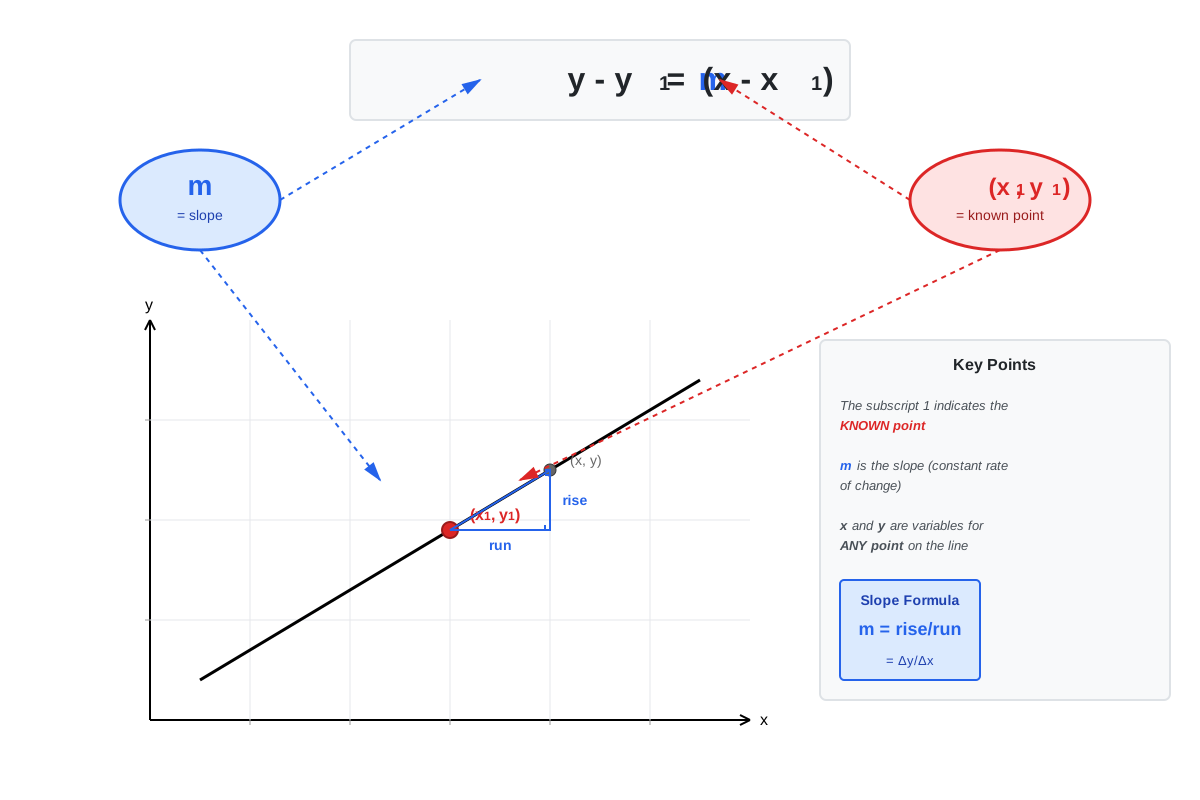
The point-slope form of a linear equation is expressed as:
y - y₁ = m(x - x₁)In this formula:
- m represents the slope of the line
- (x₁, y₁) represents a specific point on the line (these are known coordinates)
- x and y are variables representing any point on the line
This form directly encodes the definition of slope. Since slope equals the change in y divided by the change in x, we can write: m = (y - y₁)/(x - x₁). Multiplying both sides by (x - x₁) yields the point-slope form. This derivation reveals why the form works: it's simply the slope formula rearranged to create an equation.
When to Use Point-Slope Form
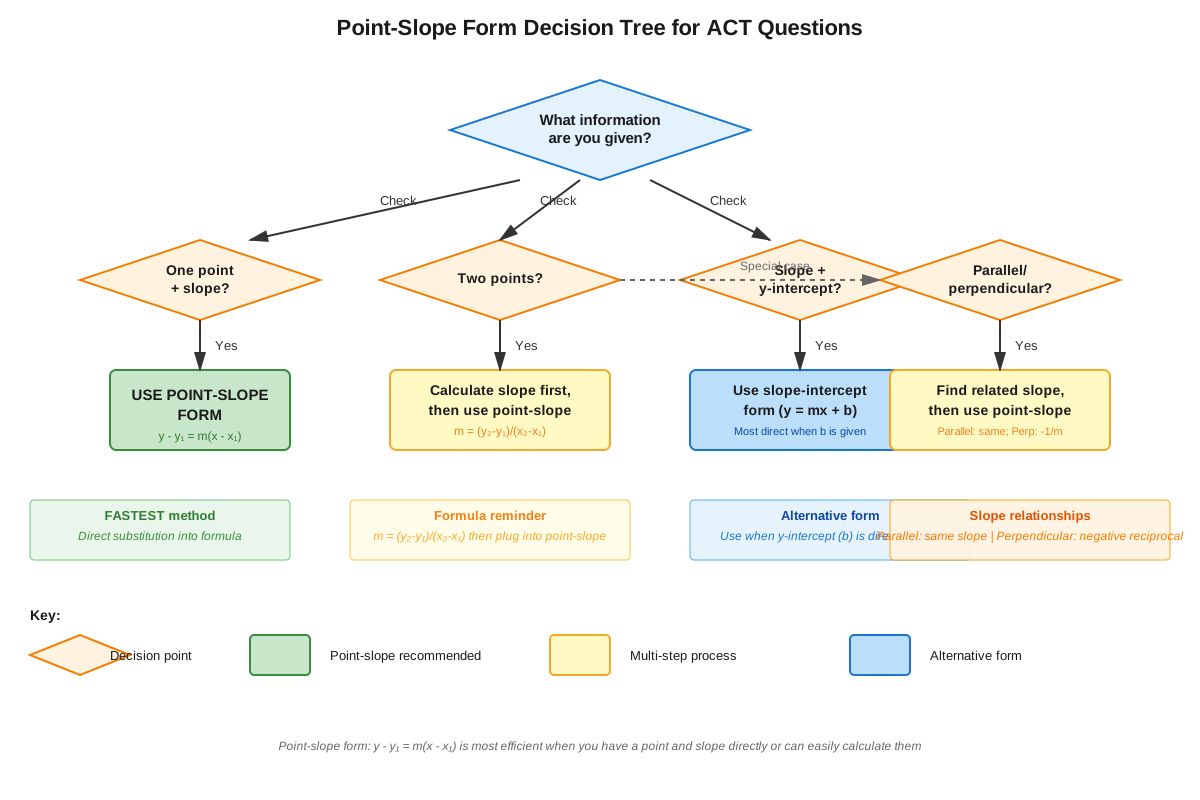
Point-slope form is the optimal choice in several specific scenarios:
- Given one point and the slope: When a problem provides coordinates of a single point and the slope value, point-slope form allows immediate equation writing without additional calculations
- Given two points: After calculating the slope from two points, use either point with the calculated slope to write the equation
- Parallel or perpendicular line problems: When finding a line parallel or perpendicular to another line through a specific point, determine the new slope and apply point-slope form
- Rate of change problems: Word problems describing a starting value and constant rate naturally fit point-slope structure
Converting Between Forms
Understanding conversions between linear equation forms is crucial for ACT success:
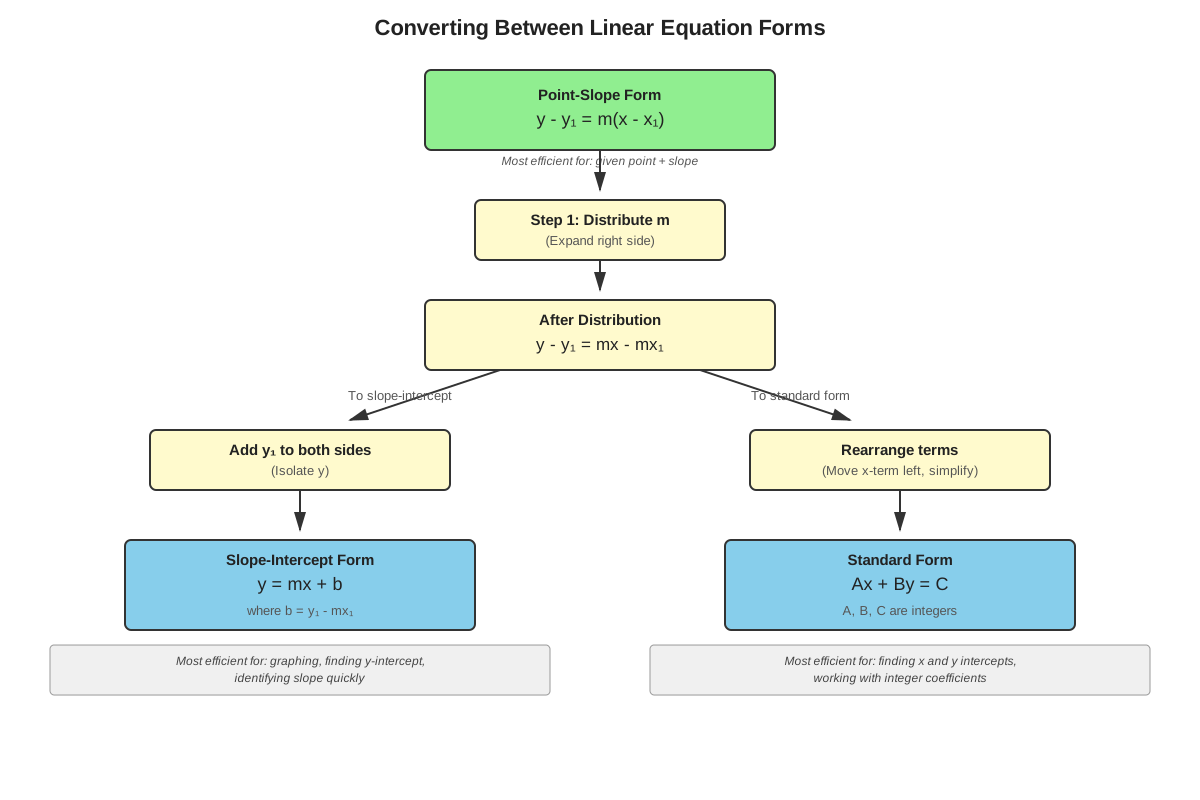
Point-Slope to Slope-Intercept:
Starting with y - y₁ = m(x - x₁), distribute the slope and solve for y:
- Distribute: y - y₁ = mx - mx₁
- Add y₁ to both sides: y = mx - mx₁ + y₁
- Simplify: y = mx + b (where b = y₁ - mx₁)
Point-Slope to Standard Form:
Starting with y - y₁ = m(x - x₁), distribute and rearrange to Ax + By = C:
- Distribute: y - y₁ = mx - mx₁
- Move all terms to one side: -mx + y = mx₁ + y₁
- Multiply to eliminate fractions if m is a fraction
- Arrange with x-term first: Ax + By = C
Slope-Intercept to Point-Slope:
Given y = mx + b, identify the slope m and choose any point on the line (often the y-intercept (0, b) is convenient), then substitute into y - y₁ = m(x - x₁).
Writing Equations from Two Points
When given two points but no explicit slope, follow this systematic process:
- Calculate the slope: m = (y₂ - y₁)/(x₂ - x₁)
- Choose one point: Either point works; select the one with simpler coordinates
- Substitute into point-slope form: Use the calculated slope and chosen point
- Simplify if required: Convert to the requested form if specified
For example, given points (2, 5) and (6, 13):
- Slope: m = (13 - 5)/(6 - 2) = 8/4 = 2
- Using point (2, 5): y - 5 = 2(x - 2)
- This is the equation in point-slope form
Interpreting Point-Slope Form
Each component of point-slope form carries specific meaning:
- The slope (m) indicates the steepness and direction of the line (positive slopes rise left to right, negative slopes fall)
- The point (x₁, y₁) is guaranteed to satisfy the equation and lie on the line
- The expression (x - x₁) represents horizontal distance from the known point
- The expression (y - y₁) represents vertical distance from the known point
This interpretation helps verify answers: substituting the given point into the equation should yield a true statement (0 = 0).
Special Cases and Considerations
Vertical lines cannot be expressed in point-slope form because their slope is undefined. These lines have equations of the form x = c.
Horizontal lines have slope m = 0, making point-slope form y - y₁ = 0(x - x₁), which simplifies to y = y₁.
When working with fractional slopes, keep fractions in the equation rather than converting to decimals to maintain precision and match ACT answer choices.
Concept Relationships
Point-slope form sits at the intersection of several mathematical concepts, creating a web of interconnected ideas. The foundation begins with slope calculation → which feeds directly into → point-slope form construction. Once an equation is in point-slope form, it can be → converted to slope-intercept form → which reveals the y-intercept and provides an alternative representation.
The relationship extends to geometric concepts: parallel lines share identical slopes, so finding a parallel line through a given point requires → using the same slope in point-slope form with the new point. Similarly, perpendicular lines have negative reciprocal slopes, creating a pathway from → identifying the original slope → calculating the perpendicular slope → applying point-slope form.
Point-slope form also connects to systems of equations: two lines in point-slope form can be → converted to a common form → solved simultaneously to find intersection points. This relationship appears frequently in ACT problems involving line intersections.
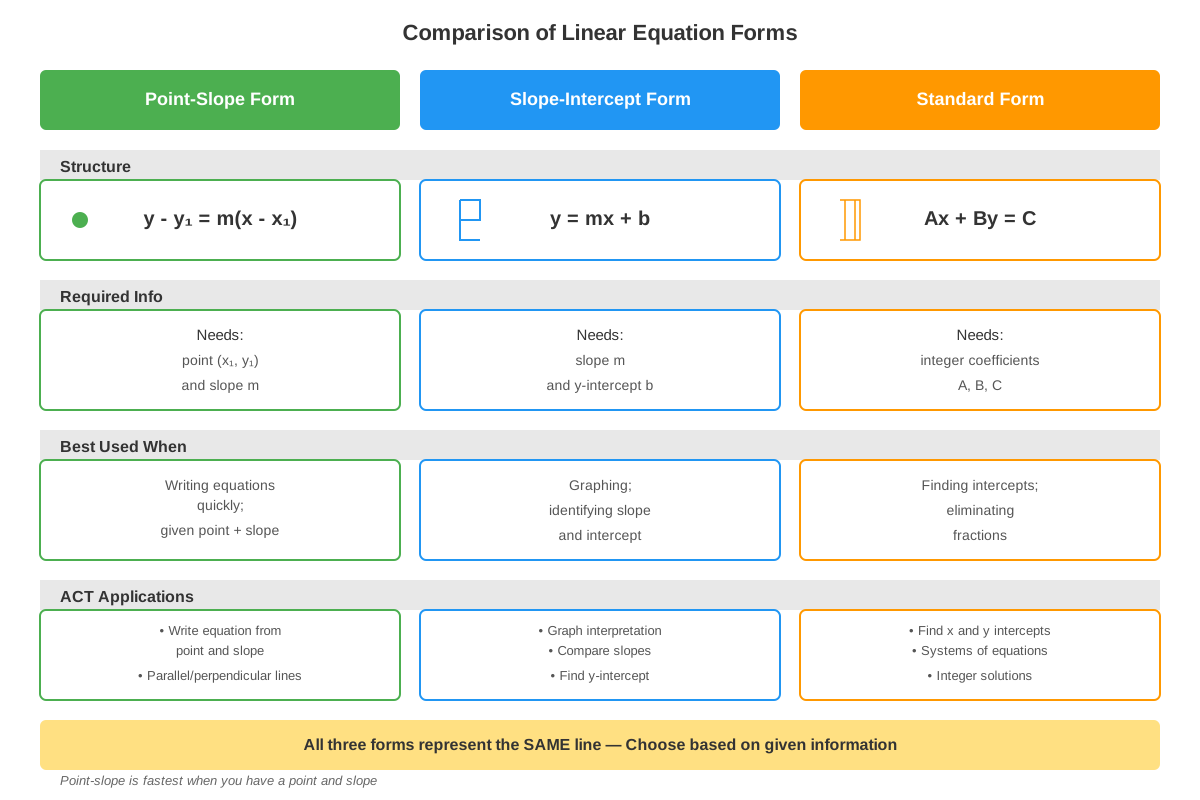
The broader connection to linear functions shows that point-slope form is simply another way to express the same linear relationship that could be written in slope-intercept or standard form. Each form has advantages: point-slope excels when points and slopes are known, slope-intercept reveals the y-intercept immediately, and standard form facilitates finding both intercepts quickly.
High-Yield Facts
⭐ Point-slope form is y - y₁ = m(x - x₁), where m is slope and (x₁, y₁) is a point on the line
⭐ Any point on the line can be used as (x₁, y₁) in point-slope form; the resulting equations are equivalent
⭐ To convert point-slope to slope-intercept form, distribute the slope and solve for y
⭐ Parallel lines have equal slopes; perpendicular lines have negative reciprocal slopes
⭐ When given two points, calculate slope first, then use either point to write point-slope form
- Point-slope form is most efficient when you know one point and the slope directly
- Substituting the given point (x₁, y₁) into the equation should always yield 0 = 0 as verification
- The slope in point-slope form has the same interpretation as in slope-intercept form: rise over run
- Converting between forms doesn't change the line itself, only its representation
- Horizontal lines (slope = 0) in point-slope form simplify to y = y₁
- Point-slope form cannot represent vertical lines because vertical lines have undefined slope
- The ACT often provides answer choices in different forms, requiring conversion skills
Quick check — test yourself on Point-slope form so far.
Try Flashcards →Common Misconceptions
Misconception: The point (x₁, y₁) must be the y-intercept → Correction: Any point on the line can serve as (x₁, y₁) in point-slope form. The y-intercept is just one possible choice, and often other points are more convenient or are the only points provided.
Misconception: The signs in y - y₁ = m(x - x₁) should match the signs of the coordinates → Correction: The formula always uses subtraction. If y₁ = -3, the equation becomes y - (-3) = y + 3. If x₁ = -2, it becomes (x - (-2)) = (x + 2). The subtraction in the formula creates the correct signs automatically.
Misconception: Point-slope form and slope-intercept form are completely different equations → Correction: These are equivalent representations of the same line. Converting between them doesn't change which points satisfy the equation; it only changes how the equation appears.
Misconception: You must always convert point-slope form to slope-intercept form to use it → Correction: Point-slope form is a complete, valid equation. You can substitute values, check if points lie on the line, and solve problems directly in point-slope form without conversion.
Misconception: When given two points, you must use both points in the equation → Correction: After calculating slope from two points, choose only one point to substitute into point-slope form. Using both points simultaneously is incorrect; the formula requires one specific point (x₁, y₁) and leaves x and y as variables.
Misconception: The order of subtraction in slope calculation doesn't matter → Correction: While you can subtract in either order, you must be consistent: (y₂ - y₁)/(x₂ - x₁) or (y₁ - y₂)/(x₁ - x₂). Mixing orders like (y₂ - y₁)/(x₁ - x₂) produces the wrong sign for slope.
Worked Examples
Example 1: Writing an Equation from a Point and Slope
Problem: Write the equation of a line that passes through the point (3, -4) and has a slope of 2/3 in point-slope form. Then convert it to slope-intercept form.
Solution:
Step 1: Identify the given information
- Point: (x₁, y₁) = (3, -4)
- Slope: m = 2/3
Step 2: Substitute into point-slope form y - y₁ = m(x - x₁)
- y - (-4) = (2/3)(x - 3)
- y + 4 = (2/3)(x - 3)
This is the answer in point-slope form: y + 4 = (2/3)(x - 3)
Step 3: Convert to slope-intercept form by distributing and solving for y
- y + 4 = (2/3)x - 2
- y = (2/3)x - 2 - 4
- y = (2/3)x - 6
Connection to Learning Objectives: This example demonstrates applying point-slope form to construct equations accurately and converting between forms, addressing objectives 2, 3, and 4.
Example 2: Finding an Equation from Two Points
Problem: A line passes through points (-2, 7) and (4, -5). Write the equation of this line in point-slope form using the point (-2, 7).
Solution:
Step 1: Calculate the slope using m = (y₂ - y₁)/(x₂ - x₁)
- Let (x₁, y₁) = (-2, 7) and (x₂, y₂) = (4, -5)
- m = (-5 - 7)/(4 - (-2))
- m = -12/6
- m = -2
Step 2: Use the calculated slope and the specified point (-2, 7)
- y - y₁ = m(x - x₁)
- y - 7 = -2(x - (-2))
- y - 7 = -2(x + 2)
Answer: y - 7 = -2(x + 2)
Step 3: Verify by checking if the other point (4, -5) satisfies this equation
- -5 - 7 = -2(4 + 2)
- -12 = -2(6)
- -12 = -12 ✓
Connection to Learning Objectives: This example shows how to apply point-slope form when given two points (objective 5) and demonstrates verification techniques that help identify when point-slope form is being tested (objective 1).
Example 3: Parallel Line Application
Problem: Line ℓ has equation y = -3x + 5. Write the equation in point-slope form of a line parallel to ℓ that passes through the point (2, 1).
Solution:
Step 1: Identify the slope of the given line
- The equation y = -3x + 5 is in slope-intercept form
- The slope is m = -3
Step 2: Recognize that parallel lines have equal slopes
- The parallel line also has slope m = -3
Step 3: Use the given point (2, 1) and the slope -3 in point-slope form
- y - y₁ = m(x - x₁)
- y - 1 = -3(x - 2)
Answer: y - 1 = -3(x - 2)
Connection to Learning Objectives: This problem demonstrates identifying when point-slope form is being tested (objective 1) through the context of parallel lines, and applying the form accurately (objective 3) in a geometric context.
Exam Strategy
When approaching ACT questions involving point-slope form, begin by identifying what information is provided. Look for trigger phrases such as "passes through the point," "has a slope of," "parallel to," "perpendicular to," or "rate of change." These phrases signal that point-slope form may be the most efficient approach.
Question Recognition Strategy: If a problem gives you a point and a slope directly, point-slope form is almost certainly the intended method. If you're given two points, calculate the slope first, then decide whether to use point-slope form or convert directly to another form based on what the question asks for.
Time-Saving Approach: Don't automatically convert to slope-intercept form unless the question specifically requests it or answer choices are in that form. Many students waste time converting unnecessarily. If answer choices are in point-slope form, write your equation and match it directly.
Process of Elimination Tips:
- Eliminate any answer choice where substituting the given point doesn't yield 0 = 0
- Check the slope sign: if the line rises left to right, eliminate negative slopes; if it falls, eliminate positive slopes
- For parallel line questions, eliminate any choice with a different slope than the original line
- For perpendicular line questions, eliminate any choice that doesn't have the negative reciprocal slope
Common Trap Avoidance: The ACT frequently includes incorrect answer choices with sign errors. If the point is (3, -5), wrong answers might show y - 3 = m(x + 5) or y + 5 = m(x + 3). Always double-check that you're subtracting both coordinates: y - (-5) = y + 5 and x - 3.
Time Allocation: Point-slope form questions should take 30-60 seconds once you've mastered the concept. If you find yourself spending more than a minute, you may be overcomplicating the problem. Consider whether you're using the most efficient form for the given information.
Answer Verification: When time permits, substitute the given point into your equation to verify it produces 0 = 0. This quick check catches most algebraic errors and provides confidence in your answer.
Memory Techniques
Mnemonic for Point-Slope Form: "Y Minus Y-one Equals M times X minus X-one" → "Y MY EMX X" helps recall the structure y - y₁ = m(x - x₁).
Visual Memory Aid: Picture the formula as a balance scale: the left side (y - y₁) represents vertical distance from your known point, and the right side m(x - x₁) represents slope times horizontal distance. They must balance because that's the definition of slope.
Acronym for When to Use Point-Slope: "POPS" - Point given, One slope known, Parallel/perpendicular problems, Starting point in word problems.
Sign Memory Trick: Remember "Subtract Subtract" - you always subtract both coordinates in point-slope form. If you see addition in the formula, it's because you're subtracting a negative number.
Conversion Memory: To go from point-slope to slope-intercept, think "Distribute and Isolate" → DI (distribute the slope, isolate y).
Parallel/Perpendicular Memory: "Parallel = Same Slope" and "Perpendicular = Flip and Negate" (negative reciprocal). Visualize parallel lines as train tracks (same slope) and perpendicular lines as a plus sign (opposite relationship).
Summary
Point-slope form, expressed as y - y₁ = m(x - x₁), is a powerful tool for writing linear equations when a point and slope are known. This form directly encodes the definition of slope and provides the most efficient path to an equation in many ACT scenarios. Mastery requires understanding when to apply point-slope form (given one point and slope, given two points after calculating slope, or in parallel/perpendicular line problems), how to convert between different linear equation forms, and how to interpret each component of the formula. The ACT tests point-slope form through direct equation-writing questions, conversion problems, and application scenarios involving rates of change. Success depends on recognizing trigger phrases, avoiding common sign errors, and choosing the most efficient form for the given information. Students who can fluently work with point-slope form gain speed and accuracy advantages across multiple question types in the coordinate geometry and algebra domains.
Key Takeaways
- Point-slope form y - y₁ = m(x - x₁) is the optimal choice when you know a point and the slope
- Always subtract both coordinates in the formula; apparent addition occurs when subtracting negative numbers
- Any point on the line can serve as (x₁, y₁); all resulting equations are equivalent
- Converting between forms doesn't change the line, only its representation
- Parallel lines share the same slope; perpendicular lines have negative reciprocal slopes
- Verify answers by substituting the given point to check if the equation yields 0 = 0
- Point-slope form appears in 2-4 questions per ACT, making it a high-yield topic for score improvement
Related Topics
Slope-Intercept Form (y = mx + b): Understanding this form enhances your ability to convert from point-slope form and recognize when each form is most efficient. Mastering both forms provides flexibility in approaching linear equation problems.
Standard Form (Ax + By = C): This alternative representation of linear equations is useful for finding intercepts quickly and appears frequently in systems of equations. Converting from point-slope to standard form is a common ACT task.
Systems of Linear Equations: Point-slope form equations often appear in systems problems where you must find intersection points or determine if lines are parallel. This topic builds directly on point-slope mastery.
Linear Functions and Modeling: Real-world applications of point-slope form appear in function notation and modeling scenarios. This topic extends point-slope concepts to practical problem-solving contexts.
Parallel and Perpendicular Lines: These geometric relationships rely heavily on slope concepts and frequently require point-slope form for equation writing. Mastering point-slope form is essential for success with these problems.
Practice CTA
Now that you've mastered the concepts, formulas, and strategies for point-slope form, it's time to solidify your understanding through practice. Attempt the practice questions to apply these concepts to ACT-style problems, and use the flashcards to reinforce key formulas and facts. Remember, point-slope form is a high-yield topic that appears on every ACT—your investment in mastering it will pay dividends on test day. Consistent practice with these problems will build the speed and confidence you need to tackle any point-slope question the ACT presents!
Sign up free to keep reading
Create a free AnvayaPrep account to finish this ACT guide on Point-slope form — plus flashcards and practice questions.