Overview
Systems on graphs represent one of the most visually intuitive yet strategically important topics in ACT Math's Coordinate Geometry section. This concept involves analyzing two or more equations simultaneously by examining where their graphical representations intersect, overlap, or remain distinct on the coordinate plane. Rather than solving systems algebraically through substitution or elimination, students must interpret visual information to determine solutions, count intersection points, or identify relationships between linear and nonlinear functions. This skill bridges algebraic reasoning with geometric visualization, making it a powerful tool for efficient problem-solving under timed conditions.
The ACT frequently tests ACT systems on graphs because it assesses multiple competencies simultaneously: graph interpretation, coordinate geometry understanding, and algebraic reasoning. Questions typically present two equations graphed on the same coordinate plane and ask students to identify solution sets, determine the number of solutions, or analyze specific properties of intersection points. These questions appear in approximately 2-4 problems per ACT Math section, making them high-yield content that directly impacts scores. The visual nature of these problems allows for rapid solution identification when students recognize key patterns and apply systematic analysis strategies.
Understanding systems on graphs connects deeply to broader mathematical concepts including linear equations, quadratic functions, circles, and absolute value functions. This topic serves as a practical application of function behavior, reinforcing how algebraic expressions translate into visual representations. Mastery of this concept not only improves performance on direct systems questions but also strengthens overall graph literacy, which appears throughout the coordinate geometry and functions domains of the ACT Math test.
Learning Objectives
- [ ] Identify when Systems on graphs is being tested
- [ ] Explain the core rule or strategy behind Systems on graphs
- [ ] Apply Systems on graphs to ACT-style questions accurately
- [ ] Determine the number of solutions to a system by analyzing graph intersections
- [ ] Distinguish between consistent, inconsistent, and dependent systems visually
- [ ] Evaluate solution coordinates directly from graphical representations
- [ ] Analyze systems involving linear, quadratic, and other function types
Prerequisites
- Linear equations and their graphs: Understanding slope-intercept form and how to plot lines is essential for recognizing linear relationships in systems
- Coordinate plane fundamentals: Ability to read coordinates, identify quadrants, and understand x and y-axes enables accurate solution identification
- Function notation and evaluation: Recognizing f(x) notation and understanding function values helps interpret what intersection points represent
- Basic algebraic manipulation: While not solving algebraically, understanding what equations represent helps verify visual solutions
- Quadratic and absolute value graphs: Familiarity with parabolas and V-shaped graphs allows recognition of nonlinear system components
Why This Topic Matters
In real-world applications, systems of equations model countless scenarios where multiple constraints must be satisfied simultaneously. Engineers use systems to determine optimal design parameters, economists analyze market equilibrium where supply meets demand, and physicists calculate intersection points of trajectories. The graphical approach provides immediate visual insight into whether solutions exist, how many solutions are possible, and where those solutions occur—information that purely algebraic methods may obscure until calculations are complete.
On the ACT Math test, systems on graphs questions appear with remarkable consistency, typically comprising 3-5% of the 60-question exam. These problems most commonly appear in two formats: (1) identifying the number of intersection points between two graphed functions, and (2) determining the coordinates of specific intersection points. Less frequently, questions ask students to identify which system of equations corresponds to a given graph or to determine properties of solutions (such as whether x-coordinates are positive or negative). The visual nature of these questions makes them among the fastest to solve when approached strategically, offering significant time-saving opportunities for test-takers who master pattern recognition.
Common ACT presentations include: linear-linear systems (parallel, intersecting, or coincident lines), linear-quadratic systems (line intersecting parabola), quadratic-quadratic systems (two parabolas), circle-line systems, and absolute value-linear systems. The test frequently uses these questions to assess whether students understand that intersection points represent simultaneous solutions to both equations, and whether they can accurately count solutions including those at boundaries of the displayed coordinate plane.
Core Concepts
Fundamental Definition of Systems on Graphs
A system of equations consists of two or more equations that must be satisfied simultaneously. When these equations are graphed on the same coordinate plane, any point where the graphs intersect represents a solution to the system—a coordinate pair (x, y) that makes both equations true. The graphical approach transforms an algebraic problem into a visual one: instead of manipulating equations symbolically, students examine where curves or lines cross.
The solution set of a system depends entirely on the intersection behavior:
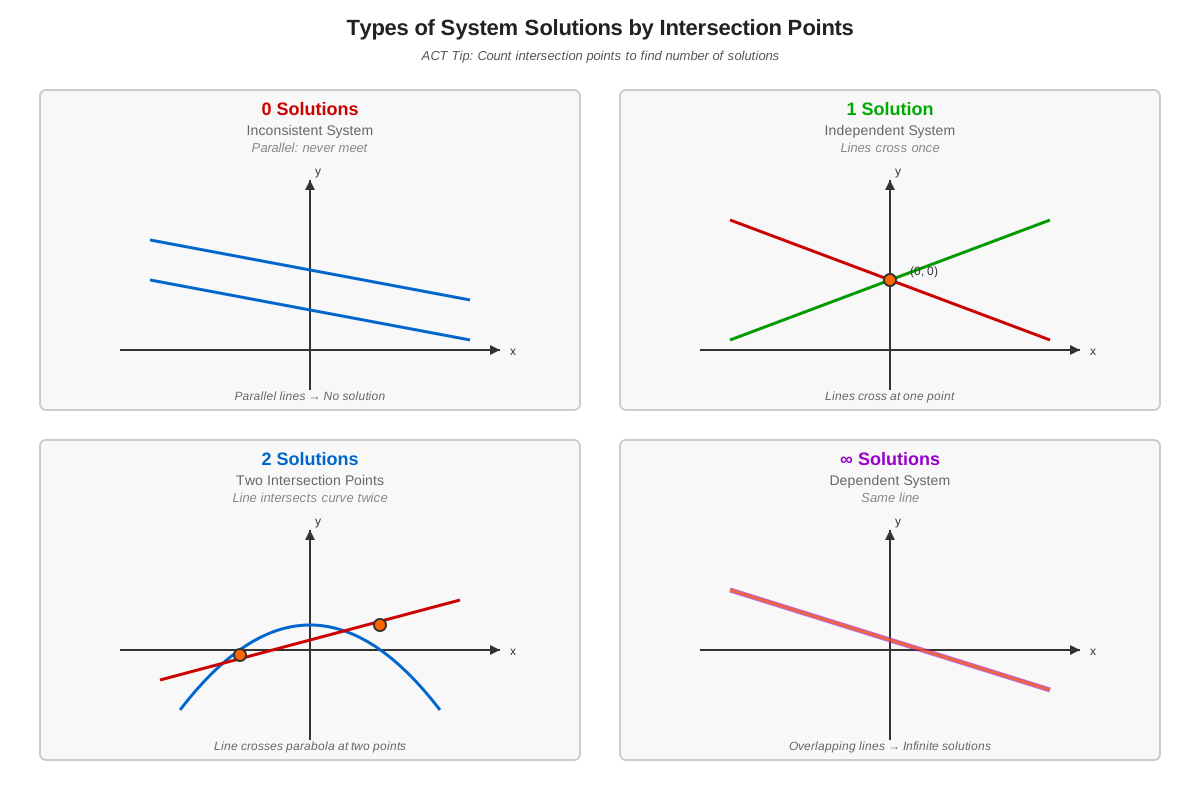
- One solution: Graphs intersect at exactly one point (most common on ACT)
- No solution: Graphs never intersect (parallel lines, non-intersecting curves)
- Infinitely many solutions: Graphs coincide completely (same line or curve)
- Multiple finite solutions: Graphs intersect at several distinct points (common with nonlinear systems)
Types of Systems by Classification
Systems are classified by their solution characteristics:
| System Type | Visual Characteristic | Number of Solutions | Example |
|---|---|---|---|
| Consistent Independent | Graphs intersect at distinct point(s) | One or more finite solutions | Two non-parallel lines |
| Inconsistent | Graphs never intersect | Zero solutions | Parallel lines with different y-intercepts |
| Consistent Dependent | Graphs coincide completely | Infinitely many solutions | Same line graphed twice |
For ACT purposes, recognizing these patterns quickly enables immediate answer selection without calculation.
Linear-Linear Systems
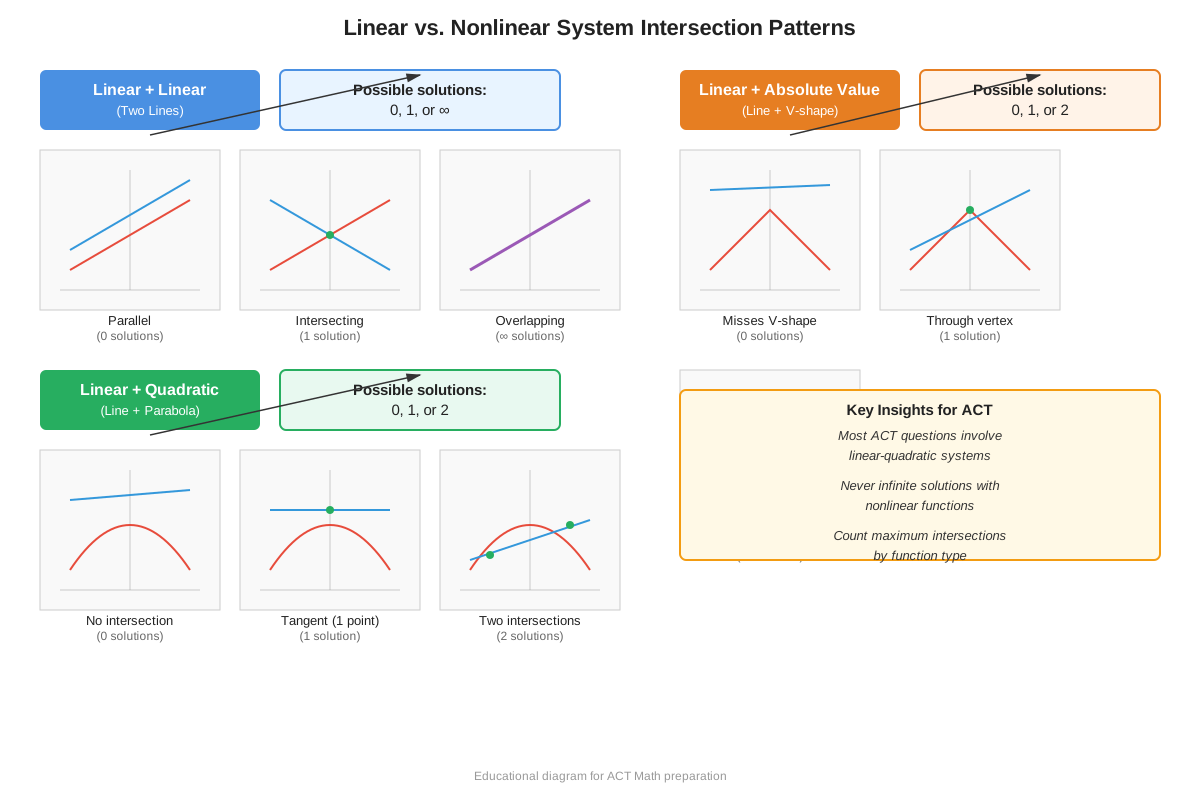
When two linear equations are graphed, three scenarios exist:
- Intersecting lines (different slopes): Exactly one solution at the intersection point. The solution coordinates can be read directly from the graph where the lines cross.
- Parallel lines (same slope, different y-intercepts): No solution because the lines never meet. Visually, the lines maintain constant separation across the entire plane.
- Coincident lines (identical equations): Infinitely many solutions because every point on one line is also on the other. These appear as a single line on the graph.
The ACT most frequently tests intersecting lines, asking students to identify the solution coordinates or verify that exactly one solution exists.
Linear-Quadratic Systems
A linear-quadratic system pairs a straight line with a parabola. This combination can produce:
- Two solutions: Line intersects parabola at two distinct points (most common scenario)
- One solution: Line is tangent to parabola, touching at exactly one point
- No solutions: Line and parabola never intersect
The number of solutions depends on the line's position relative to the parabola's vertex and orientation. A line passing through a parabola's interior typically creates two intersection points, while a line positioned entirely above an upward-opening parabola creates zero intersections.
Quadratic-Quadratic Systems
When two parabolas are graphed together, the intersection possibilities expand:
- Zero solutions: Parabolas don't touch (one entirely above the other)
- One solution: Parabolas are tangent or one vertex touches the other curve
- Two solutions: Parabolas intersect at two points (most common)
- Three or four solutions: Possible with specific orientations, though rare on ACT
The ACT typically presents quadratic-quadratic systems with two clear intersection points, testing whether students can accurately count intersections even when curves are involved.
Circle-Line Systems
A circle graphed with a line creates three possible scenarios:
- Two solutions: Line is a secant, passing through the circle and intersecting at two points
- One solution: Line is tangent, touching the circle at exactly one point
- No solutions: Line is external, never touching the circle
These systems test understanding of both circle equations and geometric relationships between lines and circles.
Reading Solution Coordinates from Graphs
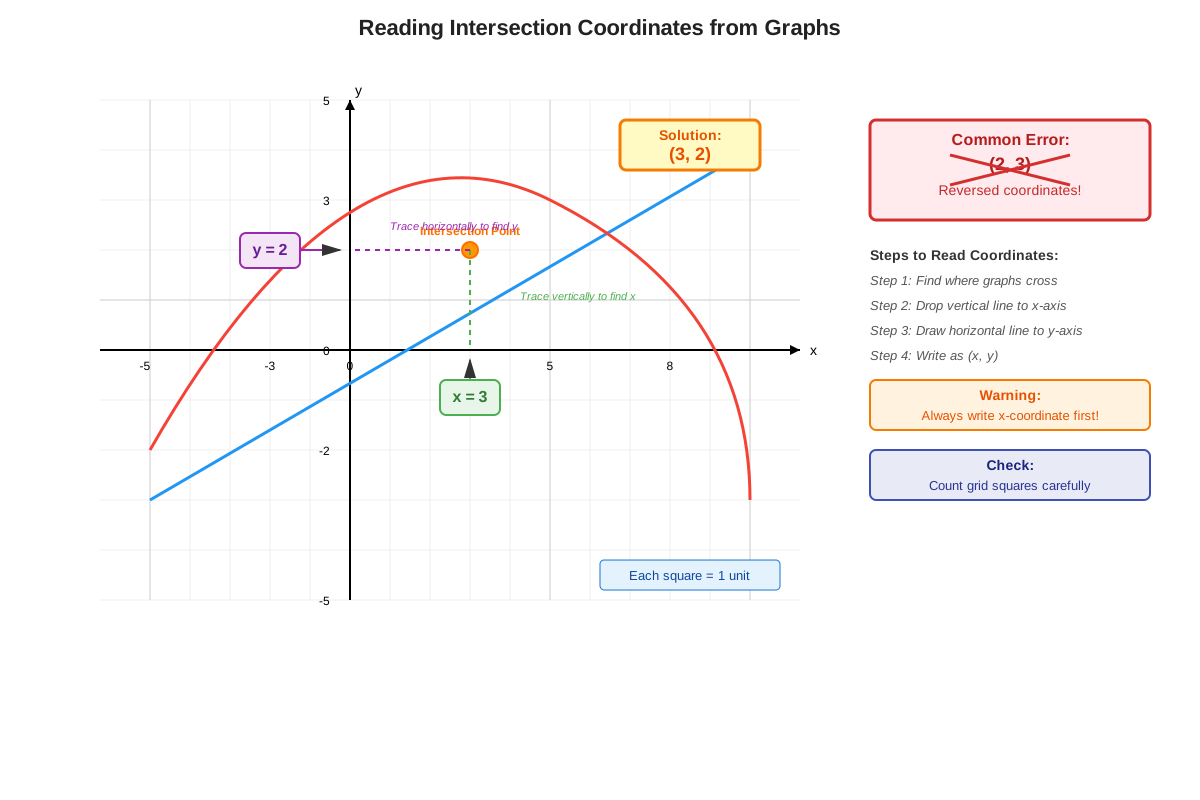
To identify solution coordinates accurately:
- Locate all intersection points visually
- Draw imaginary vertical and horizontal lines from each intersection to the axes
- Read the x-coordinate from the x-axis and y-coordinate from the y-axis
- Verify the point satisfies both equations if time permits
ACT graphs typically use grid lines at integer intervals, making coordinate reading straightforward. However, students must be careful with scale—sometimes axes use intervals of 2, 5, or other values rather than 1.
Counting Solutions Systematically
The most common ACT question format asks: "How many solutions does this system have?" To answer reliably:
- Identify each function type (linear, quadratic, circle, etc.)
- Scan the entire visible graph for intersection points, including edges
- Count carefully, marking each intersection mentally or with pencil
- Consider whether graphs might intersect outside the visible window (rare on ACT, but worth noting)
Students should be particularly careful with tangent points (where curves touch but don't cross) and with intersections occurring exactly on axis lines.
Concept Relationships
The concepts within systems on graphs build hierarchically: understanding individual function graphs (lines, parabolas, circles) → recognizing how multiple graphs can relate spatially → identifying intersection points as simultaneous solutions → classifying systems by solution count and type. Each concept reinforces the others—knowing that parallel lines never intersect helps identify inconsistent systems, while understanding parabola shape predicts how many times a line might cross it.
Systems on graphs connects backward to prerequisite topics extensively. Linear equations provide the foundation for understanding line behavior in systems, while quadratic functions enable interpretation of parabolic curves. Coordinate plane fundamentals make reading intersection coordinates possible, and function notation helps students understand that intersection points represent x-values where f(x) = g(x).
Forward connections include optimization problems (finding maximum/minimum values subject to constraints), inequalities on graphs (shading regions), and parametric equations. The visual reasoning developed through systems on graphs transfers directly to analyzing more complex multi-variable relationships.
Relationship map: Individual function graphs → Multiple functions on same plane → Intersection analysis → Solution identification → System classification → Application to word problems and constraints
High-Yield Facts
⭐ An intersection point of two graphs represents a coordinate pair (x, y) that satisfies both equations simultaneously
⭐ Two non-parallel lines always intersect at exactly one point
⭐ A line can intersect a parabola at 0, 1, or 2 points
⭐ Parallel lines have the same slope but different y-intercepts and create inconsistent systems with no solution
⭐ The number of solutions equals the number of intersection points visible on the graph
- Two parabolas can intersect at 0, 1, 2, 3, or 4 points, though 2 is most common on the ACT
- A line tangent to a curve touches at exactly one point, creating a system with one solution
- Coincident lines (identical equations) produce infinitely many solutions
- A circle and a line can intersect at 0, 1, or 2 points depending on whether the line is external, tangent, or secant
- Solution coordinates can be read directly from the graph by identifying x and y values at intersection points
- Systems with no intersection points are called inconsistent and have no solution
- The ACT typically displays graphs with clear intersection points at or near grid intersections for easy reading
Quick check — test yourself on Systems on graphs so far.
Try Flashcards →Common Misconceptions
Misconception: Intersection points only count if they fall exactly on grid intersections → Correction: Any point where graphs cross is a solution, regardless of whether coordinates are integers. ACT graphs may show intersections between grid lines, requiring estimation or careful reading of the scale.
Misconception: If two graphs touch at a point, that creates two solutions → Correction: Tangent points where graphs touch but don't cross represent exactly one solution. The graphs must actually cross through each other to create distinct solutions on either side.
Misconception: Parallel lines that appear very close together will eventually intersect → Correction: Parallel lines maintain constant separation and never intersect, no matter how far extended. If lines have the same slope, they either never meet (parallel) or are the same line (coincident).
Misconception: A system can have exactly three solutions → Correction: While possible with certain curve combinations (like two parabolas), linear-linear systems have 0, 1, or infinitely many solutions, and linear-quadratic systems have 0, 1, or 2 solutions. The number of solutions depends on the function types involved.
Misconception: The solution to a system is found by adding the y-values where graphs intersect → Correction: The solution is the actual coordinate point (x, y) where graphs intersect, not any arithmetic combination of coordinates. Each intersection point is itself a complete solution.
Misconception: If graphs intersect outside the visible coordinate plane, those intersections don't count → Correction: While ACT questions typically show all relevant intersections within the displayed window, mathematically, solutions exist wherever graphs intersect, visible or not. However, ACT questions are designed so all necessary information appears in the displayed region.
Worked Examples
Example 1: Linear-Quadratic System
Problem: The graph shows a line and a parabola on the coordinate plane. The line passes through points (-2, 0) and (0, 4). The parabola has vertex at (1, -1) and opens upward, passing through point (0, 0). How many solutions does this system have?
Solution:
Step 1: Visualize or sketch the described graphs. The line has slope m = (4-0)/(0-(-2)) = 4/2 = 2, so its equation is y = 2x + 4.
Step 2: The parabola opens upward with vertex at (1, -1). Since it passes through (0, 0), we can determine it rises from its vertex.
Step 3: Analyze intersection possibilities. The line has positive slope and positive y-intercept (4), so it rises from left to right starting above the origin. The parabola has its lowest point at (1, -1) and opens upward.
Step 4: Trace the line's path: at x = -2, y = 0; at x = 0, y = 4; continuing right with slope 2. Trace the parabola's path: vertex at (1, -1), passing through (0, 0), rising on both sides of the vertex.
Step 5: The line starts above the parabola on the left (since the parabola dips down to vertex at y = -1), crosses through the parabola at (0, 0) [first intersection], and continues rising. The parabola also rises from its vertex, and since it curves upward while the line is straight, they will intersect again on the right side [second intersection].
Answer: The system has 2 solutions—one at (0, 0) and another at a point to the right of the vertex.
Connection to learning objectives: This example demonstrates identifying systems on graphs (recognizing the linear-quadratic combination), explaining the strategy (analyzing how line and parabola positions create intersections), and applying the concept to determine solution count.
Example 2: Identifying Solution Coordinates
Problem: The graph below shows two lines intersecting. Line A passes through (-3, 2) and (3, 8). Line B passes through (-2, 10) and (4, 4). At what point do these lines intersect?
Solution:
Step 1: Find the equation of Line A. Slope = (8-2)/(3-(-3)) = 6/6 = 1. Using point-slope form with (3, 8): y - 8 = 1(x - 3), so y = x + 5.
Step 2: Find the equation of Line B. Slope = (4-10)/(4-(-2)) = -6/6 = -1. Using point-slope form with (4, 4): y - 4 = -1(x - 4), so y = -x + 8.
Step 3: Set equations equal to find intersection: x + 5 = -x + 8
Step 4: Solve for x: 2x = 3, so x = 1.5
Step 5: Substitute back: y = 1.5 + 5 = 6.5
Step 6: Verify with second equation: y = -1.5 + 8 = 6.5 ✓
Answer: The lines intersect at (1.5, 6.5) or (3/2, 13/2).
Graphical approach: If this were presented as a graph, students would locate where the lines cross and read the coordinates directly from the axes, checking that x = 1.5 (halfway between 1 and 2) and y = 6.5 (halfway between 6 and 7).
Connection to learning objectives: This demonstrates applying systems on graphs to find exact solution coordinates, showing both algebraic verification and the graphical reading strategy that makes ACT questions faster to solve.
Exam Strategy
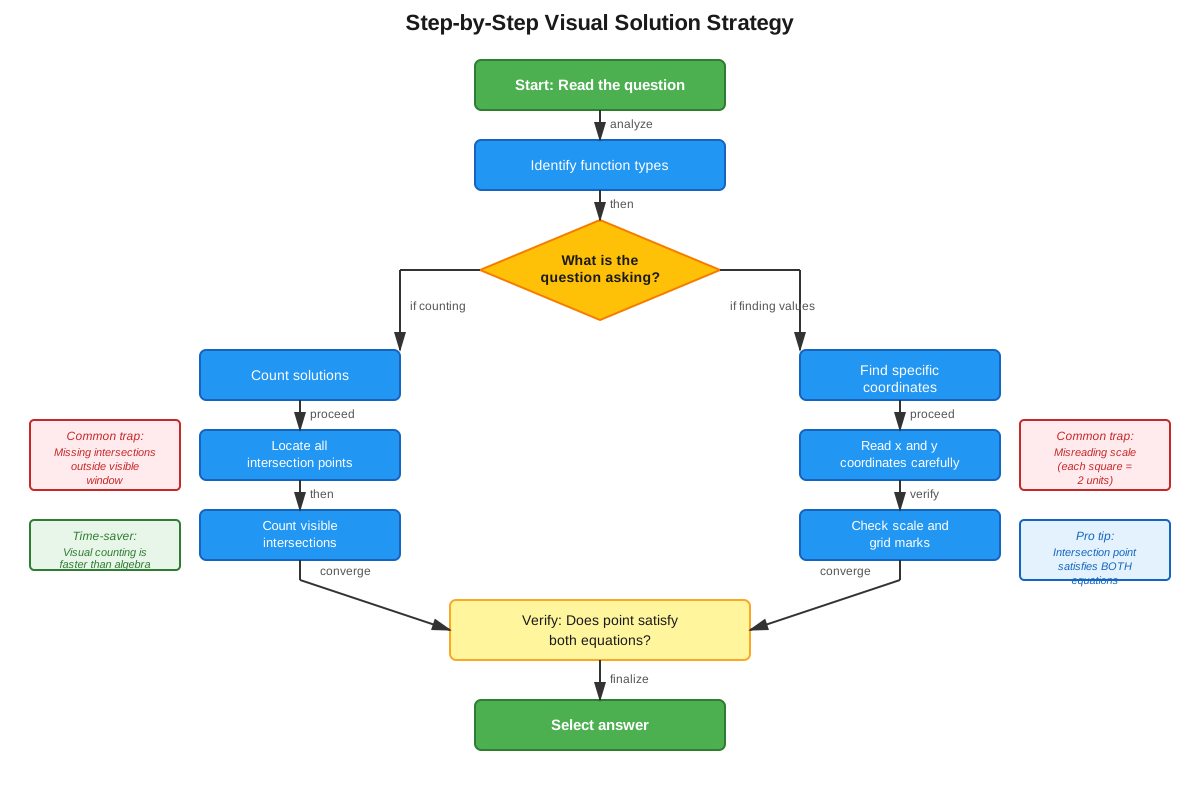
When approaching ACT systems on graphs questions, follow this systematic process:
Step 1: Identify the question type. Look for trigger phrases like "how many solutions," "at what point do the graphs intersect," "which coordinate pair satisfies both equations," or "the system has no solution when." These phrases immediately signal a systems on graphs problem.
Step 2: Classify the functions involved. Quickly identify whether you're dealing with lines (straight), parabolas (U-shaped), circles, absolute value functions (V-shaped), or other curves. This classification predicts possible solution counts.
Step 3: Scan for intersections systematically. Start from the left side of the graph and move right, marking each intersection point mentally or with your pencil. Don't forget to check the edges of the displayed region.
Step 4: For coordinate questions, read carefully. Use the grid lines to determine exact x and y values. If the intersection falls between grid lines, estimate based on the scale or use the answer choices to guide you.
Step 5: Verify using answer choices. If asked for solution coordinates, you can often plug answer choices back into the equations mentally or check them against the graph visually.
Exam Tip: Questions asking "how many solutions" are typically faster than those asking for specific coordinates. If running short on time, prioritize solution-counting questions.
Trigger words and phrases to watch for:
- "intersect" or "intersection point" → find where graphs cross
- "solution to the system" → identify intersection coordinates
- "how many solutions" → count intersection points
- "no solution" → look for parallel lines or non-intersecting curves
- "infinitely many solutions" → look for coincident (identical) graphs
- "satisfy both equations" → find intersection points
Process of elimination tips:
- If graphs clearly intersect twice, eliminate answers saying 0, 1, or infinitely many solutions
- If lines are parallel (same slope), eliminate any answer suggesting they intersect
- For coordinate questions, eliminate any answer where the point clearly doesn't lie on both graphs
- If a point is in the wrong quadrant based on the graph, eliminate it immediately
Time allocation: Spend 30-45 seconds on solution-counting questions and up to 60 seconds on coordinate-identification questions. If a question requires extensive calculation to verify coordinates, consider marking it and returning if time permits—the visual approach should be faster.
Memory Techniques
Mnemonic for solution counts: "L-L-Q" (Linear-Linear-Quadratic)
- Linear + Linear = 0, 1, or ∞ solutions
- Linear + Quadratic = 0, 1, or 2 solutions
- Quadratic + Quadratic = 0, 1, 2, 3, or 4 solutions
Visualization strategy: Picture graphs as "paths" that either cross, run parallel, or overlap. Intersections are "meetings" where both paths occupy the same point simultaneously.
Acronym for systematic checking: "SCAN"
- Spot the function types
- Count intersection points
- Analyze coordinates if needed
- Notate or mark your answer
Memory aid for parallel lines: "Same Slope, Separate Paths" (SSSP) → Parallel lines have identical slopes but never meet, creating no solution.
Tangent point reminder: "Touch Once, One Solution" → When graphs are tangent (touching at one point without crossing), the system has exactly one solution.
Summary
Systems on graphs represent the visual interpretation of simultaneous equations, where intersection points of graphed functions correspond to coordinate pairs satisfying all equations in the system. The ACT tests this concept by presenting two or more functions on a coordinate plane and asking students to count solutions, identify intersection coordinates, or classify system types. Mastery requires recognizing function types (linear, quadratic, circles, etc.), understanding how different combinations create varying numbers of solutions, and accurately reading coordinates from graphs. Linear-linear systems produce 0, 1, or infinitely many solutions depending on whether lines are parallel, intersecting, or coincident. Linear-quadratic systems typically yield 0, 1, or 2 solutions based on line position relative to the parabola. The key strategy involves systematic visual scanning for intersections rather than algebraic manipulation, making these questions among the fastest to solve when approached correctly. Success depends on careful counting, accurate coordinate reading, and understanding that each intersection point represents a complete solution to the system.
Key Takeaways
- Intersection points are solutions: Every point where graphs cross represents an (x, y) pair satisfying all equations simultaneously
- Function type determines solution count: Linear-linear systems have 0, 1, or ∞ solutions; linear-quadratic systems have 0, 1, or 2 solutions
- Visual analysis beats algebra: On the ACT, reading intersections from graphs is faster and more reliable than solving systems algebraically
- Parallel lines never intersect: Same slope with different y-intercepts creates inconsistent systems with no solution
- Count carefully and systematically: Scan the entire graph from left to right, marking each intersection to avoid missing or double-counting solutions
- Tangent means one solution: When graphs touch at exactly one point without crossing, the system has precisely one solution
- Read coordinates precisely: Use grid lines and scale to determine exact x and y values at intersection points
Related Topics
Linear Inequalities on Graphs: After mastering systems of equations, students progress to systems of inequalities, where solution regions are shaded areas rather than discrete points. This builds on intersection concepts by adding boundary analysis.
Quadratic Functions and Transformations: Deeper understanding of parabola behavior (vertex form, axis of symmetry, transformations) enhances ability to predict intersection patterns in quadratic systems.
Circle Equations: The standard form (x-h)² + (y-k)² = r² connects to systems when circles are graphed with lines or other functions, requiring understanding of radius and center.
Absolute Value Functions: These V-shaped graphs create unique intersection patterns with lines and parabolas, extending system analysis to piecewise-defined functions.
Parametric Equations: Advanced topic where x and y are both functions of a third variable, requiring graphical analysis similar to systems but with time-based interpretation.
Mastering systems on graphs provides the visual reasoning foundation necessary for all these advanced topics, making it a gateway skill for higher-level coordinate geometry.
Practice CTA
Now that you've mastered the core concepts of systems on graphs, it's time to cement your understanding through active practice. Work through the practice questions to apply these strategies to ACT-style problems, and use the flashcards to reinforce high-yield facts and common patterns. Remember: visual pattern recognition improves with repetition, so the more graphs you analyze, the faster and more accurate you'll become on test day. Each practice problem you solve builds the confidence and speed you need to excel on this high-yield ACT topic!
Sign up free to keep reading
Create a free AnvayaPrep account to finish this ACT guide on Systems on graphs — plus flashcards and practice questions.