Overview
Absolute value is one of the most frequently tested concepts in the ACT Math section, appearing in approximately 2-4 questions per exam. This fundamental mathematical concept measures the distance of a number from zero on the number line, regardless of direction. Understanding absolute value is crucial not only for direct questions but also for solving inequalities, graphing functions, and working with complex algebraic expressions that appear throughout the test.
The beauty of absolute value lies in its simplicity and its power. While the basic definition is straightforward—the absolute value of a number is always non-negative—the ACT tests this concept in increasingly sophisticated ways. Students must recognize absolute value in equations, inequalities, coordinate geometry, and even word problems. Mastery of this topic requires understanding both the conceptual foundation and the procedural techniques for solving various problem types.
ACT absolute value questions connect to numerous other mathematical domains tested on the exam. They frequently appear alongside linear equations, quadratic functions, coordinate geometry, and number line representations. Strong absolute value skills enable students to tackle more complex problems involving distance, optimization, and piecewise functions. This topic serves as a bridge between basic arithmetic operations and advanced algebraic reasoning, making it essential for achieving a competitive Math score.
Learning Objectives
- [ ] Identify when Absolute value is being tested in ACT questions
- [ ] Explain the core rule or strategy behind Absolute value operations
- [ ] Apply Absolute value to ACT-style questions accurately
- [ ] Solve absolute value equations with one or two solutions
- [ ] Solve and graph absolute value inequalities on a number line
- [ ] Recognize and interpret absolute value functions in coordinate geometry
- [ ] Translate word problems involving distance into absolute value expressions
Prerequisites
- Basic number line concepts: Understanding positive and negative numbers is essential because absolute value represents distance from zero
- Solving linear equations: Absolute value equations often split into two linear equations that must be solved separately
- Understanding of inequalities: Absolute value inequalities require knowledge of inequality symbols and solution sets
- Coordinate plane basics: Graphing absolute value functions requires familiarity with plotting points and understanding function notation
Why This Topic Matters
Absolute value appears in real-world contexts whenever distance, magnitude, or deviation from a standard matters. Engineers use absolute value to calculate tolerances in manufacturing (a part must be within ±0.05 inches of specification). Statisticians employ it when measuring error or deviation from the mean. GPS systems calculate absolute differences in coordinates to determine distances. Temperature variations, financial gains and losses, and quality control all rely on absolute value concepts.
On the ACT Math section, absolute value questions appear with remarkable consistency. Approximately 3-7% of all Math questions directly test absolute value, translating to 2-4 questions per exam. These questions typically fall into three categories: solving absolute value equations (most common), solving absolute value inequalities (moderately common), and interpreting absolute value in graphs or word problems (less common but higher difficulty). The questions range from straightforward computational problems worth 1 point to complex multi-step problems that separate high scorers from average performers.
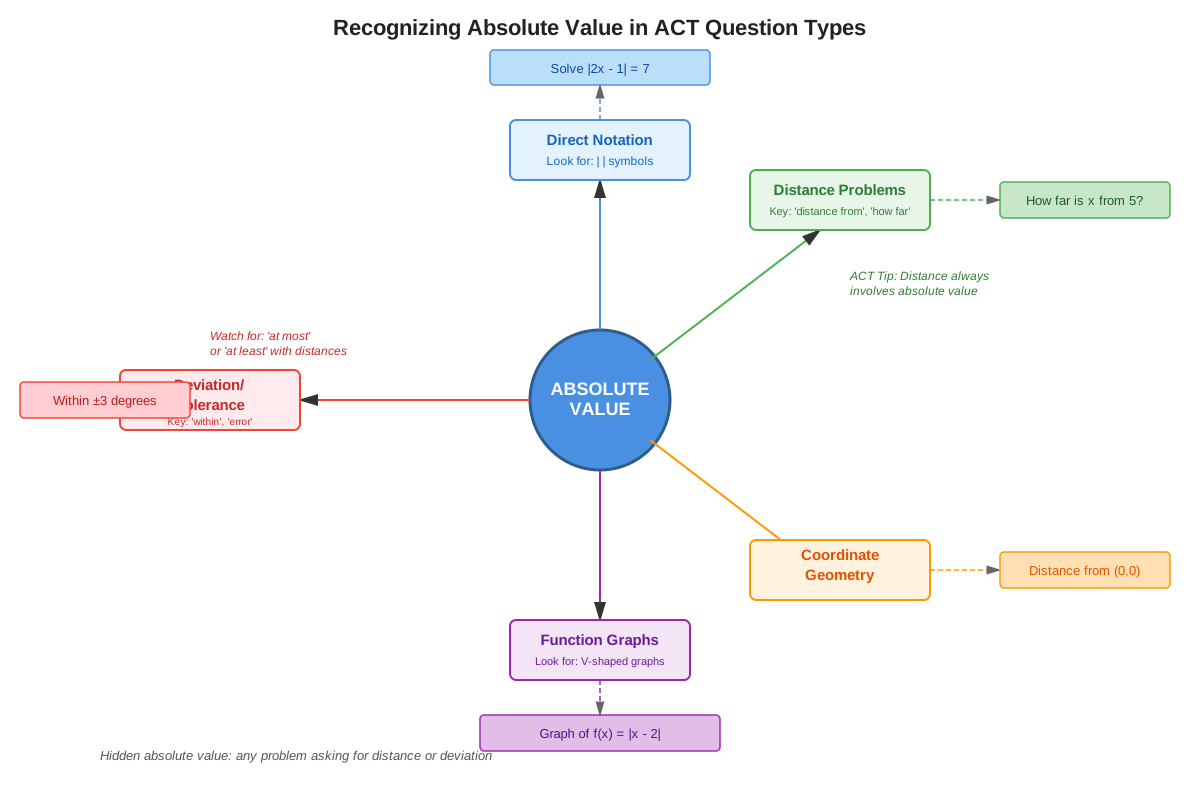
The ACT presents absolute value in various disguises: as standalone equations, embedded within word problems about distance or error, in coordinate geometry questions involving distance from the origin, and in function transformation problems. Recognizing these patterns is crucial for efficient problem-solving. Questions often combine absolute value with other topics like systems of equations, quadratic functions, or geometric formulas, making this a high-yield topic that rewards thorough preparation.
Core Concepts
Definition and Basic Properties
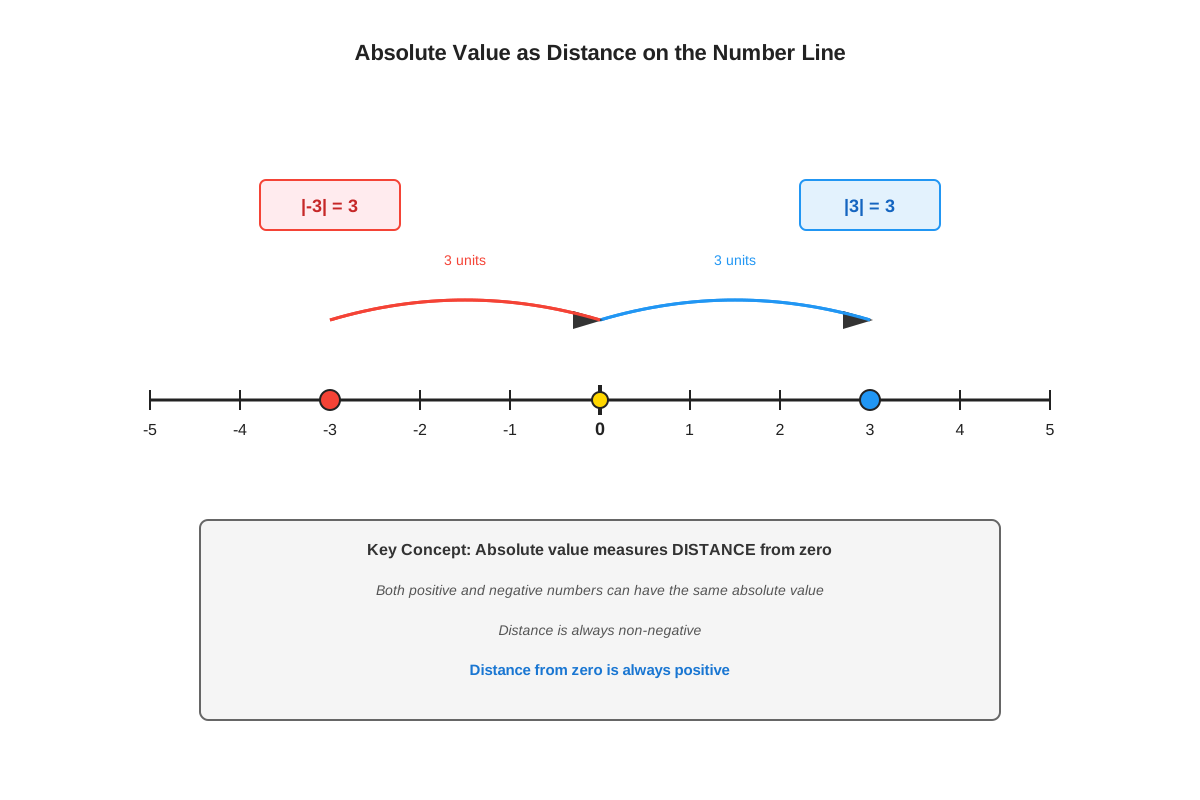
The absolute value of a number, denoted |x|, represents the distance between that number and zero on the number line. Distance is always non-negative, which explains why absolute values are never negative. Mathematically, the absolute value function can be defined piecewise:
|x| = {
  x,   if x ≥ 0
  -x,  if x < 0
}
This definition reveals a crucial insight: for positive numbers and zero, the absolute value equals the number itself. For negative numbers, the absolute value equals the opposite (which makes it positive). For example, |5| = 5 because 5 is already positive, while |-5| = 5 because we take the opposite of -5.
Key properties of absolute value include:
- |x| ≥ 0 for all real numbers x
- |x| = 0 if and only if x = 0
- |x| = |-x| (symmetry property)
- |xy| = |x| · |y| (multiplicative property)
- |x/y| = |x|/|y| when y ≠ 0
Solving Absolute Value Equations
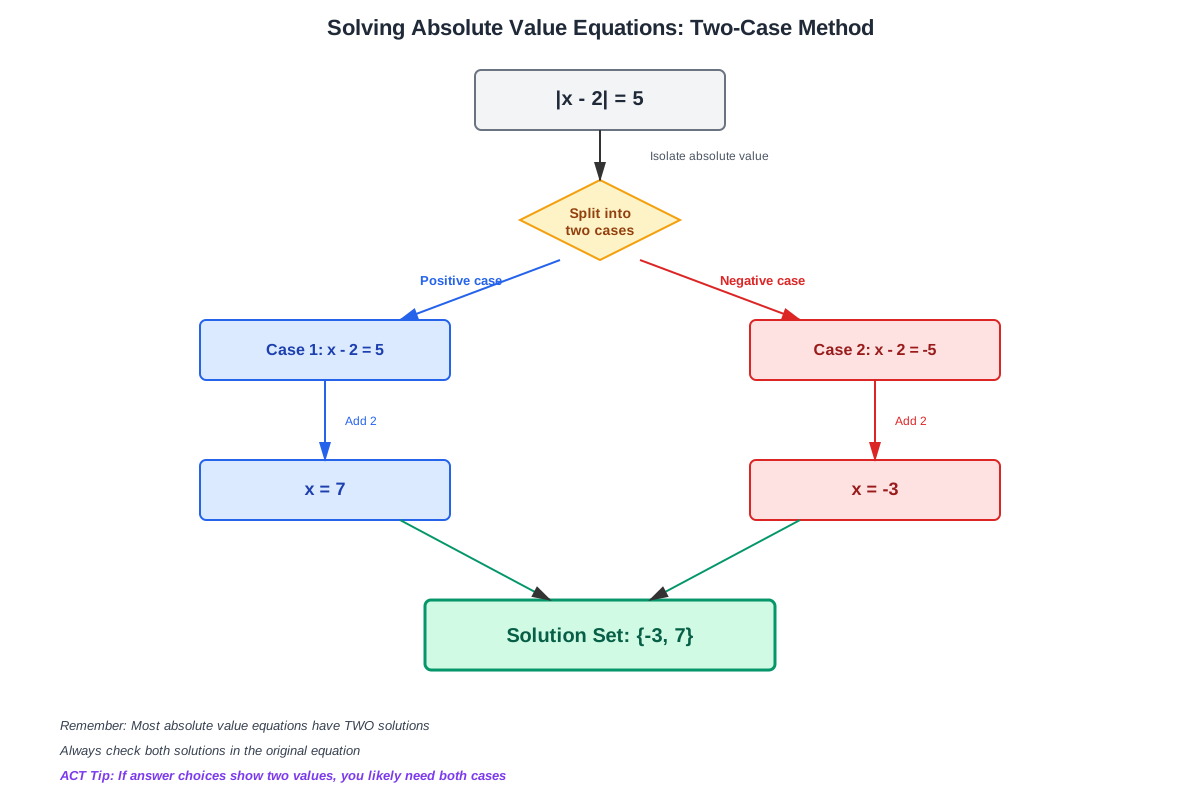
When solving equations involving absolute value, the fundamental strategy involves recognizing that if |x| = a (where a > 0), then x could equal either a or -a. This is because both a and -a are the same distance from zero. This leads to the two-case method:
For |x| = a where a > 0:
- Case 1: x = a
- Case 2: x = -a
For example, solving |x - 3| = 7:
- Case 1: x - 3 = 7, so x = 10
- Case 2: x - 3 = -7, so x = -4
Both solutions should be verified by substituting back into the original equation. Note that if a < 0 in the equation |x| = a, there are no solutions because absolute values cannot be negative.
More complex equations like |2x + 1| = |x - 4| require a different approach. Since both sides are absolute values, we consider when the expressions inside are equal or opposites:
- Case 1: 2x + 1 = x - 4
- Case 2: 2x + 1 = -(x - 4)
Solving Absolute Value Inequalities
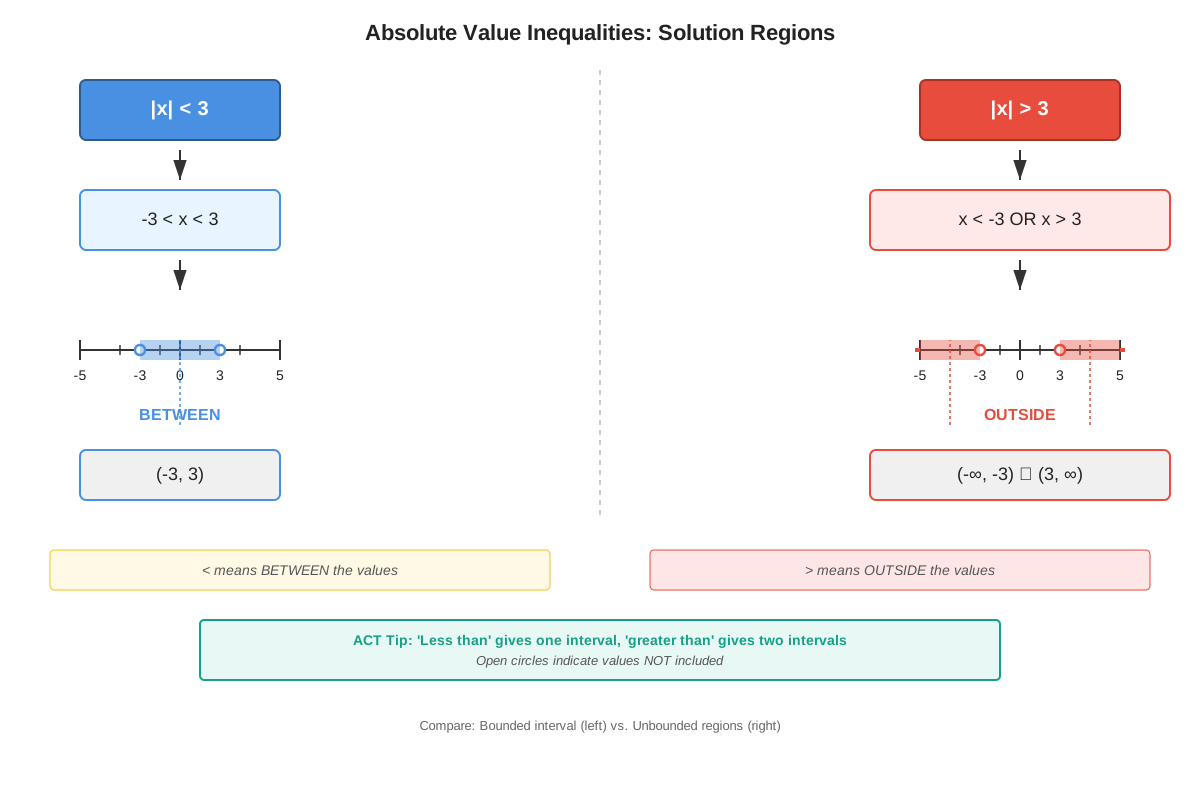
Absolute value inequalities require understanding two distinct patterns based on the inequality direction:
Pattern 1: |x| < a (less than)
This means x is within distance a from zero, creating a bounded interval:
-a < x < a
Example: |x - 2| < 5 translates to -5 < x - 2 < 5, which simplifies to -3 < x < 7.
Pattern 2: |x| > a (greater than)
This means x is more than distance a from zero, creating two separate regions:
x < -a OR x > a
Example: |x + 1| > 3 translates to x + 1 < -3 OR x + 1 > 3, which simplifies to x < -4 OR x > 2.
| Inequality Type | Solution Pattern | Verbal Description | ||
|---|---|---|---|---|
| \ | x\ | < a | -a < x < a | Between -a and a |
| \ | x\ | ≤ a | -a ≤ x ≤ a | Between -a and a, inclusive |
| \ | x\ | > a | x < -a OR x > a | Outside the interval |
| \ | x\ | ≥ a | x ≤ -a OR x ≥ a | Outside the interval, inclusive |
Graphing Absolute Value Functions
The parent absolute value function f(x) = |x| creates a V-shaped graph with its vertex at the origin (0, 0). The graph has two linear pieces: one with slope 1 for x ≥ 0, and one with slope -1 for x < 0.
Transformations follow standard function transformation rules:
- f(x) = |x - h| + k shifts the vertex to (h, k)
- f(x) = a|x| changes the slope to a and -a (vertical stretch/compression)
- f(x) = |x| reflected over the x-axis becomes f(x) = -|x|
Understanding these transformations helps solve ACT questions that ask about vertex location, intercepts, or the number of solutions to equations involving absolute value functions.
Distance Interpretation
One of the most powerful applications of absolute value on the ACT involves interpreting |x - a| as the distance between x and a on the number line. This interpretation transforms abstract equations into concrete geometric problems.
For example, |x - 5| = 3 asks: "What numbers are exactly 3 units away from 5?" The answers are 2 and 8. Similarly, |x - 5| < 3 asks: "What numbers are less than 3 units away from 5?" The answer is all numbers between 2 and 8.
This distance interpretation extends to two-dimensional problems. The expression |x| + |y| represents the "taxicab distance" from the origin, while √(x² + y²) represents the Euclidean distance. Though different, both involve absolute value concepts.
Concept Relationships
The core concepts within absolute value form a logical progression: Definition and Properties → Solving Equations → Solving Inequalities → Graphing Functions → Applications. Each level builds upon the previous, with the definition providing the foundation for all problem-solving techniques.
The two-case method for equations directly stems from the piecewise definition of absolute value. Understanding that |x| represents distance explains why equations have two solutions (two points equidistant from zero) and why inequalities create intervals or unions (regions within or beyond a certain distance).
Absolute value connects to prerequisite topics in essential ways. Linear equations provide the tools for solving each case after splitting an absolute value equation. Number line concepts help visualize solutions to inequalities. Function transformations from algebra enable understanding of absolute value graphs.
This topic also connects forward to more advanced concepts. Piecewise functions are essentially absolute value functions written in expanded form. Distance formulas in coordinate geometry rely on absolute value principles. Optimization problems often involve minimizing absolute value expressions. Understanding absolute value thoroughly creates a foundation for these higher-level topics.
High-Yield Facts
⭐ The absolute value of any real number is always non-negative: |x| ≥ 0 for all x
⭐ If |x| = a where a > 0, then x = a or x = -a: This is the foundation for solving all absolute value equations
⭐ If |x| < a, then -a < x < a: Less than inequalities create a single bounded interval
⭐ If |x| > a, then x < -a OR x > a: Greater than inequalities create two separate regions
⭐ |x - a| represents the distance between x and a on the number line: This interpretation simplifies many word problems
- The equation |x| = a has no solution when a < 0 because absolute values cannot be negative
- |x| = |-x| for all real numbers x, demonstrating the symmetry property
- The graph of f(x) = |x| is V-shaped with vertex at the origin and slopes of ±1
- When solving |A| = |B|, consider both A = B and A = -B as separate cases
- Absolute value can be distributed over multiplication: |xy| = |x| · |y|
- The vertex of f(x) = |x - h| + k is located at the point (h, k)
- Absolute value inequalities with ≤ or ≥ include the boundary points in the solution
Quick check — test yourself on Absolute value so far.
Try Flashcards →Common Misconceptions
Misconception: |x| always equals x → Correction: The absolute value equals x only when x is non-negative. When x is negative, |x| = -x, which is positive. For example, |-3| = 3, not -3.
Misconception: The equation |x| = -5 has solutions x = 5 and x = -5 → Correction: This equation has no solutions because absolute values are never negative. If |x| = a and a < 0, the solution set is empty.
Misconception: |x + 3| = x + 3 for all x → Correction: This is only true when x + 3 ≥ 0, meaning x ≥ -3. When x < -3, the expression inside is negative, so |x + 3| = -(x + 3) = -x - 3.
Misconception: To solve |x| < 5, split it into x < 5 or x < -5 → Correction: Less than inequalities create a single bounded interval, not an "or" statement. The correct solution is -5 < x < 5, which can be written as a compound inequality.
Misconception: |a + b| = |a| + |b| for all values → Correction: This is false in general. For example, |-3 + 3| = 0, but |-3| + |3| = 6. The triangle inequality states |a + b| ≤ |a| + |b|, with equality only when a and b have the same sign.
Misconception: When graphing y = -|x|, the V-shape opens upward → Correction: The negative sign in front reflects the graph over the x-axis, creating a V-shape that opens downward with vertex at the origin.
Misconception: |x²| = x² is unnecessary to write because squaring is already positive → Correction: While it's true that x² ≥ 0 for all real x, making |x²| = x², the absolute value notation is sometimes used for emphasis or in contexts where the expression might be generalized.
Worked Examples
Example 1: Solving an Absolute Value Equation
Problem: Solve |2x - 5| = 11
Solution:
Step 1: Recognize this is an absolute value equation with a positive right side, so we'll have two cases.
Step 2: Set up Case 1 (positive case):
2x - 5 = 11
2x = 16
x = 8
Step 3: Set up Case 2 (negative case):
2x - 5 = -11
2x = -6
x = -3
Step 4: Verify both solutions:
- For x = 8: |2(8) - 5| = |16 - 5| = |11| = 11 ✓
- For x = -3: |2(-3) - 5| = |-6 - 5| = |-11| = 11 ✓
Answer: x = 8 or x = -3
This example demonstrates the two-case method and shows how both solutions must be verified. This directly addresses the learning objective of applying absolute value to ACT-style questions accurately.
Example 2: Solving an Absolute Value Inequality
Problem: Solve and graph |x + 2| ≤ 6
Solution:
Step 1: Identify this as a "less than or equal to" inequality, which creates a bounded interval.
Step 2: Apply the pattern |x| ≤ a means -a ≤ x ≤ a:
-6 ≤ x + 2 ≤ 6
Step 3: Solve the compound inequality by subtracting 2 from all parts:
-6 - 2 ≤ x ≤ 6 - 2
-8 ≤ x ≤ 4
Step 4: Graph on a number line:
The solution includes all numbers from -8 to 4, inclusive. On a number line, this would be represented with closed circles at -8 and 4, with a solid line connecting them.
Step 5: Verify with a test point (x = 0):
|0 + 2| = 2, and 2 ≤ 6 ✓
Answer: -8 ≤ x ≤ 4, or in interval notation: [-8, 4]
This example illustrates the core strategy for solving absolute value inequalities and connects to the learning objective of explaining the core rule behind absolute value operations.
Example 3: Word Problem Application
Problem: A manufacturing machine produces bolts that must be 2.5 inches long, with a tolerance of ±0.03 inches. Write an absolute value inequality that represents acceptable bolt lengths, and determine if a bolt measuring 2.47 inches is acceptable.
Solution:
Step 1: Interpret the problem using distance language. The bolt length x must be within 0.03 inches of 2.5 inches.
Step 2: Translate to absolute value: |x - 2.5| ≤ 0.03
Step 3: Solve the inequality:
-0.03 ≤ x - 2.5 ≤ 0.03
2.47 ≤ x ≤ 2.53
Step 4: Test the given bolt length:
Is 2.47 in the interval [2.47, 2.53]? Yes, it's at the lower boundary.
Alternatively, check directly: |2.47 - 2.5| = |-0.03| = 0.03 ≤ 0.03 ✓
Answer: The inequality is |x - 2.5| ≤ 0.03, and the 2.47-inch bolt is acceptable (just barely).
This example demonstrates how to identify when absolute value is being tested in real-world contexts and shows the distance interpretation of absolute value expressions.
Exam Strategy
Key Trigger Words: Watch for "distance from," "within," "tolerance," "deviation," "how far," and "difference between" in word problems—these often signal absolute value.
When approaching ACT absolute value questions, follow this systematic process:
Step 1: Identify the type (equation, inequality, or graph/application)
- Equations: Look for |expression| = number
- Inequalities: Look for |expression| < number or |expression| > number
- Applications: Look for distance or deviation language
Step 2: Choose the appropriate strategy
- For equations with positive right side: Split into two cases
- For < or ≤ inequalities: Create a compound inequality (bounded interval)
- For > or ≥ inequalities: Create an "or" statement (two separate regions)
Step 3: Solve carefully
- Show all algebraic steps to avoid careless errors
- Remember to apply operations to all parts of compound inequalities
- Keep track of whether boundaries are included (≤, ≥) or excluded (<, >)
Step 4: Check your answer
- Substitute solutions back into the original equation
- Test a point in your solution interval for inequalities
- Verify that your answer makes sense in context for word problems
Time Management: Straightforward absolute value equations should take 30-45 seconds. Inequalities may require 60-90 seconds. Complex word problems or multi-step questions might need 2 minutes. If a question combines absolute value with other topics (like systems of equations), allocate additional time but consider whether it's worth attempting if you're running short on time.
Process of Elimination Tips:
- Eliminate any answer choice that gives a negative result when substituted into an absolute value expression that should equal a positive number
- For inequality questions, test the boundary points—if they don't work and the inequality is strict (< or >), eliminate choices that include them
- For graphing questions, eliminate any graph that doesn't have the characteristic V-shape or has the vertex in the wrong location
Memory Techniques
LESS-THAN-BETWEEN Mnemonic: For absolute value inequalities, remember "LESS than means BETWEEN." When you see |x| < a, the solution is between -a and a. The word "less" has fewer letters than "greater," just as the solution is a smaller, bounded region.
GREATER-THAN-OUTER Mnemonic: "GREATER than means OUTER regions." When you see |x| > a, the solution is in the outer regions: x < -a OR x > a.
Two-Case Visualization: Picture a number line with zero in the center. When solving |x| = 5, visualize two points that are 5 units from zero—one to the left (-5) and one to the right (5). This mental image reinforces why equations have two solutions.
V for Victory: Remember that absolute value graphs make a "V" shape. The vertex is at the point (h, k) in the form |x - h| + k. Think "V for Vertex" to remember the V-shape.
Distance Definition: Create a mental anchor: "Absolute value = Always positive distance." The three A's help remember that absolute value measures distance, which is always positive.
PEMDAS Plus: When evaluating expressions with absolute value, treat the absolute value bars like parentheses in the order of operations—evaluate what's inside first, then take the absolute value.
Summary
Absolute value is a high-yield ACT Math topic that measures distance from zero on the number line, always producing non-negative results. The fundamental principle—that |x| equals x when x is positive and equals -x when x is negative—underlies all problem-solving strategies. Equations of the form |x| = a split into two cases (x = a and x = -a), while inequalities follow two distinct patterns: |x| < a creates a bounded interval (-a < x < a), and |x| > a creates two separate regions (x < -a OR x > a). Recognizing absolute value in various contexts—from straightforward equations to word problems involving distance, tolerance, or deviation—is essential for ACT success. The distance interpretation (|x - a| represents distance between x and a) provides powerful insight for solving complex problems. Mastery requires understanding both the conceptual foundation and the procedural techniques, including the two-case method for equations, compound inequalities for "less than" problems, and union notation for "greater than" problems. With consistent practice and attention to common misconceptions, students can confidently tackle the 2-4 absolute value questions that appear on each ACT Math section.
Key Takeaways
- Absolute value always produces non-negative results and represents distance from zero on the number line
- Equations split into two cases: If |x| = a (where a > 0), then x = a or x = -a
- "Less than" inequalities create bounded intervals: |x| < a means -a < x < a
- "Greater than" inequalities create two separate regions: |x| > a means x < -a OR x > a
- Distance interpretation is powerful: |x - a| represents the distance between x and a
- Watch for trigger words in word problems: distance, tolerance, deviation, within, difference
- Always verify solutions by substituting back into the original equation or testing points in inequality solutions
Related Topics
Piecewise Functions: Absolute value functions are special cases of piecewise functions. Understanding how to write |x| as a piecewise function deepens comprehension and prepares for more complex function analysis.
Distance Formula in Coordinate Geometry: The distance formula √[(x₂-x₁)² + (y₂-y₁)²] involves absolute value concepts, as squaring and taking square roots ensures positive distance values.
Quadratic Equations: Some absolute value equations, when squared to eliminate the absolute value, become quadratic equations requiring factoring or the quadratic formula.
Function Transformations: Mastering absolute value graphs provides a foundation for understanding transformations of all function types, including translations, reflections, and stretches.
Systems of Equations: Advanced problems may combine absolute value equations with linear or quadratic equations, requiring simultaneous solution techniques.
Practice CTA
Now that you've mastered the core concepts of absolute value, it's time to solidify your understanding through practice! Work through the practice questions to apply these strategies to ACT-style problems, and use the flashcards to reinforce key definitions and formulas. Remember, absolute value appears on every ACT Math section—your investment in mastering this topic will pay dividends on test day. Approach each practice problem systematically, and don't hesitate to review the worked examples if you get stuck. You've got this!
Sign up free to keep reading
Create a free AnvayaPrep account to finish this ACT guide on Absolute value — plus flashcards and practice questions.