Overview
Approximation is a critical mathematical skill that enables students to estimate values quickly and efficiently without performing lengthy calculations. On the ACT Math test, approximation serves as both a standalone problem-solving technique and a powerful verification tool for checking answers. This skill becomes particularly valuable when dealing with complex calculations, irrational numbers, or time-constrained situations where exact computation would consume precious minutes. The ability to approximate effectively can mean the difference between completing all 60 questions and leaving several unanswered.
The ACT frequently tests approximation in contexts involving square roots, fractions, percentages, scientific notation, and geometric measurements. Rather than requiring students to calculate exact values, many questions reward those who can quickly estimate to eliminate incorrect answer choices or identify the most reasonable solution. This approach aligns with the exam's emphasis on mathematical reasoning and practical problem-solving over rote computation. Understanding when and how to apply ACT approximation strategies can significantly improve both accuracy and time management.
Approximation connects to virtually every area of ACT Math, from basic arithmetic through advanced algebra and geometry. It serves as a bridge between conceptual understanding and practical application, allowing students to leverage number sense and mathematical intuition. Mastering approximation techniques enhances performance across topics including radical expressions, trigonometric values, exponential functions, and data interpretation—making it one of the highest-yield skills for comprehensive ACT preparation.
Learning Objectives
- [ ] Identify when Approximation is being tested in ACT Math questions
- [ ] Explain the core rule or strategy behind Approximation techniques
- [ ] Apply Approximation to ACT-style questions accurately and efficiently
- [ ] Determine appropriate levels of precision for different question types
- [ ] Use approximation to eliminate incorrect answer choices systematically
- [ ] Verify exact calculations using estimation techniques
- [ ] Recognize when approximation is insufficient and exact calculation is required
Prerequisites
- Basic arithmetic operations: Essential for performing mental calculations and understanding the magnitude of numbers during estimation
- Understanding of place value: Necessary for rounding numbers appropriately and maintaining reasonable precision
- Familiarity with fractions, decimals, and percentages: Required for converting between forms and estimating equivalent values
- Knowledge of perfect squares and common roots: Enables quick estimation of radical expressions without calculation
- Basic algebraic manipulation: Needed to simplify expressions before approximating their values
Why This Topic Matters
Approximation skills extend far beyond standardized testing into everyday life and professional contexts. Engineers use approximation to verify complex calculations, scientists employ estimation to assess experimental results, and business professionals rely on quick mental math to evaluate financial scenarios. The ability to determine whether an answer is "in the ballpark" prevents costly errors and builds confidence in mathematical reasoning.
On the ACT Math test, approximation-related questions appear with remarkable frequency—approximately 8-12 questions per exam either directly test approximation or can be solved more efficiently using estimation techniques. These questions span multiple content areas including Number and Quantity (15-20% of the test), Algebra (30-35%), and Geometry (20-25%). The ACT deliberately includes answer choices that represent common calculation errors, making approximation an invaluable tool for identifying and avoiding these traps.
Common question formats include: estimating the value of radical expressions (√47 ≈ ?), approximating results of complex fraction operations, determining reasonable values for trigonometric functions, estimating areas and volumes in geometric contexts, and evaluating whether calculated answers are reasonable. The exam also tests approximation indirectly through "reasonableness" questions that ask students to identify which answer choice makes sense in a real-world context. Questions may present scenarios where exact calculation is possible but time-consuming, rewarding students who recognize that approximation provides a faster path to the correct answer.
Core Concepts
Understanding Approximation Fundamentals
Approximation is the process of finding a value that is close enough to the correct answer for practical purposes. Unlike rounding, which follows strict rules about place value, approximation involves strategic estimation based on context and available information. The key principle is maintaining sufficient accuracy while simplifying calculations. On the ACT, approximation typically means getting within 5-10% of the exact value, though the required precision varies by question type.
The fundamental strategy involves identifying which components of a calculation have the greatest impact on the final result and focusing precision there while simplifying less significant elements. For example, when calculating 49.7 × 3.02, approximating as 50 × 3 = 150 provides a reasonable estimate, while the exact answer (150.094) differs by less than 0.1%. This approach leverages the mathematical principle that small relative errors in factors produce small relative errors in products.
Rounding Strategies for Approximation
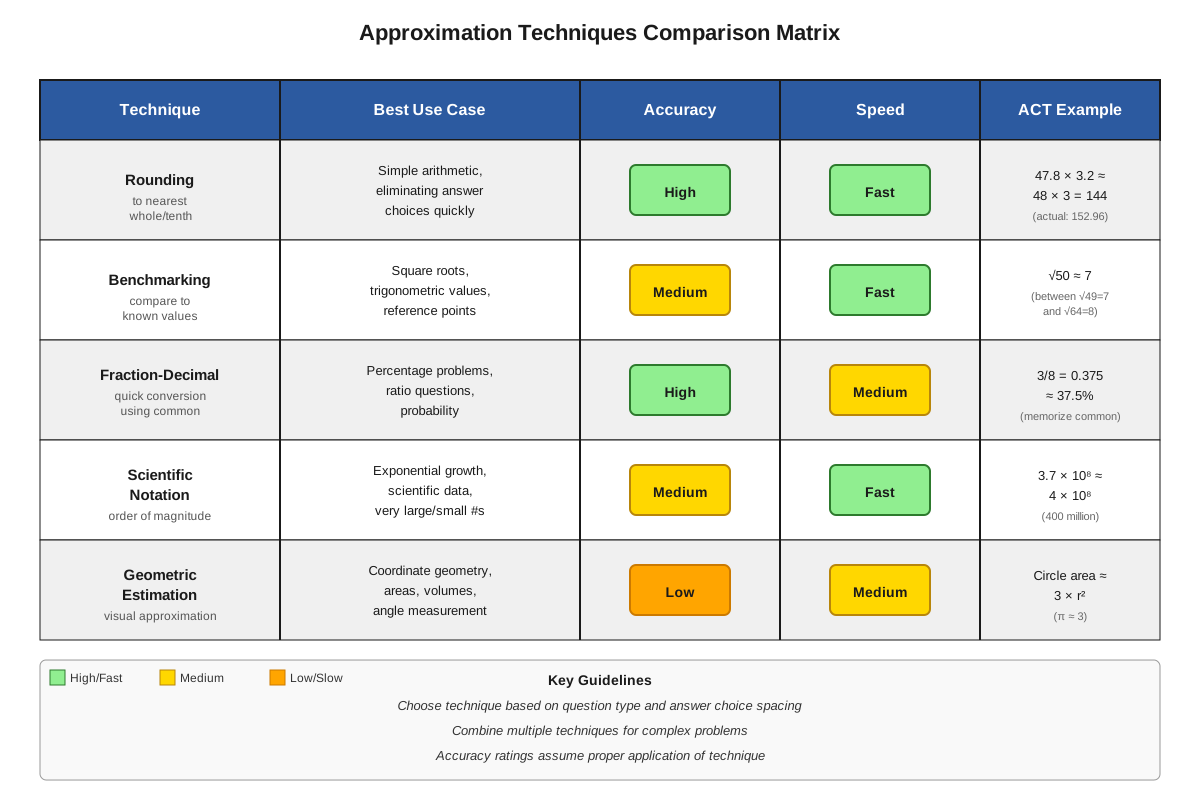
Effective approximation begins with strategic rounding. The ACT rewards students who can round numbers to values that simplify mental calculation while maintaining accuracy. Key strategies include:
Rounding to benchmark numbers: Convert values to nearby multiples of 10, 100, or other convenient numbers. For instance, 487 becomes 500, and 0.0297 becomes 0.03.
Compensating rounding: When rounding multiple numbers, balance overestimates and underestimates. If calculating 48 × 52, round to 50 × 50 = 2,500 (the exact answer is 2,496). Both numbers were rounded in opposite directions, partially canceling the errors.
Maintaining significant figures: Preserve the most important digits while simplifying less significant ones. The number 3,847 might become 3,800 or 4,000 depending on context, but rarely 3,850 since the extra precision provides minimal benefit.
Approximating Radical Expressions
Square roots and other radicals appear frequently on the ACT, and memorizing perfect squares enables rapid approximation. Students should know perfect squares from 1² through 15² at minimum:
| Perfect Square | Value | Perfect Square | Value |
|---|---|---|---|
| 1² | 1 | 9² | 81 |
| 2² | 4 | 10² | 100 |
| 3² | 9 | 11² | 121 |
| 4² | 16 | 12² | 144 |
| 5² | 25 | 13² | 169 |
| 6² | 36 | 14² | 196 |
| 7² | 49 | 15² | 225 |
| 8² | 64 | 16² | 256 |
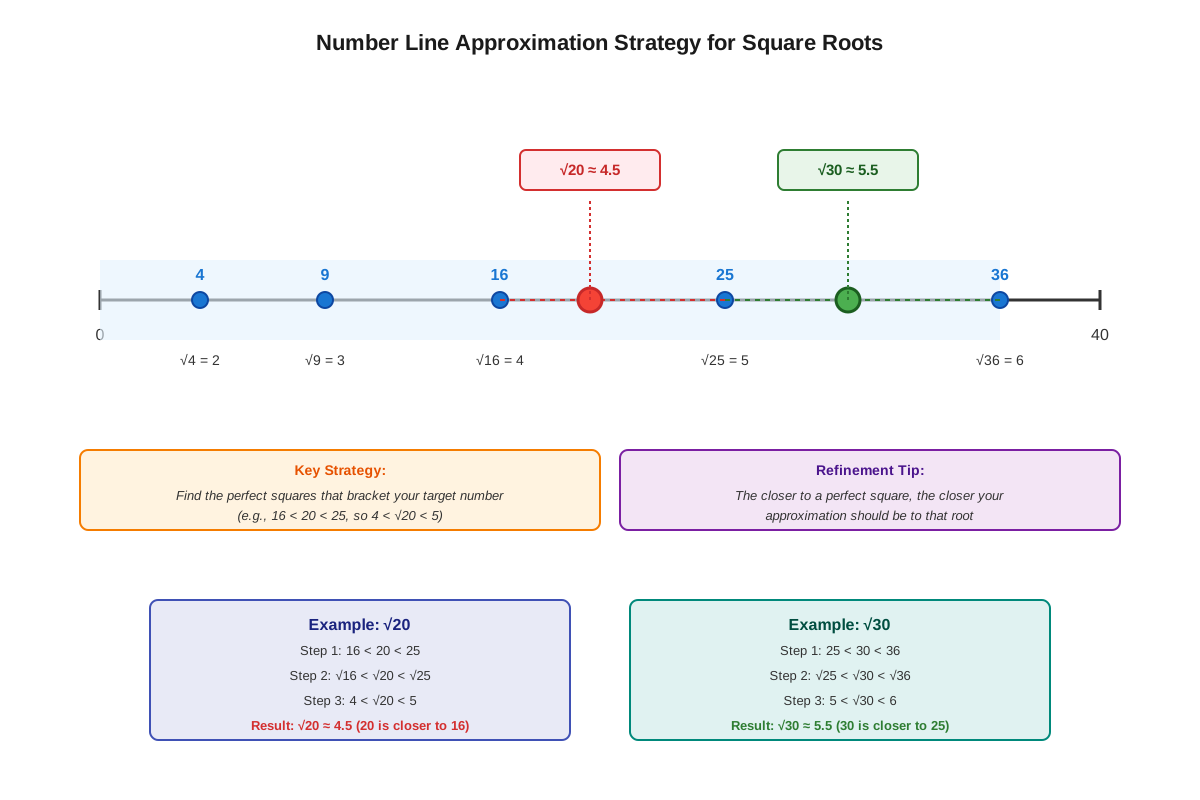
To approximate √N where N is not a perfect square, identify the perfect squares immediately above and below N. For √50, note that 49 < 50 < 64, so 7 < √50 < 8. Since 50 is very close to 49, √50 ≈ 7.1. For greater precision, use linear interpolation: √50 is 1/15 of the way from 49 to 64, so estimate √50 ≈ 7 + (1/15) ≈ 7.07 (actual value: 7.071).
Fraction and Decimal Approximation
Converting between fractions and decimals mentally requires knowing common equivalents:
- 1/2 = 0.5
- 1/3 ≈ 0.33, 2/3 ≈ 0.67
- 1/4 = 0.25, 3/4 = 0.75
- 1/5 = 0.2, 2/5 = 0.4, 3/5 = 0.6, 4/5 = 0.8
- 1/8 = 0.125, 3/8 = 0.375, 5/8 = 0.625, 7/8 = 0.875
- 1/10 = 0.1, 1/100 = 0.01
For complex fractions, simplify before approximating. The expression 47/98 can be approximated as 50/100 = 1/2 = 0.5 (exact value: 0.480). When adding or subtracting fractions, convert to decimals if the denominators are difficult to work with mentally.
Percentage Approximation
Percentage calculations often benefit from approximation. To find 23% of 487, round to 25% of 500: (1/4) × 500 = 125. The exact answer (111.01) is reasonably close for elimination purposes. Key percentage benchmarks include:
- 10% = divide by 10
- 20% = double 10%
- 25% = divide by 4
- 50% = divide by 2
- 75% = three times 25%
Scientific Notation and Order of Magnitude
When working with very large or small numbers, focus on the order of magnitude (the power of 10) before worrying about the coefficient. The number 4.7 × 10⁸ is approximately 5 × 10⁸ or "about half a billion." When multiplying numbers in scientific notation, add exponents and multiply coefficients separately: (3 × 10⁴) × (2 × 10⁷) ≈ 6 × 10¹¹.
Geometric Approximation
For geometric problems, use approximations of π (3.14 or simply 3), and round measurements to convenient values. When calculating the area of a circle with radius 4.9, approximate as π × 5² ≈ 3 × 25 = 75 (exact: 75.43). For irregular shapes, decompose into simpler components and approximate each separately.
Answer Choice Elimination Through Approximation
The ACT's multiple-choice format makes approximation particularly powerful. Often, only one answer choice falls within the reasonable range of an approximation. When calculating 18.7 × 31.4, approximate as 20 × 30 = 600. If answer choices are 387, 587, 687, 787, and 887, only 587 and 687 are plausible, immediately eliminating three options.
Concept Relationships
Approximation serves as a meta-skill that enhances performance across all mathematical domains. The relationship begins with basic arithmetic operations → which enable strategic rounding → which facilitates rapid estimation → which supports answer verification and efficient problem-solving.
Within the approximation framework itself, concepts build hierarchically. Rounding strategies form the foundation, enabling benchmark number recognition → which powers mental calculation shortcuts → which enable complex expression estimation. Simultaneously, memorized values (perfect squares, common fractions) → combine with interpolation techniques → to produce precise approximations when needed.
Approximation connects to prerequisite knowledge through multiple pathways. Place value understanding → enables appropriate rounding decisions → which determine approximation accuracy. Similarly, fraction-decimal equivalence → facilitates percentage approximation → which applies to real-world problem contexts.
The skill also bridges to advanced topics. Approximation of radical expressions → prepares students for quadratic formula applications and distance calculations. Scientific notation approximation → supports exponential function analysis and logarithmic reasoning. Geometric approximation → enhances trigonometric problem-solving and coordinate geometry applications.
High-Yield Facts
⭐ The ACT includes answer choices specifically designed to catch calculation errors, making approximation essential for verification
⭐ Memorizing perfect squares from 1² to 15² enables rapid approximation of most radical expressions on the exam
⭐ When approximating products, rounding one factor up and another down (compensating rounding) minimizes total error
⭐ If an approximation eliminates all but one answer choice, that choice is correct—no exact calculation needed
⭐ For percentage problems, converting to benchmark percentages (10%, 25%, 50%) dramatically speeds calculation
- Approximation is most valuable when exact calculation would require more than 30 seconds
- The ACT rarely requires precision beyond two decimal places in final answers
- When approximating square roots, the result should be closer to the nearer perfect square
- Scientific notation approximation focuses on order of magnitude first, coefficient precision second
- Geometric approximations using π ≈ 3 are sufficient for eliminating incorrect answer choices
- Fraction approximation works best when converting to decimals for addition/subtraction, but keeping fractions for multiplication/division
- When time is limited, approximating to check reasonableness prevents careless errors worth more points than additional problems attempted
Quick check — test yourself on Approximation so far.
Try Flashcards →Common Misconceptions
Misconception: Approximation means rounding everything to the nearest ten or hundred.
Correction: Effective approximation involves strategic rounding to numbers that simplify mental calculation (like 25, 50, or 100) while maintaining sufficient accuracy for the context. Sometimes rounding to the nearest 5 or even keeping one decimal place is more appropriate.
Misconception: Using approximation is "cheating" or shows weak math skills.
Correction: Approximation is a sophisticated mathematical skill that demonstrates number sense and efficiency. Professional mathematicians, scientists, and engineers use approximation constantly to verify calculations and make quick decisions. The ACT explicitly rewards this skill.
Misconception: If you approximate, you can't get the exact right answer.
Correction: Approximation on the ACT is used primarily for eliminating wrong answers and verifying calculations. When approximation narrows choices to one option, that option is correct. Students should still calculate exactly when needed, but approximation guides the process.
Misconception: Always round to the nearest whole number for simplicity.
Correction: The appropriate level of rounding depends on the magnitude of the numbers involved. For 0.047 × 0.053, rounding both to 0 would be useless; instead, round to 0.05 × 0.05. Maintain enough precision to distinguish between answer choices.
Misconception: Approximation only works for arithmetic problems.
Correction: Approximation applies across all ACT Math topics including algebra (estimating solutions to equations), geometry (approximating areas and volumes), trigonometry (estimating function values), and coordinate geometry (estimating distances and slopes). The technique is universal.
Misconception: You should approximate every number in a complex expression.
Correction: Focus approximation on the components that most significantly affect the result. In (49.7 × 3.02) + 0.8, approximate the product but keep 0.8 exact since it's already simple. Over-approximating can introduce unnecessary error.
Misconception: √50 is approximately 5 because 50 ÷ 10 = 5.
Correction: Square roots don't work by simple division. √50 ≈ 7.1 because 7² = 49 and 8² = 64, placing √50 between 7 and 8, closer to 7. Always use perfect squares as reference points for radical approximation.
Worked Examples
Example 1: Approximating Radical Expressions
Problem: Which of the following is closest to √83 + √47?
A) 12
B) 13
C) 14
D) 15
E) 16
Solution:
Step 1: Approximate √83 by identifying nearby perfect squares.
- 9² = 81 and 10² = 100
- Since 83 is very close to 81, √83 ≈ 9.1
Step 2: Approximate √47 using the same method.
- 6² = 36 and 7² = 49
- Since 47 is very close to 49, √47 ≈ 6.9
Step 3: Add the approximations.
- √83 + √47 ≈ 9.1 + 6.9 = 16.0
Step 4: Select the closest answer choice.
- The answer is E) 16
Verification: Using a calculator, √83 ≈ 9.110 and √47 ≈ 6.856, so the sum is approximately 15.966, confirming our approximation was excellent.
Connection to Learning Objectives: This example demonstrates identifying when approximation is being tested (radical expressions without calculators), applying the core strategy (using perfect squares as benchmarks), and using approximation to select the correct answer efficiently.
Example 2: Using Approximation for Answer Elimination
Problem: A rectangular garden measures 47.3 feet by 28.6 feet. Which of the following is closest to the area of the garden in square feet?
A) 950
B) 1,150
C) 1,350
D) 1,550
E) 1,750
Solution:
Step 1: Recognize that exact calculation would be time-consuming.
- 47.3 × 28.6 requires multi-digit multiplication
Step 2: Round strategically to simplify mental calculation.
- Round 47.3 to 50 (up by 2.7)
- Round 28.6 to 30 (up by 1.4)
- Note: Both rounded up, so our estimate will be slightly high
Step 3: Calculate the approximation.
- 50 × 30 = 1,500 square feet
Step 4: Adjust for the direction of rounding.
- Since both dimensions were rounded up, the actual area is somewhat less than 1,500
- The exact answer should be slightly below 1,500
Step 5: Examine answer choices.
- 1,350 is the only choice reasonably close to but below 1,500
- The answer is C) 1,350
Verification: The exact calculation is 47.3 × 28.6 = 1,352.78 square feet, confirming that our approximation strategy led to the correct answer without tedious calculation.
Connection to Learning Objectives: This example shows how to identify when approximation provides an advantage (complex multiplication with convenient answer spacing), apply compensating rounding strategy, and use the approximation to eliminate incorrect choices and identify the correct answer.
Example 3: Percentage Approximation in Context
Problem: A store offers a 23% discount on an item originally priced at $187. Approximately how much will a customer save?
A) $35
B) $43
C) $51
D) $59
E) $67
Solution:
Step 1: Recognize that 23% is close to 25% (one-quarter).
- 25% = 1/4, which is easy to calculate mentally
Step 2: Round the price to a convenient number.
- $187 ≈ $200
Step 3: Calculate 25% of $200.
- 1/4 × $200 = $50
Step 4: Adjust for approximation direction.
- We rounded the percentage up (23% → 25%) and the price up ($187 → $200)
- Both adjustments increase our estimate, so the actual savings is somewhat less than $50
Step 5: Select the closest answer below $50.
- The answer is B) $43
Verification: The exact calculation is 0.23 × $187 = $43.01, confirming our approximation was highly effective.
Connection to Learning Objectives: This demonstrates recognizing approximation opportunities in percentage problems, applying the benchmark percentage strategy (converting to 25%), and using directional awareness to refine the estimate.
Exam Strategy
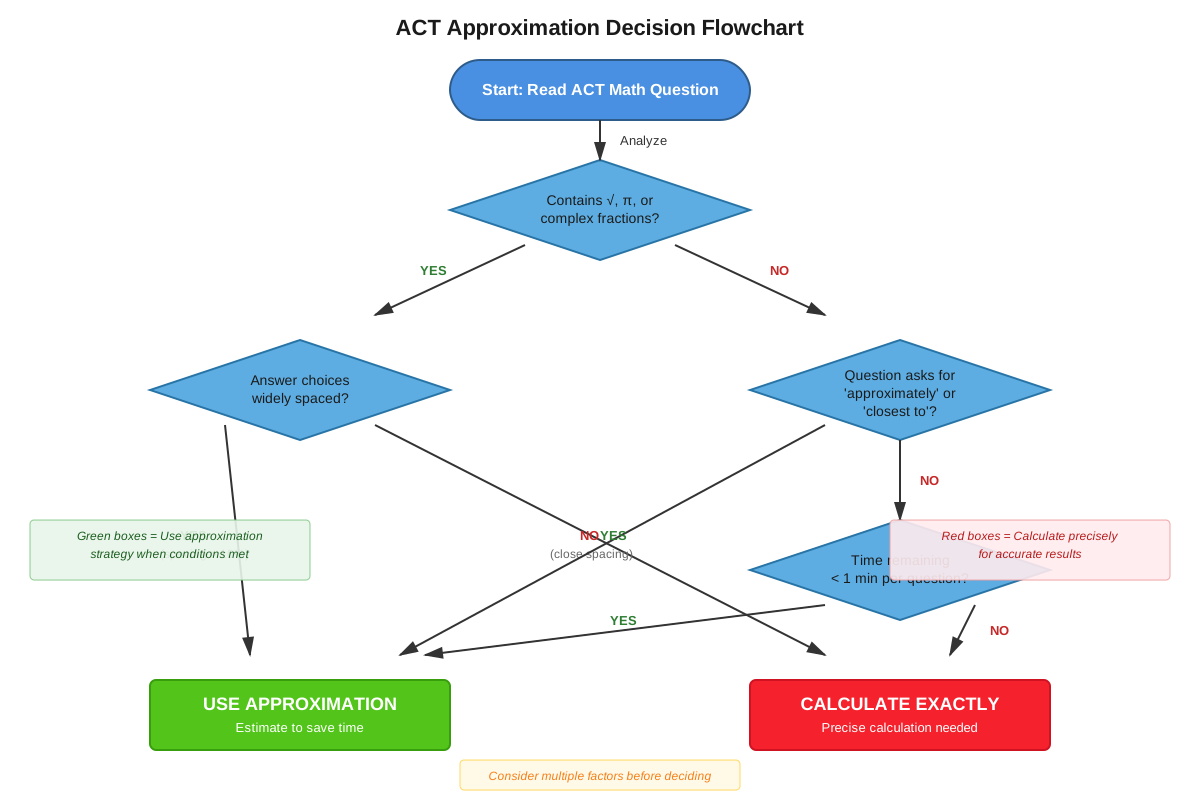
When approaching ACT Math questions, develop a systematic process for determining whether approximation is appropriate. First, read the question stem carefully for trigger words like "approximately," "closest to," "about," or "estimate." These explicitly signal that approximation is expected. Second, examine the answer choices before calculating—if they're widely spaced (differing by 20% or more), approximation will likely suffice. Third, assess calculation complexity—if exact calculation would require more than 30 seconds, approximation probably offers a faster path.
Key trigger phrases that indicate approximation opportunities include:
- "Which is closest to..."
- "Approximately how many/much..."
- "About how long/far/large..."
- "The best estimate for..."
- "Nearly equal to..."
- "Roughly..."
Process-of-elimination strategy: After approximating, immediately eliminate answer choices that fall outside your estimated range. If your approximation is 75 and answer choices are 45, 68, 73, 89, and 102, eliminate 45 and 102 immediately. If remaining choices are close, consider whether your rounding was up or down to refine further. Often, approximation eliminates three or four choices, making an educated guess among remaining options highly effective.
Time allocation: Spend no more than 15-20 seconds on approximation itself. If approximation doesn't quickly narrow choices to one or two options, proceed with exact calculation rather than refining the estimate. The goal is efficiency—approximation should save time, not consume it.
Verification strategy: Even when calculating exactly, use approximation to verify reasonableness. If calculating 47 × 23 and getting 281, a quick approximation (50 × 20 = 1,000) reveals the answer is wrong by an order of magnitude, catching a decimal point error or calculation mistake.
When NOT to approximate: Avoid approximation when answer choices are very close together (within 5% of each other), when the question asks for an exact value, or when dealing with problems involving precise geometric relationships where small errors compound. Also avoid approximation in multi-step problems where errors accumulate—calculate exactly at intermediate steps, then verify the final answer with approximation.
Memory Techniques
Perfect Squares Mnemonic: Memorize perfect squares in groups:
- "1-4-9, 16-25, 36-49-64" (rhythm: 1-2-3, 4-5, 6-7-8)
- "81-100-121, 144-169-196, 225-256" (rhythm: 9-10-11, 12-13-14, 15-16)
Fraction-Decimal Visualization: Picture a clock face for eighths:
- 12:00 = 0/8 = 0
- 1:30 = 1/8 = 0.125
- 3:00 = 2/8 = 0.25
- 4:30 = 3/8 = 0.375
- 6:00 = 4/8 = 0.5
- Continue around the clock for remaining eighths
Percentage Benchmark Acronym - "TENT":
- Ten percent (÷10)
- Eighth (12.5%, ÷8)
- Ninth (11.1%, ≈1/9)
- Twenty-five percent (÷4)
Rounding Direction Memory: "SAME SAME, OPPOSITE CANCEL"
- When rounding factors in the SAME direction (both up or both down), your estimate is farther from the true value
- When rounding in OPPOSITE directions, errors partially CANCEL
Pi Approximation Levels: "3-3.1-3.14" represents increasing precision levels
- Use 3 for quick elimination
- Use 3.1 for moderate precision
- Use 3.14 only when answer choices are very close
Square Root Interpolation: "Distance from bottom, divided by gap"
- For √N between perfect squares A² and B², estimate: A + (N - A²)/(B² - A²)
- Example: √50 = 7 + (50-49)/(64-49) = 7 + 1/15 ≈ 7.07
Summary
Approximation is a high-yield ACT Math skill that combines number sense, strategic rounding, and efficient calculation to solve problems quickly and verify answers effectively. The core principle involves simplifying calculations by rounding to benchmark numbers while maintaining sufficient accuracy to distinguish between answer choices. Mastery requires memorizing key values (perfect squares, common fractions, percentage equivalents) and developing judgment about when approximation provides advantages over exact calculation. The ACT explicitly rewards approximation through question phrasing and answer choice spacing, making it essential for time management and score maximization. Students who systematically apply approximation strategies—identifying trigger words, examining answer choice spacing, using compensating rounding, and verifying calculations—gain significant advantages in both speed and accuracy. The skill connects to all areas of ACT Math, from basic arithmetic through advanced geometry and trigonometry, serving as both a standalone problem-solving technique and a verification tool that prevents careless errors.
Key Takeaways
- Approximation is explicitly tested on 8-12 ACT Math questions and provides strategic advantages on many more
- Memorize perfect squares 1² through 15² and common fraction-decimal equivalents for rapid estimation
- Use compensating rounding (one factor up, one down) to minimize error in multiplication and division
- Wide answer choice spacing (>20% difference) signals that approximation will suffice
- Always verify exact calculations with quick approximations to catch order-of-magnitude errors
- Trigger words like "approximately," "closest to," and "about" explicitly indicate approximation opportunities
- Approximation should save time—if it doesn't quickly narrow choices, proceed with exact calculation
Related Topics
Radical Expressions and Simplification: Mastering approximation of square roots and other radicals provides the foundation for simplifying radical expressions, solving quadratic equations using the quadratic formula, and working with distance formulas in coordinate geometry.
Scientific Notation and Exponents: Approximation skills in scientific notation extend to exponential functions, logarithmic relationships, and growth/decay problems, all of which appear regularly on the ACT.
Percentage Applications: The approximation techniques learned here apply directly to percent change problems, compound interest calculations, and probability questions involving percentages.
Geometric Measurement: Approximating areas, volumes, and perimeters connects to more complex geometric problem-solving including optimization problems and three-dimensional geometry.
Trigonometric Values: Approximating trigonometric function values for non-standard angles builds on the same interpolation and benchmark techniques used for radical approximation.
Practice CTA
Now that you've mastered the concepts and strategies of approximation, it's time to put your knowledge into practice! Work through the practice questions to reinforce these techniques and build the speed and confidence you need for test day. Remember, approximation is a skill that improves dramatically with practice—each problem you solve strengthens your number sense and strategic thinking. The flashcards will help you memorize essential values like perfect squares and fraction-decimal equivalents, making approximation second nature. You've got this!
Sign up free to keep reading
Create a free AnvayaPrep account to finish this ACT guide on Approximation — plus flashcards and practice questions.