Overview
Complex numbers basics form a critical component of the ACT Math test, appearing regularly in questions that assess algebraic manipulation and number sense. A complex number extends the real number system by introducing the imaginary unit i, defined as the square root of -1. This seemingly abstract concept enables mathematicians and scientists to solve equations that have no real solutions, such as x² + 1 = 0. On the ACT, students encounter complex numbers in various contexts: simplifying expressions involving i, performing arithmetic operations with complex numbers, and understanding the relationship between real and imaginary components.
The ACT typically includes 1-3 questions directly testing complex numbers basics knowledge, making this a high-yield topic that can significantly impact overall Math scores. These questions often appear in the latter half of the Math section, where difficulty increases. Understanding complex numbers demonstrates mathematical maturity and prepares students for advanced algebra and precalculus concepts. The topic bridges pure arithmetic with abstract algebraic thinking, requiring both computational accuracy and conceptual understanding.
Mastery of ACT complex numbers basics connects directly to polynomial operations, quadratic equations, and algebraic expressions—all fundamental ACT Math topics. Students who thoroughly understand complex number operations gain confidence tackling multi-step problems and can quickly identify efficient solution pathways. This topic also reinforces the broader mathematical principle that number systems can be extended to solve previously unsolvable problems, a concept that appears throughout higher mathematics.
Learning Objectives
- [ ] Identify when Complex numbers basics is being tested
- [ ] Explain the core rule or strategy behind Complex numbers basics
- [ ] Apply Complex numbers basics to ACT-style questions accurately
- [ ] Simplify powers of the imaginary unit i to their simplest form
- [ ] Perform addition, subtraction, multiplication, and division operations with complex numbers
- [ ] Recognize and apply the complex conjugate to rationalize denominators
- [ ] Convert between standard form (a + bi) and identify real and imaginary components
Prerequisites
- Basic algebraic operations: Students must confidently add, subtract, multiply, and divide algebraic expressions, as complex number operations follow identical structural rules with the added element of i.
- Exponent rules: Understanding how to simplify powers and apply exponent properties is essential for working with powers of i.
- Polynomial multiplication: The distributive property and FOIL method are fundamental to multiplying complex numbers.
- Radical simplification: Familiarity with square roots and radical expressions helps students understand the origin and behavior of the imaginary unit.
- Rational expressions: Rationalizing denominators with radicals provides the foundation for dividing complex numbers using conjugates.
Why This Topic Matters
Complex numbers have profound real-world applications in electrical engineering (analyzing AC circuits), quantum mechanics (describing wave functions), signal processing (Fourier transforms), and control systems engineering. While ACT questions focus on fundamental operations rather than applications, understanding that complex numbers solve real problems helps students appreciate their significance beyond abstract mathematics.
On the ACT Math test, complex numbers appear with consistent frequency—typically 1-3 questions per exam. These questions usually test computational fluency with operations, simplification of powers of i, and occasionally require students to identify real or imaginary components. The questions often appear between positions 40-60 in the 60-question Math section, placing them in the medium-to-difficult range. Students who master this topic can quickly secure these points, which is especially valuable given the time constraints of the ACT.
Common question formats include: simplifying expressions like (3 + 2i)(4 - i), finding equivalent forms of complex fractions, determining which power of i equals a given value, and identifying the result of operations. The ACT may also embed complex numbers within larger algebraic problems, requiring students to recognize when complex number rules apply. Questions frequently use answer choices that represent common computational errors, making accuracy essential.
Core Concepts
The Imaginary Unit i
The foundation of all complex number work rests on defining the imaginary unit i as the square root of -1. Mathematically, this means i² = -1. This definition allows us to take square roots of negative numbers, which are undefined in the real number system. For example, √(-9) = √(9 × -1) = √9 × √(-1) = 3i.
The imaginary unit follows specific patterns when raised to successive powers:
- i¹ = i
- i² = -1
- i³ = i² × i = -1 × i = -i
- i⁴ = i² × i² = (-1)(-1) = 1
- i⁵ = i⁴ × i = 1 × i = i
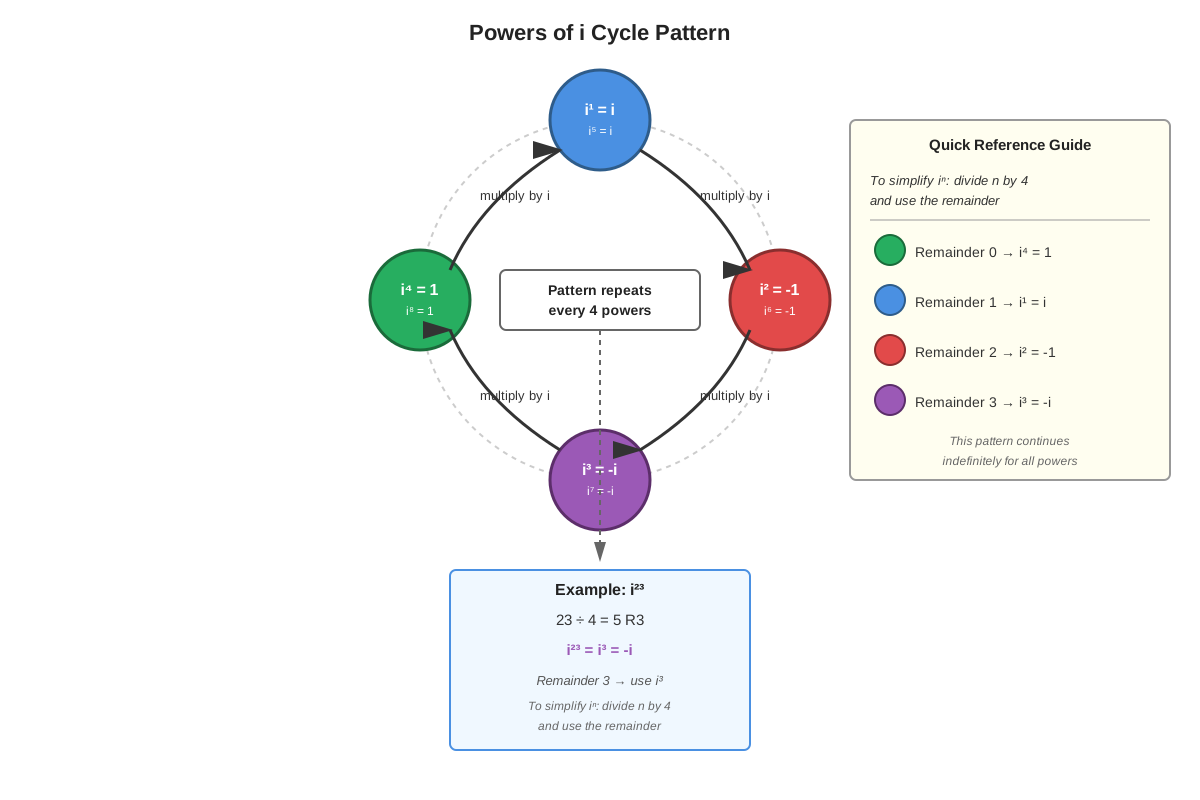
This pattern repeats every four powers, which is crucial for simplifying higher powers of i. To simplify any power of i, divide the exponent by 4 and use the remainder:
- Remainder 0: result is 1
- Remainder 1: result is i
- Remainder 2: result is -1
- Remainder 3: result is -i
Standard Form of Complex Numbers
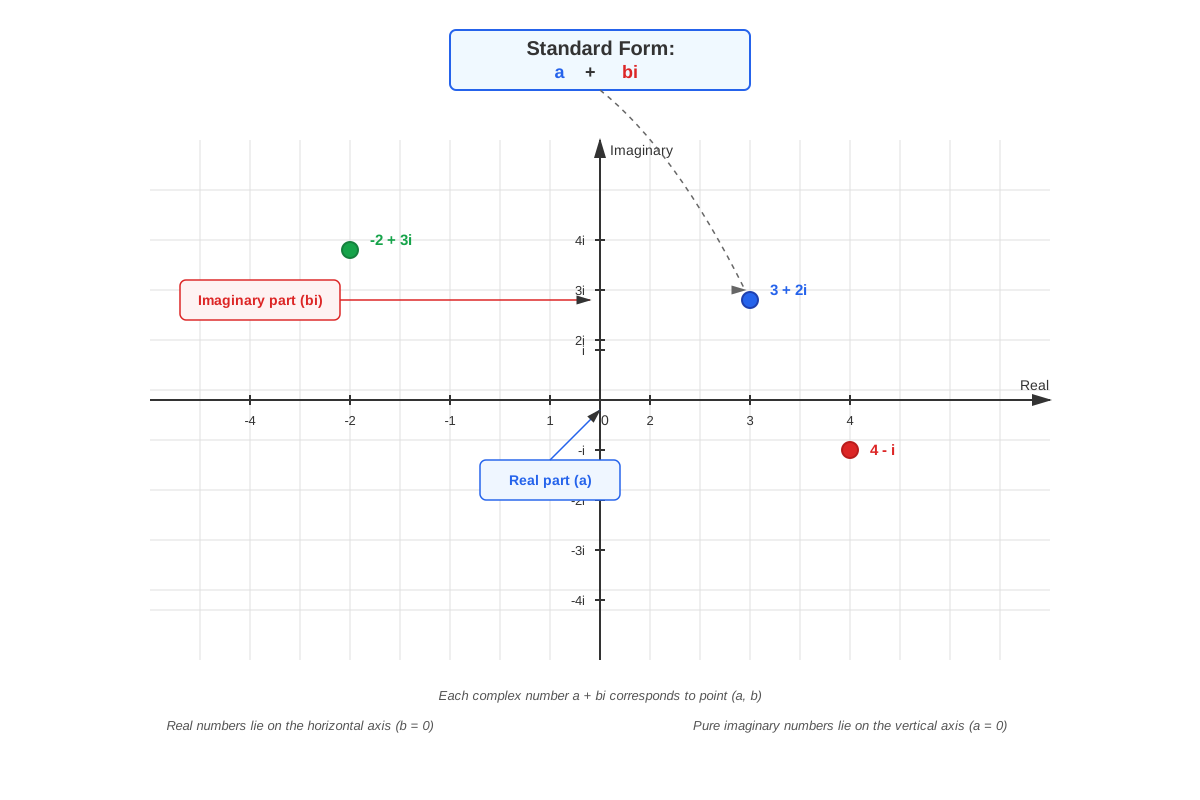
A complex number is written in standard form as a + bi, where:
- a is the real part (a real number)
- b is the imaginary part (a real number coefficient)
- i is the imaginary unit
For example, in the complex number 5 + 3i, the real part is 5 and the imaginary part is 3. Note that the imaginary part is the coefficient 3, not 3i. When b = 0, the complex number is purely real (like 7 + 0i = 7). When a = 0, the complex number is purely imaginary (like 0 + 4i = 4i).
Addition and Subtraction of Complex Numbers
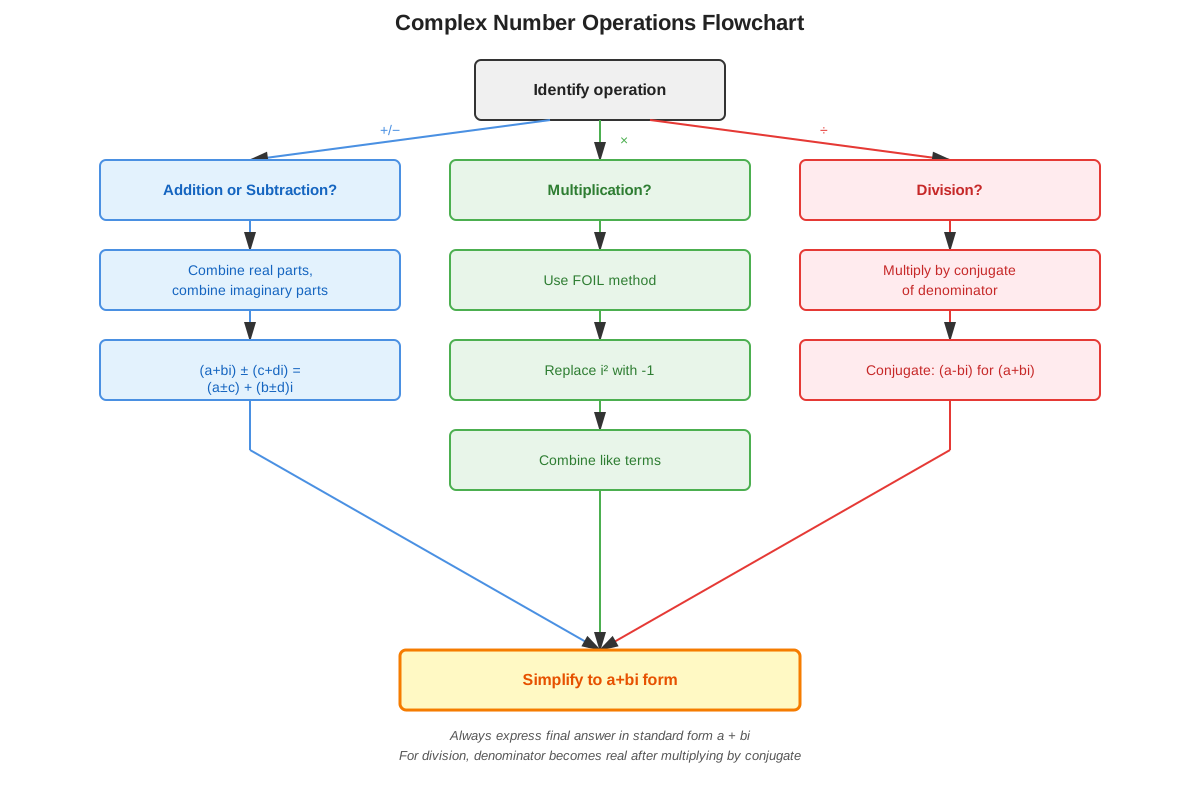
Adding and subtracting complex numbers follows the principle of combining like terms. Real parts combine with real parts, and imaginary parts combine with imaginary parts.
Addition: (a + bi) + (c + di) = (a + c) + (b + d)i
Subtraction: (a + bi) - (c + di) = (a - c) + (b - d)i
Example: (7 + 3i) + (2 - 5i) = (7 + 2) + (3 - 5)i = 9 - 2i
Example: (4 + 6i) - (1 + 2i) = (4 - 1) + (6 - 2)i = 3 + 4i
Multiplication of Complex Numbers
Multiplying complex numbers uses the distributive property (FOIL for binomials), with the critical step of simplifying i² to -1.
(a + bi)(c + di) = ac + adi + bci + bdi²
Since i² = -1, this becomes:
= ac + adi + bci + bd(-1)
= (ac - bd) + (ad + bc)i
Example: (3 + 2i)(4 - i)
= 3(4) + 3(-i) + 2i(4) + 2i(-i)
= 12 - 3i + 8i - 2i²
= 12 + 5i - 2(-1)
= 12 + 5i + 2
= 14 + 5i
Complex Conjugates
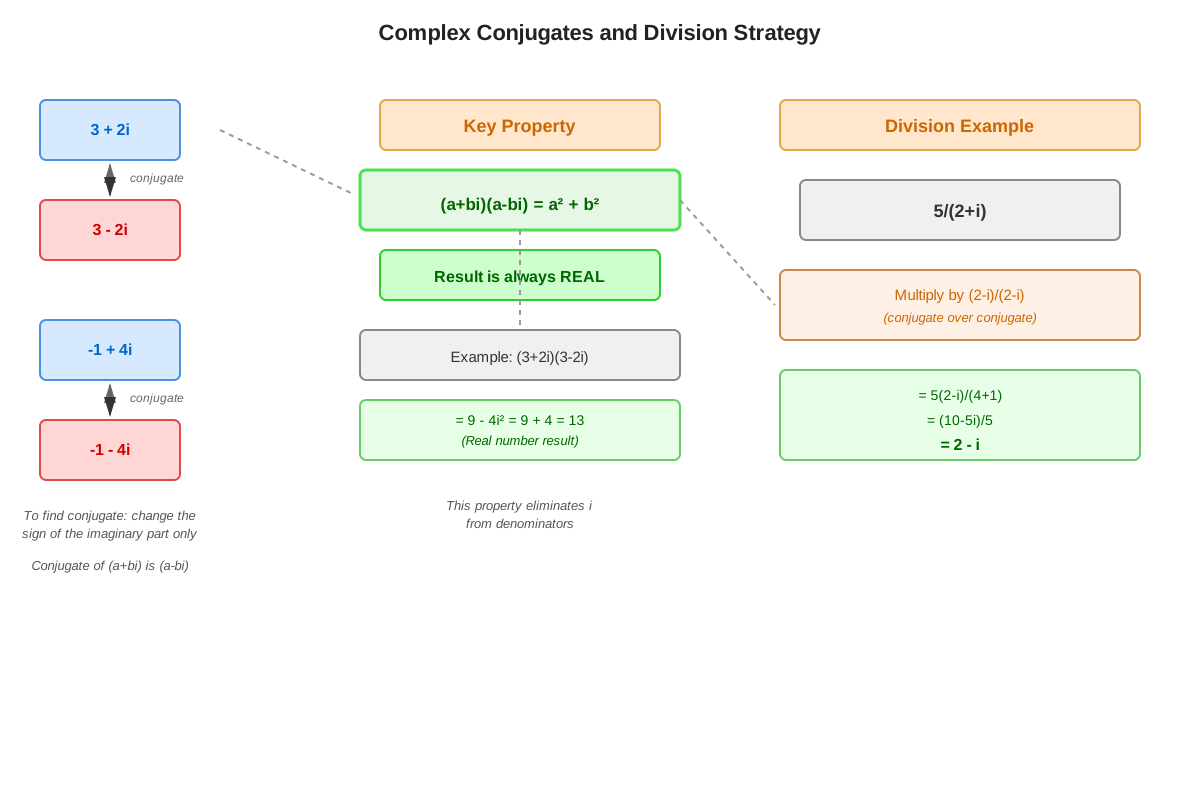
The complex conjugate of a + bi is a - bi. Conjugates are formed by changing the sign of the imaginary part. This concept is essential for division and appears frequently on the ACT.
Key property: When a complex number is multiplied by its conjugate, the result is always a real number:
(a + bi)(a - bi) = a² - abi + abi - b²i² = a² - b²(-1) = a² + b²
| Complex Number | Complex Conjugate | Product |
|---|---|---|
| 3 + 4i | 3 - 4i | 9 + 16 = 25 |
| 5 - 2i | 5 + 2i | 25 + 4 = 29 |
| -1 + 7i | -1 - 7i | 1 + 49 = 50 |
Division of Complex Numbers
Dividing complex numbers requires rationalizing the denominator by multiplying both numerator and denominator by the conjugate of the denominator.
Process:
- Identify the conjugate of the denominator
- Multiply both numerator and denominator by this conjugate
- Simplify the numerator (will remain complex)
- Simplify the denominator (will become real)
- Write in standard form a + bi
Example: Simplify (2 + 3i)/(1 - 2i)
Multiply by conjugate (1 + 2i)/(1 + 2i):
= [(2 + 3i)(1 + 2i)]/[(1 - 2i)(1 + 2i)]
= [2 + 4i + 3i + 6i²]/[1 + 4]
= [2 + 7i + 6(-1)]/5
= [2 + 7i - 6]/5
= [-4 + 7i]/5
= -4/5 + (7/5)i
Concept Relationships
The concepts within complex numbers basics build hierarchically. Understanding begins with the imaginary unit i and its defining property i² = -1. This foundation leads directly to recognizing powers of i and their cyclical pattern, which enables quick simplification of expressions containing high powers.
The definition of i → enables writing complex numbers in standard form (a + bi) → which allows addition and subtraction by combining like terms → and multiplication using distributive properties with i² = -1.
Complex conjugates emerge as a special relationship between complex numbers, connecting to multiplication through the property that conjugate products yield real numbers. This property → enables division of complex numbers through rationalization.
These concepts connect to prerequisite knowledge: polynomial operations provide the framework for complex number arithmetic, exponent rules govern powers of i, and rationalizing radical denominators parallels the conjugate method for division.
Complex numbers basics also connect forward to: quadratic equations (complex solutions when discriminant is negative), polynomial factoring (complex zeros), and graphing in the complex plane (though rarely tested on ACT).
Quick check — test yourself on Complex numbers basics so far.
Try Flashcards →High-Yield Facts
⭐ The imaginary unit i is defined as √(-1), and i² = -1
⭐ Powers of i cycle every 4: i¹ = i, i² = -1, i³ = -i, i⁴ = 1
⭐ To simplify iⁿ, divide n by 4 and use the remainder (0→1, 1→i, 2→-1, 3→-i)
⭐ Complex numbers in standard form: a + bi, where a is real part and b is imaginary part
⭐ The complex conjugate of a + bi is a - bi
- When adding/subtracting complex numbers, combine real parts separately from imaginary parts
- When multiplying complex numbers, use FOIL and remember i² = -1
- The product of a complex number and its conjugate is always real: (a + bi)(a - bi) = a² + b²
- To divide complex numbers, multiply numerator and denominator by the conjugate of the denominator
- √(-n) = i√n for any positive real number n
- A purely imaginary number has the form 0 + bi or simply bi
- A purely real number can be written as a + 0i
Common Misconceptions
Misconception: i = √(-1) means i² = √(-1)² = -1² = -1, so the square root and square cancel.
Correction: While i² does equal -1, the reasoning is circular. By definition, i is the number whose square is -1. The equation i² = -1 is the defining property, not derived from manipulating √(-1).
Misconception: When multiplying (a + bi)(c + di), students forget to simplify i² or leave it as i².
Correction: Always replace i² with -1 immediately after expanding. The expression 2 + 3i² is not in standard form; it must be simplified to 2 + 3(-1) = 2 - 3 = -1.
Misconception: The imaginary part of 5 + 3i is 3i.
Correction: The imaginary part is the coefficient 3, not 3i. The term 3i consists of the imaginary part (3) multiplied by the imaginary unit (i).
Misconception: To divide complex numbers, divide real parts and imaginary parts separately: (a + bi)/(c + di) = a/c + (b/d)i.
Correction: Division requires multiplying by the conjugate of the denominator to rationalize it. Separating components only works for addition and subtraction.
Misconception: i³ = i × i × i = i³, so it cannot be simplified further.
Correction: i³ = i² × i = (-1) × i = -i. Always break down powers of i using the fundamental relationships i² = -1 and i⁴ = 1.
Misconception: The conjugate of 3 - 4i is -3 + 4i.
Correction: The conjugate only changes the sign of the imaginary part, not the real part. The conjugate of 3 - 4i is 3 + 4i.
Worked Examples
Example 1: Simplifying Powers of i
Problem: Simplify i⁴⁷
Solution:
Step 1: Divide the exponent by 4 to find the remainder.
47 ÷ 4 = 11 remainder 3
Step 2: Use the remainder to determine the simplified form.
Since the remainder is 3, i⁴⁷ = i³
Step 3: Simplify i³.
i³ = i² × i = (-1) × i = -i
Answer: i⁴⁷ = -i
Connection to Learning Objectives: This demonstrates identifying when complex numbers are being tested (powers of i) and applying the core strategy of using the cyclical pattern of powers.
Example 2: Complex Number Operations
Problem: Simplify (3 - 2i) - (1 + 4i) and then multiply the result by (2 + i).
Solution:
Step 1: Perform the subtraction.
(3 - 2i) - (1 + 4i) = 3 - 2i - 1 - 4i
= (3 - 1) + (-2 - 4)i
= 2 - 6i
Step 2: Multiply the result by (2 + i).
(2 - 6i)(2 + i)
Step 3: Use FOIL to expand.
= 2(2) + 2(i) + (-6i)(2) + (-6i)(i)
= 4 + 2i - 12i - 6i²
Step 4: Simplify i² = -1.
= 4 + 2i - 12i - 6(-1)
= 4 + 2i - 12i + 6
= 10 - 10i
Answer: 10 - 10i
Connection to Learning Objectives: This multi-step problem requires applying complex number operations accurately, demonstrating mastery of both subtraction and multiplication in ACT-style format.
Example 3: Division with Complex Numbers
Problem: Express (5 + 2i)/(3 - i) in standard form.
Solution:
Step 1: Identify the conjugate of the denominator.
The conjugate of 3 - i is 3 + i
Step 2: Multiply numerator and denominator by the conjugate.
[(5 + 2i)(3 + i)]/[(3 - i)(3 + i)]
Step 3: Expand the numerator.
(5 + 2i)(3 + i) = 15 + 5i + 6i + 2i²
= 15 + 11i + 2(-1)
= 15 + 11i - 2
= 13 + 11i
Step 4: Expand the denominator.
(3 - i)(3 + i) = 9 + 3i - 3i - i²
= 9 - (-1)
= 9 + 1
= 10
Step 5: Write in standard form.
(13 + 11i)/10 = 13/10 + (11/10)i
Answer: 13/10 + (11/10)i or 1.3 + 1.1i
Connection to Learning Objectives: This demonstrates the core strategy of using complex conjugates to rationalize denominators, a high-yield ACT skill.
Exam Strategy
Trigger Words: Watch for "simplify," "express in standard form," "imaginary unit," "i²," and "complex number" in question stems. These signal that complex number rules apply.
When approaching ACT complex number questions, follow this systematic process:
- Identify the operation required: Is the question asking for addition, subtraction, multiplication, division, or simplification of powers?
- For powers of i: Immediately divide the exponent by 4 and use the remainder. Don't waste time multiplying out i × i × i repeatedly.
- For multiplication: Expand using FOIL or distributive property, then immediately replace any i² with -1. Check your answer choices—if they contain i², you've made an error.
- For division: Recognize that you must multiply by the conjugate. If answer choices are in standard form a + bi, this confirms you need to rationalize.
- Process of elimination: ACT answer choices often include common errors:
- Forgetting to simplify i² to -1
- Incorrectly combining real and imaginary parts
- Using wrong sign when finding conjugates
- Arithmetic errors in final simplification
- Time allocation: Complex number questions should take 45-60 seconds each. If you're spending more than 90 seconds, mark it and return later.
- Check your work: Verify that your final answer is in standard form (a + bi) with no i² terms remaining. Ensure real and imaginary parts are clearly separated.
Quick Check: If multiplying a complex number by its conjugate, your answer must be a real number (no i term). If it's not, you've made an error.
Memory Techniques
Powers of i Mnemonic: "I Never Need One" represents the cycle:
- I = i¹ = i
- N(egative) = i² = -1
- N(egative i) = i³ = -i
- One = i⁴ = 1
FOIL for Complex Multiplication: Remember "First Outer Inner Last, then Simplify i²" (FOILS)
Conjugate Visualization: Picture a mirror reflecting across a horizontal line—the real part stays the same (doesn't cross the mirror), but the imaginary part flips sign (reflects across).
Division Acronym - CRAM:
- Conjugate of denominator
- Rationalize by multiplying
- Apply FOIL to both parts
- Make standard form
Standard Form Reminder: "Real Before Imaginary" (RBI, like baseball) reminds you that standard form is a + bi, with the real part first.
Summary
Complex numbers basics represent an essential ACT Math topic that extends the real number system through the imaginary unit i, defined by i² = -1. Mastery requires understanding that powers of i cycle every four exponents (i, -1, -i, 1), enabling quick simplification of any power by dividing the exponent by 4 and using the remainder. Complex numbers in standard form a + bi combine a real part (a) and an imaginary part (b), and operations follow algebraic rules with the critical step of replacing i² with -1. Addition and subtraction combine like terms separately, while multiplication uses the distributive property followed by simplification. Division requires multiplying by the complex conjugate of the denominator to rationalize it, producing a real denominator and complex numerator that can be expressed in standard form. The ACT tests these concepts through direct computation problems and embedded applications within larger algebraic contexts, making fluency with these operations a high-yield investment of study time.
Key Takeaways
- The imaginary unit i satisfies i² = -1, and powers of i repeat in a four-term cycle: i, -1, -i, 1
- Complex numbers in standard form a + bi have a real part (a) and imaginary part (b), which must be kept separate during operations
- Add and subtract complex numbers by combining real parts with real parts and imaginary parts with imaginary parts
- Multiply complex numbers using FOIL or distributive property, always simplifying i² to -1
- The complex conjugate of a + bi is a - bi, and their product (a + bi)(a - bi) = a² + b² is always real
- Divide complex numbers by multiplying numerator and denominator by the conjugate of the denominator
- ACT questions test computational accuracy with these operations and recognition of when complex number rules apply
Related Topics
Quadratic Equations with Complex Solutions: When the discriminant (b² - 4ac) is negative, quadratic equations have complex solutions. Mastering complex numbers basics enables solving and understanding these solutions, which appear in advanced ACT algebra questions.
Polynomial Zeros and Factoring: Complex numbers allow complete factorization of polynomials. The Fundamental Theorem of Algebra states that every polynomial has complex zeros, making this topic foundational for advanced polynomial work.
The Complex Plane: Complex numbers can be graphed with the real part on the x-axis and imaginary part on the y-axis. While rarely tested directly on the ACT, this geometric interpretation deepens understanding.
Absolute Value of Complex Numbers: The absolute value (or modulus) of a + bi equals √(a² + b²), connecting complex numbers to distance formulas and coordinate geometry.
Practice CTA
Now that you've mastered the fundamentals of complex numbers basics, it's time to solidify your understanding through active practice. Attempt the practice questions to test your ability to identify question types, apply the correct strategies, and execute calculations accurately under timed conditions. Use the flashcards to reinforce the cyclical pattern of powers of i, the conjugate relationships, and the step-by-step procedures for each operation. Remember: complex numbers appear consistently on the ACT, and these are points you can confidently secure with focused practice. Every problem you solve correctly builds the automaticity you need to excel on test day!
Sign up free to keep reading
Create a free AnvayaPrep account to finish this ACT guide on Complex numbers basics — plus flashcards and practice questions.