Overview
The greatest common factor (GCF), also known as the greatest common divisor, represents the largest positive integer that divides evenly into two or more numbers without leaving a remainder. This fundamental concept in number theory appears regularly on the ACT Math section, often embedded within algebra problems, fraction simplification questions, and word problems involving distribution or grouping scenarios. Understanding how to quickly identify and calculate the GCF is essential for solving problems efficiently under timed conditions.
On the ACT, ACT greatest common factor questions test not only computational ability but also conceptual understanding of divisibility, prime factorization, and number relationships. These questions may appear straightforward, asking directly for the GCF of two numbers, or they may be disguised within more complex scenarios such as finding the largest possible group size when dividing items, simplifying algebraic expressions, or working with ratios and proportions. The ability to recognize when a problem requires finding the GCF is just as important as knowing how to calculate it.
Mastery of the greatest common factor connects directly to broader mathematical concepts including least common multiple (LCM), fraction operations, polynomial factoring, and rational expressions. Students who develop strong GCF skills build a foundation for more advanced algebraic manipulation and problem-solving strategies that appear throughout the ACT Math section. This topic typically accounts for 2-4 questions per test, either directly or as a necessary step in multi-part problems, making it a high-yield area for focused study.
Learning Objectives
- [ ] Identify when Greatest common factor is being tested
- [ ] Explain the core rule or strategy behind Greatest common factor
- [ ] Apply Greatest common factor to ACT-style questions accurately
- [ ] Calculate the GCF of two or more integers using multiple methods (listing factors, prime factorization, Euclidean algorithm)
- [ ] Recognize real-world scenarios that require GCF application, such as grouping problems and distribution tasks
- [ ] Simplify algebraic expressions and fractions using GCF techniques
- [ ] Distinguish between situations requiring GCF versus LCM
Prerequisites
- Basic multiplication and division: Essential for identifying factors and determining divisibility; the GCF concept relies entirely on understanding which numbers divide evenly into others
- Prime numbers and composite numbers: Necessary for prime factorization method; recognizing primes (2, 3, 5, 7, 11, etc.) speeds up the factorization process
- Exponent rules: Required when working with prime factorization in exponential form; understanding how to compare and select minimum exponents is crucial
- Factor pairs: Ability to systematically list all factors of a number; this foundational skill enables the listing method for finding GCF
Why This Topic Matters
The greatest common factor has immediate practical applications in everyday life, from dividing items into equal groups to scaling recipes and understanding gear ratios in mechanical systems. When organizing 24 pencils and 36 notebooks into identical gift bags, the GCF determines the maximum number of bags possible (12) while ensuring equal distribution. Construction projects use GCF when cutting materials into equal lengths with minimal waste, and musicians apply it when finding common time signatures.
On the ACT Math section, GCF questions appear with notable frequency—approximately 3-5% of all math questions involve GCF either directly or as an intermediate step. These questions most commonly appear in the Number and Quantity domain but also surface in algebra problems involving polynomial factoring and rational expressions. The ACT favors testing GCF through word problems that require students to translate real-world scenarios into mathematical operations, making conceptual understanding more valuable than mere computational ability.
Common ACT question formats include: finding the largest possible group size when distributing multiple types of items equally; simplifying fractions or ratios to lowest terms; factoring out common terms from algebraic expressions; and determining the greatest measurement that divides evenly into multiple quantities. Questions may also combine GCF with other concepts, such as asking for the LCM after finding the GCF, or requiring GCF calculation as a preliminary step in solving a more complex problem.
Core Concepts
Definition and Fundamental Properties
The greatest common factor of two or more integers is the largest positive integer that divides each of the numbers without leaving a remainder. For any set of numbers, the GCF must be less than or equal to the smallest number in the set. The GCF of any number and 1 is always 1, and the GCF of any number with itself is that number. When two numbers share no common factors other than 1, they are called relatively prime or coprime, and their GCF is 1.
Key properties of GCF include:
- The GCF is always a positive integer
- GCF(a, b) = GCF(b, a) (commutative property)
- GCF(a, 0) = a for any non-zero integer a
- If d = GCF(a, b), then d divides both a and b
- Any common divisor of a and b must also divide their GCF
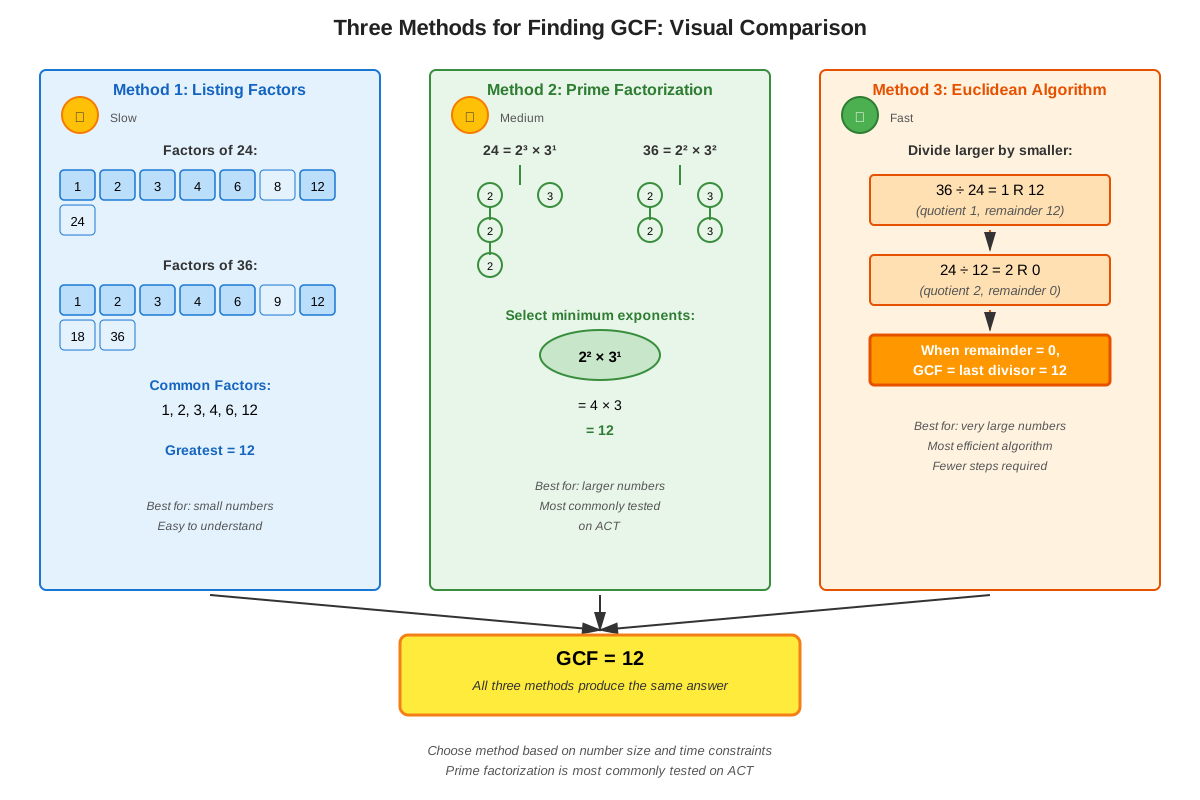
Method 1: Listing Factors
The most intuitive method involves listing all factors of each number and identifying the largest factor that appears in all lists. This approach works well for smaller numbers and provides clear visualization of the concept.
Steps:
- List all positive factors of the first number in ascending order
- List all positive factors of the second number in ascending order
- Identify all factors that appear in both lists (common factors)
- Select the largest number from the common factors
Example: Find GCF(24, 36)
- Factors of 24: 1, 2, 3, 4, 6, 8, 12, 24
- Factors of 36: 1, 2, 3, 4, 6, 9, 12, 18, 36
- Common factors: 1, 2, 3, 4, 6, 12
- GCF = 12
Method 2: Prime Factorization
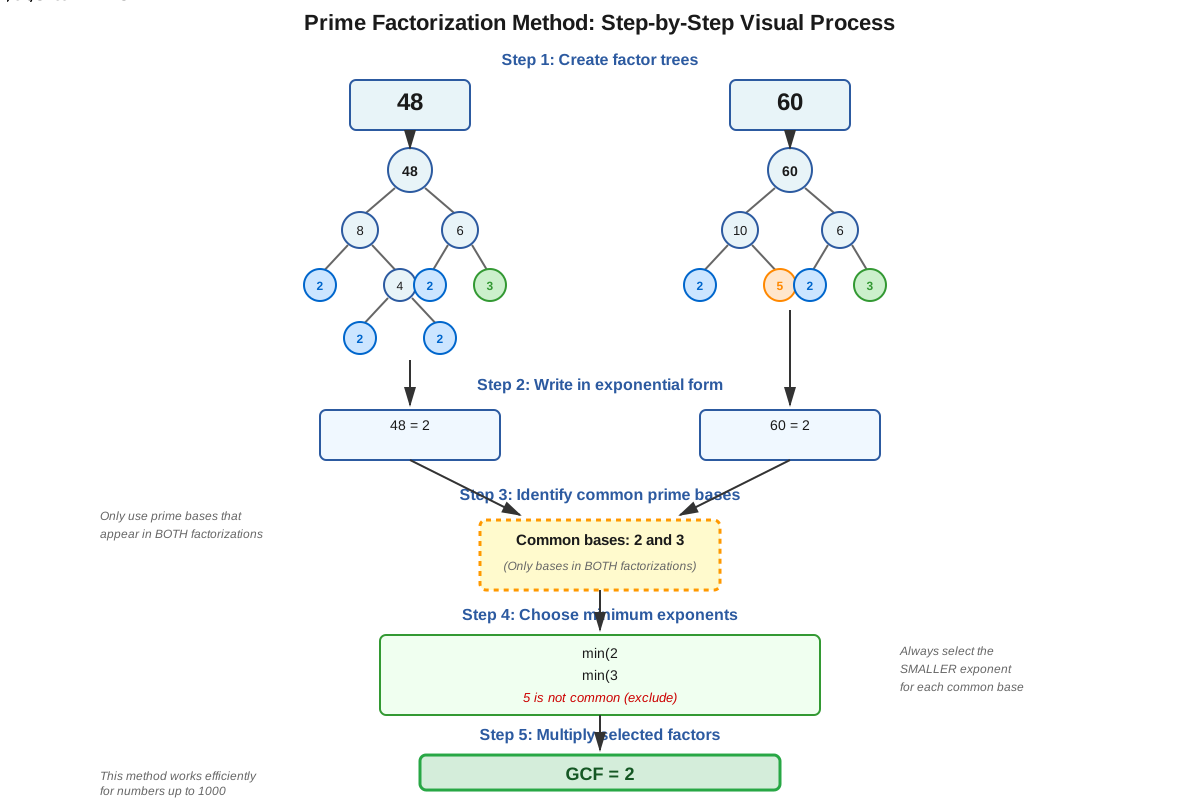
The prime factorization method is the most efficient approach for larger numbers and the preferred technique for ACT questions. This method involves breaking each number down into its prime factors, then selecting the lowest power of each common prime.
Steps:
- Express each number as a product of prime factors
- Identify all prime factors that appear in every number
- For each common prime factor, select the smallest exponent
- Multiply these selected prime powers together
Example: Find GCF(180, 234)
- 180 = 2² × 3² × 5
- 234 = 2 × 3² × 13
- Common primes: 2 and 3
- Minimum exponents: 2¹ and 3²
- GCF = 2 × 9 = 18
| Number | Prime Factorization | Common Primes | Minimum Powers |
|---|---|---|---|
| 180 | 2² × 3² × 5 | 2, 3 | 2¹, 3² |
| 234 | 2¹ × 3² × 13 | 2, 3 | 2¹, 3² |
| GCF | 2¹ × 3² | = 18 |
Method 3: Euclidean Algorithm
The Euclidean algorithm provides the fastest computational method, especially useful for very large numbers. This recursive approach uses division and remainders to find the GCF without requiring prime factorization.
Steps:
- Divide the larger number by the smaller number
- Replace the larger number with the smaller number
- Replace the smaller number with the remainder from step 1
- Repeat until the remainder is 0
- The last non-zero remainder is the GCF
Example: Find GCF(252, 105)
- 252 ÷ 105 = 2 remainder 42
- 105 ÷ 42 = 2 remainder 21
- 42 ÷ 21 = 2 remainder 0
- GCF = 21
GCF with More Than Two Numbers
When finding the GCF of three or more numbers, apply any method systematically:
- Listing method: Find factors common to all numbers
- Prime factorization: Include only primes appearing in all numbers, using the minimum exponent across all factorizations
- Euclidean algorithm: Find GCF of first two numbers, then find GCF of that result with the third number, continuing sequentially
Example: Find GCF(48, 72, 120)
- 48 = 2⁴ × 3
- 72 = 2³ × 3²
- 120 = 2³ × 3 × 5
- Common primes: 2 and 3
- Minimum exponents: 2³ and 3¹
- GCF = 8 × 3 = 24
GCF in Algebraic Expressions
The greatest common factor extends beyond numerical values to algebraic expressions containing variables. When factoring algebraic expressions, identify the GCF of coefficients and the lowest power of each common variable.
Steps for algebraic GCF:
- Find the GCF of all numerical coefficients
- For each variable appearing in all terms, select the smallest exponent
- Multiply the numerical GCF by the variable factors with minimum exponents
Example: Factor 12x³y² + 18x²y⁴ - 24x⁴y
- Coefficients: GCF(12, 18, 24) = 6
- Variable x: minimum exponent is 2 (appears as x², x³, x⁴)
- Variable y: minimum exponent is 1 (appears as y, y², y⁴)
- GCF = 6x²y
- Factored form: 6x²y(2xy + 3y³ - 4x²)
Concept Relationships
The greatest common factor serves as a foundational concept connecting multiple areas of mathematics. Understanding GCF directly enables mastery of fraction simplification, where dividing both numerator and denominator by their GCF reduces fractions to lowest terms. This relationship flows as: GCF identification → fraction reduction → simplified ratios and proportions.
GCF shares an inverse relationship with the least common multiple (LCM). For any two numbers a and b, the product a × b equals GCF(a,b) × LCM(a,b). This relationship allows students to find one value when given the other, creating a bidirectional connection: GCF ↔ LCM through the product relationship.
The prime factorization method for finding GCF builds directly on understanding of prime numbers and divisibility rules. This progression follows: divisibility concepts → prime factorization skills → GCF calculation → polynomial factoring. Each step reinforces and extends the previous concept.
In algebra, GCF connects to factoring polynomials, where factoring out the GCF represents the first step in most factoring problems. This relationship maps as: GCF of coefficients and variables → factored form → simplified expressions → solving equations. The algebraic GCF also enables simplification of rational expressions, connecting to more advanced topics in Algebra II and Precalculus.
High-Yield Facts
⭐ The GCF of two numbers is always less than or equal to the smaller of the two numbers
⭐ When using prime factorization, select the minimum exponent for each common prime factor
⭐ The GCF of two consecutive integers is always 1 (they are relatively prime)
⭐ For ACT word problems, "largest possible group" or "maximum number of groups" signals GCF
⭐ The product of GCF and LCM of two numbers equals the product of the two numbers: GCF(a,b) × LCM(a,b) = a × b
- If one number divides evenly into another, the smaller number is the GCF
- The GCF of any number and 1 is always 1
- The GCF of two prime numbers is always 1
- Finding GCF is the first step in simplifying fractions to lowest terms
- The Euclidean algorithm is fastest for large numbers but requires understanding of division with remainders
- When factoring algebraic expressions, the GCF includes both numerical coefficients and variable factors
- Two numbers are relatively prime (coprime) if and only if their GCF is 1
Quick check — test yourself on Greatest common factor so far.
Try Flashcards →Common Misconceptions
Misconception: The GCF is always found by dividing the larger number by the smaller number.
Correction: Division alone doesn't yield the GCF; you must use systematic methods like listing factors, prime factorization, or the Euclidean algorithm. Simple division only works when one number is a multiple of the other.
Misconception: The GCF of two numbers is always smaller than both numbers.
Correction: When one number divides evenly into another, the GCF equals the smaller number. For example, GCF(12, 24) = 12, which equals one of the original numbers.
Misconception: When using prime factorization, multiply all common prime factors together.
Correction: You must select the minimum exponent for each common prime factor. If 2³ appears in one factorization and 2⁵ in another, use 2³ (the smaller exponent) in the GCF calculation.
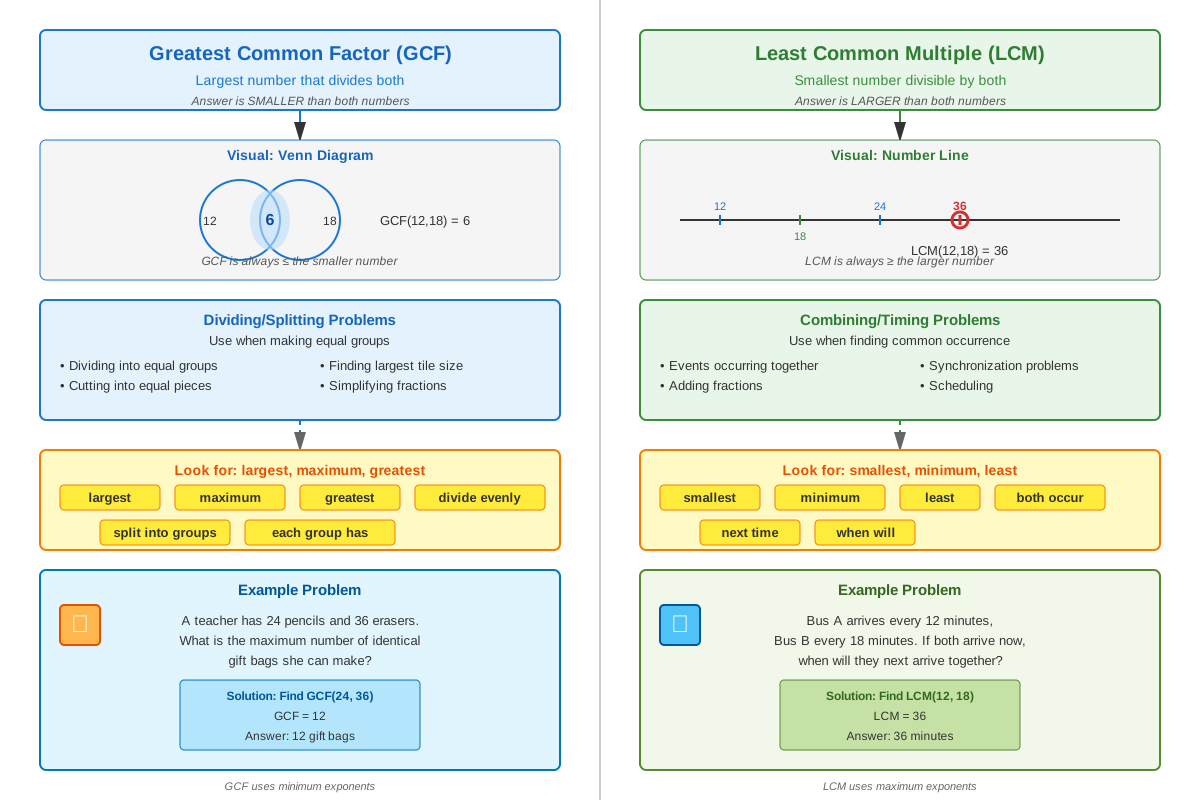
Misconception: The GCF and LCM are the same thing.
Correction: GCF finds the largest number that divides into all given numbers, while LCM finds the smallest number that all given numbers divide into. They are inverse concepts with different applications.
Misconception: You can find the GCF by adding or subtracting the numbers.
Correction: GCF involves divisibility relationships, not arithmetic operations between the numbers themselves. Addition and subtraction of the original numbers do not reveal their GCF.
Misconception: When finding GCF of algebraic expressions, only consider the coefficients.
Correction: The GCF of algebraic expressions includes both the numerical GCF of coefficients and the lowest power of each variable that appears in all terms. Ignoring variables leads to incomplete factoring.
Misconception: All even numbers have a GCF of 2.
Correction: While all even numbers share 2 as a common factor, their GCF may be larger. For example, GCF(12, 18) = 6, not 2, because 6 is the largest number dividing both.
Worked Examples
Example 1: Direct GCF Calculation with Prime Factorization
Problem: Find the greatest common factor of 126 and 180.
Solution:
Step 1: Find the prime factorization of 126
- 126 ÷ 2 = 63
- 63 ÷ 3 = 21
- 21 ÷ 3 = 7
- 7 is prime
- Therefore: 126 = 2 × 3² × 7
Step 2: Find the prime factorization of 180
- 180 ÷ 2 = 90
- 90 ÷ 2 = 45
- 45 ÷ 3 = 15
- 15 ÷ 3 = 5
- 5 is prime
- Therefore: 180 = 2² × 3² × 5
Step 3: Identify common prime factors
- Both contain 2 and 3
- 126 has 2¹, 180 has 2²: minimum is 2¹
- Both have 3²: minimum is 3²
- 7 appears only in 126, 5 appears only in 180 (not common)
Step 4: Calculate GCF
- GCF = 2¹ × 3² = 2 × 9 = 18
Answer: The greatest common factor of 126 and 180 is 18.
Connection to Learning Objectives: This example demonstrates the core strategy of using prime factorization and selecting minimum exponents, directly addressing the objective to explain and apply GCF calculation methods.
Example 2: ACT-Style Word Problem
Problem: A teacher has 48 pencils and 72 erasers to distribute equally among students. Each student must receive the same number of pencils and the same number of erasers, with no items left over. What is the maximum number of students who can receive supplies?
Solution:
Step 1: Recognize this as a GCF problem
- Key phrase: "maximum number" with equal distribution
- Need the largest number that divides evenly into both quantities
Step 2: Find GCF(48, 72) using prime factorization
- 48 = 2⁴ × 3 = 16 × 3
- 72 = 2³ × 3² = 8 × 9
Step 3: Identify common primes and minimum exponents
- Common primes: 2 and 3
- Minimum exponent for 2: 2³ (comparing 2⁴ and 2³)
- Minimum exponent for 3: 3¹ (comparing 3¹ and 3²)
Step 4: Calculate GCF
- GCF = 2³ × 3¹ = 8 × 3 = 24
Step 5: Verify the answer
- 48 ÷ 24 = 2 pencils per student
- 72 ÷ 24 = 3 erasers per student
- All items distributed with none remaining ✓
Answer: The maximum number of students is 24.
Connection to Learning Objectives: This problem demonstrates identifying when GCF is being tested through word problem context clues and applying the concept to an ACT-style question, addressing multiple learning objectives simultaneously.
Example 3: Algebraic GCF Application
Problem: Factor completely: 15x⁴y³ - 25x³y⁵ + 20x⁵y²
Solution:
Step 1: Find GCF of coefficients
- Coefficients: 15, 25, 20
- 15 = 3 × 5
- 25 = 5²
- 20 = 2² × 5
- GCF of coefficients = 5
Step 2: Find GCF of x terms
- Powers of x: x⁴, x³, x⁵
- Minimum exponent: 3
- GCF includes x³
Step 3: Find GCF of y terms
- Powers of y: y³, y⁵, y²
- Minimum exponent: 2
- GCF includes y²
Step 4: Complete GCF
- GCF = 5x³y²
Step 5: Factor out the GCF
- 15x⁴y³ ÷ 5x³y² = 3xy
- 25x³y⁵ ÷ 5x³y² = 5y³
- 20x⁵y² ÷ 5x³y² = 4x²
Answer: 5x³y²(3xy - 5y³ + 4x²)
Connection to Learning Objectives: This example extends GCF application to algebraic expressions, demonstrating how the core concept applies across different mathematical contexts on the ACT.
Exam Strategy
When approaching ACT greatest common factor questions, begin by identifying trigger words and phrases that signal GCF is required. Watch for "maximum number," "largest possible," "greatest," "equal groups," "evenly distributed," and "no remainder." These phrases indicate you need to find the largest value that divides into all given quantities.
Exam Tip: If a problem asks for the "largest" or "maximum" in a distribution context, immediately think GCF. If it asks for "smallest" or "minimum," consider LCM instead.
For computational efficiency under time pressure, choose your method strategically:
- Small numbers (under 50): Use the listing factors method for speed
- Medium numbers (50-200): Prime factorization is most reliable
- Large numbers (over 200): Euclidean algorithm saves time
- Algebraic expressions: Always use the coefficient-and-variable GCF approach
Process of elimination strategies specific to GCF questions:
- Eliminate any answer choice larger than the smallest given number
- Eliminate choices that don't divide evenly into all given numbers
- Test remaining choices starting with the largest (since you want the greatest)
- For word problems, eliminate answers that don't make logical sense in context
Time allocation for GCF questions should average 45-60 seconds for straightforward calculations and 90-120 seconds for word problems requiring translation and setup. If a problem takes longer, mark it and return after completing easier questions. Most ACT GCF questions can be solved in under one minute with practiced technique.
Quick verification technique: After finding your GCF, divide each original number by your answer. All divisions should result in whole numbers with no remainders. If any division produces a remainder or decimal, your GCF is incorrect.
Memory Techniques
Mnemonic for Prime Factorization Method: "Please Find My Minimum"
- Prime factorize each number
- Find common primes
- Minimum exponents
- Multiply together
Visualization Strategy: Picture GCF as finding the largest box that can hold equal groups of different items. If you have 24 apples and 36 oranges, the GCF (12) represents the largest number of identical fruit baskets you can create, with each basket containing the same number of apples (2) and oranges (3).
Acronym for GCF vs. LCM: "GCF Goes Down, LCM Lifts Up"
- GCF finds the largest factor (going down into the numbers through division)
- LCM finds the smallest multiple (lifting up to larger numbers)
Memory Hook for Euclidean Algorithm: "Divide, Replace, Repeat, Done"
- Divide larger by smaller
- Replace with quotient and remainder
- Repeat until remainder is zero
- Done—last non-zero remainder is GCF
Rhyme for Common Mistake Prevention: "When primes align, take the minimum sign" (reminds you to use the smallest exponent for common prime factors)
Summary
The greatest common factor represents the largest positive integer that divides evenly into two or more numbers, serving as a critical concept for ACT Math success. Students must master three primary calculation methods: listing factors (best for small numbers), prime factorization (most versatile and reliable), and the Euclidean algorithm (fastest for large numbers). The prime factorization method requires identifying all common prime factors and selecting the minimum exponent for each, then multiplying these selected powers together. On the ACT, GCF appears both in direct calculation questions and embedded within word problems involving equal distribution, grouping, and simplification tasks. Recognition of trigger phrases like "maximum number" and "largest possible" enables quick identification of GCF problems. The concept extends to algebraic expressions where both numerical coefficients and variable factors must be considered. Understanding the relationship between GCF and related concepts like LCM, fraction simplification, and polynomial factoring creates a comprehensive mathematical foundation essential for achieving high ACT Math scores.
Key Takeaways
- The GCF is the largest positive integer dividing evenly into all given numbers, always less than or equal to the smallest number in the set
- Prime factorization method (find common primes, select minimum exponents, multiply) provides the most reliable approach for ACT questions
- Word problems using "maximum," "largest possible," or "equal groups" typically require GCF calculation
- For algebraic expressions, GCF includes both the numerical GCF of coefficients and the lowest power of each common variable
- The relationship GCF(a,b) × LCM(a,b) = a × b connects two fundamental concepts and enables solving for one when given the other
- Quick verification: divide each original number by your calculated GCF—all results must be whole numbers
- Strategic method selection based on number size optimizes time management under test conditions
Related Topics
Least Common Multiple (LCM): The inverse concept to GCF, finding the smallest number divisible by all given numbers; mastering GCF provides the foundation for understanding LCM through their product relationship and shared prime factorization techniques.
Fraction Simplification: Reducing fractions to lowest terms requires finding the GCF of numerator and denominator; this direct application makes GCF essential for all fraction operations on the ACT.
Polynomial Factoring: Factoring out the GCF represents the first step in factoring polynomials; this algebraic extension of GCF enables solving quadratic equations and simplifying rational expressions.
Divisibility Rules: Understanding which numbers divide evenly into others accelerates GCF calculation; these rules complement GCF skills and improve overall number sense.
Prime Factorization: Breaking numbers into prime factors serves as the foundation for the most reliable GCF method; deepening prime factorization skills directly enhances GCF proficiency.
Practice CTA
Now that you've mastered the core concepts, strategies, and applications of greatest common factor, it's time to solidify your understanding through active practice. Complete the practice questions to test your ability to identify GCF problems, apply the appropriate calculation method, and solve ACT-style questions under timed conditions. Use the flashcards to reinforce key facts, formulas, and trigger words until recognition becomes automatic. Remember: consistent practice with immediate feedback transforms conceptual understanding into test-day confidence and accuracy. Your investment in mastering this high-yield topic will pay dividends across multiple question types on the ACT Math section!
Sign up free to keep reading
Create a free AnvayaPrep account to finish this ACT guide on Greatest common factor — plus flashcards and practice questions.