Overview
Divisibility rules are mathematical shortcuts that allow students to quickly determine whether one integer is divisible by another without performing long division. These rules are fundamental tools in the ACT Math section, appearing in approximately 2-4 questions per test across various question types. Mastery of divisibility rules enables students to solve problems involving factors, multiples, prime factorization, and remainders with remarkable speed—a critical advantage when working under the ACT's strict time constraints.
Understanding ACT divisibility rules goes beyond simple memorization; it requires recognizing when these rules can be applied strategically to eliminate answer choices, verify solutions, or simplify complex calculations. The ACT frequently embeds divisibility concepts within word problems, algebraic expressions, and number theory questions, making these rules essential for achieving scores in the upper percentile ranges. Students who can instantly recognize divisibility patterns gain precious seconds on each question, allowing more time for challenging problems later in the section.
Divisibility rules connect to broader mathematical concepts including prime factorization, greatest common factors (GCF), least common multiples (LCM), modular arithmetic, and algebraic manipulation. They serve as foundational tools for understanding number properties and relationships, which appear throughout the Number and Quantity unit and extend into Algebra and Problem Solving sections. The ability to quickly assess divisibility also supports estimation strategies and answer verification techniques that are invaluable across the entire ACT Math test.
Learning Objectives
- [ ] Identify when Divisibility rules is being tested
- [ ] Explain the core rule or strategy behind Divisibility rules
- [ ] Apply Divisibility rules to ACT-style questions accurately
- [ ] Determine divisibility by 2, 3, 4, 5, 6, 8, 9, 10, and 11 using appropriate rules
- [ ] Combine multiple divisibility rules to solve complex problems involving composite numbers
- [ ] Use divisibility rules to eliminate incorrect answer choices efficiently under time pressure
Prerequisites
- Basic arithmetic operations: Understanding addition, subtraction, multiplication, and division is essential for applying divisibility rules and verifying results
- Place value system: Recognizing ones, tens, hundreds, and other place values enables application of rules that depend on digit position
- Even and odd number properties: Distinguishing between even and odd numbers forms the foundation for several divisibility rules
- Factors and multiples: Understanding that divisibility relates to factor-multiple relationships provides context for why these rules work
Why This Topic Matters
Divisibility rules have practical applications far beyond standardized testing. In everyday life, these mental math shortcuts help with splitting bills evenly, determining package quantities, scheduling rotations, and verifying calculations without a calculator. In professional contexts, divisibility concepts appear in computer science (hash functions and modular arithmetic), cryptography, quality control sampling, and financial calculations involving periodic payments or distributions.
On the ACT Math section, divisibility rules appear in approximately 3-5% of questions, which translates to 2-3 questions per 60-question test. These questions typically appear in the first 40 questions (easy to medium difficulty range) but can also emerge in challenging multi-step problems. The ACT tests divisibility through several question formats: direct divisibility questions ("Which of the following is divisible by 6?"), word problems requiring divisibility logic ("How many ways can 24 students be divided into equal groups?"), algebraic expressions with divisibility constraints, and remainder problems.
Common ACT question types involving divisibility include: identifying numbers with specific divisibility properties from a list, determining unknown digits that make a number divisible by a given value, finding the number of integers in a range divisible by a specific number, solving problems involving equal distribution or grouping, and verifying whether algebraic expressions are divisible by certain values. Recognizing these patterns allows students to immediately activate the appropriate divisibility rules and solve problems in 30-45 seconds rather than 90+ seconds using traditional methods.
Core Concepts
Fundamental Divisibility Rules for Single-Digit Divisors
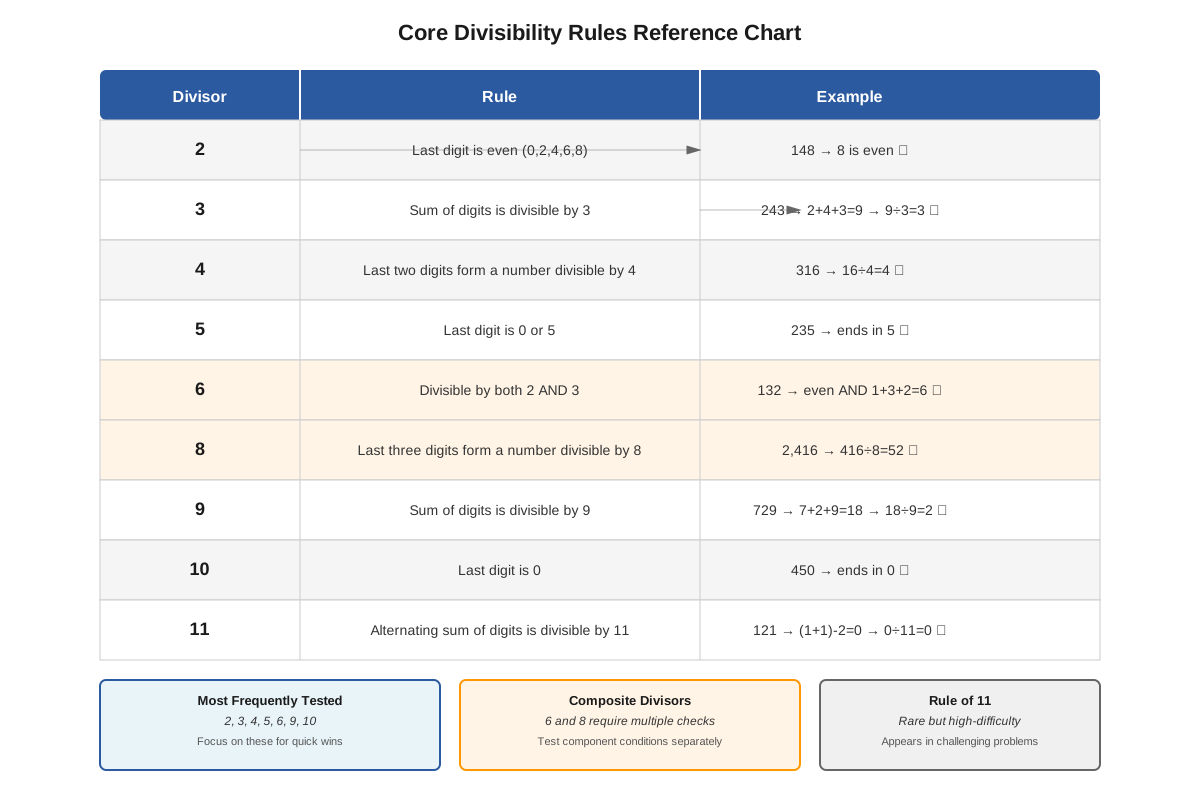
Divisibility by 2: A number is divisible by 2 if its last digit (ones place) is even (0, 2, 4, 6, or 8). This is the most straightforward divisibility rule and forms the basis for identifying even numbers. For example, 1,234 is divisible by 2 because it ends in 4, while 1,237 is not divisible by 2 because it ends in 7.
Divisibility by 3: A number is divisible by 3 if the sum of all its digits is divisible by 3. This rule requires adding all digits together and checking whether that sum is divisible by 3. For instance, to check if 2,451 is divisible by 3, calculate 2 + 4 + 5 + 1 = 12. Since 12 is divisible by 3 (12 ÷ 3 = 4), the original number 2,451 is also divisible by 3.
Divisibility by 4: A number is divisible by 4 if the number formed by its last two digits is divisible by 4. Only the tens and ones places matter for this rule. For example, 3,516 is divisible by 4 because 16 is divisible by 4, while 3,514 is not because 14 is not divisible by 4. Students should memorize common two-digit multiples of 4 (04, 08, 12, 16, 20, 24, 28, 32, 36, 40, etc.) for rapid application.
Divisibility by 5: A number is divisible by 5 if its last digit is either 0 or 5. This simple rule makes identifying multiples of 5 instantaneous. Numbers like 1,235 and 1,240 are divisible by 5, while 1,237 is not.
Divisibility by 6: A number is divisible by 6 if it is divisible by both 2 AND 3. This is the first composite divisibility rule, requiring application of two separate tests. For example, 2,454 is divisible by 6 because it ends in 4 (divisible by 2) and its digit sum is 2 + 4 + 5 + 4 = 15, which is divisible by 3.
Advanced Divisibility Rules
Divisibility by 8: A number is divisible by 8 if the number formed by its last three digits is divisible by 8. This rule extends the pattern from divisibility by 4. For 5,216, check whether 216 is divisible by 8 (216 ÷ 8 = 27), confirming that 5,216 is divisible by 8. Common three-digit multiples of 8 include 000, 008, 016, 024, 032, 040, 048, 056, 064, 072, 080, 088, 096, 104, 112, 120, and so forth.
Divisibility by 9: A number is divisible by 9 if the sum of all its digits is divisible by 9. This rule parallels the divisibility by 3 rule but with a stricter requirement. For 7,326, calculate 7 + 3 + 2 + 6 = 18. Since 18 is divisible by 9, the number 7,326 is divisible by 9. Note that any number divisible by 9 is automatically divisible by 3, but not vice versa.
Divisibility by 10: A number is divisible by 10 if its last digit is 0. This is the simplest rule and identifies numbers in the decimal system's base structure. Numbers like 1,230 and 4,560 are divisible by 10, while 1,235 is not.
Divisibility by 11: A number is divisible by 11 if the alternating sum of its digits is divisible by 11 (including 0). Start from the right, alternately adding and subtracting digits. For 2,728: 8 - 2 + 7 - 2 = 11, which is divisible by 11, so 2,728 is divisible by 11. For 1,342: 2 - 4 + 3 - 1 = 0, which is divisible by 11 (0 ÷ 11 = 0), so 1,342 is divisible by 11.
Composite Number Divisibility
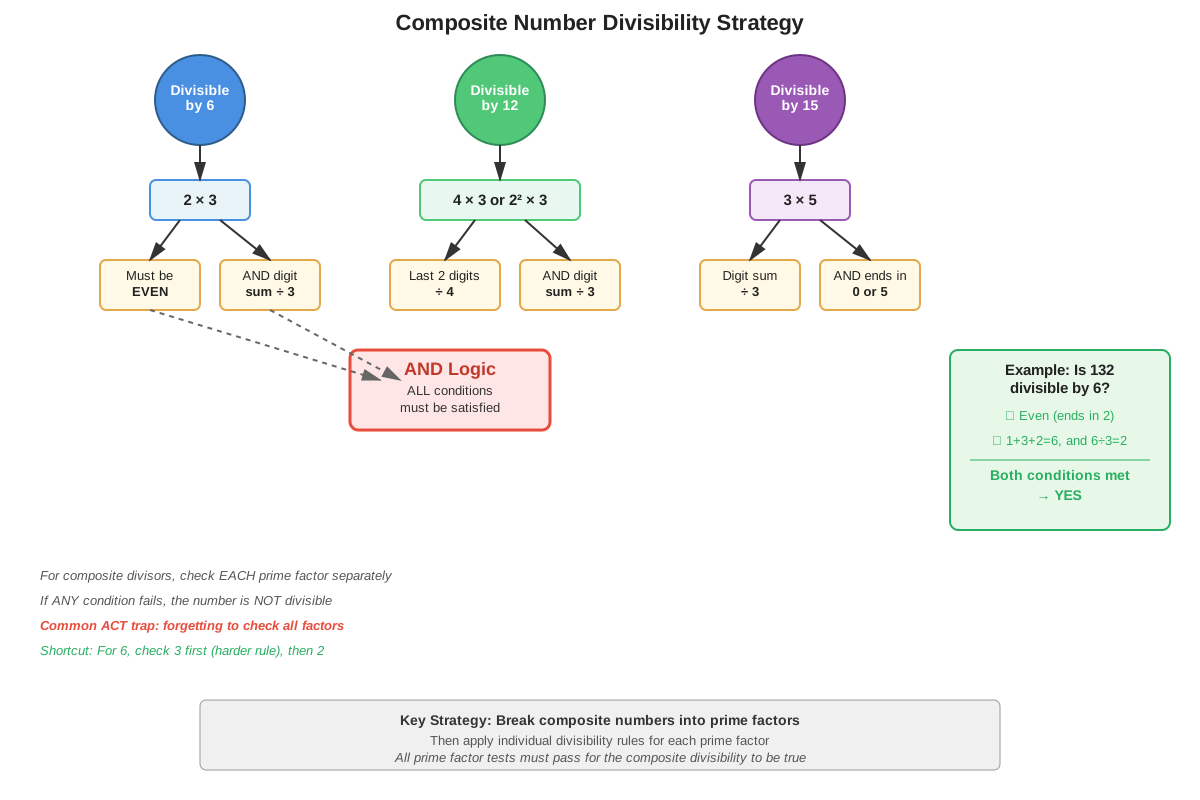
For divisibility by composite numbers (numbers with more than two factors), apply the divisibility rules of the prime factors:
| Divisor | Prime Factorization | Divisibility Test |
|---|---|---|
| 12 | 2² × 3 | Divisible by both 4 AND 3 |
| 15 | 3 × 5 | Divisible by both 3 AND 5 |
| 18 | 2 × 3² | Divisible by both 2 AND 9 |
| 20 | 2² × 5 | Divisible by both 4 AND 5 |
| 24 | 2³ × 3 | Divisible by both 8 AND 3 |
When checking divisibility by composite numbers, students must verify all prime factor conditions are met. For example, to check if 1,440 is divisible by 12, verify it's divisible by 4 (last two digits: 40 ÷ 4 = 10 ✓) and by 3 (digit sum: 1 + 4 + 4 + 0 = 9, divisible by 3 ✓). Both conditions are satisfied, so 1,440 is divisible by 12.
Strategic Application Process
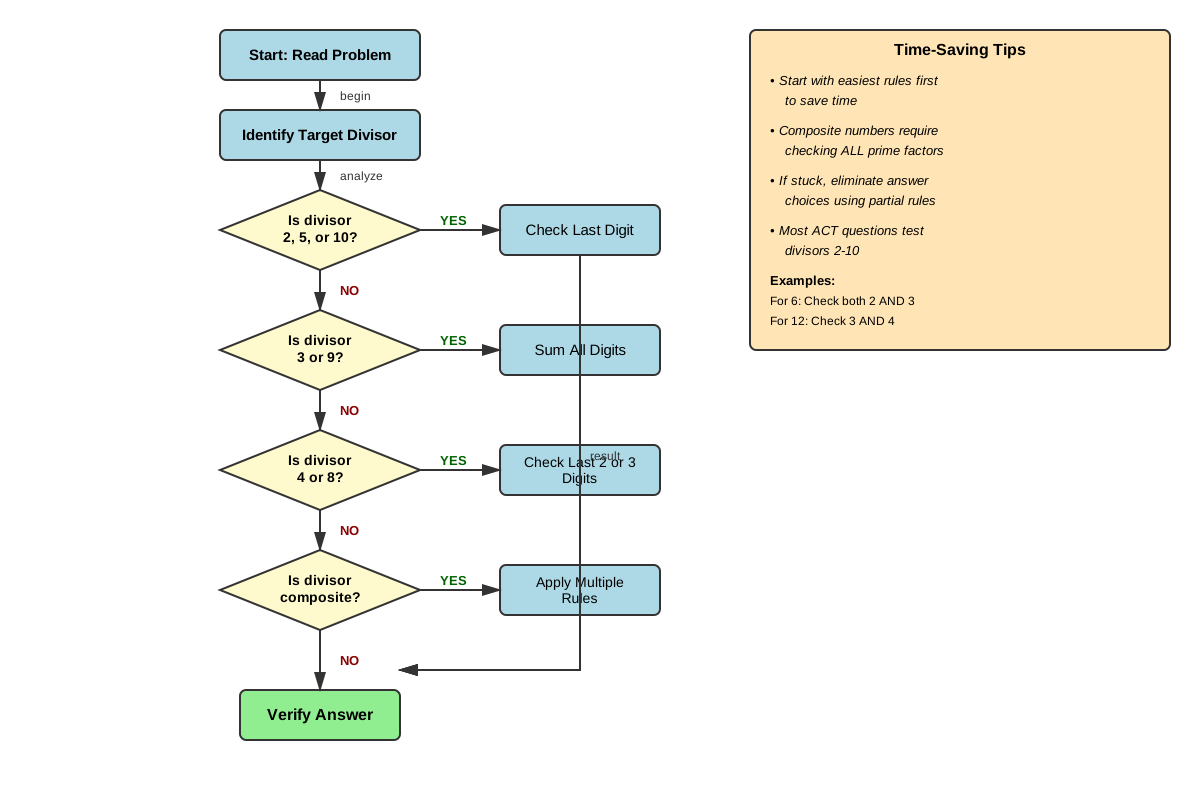
When encountering ACT questions involving divisibility:
- Identify the divisor(s) mentioned in the question
- Recall the appropriate rule(s) for that divisor
- Apply the rule systematically to the given number or expression
- Verify the result if time permits or if the answer seems unusual
- Use elimination on multiple-choice questions by testing answer choices
For algebraic expressions, divisibility rules can determine constraints on variables. If the expression 3n + 6 must be divisible by 9, then 3n + 6 = 9k for some integer k, which simplifies to n + 2 = 3k, meaning n must be one less than a multiple of 3.
Concept Relationships
Divisibility rules form a hierarchical network where simpler rules build toward more complex applications. The divisibility by 2 rule (checking the last digit) establishes the pattern that divisibility by powers of 2 (4, 8, 16) involves checking the last 2, 3, or 4 digits respectively. Similarly, divisibility by 3 (digit sum) extends to divisibility by 9 (digit sum with stricter requirement), demonstrating how related divisors share similar testing methods.
The relationship flows as follows: Basic digit-position rules (2, 5, 10) → Digit-sum rules (3, 9) → Multi-digit position rules (4, 8) → Composite rules (6, 12, 15, 18) → Complex alternating rules (11). Understanding this progression helps students remember rules by pattern rather than rote memorization.
Divisibility rules connect directly to prerequisite knowledge of factors and multiples: if a number is divisible by another, the divisor is a factor and the dividend is a multiple. This relationship extends to prime factorization, where divisibility by composite numbers requires divisibility by all prime factors. The connection to GCF and LCM becomes apparent when solving problems involving common divisors or shared multiples.
These rules also support modular arithmetic concepts (though not explicitly tested on the ACT), where divisibility relates to remainders of zero. The divisibility by 11 rule, using alternating sums, introduces students to more sophisticated number theory concepts that appear in advanced mathematics. Finally, divisibility rules enhance algebraic reasoning when determining whether expressions with variables meet divisibility criteria, bridging number theory and algebra.
High-Yield Facts
⭐ A number is divisible by 3 if and only if the sum of its digits is divisible by 3
⭐ A number is divisible by 4 if its last two digits form a number divisible by 4
⭐ A number is divisible by 6 if it is divisible by both 2 and 3 simultaneously
⭐ A number is divisible by 9 if and only if the sum of its digits is divisible by 9
⭐ A number is divisible by 8 if its last three digits form a number divisible by 8
- A number ending in 0 is divisible by both 2, 5, and 10
- Any number divisible by 9 is automatically divisible by 3, but not vice versa
- Divisibility by 11 uses an alternating sum: add and subtract digits alternately from right to left
- To test divisibility by composite numbers, verify divisibility by all prime factors
- Zero is divisible by every integer (except division by zero itself, which is undefined)
- Divisibility rules work for both positive and negative integers
- If a number is divisible by both m and n, and m and n share no common factors (are coprime), then the number is divisible by m × n
- The divisibility by 7 rule (multiply last digit by 2, subtract from remaining number, repeat) is rarely tested on the ACT due to its complexity
- Consecutive integers include exactly one multiple of any given number within each set of that many consecutive integers
Quick check — test yourself on Divisibility rules so far.
Try Flashcards →Common Misconceptions
Misconception: A number is divisible by 6 if it's divisible by 2 or 3 → Correction: A number must be divisible by both 2 AND 3 to be divisible by 6. The number 9 is divisible by 3 but not by 2, so it's not divisible by 6. The number 14 is divisible by 2 but not by 3, so it's also not divisible by 6.
Misconception: To check divisibility by 4, just look at the last digit → Correction: Divisibility by 4 requires checking the last TWO digits. The number 214 ends in 4 (an even number), but 14 is not divisible by 4, so 214 is not divisible by 4. The correct approach is to verify that the two-digit number formed by the last two digits is divisible by 4.
Misconception: If a number is divisible by 9, it must be divisible by 6 → Correction: Divisibility by 9 guarantees divisibility by 3, but not by 2. A number must be divisible by both 2 and 3 to be divisible by 6. The number 27 is divisible by 9 but not by 2, so it's not divisible by 6.
Misconception: The divisibility by 3 rule only works for small numbers → Correction: The digit-sum rule for divisibility by 3 works for numbers of any size. For very large numbers, if the digit sum is still large, apply the rule repeatedly. For 123,456, the digit sum is 21, and 2 + 1 = 3, which is divisible by 3, confirming 123,456 is divisible by 3.
Misconception: A number ending in 5 is divisible by 10 → Correction: Only numbers ending in 0 are divisible by 10. Numbers ending in 5 are divisible by 5 but not by 10. The number 25 is divisible by 5 but leaves a remainder when divided by 10.
Misconception: To check divisibility by 12, verify divisibility by 6 and 2 → Correction: While this approach might work in some cases, the proper method is to verify divisibility by both 4 and 3 (the highest powers of 2 and 3 in 12's factorization). A number divisible by 6 is divisible by 2 and 3, but not necessarily by 4, which is required for divisibility by 12.
Misconception: The alternating sum for divisibility by 11 always starts with addition → Correction: The alternating sum for divisibility by 11 should start from the ones place (rightmost digit) and alternate subtraction and addition moving left. For consistency, start by adding the ones digit, subtracting the tens digit, adding the hundreds digit, and so on.
Worked Examples
Example 1: Multi-Step Divisibility Problem
Question: Which of the following four-digit numbers is divisible by both 6 and 9?
A) 1,234
B) 2,358
C) 3,456
D) 4,572
E) 5,688
Solution Process:
For a number to be divisible by both 6 and 9, it must satisfy:
- Divisibility by 6: divisible by both 2 AND 3
- Divisibility by 9: digit sum divisible by 9
Since divisibility by 9 is more restrictive than divisibility by 3, we can simplify: the number must be divisible by both 2 AND 9.
Testing Option A (1,234):
- Divisibility by 2: ends in 4 (even) ✓
- Digit sum: 1 + 2 + 3 + 4 = 10
- Is 10 divisible by 9? No ✗
- Eliminate A
Testing Option B (2,358):
- Divisibility by 2: ends in 8 (even) ✓
- Digit sum: 2 + 3 + 5 + 8 = 18
- Is 18 divisible by 9? Yes (18 ÷ 9 = 2) ✓
- This is our answer, but let's verify divisibility by 6:
- Divisible by 2: Yes ✓
- Divisible by 3: digit sum 18 is divisible by 3 ✓
- Therefore divisible by 6 ✓
Answer: B
This example demonstrates the strategic approach of identifying the most restrictive condition (divisibility by 9) and using it to eliminate options quickly. This problem addresses the learning objectives of identifying when divisibility rules are tested, applying multiple rules accurately, and using them to solve ACT-style questions efficiently.
Example 2: Algebraic Expression with Divisibility Constraint
Question: If n is a positive integer and the expression 4n + 12 is divisible by 8, which of the following must be true about n?
F) n is divisible by 2
G) n is divisible by 4
H) n is odd
J) n is even
K) n is divisible by 8
Solution Process:
Given: 4n + 12 is divisible by 8
This means 4n + 12 = 8k for some integer k.
Factor out 4: 4(n + 3) = 8k
Divide both sides by 4: n + 3 = 2k
This tells us that n + 3 must be even (since it equals 2k).
If n + 3 is even, then n must be odd (because odd + 3 = even).
Let's verify with examples:
- If n = 1: 4(1) + 12 = 16, which is divisible by 8 ✓ (and 1 is odd)
- If n = 3: 4(3) + 12 = 24, which is divisible by 8 ✓ (and 3 is odd)
- If n = 5: 4(5) + 12 = 32, which is divisible by 8 ✓ (and 5 is odd)
- If n = 2: 4(2) + 12 = 20, which is NOT divisible by 8 ✗ (and 2 is even)
Answer: H
This example shows how divisibility rules extend to algebraic contexts, requiring students to manipulate expressions and understand the relationship between divisibility and number properties (even/odd). This addresses the learning objective of applying divisibility rules to various ACT question formats and demonstrates the connection between divisibility and algebraic reasoning.
Exam Strategy
When approaching ACT questions involving divisibility, follow this systematic process:
Recognition triggers: Watch for keywords and phrases including "divisible by," "evenly divided," "equal groups," "no remainder," "multiple of," "factor of," and "how many times does X go into Y." Questions asking about "splitting," "distributing equally," or "arranging in rows" often involve divisibility concepts.
Initial assessment: Quickly identify which divisibility rules apply. If the question involves 6, 12, 15, or other composite numbers, immediately recognize that multiple rules must be applied. For questions with answer choices, scan the options first—if all answers end in the same digit, that information won't help eliminate choices, so focus on other divisibility tests.
Strategic testing order: When testing multiple answer choices, start with the most restrictive divisibility rules first. For example, if checking divisibility by both 3 and 8, test divisibility by 8 first (fewer numbers are divisible by 8), which eliminates more options quickly. Similarly, divisibility by 9 is more restrictive than divisibility by 3.
Time-saving shortcuts:
- For divisibility by 2, 5, or 10, glance at the last digit only
- For divisibility by 3 or 9, add digits mentally while reading the number
- For divisibility by 4, isolate and mentally divide only the last two digits
- For composite divisors, check the largest prime factor first
Process of elimination: On multiple-choice questions, eliminate obviously incorrect answers before applying divisibility rules. If a question asks for numbers divisible by 6, immediately eliminate any odd numbers (not divisible by 2). If looking for numbers divisible by 9, eliminate any whose digit sum is clearly not a multiple of 9.
Verification technique: If time permits, verify your answer using a different method. For instance, if you determined a number is divisible by 12 using the rules for 4 and 3, quickly check by estimating the division (e.g., 144 ÷ 12 ≈ 12, which is exact).
Time allocation: Divisibility questions should take 30-60 seconds maximum. If a problem requires more than 90 seconds, mark it and return later. These questions are designed to be solved quickly using rules, not through long division or extensive calculation.
ACT Tip: When a question provides a large number and asks about divisibility, never perform actual long division. The question is specifically testing whether you know and can apply divisibility rules efficiently.
Memory Techniques
Mnemonic for divisibility by 2, 3, 5, 10: "Two Toes, Three Total, Five Fingers, Ten Toes"
- Two Toes: Check the last digit (toes = ends)
- Three Total: Add up the total of all digits
- Five Fingers: Last digit is 5 or 0 (fingers = ends)
- Ten Toes: Last digit is 0 (toes = ends)
Visualization for divisibility by 4 and 8: Picture looking at a number through a "window" that only shows the last few digits:
- Window of 2 (last 2 digits) for divisibility by 4
- Window of 3 (last 3 digits) for divisibility by 8
- The pattern continues: window of 1 for divisibility by 2
Acronym for composite divisibility: "PF-ALL" (Prime Factors - ALL required)
- To check divisibility by composite numbers, verify divisibility by ALL Prime Factors
- Example: For 12 = 2² × 3, check divisibility by 4 (2²) and 3
Rhyme for divisibility by 6: "Two and three must both agree, then six divides quite easily"
Hand trick for divisibility by 9: When adding digits, use your fingers to keep track. Start with a closed fist, extend one finger for each digit you add. When you reach 9, close your fist and start over. The number of fingers extended at the end shows the remainder when divided by 9 (0 fingers = divisible by 9).
Pattern recognition for 11: Remember "Add Subtract Add Subtract" (ASAS) starting from the right. Visualize the digits bouncing up and down like a wave as you alternate operations.
Summary
Divisibility rules are essential mathematical shortcuts that enable rapid determination of whether one integer divides evenly into another without performing long division. These rules form a critical component of ACT Math success, appearing in 2-4 questions per test across various formats including direct divisibility questions, word problems involving equal distribution, and algebraic expressions with divisibility constraints. Mastery requires understanding both simple rules (checking last digits for 2, 5, 10) and complex rules (digit sums for 3 and 9, alternating sums for 11, and multi-digit checks for 4 and 8). For composite divisors, students must apply multiple rules simultaneously, verifying divisibility by all prime factors. Strategic application involves recognizing trigger words, testing the most restrictive conditions first, and using process of elimination on multiple-choice questions. These rules connect to broader mathematical concepts including factors, multiples, prime factorization, and algebraic reasoning, making them foundational for success throughout the Number and Quantity unit and beyond.
Key Takeaways
- Divisibility rules eliminate the need for long division, saving critical time on the ACT Math section
- The most frequently tested rules involve divisibility by 2, 3, 4, 5, 6, 8, 9, and 10
- Composite number divisibility requires checking all prime factors simultaneously (e.g., divisibility by 6 requires divisibility by both 2 AND 3)
- Digit-sum rules (for 3 and 9) work for numbers of any size and can be applied repeatedly if needed
- Position-based rules check specific digits: last digit for 2/5/10, last two digits for 4, last three digits for 8
- Strategic testing order prioritizes the most restrictive rules first to eliminate answer choices efficiently
- Divisibility rules extend to algebraic expressions, requiring manipulation to determine variable constraints
Related Topics
Prime Factorization: Understanding how to break numbers into prime factors builds directly on divisibility rules, as divisibility by composite numbers requires divisibility by all prime factors. Mastering divisibility rules makes prime factorization faster and more intuitive.
Greatest Common Factor (GCF) and Least Common Multiple (LCM): These concepts rely heavily on understanding divisibility and factor relationships. Students who master divisibility rules can more quickly identify common factors and multiples.
Modular Arithmetic and Remainders: Divisibility represents the special case where remainders equal zero. Understanding divisibility rules provides foundation for more advanced remainder problems that appear on the ACT.
Integer Properties: Divisibility rules connect to broader integer properties including even/odd relationships, consecutive integer patterns, and number theory concepts that appear throughout the ACT Math section.
Algebraic Expressions with Constraints: Many ACT algebra problems involve expressions that must meet divisibility requirements, requiring students to combine algebraic manipulation with divisibility rule application.
Practice CTA
Now that you've mastered the core concepts and strategies for divisibility rules, it's time to cement your understanding through active practice. Complete the practice questions to test your ability to recognize when divisibility rules apply, select the appropriate rule for each situation, and apply these rules accurately under timed conditions. The flashcards will help you memorize the specific rules and develop the instant recall necessary for ACT success. Remember: understanding the concepts is just the first step—consistent practice transforms knowledge into the automatic, rapid problem-solving skills that lead to top scores. Challenge yourself to apply these rules without a calculator, building the mental math confidence that will serve you throughout the entire ACT Math section!
Sign up free to keep reading
Create a free AnvayaPrep account to finish this ACT guide on Divisibility rules — plus flashcards and practice questions.