Overview
Integers form one of the most fundamental building blocks of mathematics tested on the ACT Math section. These whole numbers—including positive numbers, negative numbers, and zero—appear in approximately 10-15% of all ACT Math questions, either as the primary focus or as essential components of more complex problems. Understanding integers goes far beyond simple arithmetic; it encompasses properties, operations, patterns, and relationships that underpin algebra, coordinate geometry, and even some trigonometry questions on the exam.
The ACT consistently tests integer concepts in multiple ways: through direct computation problems, word problems requiring integer solutions, questions about divisibility and factors, and problems involving number properties like even/odd relationships or consecutive integer patterns. Students who master ACT integers gain a significant advantage because these concepts appear not only in standalone questions but also as critical steps in multi-part problems across various mathematical domains. A solid grasp of integer properties enables faster problem-solving and reduces careless errors that cost valuable points.
Integer mastery connects directly to rational numbers, algebraic expressions, inequalities, and coordinate plane problems. When students understand how integers behave under different operations and recognize their unique properties, they develop the mathematical fluency necessary to tackle the ACT's most challenging questions efficiently. This topic serves as a gateway to higher-level mathematical reasoning and pattern recognition—skills that distinguish top scorers from average performers on test day.
Learning Objectives
- [ ] Identify when Integers is being tested in ACT Math questions
- [ ] Explain the core rule or strategy behind Integers operations and properties
- [ ] Apply Integers concepts to ACT-style questions accurately
- [ ] Distinguish between integer and non-integer solutions in problem contexts
- [ ] Analyze divisibility patterns and factor relationships among integers
- [ ] Solve problems involving consecutive integers and integer sequences
- [ ] Apply even/odd integer properties to eliminate incorrect answer choices
Prerequisites
- Basic arithmetic operations: Addition, subtraction, multiplication, and division form the foundation for all integer manipulations and are required for every integer problem on the ACT.
- Number line understanding: Visualizing integers on a number line helps with ordering, absolute value, and understanding negative number relationships.
- Order of operations (PEMDAS): Correctly sequencing operations ensures accurate computation when working with complex integer expressions.
- Concept of zero: Understanding zero's unique properties as neither positive nor negative is essential for classification problems and special cases.
Why This Topic Matters
Integers appear throughout daily life in contexts ranging from temperature readings (negative integers for below-zero temperatures) to financial transactions (debits as negative integers, credits as positive), elevation measurements (below sea level), and time calculations (years BCE as negative integers). This practical relevance makes integer problems on the ACT particularly accessible when framed as real-world scenarios, but it also means students must translate word problems into mathematical operations accurately.
On the ACT Math section, integer questions appear with remarkable consistency. Approximately 6-9 questions out of 60 directly test integer concepts, while another 10-15 questions require integer knowledge as an intermediate step. These questions span difficulty levels from straightforward computation (early in the test) to complex multi-step problems involving multiple integer properties (later questions). Common question formats include: identifying integer solutions to equations, determining factors or multiples, analyzing consecutive integer relationships, applying divisibility rules, and working with absolute value.
The ACT particularly favors questions that combine integer properties with other concepts. For example, a coordinate geometry problem might ask for integer coordinates satisfying certain conditions, or an algebra question might require finding integer values that make an expression divisible by a specific number. Recognizing when integer constraints apply—such as when a problem asks for "whole number" solutions or "how many complete items"—is crucial for selecting correct answers and avoiding trap choices that include non-integer values.
Core Concepts
Definition and Classification of Integers
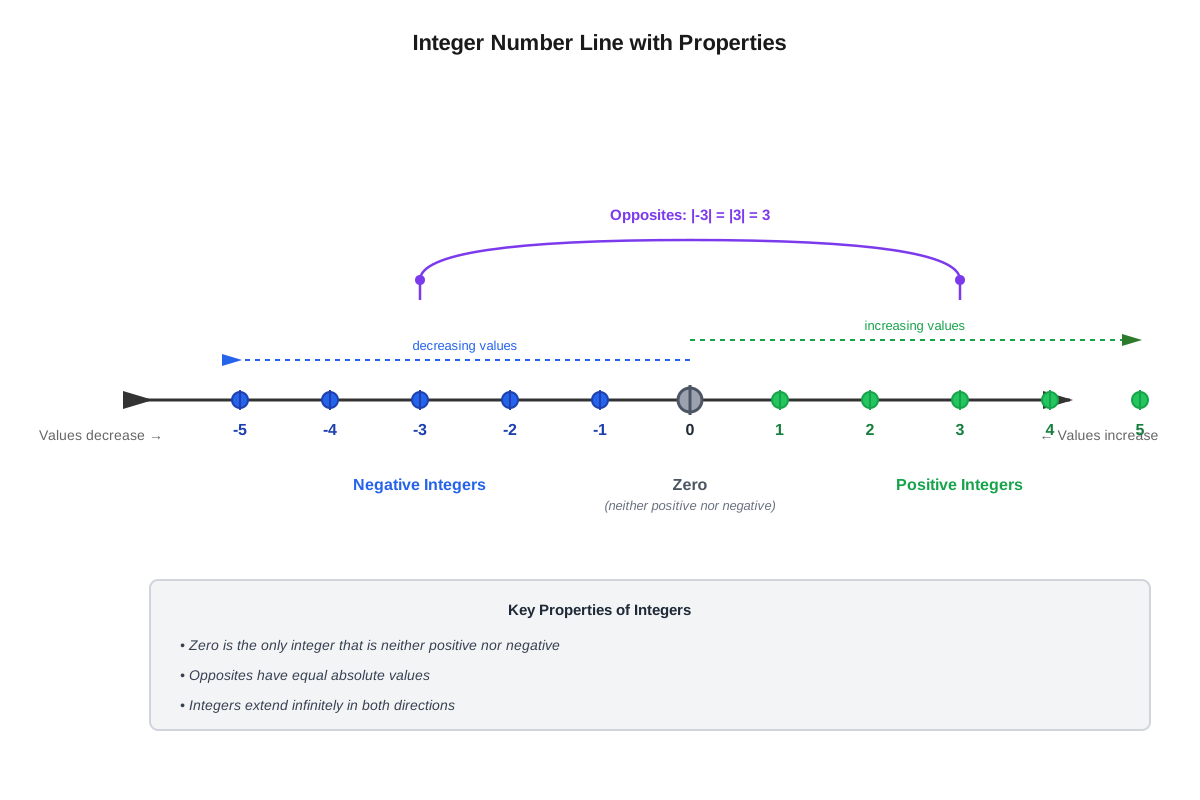
Integers are the set of whole numbers and their opposites, represented mathematically as {..., -3, -2, -1, 0, 1, 2, 3, ...}. This set includes three distinct categories: positive integers (natural numbers: 1, 2, 3, ...), negative integers (-1, -2, -3, ...), and zero (which is neither positive nor negative). The ACT frequently tests whether students correctly classify zero and understand that it belongs to the integer set but occupies a unique position.
Integers do NOT include fractions, decimals, or irrational numbers. When the ACT asks for integer solutions, answers like 2.5, -1/3, or √2 are automatically incorrect, even if they satisfy other problem conditions. This distinction becomes critical in word problems asking for quantities that must be whole (people, complete objects, full cycles).
Integer Operations and Properties
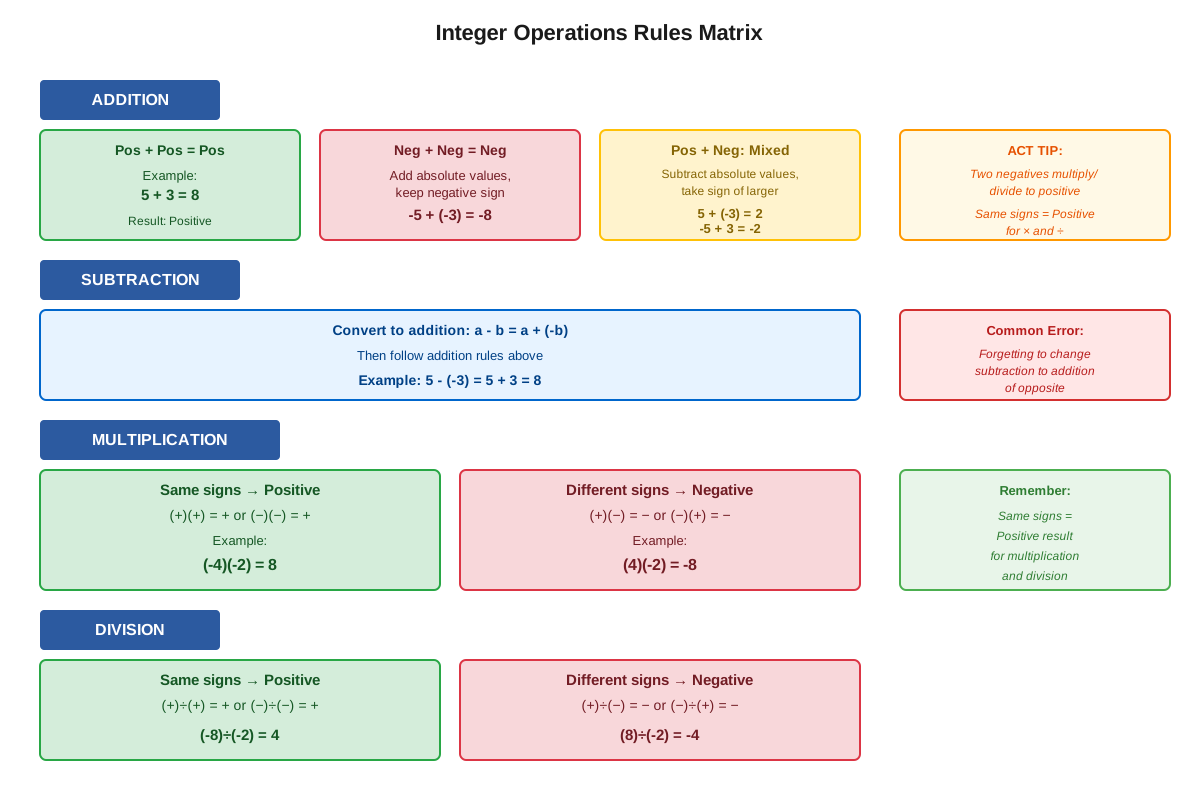
Addition and Subtraction: When adding integers with the same sign, add their absolute values and keep the common sign. When adding integers with different signs, subtract the smaller absolute value from the larger and use the sign of the number with the larger absolute value. For example: (-8) + (-3) = -11, while (-8) + 3 = -5. Subtraction of integers can always be rewritten as addition of the opposite: a - b = a + (-b).
Multiplication and Division: The product or quotient of two integers with the same sign is always positive, while the product or quotient of two integers with different signs is always negative. Key rules include:
- Positive × Positive = Positive
- Negative × Negative = Positive
- Positive × Negative = Negative
- Negative × Positive = Negative
These rules extend to division with one critical caveat: division by zero is undefined. The ACT occasionally includes trap answers that would require division by zero.
Even and Odd Integer Properties
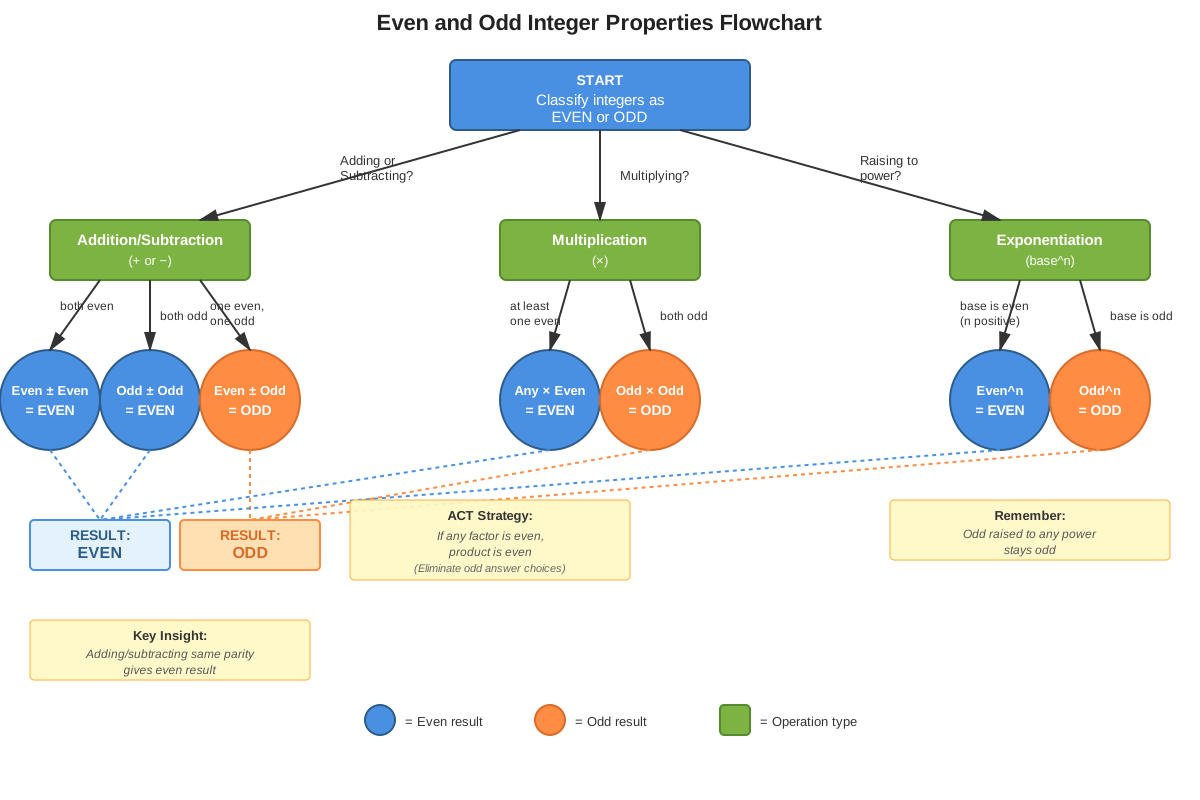
Even integers are divisible by 2 (can be expressed as 2n where n is an integer): {..., -4, -2, 0, 2, 4, ...}. Odd integers leave a remainder of 1 when divided by 2 (can be expressed as 2n + 1): {..., -3, -1, 1, 3, 5, ...}. Note that zero is even, a fact the ACT tests regularly.
| Operation | Result | Example |
|---|---|---|
| Even + Even | Even | 4 + 6 = 10 |
| Odd + Odd | Even | 3 + 5 = 8 |
| Even + Odd | Odd | 4 + 5 = 9 |
| Even × Even | Even | 4 × 6 = 24 |
| Odd × Odd | Odd | 3 × 5 = 15 |
| Even × Odd | Even | 4 × 5 = 20 |
These properties enable rapid elimination of answer choices. If a problem states that n is odd and asks for the value of 2n + 3, you immediately know the answer must be odd (even + odd = odd).
Consecutive Integers
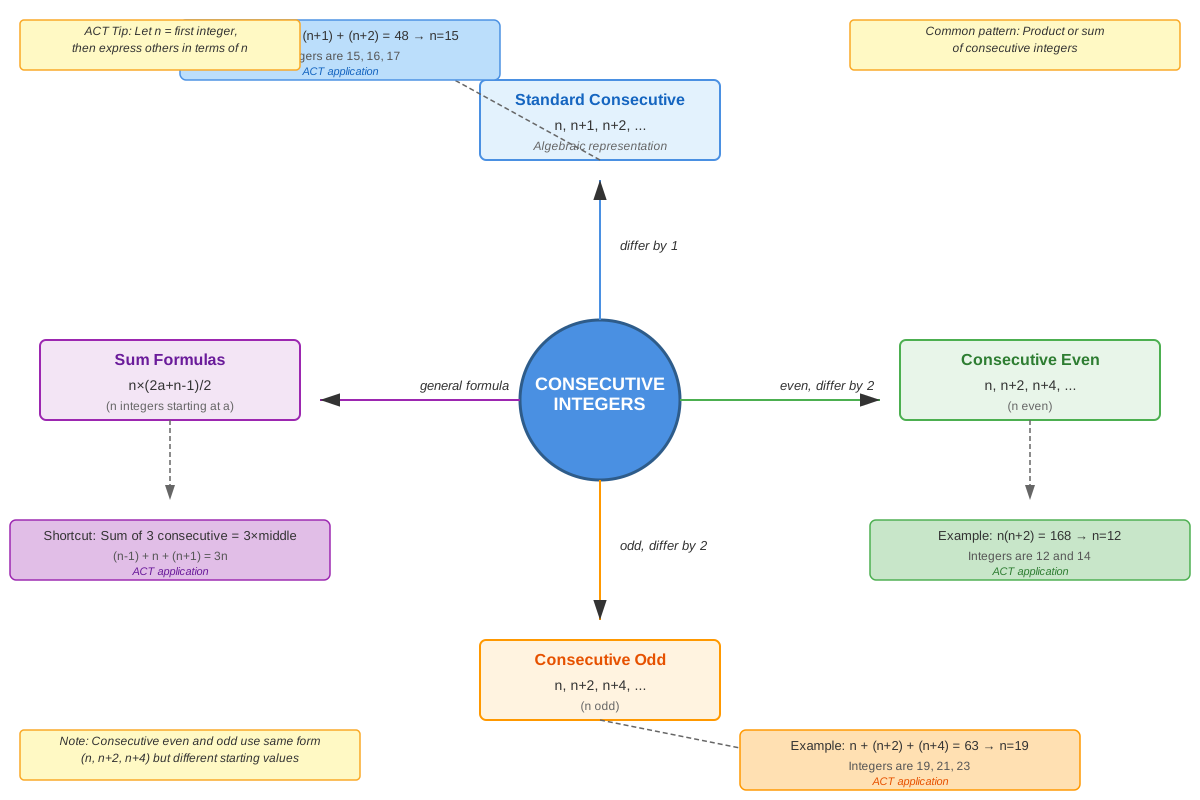
Consecutive integers are integers that follow in sequence with a difference of 1: n, n+1, n+2, etc. The ACT frequently tests problems involving sums or products of consecutive integers. Key patterns include:
- The sum of any two consecutive integers is always odd
- The sum of three consecutive integers equals 3 times the middle integer
- The product of any two consecutive integers is always even (one must be even)
- For any set of consecutive integers, if the count is odd, the sum equals the count times the middle number
Consecutive even integers (n, n+2, n+4) and consecutive odd integers (n, n+2, n+4 where n is odd) follow similar patterns but maintain their even/odd character throughout the sequence.
Divisibility and Factors
An integer a is divisible by integer b if a ÷ b results in an integer with no remainder (equivalently, b is a factor of a). The ACT tests divisibility rules extensively:
- Divisibility by 2: Last digit is even (0, 2, 4, 6, 8)
- Divisibility by 3: Sum of digits is divisible by 3
- Divisibility by 4: Last two digits form a number divisible by 4
- Divisibility by 5: Last digit is 0 or 5
- Divisibility by 6: Number is divisible by both 2 and 3
- Divisibility by 9: Sum of digits is divisible by 9
- Divisibility by 10: Last digit is 0
Prime numbers are integers greater than 1 with exactly two factors: 1 and themselves. The first several primes (2, 3, 5, 7, 11, 13, 17, 19, 23, 29) appear regularly in ACT problems. Note that 2 is the only even prime number.
Absolute Value
The absolute value of an integer is its distance from zero on the number line, always expressed as a non-negative number. Notation: |a|. For any integer a:
- If a ≥ 0, then |a| = a
- If a < 0, then |a| = -a
For example: |5| = 5 and |-5| = 5. The ACT tests absolute value in equations (|x| = 3 has solutions x = 3 and x = -3) and inequalities (|x| < 3 means -3 < x < 3).
Integer Exponents
When integers are raised to powers, specific patterns emerge:
- Any integer (except 0) raised to the power of 0 equals 1
- Negative bases raised to even powers yield positive results: (-2)⁴ = 16
- Negative bases raised to odd powers yield negative results: (-2)³ = -8
- The expression -2⁴ equals -16 (the negative is not part of the base), while (-2)⁴ equals 16
Concept Relationships
Integer properties form an interconnected web where understanding one concept reinforces others. Even/odd properties directly connect to divisibility rules (even numbers are divisible by 2), which in turn relate to factors and multiples. When working with consecutive integers, both even/odd properties and addition rules come into play simultaneously.
The relationship flows as follows: Basic integer operations → Even/odd classification → Divisibility patterns → Factor relationships → Prime factorization → Greatest common factors and least common multiples. Each level builds upon the previous, creating a hierarchy of complexity.
Absolute value connects integers to distance concepts, bridging to coordinate geometry and inequality problems. Integer exponents link to polynomial expressions and exponential growth problems. Understanding that zero is an integer but neither positive nor negative affects inequality solutions and domain restrictions.
Prerequisite knowledge of the number line enables visualization of integer relationships, particularly for ordering and comparing integers. Order of operations ensures correct evaluation of complex integer expressions. These foundational skills support all higher-level integer applications on the ACT.
Quick check — test yourself on Integers so far.
Try Flashcards →High-Yield Facts
⭐ Zero is an integer, and it is even (divisible by 2), but it is neither positive nor negative.
⭐ The product of any integer and zero equals zero, making zero a critical consideration in factoring and equation-solving.
⭐ The sum of an even integer and an odd integer is always odd, enabling quick answer elimination.
⭐ Any integer multiplied by an even integer produces an even result, regardless of whether the first integer is even or odd.
⭐ The sum of three consecutive integers equals three times the middle integer: n + (n+1) + (n+2) = 3n + 3 = 3(n+1).
- The product of two consecutive integers is always even because one must be even.
- An integer is divisible by 6 if and only if it is divisible by both 2 and 3.
- The only even prime number is 2; all other primes are odd.
- When an odd number of negative integers are multiplied together, the result is negative; when an even number of negative integers are multiplied, the result is positive.
- The absolute value of a product equals the product of absolute values: |a × b| = |a| × |b|.
- If n is an integer, then n² is always non-negative (positive or zero).
- The difference between any two consecutive perfect squares increases by 2 each time: 1, 3, 5, 7, 9... (these are consecutive odd integers).
- Division of integers does not always yield an integer result, but the ACT will specify when integer results are required.
Common Misconceptions
Misconception: Zero is neither an integer nor a number with defined properties.
Correction: Zero is definitively an integer and is classified as even. It serves as the additive identity (a + 0 = a) and has the unique property that any number multiplied by zero equals zero.
Misconception: Negative numbers multiplied by negative numbers yield negative results.
Correction: The product of two negative integers is always positive. Only when an odd number of negative factors are multiplied together is the result negative. For example: (-3) × (-4) = 12, not -12.
Misconception: All integers are positive whole numbers.
Correction: Integers include negative whole numbers and zero in addition to positive whole numbers. The set is {..., -2, -1, 0, 1, 2, ...}, extending infinitely in both directions.
Misconception: If a number is divisible by 4 and by 6, it must be divisible by 24.
Correction: Divisibility by two numbers does not guarantee divisibility by their product. A number divisible by both 4 and 6 is guaranteed to be divisible by their least common multiple (12), not necessarily their product. For example, 12 is divisible by both 4 and 6 but not by 24.
Misconception: The expression -n² equals (-n)² for any integer n.
Correction: These expressions are different. The expression -n² means -(n²), where the negative applies after squaring. If n = 3, then -n² = -9. However, (-n)² means the negative is squared with the number: (-3)² = 9. The placement of parentheses is critical.
Misconception: Absolute value always makes numbers positive, so |-5| + |-3| = |(-5) + (-3)|.
Correction: While absolute value yields non-negative results, it does not distribute over addition. |-5| + |-3| = 5 + 3 = 8, but |(-5) + (-3)| = |-8| = 8. These happen to equal each other in this case, but |-5| + |3| = 8 while |(-5) + 3| = |-2| = 2, demonstrating the expressions are not equivalent in general.
Misconception: All odd numbers are prime numbers.
Correction: While all primes except 2 are odd, not all odd numbers are prime. For example, 9, 15, 21, 25, and 27 are all odd but composite (not prime) because they have factors other than 1 and themselves.
Worked Examples
Example 1: Consecutive Integer Sum Problem
Problem: The sum of three consecutive even integers is 72. What is the smallest of these integers?
Solution:
Step 1: Define the consecutive even integers. Let the smallest be n. Then the three consecutive even integers are n, n+2, and n+4.
Step 2: Set up the equation based on the given information:
n + (n+2) + (n+4) = 72
Step 3: Simplify and solve:
3n + 6 = 72
3n = 66
n = 22
Step 4: Verify the answer. The three integers are 22, 24, and 26. Check: 22 + 24 + 26 = 72 ✓
Answer: 22
Connection to Learning Objectives: This problem requires identifying that integers are being tested (consecutive even integers), applying the core strategy of representing consecutive integers algebraically (n, n+2, n+4), and accurately solving an ACT-style question. The solution demonstrates understanding of even integer properties and algebraic manipulation.
Example 2: Divisibility and Factor Problem
Problem: How many positive integers less than 100 are divisible by both 3 and 4?
Solution:
Step 1: Recognize that a number divisible by both 3 and 4 must be divisible by their least common multiple (LCM). Since 3 and 4 share no common factors, LCM(3,4) = 3 × 4 = 12.
Step 2: Find all multiples of 12 less than 100:
12, 24, 36, 48, 60, 72, 84, 96
Step 3: Count the multiples. Alternatively, divide: 96 ÷ 12 = 8, so there are 8 multiples of 12 less than 100.
Answer: 8
Connection to Learning Objectives: This problem tests the ability to identify divisibility as an integer concept, explain the strategy of using LCM for common divisibility, and apply systematic counting to reach an accurate answer. It demonstrates the relationship between divisibility rules and factor concepts.
Example 3: Even/Odd Property Application
Problem: If x and y are integers, x is even, and y is odd, which of the following must be odd?
A) x + y + 1
B) xy
C) x² + y
D) 2x + y
E) x + 2y
Solution:
Step 1: Recall even/odd properties:
- Even + Odd = Odd
- Even × Odd = Even
- Even + Even = Even
- Odd + Odd = Even
Step 2: Evaluate each choice:
A) x + y + 1 = Even + Odd + Odd = Odd + Odd = Even ✗
B) xy = Even × Odd = Even ✗
C) x² + y = Even² + Odd = Even + Odd = Odd ✓
D) 2x + y = Even + Odd = Odd, but wait—2x is 2(Even) = Even, so Even + Odd = Odd ✓
E) x + 2y = Even + 2(Odd) = Even + Even = Even ✗
Step 3: Both C and D appear odd. Re-examine: The question asks which MUST be odd. Both C and D are always odd given the conditions.
Step 4: Check if this is a "select all that apply" or if there's an error in the problem setup. For standard ACT format with single answers, verify calculations. Both C and D are indeed always odd.
Answer: C and D both must be odd (if only one answer is allowed, verify the original problem statement)
Connection to Learning Objectives: This demonstrates identifying integer property testing, explaining even/odd rules as the core strategy, and applying these rules to eliminate incorrect answers systematically—a crucial ACT skill.
Exam Strategy
When approaching ACT integers questions, begin by identifying trigger words that signal integer constraints: "whole number," "how many complete," "integer solutions," "consecutive," "even," "odd," "divisible," or "factor." These terms indicate that non-integer answers are incorrect, immediately eliminating some choices.
For problems involving consecutive integers, quickly set up algebraic representations (n, n+1, n+2 or n, n+2, n+4 for consecutive even/odd). Remember that the sum of consecutive integers often relates to the middle value, enabling faster calculation.
When even/odd properties are involved, create a quick reference table in your test booklet margin if needed, or memorize the key combinations: even+even=even, odd+odd=even, even+odd=odd, even×anything=even, odd×odd=odd. Use these to eliminate answer choices before calculating.
For divisibility questions, apply divisibility rules rather than performing long division. If a problem asks whether a large number is divisible by 6, check divisibility by 2 (last digit even) and 3 (sum of digits divisible by 3) separately—both must be true.
Time allocation: Simple integer computation questions should take 30-45 seconds. Multi-step problems involving consecutive integers or combined properties may require 60-90 seconds. If a problem requires testing multiple cases or extensive calculation, consider marking it and returning after completing faster questions.
Process of elimination: When answer choices include both integers and non-integers, and the problem context requires whole units (people, objects, complete cycles), immediately eliminate non-integer options. When testing even/odd properties, eliminate any answer that contradicts the established rules.
Watch for trap answers that result from common errors: forgetting that zero is even, miscounting in sequences, or applying incorrect signs in operations with negative integers. The ACT deliberately includes these as wrong answer choices.
Memory Techniques
EVEN-ODD Operations Mnemonic: "Even Eats Everything" (Even × Anything = Even). For addition: "Same Signs Stay Even" (Even+Even=Even, Odd+Odd=Even), while "Different Does Odd" (Even+Odd=Odd).
Divisibility Rules Acronym - "2-3-5-9 TELLS":
- Two: Terminal digit even
- Eight: Last three digits divisible by 8
- Last digit: 0 or 5 for five
- Last two: divisible by 4 for four
- Sum: of digits divisible by 3 or 9
Consecutive Integer Sum: Visualize a balanced scale. For three consecutive integers, the middle number is the balance point—the sum equals 3 times the middle. For five consecutive integers, sum equals 5 times the middle. This pattern extends to any odd count of consecutive integers.
Negative Multiplication: Use the "Sign Counter" method. Count the number of negative signs in a multiplication problem. Even count = positive result, odd count = negative result. For example: (-2)(-3)(-4) has three negatives (odd), so the result is negative.
Absolute Value: Think "Distance Never Negative." Absolute value measures distance from zero, and distance cannot be negative, so |anything| ≥ 0 always.
Summary
Integers—the set of whole numbers including positive numbers, negative numbers, and zero—form a critical foundation for ACT Math success. Mastery requires understanding integer classification (positive, negative, zero), operations (addition, subtraction, multiplication, division with sign rules), and special properties (even/odd behavior, divisibility rules, consecutive integer patterns). The ACT tests integers both directly and as components of complex problems across multiple mathematical domains. Key strategies include recognizing integer constraints in word problems, applying even/odd properties for rapid answer elimination, using divisibility rules to avoid lengthy calculations, and representing consecutive integers algebraically. Students must remember that zero is an even integer, that multiplication of negatives follows the even/odd sign rule, and that integer solutions exclude all fractions and decimals. Success on integer questions requires both computational accuracy and strategic thinking—knowing when to calculate versus when to apply properties or eliminate answers. With approximately 10-15% of ACT Math questions directly involving integer concepts, thorough preparation in this topic yields significant score improvements.
Key Takeaways
- Integers include all whole numbers (positive, negative, and zero), but exclude fractions, decimals, and irrational numbers—critical for identifying valid solutions
- Even/odd properties enable rapid answer elimination: even+even=even, odd+odd=even, even+odd=odd, and even×anything=even
- Zero is an even integer that is neither positive nor negative, a fact the ACT tests regularly in classification problems
- Consecutive integer problems are efficiently solved by algebraic representation (n, n+1, n+2) and recognizing that sums relate to middle values
- Divisibility rules (especially for 2, 3, 4, 5, 6, 9, 10) allow quick determination without long division, saving valuable test time
- Sign rules for multiplication/division: same signs yield positive results, different signs yield negative results
- Absolute value represents distance from zero and is always non-negative, with |a| = a when a ≥ 0 and |a| = -a when a < 0
Related Topics
Rational Numbers and Fractions: Building on integer understanding, rational numbers extend to ratios of integers (fractions), requiring knowledge of integer operations for simplification and computation. Mastering integers provides the foundation for fraction arithmetic and decimal conversions.
Factors, Multiples, and Prime Factorization: This advanced topic deepens integer divisibility concepts, exploring greatest common factors (GCF), least common multiples (LCM), and prime factorization methods essential for complex ACT problems.
Algebraic Expressions and Equations: Integer properties apply directly to solving equations, particularly when problems specify integer solutions or involve integer coefficients. Understanding integer behavior under operations is essential for algebraic manipulation.
Number Line and Inequalities: Integers serve as reference points on the number line, and integer solutions to inequalities require understanding of ordering and interval notation. This connection bridges arithmetic and algebraic reasoning.
Coordinate Geometry: Many coordinate plane problems involve integer coordinates, and understanding integer properties helps identify valid points, calculate distances, and determine slopes efficiently.
Practice CTA
Now that you've mastered the core concepts of integers, it's time to solidify your understanding through active practice. Complete the practice questions to test your ability to identify integer concepts in various contexts, apply even/odd properties strategically, and solve consecutive integer problems efficiently. Use the flashcards to reinforce divisibility rules and key properties until they become automatic. Remember: the difference between knowing integer concepts and scoring points on the ACT lies in repeated, timed practice. Each problem you solve builds the pattern recognition and speed essential for test day success. You've built a strong foundation—now strengthen it through application!
Sign up free to keep reading
Create a free AnvayaPrep account to finish this ACT guide on Integers — plus flashcards and practice questions.