Overview
Rational numbers form one of the foundational pillars of the ACT Math section, appearing in approximately 10-15% of all test questions either directly or as an embedded component of more complex problems. A rational number is any number that can be expressed as a fraction p/q where p and q are integers and q ≠ 0. This seemingly simple definition encompasses integers, terminating decimals, repeating decimals, and proper and improper fractions—all of which appear regularly throughout the ACT Math test. Understanding rational numbers is not merely about recognizing fractions; it involves fluency with operations, conversions between forms, ordering, and applying these skills to solve real-world problems under timed conditions.
The importance of mastering ACT rational numbers extends beyond isolated calculation questions. Rational number concepts integrate seamlessly with algebra (solving equations with fractional coefficients), geometry (calculating fractional dimensions and ratios), coordinate geometry (working with slopes as fractions), and data analysis (interpreting fractional or decimal representations of statistics). Students who struggle with rational numbers often find themselves losing points not just on "number sense" questions but across multiple content domains. The ACT frequently tests whether students can move fluidly between different representations of the same rational value—converting 0.375 to 3/8, recognizing that -2 can be written as -2/1, or understanding that 0.333... equals 1/3.
Rational numbers serve as the bridge between basic arithmetic and advanced mathematical reasoning. They represent the complete number system that students use for most practical calculations, and the ACT exploits this ubiquity by embedding rational number operations within word problems, geometric calculations, and algebraic manipulations. Mastery of this topic provides the numerical fluency necessary to work efficiently through the 60 questions in 60 minutes that define the ACT Math section, making it a high-yield investment of study time.
Learning Objectives
- [ ] Identify when Rational numbers is being tested in ACT questions
- [ ] Explain the core rule or strategy behind Rational numbers operations and properties
- [ ] Apply Rational numbers to ACT-style questions accurately and efficiently
- [ ] Convert fluently between fraction, decimal, and percent representations of rational numbers
- [ ] Compare and order rational numbers in various forms without converting all to a common format
- [ ] Simplify complex fractions and perform multi-step operations with rational numbers
- [ ] Recognize when rational number properties can simplify algebraic expressions and equations
Prerequisites
- Integer operations: Addition, subtraction, multiplication, and division of positive and negative whole numbers form the foundation for understanding numerators and denominators
- Basic fraction concepts: Understanding what fractions represent (parts of a whole) and the relationship between numerator and denominator is essential before working with rational number operations
- Decimal place value: Recognizing tenths, hundredths, and thousandths places enables conversion between decimal and fraction forms
- Order of operations (PEMDAS): Rational number calculations often involve multiple operations that must be performed in the correct sequence
- Prime factorization: Finding greatest common factors and least common multiples requires identifying prime factors of integers
Why This Topic Matters
Rational numbers appear in virtually every aspect of quantitative reasoning, from calculating tips and sales tax to understanding financial ratios and scientific measurements. In professional contexts, engineers work with fractional dimensions, medical professionals calculate dosages using decimal representations, and financial analysts interpret data presented as percentages—all applications of rational number fluency. The ability to work confidently with rational numbers in multiple forms distinguishes mathematically proficient individuals from those who struggle with quantitative tasks.
On the ACT specifically, rational numbers appear in approximately 6-9 questions per test, representing roughly 10-15% of the Math section. These questions span multiple formats: direct computation problems asking students to add or multiply fractions, word problems requiring interpretation and calculation with decimals, coordinate geometry questions involving fractional slopes, and algebra problems with rational coefficients. The ACT particularly favors questions that require students to convert between forms (fraction to decimal, decimal to percent) or to recognize equivalent representations without explicit conversion.
Common question types include: comparing the size of rational numbers presented in different forms; simplifying complex fractions; solving equations with fractional coefficients; calculating fractional parts of geometric figures; interpreting data displays with decimal or fractional values; and applying percent increase/decrease in real-world contexts. The test writers deliberately present rational numbers in the form least convenient for calculation, requiring students to demonstrate flexibility and strategic thinking about which representation to use.
Core Concepts
Definition and Classification of Rational Numbers
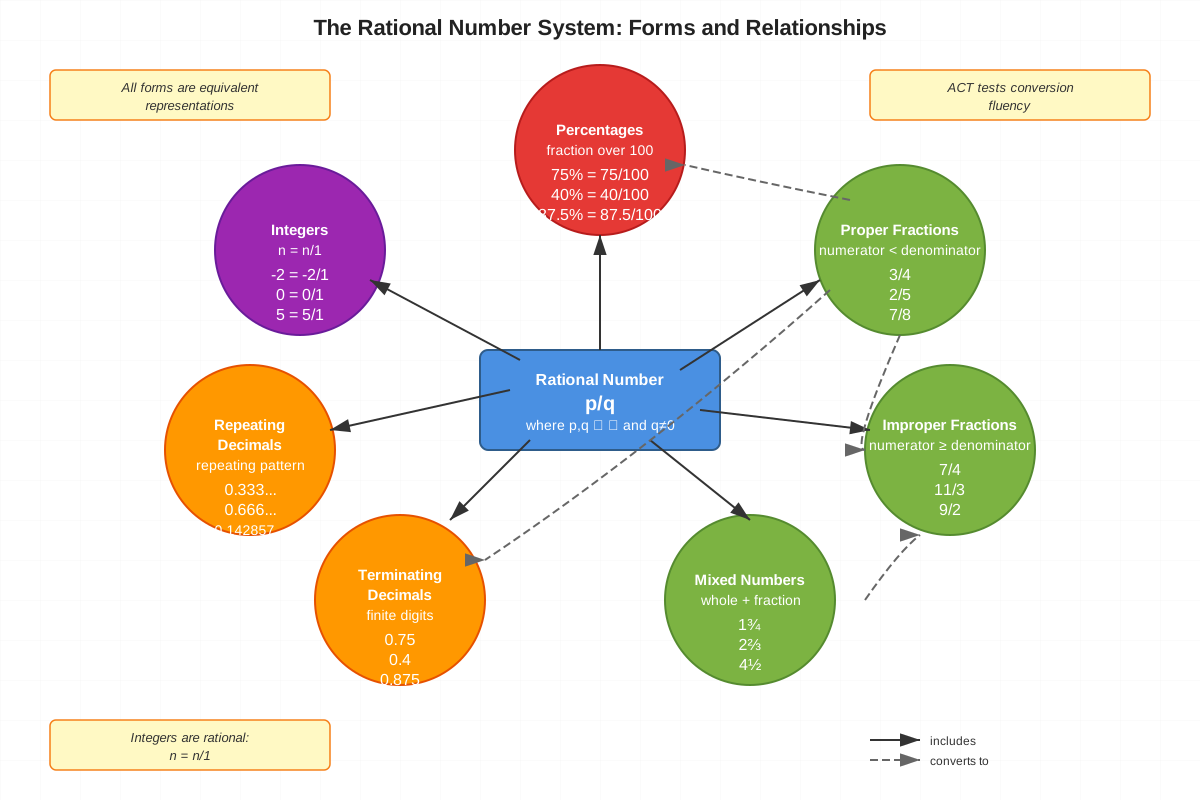
A rational number is any number that can be expressed as the quotient of two integers, written as p/q where p and q are integers and q ≠ 0. This definition is broader than many students initially realize. All integers are rational numbers (5 = 5/1, -3 = -3/1, 0 = 0/1). All terminating decimals are rational (0.75 = 75/100 = 3/4). All repeating decimals are rational (0.333... = 1/3, 0.142857142857... = 1/7). The set of rational numbers is dense on the number line, meaning between any two rational numbers, infinitely many other rational numbers exist.
Rational numbers can be classified as positive, negative, or zero. They can be proper fractions (absolute value less than 1), improper fractions (absolute value greater than or equal to 1), or integers. Understanding these classifications helps students quickly assess the reasonableness of their answers and make strategic decisions about solution approaches.
Converting Between Forms
The ACT frequently tests the ability to convert between fraction, decimal, and percent representations. To convert a fraction to a decimal, divide the numerator by the denominator: 3/8 = 3 ÷ 8 = 0.375. To convert a decimal to a fraction, write the decimal as a fraction with a denominator that is a power of 10, then simplify: 0.64 = 64/100 = 16/25. To convert a decimal to a percent, multiply by 100 and add the percent symbol: 0.375 = 37.5%. To convert a percent to a decimal, divide by 100: 45% = 0.45.
Certain conversions appear so frequently on the ACT that memorizing them saves valuable time:
| Fraction | Decimal | Percent |
|---|---|---|
| 1/2 | 0.5 | 50% |
| 1/3 | 0.333... | 33.33...% |
| 2/3 | 0.666... | 66.66...% |
| 1/4 | 0.25 | 25% |
| 3/4 | 0.75 | 75% |
| 1/5 | 0.2 | 20% |
| 1/8 | 0.125 | 12.5% |
| 3/8 | 0.375 | 37.5% |
| 5/8 | 0.625 | 62.5% |
| 1/10 | 0.1 | 10% |
Operations with Fractions
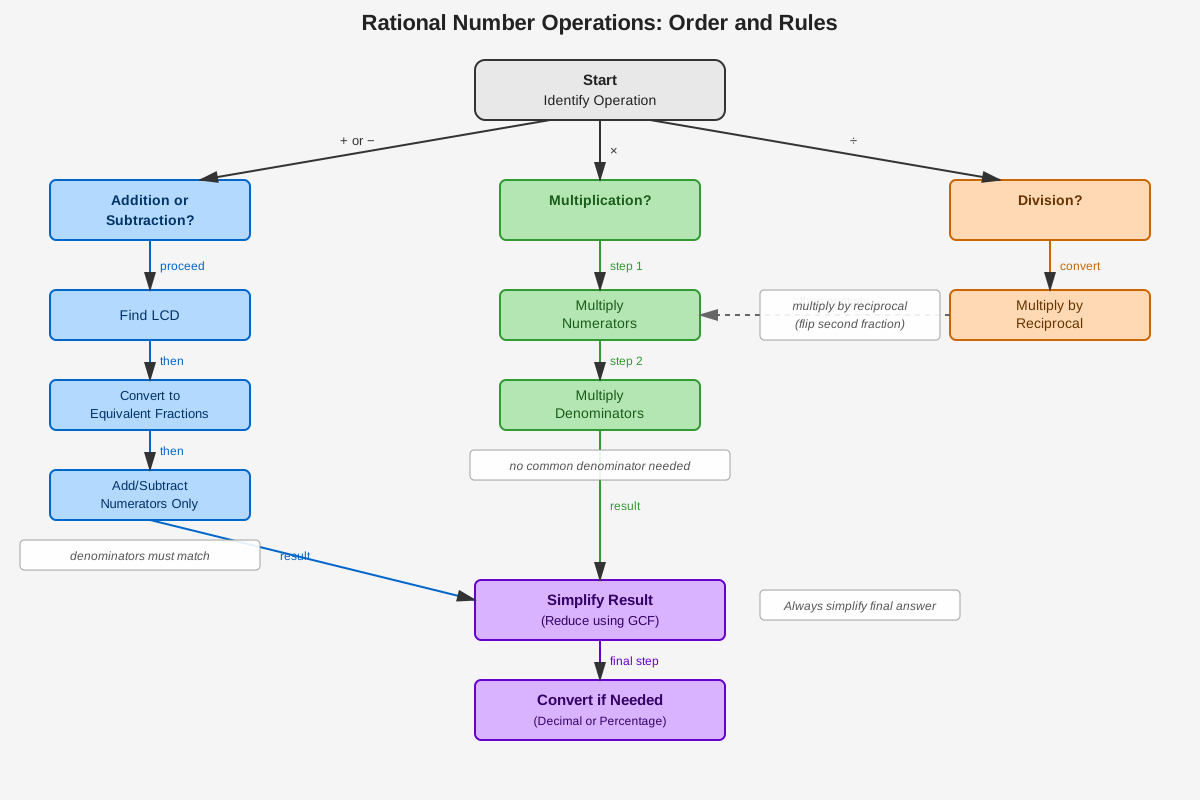
Addition and subtraction of fractions require a common denominator. To add 2/3 + 3/4, find the least common multiple of the denominators (12), convert each fraction (8/12 + 9/12), then add the numerators: 17/12 or 1 5/12. When denominators are already common, simply add or subtract numerators while keeping the denominator unchanged.
Multiplication of fractions is more straightforward: multiply numerators together and denominators together, then simplify. (2/3) × (4/5) = 8/15. Before multiplying, look for opportunities to cancel common factors between any numerator and any denominator: (3/4) × (8/9) = (3/4) × (8/9) = (1/1) × (2/3) = 2/3 after canceling the 3 and the 4 with 8.
Division of fractions uses the "invert and multiply" rule: multiply by the reciprocal of the divisor. (2/3) ÷ (4/5) = (2/3) × (5/4) = 10/12 = 5/6. This rule works because dividing by a number is equivalent to multiplying by its multiplicative inverse.
Operations with Decimals
Adding and subtracting decimals requires aligning decimal points vertically and performing the operation as with whole numbers, maintaining the decimal point position in the answer. Multiplying decimals involves multiplying as if they were whole numbers, then placing the decimal point in the product so that the total number of decimal places equals the sum of decimal places in the factors: 2.5 × 0.3 = 0.75 (one decimal place plus one decimal place equals two decimal places in the product).
Dividing decimals requires moving the decimal point in the divisor to make it a whole number, then moving the decimal point in the dividend the same number of places. For 1.2 ÷ 0.04, move both decimal points two places right: 120 ÷ 4 = 30.
Comparing and Ordering Rational Numbers
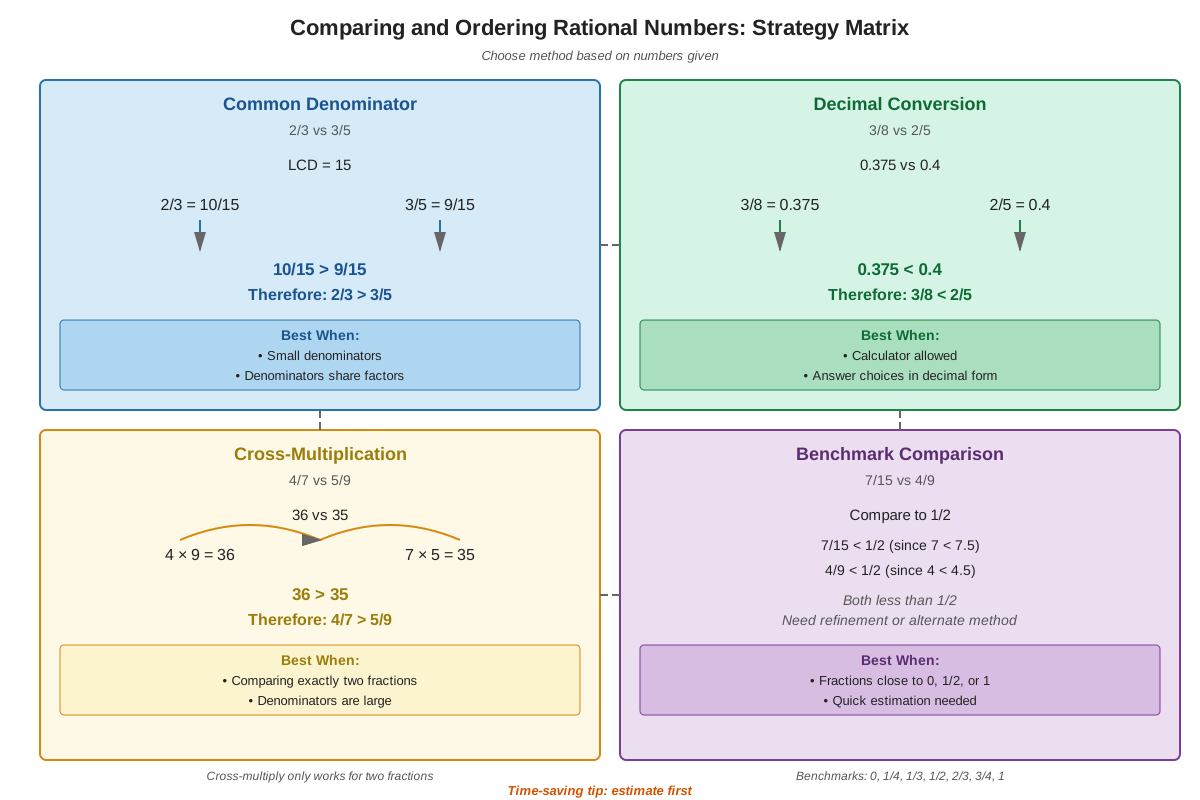
The ACT often asks students to order rational numbers presented in different forms. Strategies include: converting all numbers to the same form (usually decimals for speed), using benchmark values (comparing to 0, 0.5, or 1), or using cross-multiplication for fractions. To compare 3/7 and 5/11 without converting to decimals, cross-multiply: 3 × 11 = 33 and 5 × 7 = 35. Since 33 < 35, we know 3/7 < 5/11.
When comparing negative rational numbers, remember that the number closer to zero is greater: -0.3 > -0.5 because -0.3 is to the right of -0.5 on the number line.
Complex Fractions
A complex fraction is a fraction that contains fractions in its numerator, denominator, or both. To simplify (2/3)/(4/5), multiply the numerator by the reciprocal of the denominator: (2/3) × (5/4) = 10/12 = 5/6. Alternatively, multiply both numerator and denominator by the least common multiple of all denominators present: multiply both by 15 to get 10/12 = 5/6.
Rational Numbers in Equations
When solving equations with rational coefficients, multiply both sides by the least common multiple of all denominators to clear fractions. For (2/3)x + (1/4) = (5/6), multiply everything by 12: 8x + 3 = 10, so 8x = 7, and x = 7/8. This technique transforms a problem with fractions into one with integers, reducing calculation errors.
Concept Relationships
The concepts within rational numbers form an interconnected web where fluency in one area supports proficiency in others. Converting between forms serves as the foundation for comparing and ordering rational numbers, since comparison often requires expressing numbers in a common format. Operations with fractions and operations with decimals are parallel skill sets that both rely on understanding place value and the properties of arithmetic operations. Complex fractions represent an application of fraction division, requiring students to recognize that a fraction bar indicates division.
Rational numbers connect directly to prerequisite topics: integer operations extend naturally to rational number operations, with the added complexity of managing denominators and decimal places. Prime factorization enables finding least common multiples and greatest common factors, which are essential for adding fractions and simplifying results. The relationship flows: Prime Factorization → GCF and LCM → Adding/Subtracting Fractions → Complex Fractions.
Looking forward, rational number mastery enables progression to more advanced topics. Rational expressions in algebra are simply rational numbers with variables. Slope in coordinate geometry is a rational number representing rate of change. Probability is expressed as rational numbers between 0 and 1. Trigonometric ratios are rational numbers for certain special angles. The conceptual map flows: Rational Numbers → Rational Expressions → Solving Rational Equations → Advanced Algebra.
Quick check — test yourself on Rational numbers so far.
Try Flashcards →High-Yield Facts
⭐ Any number that can be written as p/q where p and q are integers and q ≠ 0 is a rational number
⭐ All integers, terminating decimals, and repeating decimals are rational numbers
⭐ To add or subtract fractions, find a common denominator, convert both fractions, then add or subtract numerators only
⭐ To multiply fractions, multiply numerators together and denominators together, then simplify
⭐ To divide fractions, multiply by the reciprocal of the divisor (invert and multiply)
- When converting a fraction to a decimal, divide the numerator by the denominator
- When converting a decimal to a percent, multiply by 100 and add the % symbol
- To compare fractions with different denominators, cross-multiply or convert to decimals
- The reciprocal of a/b is b/a; the product of a number and its reciprocal equals 1
- Simplifying fractions requires dividing both numerator and denominator by their greatest common factor
⭐ Complex fractions are simplified by multiplying the numerator by the reciprocal of the denominator
- Negative rational numbers follow the same operational rules as positive ones, with sign rules applied
- Between any two rational numbers, infinitely many other rational numbers exist (density property)
- The decimal representation of a rational number either terminates or repeats
- When solving equations with fractions, multiply all terms by the LCD to clear denominators
Common Misconceptions
Misconception: All decimals are rational numbers → Correction: Only terminating and repeating decimals are rational. Non-terminating, non-repeating decimals like π (3.14159...) and √2 (1.41421...) are irrational numbers that cannot be expressed as p/q.
Misconception: To add fractions, add the numerators and add the denominators (1/2 + 1/3 = 2/5) → Correction: Fractions must have a common denominator before adding. Find the LCD, convert both fractions, then add only the numerators: 1/2 + 1/3 = 3/6 + 2/6 = 5/6.
Misconception: When dividing fractions, flip both fractions → Correction: Only invert (flip) the divisor (the second fraction), then multiply. (2/3) ÷ (4/5) = (2/3) × (5/4), not (3/2) × (5/4).
Misconception: A larger denominator always means a larger fraction → Correction: For fractions with the same numerator, a larger denominator means a smaller fraction. 1/8 < 1/4 because dividing into more pieces creates smaller pieces.
Misconception: 0.3 is the same as 1/3 → Correction: 0.3 = 3/10, while 1/3 = 0.333... (repeating). The repeating decimal 0.333... is approximately 0.3, but they are not equal. 1/3 is slightly larger than 0.3.
Misconception: Negative fractions are always less than positive fractions → Correction: While true, students often incorrectly order negative fractions. -1/4 > -1/2 because -1/4 is closer to zero (less negative) than -1/2.
Misconception: You cannot have a fraction with a negative denominator → Correction: While unconventional, -3/-4 is a valid representation equal to 3/4. However, standard form places the negative sign in the numerator or in front: -3/4 or -(3/4).
Misconception: Multiplying always makes numbers larger → Correction: Multiplying by a rational number between 0 and 1 makes the product smaller than the original number. 10 × (1/2) = 5, which is less than 10.
Worked Examples
Example 1: Multi-Step Rational Number Operations
Problem: Calculate (2/3 + 3/4) ÷ (5/6 - 1/2) and express the answer as a simplified fraction.
Solution:
Step 1: Solve the addition in the numerator of the complex fraction.
- 2/3 + 3/4 requires a common denominator
- LCD of 3 and 4 is 12
- 2/3 = 8/12 and 3/4 = 9/12
- 8/12 + 9/12 = 17/12
Step 2: Solve the subtraction in the denominator of the complex fraction.
- 5/6 - 1/2 requires a common denominator
- LCD of 6 and 2 is 6
- 5/6 = 5/6 and 1/2 = 3/6
- 5/6 - 3/6 = 2/6 = 1/3 (simplified)
Step 3: Divide the results from Steps 1 and 2.
- (17/12) ÷ (1/3)
- Multiply by the reciprocal: (17/12) × (3/1)
- (17 × 3)/(12 × 1) = 51/12
Step 4: Simplify the result.
- Find GCF of 51 and 12
- 51 = 3 × 17 and 12 = 3 × 4
- GCF = 3
- 51/12 = 17/4
Step 5: Convert to mixed number if needed.
- 17/4 = 4 1/4
Answer: 17/4 or 4 1/4
This problem tests multiple learning objectives: performing operations with fractions, simplifying complex fractions, and expressing answers in simplified form. The ACT often embeds such multi-step calculations within word problems or geometric contexts.
Example 2: Comparing Rational Numbers in Mixed Forms
Problem: Arrange the following numbers in order from least to greatest: 0.625, 5/8, 62%, 0.6̄ (0.6 repeating), 3/5
Solution:
Step 1: Convert all numbers to decimal form for easy comparison.
- 0.625 is already in decimal form
- 5/8: Divide 5 by 8 = 0.625
- 62%: Divide by 100 = 0.62
- 0.6̄ (repeating): 0.666...
- 3/5: Divide 3 by 5 = 0.6
Step 2: List the decimal equivalents.
- 0.625
- 0.625
- 0.62
- 0.666...
- 0.6
Step 3: Order from least to greatest.
- 0.6 < 0.62 < 0.625 = 0.625 < 0.666...
Step 4: Write the answer using the original forms.
- 3/5, 62%, 0.625, 5/8, 0.6̄
Answer: 3/5, 62%, 0.625, 5/8, 0.6̄
Note that 0.625 and 5/8 are equal, so their order relative to each other doesn't matter. This problem demonstrates the importance of converting to a common form for comparison and recognizing that 0.6̄ (0.666...) is greater than 0.625, even though it might appear smaller at first glance. The ACT frequently includes such comparison questions to test whether students can work flexibly with different representations.
Exam Strategy
When approaching ACT rational numbers questions, first identify what form the answer choices are in—this often dictates the most efficient solution path. If answer choices are decimals, convert fractions to decimals early. If answer choices are fractions, keep calculations in fraction form to avoid rounding errors. The ACT rarely requires converting between forms without purpose; the answer format is a strategic hint.
Trigger words and phrases that signal rational number questions include: "fraction," "decimal," "percent," "ratio," "of" (often means multiply), "is" (often means equals), "what part," "what portion," and "express as." Questions asking to "simplify" or "reduce" require finding the GCF. Questions asking to "compare" or "order" require converting to a common form or using cross-multiplication.
For process of elimination, use estimation and benchmark values. If asked which fraction is closest to 1/2, eliminate any fraction where the numerator is much smaller or much larger than half the denominator. If asked to multiply two fractions, eliminate answers that are larger than both factors (unless both factors are greater than 1) or smaller than both factors (unless both are between 0 and 1). Check whether the answer should be positive or negative based on sign rules.
Time allocation for rational number questions should average 45-60 seconds for straightforward computation and 60-90 seconds for multi-step problems or word problems involving rational numbers. If a calculation is taking longer than 90 seconds, mark it and return later. Often, recognizing a pattern or using estimation is faster than completing full calculations. For example, if asked whether 7/12 + 5/8 is greater than 1, recognize that 7/12 is slightly more than 1/2 and 5/8 is slightly more than 1/2, so their sum must exceed 1—no calculation needed.
Always simplify fractions in your final answer unless the question specifically asks for an unsimplified form. The ACT answer choices typically present fractions in simplified form, and selecting an unsimplified equivalent may not be available. When working with complex fractions, write out the division explicitly: (a/b)/(c/d) = (a/b) ÷ (c/d) = (a/b) × (d/c). This prevents errors in determining which fraction to invert.
Memory Techniques
MADSPM for fraction operations: Multiply straight across (numerators together, denominators together), Add/subtract with common denominators, Divide by multiplying by the reciprocal, Simplify by finding GCF, Proper form (simplified), Mixed numbers when appropriate.
"Dividing fractions, as easy as pie, flip the second and multiply" - This rhyme helps remember to invert the divisor when dividing fractions.
Common fraction-decimal-percent equivalents: Visualize a clock face for eighths: 1/8 = 12.5% (1:30 position), 1/4 = 25% (3:00 position), 3/8 = 37.5% (4:30 position), 1/2 = 50% (6:00 position), 5/8 = 62.5% (7:30 position), 3/4 = 75% (9:00 position), 7/8 = 87.5% (10:30 position).
"Keep, Change, Flip" for fraction division: Keep the first fraction the same, Change division to multiplication, Flip the second fraction (use its reciprocal).
Thirds and sixths: Remember that thirds produce repeating decimals with 3s (1/3 = 0.333..., 2/3 = 0.666...) and sixths alternate between terminating and repeating (1/6 = 0.1666..., 1/3 = 0.333..., 1/2 = 0.5, 2/3 = 0.666..., 5/6 = 0.8333...).
For comparing fractions, use the "Butterfly Method": Draw wings connecting each numerator to the opposite denominator, multiply, and compare the products. The larger product indicates the larger fraction.
Summary
Rational numbers represent any value expressible as a quotient of integers (p/q where q ≠ 0), encompassing integers, terminating decimals, and repeating decimals. Mastery of rational numbers for the ACT requires fluency in three core areas: converting between fraction, decimal, and percent forms; performing operations (addition, subtraction, multiplication, division) with both fractions and decimals; and comparing or ordering rational numbers presented in various forms. The key operational rules include finding common denominators for addition and subtraction, multiplying straight across for multiplication, and inverting the divisor for division. Students must recognize that rational numbers appear throughout the ACT Math section, not just in isolated computation questions but embedded within algebra, geometry, and word problems. Success requires both procedural fluency (executing calculations accurately) and conceptual understanding (knowing when to convert forms, which operations to apply, and how to verify reasonableness of answers). The most efficient test-takers memorize common fraction-decimal-percent equivalents, use strategic estimation to eliminate wrong answers, and maintain flexibility in choosing whether to work with fractions or decimals based on the problem context and answer format.
Key Takeaways
- Rational numbers include all integers, terminating decimals, and repeating decimals—any number expressible as p/q with integer p and q (q ≠ 0)
- Converting between forms (fraction ↔ decimal ↔ percent) is essential; memorize common equivalents like 1/4 = 0.25 = 25% to save time
- Fraction operations follow specific rules: common denominators for addition/subtraction, multiply straight across, divide by multiplying by the reciprocal
- Simplify fractions by dividing numerator and denominator by their GCF; express final answers in simplified form
- Compare rational numbers by converting to a common form (usually decimals) or using cross-multiplication for fractions
- Complex fractions simplify by multiplying the numerator by the reciprocal of the denominator
- Rational numbers appear in 10-15% of ACT Math questions across multiple content areas, making this a high-yield topic for focused study
Related Topics
Rational Expressions: Extends rational number concepts to algebraic fractions containing variables. Mastering rational numbers provides the foundation for simplifying, adding, subtracting, multiplying, and dividing rational expressions, which appear in higher-level algebra questions on the ACT.
Proportions and Ratios: Ratios are comparisons of two quantities expressed as rational numbers. Understanding rational number operations enables solving proportion problems, which frequently appear in ACT word problems involving rates, scales, and similar figures.
Percent Applications: Percent increase/decrease, percent of a number, and finding what percent one number is of another all rely on rational number fluency. These applications appear in 3-5 ACT questions per test across various contexts.
Slope and Rate of Change: In coordinate geometry, slope is calculated as a rational number (rise/run). Understanding rational numbers as rates enables interpretation of linear relationships and graphical analysis.
Probability: Theoretical probability is expressed as a rational number between 0 and 1 (favorable outcomes/total outcomes). Rational number operations are necessary for calculating compound probabilities and expected values.
Practice CTA
Now that you've built a comprehensive understanding of rational numbers, it's time to solidify your mastery through active practice. Attempt the practice questions designed specifically for this topic, focusing on applying the strategies and techniques you've learned. Use the flashcards to reinforce common fraction-decimal-percent equivalents and operational rules until they become automatic. Remember, the ACT rewards both accuracy and speed—practice will build the fluency you need to confidently tackle rational number questions in under 60 seconds each. Every practice problem you complete strengthens your mathematical foundation and brings you closer to your target score. You've got this!
Sign up free to keep reading
Create a free AnvayaPrep account to finish this ACT guide on Rational numbers — plus flashcards and practice questions.