Overview
Algebraic expressions form the foundation of algebra and represent one of the most frequently tested concepts on the ACT Math section. An algebraic expression is a mathematical phrase that combines numbers, variables, and operations (addition, subtraction, multiplication, division, and exponentiation) without an equals sign. Unlike equations, which show relationships between two expressions, algebraic expressions stand alone as mathematical statements that can be simplified, evaluated, or manipulated. Mastering algebraic expressions is crucial because they appear in approximately 15-20% of ACT Math questions, either directly or as components of more complex problems involving equations, functions, or word problems.
Understanding ACT algebraic expressions requires proficiency in multiple skills: recognizing like terms, applying the distributive property, combining terms correctly, factoring, and expanding expressions. These skills serve as building blocks for virtually every other algebra topic tested on the ACT, including solving equations, working with polynomials, manipulating rational expressions, and analyzing functions. Students who struggle with algebraic expressions often find themselves unable to progress through multi-step problems, even when they understand the underlying concepts.
The ACT tests algebraic expressions in various contexts, from straightforward simplification problems to complex word problems where students must first translate verbal descriptions into mathematical notation. Questions may ask students to evaluate expressions for given variable values, identify equivalent expressions, factor or expand expressions, or recognize patterns in algebraic structures. Success with this topic requires both procedural fluency and conceptual understanding—knowing not just how to manipulate expressions, but why certain operations are valid and how different forms of the same expression reveal different information.
Learning Objectives
- [ ] Identify when Algebraic expressions is being tested
- [ ] Explain the core rule or strategy behind Algebraic expressions
- [ ] Apply Algebraic expressions to ACT-style questions accurately
- [ ] Simplify complex algebraic expressions by combining like terms and applying the distributive property
- [ ] Factor algebraic expressions using common factoring techniques (GCF, difference of squares, trinomial factoring)
- [ ] Evaluate algebraic expressions for specific variable values efficiently and accurately
- [ ] Recognize equivalent forms of algebraic expressions and determine which form is most useful for a given context
Prerequisites
- Basic arithmetic operations: Addition, subtraction, multiplication, and division form the foundation for all algebraic manipulations
- Order of operations (PEMDAS): Essential for correctly evaluating and simplifying expressions with multiple operations
- Understanding of variables: Variables represent unknown or changing quantities and can be manipulated according to algebraic rules
- Properties of real numbers: Commutative, associative, and distributive properties govern how expressions can be rearranged and simplified
- Integer exponent rules: Powers and exponents appear frequently in algebraic expressions and must be handled correctly
Why This Topic Matters
Algebraic expressions represent the language of mathematics and science. In real-world applications, they model relationships between quantities in physics (distance = rate × time), economics (profit = revenue - cost), engineering (stress-strain relationships), and countless other fields. The ability to manipulate algebraic expressions allows professionals to solve problems, make predictions, and optimize outcomes across virtually every technical discipline.
On the ACT Math section, algebraic expressions appear in approximately 9-12 questions out of 60, making them one of the highest-yield topics for focused study. These questions typically fall into several categories: direct simplification problems (20% of algebra questions), evaluation problems where specific values are substituted (15%), factoring and expanding expressions (25%), identifying equivalent expressions (20%), and word problems requiring expression creation and manipulation (20%). The difficulty ranges from straightforward one-step simplifications to complex multi-step problems involving multiple variables and operations.
The ACT frequently embeds algebraic expression questions within other contexts. A geometry problem might require simplifying an expression for area or perimeter. A function problem might ask students to evaluate or simplify f(x + 2) given f(x). A word problem might require translating a verbal description into an algebraic expression before solving. This integration means that mastering algebraic expressions isn't just about answering dedicated algebra questions—it's about building the foundation needed for success across the entire Math section.
Core Concepts
Components of Algebraic Expressions
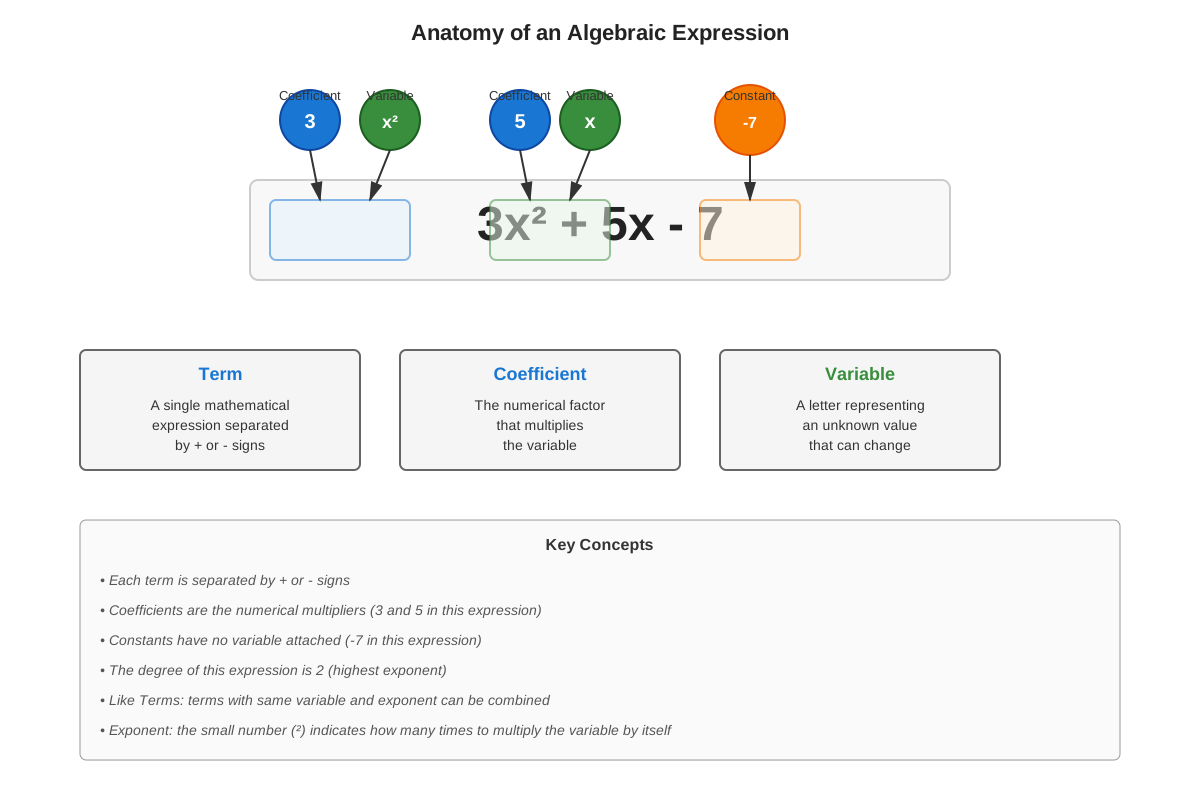
An algebraic expression consists of several key components that must be identified and understood. Terms are the building blocks of expressions, separated by addition or subtraction signs. Each term contains a coefficient (the numerical factor), one or more variables (letters representing unknown quantities), and possibly exponents (indicating repeated multiplication). For example, in the expression 3x² - 5xy + 7, there are three terms: 3x², -5xy, and 7. The coefficients are 3, -5, and 7 respectively.
Like terms share identical variable parts with the same exponents. Only like terms can be combined through addition or subtraction. For instance, 4x² and -2x² are like terms, but 4x² and 4x³ are not. The constant term (a number without variables) is considered a like term only with other constants. Recognizing like terms quickly is essential for efficient simplification on timed tests.
The Distributive Property
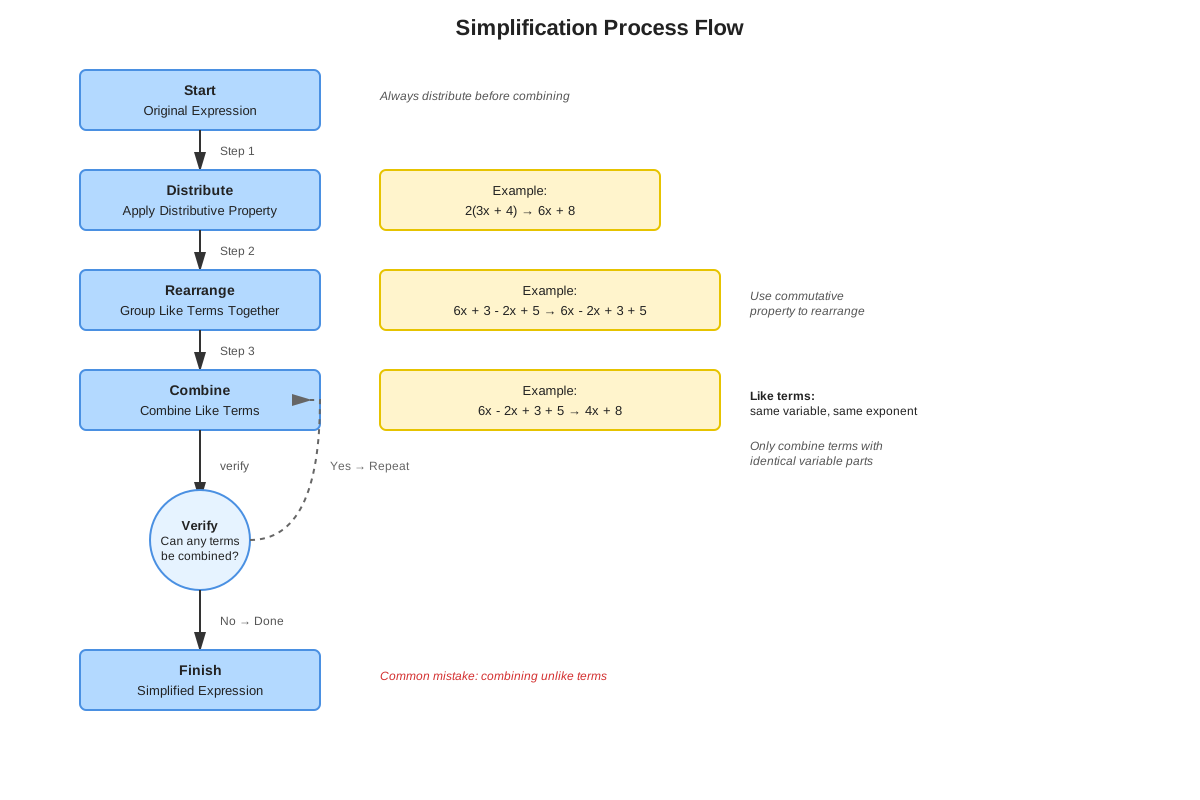
The distributive property states that a(b + c) = ab + ac. This property allows multiplication to be distributed across addition or subtraction within parentheses. On the ACT, the distributive property appears in two primary forms: expanding expressions and factoring expressions. When expanding, multiply the term outside the parentheses by each term inside: 3(2x - 5) = 6x - 15. When factoring, reverse this process by identifying common factors: 6x - 15 = 3(2x - 5).
The distributive property extends to more complex situations, including multiplying binomials. The FOIL method (First, Outer, Inner, Last) is a specific application: (x + 3)(x + 5) = x² + 5x + 3x + 15 = x² + 8x + 15. For the ACT, students must be comfortable distributing negative signs, which changes the sign of every term inside parentheses: -(3x - 4) = -3x + 4.
Combining Like Terms
Combining like terms simplifies expressions by adding or subtracting coefficients of terms with identical variable parts. The process follows these steps:
- Identify all like terms in the expression
- Add or subtract their coefficients
- Keep the variable part unchanged
- Write the simplified term
For example, simplifying 5x² + 3x - 2x² + 7x - 4:
- Combine x² terms: 5x² - 2x² = 3x²
- Combine x terms: 3x + 7x = 10x
- The constant remains: -4
- Final result: 3x² + 10x - 4
Common errors include combining unlike terms (adding x² and x) or incorrectly handling negative signs. Always maintain the sign attached to each term's coefficient.
Evaluating Algebraic Expressions
Evaluating an expression means calculating its numerical value when specific values are substituted for variables. The process requires careful attention to order of operations:
- Substitute the given values for each variable
- Perform operations inside parentheses first
- Calculate exponents
- Perform multiplication and division from left to right
- Perform addition and subtraction from left to right
For example, evaluate 2x² - 3xy + y when x = 4 and y = -2:
- Substitute: 2(4)² - 3(4)(-2) + (-2)
- Exponents: 2(16) - 3(4)(-2) + (-2)
- Multiplication: 32 - (-24) + (-2)
- Addition/subtraction: 32 + 24 - 2 = 54
Factoring Techniques
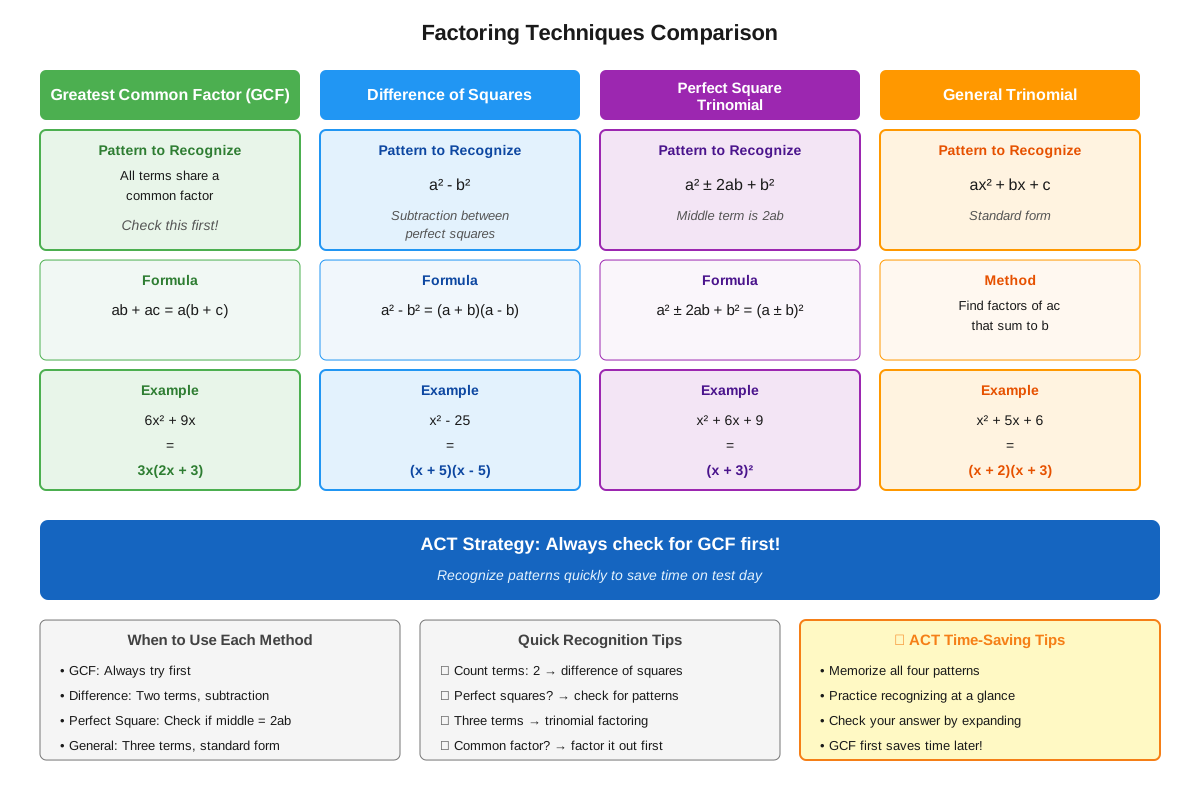
Factoring rewrites an expression as a product of simpler expressions. Several techniques appear frequently on the ACT:
Greatest Common Factor (GCF): Factor out the largest expression that divides all terms evenly. For 6x³ + 9x² - 12x, the GCF is 3x, giving 3x(2x² + 3x - 4).
Difference of Squares: Recognizes the pattern a² - b² = (a + b)(a - b). For example, x² - 25 = (x + 5)(x - 5).
Trinomial Factoring: For expressions like x² + bx + c, find two numbers that multiply to c and add to b. For x² + 7x + 12, the numbers 3 and 4 work: (x + 3)(x + 4).
Grouping: For four-term expressions, group terms in pairs and factor each pair. For x³ + 3x² + 2x + 6, group as (x³ + 3x²) + (2x + 6) = x²(x + 3) + 2(x + 3) = (x² + 2)(x + 3).
Special Products and Patterns
Certain algebraic patterns appear repeatedly on the ACT and should be recognized instantly:
| Pattern Name | Expanded Form | Factored Form |
|---|---|---|
| Perfect Square Trinomial | a² + 2ab + b² | (a + b)² |
| Perfect Square Trinomial | a² - 2ab + b² | (a - b)² |
| Difference of Squares | a² - b² | (a + b)(a - b) |
| Sum of Cubes | a³ + b³ | (a + b)(a² - ab + b²) |
| Difference of Cubes | a³ - b³ | (a - b)(a² + ab + b²) |
Recognizing these patterns saves significant time and reduces calculation errors. For instance, identifying x² + 10x + 25 as (x + 5)² is faster than factoring from scratch.
Simplifying Rational Expressions
Rational expressions are fractions containing algebraic expressions in the numerator, denominator, or both. Simplification requires factoring both parts and canceling common factors:
For (x² - 9)/(x² + 6x + 9):
- Factor numerator: (x + 3)(x - 3)
- Factor denominator: (x + 3)(x + 3)
- Cancel common factor: (x - 3)/(x + 3)
Never cancel terms that are added or subtracted—only factors that are multiplied can be canceled.
Concept Relationships
The concepts within algebraic expressions build upon each other in a logical progression. Understanding terms and coefficients → enables → identifying like terms → which allows → combining like terms for simplification. Simultaneously, mastering the distributive property → enables → both expanding expressions (multiplying out parentheses) and factoring expressions (reversing the process). These two skill branches converge when simplifying complex expressions that require both distribution and combining like terms.
Factoring techniques connect directly to special products and patterns—recognizing patterns is simply the reverse of expanding them. For example, knowing that (a + b)² = a² + 2ab + b² allows instant recognition that x² + 6x + 9 factors as (x + 3)². This bidirectional relationship between expanding and factoring is fundamental to algebraic fluency.
Evaluating expressions depends on all previous concepts: students must first simplify expressions (combining like terms, distributing) before substituting values, then apply order of operations correctly. Rational expressions represent an advanced application that combines factoring skills with fraction operations, requiring students to factor both numerator and denominator before simplifying.
These concepts connect to prerequisite knowledge through the properties of real numbers (commutative, associative, distributive) and order of operations. They extend forward to solving equations (where expressions are set equal to each other), working with functions (where expressions define relationships), and manipulating formulas (where expressions represent real-world quantities). The relationship map flows: Basic Operations → Properties of Numbers → Algebraic Expressions → Equations → Functions → Advanced Algebra.
High-Yield Facts
⭐ Like terms must have identical variable parts with the same exponents; only coefficients are combined
⭐ The distributive property a(b + c) = ab + ac works in both directions: expanding and factoring
⭐ When distributing a negative sign, change the sign of every term inside the parentheses
⭐ The difference of squares a² - b² always factors as (a + b)(a - b)
⭐ Perfect square trinomials follow the pattern a² ± 2ab + b² = (a ± b)²
- When evaluating expressions, always substitute values in parentheses to avoid sign errors
- The GCF (Greatest Common Factor) should always be factored out first before attempting other factoring methods
- Terms separated by addition or subtraction signs; factors are separated by multiplication
- Exponents apply only to the base directly to their left unless parentheses indicate otherwise: -3² = -9 but (-3)² = 9
- When simplifying rational expressions, factor completely before canceling common factors
- The sum of squares a² + b² cannot be factored using real numbers
- Combining like terms does not change the degree of the expression
- Zero as a coefficient makes the entire term equal to zero: 0 · x³ = 0
- Coefficients of 1 are typically not written: 1x = x
- The order of terms in an expression doesn't affect its value due to the commutative property
Quick check — test yourself on Algebraic expressions so far.
Try Flashcards →Common Misconceptions
Misconception: Like terms can be combined if they have the same coefficient.
Correction: Like terms must have identical variable parts with the same exponents. The coefficient is what gets combined, not what determines whether terms are alike. For example, 3x² and 5x² are like terms (combine to 8x²), but 3x² and 3x³ are not like terms and cannot be combined.
Misconception: When distributing a negative sign, only the first term inside parentheses becomes negative.
Correction: A negative sign (or negative coefficient) outside parentheses must be distributed to every term inside. For -(3x - 5 + 2y), the result is -3x + 5 - 2y. Every term's sign changes.
Misconception: x² + x³ can be simplified to x⁵ by adding exponents.
Correction: Exponents are added only when multiplying terms with the same base (x² · x³ = x⁵). When adding or subtracting, terms with different exponents cannot be combined—they are not like terms. The expression x² + x³ is already in simplest form.
Misconception: (x + 3)² equals x² + 9.
Correction: Squaring a binomial requires using the distributive property twice or recognizing the perfect square pattern: (x + 3)² = (x + 3)(x + 3) = x² + 3x + 3x + 9 = x² + 6x + 9. The middle term (2ab) is often forgotten.
Misconception: In the expression 3x², the exponent applies to both 3 and x.
Correction: Exponents apply only to the base immediately to their left unless parentheses indicate otherwise. In 3x², only x is squared, giving 3 · x · x. To square both, write (3x)² = 9x². This distinction is critical when evaluating expressions.
Misconception: Terms in the numerator and denominator can be canceled if they appear in the expression.
Correction: Only common factors (terms that are multiplied) can be canceled, never terms that are added or subtracted. In (x + 3)/(x + 5), the x's cannot cancel because they are not factors—they are terms being added. The expression must be factored first to reveal common factors.
Misconception: Factoring and simplifying are the same operation.
Correction: Factoring rewrites an expression as a product of factors, while simplifying combines like terms and reduces complexity. An expression like 2x + 4 simplifies to 2(x + 2) through factoring, but 2x + 3x simplifies to 5x through combining like terms. Both are simplification techniques, but factoring specifically creates products.
Worked Examples
Example 1: Simplifying a Complex Expression
Problem: Simplify the expression 3(2x - 5) - 2(x + 4) + 5x
Solution:
Step 1: Apply the distributive property to both sets of parentheses.
- 3(2x - 5) = 6x - 15
- -2(x + 4) = -2x - 8 (note the negative sign distributes to both terms)
Step 2: Rewrite the expression with distributed terms.
- 6x - 15 - 2x - 8 + 5x
Step 3: Identify like terms.
- x terms: 6x, -2x, 5x
- Constant terms: -15, -8
Step 4: Combine like terms.
- x terms: 6x - 2x + 5x = 9x
- Constants: -15 - 8 = -23
Step 5: Write the final simplified expression.
- 9x - 23
Connection to Learning Objectives: This problem demonstrates applying the distributive property (core strategy) and combining like terms (accurate application to ACT-style questions). The presence of negative signs and multiple sets of parentheses makes this a medium-difficulty ACT problem.
Example 2: Factoring and Evaluating
Problem: Factor the expression x² - 7x + 12, then evaluate the factored form when x = 5.
Solution:
Step 1: Identify the factoring pattern.
- This is a trinomial in the form x² + bx + c
- Need two numbers that multiply to 12 and add to -7
- The numbers are -3 and -4 because (-3)(-4) = 12 and -3 + (-4) = -7
Step 2: Write the factored form.
- x² - 7x + 12 = (x - 3)(x - 4)
Step 3: Evaluate the factored form at x = 5.
- Substitute: (5 - 3)(5 - 4)
- Simplify inside parentheses: (2)(1)
- Multiply: 2
Step 4: Verify by evaluating the original expression.
- Original: 5² - 7(5) + 12 = 25 - 35 + 12 = 2 ✓
Connection to Learning Objectives: This problem shows how to identify when factoring is being tested, explains the core strategy (finding numbers that multiply and add to specific values), and demonstrates accurate application. The verification step illustrates why factoring creates equivalent expressions—they yield the same value for any input.
Example 3: Identifying Equivalent Expressions
Problem: Which of the following expressions is equivalent to (x + 2)² - (x - 2)²?
A) 4
B) 8x
C) 2x²
D) 4x
E) 8x + 8
Solution:
Step 1: Recognize the difference of squares pattern.
- The expression has the form a² - b² where a = (x + 2) and b = (x - 2)
- Difference of squares factors as (a + b)(a - b)
Step 2: Apply the pattern.
- [(x + 2) + (x - 2)][(x + 2) - (x - 2)]
Step 3: Simplify each factor.
- First factor: x + 2 + x - 2 = 2x
- Second factor: x + 2 - x + 2 = 4
Step 4: Multiply the simplified factors.
- (2x)(4) = 8x
Answer: B
Alternative Method (expanding both squares):
- (x + 2)² = x² + 4x + 4
- (x - 2)² = x² - 4x + 4
- Subtract: (x² + 4x + 4) - (x² - 4x + 4) = x² + 4x + 4 - x² + 4x - 4 = 8x
Connection to Learning Objectives: This problem requires identifying when special patterns (difference of squares) are being tested and choosing the most efficient strategy. Recognizing the pattern saves time compared to expanding both squares, demonstrating why understanding core concepts matters for ACT success.
Exam Strategy
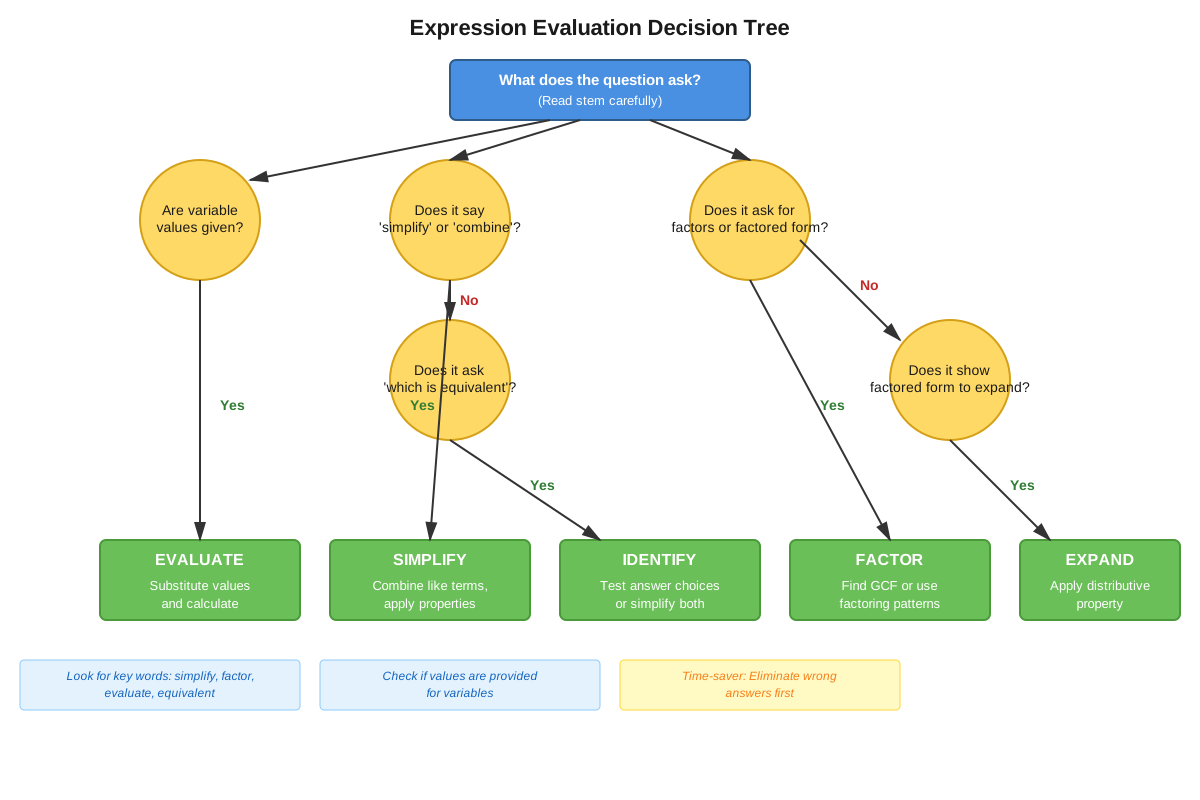
When approaching ACT questions on algebraic expressions, begin by identifying what the question asks: simplify, factor, expand, evaluate, or identify equivalent expressions. Each task requires different strategies, and recognizing the goal prevents wasted effort on unnecessary steps.
Trigger words and phrases signal specific operations:
- "Simplify" → combine like terms and reduce complexity
- "Factor" → rewrite as a product
- "Expand" → distribute and remove parentheses
- "Evaluate for x = ..." → substitute and calculate
- "Equivalent to" → may require factoring, expanding, or simplifying to match answer choices
- "In terms of" → isolate a specific variable
For multiple-choice questions, use answer choice analysis strategically. If asked to simplify or factor, check whether answer choices are in factored or expanded form—this tells you which direction to work. When evaluating expressions, estimate the answer's magnitude before calculating to eliminate unreasonable choices quickly.
Process of elimination works particularly well for algebraic expressions:
- Eliminate answers with incorrect degrees (highest exponent)
- Check the constant term—it's often easiest to verify
- Substitute x = 0 or x = 1 to quickly eliminate incorrect expressions
- For factoring questions, expand one or two answer choices to verify
Time allocation for algebraic expression questions should average 45-60 seconds for straightforward problems and up to 90 seconds for complex multi-step questions. If a problem requires more than two minutes, mark it and return later. Common time traps include: attempting to factor expressions that don't factor nicely (check if the answer choices suggest a different approach), over-simplifying when the question asks for a specific form, and making arithmetic errors during evaluation (use calculator when permitted).
When stuck, try working backwards from answer choices. For evaluation problems, substitute the given value into each answer choice. For "which expression is equivalent" questions, test a simple value like x = 2 in both the original expression and each answer choice—only the correct answer will match.
Memory Techniques
FOIL for multiplying binomials: First, Outer, Inner, Last terms
- (a + b)(c + d) = ac + ad + bc + bd
- Visualize drawing arrows connecting each pair of terms
DOTS for difference of squares: Difference Of Two Squares
- Pattern: a² - b² = (a + b)(a - b)
- Remember: "Difference" means subtraction, "Two Squares" means both terms are perfect squares
PST for perfect square trinomials: Perfect Square Trinomial
- Pattern: a² ± 2ab + b² = (a ± b)²
- Check: Is the middle term exactly twice the product of the square roots of the first and last terms?
GCF First mnemonic: "Get Common Factors First"
- Always factor out the greatest common factor before attempting other factoring methods
- Visualize pulling out the common factor like removing a common ingredient from a recipe
PEMDAS for order of operations when evaluating: Parentheses, Exponents, Multiplication/Division, Addition/Subtraction
- Alternative: "Please Excuse My Dear Aunt Sally"
- Critical for evaluation problems—work from top to bottom of the hierarchy
Sign Distribution Visualization: Imagine a negative sign as a "sign flipper" that touches every term inside parentheses
- -(3x - 5 + 2y) → the flipper changes + to - and - to +
- Result: -3x + 5 - 2y
Like Terms Matching: Visualize like terms as puzzle pieces that fit together—they must have identical shapes (variable parts)
- 3x² and 5x² fit together → 8x²
- 3x² and 5x³ don't fit—different shapes
Summary
Algebraic expressions form the cornerstone of ACT Math algebra questions, appearing in approximately 15-20% of problems either directly or embedded within other contexts. Mastery requires understanding that expressions are mathematical phrases combining numbers, variables, and operations without equals signs. The core skills include identifying and combining like terms (terms with identical variable parts and exponents), applying the distributive property in both directions (expanding and factoring), recognizing special patterns (difference of squares, perfect square trinomials), and evaluating expressions by substituting values and following order of operations. Success on ACT algebraic expression questions demands both procedural fluency—executing operations quickly and accurately—and conceptual understanding—knowing why operations work and which form of an expression is most useful for a given situation. Students must recognize trigger words, work efficiently with answer choices, and avoid common pitfalls like combining unlike terms, incorrectly distributing negative signs, or confusing addition with multiplication of exponents. The ability to manipulate algebraic expressions fluently enables success across the entire ACT Math section, from solving equations to analyzing functions.
Key Takeaways
- Like terms have identical variable parts with the same exponents; only their coefficients are combined during simplification
- The distributive property a(b + c) = ab + ac works bidirectionally: expand by distributing multiplication, factor by reversing the process
- Special patterns (difference of squares, perfect square trinomials) should be recognized instantly to save time and reduce errors
- When evaluating expressions, always use parentheses when substituting negative values to avoid sign errors
- Factoring completely means factoring out the GCF first, then applying other techniques until no further factoring is possible
- Negative signs distribute to every term inside parentheses, changing all signs when removed
- Process of elimination using simple test values (x = 0, x = 1, x = 2) quickly identifies incorrect answer choices
Related Topics
Solving Linear Equations: Builds directly on algebraic expression manipulation by setting expressions equal to values or other expressions and isolating variables. Mastering expression simplification makes equation solving significantly easier.
Polynomial Operations: Extends algebraic expression concepts to higher-degree expressions, including adding, subtracting, multiplying, and dividing polynomials. The same principles of combining like terms and distributing apply to more complex expressions.
Rational Expressions and Equations: Applies factoring and simplification skills to fractions containing algebraic expressions. Requires factoring both numerators and denominators before simplifying.
Functions and Function Notation: Uses algebraic expressions to define relationships between variables. Evaluating f(x + 2) or simplifying f(x) + g(x) requires expression manipulation skills.
Quadratic Equations and Factoring: Relies heavily on factoring techniques learned with algebraic expressions. Recognizing patterns and factoring trinomials becomes essential for solving quadratic equations efficiently.
Practice CTA
Now that you've mastered the core concepts of algebraic expressions, it's time to solidify your understanding through practice. Attempt the practice questions to apply these strategies to ACT-style problems, and use the flashcards to reinforce high-yield facts and patterns. Remember: algebraic expressions appear throughout the ACT Math section, so investing time in mastering this topic pays dividends across multiple question types. Consistent practice with immediate feedback is the key to building the speed and accuracy needed for test day success. You've got this!
Sign up free to keep reading
Create a free AnvayaPrep account to finish this ACT guide on Algebraic expressions — plus flashcards and practice questions.