Overview
Irrational numbers represent a fundamental category of real numbers that cannot be expressed as a simple fraction of two integers. Unlike rational numbers such as 1/2 or 3/4, irrational numbers have decimal expansions that continue infinitely without repeating. Common examples include π (pi), √2 (the square root of 2), and e (Euler's number). Understanding irrational numbers is crucial for success on the ACT Math section, as these numbers appear in geometry problems involving circles and triangles, algebraic expressions with radicals, and questions testing number properties and classifications.
The ACT frequently tests students' ability to distinguish between rational and irrational numbers, simplify expressions containing irrational values, and perform operations with these numbers. Questions may ask students to identify which numbers in a set are irrational, determine whether the result of an operation produces a rational or irrational number, or work with approximations of irrational values. This topic bridges multiple mathematical domains, connecting number theory with algebra, geometry, and even trigonometry.
Mastery of act irrational numbers concepts provides the foundation for understanding more advanced mathematical ideas tested on the exam. Irrational numbers relate directly to radical expressions, the Pythagorean theorem, properties of circles, and the real number system hierarchy. Students who thoroughly understand irrational numbers gain confidence in tackling complex problems involving square roots, cube roots, and transcendental numbers, all of which appear regularly in medium to high-difficulty ACT Math questions.
Learning Objectives
- [ ] Identify when Irrational numbers is being tested
- [ ] Explain the core rule or strategy behind Irrational numbers
- [ ] Apply Irrational numbers to ACT-style questions accurately
- [ ] Distinguish between rational and irrational numbers in various forms (fractions, decimals, radicals)
- [ ] Determine whether operations on irrational numbers yield rational or irrational results
- [ ] Simplify expressions containing irrational numbers to identify equivalent forms
- [ ] Apply properties of irrational numbers to solve geometric and algebraic problems
Prerequisites
- Integer operations: Understanding addition, subtraction, multiplication, and division of whole numbers is essential for comparing and operating with irrational numbers
- Fraction concepts: Knowledge of rational numbers as ratios of integers provides the contrast needed to understand what makes numbers irrational
- Decimal notation: Familiarity with decimal representations helps distinguish between terminating, repeating, and non-repeating decimals
- Square roots and radicals: Basic understanding of radical notation is necessary since many irrational numbers involve roots
- Real number system: Awareness of the hierarchy of number types (natural, whole, integer, rational, real) provides context for where irrational numbers fit
Why This Topic Matters
Irrational numbers appear throughout mathematics and real-world applications. In architecture and engineering, calculations involving circles require π, while construction projects use the Pythagorean theorem with irrational square roots. Computer graphics, physics simulations, and financial modeling all rely on precise understanding of irrational values. The golden ratio (φ), an irrational number, appears in art, nature, and design, demonstrating how these mathematical concepts transcend pure theory.
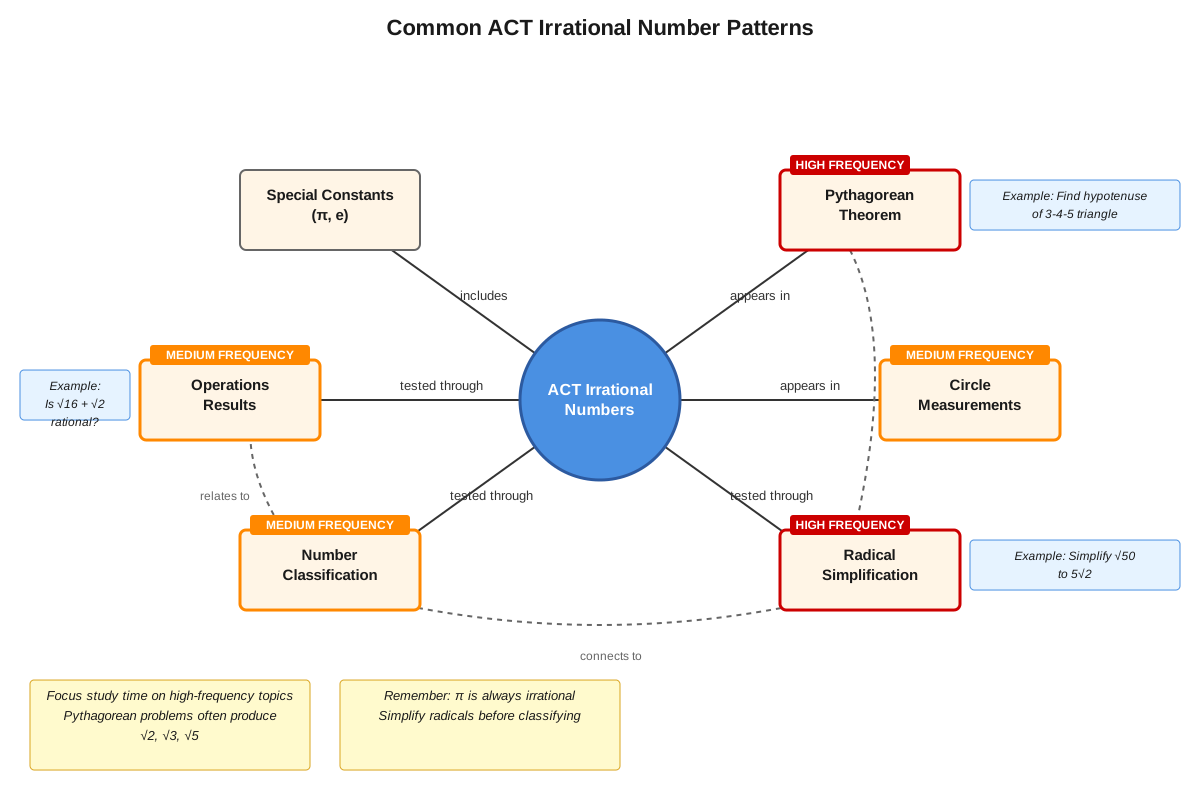
On the ACT Math section, irrational numbers appear in approximately 3-5 questions per test, representing roughly 5-8% of the 60 math questions. These questions typically fall into the medium to high difficulty range and appear most frequently in the Number and Quantity and Algebra domains. The ACT tests irrational numbers through direct identification questions, operations problems, simplification tasks, and application scenarios involving geometric formulas.
Common question formats include: identifying which expression produces an irrational result, determining whether a given decimal or radical represents a rational or irrational number, simplifying radical expressions to reveal rational or irrational values, and solving word problems where irrational numbers emerge naturally from geometric relationships. The topic also appears indirectly in questions about the real number line, inequalities involving radicals, and approximation problems.
Core Concepts
Definition and Characteristics
An irrational number is a real number that cannot be expressed as a ratio of two integers (a fraction a/b where a and b are integers and b ≠ 0). The defining characteristic of irrational numbers is their decimal representation: they have infinite, non-repeating decimal expansions. This means that no matter how many decimal places you write, the pattern never repeats and never terminates.
For example, π = 3.14159265358979... continues forever without any repeating pattern. Similarly, √2 = 1.41421356237... extends infinitely without repetition. This contrasts sharply with rational numbers like 1/3 = 0.333... (repeating) or 1/4 = 0.25 (terminating).
Common Examples of Irrational Numbers
Several categories of irrational numbers appear frequently on the ACT:
Square roots of non-perfect squares: Any square root of a positive integer that is not a perfect square is irrational. Examples include √2, √3, √5, √6, √7, √8, √10, etc. However, √4 = 2 and √9 = 3 are rational because 4 and 9 are perfect squares.
Higher-order roots of non-perfect powers: Cube roots like ∛2, ∛5, and fourth roots like ⁴√3 are irrational unless the radicand is a perfect power. For instance, ∛8 = 2 is rational, but ∛7 is irrational.
Transcendental numbers: These special irrational numbers cannot be roots of any polynomial equation with integer coefficients. The most important examples are:
- π (pi) ≈ 3.14159..., the ratio of a circle's circumference to its diameter
- e (Euler's number) ≈ 2.71828..., the base of natural logarithms
Combinations involving irrational numbers: Numbers like 2 + √3, π/2, or √2 + √3 are also irrational (with some exceptions discussed below).
Identifying Rational vs. Irrational Numbers
| Number Type | Decimal Form | Examples | Can be written as a/b? |
|---|---|---|---|
| Rational | Terminating or repeating | 0.5, 0.333..., 2.75 | Yes |
| Irrational | Non-terminating, non-repeating | √2, π, e | No |
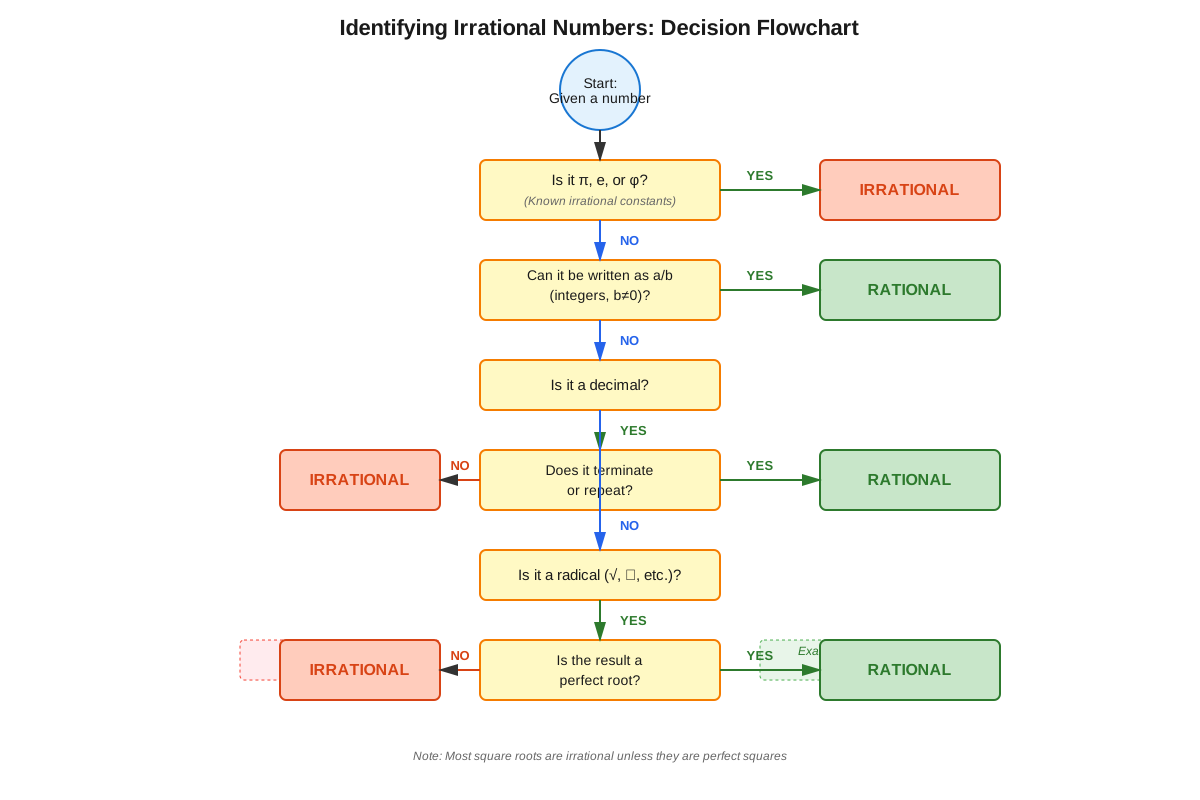
To identify whether a number is irrational on the ACT:
- Check if it's a radical: If it's √n where n is not a perfect square, it's irrational
- Examine the decimal: If given a decimal, look for patterns—repeating means rational, non-repeating means irrational
- Recognize special constants: π, e, and the golden ratio φ are always irrational
- Test if it can be written as a fraction: If you can express it as a ratio of integers, it's rational
Operations with Irrational Numbers
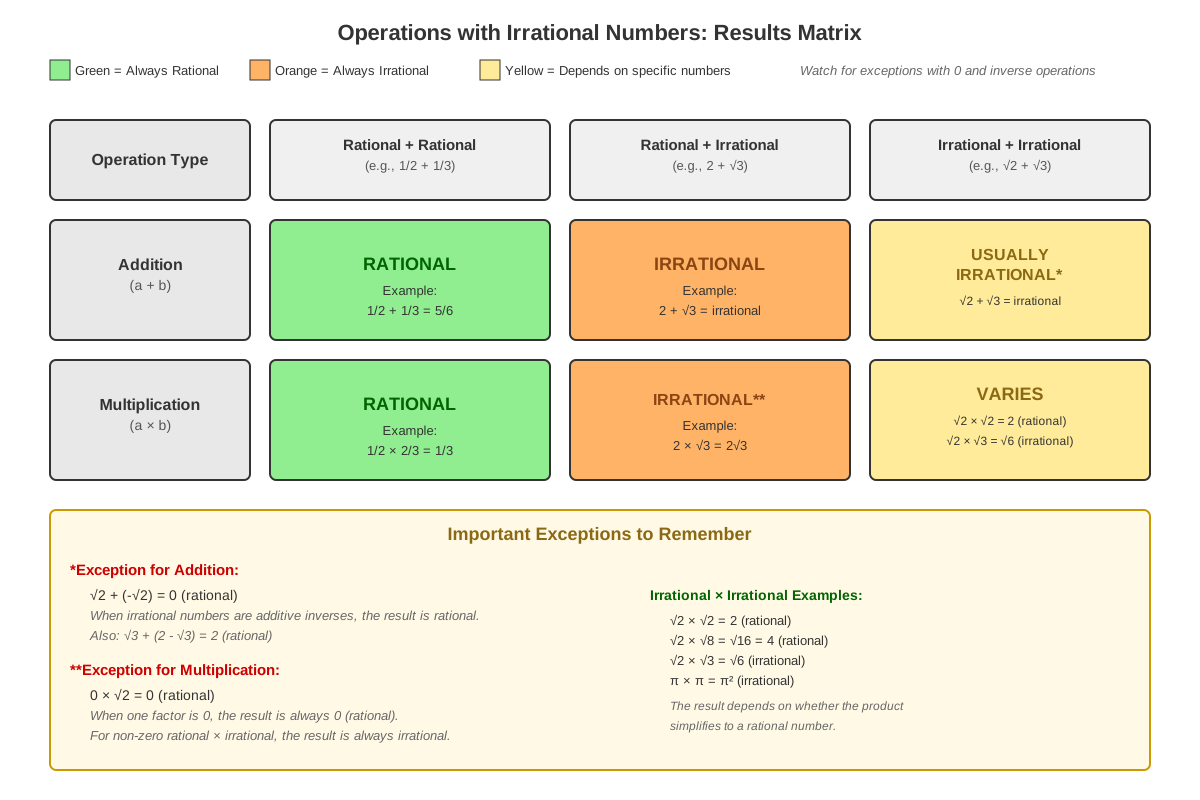
Understanding how operations affect the rationality of numbers is crucial for ACT success:
Addition and Subtraction:
- Irrational + Irrational = Usually irrational (but not always: √2 + (-√2) = 0, which is rational)
- Rational + Irrational = Always irrational (example: 3 + √2 is irrational)
- Irrational - Irrational = Usually irrational (exceptions exist when they cancel)
Multiplication and Division:
- Irrational × Rational (non-zero) = Always irrational (example: 2√3 is irrational)
- Irrational × Irrational = Sometimes rational (example: √2 × √2 = 2, which is rational)
- Irrational ÷ Rational (non-zero) = Always irrational (example: √5 ÷ 2 is irrational)
- Rational ÷ Irrational = Always irrational (example: 6 ÷ √3 = 2√3 is irrational)
Powers and Roots:
- (Irrational)² = Sometimes rational (√3)² = 3 is rational
- √(Irrational) = Usually irrational, but depends on the specific number
Simplifying Expressions with Irrational Numbers
The ACT often requires simplifying radical expressions to determine whether the result is rational or irrational:
Simplifying square roots:
- √12 = √(4 × 3) = √4 × √3 = 2√3 (irrational)
- √50 = √(25 × 2) = 5√2 (irrational)
- √16 = 4 (rational)
Rationalizing denominators:
When a fraction has an irrational denominator, multiply by a form of 1 to eliminate it:
- 1/√2 = (1/√2) × (√2/√2) = √2/2 (still irrational, but in standard form)
- 3/√5 = (3/√5) × (√5/√5) = 3√5/5 (irrational)
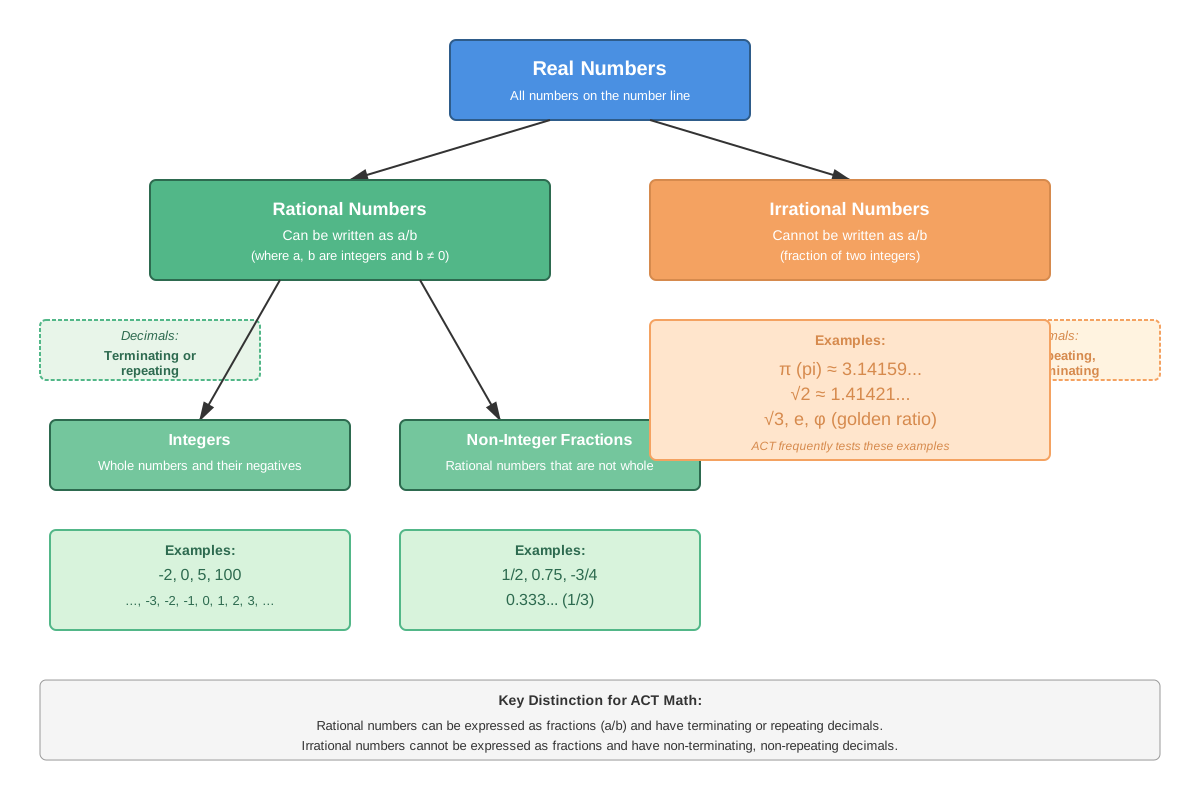
The Real Number System Hierarchy
Understanding where irrational numbers fit in the number system helps with classification questions:
Real Numbers
├── Rational Numbers
│   ├── Integers
│   │   ├── Whole Numbers
│   │   │   └── Natural Numbers
│   │   └── Negative Integers
│   └── Non-integer Fractions
└── Irrational Numbers
Every irrational number is a real number, but not every real number is irrational. The set of real numbers is the union of rational and irrational numbers, with no overlap between these two subsets.
Concept Relationships
The concept of irrational numbers connects deeply with multiple mathematical domains. Irrational numbers emerge from the real number system, which provides the overarching framework for all numbers used in ACT Math. Within this system, irrational numbers complement rational numbers to form the complete set of real numbers.
Radical expressions → directly produce → irrational numbers when the radicand is not a perfect power. This connection makes simplifying radicals essential for identifying whether an expression is rational or irrational. The Pythagorean theorem → frequently generates → irrational numbers when calculating the hypotenuse or legs of right triangles with integer side lengths (e.g., a triangle with legs of 1 and 1 has a hypotenuse of √2).
Geometric formulas → incorporate → irrational numbers through π in circle calculations (circumference = 2πr, area = πr²). Understanding that π is irrational helps students recognize when exact answers versus approximations are appropriate. Number properties → govern → operations with irrational numbers, determining when sums, products, or quotients remain irrational.
The concept also connects forward to more advanced topics: irrational numbers → provide foundation for → complex numbers and transcendental functions. Understanding irrational numbers strengthens algebraic manipulation skills needed for polynomial equations and exponential functions.
Quick check — test yourself on Irrational numbers so far.
Try Flashcards →High-Yield Facts
⭐ Any square root of a positive integer that is not a perfect square is irrational (√2, √3, √5, √7, etc. are all irrational)
⭐ The sum of a rational number and an irrational number is always irrational (5 + √2 is irrational)
⭐ π (pi) and e are the most commonly tested transcendental irrational numbers on the ACT
⭐ The product of a non-zero rational number and an irrational number is always irrational (3√7 is irrational)
⭐ The decimal expansion of an irrational number never terminates and never repeats
- The product of two irrational numbers can be rational (√2 × √2 = 2)
- The sum or difference of two irrational numbers can be rational (√5 + (-√5) = 0)
- All irrational numbers are real numbers, but not all real numbers are irrational
- The golden ratio φ = (1 + √5)/2 is irrational and appears in geometry problems
- Between any two rational numbers, there exist infinitely many irrational numbers
- Cube roots of non-perfect cubes are irrational (∛2, ∛5, ∛10)
- The number 0.101001000100001... (with increasing zeros) is irrational because it doesn't repeat
- Rationalizing the denominator doesn't change whether a number is rational or irrational
- √(a/b) where a/b is a positive rational non-perfect square is irrational
- The ACT never requires memorizing decimal approximations beyond π ≈ 3.14
Common Misconceptions
Misconception: All square roots are irrational → Correction: Only square roots of non-perfect squares are irrational. √4 = 2, √9 = 3, √16 = 4, and √25 = 5 are all rational numbers because they equal integers.
Misconception: All decimals that go on forever are irrational → Correction: Decimals must be both non-terminating AND non-repeating to be irrational. The decimal 0.333... = 1/3 is rational because it repeats, even though it continues infinitely.
Misconception: The product of two irrational numbers is always irrational → Correction: Two irrational numbers can multiply to give a rational result. For example, √3 × √3 = 3, which is rational. Similarly, √2 × √8 = √16 = 4.
Misconception: π equals 22/7 or 3.14 exactly → Correction: π is irrational and cannot be expressed exactly as any fraction or terminating decimal. The values 22/7 ≈ 3.142857... and 3.14 are only approximations. π's decimal expansion continues infinitely without repeating.
Misconception: Rationalizing a denominator changes an irrational number to a rational one → Correction: Rationalizing the denominator is a simplification technique that changes the form but not the value. If 1/√2 is irrational, then √2/2 (its rationalized form) is equally irrational—they're the same number written differently.
Misconception: All numbers with radicals are irrational → Correction: Expressions like √(4/9) = 2/3 are rational because they simplify to fractions. Similarly, 2√4 = 2(2) = 4 is rational. Only radicals that cannot be simplified to remove the radical sign represent irrational numbers.
Misconception: You can't perform arithmetic with irrational numbers → Correction: Irrational numbers follow all standard arithmetic rules. You can add, subtract, multiply, and divide them (except by zero), though the results may be rational or irrational depending on the specific operation.
Worked Examples
Example 1: Identifying Rational and Irrational Numbers
Problem: Which of the following numbers are irrational?
A) √16
B) √20
C) 0.75
D) 0.121221222...
E) π/4
Solution:
Let's examine each option systematically:
Option A: √16
√16 = 4, which is an integer. Since all integers can be written as fractions (4 = 4/1), this is rational.
Result: Rational
Option B: √20
First, check if 20 is a perfect square. Since 4² = 16 and 5² = 25, there's no integer whose square equals 20. We can simplify: √20 = √(4 × 5) = 2√5. Since √5 cannot be simplified further and 5 is not a perfect square, √20 is irrational.
Result: Irrational ✓
Option C: 0.75
This decimal terminates after two places. We can write it as 75/100 = 3/4, which is a ratio of integers.
Result: Rational
Option D: 0.121221222...
The pattern shows an increasing number of 2's between the 1's (one 2, then two 2's, then three 2's, etc.). This means the decimal never settles into a repeating pattern—it continues infinitely without repetition.
Result: Irrational ✓
Option E: π/4
Since π is irrational and we're dividing it by 4 (a non-zero rational number), the quotient remains irrational. Dividing an irrational number by a rational number always yields an irrational result.
Result: Irrational ✓
Answer: B, D, and E are irrational numbers.
Connection to Learning Objectives: This example demonstrates how to identify when irrational numbers are being tested and apply the core rules for distinguishing rational from irrational numbers.
Example 2: Operations with Irrational Numbers
Problem: If a = √3 and b = √12, determine whether each expression is rational or irrational:
- a + b
- a × b
- b²
- a + 2
Solution:
First, let's simplify b: √12 = √(4 × 3) = 2√3
Expression 1: a + b = √3 + 2√3
Combining like terms: √3 + 2√3 = 3√3
Since this contains √3 (an irrational number) multiplied by 3 (a rational number), the result is irrational.
Result: 3√3 is irrational
Expression 2: a × b = √3 × 2√3
Multiply: √3 × 2√3 = 2 × (√3 × √3) = 2 × 3 = 6
The product equals 6, which is an integer and therefore rational. This demonstrates that two irrational numbers can multiply to give a rational result.
Result: 6 is rational
Expression 3: b² = (√12)²
When you square a square root, they cancel: (√12)² = 12
The result is an integer, which is rational.
Result: 12 is rational
Expression 4: a + 2 = √3 + 2
This is the sum of an irrational number (√3) and a rational number (2). The sum of a rational and irrational number is always irrational because adding a rational number cannot create a repeating or terminating decimal pattern from a non-repeating, non-terminating one.
Result: √3 + 2 is irrational
Summary of Results:
- Irrational
- Rational
- Rational
- Irrational
Connection to Learning Objectives: This example shows how to apply irrational number properties to operations and demonstrates the core strategy of simplifying before determining rationality.
Exam Strategy
When approaching ACT questions involving irrational numbers, follow this systematic approach:
Step 1: Identify the question type
Look for trigger words and phrases such as "irrational," "rational," "can be expressed as a fraction," "decimal expansion," "repeating decimal," or "non-terminating decimal." Questions may also present radicals, π, or e without explicitly mentioning irrational numbers.
Step 2: Simplify all expressions first
Before determining whether a number is rational or irrational, simplify radicals completely. Factor out perfect squares from under square roots, combine like terms, and perform any obvious arithmetic. A number that looks irrational might simplify to a rational value.
Step 3: Apply the key rules
- If you see √n where n is not a perfect square → irrational
- If you see rational + irrational → irrational
- If you see rational × irrational (non-zero) → irrational
- If you see irrational × irrational → could be either, must simplify
- If you see π or e → irrational (and any non-zero multiple or quotient with rationals)
Step 4: Use process of elimination
On multiple-choice questions, eliminate obviously wrong answers first. If asked which number is irrational, immediately eliminate perfect squares, terminating decimals, and simple fractions. If asked which is rational, eliminate non-perfect square roots and expressions with π or e.
Step 5: Watch for trap answers
The ACT often includes answers that look irrational but simplify to rational numbers (like √4 or √(9/16)). Conversely, they may present rational-looking expressions that are actually irrational (like 1 + √2). Always simplify before deciding.
Time-Saving Tip: On the ACT, you typically have about 1 minute per question. For irrational number questions, spend 10-15 seconds identifying the question type, 20-30 seconds simplifying, and 20-30 seconds applying rules and checking your answer.
Trigger phrases to watch for:
- "Which of the following is irrational?"
- "The result is a rational number when..."
- "Can be expressed as a ratio of integers"
- "Has a repeating decimal expansion"
- "Non-terminating and non-repeating"
Memory Techniques
PINE Mnemonic for Common Irrational Numbers:
- Pi (π)
- Irrational roots (√2, √3, √5, etc.)
- Non-perfect powers (∛2, ⁴√5, etc.)
- Euler's number (e)
The "Perfect or Not" Rule:
When you see a radical, ask: "Is it perfect or not?"
- Perfect square/cube/etc. → Rational
- Not perfect → Irrational
R.A.I.N. for Operations (Rational And Irrational Numbers):
- Rational + Irrational = Irrational (always)
- Always check if irrational × irrational simplifies
- Irrational × Rational (non-zero) = Irrational (always)
- Never assume—simplify first!
Visualization Strategy:
Picture the number line with rational numbers as dots and irrational numbers filling all the spaces between. This helps remember that irrational numbers are "everywhere" on the number line—in fact, there are infinitely more irrational numbers than rational ones.
The "Decimal Detective" Method:
When examining decimals, be a detective looking for patterns:
- Terminates (stops) → Rational
- Repeats (pattern cycles) → Rational
- Runs forever without repeating → Irrational
Summary
Irrational numbers are real numbers that cannot be expressed as fractions of integers and have infinite, non-repeating decimal expansions. The most important irrational numbers for the ACT are square roots of non-perfect squares (√2, √3, √5, etc.), π, and occasionally e. Success on ACT questions requires recognizing that operations with irrational numbers follow specific patterns: adding a rational to an irrational always yields an irrational result, multiplying a non-zero rational by an irrational always produces an irrational number, but multiplying or adding two irrational numbers can sometimes produce rational results. The key strategy is to simplify all expressions completely before determining whether they're rational or irrational, as expressions that appear irrational may simplify to rational values and vice versa. Understanding the distinction between terminating decimals, repeating decimals, and non-repeating decimals is crucial for classification questions.
Key Takeaways
- Irrational numbers cannot be written as fractions and have non-terminating, non-repeating decimal expansions
- Square roots of non-perfect squares are always irrational (√2, √3, √5, √7, etc.)
- The sum of any rational number and any irrational number is always irrational
- The product of a non-zero rational number and an irrational number is always irrational
- Two irrational numbers can multiply or add to produce a rational result (√2 × √2 = 2)
- Always simplify radical expressions completely before determining if they're rational or irrational
- π and e are the most commonly tested transcendental irrational numbers on the ACT
Related Topics
Radical Expressions and Equations: Mastering irrational numbers provides the foundation for solving equations involving square roots and other radicals, including rationalizing denominators and simplifying complex radical expressions.
The Real Number System: Understanding irrational numbers completes your knowledge of how numbers are classified, enabling you to work with number line problems, inequalities, and set theory questions.
Pythagorean Theorem Applications: Many right triangle problems produce irrational answers, so recognizing when to leave answers in radical form versus using decimal approximations becomes essential.
Circle Geometry: Since π is irrational, all exact calculations involving circumference and area of circles require understanding how to work with this irrational constant.
Exponents and Logarithms: The number e appears in exponential growth and decay problems, and understanding its irrational nature helps with more advanced algebra topics.
Practice CTA
Now that you've mastered the core concepts of irrational numbers, it's time to solidify your understanding through practice! Work through the practice questions to test your ability to identify, classify, and operate with irrational numbers under timed conditions. Use the flashcards to reinforce key definitions and rules until they become automatic. Remember, the ACT rewards both accuracy and speed—consistent practice with these concepts will help you quickly recognize irrational number questions and apply the correct strategies. You've built a strong foundation; now apply it with confidence!
Sign up free to keep reading
Create a free AnvayaPrep account to finish this ACT guide on Irrational numbers — plus flashcards and practice questions.