Overview
The Pythagorean theorem stands as one of the most fundamental and frequently tested concepts in ACT Math, appearing in approximately 2-4 questions per test. This ancient mathematical principle, discovered by the Greek mathematician Pythagoras, establishes the relationship between the sides of a right triangle. On the ACT, the Pythagorean theorem serves as both a standalone concept and a critical tool for solving more complex geometry problems involving coordinate geometry, circles, three-dimensional figures, and trigonometry.
Understanding the ACT Pythagorean theorem applications extends far beyond simple triangle calculations. The ACT test writers frequently embed Pythagorean relationships within word problems, coordinate plane scenarios, and multi-step geometry questions. Students who master this theorem gain access to efficient problem-solving strategies that can save valuable time during the exam. The theorem's versatility makes it an essential component of the mathematical toolkit needed for success on test day.
The Pythagorean theorem connects directly to numerous other ACT Math topics, including special right triangles (45-45-90 and 30-60-90), distance formula in coordinate geometry, circles and their properties, and three-dimensional geometry. Recognizing when and how to apply this theorem often determines whether a student can solve medium and high-difficulty geometry questions within the time constraints of the ACT. Mastery of this topic provides a foundation for tackling approximately 15-20% of all ACT Math questions either directly or indirectly.
Learning Objectives
- [ ] Identify when Pythagorean theorem is being tested
- [ ] Explain the core rule or strategy behind Pythagorean theorem
- [ ] Apply Pythagorean theorem to ACT-style questions accurately
- [ ] Recognize and utilize common Pythagorean triples to solve problems quickly
- [ ] Determine whether a triangle is a right triangle using the converse of the Pythagorean theorem
- [ ] Apply the Pythagorean theorem in three-dimensional contexts and coordinate geometry
- [ ] Solve for any side of a right triangle when given two sides
Prerequisites
- Basic algebra skills: Ability to solve equations, isolate variables, and work with square roots is essential for manipulating the Pythagorean equation
- Understanding of right triangles: Recognition of right angles (90°) and the components of a triangle (legs and hypotenuse) forms the foundation for applying the theorem
- Exponents and radicals: Squaring numbers and taking square roots are fundamental operations in every Pythagorean theorem calculation
- Basic geometry vocabulary: Familiarity with terms like perpendicular, adjacent, opposite, and hypotenuse enables proper identification of triangle components
Why This Topic Matters
The Pythagorean theorem represents one of the most practical mathematical concepts with real-world applications spanning architecture, construction, navigation, computer graphics, and engineering. Carpenters use it to ensure corners are square, surveyors apply it to measure distances across obstacles, and GPS systems rely on it for calculating positions. Understanding this theorem provides insight into how mathematics solves tangible problems in everyday life.
On the ACT Math section, Pythagorean theorem questions appear with remarkable consistency. Statistical analysis of released ACT exams reveals that 2-4 questions per test directly test this concept, while an additional 3-5 questions require it as an intermediate step. This translates to approximately 8-15% of the entire Math section depending on the theorem either directly or indirectly. The questions range from straightforward applications to complex multi-step problems embedded within coordinate geometry, word problems, or three-dimensional figures.
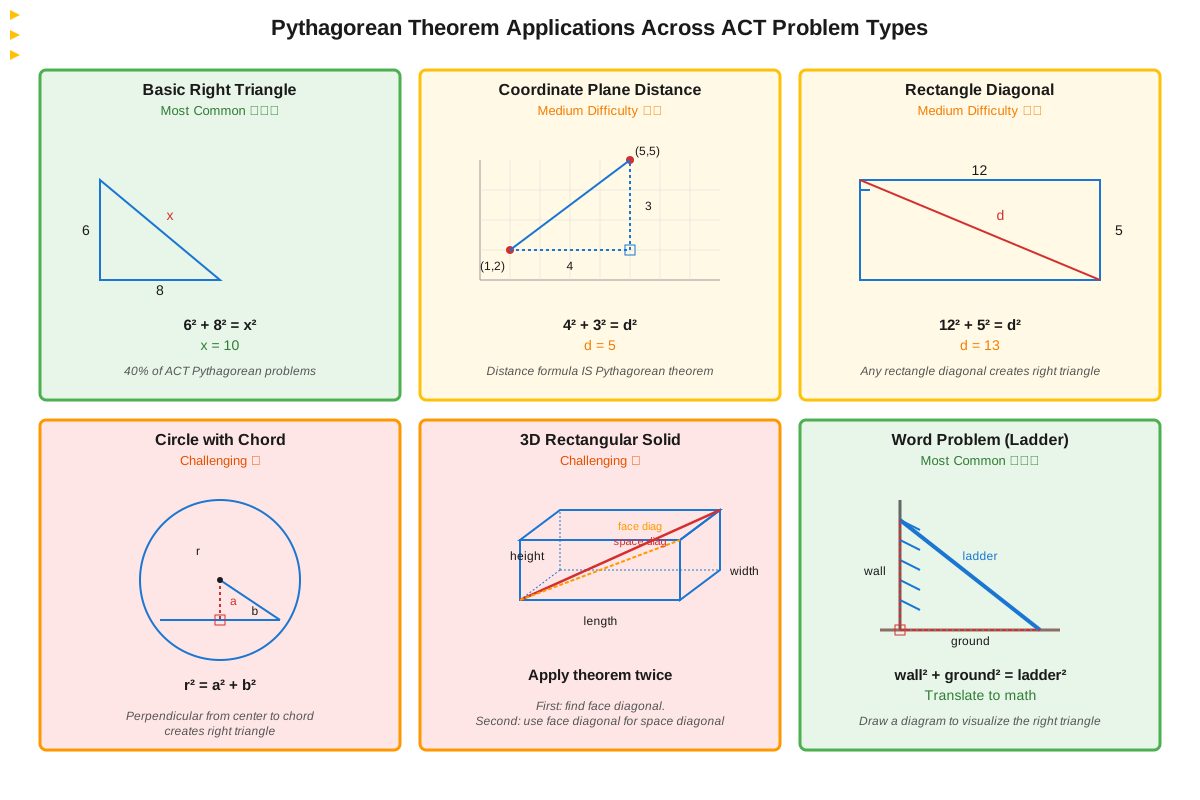
The ACT presents Pythagorean theorem questions in several distinct formats: direct calculation problems where two sides are given and the third must be found; word problems involving distances, heights, or diagonal measurements; coordinate geometry questions requiring distance calculations; problems involving squares, rectangles, or other polygons where diagonals create right triangles; and three-dimensional geometry scenarios involving rectangular prisms or pyramids. Recognizing these patterns enables students to quickly identify when the Pythagorean theorem provides the solution pathway.
Core Concepts
The Fundamental Formula
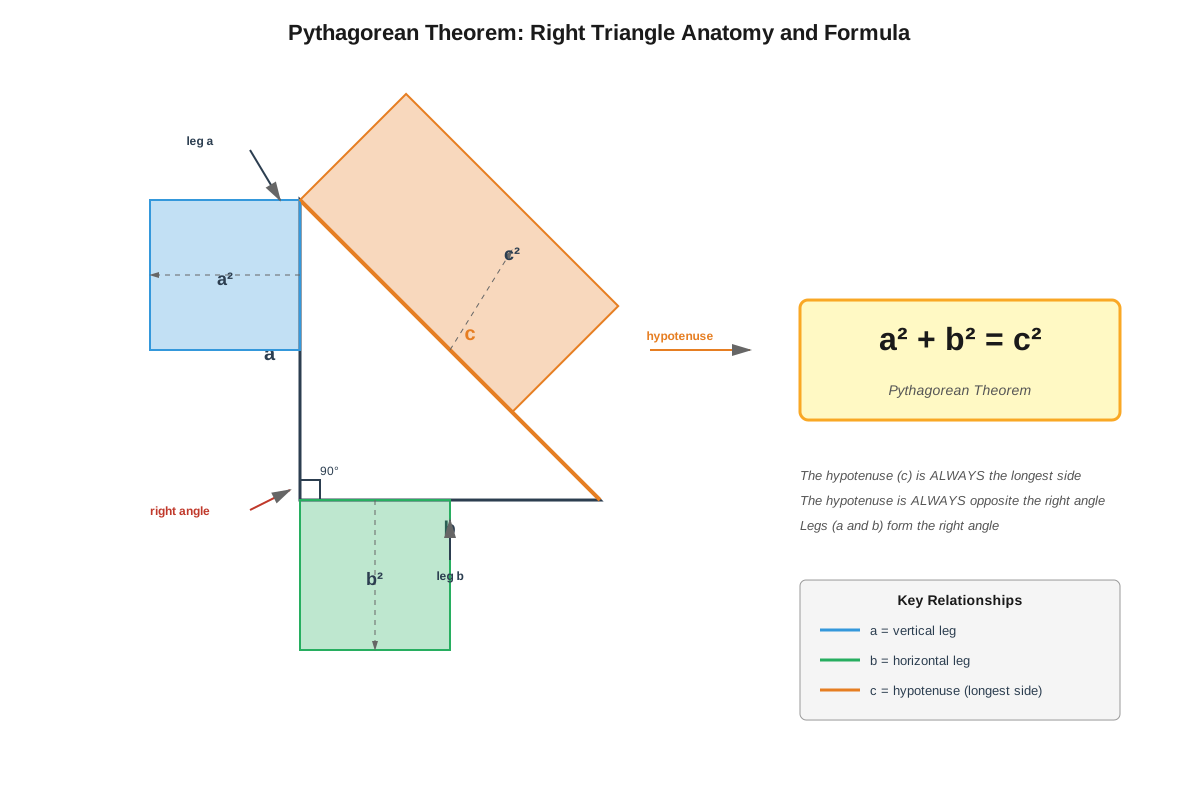
The Pythagorean theorem states that in any right triangle, the square of the length of the hypotenuse equals the sum of the squares of the lengths of the two legs. Mathematically, this relationship is expressed as:
a² + b² = c²Where:
- a and b represent the lengths of the two legs (the sides that form the right angle)
- c represents the length of the hypotenuse (the side opposite the right angle, always the longest side)
The hypotenuse is always opposite the right angle and is always the longest side of a right triangle. The legs are the two sides that meet at the right angle. This distinction is critical because misidentifying which side is the hypotenuse leads to incorrect calculations.
Identifying Right Triangle Scenarios
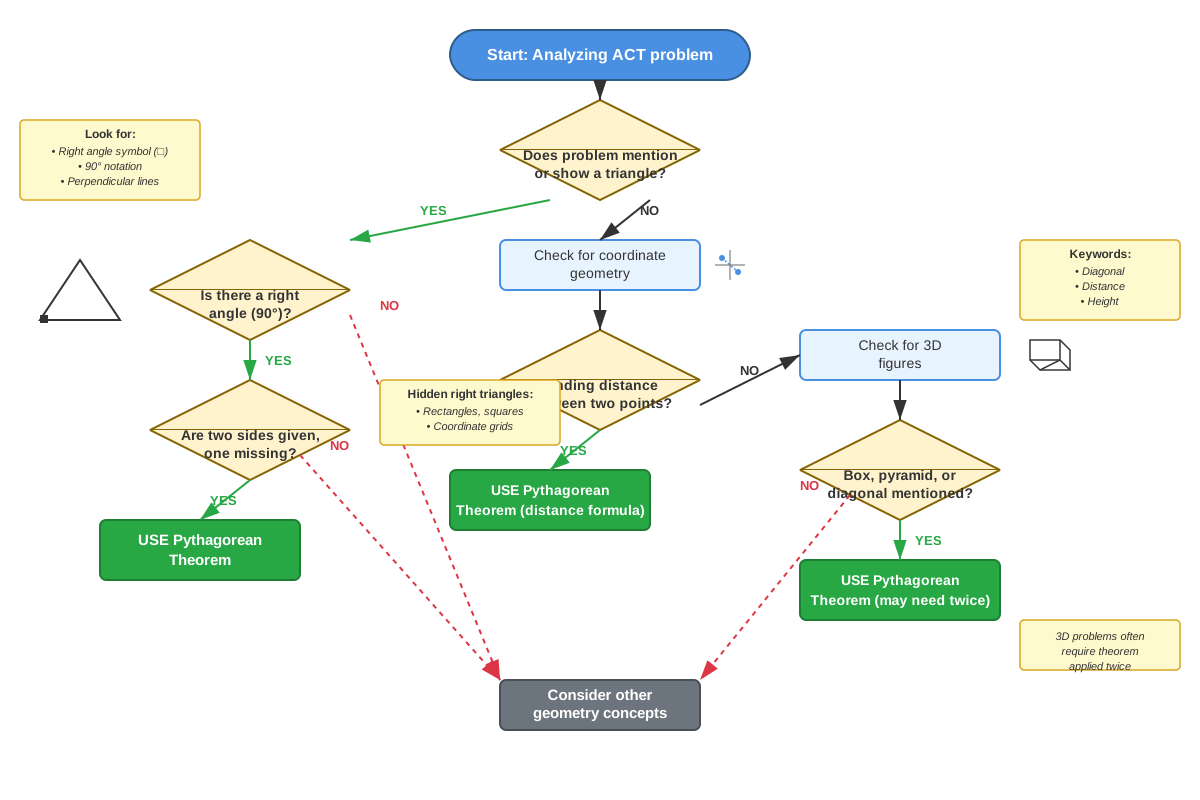
Before applying the Pythagorean theorem, students must recognize when a problem involves a right triangle. On the ACT, right triangles appear in several ways:
- Explicit right angle markers: A small square in the corner of a triangle indicates a 90° angle
- Coordinate geometry: Horizontal and vertical lines on a coordinate plane form right angles
- Word problem clues: Phrases like "perpendicular," "forms a right angle," "vertical and horizontal," or "corner" signal right triangles
- Geometric figures: Diagonals of rectangles and squares create right triangles; radii perpendicular to tangent lines form right angles
- Three-dimensional contexts: Edges of rectangular prisms meeting at corners form right angles
Solving for Different Sides
The Pythagorean theorem can be rearranged to solve for any unknown side when two sides are known:
Finding the hypotenuse (when both legs are known):
c = √(a² + b²)Finding a leg (when the hypotenuse and one leg are known):
a = √(c² - b²)or
b = √(c² - a²)The key distinction: when finding the hypotenuse, add the squares; when finding a leg, subtract the squares. This difference stems from the algebraic manipulation of the original equation.
Pythagorean Triples
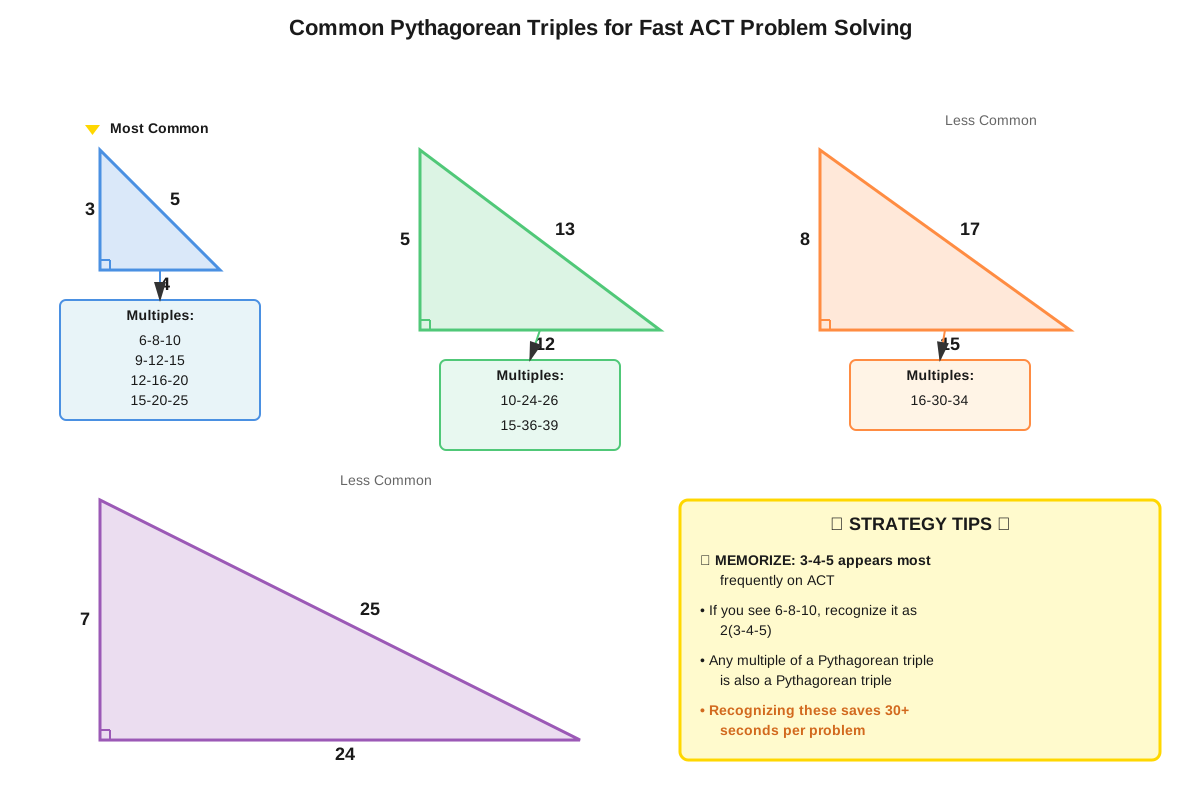
Pythagorean triples are sets of three positive integers that satisfy the Pythagorean theorem. Recognizing these common triples allows for rapid problem-solving without calculation:
| Triple | Multiples | Example |
|---|---|---|
| 3-4-5 | 6-8-10, 9-12-15, 12-16-20 | A triangle with legs 6 and 8 has hypotenuse 10 |
| 5-12-13 | 10-24-26, 15-36-39 | A triangle with legs 5 and 12 has hypotenuse 13 |
| 8-15-17 | 16-30-34 | A triangle with legs 8 and 15 has hypotenuse 17 |
| 7-24-25 | 14-48-50 | A triangle with legs 7 and 24 has hypotenuse 25 |
When an ACT problem presents two sides of a right triangle that match a Pythagorean triple (or a multiple thereof), the third side can be determined instantly without calculation. This time-saving strategy is particularly valuable given the ACT's time constraints.
The Converse of the Pythagorean Theorem
The converse states that if three sides of a triangle satisfy the equation a² + b² = c² (where c is the longest side), then the triangle must be a right triangle. This principle allows students to determine whether a triangle is a right triangle when all three sides are known.
Application: If given sides of length 7, 24, and 25, check: 7² + 24² = 49 + 576 = 625 = 25². Since the equation holds true, the triangle is a right triangle with the right angle opposite the side of length 25.
Three-Dimensional Applications
The Pythagorean theorem extends to three-dimensional geometry through sequential applications. Common ACT scenarios include:
Finding space diagonals in rectangular prisms: First use the theorem to find the diagonal of the base, then use that diagonal with the height to find the space diagonal.
Finding distances in coordinate space: When points have three coordinates (x, y, z), apply the theorem twice or use the three-dimensional distance formula, which is derived from the Pythagorean theorem.
Coordinate Geometry Connection
The distance formula in coordinate geometry is a direct application of the Pythagorean theorem:
d = √[(x₂ - x₁)² + (y₂ - y₁)²]This formula calculates the distance between two points by treating the horizontal distance (x₂ - x₁) and vertical distance (y₂ - y₁) as the legs of a right triangle, with the distance d as the hypotenuse.
Concept Relationships
The Pythagorean theorem serves as a central hub connecting multiple geometry concepts. Understanding these relationships enhances problem-solving flexibility and pattern recognition on the ACT.
Within the topic: The fundamental formula (a² + b² = c²) → enables identification of Pythagorean triples → which accelerates problem-solving → and the converse allows verification of right triangles → which determines when the theorem can be applied.
Connection to special right triangles: The Pythagorean theorem provides the foundation for understanding 45-45-90 triangles (where sides are in ratio x:x:x√2) and 30-60-90 triangles (where sides are in ratio x:x√3:2x). These special triangles are simply specific applications of the Pythagorean relationship with particular angle measures.
Connection to coordinate geometry: The distance formula is the Pythagorean theorem applied to the coordinate plane, where the difference in x-coordinates and y-coordinates form the legs of a right triangle. This connection means that any distance problem on the coordinate plane is fundamentally a Pythagorean theorem problem.
Connection to circles: When a radius is perpendicular to a chord, it bisects the chord, creating right triangles. The Pythagorean theorem then relates the radius, the distance from the center to the chord, and half the chord length. Similarly, tangent lines to circles form right angles with radii at the point of tangency.
Connection to three-dimensional geometry: Finding diagonals of rectangular prisms, pyramids, or other 3D figures requires sequential applications of the Pythagorean theorem, first in one plane, then incorporating the third dimension.
Quick check — test yourself on Pythagorean theorem so far.
Try Flashcards →High-Yield Facts
⭐ The Pythagorean theorem only applies to right triangles — never use it for acute or obtuse triangles without first creating right triangles within them.
⭐ The hypotenuse is always the longest side and is always opposite the right angle; if c is not the longest side in your calculation, an error has occurred.
⭐ The most common Pythagorean triple is 3-4-5 and its multiples (6-8-10, 9-12-15, etc.) appear frequently on the ACT.
⭐ When finding a leg, subtract the squares; when finding the hypotenuse, add the squares — this distinction prevents the most common calculation errors.
⭐ The distance formula is the Pythagorean theorem applied to coordinate geometry, making it applicable to any two-point distance problem.
- The 5-12-13 triple and its multiples appear regularly on the ACT and should be memorized for quick recognition.
- The converse of the Pythagorean theorem determines whether a triangle is a right triangle when all three sides are known.
- In three-dimensional problems, apply the Pythagorean theorem twice: once for a two-dimensional face, then again incorporating the third dimension.
- Diagonals of rectangles and squares always create right triangles with the sides of the figure.
- When a problem mentions "perpendicular," "vertical and horizontal," or "forms a right angle," the Pythagorean theorem is likely needed.
- The 8-15-17 and 7-24-25 triples, while less common than 3-4-5 and 5-12-13, appear often enough to warrant memorization.
- If two sides of a right triangle are given as expressions with variables, set up the Pythagorean equation and solve algebraically.
Common Misconceptions
Misconception: The Pythagorean theorem can be used for any triangle.
Correction: The theorem applies exclusively to right triangles. Using it on acute or obtuse triangles produces incorrect results. Always verify the presence of a right angle before applying the theorem.
Misconception: Any side can be labeled as c in the equation a² + b² = c².
Correction: The variable c must always represent the hypotenuse (the longest side opposite the right angle). The legs can be labeled as a and b interchangeably, but c has a specific meaning that cannot be changed.
Misconception: When finding a leg, the formula is a = √(c² + b²).
Correction: When solving for a leg, subtract the known leg squared from the hypotenuse squared: a = √(c² - b²). Adding the squares only applies when finding the hypotenuse.
Misconception: If a triangle has sides 3, 4, and 6, it's a right triangle because it contains the numbers 3 and 4 from the 3-4-5 triple.
Correction: All three numbers must match a Pythagorean triple or its multiple. Check: 3² + 4² = 9 + 16 = 25 ≠ 36 = 6². This is not a right triangle. Partial matches don't count.
Misconception: The Pythagorean theorem gives the area of a right triangle.
Correction: The theorem relates the lengths of the sides; it does not calculate area. To find the area of a right triangle, use the formula: Area = ½ × leg₁ × leg₂.
Misconception: In coordinate geometry, the distance between points (2, 3) and (5, 7) is found by adding the differences: (5-2) + (7-3) = 7.
Correction: Distance requires the Pythagorean theorem (distance formula): d = √[(5-2)² + (7-3)²] = √[9 + 16] = √25 = 5. Simply adding the differences gives the perimeter of a rectangle, not the diagonal distance.
Misconception: When a problem gives the hypotenuse and asks for a leg, forgetting to take the square root of the final answer.
Correction: After calculating c² - b², the square root must be taken to find the actual length: a = √(c² - b²), not just c² - b².
Worked Examples
Example 1: Direct Application with Pythagorean Triple Recognition
Problem: A ladder leans against a wall, with its base 12 feet from the wall. The top of the ladder reaches 16 feet up the wall. What is the length of the ladder?
Solution:
Step 1: Identify the right triangle. The wall (vertical), ground (horizontal), and ladder (diagonal) form a right triangle.
Step 2: Identify the components. The legs are 12 feet (distance from wall) and 16 feet (height on wall). The hypotenuse is the ladder length (unknown).
Step 3: Check for Pythagorean triples. Notice that 12 and 16 are both multiples of 4. Dividing by 4 gives 3 and 4, which are part of the 3-4-5 triple. Therefore, the complete triple is 12-16-20 (multiplying 3-4-5 by 4).
Step 4: The ladder length is 20 feet.
Verification using the formula:
c² = a² + b²
c² = 12² + 16²
c² = 144 + 256
c² = 400
c = √400 = 20
Connection to learning objectives: This example demonstrates identifying when the Pythagorean theorem applies (word problem with perpendicular elements), recognizing Pythagorean triples for efficiency, and applying the theorem accurately.
Example 2: Finding a Leg in Coordinate Geometry
Problem: Point A is located at (2, 3) and point B is located at (10, 9). A point C is located at (10, 3). What is the distance from A to C?
Solution:
Step 1: Visualize or sketch the points. Point A is at (2, 3), point C is at (10, 3). Notice they share the same y-coordinate.
Step 2: Recognize that points with the same y-coordinate form a horizontal line. The distance is simply the difference in x-coordinates: 10 - 2 = 8.
Alternative approach if C were at a different location:
Modified Problem: If C is at (10, 3) and we need the distance from A(2, 3) to B(10, 9), we would use the Pythagorean theorem.
Step 1: Find the horizontal distance (leg 1): 10 - 2 = 8
Step 2: Find the vertical distance (leg 2): 9 - 3 = 6
Step 3: Recognize the 6-8-? pattern, which is a multiple of 3-4-5 (multiply by 2). The hypotenuse is 10.
Step 4: Verify with the distance formula:
d = √[(10-2)² + (9-3)²]
d = √[8² + 6²]
d = √[64 + 36]
d = √100 = 10
Connection to learning objectives: This example shows how the Pythagorean theorem appears in coordinate geometry contexts and demonstrates the efficiency of recognizing Pythagorean triples versus calculating from scratch.
Exam Strategy
When approaching ACT Pythagorean theorem questions, implement this systematic strategy:
Step 1: Identify the right triangle. Look for explicit right angle markers, perpendicular lines, coordinate geometry setups, or words like "vertical," "horizontal," "perpendicular," or "corner." If no right triangle is visible, determine if one can be created by drawing auxiliary lines.
Step 2: Label the components. Identify which sides are legs (forming the right angle) and which is the hypotenuse (opposite the right angle, longest side). This prevents the critical error of misidentifying c.
Step 3: Check for Pythagorean triples. Before calculating, examine whether the given sides match or are multiples of common triples (3-4-5, 5-12-13, 8-15-17, 7-24-25). This recognition can save 30-45 seconds per problem.
Step 4: Set up the equation correctly. If finding the hypotenuse, use c² = a² + b². If finding a leg, use a² = c² - b². Double-check that you're adding or subtracting appropriately.
Step 5: Simplify before calculating. If possible, factor out common terms or recognize perfect squares to minimize calculation errors.
Trigger words and phrases: "perpendicular," "right angle," "vertical and horizontal," "diagonal," "distance between points," "ladder against a wall," "corner," "rectangular," "forms a square corner"
Process of elimination tips:
- Eliminate any answer choice longer than the hypotenuse when solving for a leg
- Eliminate any answer choice shorter than either leg when solving for the hypotenuse
- If two given sides are 3 and 4 (or multiples), eliminate answers that aren't 5 or its corresponding multiple
- In coordinate geometry, eliminate answers that are less than the horizontal or vertical distance alone
Time allocation: Straightforward Pythagorean theorem problems should take 30-45 seconds. Multi-step problems involving the theorem as one component should take 60-90 seconds. If a problem takes longer, mark it and return after completing easier questions.
Memory Techniques
Mnemonic for the formula: "A squared Plus B squared Creates C squared" — The first letters spell out the structure of the equation.
Visualization strategy: Picture a right triangle as a "corner" of a rectangle. The two legs form the sides of the corner, and the hypotenuse "cuts across" the corner. This mental image reinforces that the hypotenuse is always the diagonal, longest side.
Acronym for common triples: "3-4-5 FIRST" reminds students to check the most common triple first before calculating. Extend this to "5-12-13 SECOND" for the next most common.
Leg vs. Hypotenuse memory aid: "Add for the Across side (hypotenuse), Subtract for the Side (leg)" — The alliteration helps remember when to add versus subtract.
Converse memory technique: "If the equation fits, the angle sits (at 90°)" — This rhyme helps remember that when the Pythagorean equation is satisfied, a right angle exists.
Coordinate geometry connection: Remember "Distance = Diagonal" — Any distance between two points is the diagonal (hypotenuse) of a right triangle formed by horizontal and vertical movements.
Summary
The Pythagorean theorem establishes the fundamental relationship in right triangles: the square of the hypotenuse equals the sum of the squares of the two legs (a² + b² = c²). This theorem appears in 2-4 direct questions per ACT exam and serves as a critical tool in an additional 3-5 questions involving coordinate geometry, three-dimensional figures, and complex word problems. Success requires three key competencies: recognizing when a right triangle exists (through explicit markers, perpendicular relationships, or coordinate setups), correctly identifying which side is the hypotenuse versus the legs, and efficiently calculating the unknown side through either direct application of the formula or recognition of Pythagorean triples. The most common triples—3-4-5, 5-12-13, 8-15-17, and 7-24-25, along with their multiples—enable rapid problem-solving without calculation. The theorem extends beyond simple triangles to coordinate geometry through the distance formula and to three-dimensional geometry through sequential applications. Mastery requires understanding both when to add squares (finding the hypotenuse) and when to subtract squares (finding a leg), as this distinction prevents the most frequent calculation errors.
Key Takeaways
- The Pythagorean theorem (a² + b² = c²) applies exclusively to right triangles, where c always represents the hypotenuse (longest side opposite the right angle)
- Memorizing common Pythagorean triples (3-4-5, 5-12-13, 8-15-17, 7-24-25) and recognizing their multiples dramatically increases solving speed on the ACT
- When finding the hypotenuse, add the squares of the legs; when finding a leg, subtract the known leg squared from the hypotenuse squared
- The distance formula in coordinate geometry is simply the Pythagorean theorem applied to horizontal and vertical distances between points
- Trigger words like "perpendicular," "diagonal," "vertical and horizontal," and "right angle" signal Pythagorean theorem applications
- The converse of the theorem allows verification of right triangles: if a² + b² = c² (where c is the longest side), the triangle contains a right angle
- Three-dimensional problems require sequential applications: first find a diagonal in one plane, then use that diagonal with the third dimension
Related Topics
Special Right Triangles (45-45-90 and 30-60-90): These triangles represent specific applications of the Pythagorean theorem with fixed angle relationships, providing even faster solving methods for certain problems. Mastering the Pythagorean theorem provides the foundation for understanding why these special ratios work.
Trigonometry (SOH-CAH-TOA): Trigonometric ratios build upon right triangle relationships, using angles and sides together. The Pythagorean theorem often works in tandem with trigonometry to solve complex problems involving both angles and side lengths.
Coordinate Geometry and Distance Formula: This topic directly applies the Pythagorean theorem to points on a plane, extending the concept to graphical representations and algebraic expressions.
Three-Dimensional Geometry: Finding surface diagonals, space diagonals, and distances in 3D figures requires multiple applications of the Pythagorean theorem, making it essential for advanced geometry problems.
Circles and Tangent Lines: The relationship between radii, chords, and tangent lines frequently creates right triangles where the Pythagorean theorem provides the solution method.
Practice CTA
Now that you've mastered the core concepts, relationships, and strategies for the Pythagorean theorem, it's time to solidify your understanding through active practice. Attempt the practice questions to apply these concepts in ACT-style scenarios, and use the flashcards to reinforce quick recall of Pythagorean triples and key formulas. Remember, recognizing patterns and applying the theorem efficiently can save you valuable minutes on test day—time that can be redirected to more challenging problems. Every practice problem you complete builds the pattern recognition and confidence needed to excel on the ACT Math section. You've got this!
Sign up free to keep reading
Create a free AnvayaPrep account to finish this ACT guide on Pythagorean theorem — plus flashcards and practice questions.