Overview
The order of operations is a fundamental mathematical principle that dictates the sequence in which operations must be performed when evaluating expressions containing multiple operations. This systematic approach ensures that everyone arrives at the same correct answer when solving mathematical expressions, regardless of who performs the calculation. On the ACT Math test, understanding and correctly applying the order of operations is absolutely critical—it appears in approximately 15-20% of all questions, either as the primary concept being tested or as a necessary skill to solve more complex problems.
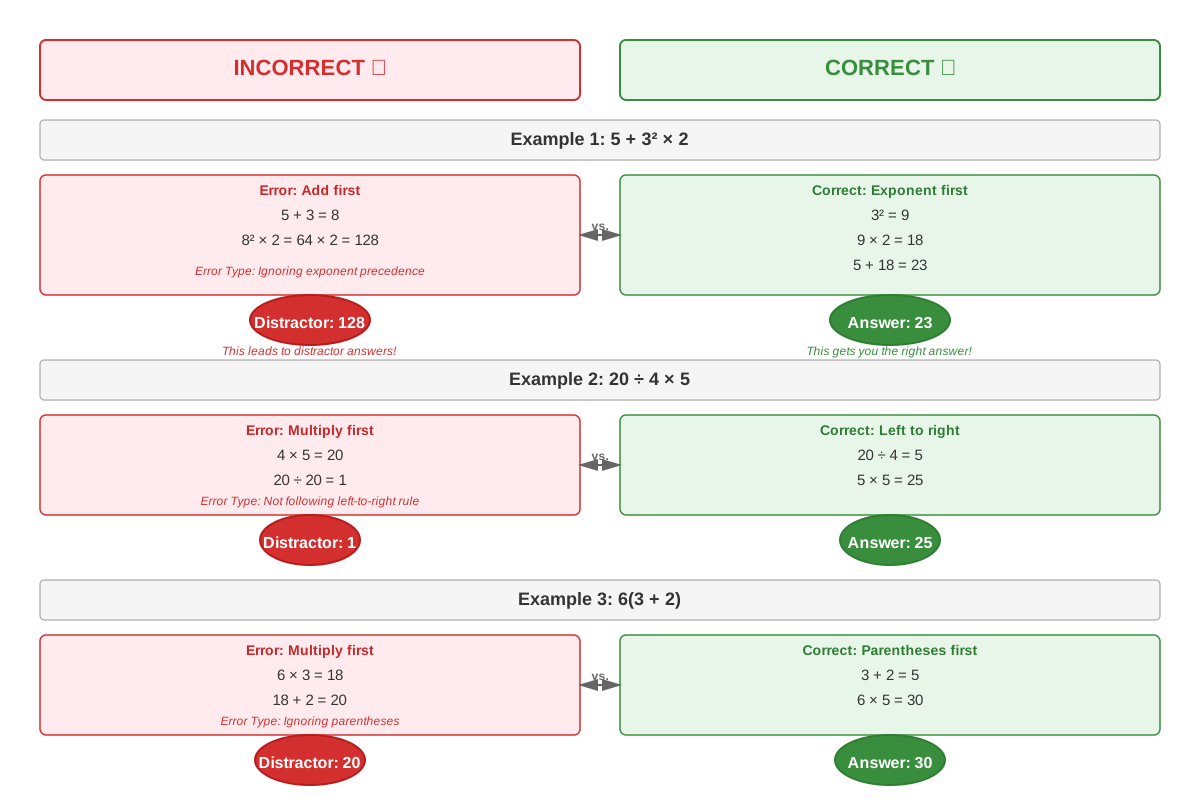
The ACT order of operations questions range from straightforward evaluation of numerical expressions to complex algebraic manipulations embedded within word problems, geometry questions, and function evaluations. Students who master this topic gain a significant advantage because order of operations errors are among the most common mistakes that lead to incorrect answers, even when students understand the underlying mathematical concepts. The ACT test writers deliberately craft answer choices that reflect common order of operations mistakes, making these "distractor" answers particularly tempting for students who rush or apply operations incorrectly.
This topic serves as the foundation for virtually every other mathematical concept tested on the ACT. Whether solving linear equations, evaluating functions, simplifying algebraic expressions, or calculating geometric measurements, the order of operations must be applied correctly at every step. It connects directly to topics in algebra, coordinate geometry, trigonometry, and even statistics, making it one of the most high-yield topics for ACT preparation.
Learning Objectives
- [ ] Identify when Order of operations is being tested
- [ ] Explain the core rule or strategy behind Order of operations
- [ ] Apply Order of operations to ACT-style questions accurately
- [ ] Evaluate complex expressions containing nested grouping symbols and multiple operation types
- [ ] Recognize and avoid common order of operations errors that appear as distractor answer choices
- [ ] Apply order of operations correctly within algebraic expressions containing variables
- [ ] Solve multi-step problems requiring order of operations at multiple stages
Prerequisites
- Basic arithmetic operations: Understanding addition, subtraction, multiplication, and division is essential because order of operations determines when to apply each operation
- Exponents and powers: Familiarity with exponential notation is necessary since exponents occupy a specific position in the operational hierarchy
- Negative numbers: Knowledge of how to work with negative values is required because signs and subtraction must be handled correctly within the order of operations framework
- Fractions and decimals: Competence with these number types is needed since order of operations applies regardless of number format
- Algebraic notation: Basic understanding of variables and expressions helps when applying order of operations to non-numerical problems
Why This Topic Matters
In real-world applications, the order of operations ensures consistency in mathematical communication across all fields that use quantitative reasoning. Engineers calculating structural loads, programmers writing algorithms, scientists analyzing experimental data, and financial analysts computing compound interest all rely on the universal agreement about operational precedence. Without this standardized approach, mathematical expressions would be ambiguous and could yield multiple different results.
On the ACT Math test, order of operations appears in approximately 3-4 questions directly and is required for solving an additional 10-15 questions where it's embedded within other concepts. This represents roughly 25-30% of the entire 60-question Math section. Questions may appear as straightforward numerical evaluations, algebraic simplifications, function evaluations, or embedded within word problems requiring formula application. The ACT frequently tests this concept by:
- Presenting complex expressions with multiple operations and asking for the simplified result
- Embedding order of operations within equation-solving problems where incorrect sequencing leads to wrong solutions
- Creating word problems where students must translate verbal descriptions into mathematical expressions and evaluate them correctly
- Testing understanding of how grouping symbols (parentheses, brackets, braces) modify the standard operational sequence
- Including calculator problems where students must input expressions correctly to obtain accurate results
The high frequency and broad application of this topic make it one of the most important concepts to master for ACT success. Students who consistently apply order of operations correctly avoid a major category of preventable errors.
Core Concepts
The PEMDAS Framework
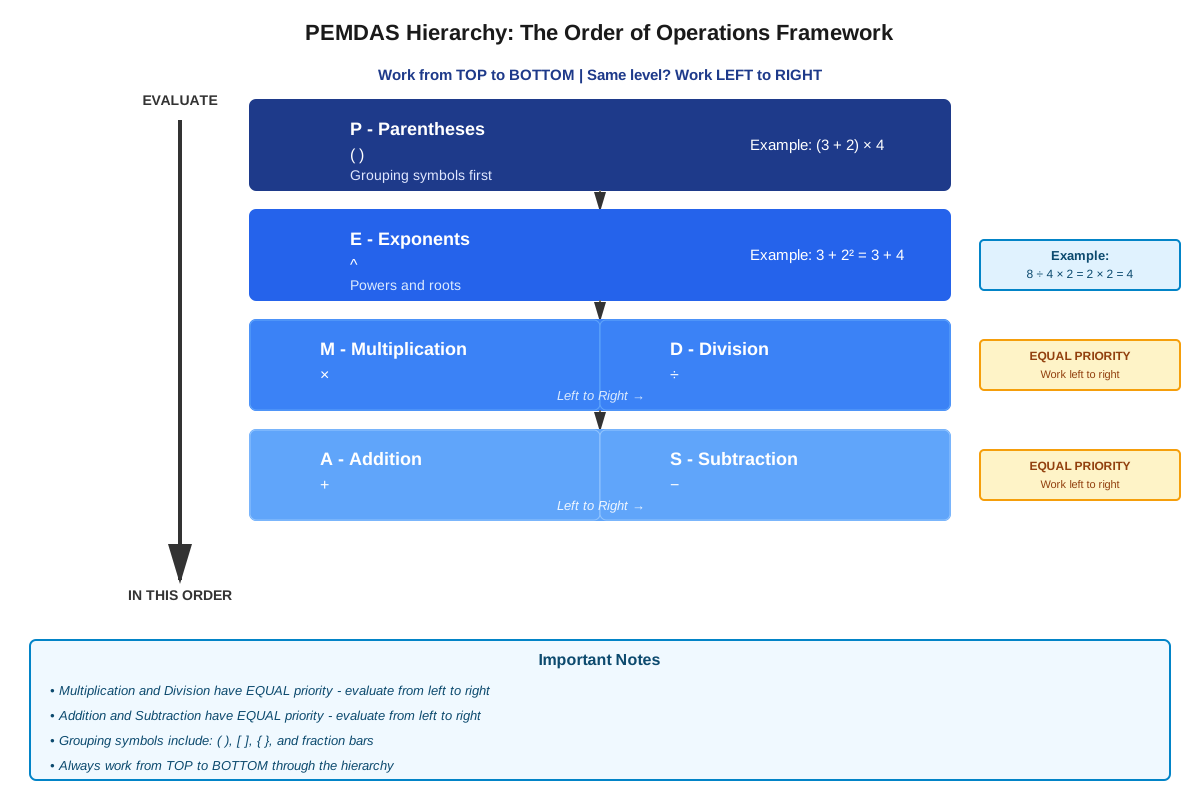
The order of operations follows a specific hierarchy remembered by the acronym PEMDAS: Parentheses, Exponents, Multiplication and Division (left to right), Addition and Subtraction (left to right). This sequence determines which operations must be performed first when evaluating any mathematical expression.
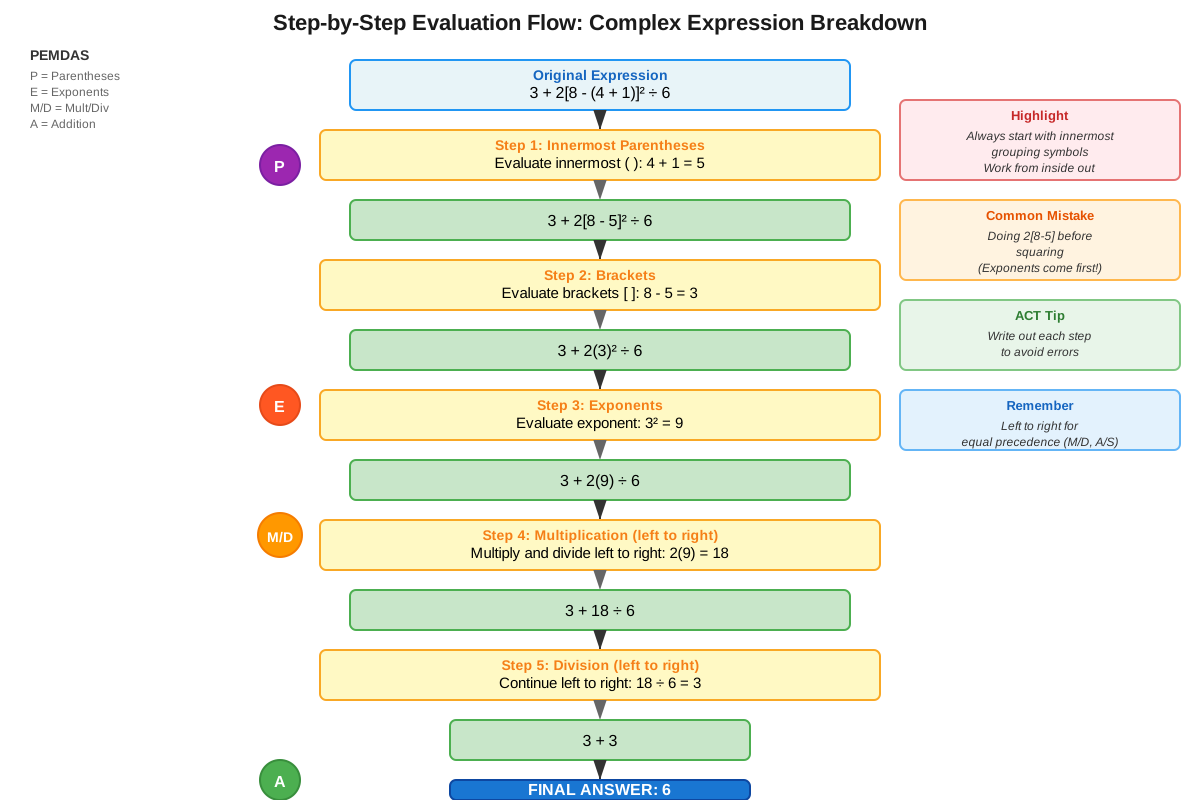
Parentheses (and all grouping symbols including brackets [ ], braces { }, and absolute value bars | |) take highest priority. Any operations contained within grouping symbols must be evaluated first, working from the innermost grouping outward. When multiple sets of parentheses are nested, always begin with the innermost set.
Exponents (including powers, roots, and exponential expressions) are evaluated second, after all grouping symbols have been resolved. This includes both numerical exponents like 2³ and algebraic expressions like x².
Multiplication and Division share equal priority and are performed from left to right as they appear in the expression. This is a critical point: multiplication does not take precedence over division. When both operations appear at the same level, work from left to right.
Addition and Subtraction also share equal priority and are performed from left to right after all higher-priority operations are complete. Like multiplication and division, neither operation takes precedence over the other.
Detailed Operational Sequence
Expression: 3 + 4 × 2² - (8 - 3) × 2

Step 1: Parentheses first
3 + 4 × 2² - (5) × 2

Step 2: Exponents
3 + 4 × 4 - 5 × 2

Step 3: Multiplication (left to right)
3 + 16 - 10

Step 4: Addition and Subtraction (left to right)
19 - 10 = 9
Nested Grouping Symbols
When expressions contain multiple layers of grouping symbols, work from the innermost grouping outward. Each layer requires complete evaluation following PEMDAS before moving to the next outer layer.
Expression: 2[3 + 4(5 - 2)]

Step 1: Innermost parentheses
2[3 + 4(3)]

Step 2: Multiplication inside brackets
2[3 + 12]

Step 3: Addition inside brackets
2[15]

Step 4: Final multiplication
30
Fraction Bars as Grouping Symbols
Fraction bars function as grouping symbols, requiring complete evaluation of both numerator and denominator before performing the division. This is a frequently tested concept on the ACT.
Expression: (6 + 4)/(3 - 1)

Step 1: Evaluate numerator
10/(3 - 1)

Step 2: Evaluate denominator
10/2

Step 3: Perform division
5
Implied Multiplication
When a number appears directly adjacent to a grouping symbol or variable without an explicit multiplication sign, multiplication is implied and follows standard order of operations rules. For example, 3(4 + 2) means 3 × (4 + 2), and 2x means 2 × x.
Negative Signs and Subtraction
Distinguishing between negative signs (indicating a negative number) and subtraction operations (indicating an operation between two numbers) is essential. Negative signs attached to numbers are part of the number itself, while subtraction is an operation performed according to order of operations.
Expression: -3² versus (-3)²

-3² = -(3²) = -9 (exponent applies only to 3)
(-3)² = (-3) × (-3) = 9 (exponent applies to -3)
Special Cases and Edge Situations
| Situation | Rule | Example | ||||
|---|---|---|---|---|---|---|
| Adjacent operations of equal priority | Work left to right | 12 ÷ 3 × 2 = 4 × 2 = 8 | ||||
| Exponents on exponents | Work right to left | 2^(3^2) = 2^9 = 512 | ||||
| Absolute value bars | Treat as grouping symbols | \ | 3 - 7\ | = \ | -4\ | = 4 |
| Multiple negative signs | Simplify signs first | -(-5) = 5 | ||||
| Zero in operations | Follow standard rules | 5 × 0 = 0, 0 ÷ 5 = 0 |
Concept Relationships
The order of operations serves as the central organizing principle for all mathematical computation. It connects directly to basic arithmetic by providing the framework for combining multiple operations, ensuring that complex calculations yield consistent results. Without order of operations, even simple expressions like 2 + 3 × 4 would be ambiguous.
The relationship flows as follows: Basic arithmetic operations → Order of operations framework → Algebraic manipulation → Equation solving → Function evaluation → Advanced mathematical applications. Each level builds upon correct application of operational precedence.
Within the topic itself, concepts connect hierarchically: Grouping symbols modify and override the standard sequence → Exponents are evaluated after grouping → Multiplication/Division are performed next → Addition/Subtraction complete the evaluation. Understanding that operations at the same level (multiplication with division, addition with subtraction) require left-to-right evaluation prevents common errors.
Order of operations connects forward to algebraic expressions where variables are manipulated using the same rules, polynomial operations where terms must be combined correctly, rational expressions where fraction bars act as grouping symbols, and function composition where nested functions require careful sequential evaluation. It also underlies equation solving where inverse operations must be applied in reverse order to isolate variables.
Quick check — test yourself on Order of operations so far.
Try Flashcards →High-Yield Facts
- ⭐ PEMDAS stands for Parentheses, Exponents, Multiplication and Division (left to right), Addition and Subtraction (left to right)
- ⭐ Multiplication and division have equal priority and are performed from left to right as they appear
- ⭐ Addition and subtraction have equal priority and are performed from left to right as they appear
- ⭐ Fraction bars act as grouping symbols, requiring complete evaluation of numerator and denominator before dividing
- ⭐ Nested grouping symbols must be evaluated from innermost to outermost
- Exponents apply only to what they are directly attached to unless parentheses indicate otherwise
- The expression -3² equals -9, while (-3)² equals 9
- Absolute value bars function as grouping symbols and must be evaluated before using the absolute value
- Implied multiplication (like 3(4) or 2x) follows the same rules as explicit multiplication
- When exponents are stacked (like 2^3^2), evaluate from right to left unless parentheses indicate otherwise
- Division by zero is undefined and cannot be performed
- Zero multiplied by any number equals zero
- The order of operations applies to algebraic expressions with variables exactly as it does to numerical expressions
- Calculator input must follow order of operations; incorrect parentheses placement yields wrong answers
- ACT answer choices often include results from common order of operations errors
Common Misconceptions
Misconception: Multiplication always comes before division in every expression.
Correction: Multiplication and division have equal priority and must be performed from left to right as they appear. In the expression 12 ÷ 3 × 2, you divide first (getting 4), then multiply (getting 8), not multiply first.
Misconception: Addition always comes before subtraction.
Correction: Addition and subtraction have equal priority and must be performed from left to right. In 10 - 3 + 2, you subtract first (getting 7), then add (getting 9), yielding 9, not 5.
Misconception: The negative sign in -3² applies to the entire expression, making it (-3)².
Correction: Without parentheses, the exponent applies only to the 3, not the negative sign. Therefore, -3² = -(3²) = -9, while (-3)² = 9. The parentheses make a critical difference.
Misconception: Operations inside parentheses can be performed in any order.
Correction: Even within parentheses, you must follow PEMDAS. For example, in (2 + 3 × 4), you must multiply 3 × 4 first to get 12, then add 2 to get 14, not add 2 + 3 first.
Misconception: When you see multiple operations, you should work from left to right regardless of operation type.
Correction: You must follow the PEMDAS hierarchy first, then work left to right only within operations of equal priority. In 2 + 3 × 4, you multiply first (getting 12), then add (getting 14), even though addition appears first from left to right.
Misconception: Fraction bars are just division signs and don't affect the order of operations.
Correction: Fraction bars act as grouping symbols, requiring complete evaluation of both numerator and denominator before performing the division. The expression (6 + 4)/(2 + 3) requires evaluating 6 + 4 = 10 and 2 + 3 = 5 before dividing to get 2.
Misconception: You can ignore parentheses if the expression inside is simple.
Correction: Parentheses always indicate priority, even for simple expressions. While 2(3) and 2 × 3 yield the same result, parentheses in more complex expressions like 2(3 + 4) are essential and cannot be ignored.
Worked Examples
Example 1: Multi-Operation Numerical Expression
Problem: Evaluate: 5 + 3² × 2 - (12 - 4) ÷ 2
Solution:
Step 1: Identify all operations present: addition, exponent, multiplication, subtraction (twice), parentheses, and division.
Step 2: Apply PEMDAS systematically.
Parentheses first: (12 - 4) = 8
Expression becomes: 5 + 3² × 2 - 8 ÷ 2
Exponents second: 3² = 9
Expression becomes: 5 + 9 × 2 - 8 ÷ 2
Multiplication and Division (left to right):
- First, 9 × 2 = 18
- Expression becomes: 5 + 18 - 8 ÷ 2
- Then, 8 ÷ 2 = 4
- Expression becomes: 5 + 18 - 4
Addition and Subtraction (left to right):
- First, 5 + 18 = 23
- Expression becomes: 23 - 4
- Finally, 23 - 4 = 19
Answer: 19
Connection to Learning Objectives: This example demonstrates identifying when order of operations is tested (multiple operations in one expression), explaining the core strategy (systematic application of PEMDAS), and applying it accurately to reach the correct answer.
Example 2: Nested Grouping with Algebraic Expression
Problem: Simplify: 3[2x + 4(x - 1)] - 2x when x = 2
Solution:
Step 1: Work with the algebraic expression first, then substitute.
Innermost parentheses: Distribute the 4
3[2x + 4x - 4] - 2x
Combine like terms inside brackets: 2x + 4x = 6x
3[6x - 4] - 2x
Distribute the 3:
18x - 12 - 2x
Combine like terms:
16x - 12
Step 2: Substitute x = 2
16(2) - 12
Multiply: 32 - 12
Subtract: 20
Answer: 20
Alternative approach: Substitute x = 2 first, then evaluate
3[2(2) + 4(2 - 1)] - 2(2)
3[4 + 4(1)] - 4
3[4 + 4] - 4
3[8] - 4
24 - 4
20
Connection to Learning Objectives: This example shows how order of operations applies to algebraic expressions with variables, demonstrates handling nested grouping symbols, and illustrates that the same rules apply whether working symbolically or numerically.
Exam Strategy
When approaching ACT order of operations questions, begin by scanning the expression to identify all operation types present and locate all grouping symbols. This initial survey helps you plan your approach and avoid missing critical elements. Circle or underline parentheses, brackets, and fraction bars to ensure you don't overlook them.
Trigger words and phrases that indicate order of operations testing include: "evaluate," "simplify," "what is the value of," "calculate," and any question presenting a complex expression without explicit step-by-step instructions. When you see multiple operations in a single expression, order of operations is definitely being tested.
For process of elimination, recognize that ACT answer choices typically include common errors:
- One choice represents working strictly left to right without following PEMDAS
- Another choice represents performing addition/subtraction before multiplication/division
- A third choice may represent treating -x² as (-x)² or similar sign errors
- The correct answer follows PEMDAS precisely
Time allocation strategy: Simple order of operations questions should take 30-45 seconds. If you find yourself spending more than one minute, you may be overcomplicating the problem. Write out each step clearly rather than trying to do too much mentally—this prevents errors and actually saves time by eliminating the need to restart.
Calculator usage: When using a calculator for order of operations problems, input parentheses explicitly to ensure correct evaluation. Many errors occur when students rely on calculator order of operations without proper grouping. For the expression 6 + 4/2, a calculator correctly gives 8, but if you meant (6 + 4)/2, you must input the parentheses to get 5.
Exam Tip: If an expression contains a fraction bar, treat everything above the bar as one grouped expression and everything below as another. Evaluate each completely before dividing.
Double-checking strategy: After solving, quickly verify by checking whether your answer is reasonable in magnitude and sign. If the original expression contained mostly positive numbers and your answer is negative, review your work for sign errors.
Memory Techniques
PEMDAS Mnemonic: "Please Excuse My Dear Aunt Sally" is the classic mnemonic where each word's first letter corresponds to an operation: Parentheses, Exponents, Multiplication, Division, Addition, Subtraction. Remember that MD and AS are pairs of equal priority.
Alternative mnemonic: "Purple Elephants May Destroy A School" or create your own memorable phrase using PEMDAS.
The Hierarchy Pyramid Visualization: Picture a pyramid with four levels:
- Top (smallest, first): Parentheses/Grouping
- Second level: Exponents
- Third level: Multiplication and Division (side by side, equal)
- Bottom (largest, last): Addition and Subtraction (side by side, equal)
The Left-to-Right Rule: For operations at the same level, visualize reading a book—you always move left to right across the page. This applies to MD operations and AS operations.
Fraction Bar Memory Aid: Think "Fraction bars are BARS that block you"—they create barriers requiring you to finish everything on each side before crossing the bar to divide.
Negative Sign Reminder: Remember "Exponents are GREEDY but not THAT greedy"—they take what they touch directly but won't reach past a negative sign without parentheses forcing them to.
GEMS Alternative: Some students prefer Grouping, Exponents, Multiplication/Division, Subtraction/Addition, which emphasizes that grouping includes all symbols (parentheses, brackets, braces, fraction bars, absolute value) and that MD and SA are pairs.
Summary
The order of operations is a systematic framework that ensures consistent evaluation of mathematical expressions by establishing a hierarchy of operational precedence. Following the PEMDAS sequence—Parentheses, Exponents, Multiplication and Division (left to right), Addition and Subtraction (left to right)—students can accurately evaluate any expression regardless of complexity. Critical points include recognizing that multiplication/division share equal priority and must be performed left to right, that addition/subtraction similarly share priority, that grouping symbols (including fraction bars) take highest priority and must be evaluated from innermost to outermost, and that exponents apply only to what they directly touch unless parentheses indicate otherwise. This topic appears frequently on the ACT Math test both as a direct testing point and as an essential skill embedded within more complex problems across all mathematical domains. Mastery requires careful attention to detail, systematic application of rules, and awareness of common errors that appear as distractor answer choices.
Key Takeaways
- PEMDAS defines the order: Parentheses, Exponents, Multiplication/Division (left to right), Addition/Subtraction (left to right)
- Multiplication and division have equal priority; perform them left to right as they appear
- Addition and subtraction have equal priority; perform them left to right as they appear
- Fraction bars act as grouping symbols requiring complete evaluation of numerator and denominator before dividing
- Nested grouping symbols must be evaluated from innermost to outermost, following PEMDAS at each level
- The expression -x² means -(x²), while (-x)² means the negative is included in the exponent
- Order of operations applies identically to algebraic expressions with variables and numerical expressions
Related Topics
Algebraic Expressions and Simplification: Mastering order of operations enables correct simplification of algebraic expressions by ensuring terms are combined and operations performed in the proper sequence, particularly when distributing and combining like terms.
Equation Solving: Understanding order of operations is essential for solving equations because inverse operations must be applied in reverse order of operations to isolate variables correctly.
Function Evaluation: When evaluating functions, especially composite functions, order of operations determines the sequence for substituting values and performing calculations.
Polynomial Operations: Adding, subtracting, multiplying, and dividing polynomials requires consistent application of order of operations to combine terms correctly and avoid errors.
Rational Expressions: Working with algebraic fractions demands careful attention to order of operations, particularly recognizing fraction bars as grouping symbols.
Practice CTA
Now that you've mastered the core concepts of order of operations, it's time to solidify your understanding through practice. Attempt the practice questions to test your ability to identify, explain, and apply order of operations in various ACT-style contexts. Use the flashcards to reinforce the PEMDAS sequence and common error patterns. Remember, order of operations mastery is one of the highest-yield investments you can make in your ACT Math preparation—it appears throughout the test and prevents a major category of avoidable errors. Consistent practice will build the automaticity you need to apply these rules quickly and accurately under test conditions!
Sign up free to keep reading
Create a free AnvayaPrep account to finish this ACT guide on Order of operations — plus flashcards and practice questions.