Overview
Proportions represent one of the most fundamental and frequently tested concepts on the ACT Math section. A proportion is an equation that states two ratios are equal, typically written as a/b = c/d. This seemingly simple concept underlies numerous question types across the ACT, from straightforward ratio problems to complex word problems involving rates, scale drawings, similar figures, and unit conversions. Understanding proportions is not merely about memorizing a cross-multiplication formula—it requires recognizing when quantities maintain a constant relationship and applying systematic problem-solving strategies to find unknown values.
The importance of mastering ACT proportions cannot be overstated. Questions involving proportional relationships appear in approximately 10-15% of all ACT Math questions, making this one of the highest-yield topics for test preparation. These questions often disguise themselves as word problems about recipes, maps, travel time, work rates, or geometric similarity. Students who can quickly identify proportional relationships and set up correct equations gain a significant advantage in both accuracy and time management. The ACT specifically favors proportion problems because they test multiple skills simultaneously: reading comprehension, algebraic manipulation, logical reasoning, and numerical fluency.
Proportions serve as a bridge between basic arithmetic and more advanced algebraic concepts. They connect directly to percentages, fractions, decimals, and ratios while providing the foundation for understanding linear relationships, direct and inverse variation, and trigonometric ratios. In the broader context of ACT Math, proportion mastery enables students to tackle problems in coordinate geometry (slope), trigonometry (sine, cosine, and tangent ratios), and even probability. This interconnectedness makes proportions an essential building block that supports success across multiple content areas on the exam.
Learning Objectives
- [ ] Identify when Proportions is being tested in ACT questions
- [ ] Explain the core rule or strategy behind Proportions
- [ ] Apply Proportions to ACT-style questions accurately
- [ ] Set up correct proportional equations from word problems without errors
- [ ] Distinguish between direct and inverse proportional relationships
- [ ] Solve multi-step problems involving proportions and unit conversions
- [ ] Recognize proportional relationships in geometric contexts (similar figures, scale factors)
Prerequisites
- Fractions and simplification: Proportions are equations involving fractions; students must manipulate fractional expressions fluently
- Basic algebraic equation solving: Solving for unknown variables using inverse operations is essential for finding missing values in proportions
- Ratios: Understanding ratios as comparisons between quantities provides the foundation for setting up proportions
- Multiplication and division: Cross-multiplication and simplification require strong computational skills
- Unit awareness: Recognizing and converting units ensures proper setup of proportional relationships
Why This Topic Matters
Proportions appear throughout everyday life, making them one of the most practical mathematical concepts students will encounter. Real-world applications include adjusting recipe quantities for different serving sizes, calculating medication dosages based on body weight, determining travel time at different speeds, converting currencies, interpreting map scales, and understanding financial concepts like interest rates and tax percentages. Architects use proportions to create scale models, photographers use them to maintain aspect ratios when resizing images, and engineers apply them to design structurally sound scaled prototypes. This practical relevance makes proportion problems particularly accessible to students who can visualize real-world contexts.
On the ACT specifically, proportion questions appear with remarkable consistency. Approximately 6-9 questions per test involve proportional reasoning, either directly or as part of a multi-step problem. These questions typically appear in the first 40 questions of the 60-question Math section, though more complex applications involving similar triangles or trigonometric ratios may appear later. The ACT favors proportion problems because they efficiently assess multiple competencies: reading comprehension (extracting relevant information from word problems), mathematical reasoning (recognizing proportional relationships), algebraic manipulation (solving equations), and numerical accuracy (performing calculations correctly).
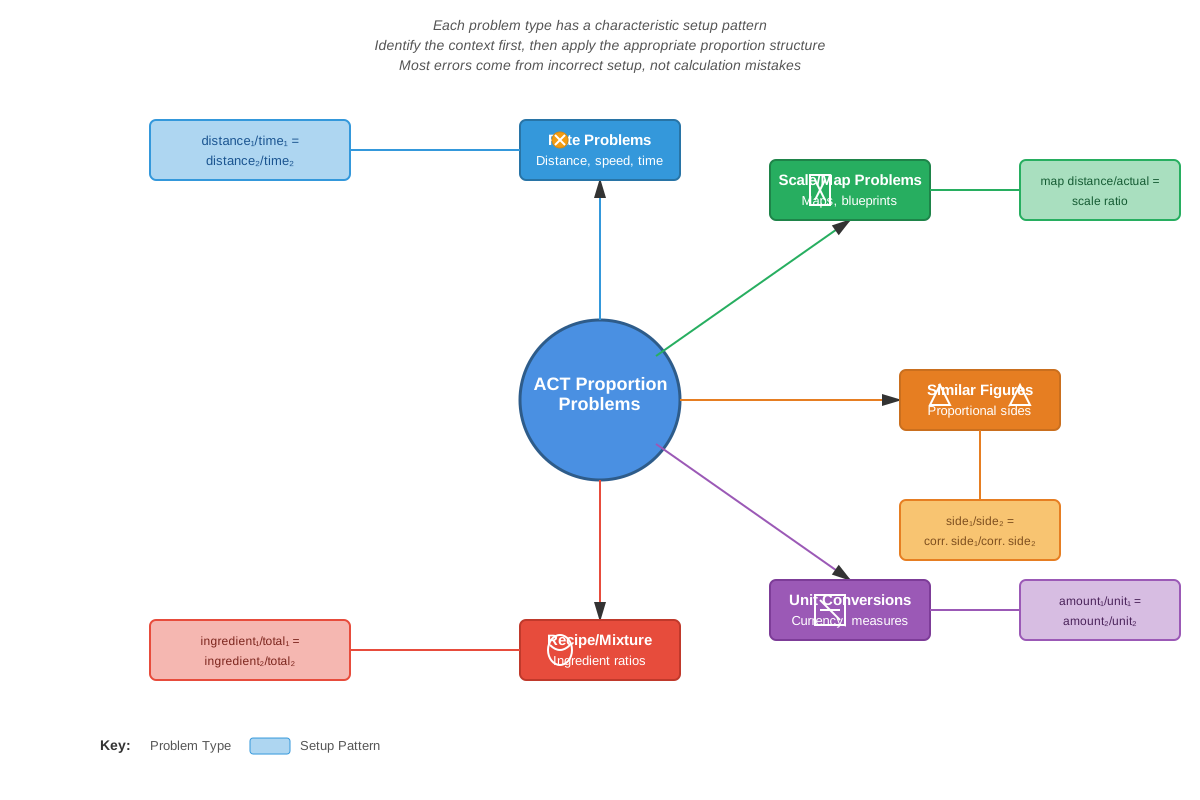
Common question formats include: rate problems (miles per hour, dollars per item, work completed per time unit), scale problems (map distances, architectural drawings, model dimensions), mixture problems (concentrations, recipe adjustments), percent problems (percent increase/decrease, part-to-whole relationships), and geometric similarity problems (corresponding sides of similar triangles, area and volume scale factors). The ACT often embeds proportions within word problems that require students to first identify the relevant quantities before setting up the equation, testing both mathematical and analytical skills simultaneously.
Core Concepts
Definition and Structure of Proportions
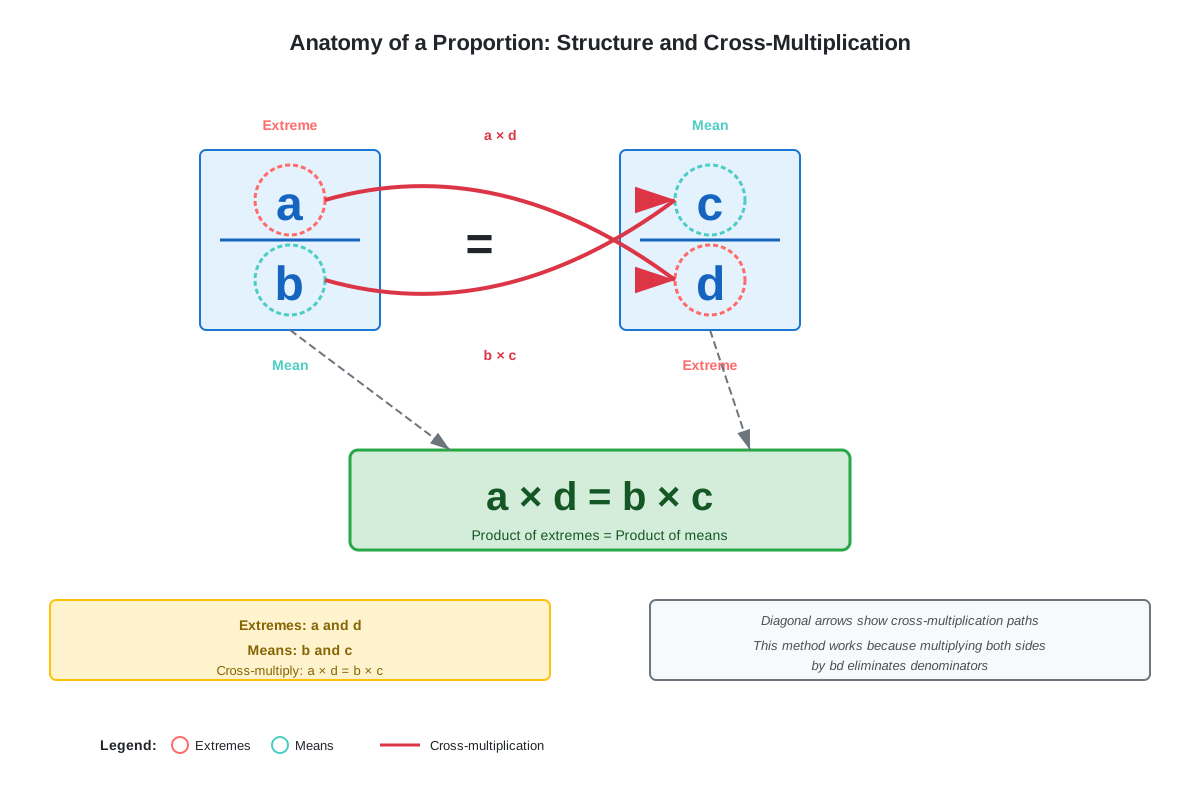
A proportion is an equation stating that two ratios are equivalent. The standard form is a/b = c/d, where a, b, c, and d represent numbers or algebraic expressions. The terms have specific names: 'a' and 'd' are called the extremes (outer terms), while 'b' and 'c' are called the means (inner terms). When a proportion is true, the product of the means equals the product of the extremes, which gives us the fundamental property: a × d = b × c. This relationship, known as cross-multiplication, provides the primary method for solving proportions.
Proportions can be written in several equivalent forms:
- Fraction form: a/b = c/d
- Colon form: a:b = c:d (read as "a is to b as c is to d")
- Verbal form: "a is to b as c is to d"
All three forms represent the same mathematical relationship, though the fraction form is most commonly used on the ACT because it facilitates algebraic manipulation.
The Cross-Multiplication Method
Cross-multiplication is the most efficient technique for solving proportions on the ACT. Given a proportion a/b = c/d, cross-multiplying yields a × d = b × c. This method works because multiplying both sides of the equation by the common denominator (b × d) eliminates the fractions. The resulting equation is typically easier to solve, especially when one of the four values is unknown.
Steps for solving proportions using cross-multiplication:
- Set up the proportion with the unknown variable in one position
- Cross-multiply: multiply the numerator of the left fraction by the denominator of the right fraction, and vice versa
- Write the resulting equation (product of extremes = product of means)
- Solve for the unknown variable using inverse operations
- Check the answer by substituting back into the original proportion
For example, to solve 3/5 = x/20:
- Cross-multiply: 3 × 20 = 5 × x
- Simplify: 60 = 5x
- Divide both sides by 5: x = 12
Setting Up Proportions from Word Problems
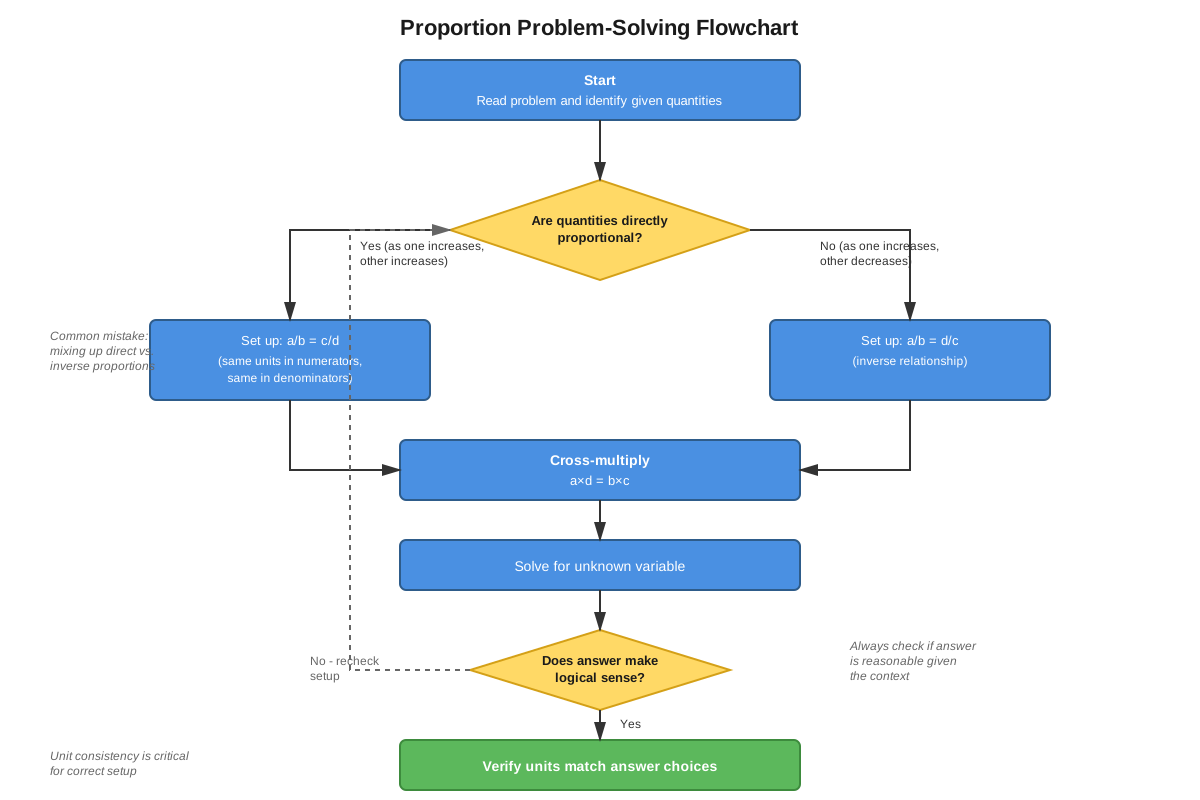
The most challenging aspect of proportion problems on the ACT is correctly translating verbal descriptions into mathematical equations. The key is identifying which quantities are being compared and ensuring consistent units and positions within the proportion.
Critical setup principle: Corresponding quantities must occupy corresponding positions in the proportion. If the left ratio compares quantity A to quantity B, the right ratio must also compare quantity A to quantity B in the same order.
For example, if a car travels 120 miles in 2 hours, how far will it travel in 5 hours?
Correct setup: miles/hours = miles/hours → 120/2 = x/5
Incorrect setup: 120/2 = 5/x (this compares miles/hours to hours/miles)
Direct Proportions vs. Inverse Proportions
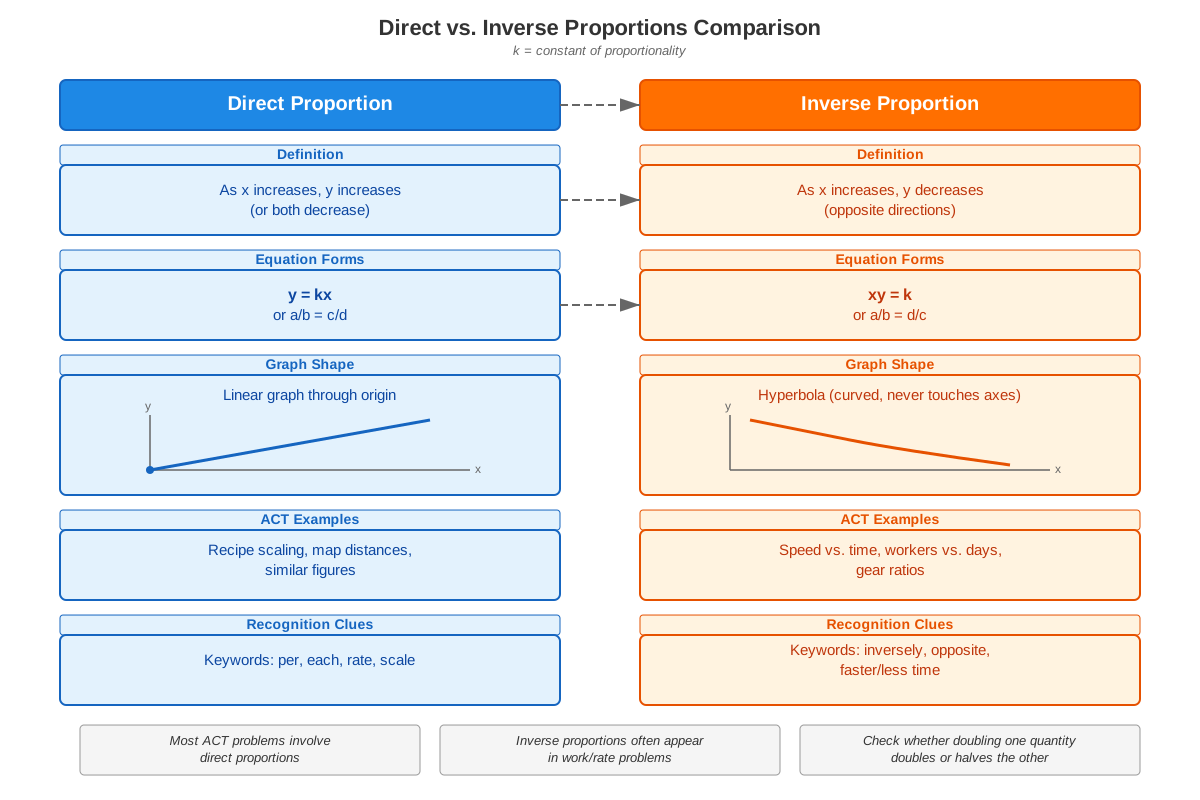
Direct proportions describe relationships where two quantities increase or decrease together at a constant rate. If one quantity doubles, the other doubles; if one is halved, the other is halved. The relationship is expressed as y = kx, where k is the constant of proportionality. Most ACT proportion problems involve direct proportions.
Examples of direct proportions:
- Distance and time (at constant speed)
- Cost and quantity (at constant unit price)
- Ingredients in a recipe (maintaining the same ratio)
Inverse proportions (also called inverse variation) describe relationships where one quantity increases as the other decreases, maintaining a constant product. The relationship is expressed as y = k/x or xy = k. These appear less frequently on the ACT but are important to recognize.
Examples of inverse proportions:
- Speed and time (for a fixed distance: faster speed means less time)
- Number of workers and time to complete a job (more workers means less time)
- Pressure and volume of a gas (at constant temperature)
| Feature | Direct Proportion | Inverse Proportion |
|---|---|---|
| Relationship | y = kx | y = k/x or xy = k |
| When x increases | y increases | y decreases |
| When x doubles | y doubles | y is halved |
| Graph shape | Straight line through origin | Hyperbola |
| ACT frequency | Very common | Occasional |
Proportions in Geometric Contexts
Proportions are fundamental to understanding similar figures—shapes that have the same form but different sizes. When two figures are similar, corresponding sides are proportional, meaning the ratios of corresponding side lengths are equal. This concept appears frequently in ACT geometry problems involving triangles, particularly with parallel lines creating similar triangles.
For similar figures with a scale factor of k:
- Linear dimensions (sides, perimeter, height) scale by factor k
- Area scales by factor k²
- Volume scales by factor k³
For example, if two similar triangles have corresponding sides in the ratio 2:3, their areas are in the ratio 4:9, and if they were three-dimensional, their volumes would be in the ratio 8:27.
Unit Rates and Proportions
A unit rate expresses a ratio as a quantity per one unit of another quantity (miles per hour, dollars per pound, words per minute). Converting between unit rates and proportions is a valuable skill on the ACT. Any unit rate can be expressed as a proportion, and solving proportion problems often involves finding or using unit rates.
For instance, if a unit rate is 60 miles per hour, this can be written as the proportion 60 miles/1 hour = x miles/t hours, which can be solved for any time t.
Concept Relationships
The concepts within proportions form a hierarchical structure. At the foundation lies the basic definition of a proportion as an equation of equal ratios. This definition leads directly to the cross-multiplication property, which serves as the primary solution method. The ability to set up proportions correctly from word problems builds upon both the definition and the cross-multiplication method, requiring students to identify corresponding quantities and maintain consistent positioning.
The distinction between direct and inverse proportions branches from the basic proportion concept, representing two different types of relationships between quantities. Direct proportions connect to linear relationships and constant rates, while inverse proportions relate to reciprocal relationships. Both types require the same fundamental solving techniques but demand different setup approaches.
Geometric applications of proportions, particularly similar figures, represent an advanced application that combines proportion concepts with spatial reasoning. These problems often require multiple steps: recognizing similarity, identifying corresponding parts, setting up proportions, and solving for unknowns.
Relationship map:
Basic Ratio Concept → Proportion Definition → Cross-Multiplication Method → Word Problem Translation → Direct/Inverse Proportion Recognition → Application to Specific Contexts (rates, scales, geometry) → Multi-step Problem Solving
Proportions connect to prerequisite topics by building directly on ratio understanding and fraction manipulation. They extend to related topics including percent problems (which are special proportions where one quantity is compared to 100), linear equations (direct proportions are linear relationships), and trigonometry (sine, cosine, and tangent are proportional relationships in right triangles). Understanding proportions also supports work with probability (ratios of favorable to total outcomes) and statistics (proportional reasoning in data interpretation).
Quick check — test yourself on Proportions so far.
Try Flashcards →High-Yield Facts
⭐ The cross-multiplication property states that if a/b = c/d, then a × d = b × c
⭐ In a correctly set up proportion, corresponding quantities must occupy corresponding positions (same units in same positions)
⭐ Direct proportions: when one quantity doubles, the other doubles; when one is halved, the other is halved
⭐ For similar figures, if the scale factor is k, linear dimensions scale by k, areas by k², and volumes by k³
⭐ Inverse proportions: the product of the two quantities remains constant (xy = k)
- A proportion can be written in multiple equivalent forms: a/b = c/d is the same as a:b = c:d
- Unit consistency is critical: all measurements in a proportion must use the same units or be converted before solving
- The constant of proportionality (k) in a direct proportion y = kx represents the unit rate
- Proportions involving rates typically use the form: amount₁/time₁ = amount₂/time₂
- When solving proportion word problems, identify what you're looking for first, then determine what information relates to it proportionally
- Scale factor problems often require recognizing that map distance/actual distance = constant for all measurements
- In mixture problems, the proportion of a component to the total remains constant when scaling up or down
- Percent problems are proportions where one ratio is expressed as a part per 100
- Similar triangles created by parallel lines cutting transversals always produce proportional segments
- Time-rate-distance problems (d = rt) can be solved using proportions when comparing two scenarios with constant rates
Common Misconceptions
Misconception: Cross-multiplication can be used on any equation involving fractions.
Correction: Cross-multiplication is specifically for equations where one fraction equals another fraction (proportions). It cannot be used when fractions are being added, subtracted, or when there are multiple terms on either side of the equation.
Misconception: In a proportion, the order of terms doesn't matter as long as all four numbers are included.
Correction: Position is critical in proportions. Corresponding quantities must occupy corresponding positions. If you write miles/hours on the left, you must write miles/hours (not hours/miles) on the right. Reversing the order creates an incorrect equation that yields wrong answers.
Misconception: All relationships between quantities are proportional.
Correction: Only relationships with a constant ratio or constant product are proportional. Many relationships are non-proportional (exponential growth, quadratic relationships, etc.). Always verify that the relationship maintains constant ratios before setting up a proportion.
Misconception: When a linear dimension of a similar figure doubles, the area also doubles.
Correction: When linear dimensions scale by a factor of k, area scales by k². If sides double (k = 2), area quadruples (k² = 4). This is one of the most commonly tested concepts involving proportions and geometry on the ACT.
Misconception: In inverse proportions, you set up the equation the same way as direct proportions.
Correction: Inverse proportions require a different setup. Instead of a₁/b₁ = a₂/b₂, inverse proportions use a₁ × b₁ = a₂ × b₂ or a₁/b₂ = a₂/b₁. Recognizing which type of relationship exists is essential before setting up the equation.
Misconception: You can cross-multiply even when variables appear in multiple places in the proportion.
Correction: Standard cross-multiplication works cleanly only when there's a single unknown in one position. If variables appear in multiple positions or in more complex expressions, you may need to use alternative algebraic methods or simplify first.
Misconception: Unit rates and proportions are completely different concepts.
Correction: Unit rates are simply proportions where one quantity is expressed per single unit of another. They're intimately connected—any unit rate can be written as a proportion, and finding a unit rate is often the first step in solving proportion problems.
Worked Examples
Example 1: Classic Proportion Word Problem
Problem: A recipe for 12 cookies requires 2 cups of flour. How many cups of flour are needed to make 30 cookies?
Solution:
Step 1: Identify what's being compared and what's unknown.
- We're comparing cookies to flour
- Unknown: cups of flour needed for 30 cookies (call this x)
Step 2: Set up the proportion with corresponding quantities in corresponding positions.
- cookies/flour = cookies/flour
- 12/2 = 30/x
Step 3: Cross-multiply.
- 12 × x = 2 × 30
- 12x = 60
Step 4: Solve for x.
- x = 60/12
- x = 5
Step 5: Check the answer.
- Does 12/2 = 30/5?
- 6 = 6 ✓
Answer: 5 cups of flour are needed.
Connection to learning objectives: This example demonstrates identifying a proportion situation (comparing two scenarios with the same ratio), setting up the equation correctly with corresponding quantities in corresponding positions, and applying cross-multiplication to solve accurately.
Example 2: Similar Triangles and Proportions
Problem: Triangle ABC is similar to triangle DEF. If AB = 6, BC = 8, AC = 10, and DE = 9, find the perimeter of triangle DEF.
Solution:
Step 1: Recognize that similar triangles have proportional corresponding sides.
- AB corresponds to DE
- BC corresponds to EF
- AC corresponds to DF
Step 2: Find the scale factor using the known corresponding sides.
- AB/DE = 6/9 = 2/3
- This means triangle ABC's sides are 2/3 the length of triangle DEF's sides
- Equivalently, triangle DEF's sides are 3/2 times triangle ABC's sides
Step 3: Set up proportions to find the unknown sides of triangle DEF.
For EF (corresponds to BC):
- BC/EF = 2/3
- 8/EF = 2/3
- 2 × EF = 8 × 3
- 2EF = 24
- EF = 12
For DF (corresponds to AC):
- AC/DF = 2/3
- 10/DF = 2/3
- 2 × DF = 10 × 3
- 2DF = 30
- DF = 15
Step 4: Calculate the perimeter of triangle DEF.
- Perimeter = DE + EF + DF
- Perimeter = 9 + 12 + 15
- Perimeter = 36
Alternative approach using scale factor directly:
- Perimeter of ABC = 6 + 8 + 10 = 24
- Scale factor from ABC to DEF = 3/2
- Perimeter of DEF = 24 × (3/2) = 36
Answer: The perimeter of triangle DEF is 36.
Connection to learning objectives: This example shows how to identify proportional relationships in geometric contexts, apply the concept that similar figures have proportional corresponding parts, and use proportions to solve multi-step problems. It also demonstrates that linear dimensions (including perimeter) scale by the same factor as individual sides.
Exam Strategy
When approaching ACT proportion questions, begin by carefully reading the problem to identify the quantities being compared. Look for trigger phrases that signal proportional relationships: "at this rate," "at the same rate," "per," "for every," "ratio of," "similar figures," "scale," and "proportional to." These phrases indicate that a proportion setup is likely the most efficient solution method.
Question identification strategy: Ask yourself three questions: (1) Are two scenarios being compared? (2) Does the relationship between quantities remain constant? (3) Is there an unknown value that corresponds to a known ratio? If you answer yes to all three, you're dealing with a proportion problem.
Setup strategy: Before writing any equations, clearly identify:
- What quantity you're solving for
- What quantities are being compared
- What units are involved
- Which values correspond to each other
Write these out briefly if needed—investing 10-15 seconds in clear setup prevents costly errors and saves time overall.
Solving strategy: After setting up the proportion, cross-multiply immediately. The ACT rarely requires alternative solution methods for basic proportions. After cross-multiplying, solve the resulting equation using standard algebraic techniques. Always check that your answer makes logical sense—if you're scaling up, the answer should be larger; if scaling down, smaller.
Process of elimination tips:
- Eliminate answers that have incorrect units
- Eliminate answers that don't maintain the directional relationship (if the problem involves increasing one quantity, the answer should reflect an increase in the proportional quantity)
- For similar figure problems, eliminate answers that don't respect the scale factor relationship
- Use estimation: if the proportion is approximately 1:2, the answer should be approximately double (or half) the given value
Time management: Standard proportion problems should take 30-45 seconds once you've identified them as such. If you're spending more than a minute, you may be overcomplicating the setup. Consider whether you've correctly identified corresponding quantities or whether you need to find a unit rate first. Multi-step problems involving proportions and other concepts (like geometry or percentages) may reasonably take 60-90 seconds.
Common trap answers: The ACT often includes distractor answers that result from:
- Setting up the proportion backwards (inverting one ratio)
- Forgetting to complete all steps (stopping after finding an intermediate value)
- Confusing direct and inverse proportions
- Applying linear scale factors to area or volume problems
Always verify that your answer addresses what the question actually asks for, not just an intermediate calculation.
Memory Techniques
Cross-Multiplication Mnemonic: "Cross the Means, Cross the Extremes" or visualize an "X" connecting the terms that multiply together: the top-left with bottom-right, and top-right with bottom-left.
Setup Mnemonic: "Corresponding Quantities in Corresponding Positions" (CQCP). Before solving any proportion, mentally check CQCP to ensure correct setup.
Direct vs. Inverse Proportion Memory Aid:
- Direct: "Direct means Ditto"—both quantities move in the same direction (both up or both down)
- Inverse: "Inverse means In opposition"—quantities move in opposite directions (one up, one down)
Similar Figures Scale Factor Mnemonic: "Linear, Area, Volume = k, k², k³" or "LAV = 1, 2, 3" (the exponents increase by one for each dimension added). Visualize: a line is 1D (k¹), a flat shape is 2D (k²), a solid is 3D (k³).
Proportion Setup Visualization: Picture a proportion as a balanced scale. The left side (a/b) must balance the right side (c/d). If you change the position of any term, you unbalance the scale. This mental image reinforces the importance of maintaining corresponding positions.
Word Problem Strategy Acronym: SETUP
- Scan for trigger words indicating proportions
- Extract the relevant quantities and their relationships
- Translate into mathematical form with correct positioning
- Use cross-multiplication to solve
- Prove your answer makes sense by checking units and magnitude
Summary
Proportions represent equations stating that two ratios are equal, typically written as a/b = c/d. This fundamental concept appears throughout the ACT Math section in various contexts including rate problems, scale drawings, similar figures, and unit conversions. The primary solution method involves cross-multiplication, which transforms the proportion into a simpler algebraic equation by multiplying the extremes and means. Success with proportion problems requires three key skills: recognizing when a situation involves proportional relationships, setting up equations with corresponding quantities in corresponding positions, and solving accurately using cross-multiplication. Direct proportions describe relationships where quantities increase or decrease together, while inverse proportions describe relationships where one quantity increases as the other decreases. In geometric contexts, similar figures have proportional corresponding sides, with linear dimensions scaling by factor k, areas by k², and volumes by k³. Mastering proportions provides a powerful tool for solving approximately 10-15% of ACT Math questions efficiently and accurately.
Key Takeaways
- Proportions are equations of equal ratios (a/b = c/d) solved primarily through cross-multiplication (a × d = b × c)
- Corresponding quantities must occupy corresponding positions in a correctly set up proportion—this is the most common source of errors
- Direct proportions mean both quantities change in the same direction; inverse proportions mean they change in opposite directions
- Similar figures have proportional sides, with scale factors affecting linear dimensions by k, areas by k², and volumes by k³
- Identify proportion problems by looking for trigger phrases like "at this rate," "per," "scale," and comparisons between two scenarios with constant relationships
- Always verify your answer makes logical sense in terms of direction (increasing vs. decreasing) and magnitude relative to the given values
- Unit consistency is essential—convert all measurements to the same units before setting up proportions
Related Topics
Percentages: Percentages are special proportions where one ratio is expressed as parts per 100. Mastering proportions provides the foundation for solving percent increase/decrease, percent of a number, and percent comparison problems that appear frequently on the ACT.
Linear Equations and Functions: Direct proportions (y = kx) are linear relationships passing through the origin. Understanding proportions helps students recognize and work with linear functions, slope, and rate of change.
Trigonometric Ratios: Sine, cosine, and tangent are proportional relationships between sides of right triangles. Proportion mastery enables students to set up and solve trigonometry problems more effectively.
Similar Figures and Geometric Transformations: Dilations create similar figures with proportional dimensions. This topic extends proportion concepts into coordinate geometry and transformation problems.
Rates and Unit Conversions: Converting between units (miles to kilometers, hours to minutes) relies on proportional reasoning. This skill appears in science reasoning passages and complex word problems.
Practice CTA
Now that you've mastered the core concepts of proportions, it's time to solidify your understanding through practice. Work through the practice questions to apply these strategies to ACT-style problems, and use the flashcards to reinforce key facts and formulas. Remember, proportion problems appear on virtually every ACT Math section—your investment in mastering this topic will pay dividends on test day. Focus especially on setting up proportions correctly from word problems, as this skill translates directly to points on the exam. You've got this!
Sign up free to keep reading
Create a free AnvayaPrep account to finish this ACT guide on Proportions — plus flashcards and practice questions.