Overview
Unit rates represent one of the most fundamental and frequently tested concepts on the ACT Math section. A unit rate expresses a ratio or comparison between two different quantities where the denominator is reduced to exactly one unit. For example, miles per hour, dollars per pound, or words per minute all represent unit rates. Understanding unit rates is essential because they appear not only as direct calculation problems but also embedded within word problems, proportion questions, and real-world application scenarios that the ACT favors.
The ACT consistently includes 2-4 questions per test that directly or indirectly assess unit rate comprehension. These questions often appear in the first 30 questions of the 60-question Math section, though more complex applications can appear later. The test writers favor unit rates because they assess both computational fluency and the ability to interpret quantitative relationships—skills that predict college readiness. Questions may ask students to calculate unit rates from given information, compare different rates to determine the best value, or use unit rates to solve multi-step problems involving distance, cost, or productivity.
Mastery of unit rates connects directly to broader mathematical concepts including ratios, proportions, linear functions, and dimensional analysis. Unit rates serve as the foundation for understanding slope in coordinate geometry (rise over run), speed and velocity in physics-based problems, and unit pricing in consumer mathematics. Students who develop strong unit rate skills find that these abilities transfer seamlessly to more advanced topics like rate of change in functions and optimization problems that appear in the higher-difficulty ACT questions.
Learning Objectives
- [ ] Identify when Unit rates is being tested in ACT Math questions
- [ ] Explain the core rule or strategy behind Unit rates calculations
- [ ] Apply Unit rates to ACT-style questions accurately and efficiently
- [ ] Convert between different unit rates within the same context (e.g., miles per hour to feet per second)
- [ ] Compare multiple unit rates to determine optimal choices or best values
- [ ] Solve multi-step word problems that require calculating and applying unit rates
- [ ] Recognize when to use unit rates versus other problem-solving strategies
Prerequisites
- Basic fraction operations: Unit rates require dividing one quantity by another and simplifying the resulting fraction
- Understanding of ratios: Unit rates are specialized ratios where the second term equals one
- Unit conversion knowledge: Converting between units (feet to miles, minutes to hours) is essential for complex unit rate problems
- Basic algebraic manipulation: Setting up and solving equations involving unit rates requires algebraic thinking
- Word problem interpretation: Extracting relevant numerical information from text descriptions is crucial for application problems
Why This Topic Matters
Unit rates appear in countless real-world contexts that students encounter daily. Comparing grocery prices to find the best deal, calculating fuel efficiency for a road trip, determining typing speed for job applications, or figuring out how long a project will take based on work rate—all these scenarios require unit rate thinking. This practical applicability makes unit rates one of the most useful mathematical concepts students will learn, extending far beyond the ACT into college coursework and professional life.
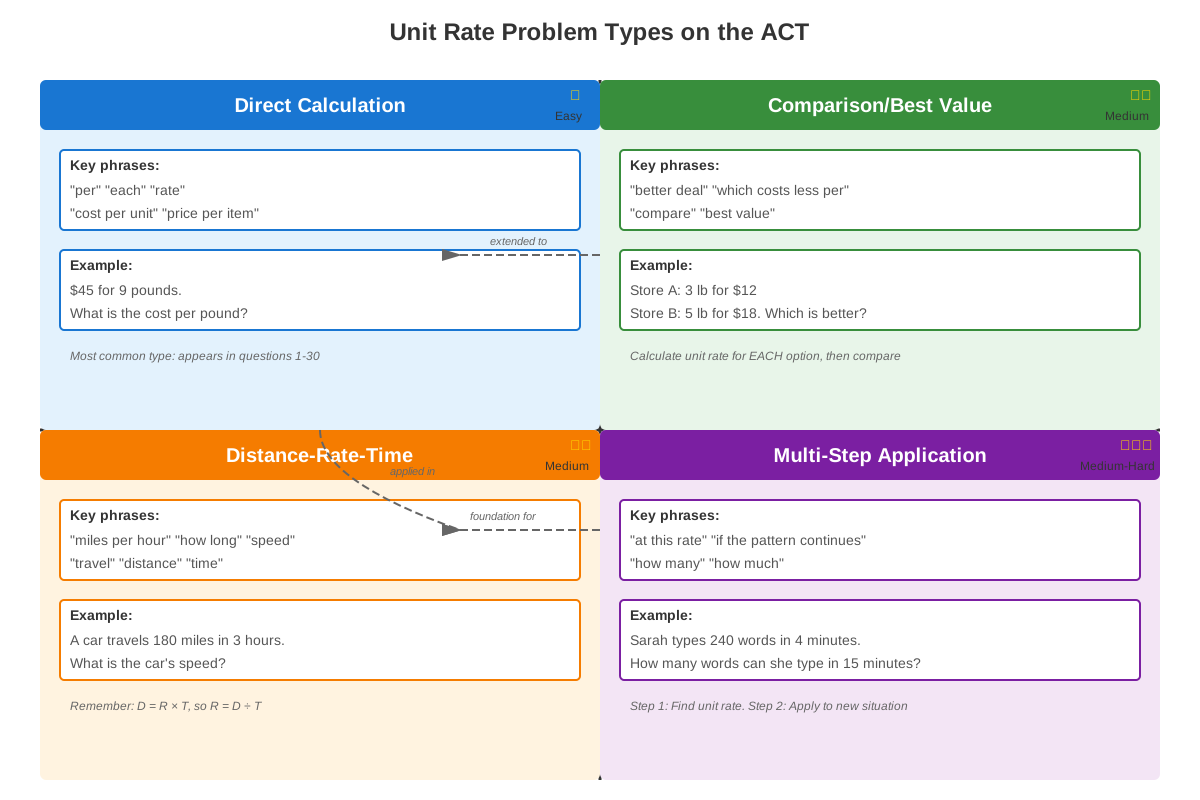
On the ACT Math section, unit rates appear with remarkable consistency. Approximately 3-7% of all Math questions directly test unit rate concepts, translating to 2-4 questions per exam. These questions typically appear in several formats: straightforward calculation problems (often in the first 20 questions), word problems involving distance-rate-time relationships, comparison problems requiring students to evaluate which option provides better value, and multi-step problems where unit rate calculation is one component of a larger solution. The ACT particularly favors scenarios involving speed (miles per hour), unit pricing (cost per item), and work rates (tasks per hour).
Common ACT question contexts include: comparing prices at different stores with different package sizes, calculating travel time given speed and distance, determining how long a job will take with multiple workers at different rates, finding average speed over a trip with varying speeds, and converting between different rate units. The test writers deliberately embed unit rates within realistic scenarios to assess whether students can apply mathematical reasoning to practical situations—a key component of the ACT's college-readiness focus.
Core Concepts
Definition and Structure of Unit Rates
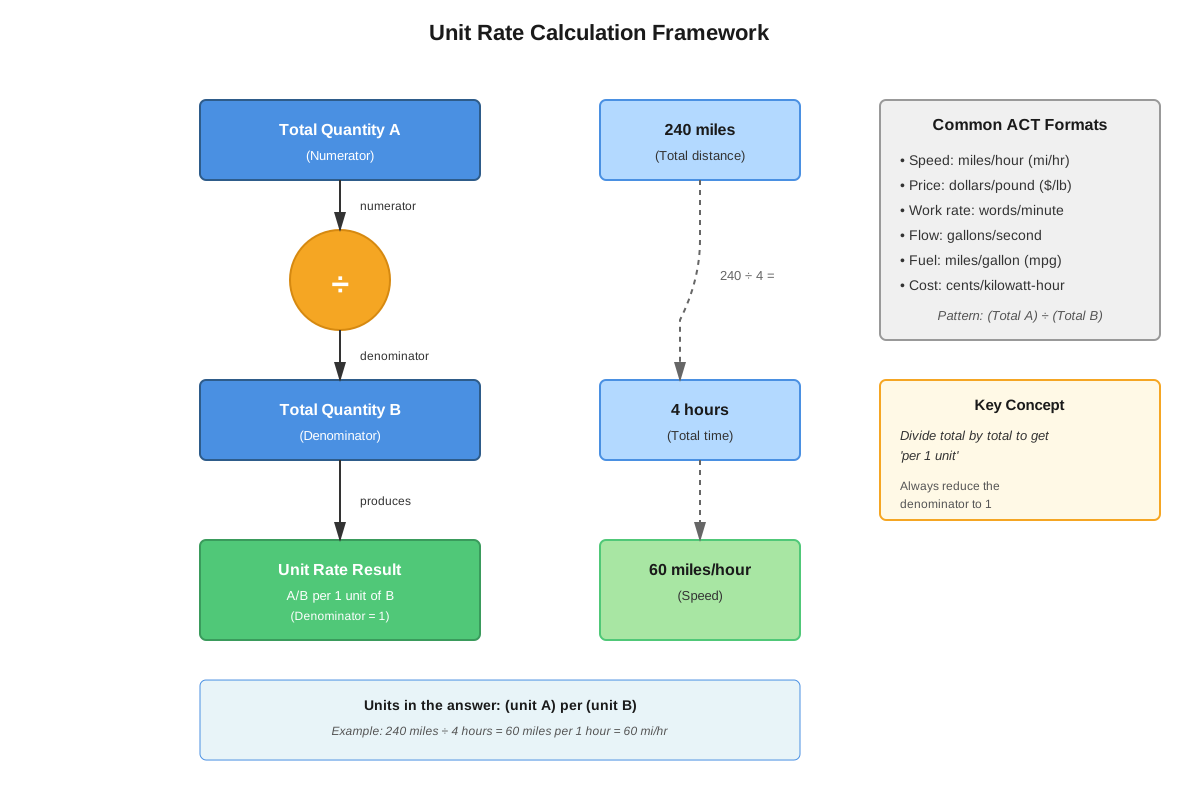
A unit rate is a ratio that compares two different quantities where the second quantity (the denominator) is exactly one unit. The general form is:
Unit Rate = Quantity A / Quantity B = (Amount of A) / (1 unit of B)For example, if a car travels 240 miles in 4 hours, the unit rate (speed) is 240 ÷ 4 = 60 miles per 1 hour, or simply 60 miles per hour. The key characteristic that distinguishes unit rates from general ratios is that the denominator must equal one. This standardization allows for easy comparison between different scenarios.
ACT unit rates questions typically involve three main categories: speed/velocity (distance per time), unit pricing (cost per item), and work rates (tasks per time). Each category follows the same fundamental principle of dividing one quantity by another to find the amount per single unit.
Calculating Basic Unit Rates
The calculation process for unit rates follows a consistent three-step approach:
- Identify the two quantities being compared and determine which should be in the numerator (the quantity you're measuring) and denominator (the unit you're measuring per)
- Divide the numerator quantity by the denominator quantity using standard division
- Express the result with appropriate units in the form "X per Y" or "X/Y"
Consider this example: A 12-ounce bottle of juice costs $2.88. To find the unit rate (price per ounce):
- Numerator: $2.88 (total cost)
- Denominator: 12 ounces (total quantity)
- Calculation: $2.88 ÷ 12 = $0.24
- Unit rate: $0.24 per ounce
Comparing Unit Rates
The ACT frequently tests whether students can calculate multiple unit rates and determine which represents the better value or faster speed. The comparison process requires:
- Calculate the unit rate for each option
- Ensure all unit rates use the same units (convert if necessary)
- Compare the numerical values, considering whether higher or lower is better for the context
| Context | Better Value | Reasoning |
|---|---|---|
| Price per unit | Lower number | Less cost per item means better deal |
| Speed (distance/time) | Higher number | More distance covered per time unit means faster |
| Work rate (tasks/time) | Higher number | More tasks completed per time unit means more efficient |
| Time per task | Lower number | Less time needed per task means more efficient |
For example, comparing Store A selling 3 pounds for $5.97 versus Store B selling 5 pounds for $9.45:
- Store A: $5.97 ÷ 3 = $1.99 per pound
- Store B: $9.45 ÷ 5 = $1.89 per pound
- Store B offers the better unit price
Distance-Rate-Time Relationships
One of the most common ACT applications of unit rates involves the fundamental relationship:
Distance = Rate × TimeThis formula can be rearranged to solve for any variable:
- Rate = Distance ÷ Time (this gives the unit rate of speed)
- Time = Distance ÷ Rate
When working with these problems, maintaining consistent units is critical. If distance is in miles and time is in hours, the rate will be in miles per hour. If the problem provides mixed units (such as minutes instead of hours), conversion is necessary before calculation.
Example: A cyclist travels 45 miles in 3 hours. The unit rate (speed) is 45 ÷ 3 = 15 miles per hour. If asked how far the cyclist travels in 5 hours at the same rate: Distance = 15 × 5 = 75 miles.
Unit Conversion with Rates
Advanced ACT questions often require converting unit rates from one measurement system to another. The conversion process involves multiplying by appropriate conversion factors:
New Rate = Original Rate × (Conversion Factor)Common conversions include:
- Miles per hour to feet per second: multiply by 5280 (feet per mile) and divide by 3600 (seconds per hour), or multiply by 1.467
- Dollars per pound to cents per ounce: multiply by 100 (cents per dollar) and divide by 16 (ounces per pound)
- Kilometers per hour to meters per second: multiply by 1000 (meters per kilometer) and divide by 3600 (seconds per hour)
Example: Convert 60 miles per hour to feet per second:
- 60 miles/hour × (5280 feet/1 mile) × (1 hour/3600 seconds)
- = 60 × 5280 ÷ 3600 = 88 feet per second
Work Rate Problems
Work rate problems involve calculating how quickly tasks are completed. The basic principle states:
Work Rate = Tasks Completed / Time TakenWhen multiple workers or machines work together, their individual rates add:
Combined Rate = Rate₁ + Rate₂ + Rate₃ + ...Example: If Worker A completes a job in 6 hours (rate = 1/6 job per hour) and Worker B completes the same job in 4 hours (rate = 1/4 job per hour), their combined rate is 1/6 + 1/4 = 2/12 + 3/12 = 5/12 job per hour. Working together, they complete the job in 12/5 = 2.4 hours.
Concept Relationships
Unit rates serve as a bridge between several fundamental mathematical concepts. At the most basic level, ratios provide the foundation for unit rates—a unit rate is simply a ratio where the second term has been standardized to one. This standardization process requires division, making computational fluency essential.
The relationship flows as follows: Ratios → (standardize denominator to 1) → Unit Rates → (multiply by quantity) → Proportional Relationships. Once a unit rate is established, it can be used to solve proportion problems by multiplying the rate by the desired quantity.
Unit rates connect directly to linear functions in algebra. The unit rate represents the slope (rate of change) of a linear relationship. For example, if a unit rate is $3 per item, the total cost function is C = 3n, where 3 is both the unit rate and the slope of the cost function.
In geometry and physics contexts, unit rates appear as speed (distance per time) and density (mass per volume). These applications demonstrate how unit rates quantify relationships between different types of measurements.
The concept also extends to dimensional analysis, where unit rates help convert between measurement systems. By treating units as algebraic quantities that can cancel, students can use unit rates as conversion factors to transform measurements while maintaining mathematical validity.
Quick check — test yourself on Unit rates so far.
Try Flashcards →High-Yield Facts
⭐ A unit rate always has a denominator of 1, expressed as "X per 1 unit" or simply "X per unit"
⭐ To find a unit rate, divide the first quantity by the second quantity: Total Amount ÷ Total Units = Amount per Unit
⭐ When comparing prices, the lower unit rate represents the better value; when comparing speeds or work rates, the higher unit rate is typically better
⭐ The distance-rate-time formula (D = R × T) is the most common ACT application of unit rates, where rate is the unit rate of speed
⭐ Unit rates must use consistent units—always convert to matching units before calculating or comparing
- Unit rates can be expressed with "per," a slash (/), or as a fraction (e.g., "60 miles per hour," "60 miles/hour," or "60 mph")
- When multiple workers or machines operate simultaneously, their individual work rates add together to find the combined rate
- Converting between unit rates requires multiplying by appropriate conversion factors while ensuring units cancel correctly
- The reciprocal of a work rate (1/rate) gives the time required to complete one unit of work
- Average speed for a trip is NOT the average of the speeds but rather total distance divided by total time
- Unit rates appear in approximately 3-7% of ACT Math questions, making them a high-yield topic for focused study
- Real-world ACT problems often hide unit rate calculations within longer word problems about shopping, travel, or productivity
Common Misconceptions
Misconception: Average speed equals the average of two speeds → Correction: Average speed equals total distance divided by total time. If you drive 60 mph for one hour and 40 mph for one hour, the average speed is (60+40)/2 = 50 mph only because the times are equal. If the times differ, you must use total distance ÷ total time.
Misconception: The larger package always offers better value → Correction: Package size doesn't determine value; unit price does. A 20-ounce package for $4.00 ($0.20/oz) is a better value than a 32-ounce package for $7.68 ($0.24/oz), despite the second package being larger.
Misconception: Unit rates can only be calculated when given exactly one unit → Correction: Unit rates can be calculated from any ratio by dividing both terms by the denominator. Given "6 apples for $3," divide both by 3 to get "2 apples for $1" or divide both by 6 to get "$0.50 for 1 apple."
Misconception: When converting unit rates, only the numerator needs conversion → Correction: Both numerator and denominator may require conversion. Converting 30 miles per hour to feet per minute requires converting miles to feet (multiply by 5280) AND hours to minutes (divide by 60).
Misconception: Combined work rates should be averaged → Correction: Work rates add, they don't average. If one worker completes 1/4 of a job per hour and another completes 1/6 per hour, together they complete 1/4 + 1/6 = 5/12 of the job per hour, not (1/4 + 1/6)/2.
Misconception: Unit rates always have smaller numbers than the original ratio → Correction: Unit rates can be larger than the original numbers. If 0.5 pounds costs $3, the unit rate is $3 ÷ 0.5 = $6 per pound, which is larger than the original $3.
Worked Examples
Example 1: Multi-Step Unit Rate Comparison
Problem: Store A sells a 24-pack of water bottles for $5.76. Store B sells a 36-pack for $9.00. Store C sells individual bottles for $0.28 each. Which store offers the best unit price, and how much would you save per bottle compared to the worst option if buying 72 bottles?
Solution:
Step 1: Calculate unit rate for each store
- Store A: $5.76 ÷ 24 bottles = $0.24 per bottle
- Store B: $9.00 ÷ 36 bottles = $0.25 per bottle
- Store C: $0.28 per bottle (already a unit rate)
Step 2: Identify best and worst options
- Best: Store A at $0.24 per bottle
- Worst: Store C at $0.28 per bottle
Step 3: Calculate savings per bottle
- Difference: $0.28 - $0.24 = $0.04 per bottle
Step 4: Calculate total savings for 72 bottles
- Total savings: $0.04 × 72 = $2.88
Answer: Store A offers the best unit price at $0.24 per bottle. Buying 72 bottles from Store A instead of Store C saves $2.88.
Connection to Learning Objectives: This problem requires identifying unit rate testing (comparing prices), applying the core strategy (dividing total cost by quantity), and accurately solving an ACT-style multi-step problem.
Example 2: Distance-Rate-Time with Unit Conversion
Problem: A train travels 180 miles in 2.5 hours during the first part of its journey, then travels 240 miles in 3 hours during the second part. What is the train's average speed for the entire journey in miles per hour? If the train needs to maintain an average speed of at least 65 mph for the complete 500-mile route, how much time does it have for the remaining 80 miles?
Solution:
Step 1: Calculate total distance and total time for completed journey
- Total distance so far: 180 + 240 = 420 miles
- Total time so far: 2.5 + 3 = 5.5 hours
Step 2: Calculate average speed for completed portion
- Average speed = 420 ÷ 5.5 = 76.36 mph (approximately)
Step 3: Calculate maximum time allowed for entire 500-mile journey
- Using D = R × T, rearrange to T = D ÷ R
- Total time allowed: 500 ÷ 65 = 7.69 hours (approximately)
Step 4: Calculate remaining time for last 80 miles
- Time already used: 5.5 hours
- Time remaining: 7.69 - 5.5 = 2.19 hours (approximately 2 hours 11 minutes)
Step 5: Verify this allows completion
- Required speed for last segment: 80 ÷ 2.19 = 36.5 mph
- This is achievable, so the train has approximately 2.19 hours
Answer: The train's average speed for the first 420 miles is approximately 76.36 mph. To maintain a 65 mph average for the complete route, the train has approximately 2.19 hours (2 hours 11 minutes) for the remaining 80 miles.
Connection to Learning Objectives: This problem demonstrates identifying unit rate testing in a distance-rate-time context, applying the D = R × T formula (core strategy), and solving a complex multi-step ACT-style problem requiring multiple unit rate calculations.
Exam Strategy
When approaching ACT questions involving unit rates, begin by identifying the trigger words that signal unit rate problems: "per," "each," "average speed," "unit price," "rate," "how much for one," "how many per," and "best value." These phrases indicate that the problem requires calculating or comparing standardized rates.
Exam Tip: Always write down the unit rate formula structure before calculating. Writing "Total ÷ Units = Rate per Unit" helps prevent the common error of dividing in the wrong direction.
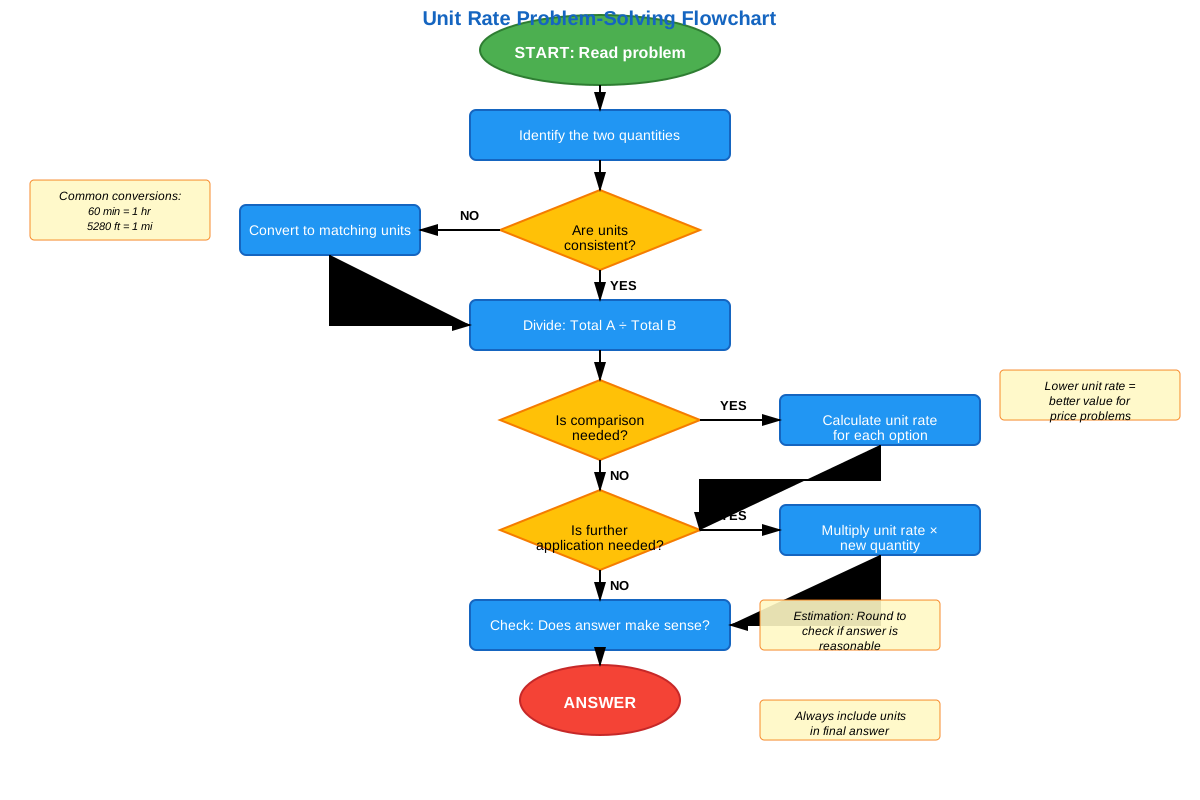
Follow this systematic approach for unit rate questions:
- Identify what's being compared: Determine the two quantities and which should be per unit
- Extract the numbers: Circle or underline the relevant numerical information in the problem
- Check units: Ensure all measurements use compatible units; convert if necessary
- Calculate carefully: Perform division, watching for decimal placement
- Label your answer: Include appropriate units (mph, $/lb, etc.)
- Verify reasonableness: Does your answer make logical sense in context?
For comparison problems, calculate all unit rates before making any decisions. The ACT often includes answer choices that represent incorrect comparisons or calculations performed in the wrong order. Having all unit rates calculated allows you to confidently eliminate wrong answers.
Time management: Basic unit rate problems should take 30-45 seconds. Multi-step problems involving unit rates may require 60-90 seconds. If a problem requires more than two minutes, mark it and return later—you may be overcomplicating the solution.
Process of elimination tips specific to unit rates:
- Eliminate answers with incorrect units
- Eliminate answers that are unreasonably large or small (e.g., a car traveling 300 mph or $50 per apple)
- When comparing prices, eliminate the highest values if looking for "best deal"
- For speed problems, eliminate answers that would make travel time impossibly short or long
Watch for distractor answers that represent:
- The reciprocal of the correct unit rate (time per unit instead of units per time)
- The total amount instead of the per-unit amount
- The result of adding or averaging instead of dividing
- The result of incorrect unit conversion
Memory Techniques
Mnemonic for Unit Rate Calculation: "TUG" - Total divided by Units Gives rate per unit
Visualization Strategy: Picture a unit rate as a single container or single time period. If calculating price per pound, visualize one pound on a scale with a price tag. If calculating miles per hour, visualize a one-hour clock with the distance traveled marked.
Acronym for Distance-Rate-Time: "DRT" (sounds like "dirt") - Distance = Rate × Time. Remember: "Don't Race Through" problems—take time to identify which variable you're solving for.
Comparison Memory Aid: "LHBV" - Lower Higher Better Value
- Lower unit price = better value
- Higher speed/work rate = better performance
Unit Conversion Reminder: "CUPS" - Check Units, Plan conversion, Solve systematically. Always verify that units cancel appropriately when multiplying by conversion factors.
For Work Rate Problems: Remember "Rates ADD, Times DON'T". When workers collaborate, add their individual rates. Don't add the times it takes each worker individually—that's a common trap.
Summary
Unit rates represent standardized comparisons between two quantities where the denominator equals exactly one unit, expressed as "amount per unit." This fundamental concept appears consistently on the ACT Math section in various contexts including speed calculations, unit pricing comparisons, and work rate problems. The core strategy involves dividing the total quantity by the number of units to find the amount per single unit, then using this standardized rate for comparisons or further calculations. Success with unit rates requires careful attention to units, ensuring consistency before performing calculations or comparisons. The distance-rate-time relationship (D = R × T) represents the most frequent ACT application, where rate serves as the unit rate of speed. When comparing options, lower unit prices indicate better value while higher speeds or work rates indicate better performance. Multi-step problems often embed unit rate calculations within larger scenarios, requiring students to extract relevant information, calculate appropriate rates, and apply them to answer the question. Mastery of unit rates provides essential foundation for proportional reasoning, linear functions, and real-world problem-solving that extends throughout the ACT Math section and beyond.
Key Takeaways
- Unit rates standardize comparisons by expressing relationships as "amount per one unit," calculated by dividing total quantity by number of units
- The formula D = R × T (distance = rate × time) is the highest-yield unit rate application on the ACT, appearing in 2-3 questions per test
- Always verify unit consistency before calculating—convert all measurements to matching units first
- When comparing prices, lower unit rates indicate better value; when comparing speeds or work rates, higher values indicate better performance
- Work rates add when combining workers or machines: Combined Rate = Rate₁ + Rate₂
- Average speed equals total distance divided by total time, NOT the average of individual speeds
- Watch for trigger words like "per," "each," "average speed," and "unit price" that signal unit rate problems
Related Topics
Ratios and Proportions: Unit rates serve as the foundation for solving proportion problems. Once a unit rate is established, it can be scaled up or down to solve for unknown quantities in proportional relationships. Mastering unit rates makes proportion problems significantly easier.
Linear Functions and Slope: The unit rate in a real-world context corresponds to the slope of a linear function. Understanding this connection helps students transition from arithmetic unit rate problems to algebraic representations and graphical interpretations.
Percent Problems: Many percent problems can be solved using unit rate thinking, particularly those involving percent increase/decrease or finding what percent one number is of another. The conceptual overlap strengthens problem-solving flexibility.
Dimensional Analysis: Advanced unit rate work leads naturally to dimensional analysis, where unit rates serve as conversion factors. This skill becomes essential in science courses and more complex ACT problems involving multiple unit conversions.
Systems of Equations: Work rate problems with multiple workers sometimes require setting up systems of equations, particularly when individual rates aren't directly given. Strong unit rate foundations make these advanced problems more accessible.
Practice CTA
Now that you've mastered the core concepts of unit rates, it's time to cement your understanding through practice! The practice questions and flashcards have been specifically designed to mirror actual ACT Math problems, giving you the opportunity to apply these strategies under test-like conditions. Focus on identifying trigger words, setting up calculations correctly, and working efficiently. Remember: unit rates appear on every ACT Math section, making this practice time a high-yield investment in your score. Each problem you solve strengthens your pattern recognition and builds the confidence you need to tackle these questions quickly and accurately on test day. You've got this—let's put your knowledge into action!
Sign up free to keep reading
Create a free AnvayaPrep account to finish this ACT guide on Unit rates — plus flashcards and practice questions.