Overview
Remainders represent one of the most frequently tested arithmetic concepts on the ACT Math section, appearing in approximately 2-4 questions per exam. Understanding remainders goes beyond simple division—it requires recognizing patterns, applying modular arithmetic principles, and connecting division concepts to real-world cyclical phenomena. The ACT tests remainders through direct calculation problems, pattern recognition questions, and word problems involving scheduling, grouping, or distribution scenarios.
Mastery of remainder concepts provides a foundation for more advanced mathematical thinking, including modular arithmetic, number theory, and algebraic problem-solving. ACT remainders questions often combine multiple mathematical skills: students must recognize when a remainder problem is being presented (sometimes disguised in word problems), select the appropriate strategy, and execute calculations accurately under time pressure. The topic connects directly to divisibility rules, factors and multiples, and integer properties—all high-yield areas for the ACT.
The strategic importance of remainders extends beyond isolated calculation questions. Many ACT problems embed remainder concepts within larger algebraic expressions, geometric sequences, or data interpretation scenarios. Students who develop fluency with remainder operations gain significant advantages in speed and accuracy across multiple question types, making this a high-return investment of study time.
Learning Objectives
- [ ] Identify when Remainders is being tested in ACT questions, including word problems and abstract scenarios
- [ ] Explain the core rule or strategy behind Remainders, including the division algorithm and modular arithmetic principles
- [ ] Apply Remainders to ACT-style questions accurately, demonstrating proper calculation techniques
- [ ] Recognize and solve cyclical pattern problems using remainder concepts
- [ ] Determine remainders for large numbers using properties of modular arithmetic
- [ ] Convert between remainder notation and standard division expressions
- [ ] Apply remainder concepts to real-world scheduling and distribution problems
Prerequisites
- Basic division operations: Understanding how to divide integers is fundamental to calculating remainders
- Multiplication and subtraction fluency: These operations are required to verify remainder calculations and apply the division algorithm
- Integer properties: Recognizing positive and negative integers helps determine when remainder concepts apply
- Factors and multiples: Understanding divisibility connects directly to when remainders equal zero
- Order of operations: Complex remainder problems often require proper sequencing of arithmetic operations
Why This Topic Matters
Remainder problems appear consistently on every ACT Math section, typically accounting for 3-7% of all math questions. These questions span difficulty levels from straightforward division problems (difficulty 1-2) to complex pattern recognition and modular arithmetic applications (difficulty 4-5). The ACT favors remainder questions because they efficiently test multiple skills: arithmetic fluency, pattern recognition, logical reasoning, and problem-solving strategy selection.
In real-world applications, remainders govern countless practical scenarios: determining what day of the week a future date falls on, calculating work schedules that repeat in cycles, distributing items into equal groups, and understanding digital clock arithmetic. Computer science relies heavily on modular arithmetic (remainder-based calculations) for encryption, hashing algorithms, and circular data structures. Engineers use remainder concepts in gear ratios, wave interference patterns, and periodic phenomena.
On the ACT, remainder questions commonly appear as:
- Direct calculation problems: "What is the remainder when 157 is divided by 13?"
- Pattern recognition: "A sequence repeats every 7 terms. What is the 100th term?"
- Word problems: "If 47 students are divided into groups of 6, how many students are in the incomplete group?"
- Algebraic expressions: "For what values of x does (x² + 5) leave a remainder of 2 when divided by 3?"
- Time and scheduling: "If an event occurs every 8 hours starting at 2 PM Monday, what time will it occur on Thursday?"
Core Concepts
The Division Algorithm
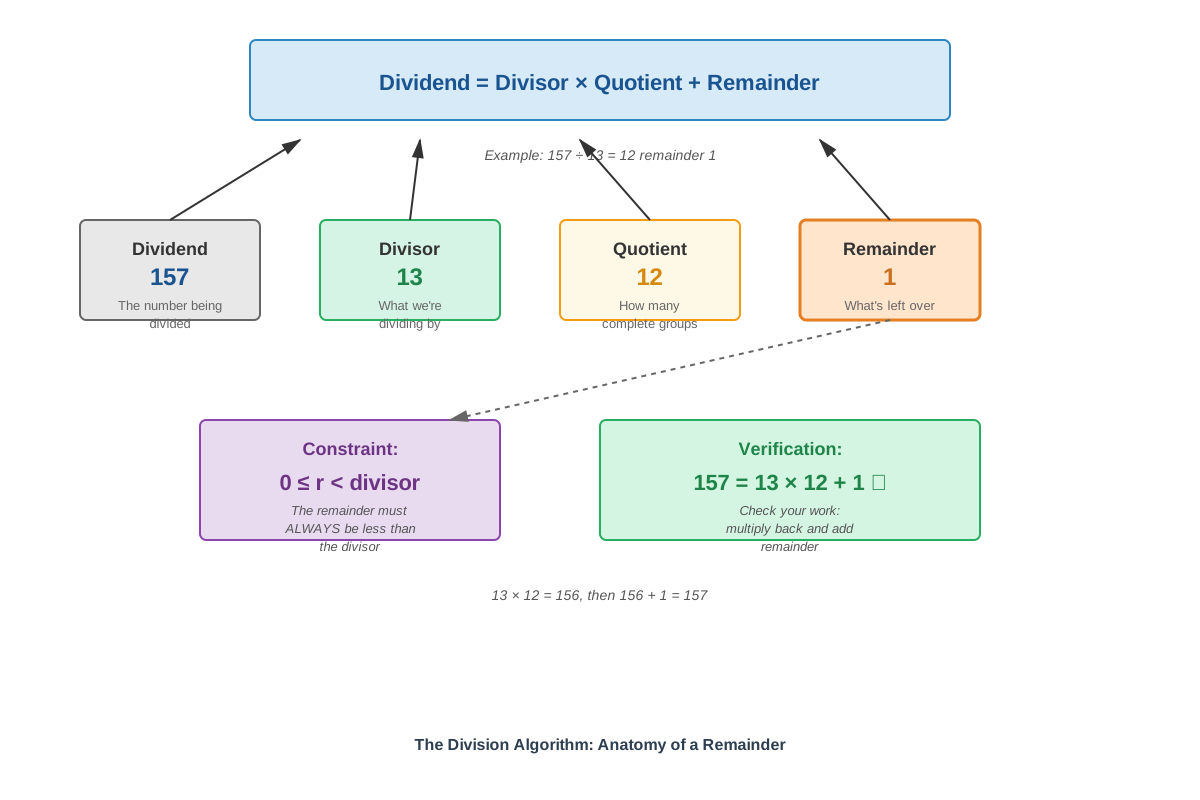
The foundation of all remainder problems is the division algorithm, which states that for any integers a (dividend) and b (divisor, where b ≠ 0), there exist unique integers q (quotient) and r (remainder) such that:
a = b × q + r, where 0 ≤ r < bThis equation means every division problem can be expressed as: dividend = (divisor × quotient) + remainder. The remainder must always be non-negative and strictly less than the divisor. For example, when dividing 23 by 5:
23 = 5 × 4 + 3Here, 23 is the dividend, 5 is the divisor, 4 is the quotient, and 3 is the remainder. The remainder (3) is less than the divisor (5), satisfying the algorithm's requirements.
Calculating Remainders
To find the remainder when dividing a by b:
- Divide a by b to find the quotient q (ignore any decimal portion)
- Multiply the divisor b by the quotient q
- Subtract this product from the dividend a
- The result is the remainder r
Example: Find the remainder when 87 is divided by 14.
- Step 1: 87 ÷ 14 = 6.214... → quotient is 6
- Step 2: 14 × 6 = 84
- Step 3: 87 - 84 = 3
- Step 4: The remainder is 3
Verification: 87 = 14 × 6 + 3 ✓
Remainder Properties and Rules
Understanding these properties accelerates problem-solving:
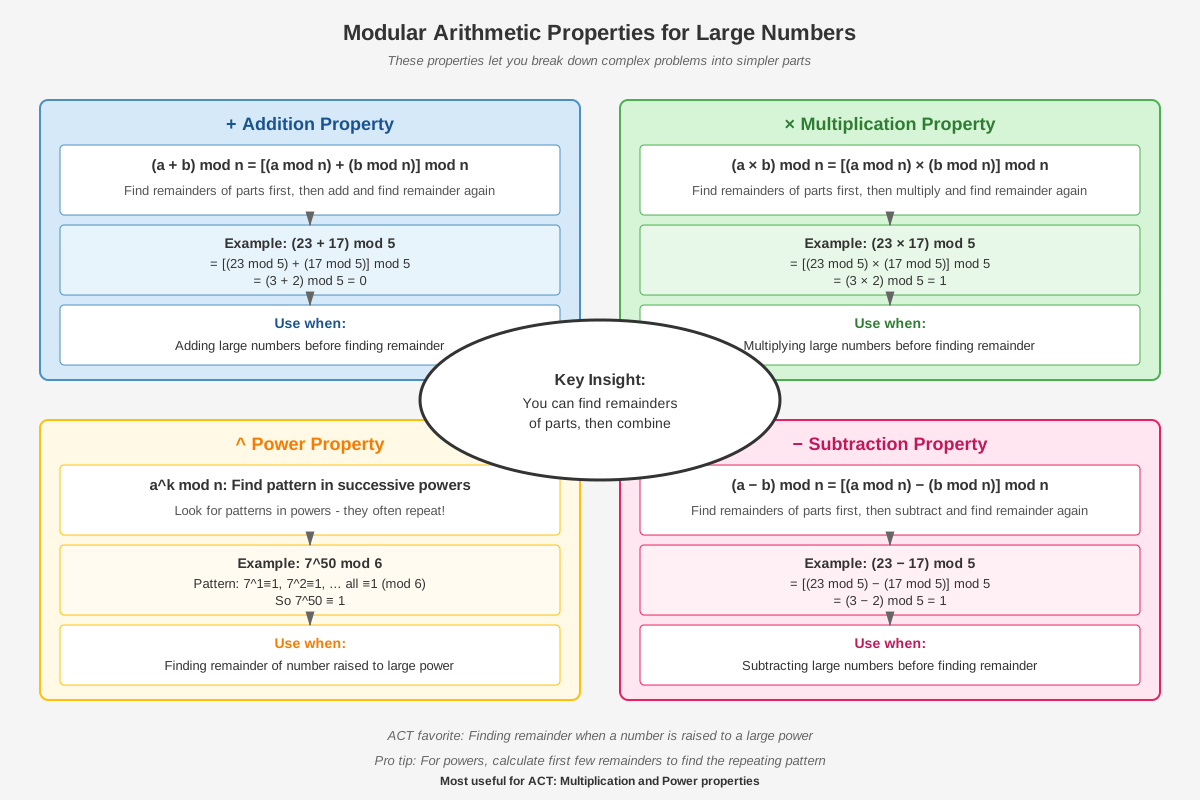
Addition Property: If a leaves remainder r₁ when divided by n, and b leaves remainder r₂ when divided by n, then (a + b) leaves remainder equal to the remainder of (r₁ + r₂) divided by n.
Multiplication Property: If a leaves remainder r₁ when divided by n, and b leaves remainder r₂ when divided by n, then (a × b) leaves remainder equal to the remainder of (r₁ × r₂) divided by n.
Subtraction Property: Similar to addition, (a - b) leaves remainder equal to the remainder of (r₁ - r₂) divided by n (adjusted if negative).
Power Property: If a leaves remainder r when divided by n, then aᵏ leaves the same remainder as rᵏ divided by n.
These properties allow breaking complex calculations into manageable pieces, especially valuable for large numbers.
Modular Arithmetic Notation
Modular arithmetic provides shorthand notation for remainder relationships. The expression "a ≡ b (mod n)" means "a and b leave the same remainder when divided by n" or equivalently "n divides (a - b)."
For example:
- 17 ≡ 2 (mod 5) because both 17 and 2 leave remainder 2 when divided by 5
- 23 ≡ 3 (mod 10) because 23 leaves remainder 3 when divided by 10
This notation simplifies complex remainder problems and appears occasionally in higher-difficulty ACT questions.
Cyclical Patterns and Remainders
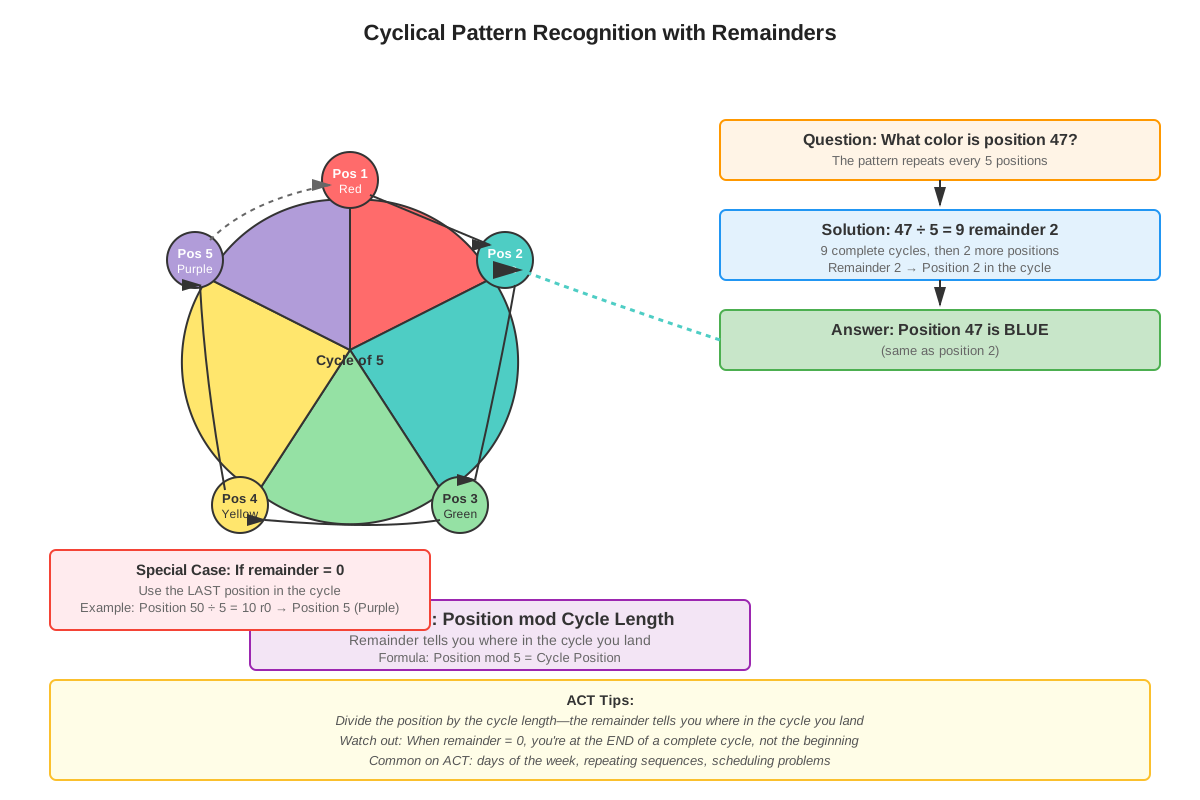
Many ACT remainder problems involve cyclical patterns—sequences that repeat after a fixed number of terms. The key strategy: use remainders to determine position within the cycle.
Pattern Recognition Strategy:
- Identify the cycle length (how many terms before repetition)
- Divide the target position by the cycle length
- The remainder indicates the position within the cycle
- If remainder is 0, the answer is the last term in the cycle
Example: A pattern repeats {A, B, C, D, E} continuously. What is the 47th term?
- Cycle length: 5 terms
- 47 ÷ 5 = 9 remainder 2
- The 47th term is the 2nd term in the cycle: B
Negative Numbers and Remainders
When dealing with negative dividends, the remainder convention on the ACT follows the mathematical standard: remainders are always non-negative and less than the divisor.
For -23 divided by 5:
- -23 = 5 × (-5) + 2 (not -3)
- The remainder is 2
The quotient adjusts to ensure the remainder stays in the range [0, divisor).
Remainder Zero and Divisibility
When the remainder equals zero, the dividend is divisible by the divisor—meaning the divisor is a factor of the dividend. This connection links remainder problems to divisibility rules and factor questions.
If a ÷ b leaves remainder 0, then:
- b is a factor of a
- a is a multiple of b
- a = b × q for some integer q
Concept Relationships
The division algorithm serves as the foundational concept from which all other remainder ideas flow. Understanding this algorithm → enables calculation of remainders → which reveals cyclical patterns → leading to solutions for scheduling and sequence problems.
Remainder properties (addition, multiplication, power) connect to the division algorithm by providing shortcuts that preserve remainder relationships through operations. These properties → enable solving problems with large numbers → without requiring complete calculation of intermediate values.
The relationship between remainders and divisibility creates a bridge to factor/multiple concepts: remainder = 0 ↔ divisibility ↔ factor relationships. This connection means remainder problems often test the same underlying concepts as divisibility questions, just from a different angle.
Modular arithmetic notation provides an alternative framework that → simplifies complex remainder relationships → particularly in algebraic contexts → enabling pattern recognition across equivalent expressions.
Cyclical patterns represent applied remainder concepts where → the cycle length becomes the divisor → the position becomes the dividend → and the remainder determines location within the cycle. This application appears in scheduling, sequences, and real-world periodic phenomena.
High-Yield Facts
⭐ The remainder must always be non-negative and strictly less than the divisor: 0 ≤ r < b
⭐ The division algorithm: a = bq + r uniquely determines quotient and remainder for any division problem
⭐ To find remainder: divide, multiply quotient by divisor, subtract from dividend
⭐ Remainder of 0 means the number is divisible by the divisor (no leftover)
⭐ For cyclical patterns: divide position by cycle length; the remainder indicates position in cycle (if remainder is 0, use the last position)
- When adding or multiplying numbers, you can work with their remainders separately, then find the remainder of the result
- Powers of numbers follow remainder patterns that often cycle with small periods
- The remainder when dividing by 10 equals the ones digit of the number
- The remainder when dividing by 100 equals the last two digits of the number
- If a leaves remainder r when divided by n, then a + n, a + 2n, a + 3n, etc., all leave remainder r
- Negative dividends still produce non-negative remainders by adjusting the quotient
- The sum of remainders may exceed the divisor, requiring one more division to find the final remainder
Quick check — test yourself on Remainders so far.
Try Flashcards →Common Misconceptions
Misconception: The remainder can be larger than the divisor.
Correction: By definition, the remainder must be strictly less than the divisor. If your calculation produces a remainder ≥ divisor, you haven't completed the division—divide again to find the true remainder.
Misconception: When the remainder is 0 in a cyclical pattern problem, the answer is 0 or undefined.
Correction: A remainder of 0 means you've completed full cycles and landed on the last position of the cycle. Use the last term in the repeating sequence as your answer.
Misconception: You can use decimal division results directly to find remainders.
Correction: While 23 ÷ 5 = 4.6, the ".6" is not the remainder. The remainder is 3, found by calculating 23 - (5 × 4). Decimals represent fractional parts, not remainders.
Misconception: Negative numbers cannot have remainders.
Correction: Negative dividends do have remainders, but the remainder is always non-negative. For -23 ÷ 5, the remainder is 2 (not -3), with quotient -5, because -23 = 5(-5) + 2.
Misconception: When adding remainders, the sum is always the final answer.
Correction: If two numbers leave remainders of 7 and 8 when divided by 9, their sum leaves remainder 6 (not 15), because 15 ÷ 9 leaves remainder 6. Always reduce the sum of remainders by dividing by the original divisor.
Misconception: Remainder problems always involve small, manageable numbers.
Correction: ACT questions often involve large numbers (like 1000+ or algebraic expressions) specifically to test whether you can apply remainder properties rather than brute-force calculation. Use modular arithmetic properties for efficiency.
Misconception: The remainder when dividing by a negative number is negative.
Correction: The divisor's sign doesn't affect the remainder's sign. Remainders are always non-negative by convention. When dividing by -5, the remainder is still in the range [0, 5).
Worked Examples
Example 1: Direct Calculation with Verification
Problem: What is the remainder when 347 is divided by 23?
Solution:
Step 1: Perform the division to find the quotient (ignore decimals)
- 347 ÷ 23 = 15.087...
- Quotient q = 15
Step 2: Multiply divisor by quotient
- 23 × 15 = 345
Step 3: Subtract from dividend to find remainder
- 347 - 345 = 2
Step 4: Verify using the division algorithm
- Does 347 = 23 × 15 + 2?
- 345 + 2 = 347 ✓
- Is 0 ≤ 2 < 23? ✓
Answer: The remainder is 2.
Connection to Learning Objectives: This demonstrates the core calculation strategy and application of the division algorithm, addressing objectives 2 and 3.
Example 2: Cyclical Pattern Problem
Problem: A factory operates on a 12-day production cycle, manufacturing products A, B, C, D, E, F, G, H, I, J, K, L in that order, one per day. If the factory produces product A on Monday, what product will it manufacture on the 100th day?
Solution:
Step 1: Identify the cycle length
- The pattern repeats every 12 days
- Cycle: {A, B, C, D, E, F, G, H, I, J, K, L}
Step 2: Find the position within the cycle
- Divide the target day by cycle length: 100 ÷ 12
- 100 ÷ 12 = 8 remainder 4
Step 3: Interpret the remainder
- Remainder 4 means we're at the 4th position in the cycle
- Position 1 = A, Position 2 = B, Position 3 = C, Position 4 = D
Step 4: Verify the logic
- After 96 days (8 complete cycles), we've produced L
- Days 97, 98, 99, 100 produce A, B, C, D respectively
Answer: Product D will be manufactured on the 100th day.
Connection to Learning Objectives: This demonstrates pattern recognition, remainder application to real-world scenarios, and the critical skill of interpreting remainder 0 versus non-zero remainders (objectives 1, 3, and 4).
Example 3: Large Number Using Properties
Problem: What is the remainder when 7¹⁵ is divided by 6?
Solution:
Rather than calculating 7¹⁵ (which equals 4,747,561,509,943), use remainder properties.
Step 1: Find the remainder of the base
- 7 ÷ 6 = 1 remainder 1
- So 7 ≡ 1 (mod 6)
Step 2: Apply the power property
- If 7 ≡ 1 (mod 6), then 7¹⁵ ≡ 1¹⁵ (mod 6)
- 1¹⁵ = 1
Step 3: Conclude
- 7¹⁵ leaves remainder 1 when divided by 6
Step 4: Verify with smaller powers
- 7¹ = 7 → remainder 1 when divided by 6 ✓
- 7² = 49 → 49 ÷ 6 = 8 remainder 1 ✓
- Pattern confirms: all powers of 7 leave remainder 1 when divided by 6
Answer: The remainder is 1.
Connection to Learning Objectives: This demonstrates advanced strategy using remainder properties for large numbers, addressing objectives 2, 3, and 5.
Exam Strategy
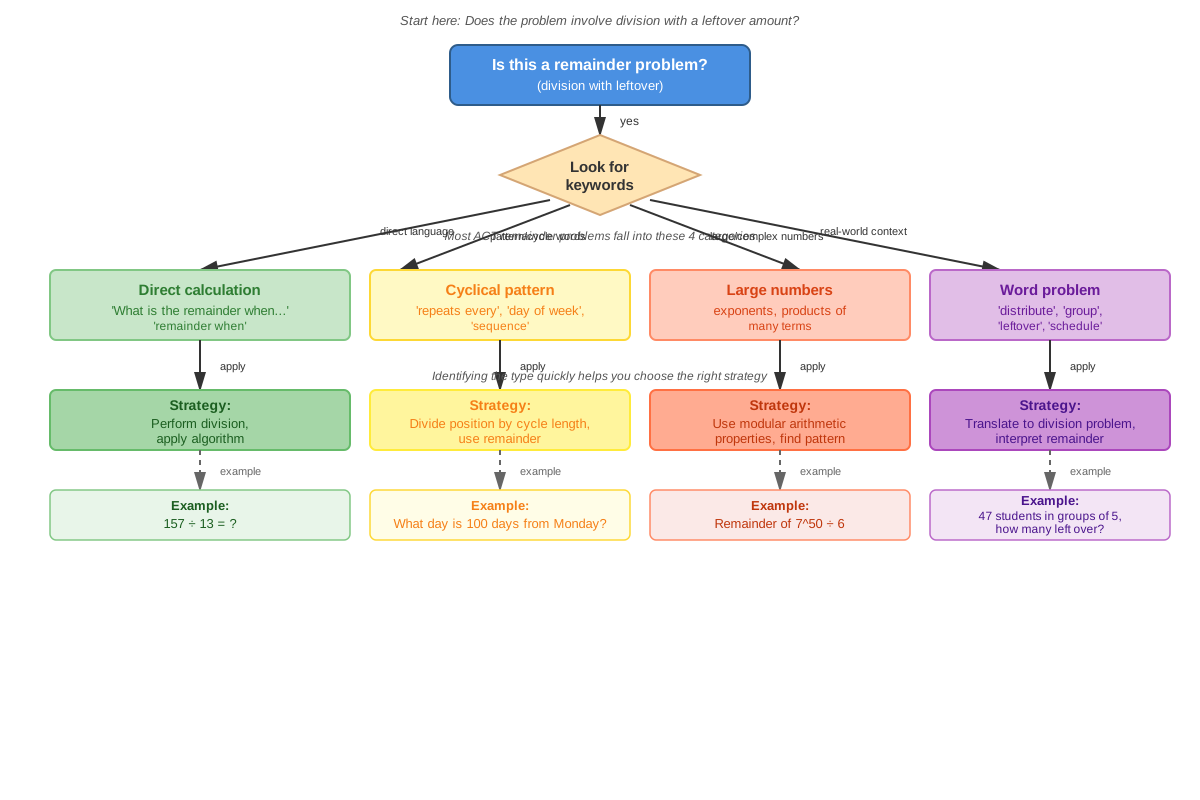
Recognition Triggers: Watch for these phrases that signal remainder problems:
- "What is the remainder when..."
- "How many are left over..."
- "...divided into groups of..."
- "What day/time will it be after..."
- "A pattern repeats every..."
- "...leaves a remainder of..."
- "...not evenly divisible..."
Approach Sequence:
- Identify the divisor and dividend: Determine what's being divided by what (word problems often disguise these)
- Choose your method: Direct calculation for small numbers, properties for large numbers, pattern recognition for cycles
- Execute carefully: Show work to avoid arithmetic errors under time pressure
- Verify reasonableness: Remainder must be less than divisor; check if remainder 0 makes sense in context
Process of Elimination Tips:
- Immediately eliminate any answer choice ≥ the divisor (impossible remainder)
- For cyclical patterns, eliminate answers outside the cycle range
- If the dividend is less than the divisor, the remainder equals the dividend
- Check if 0 is a reasonable answer (means evenly divisible)
Time Management:
- Direct calculation problems: 30-45 seconds
- Pattern/cycle problems: 45-75 seconds
- Large number/property problems: 60-90 seconds
- If calculation exceeds 90 seconds, mark and return later
Calculator Usage:
- Use calculator for multiplication verification, not division (decimals confuse remainder calculation)
- Calculate quotient × divisor, then subtract from dividend
- For large numbers, calculate remainders of smaller parts, then combine
Exam Tip: When a problem asks "how many are left over" or "how many remain," you're finding a remainder. When it asks "how many complete groups," you're finding the quotient.
Memory Techniques
Division Algorithm Mnemonic: "Dad Equals Baby Queen Plus Rose"
- D = Dividend
- E = Equals
- B = diviSor (Baby)
- Q = Quotient (Queen)
- P = Plus
- R = Remainder (Rose)
- Formula: D = B × Q + R
Remainder Range Reminder: "Remainders Run from Zero to Before the divisor"
- 0 ≤ R < B (divisor)
Cyclical Pattern Process: "Divide Position by Cycle, Remainder Reveals Place"
- Divide position by cycle length
- Remainder reveals place in cycle
- If remainder = 0, use last position
Property Shortcut: "Add or Multiply Remainders, then Divide Again"
- When combining numbers, work with remainders
- Add or multiply the remainders
- Divide the result by the original divisor to get final remainder
Visualization Strategy: Picture division as distributing items into boxes:
- Divisor = number of boxes
- Quotient = items per box
- Remainder = items that don't fit evenly
Summary
Remainders represent the "leftover" amount when one integer doesn't divide evenly into another, formalized by the division algorithm: a = bq + r, where the remainder r must satisfy 0 ≤ r < b. Mastery requires three core competencies: calculating remainders through systematic division and subtraction, recognizing cyclical patterns where remainders determine position within repeating sequences, and applying remainder properties to handle large numbers efficiently. The ACT tests remainders through direct calculation, word problems involving distribution or grouping, scheduling scenarios with periodic events, and pattern recognition in sequences. Success depends on identifying remainder problems from context clues, selecting appropriate strategies based on number size and problem type, and executing calculations accurately while maintaining awareness that remainders must always be non-negative and less than the divisor. The connection between remainder zero and divisibility creates bridges to factor and multiple concepts, while modular arithmetic notation provides advanced tools for complex problems.
Key Takeaways
- The division algorithm (a = bq + r) is the foundation: every division produces a unique quotient and remainder where 0 ≤ r < divisor
- Calculate remainders by dividing, multiplying quotient by divisor, and subtracting from the dividend—never rely on decimal portions
- For cyclical patterns, divide position by cycle length; the remainder indicates position within the cycle (remainder 0 means last position)
- Remainder properties allow working with remainders of parts rather than calculating with large numbers directly
- A remainder of zero means perfect divisibility—the divisor is a factor of the dividend
- Watch for disguised remainder problems in word problems about grouping, distribution, scheduling, and repeating patterns
- Always verify that your remainder is less than the divisor; if not, continue dividing
Related Topics
Divisibility Rules: Understanding when numbers divide evenly (remainder 0) connects directly to remainder concepts and provides shortcuts for factor identification. Mastering remainders makes divisibility rules more intuitive and applicable.
Factors and Multiples: The relationship between remainders and divisibility creates natural connections to factor/multiple problems. When remainder equals zero, you're working with factor relationships.
Modular Arithmetic: Advanced remainder concepts formalized through congruence notation, essential for higher-level number theory and appearing in challenging ACT problems.
Sequences and Patterns: Many sequence problems involve cyclical repetition, making remainder calculations essential for finding specific terms without listing entire sequences.
Integer Properties: Remainders interact with even/odd classification, prime numbers, and other integer characteristics, creating compound problems that test multiple concepts simultaneously.
Algebraic Division: Polynomial division and rational expressions extend remainder concepts to algebraic contexts, building on the same foundational principles.
Practice CTA
Now that you've mastered the core concepts, properties, and strategies for remainder problems, it's time to solidify your understanding through active practice. Work through the practice questions to apply these techniques to authentic ACT-style problems, paying special attention to recognizing problem types and selecting efficient solution strategies. Use the flashcards to reinforce high-yield facts and build automatic recall of key properties. Remember: remainder problems reward systematic thinking and careful calculation—skills that improve dramatically with focused practice. Each problem you solve strengthens your pattern recognition and builds the confidence needed to tackle any remainder question the ACT presents!
Sign up free to keep reading
Create a free AnvayaPrep account to finish this ACT guide on Remainders — plus flashcards and practice questions.