Overview
Factors represent one of the foundational pillars of number theory tested on the ACT Math section. A factor of a number is any integer that divides evenly into that number without leaving a remainder. Understanding factors goes far beyond simple division—it encompasses prime factorization, greatest common factors, least common multiples, divisibility rules, and the relationships between numbers. This topic appears consistently across multiple ACT Math questions, often disguised within word problems, algebraic expressions, or geometry scenarios where students must recognize numerical relationships.
Mastery of ACT factors questions is essential because they frequently serve as gatekeepers to solving more complex problems. A student might encounter a seemingly difficult algebra problem that becomes trivial once they recognize it's fundamentally testing factor relationships. The ACT deliberately embeds factor concepts within various contexts—from determining how many ways to arrange objects, to simplifying radical expressions, to finding dimensions of rectangles with specific area constraints. Questions testing factors typically appear 3-5 times per ACT Math section, making this a high-yield topic that directly impacts your composite score.
The beauty of factors lies in their interconnectedness with virtually every other mathematical domain. Factors bridge arithmetic and algebra, connect to geometry through area and perimeter problems, and underpin rational expressions and polynomial factoring. When you understand factors deeply, you unlock pattern recognition skills that accelerate problem-solving across the entire Math section. This topic also builds critical thinking about divisibility, prime numbers, and number properties—skills that the ACT tests both directly and indirectly throughout the 60-minute Math section.
Learning Objectives
- [ ] Identify when Factors is being tested in ACT questions, including disguised applications
- [ ] Explain the core rule or strategy behind Factors, including prime factorization methods
- [ ] Apply Factors to ACT-style questions accurately under timed conditions
- [ ] Determine all factors of a given integer efficiently using systematic methods
- [ ] Calculate the greatest common factor (GCF) and least common multiple (LCM) of two or more numbers
- [ ] Recognize factor relationships in word problems involving divisibility, grouping, and arrangement
- [ ] Use prime factorization to solve complex problems involving exponents and radicals
Prerequisites
- Basic multiplication and division: Essential for identifying which numbers divide evenly into a target number
- Understanding of integers: Factors only apply to whole numbers, requiring clear distinction between integers and other number types
- Prime number recognition: Identifying primes (2, 3, 5, 7, 11, etc.) accelerates factor-finding and prime factorization
- Exponent rules: Prime factorization uses exponential notation, and factor counting requires exponent manipulation
- Divisibility rules: Quick mental checks for divisibility by 2, 3, 5, 9, and 10 dramatically speed up factor identification
Why This Topic Matters
In real-world applications, factors appear constantly in practical problem-solving. Architects use factors when determining tile arrangements that fit perfectly without cutting. Event planners use factors to organize people into equal groups. Computer scientists rely on factors for encryption algorithms and data compression. Manufacturing depends on factors for packaging optimization—determining how many items fit into boxes, how many boxes fit on pallets, and how many pallets fit in trucks. Financial analysts use factor concepts when calculating payment schedules and interest periods that align with specific timeframes.
On the ACT specifically, factor questions appear with remarkable consistency. Statistical analysis of released ACT exams shows that 4-6 questions per test directly or indirectly assess factor understanding. These questions typically fall into several categories: direct factor identification (15% of factor questions), greatest common factor problems (25%), least common multiple scenarios (20%), word problems requiring factor analysis (30%), and algebraic/geometric applications involving factors (10%). The ACT favors medium-difficulty factor questions that require 2-3 steps of reasoning rather than simple recall.
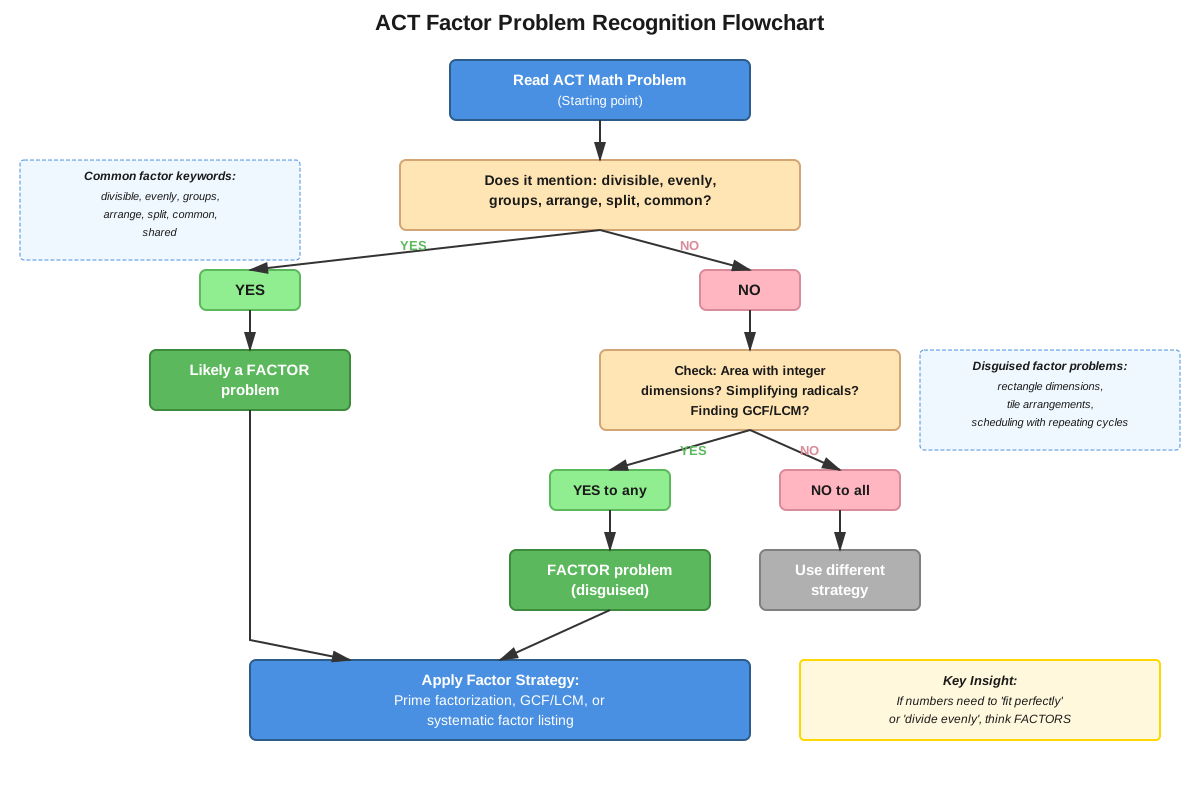
Factor questions commonly appear disguised as: "What is the greatest number of identical gift bags that can be made from 48 candies and 36 toys?"; "If a rectangle has an area of 72 square units and integer side lengths, how many different rectangles are possible?"; "What is the smallest positive integer divisible by both 12 and 18?"; or "How many positive divisors does 360 have?" Recognizing these patterns allows students to immediately activate their factor-solving toolkit rather than wasting time trying multiple approaches.
Core Concepts
Definition of Factors
A factor of a number is any integer that divides into that number evenly, producing another integer with no remainder. For example, the factors of 12 are 1, 2, 3, 4, 6, and 12 because each of these numbers divides into 12 exactly. Mathematically, if a × b = n, then both a and b are factors of n. Every positive integer has at least two factors: 1 and itself. Numbers with exactly two factors are called prime numbers, while numbers with more than two factors are composite numbers.
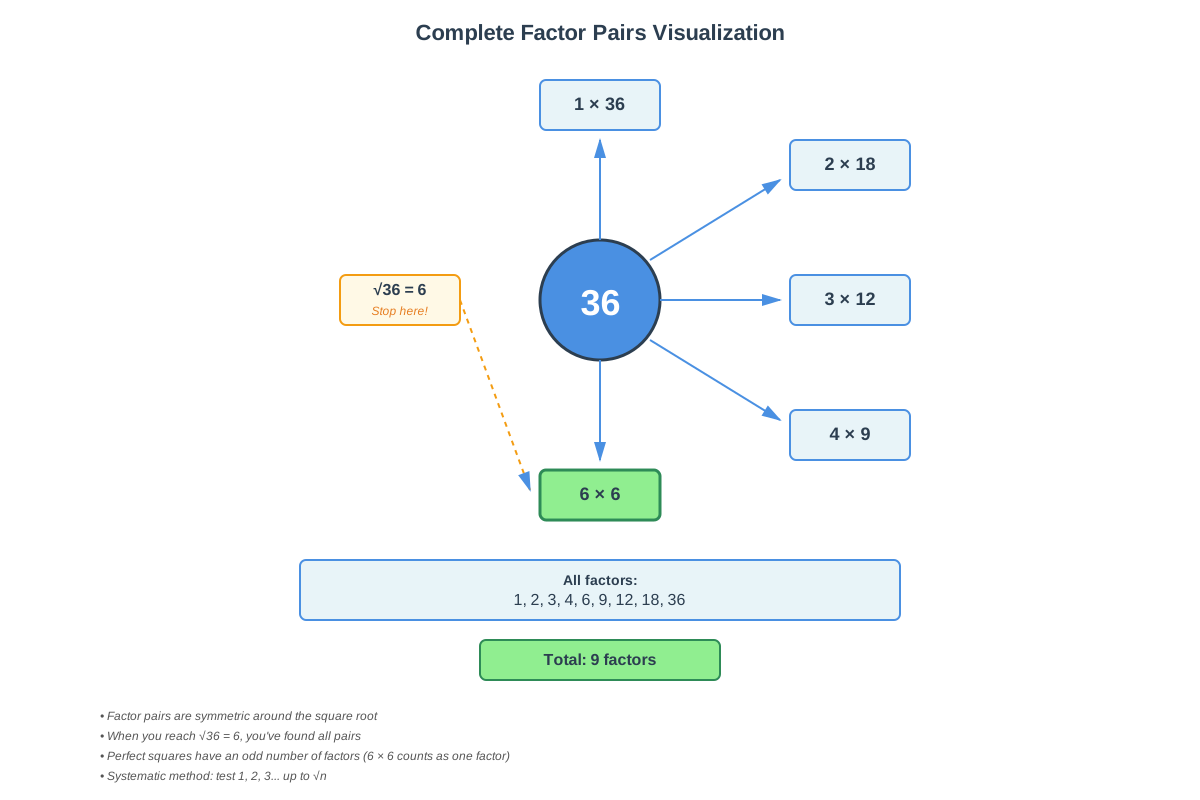
Factors always come in pairs. When finding factors systematically, start with 1 and the number itself, then work inward. For 36: (1, 36), (2, 18), (3, 12), (4, 9), (6, 6). Notice that 6 pairs with itself, which happens when finding factors of perfect squares. This pairing principle helps ensure you don't miss any factors and provides a stopping point—once your factors meet or cross, you've found them all.
Prime Factorization
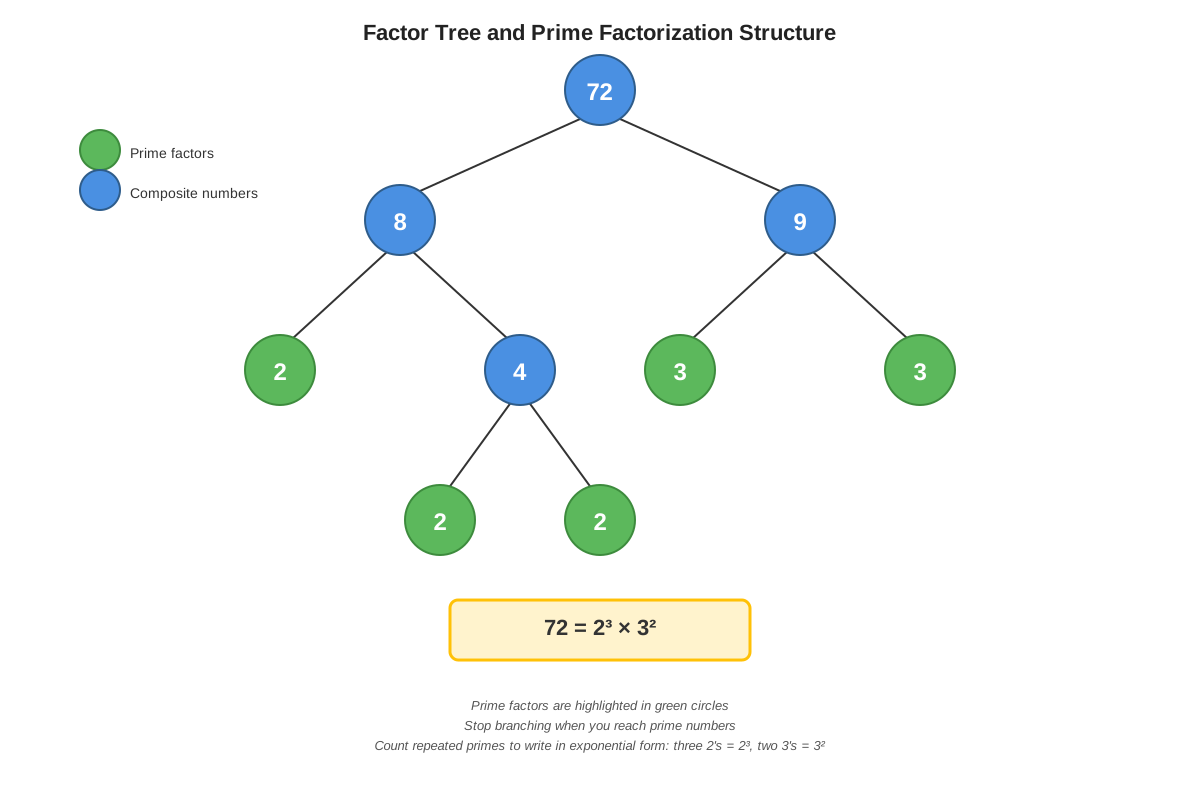
Prime factorization expresses any composite number as a product of prime numbers raised to various powers. This representation is unique for every number (the Fundamental Theorem of Arithmetic) and serves as the foundation for advanced factor work. To find the prime factorization, use a factor tree: divide by the smallest prime that works, then continue dividing the quotient until only primes remain.
For example, to find the prime factorization of 360:
- 360 ÷ 2 = 180
- 180 ÷ 2 = 90
- 90 ÷ 2 = 45
- 45 ÷ 3 = 15
- 15 ÷ 3 = 5
- 5 is prime
Therefore, 360 = 2³ × 3² × 5¹
Prime factorization unlocks powerful problem-solving capabilities. It allows you to count total factors, find GCF and LCM efficiently, simplify radicals, and solve divisibility problems. The ACT frequently requires prime factorization as an intermediate step even when not explicitly requested.
Counting Total Factors
Once you have the prime factorization, counting all factors becomes formulaic. For a number expressed as p₁^a × p₂^b × p₃^c (where p represents prime factors and the letters represent exponents), the total number of factors equals (a+1)(b+1)(c+1).
Using our example of 360 = 2³ × 3² × 5¹:
- Total factors = (3+1)(2+1)(1+1) = 4 × 3 × 2 = 24 factors
This works because each factor is formed by choosing an exponent from 0 to the maximum for each prime. For 2³, you can choose 2⁰, 2¹, 2², or 2³ (4 choices). For 3², you can choose 3⁰, 3¹, or 3² (3 choices). For 5¹, you can choose 5⁰ or 5¹ (2 choices). Multiplying these choices gives all possible combinations.
Greatest Common Factor (GCF)
The greatest common factor (also called greatest common divisor) of two or more numbers is the largest integer that divides evenly into all of them. The GCF appears frequently in ACT word problems involving grouping, distribution, or simplification.
Method 1: List all factors
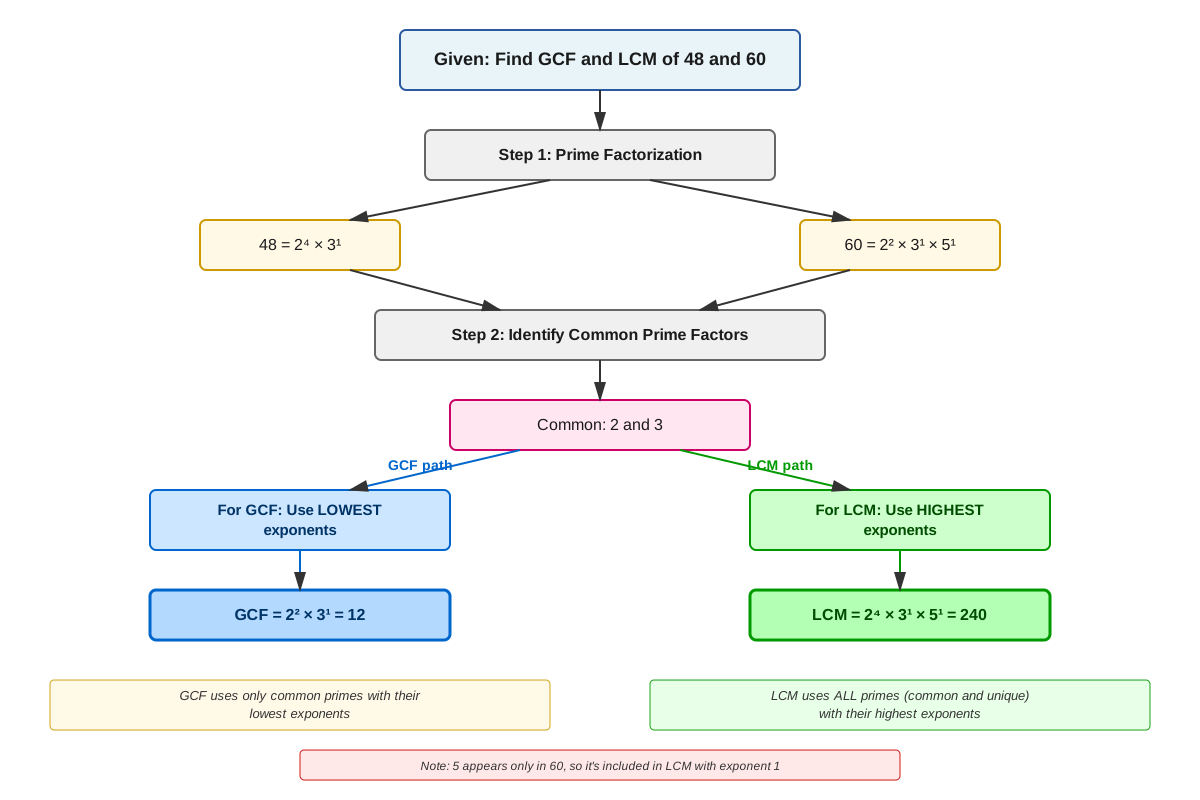
For GCF of 48 and 60:
- Factors of 48: 1, 2, 3, 4, 6, 8, 12, 16, 24, 48
- Factors of 60: 1, 2, 3, 4, 5, 6, 10, 12, 15, 20, 30, 60
- Common factors: 1, 2, 3, 4, 6, 12
- GCF = 12
Method 2: Prime factorization (faster for larger numbers)
- 48 = 2⁴ × 3¹
- 60 = 2² × 3¹ × 5¹
- GCF = 2² × 3¹ = 12 (take the lowest power of each common prime)
Least Common Multiple (LCM)
The least common multiple of two or more numbers is the smallest positive integer that is divisible by all of them. LCM questions often involve scheduling, repeating events, or finding when cycles align.
Method 1: List multiples
For LCM of 12 and 18:
- Multiples of 12: 12, 24, 36, 48, 60, 72...
- Multiples of 18: 18, 36, 54, 72...
- LCM = 36
Method 2: Prime factorization (more efficient)
- 12 = 2² × 3¹
- 18 = 2¹ × 3²
- LCM = 2² × 3² = 36 (take the highest power of each prime that appears)
Method 3: GCF relationship
For two numbers a and b: LCM(a,b) × GCF(a,b) = a × b
Therefore: LCM(12,18) = (12 × 18) ÷ GCF(12,18) = 216 ÷ 6 = 36
Factor Pairs and Dimensions
Many ACT geometry problems disguise factor questions as dimension problems. If a rectangle has area A, its possible integer dimensions are the factor pairs of A. For area = 24:
- 1 × 24
- 2 × 12
- 3 × 8
- 4 × 6
This yields 4 different rectangles (or 8 if you count 24 × 1 as different from 1 × 24, though the ACT typically considers these the same rectangle).
Divisibility and Remainders
Understanding factors means understanding when division produces no remainder. A number n is divisible by factor f if n ÷ f yields an integer. The ACT tests this through:
- Direct divisibility questions
- Remainder problems (if n leaves remainder r when divided by f, then n - r is divisible by f)
- Modular arithmetic applications
- Pattern recognition in sequences
Concept Relationships
The factor concepts form a hierarchical structure where each builds upon previous understanding. Basic factor identification serves as the foundation, requiring only multiplication and division skills. This leads directly to prime factorization, which reorganizes factors into their most fundamental building blocks. Prime factorization then enables three parallel branches: counting total factors (using the exponent formula), finding GCF (taking minimum exponents of common primes), and finding LCM (taking maximum exponents of all primes).
The relationship between GCF and LCM is particularly elegant: GCF(a,b) × LCM(a,b) = a × b. This means if you know any three of these values, you can calculate the fourth. This relationship stems from how prime factorization works—GCF uses the minimum powers while LCM uses maximum powers, and together they account for all prime factors exactly once at their highest power in either number.
Factor pairs connect factors to geometry and algebra. Every factor relationship a × b = n represents both a factorization and a potential geometric dimension pair. This bridges number theory to spatial reasoning, which the ACT exploits in problems involving area, volume, and arrangements.
Divisibility rules serve as shortcuts for factor identification, connecting mental math strategies to formal factor theory. Recognizing that a number is divisible by 3 (sum of digits divisible by 3) immediately identifies 3 as a factor without performing division.
All factor concepts ultimately connect to prime numbers, which serve as the "atoms" of number theory. Understanding that every composite number is a unique product of primes unifies all factor work under one theoretical framework, making complex problems more approachable through systematic prime factorization.
Quick check — test yourself on Factors so far.
Try Flashcards →High-Yield Facts
⭐ Every positive integer has at least two factors: 1 and itself
⭐ The total number of factors of n = p₁^a × p₂^b × p₃^c is (a+1)(b+1)(c+1)
⭐ GCF is found by taking the minimum exponent of each common prime factor
⭐ LCM is found by taking the maximum exponent of each prime factor that appears in any number
⭐ For any two numbers a and b: GCF(a,b) × LCM(a,b) = a × b
- Factors always come in pairs; when finding factors systematically, stop when factors meet or cross
- Prime factorization is unique for every positive integer (Fundamental Theorem of Arithmetic)
- Perfect squares have an odd number of total factors because one factor pairs with itself
- The number 1 is neither prime nor composite; it has exactly one factor (itself)
- If a number is divisible by another number, it's also divisible by all factors of that number
- The GCF of two consecutive integers is always 1 (they are relatively prime)
- The LCM of two numbers is equal to their product if and only if they share no common factors except 1
- Any number ending in 0, 2, 4, 6, or 8 has 2 as a factor
- Any number whose digits sum to a multiple of 3 has 3 as a factor
- The more prime factors a number has, the more total factors it has
Common Misconceptions
Misconception: Factors can be negative numbers or fractions.
Correction: In ACT contexts, factors refer exclusively to positive integers unless explicitly stated otherwise. While mathematically -3 divides into -12, the ACT tests positive factors. Similarly, 1.5 × 8 = 12, but 1.5 is not considered a factor.
Misconception: Prime numbers have no factors.
Correction: Prime numbers have exactly two factors: 1 and themselves. Having "no factors" would make a number impossible to work with. The defining characteristic of primes is having exactly two factors, not zero factors.
Misconception: The GCF of two numbers is always smaller than both numbers.
Correction: When one number is a factor of another, the GCF equals the smaller number. For example, GCF(12, 36) = 12. The GCF is always less than or equal to the smallest number in the set.
Misconception: To find LCM, just multiply the two numbers together.
Correction: Multiplying gives a common multiple, but rarely the least common multiple. LCM(12, 18) = 36, not 216. Only when numbers share no common factors (are relatively prime) does LCM equal their product.
Misconception: A number with more digits has more factors.
Correction: Factor count depends on prime factorization structure, not magnitude. The number 128 = 2⁷ has 8 factors, while 30 = 2 × 3 × 5 has 8 factors despite being much smaller. Meanwhile, 97 (a prime) has only 2 factors despite being larger than both.
Misconception: When finding factors, you must test every number up to the target number.
Correction: You only need to test up to the square root of the number. If n = a × b and a ≤ √n, then b ≥ √n. Once you reach √n, you've found all factor pairs.
Misconception: The number 1 is prime because it's only divisible by itself.
Correction: By definition, prime numbers must have exactly two distinct factors. Since 1 only has one factor (itself), it's neither prime nor composite—it's a special case called a unit.
Worked Examples
Example 1: Multi-Step Factor Problem
Question: A teacher has 48 pencils and 72 erasers to distribute equally among students, with no items left over. What is the greatest number of students who can receive supplies, and how many of each item will each student receive?
Solution:
Step 1: Recognize this as a GCF problem
The phrase "distribute equally" with "no items left over" signals we need the greatest common factor. The number of students must divide evenly into both 48 and 72.
Step 2: Find GCF using prime factorization
- 48 = 2⁴ × 3¹
- 72 = 2³ × 3²
GCF = 2³ × 3¹ = 8 × 3 = 24
Step 3: Calculate items per student
- Pencils per student: 48 ÷ 24 = 2 pencils
- Erasers per student: 72 ÷ 24 = 3 erasers
Answer: 24 students can receive supplies, with each student getting 2 pencils and 3 erasers.
Connection to learning objectives: This problem requires identifying when factors are being tested (recognizing "distribute equally" as a GCF trigger), explaining the strategy (using prime factorization for efficiency), and applying the concept accurately to reach the correct answer.
Example 2: Factor Counting with Geometry
Question: A rectangle has an area of 60 square inches and integer side lengths. How many different rectangles are possible? (Note: A 3×20 rectangle is considered the same as a 20×3 rectangle.)
Solution:
Step 1: Recognize the connection between area and factors
If area = 60 and dimensions are integers, then length × width = 60. We need to find factor pairs of 60.
Step 2: Find prime factorization
60 = 2² × 3¹ × 5¹
Step 3: List factor pairs systematically
Start with 1 and work up to √60 ≈ 7.75:
- 1 × 60
- 2 × 30
- 3 × 20
- 4 × 15
- 5 × 12
- 6 × 10
Step 4: Count the pairs
There are 6 different rectangles possible.
Alternative approach using factor formula:
Total factors of 60 = (2+1)(1+1)(1+1) = 12 factors
Factor pairs = 12 ÷ 2 = 6 pairs
Answer: 6 different rectangles are possible.
Connection to learning objectives: This demonstrates how factor concepts appear in geometry contexts, requiring students to identify the disguised factor question, apply systematic factor-finding strategies, and connect abstract number theory to concrete spatial problems.
Exam Strategy
When approaching ACT factors questions, begin by identifying trigger words and phrases that signal factor concepts. Watch for: "divides evenly," "no remainder," "distribute equally," "greatest number," "smallest number," "how many groups," "integer dimensions," "common divisor," and "common multiple." These phrases immediately indicate you should activate factor-solving strategies rather than attempting algebraic or arithmetic approaches.
Develop a systematic approach for factor problems:
- Identify the question type: Is this asking for GCF, LCM, total factors, or factor pairs?
- Choose your method: For small numbers (under 50), listing factors works quickly. For larger numbers, use prime factorization.
- Show your work systematically: Even on multiple-choice tests, organized work prevents errors and allows quick error-checking.
- Verify your answer: Check that your answer makes logical sense (GCF can't exceed the smallest number, LCM can't be less than the largest number).
For process of elimination, use these factor-specific strategies:
- If finding GCF, eliminate any answer choice larger than the smallest number in the problem
- If finding LCM, eliminate any answer choice smaller than the largest number in the problem
- For "how many factors" questions, eliminate odd numbers unless the original number is a perfect square
- Check divisibility: if an answer choice doesn't divide evenly into the numbers in question, eliminate it
Time allocation is crucial. Simple factor identification should take 15-30 seconds. GCF and LCM problems typically require 45-60 seconds. Complex multi-step factor problems might need 90-120 seconds. If you're exceeding these times, you may be using an inefficient method—consider switching to prime factorization or looking for a pattern you've missed.
When stuck, ask yourself: "What is this problem really asking?" Many factor problems hide behind word problems or geometric scenarios. Strip away the context and identify the core mathematical relationship. A problem about scheduling buses and trains is really asking for LCM. A problem about arranging students in equal rows is really asking for factors or GCF.
Memory Techniques
GCF vs LCM Mnemonic: "Go Low, Lift High"
- GCF uses the Lowest exponents of common primes
- LCM uses the Highest exponents of all primes
Factor Formula Mnemonic: "Add One Multiply"
- Take exponents, Add One to each, then Multiply them together
Prime Factorization Visualization: Picture a tree where the original number is the trunk, and you keep branching down until you reach prime "leaves." All composite numbers eventually break down into prime components, just as all branches eventually end in leaves.
Factor Pairs Memory Technique: Visualize factors as dance partners. Every factor needs a partner to multiply with to create the original number. When you find one partner, you automatically know the other. This prevents missing factors and provides a natural stopping point (when partners would dance with themselves, you've found them all).
Divisibility Rules Acronym: "TEEN FIVES"
- Two: ends in 0, 2, 4, 6, 8
- Eight: last three digits divisible by 8
- Eleven: alternating digit sum divisible by 11
- Nine: digit sum divisible by 9
- Four: last two digits divisible by 4
- I: (placeholder)
- V: (placeholder)
- E: (placeholder)
- Six: divisible by both 2 and 3
GCF Word Problem Trigger: When you see "greatest," "largest," "maximum," combined with "equal groups," "distribute," or "divide," think GCF.
LCM Word Problem Trigger: When you see "least," "smallest," "minimum," combined with "both," "all," "together," or "align," think LCM.
Summary
Factors represent the building blocks of number relationships, forming a critical foundation for ACT Math success. Mastering factors requires understanding that they are positive integers that divide evenly into a target number, always appearing in pairs that multiply to produce the original number. Prime factorization serves as the most powerful tool for factor work, expressing any composite number as a unique product of prime powers and enabling efficient calculation of total factors, GCF, and LCM. The GCF represents the largest number dividing into all given numbers (found using minimum exponents of common primes), while the LCM represents the smallest number divisible by all given numbers (found using maximum exponents of all primes). These concepts appear throughout the ACT in various disguises—word problems about distribution, geometry problems about dimensions, and scheduling problems about repeating cycles. Success requires recognizing trigger words, choosing efficient solution methods (prime factorization for larger numbers, listing for smaller ones), and understanding the relationships between concepts. The formula for counting total factors—adding one to each exponent in the prime factorization and multiplying the results—provides a quick method for problems asking "how many factors" or "how many rectangles." With systematic practice and strategic application of these principles, students can confidently tackle any factor question the ACT presents.
Key Takeaways
- Factors are positive integers that divide evenly into a number; they always come in pairs that multiply to the original number
- Prime factorization (expressing numbers as products of prime powers) is the most efficient method for solving complex factor problems
- GCF uses minimum exponents of common prime factors; LCM uses maximum exponents of all prime factors present
- The total number of factors formula (a+1)(b+1)(c+1) for n = p₁^a × p₂^b × p₃^c is essential for counting problems
- Factor questions appear disguised as word problems about distribution, geometry problems about dimensions, and scheduling problems about cycles
- Systematic approaches (listing factors up to the square root, using prime factorization for larger numbers) prevent errors and save time
- The relationship GCF(a,b) × LCM(a,b) = a × b allows calculation of any value when three are known
Related Topics
Prime Numbers and Divisibility: Deepening understanding of prime numbers, divisibility rules, and their applications builds directly on factor knowledge and enables faster mental math on the ACT.
Exponents and Powers: Since prime factorization uses exponential notation, mastering exponent rules enhances factor work and connects to scientific notation and exponential growth problems.
Rational Expressions and Simplification: Finding GCF of algebraic expressions parallels finding GCF of numbers, making factor mastery essential for simplifying fractions and rational expressions.
Polynomial Factoring: The concept of factoring extends from numbers to algebraic expressions, where finding factors of polynomials uses similar pattern-recognition skills developed through numerical factor work.
Number Theory and Modular Arithmetic: Advanced applications of factors include remainder problems, modular arithmetic, and number patterns that appear on challenging ACT questions.
Practice CTA
Now that you've mastered the core concepts of factors, it's time to cement your understanding through active practice. The practice questions and flashcards have been specifically designed to mirror actual ACT question formats and difficulty levels. Work through each problem systematically, applying the strategies and formulas you've learned. Pay special attention to recognizing trigger words and choosing efficient solution methods. Remember, factor questions are high-yield—mastering this topic will directly improve your ACT Math score. Challenge yourself to complete the practice set, review any mistakes carefully to understand where your reasoning diverged from the correct approach, and use the flashcards to reinforce key formulas and concepts until they become automatic. Your investment in practice now will pay dividends on test day!
Sign up free to keep reading
Create a free AnvayaPrep account to finish this ACT guide on Factors — plus flashcards and practice questions.