Overview
Arc length is a fundamental concept in plane geometry that measures the distance along a curved portion of a circle's circumference. On the ACT Math test, arc length problems appear regularly and test students' ability to work with circles, angles, proportions, and the relationship between linear and angular measurements. Understanding arc length is essential because it bridges multiple mathematical concepts including circle properties, angle measurement, and proportional reasoning—all high-yield topics on the ACT.
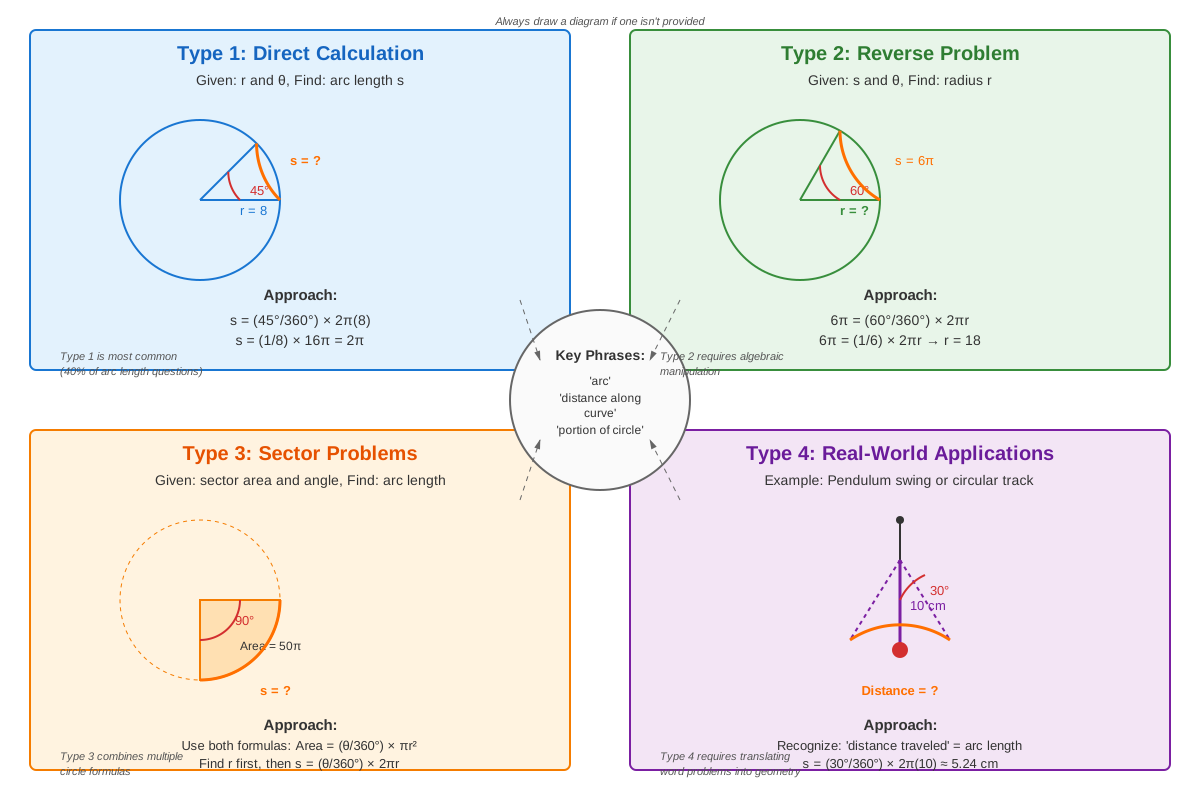
The concept of ACT arc length questions typically involves finding the distance along a circular arc when given information about the circle's radius and the central angle that intercepts the arc. These problems may appear straightforward, but they often require students to convert between degrees and radians, recognize proportional relationships, or combine arc length calculations with other geometric properties. The ACT frequently embeds arc length within more complex scenarios involving sectors, inscribed figures, or real-world applications like pendulum motion or circular tracks.
Mastering arc length connects directly to broader mathematical reasoning skills tested throughout the ACT Math section. This topic reinforces understanding of circles, ratios, and unit conversions while providing a foundation for more advanced concepts in trigonometry and calculus. Students who develop fluency with arc length calculations gain confidence in approaching multi-step geometry problems and improve their ability to recognize when circular measurements are being tested, even when questions don't explicitly use the term "arc length."
Learning Objectives
- [ ] Identify when Arc length is being tested in ACT questions
- [ ] Explain the core rule or strategy behind Arc length calculations
- [ ] Apply Arc length formulas to ACT-style questions accurately
- [ ] Convert between degrees and radians when calculating arc length
- [ ] Determine arc length using proportional relationships without memorized formulas
- [ ] Solve multi-step problems that combine arc length with other geometric properties
- [ ] Recognize real-world contexts where arc length concepts apply on the ACT
Prerequisites
- Circle properties: Understanding radius, diameter, and circumference is essential because arc length represents a fraction of the total circumference
- Angle measurement: Knowledge of degrees and the 360° total in a circle enables proportional reasoning for arc calculations
- Basic algebra: Solving equations and working with formulas is necessary for manipulating arc length relationships
- Proportional reasoning: Arc length problems fundamentally rely on setting up and solving proportions between angles and distances
- Pi (π) calculations: Comfort with π as both an exact value and decimal approximation (3.14) is required for accurate computations
Why This Topic Matters
Arc length appears in real-world applications ranging from engineering and architecture to sports and navigation. Circular tracks, rotating machinery, satellite orbits, and pendulum swings all involve arc length calculations. Understanding this concept enables problem-solving in fields like mechanical engineering, astronomy, and urban planning. The ability to measure curved distances is fundamental to designing everything from highway exit ramps to amusement park rides.
On the ACT Math test, arc length questions appear with moderate frequency—typically 1-2 questions per exam. These questions fall within the Geometry content area, which comprises approximately 35-45% of the ACT Math section. Arc length problems often appear as standalone calculations but can also be embedded within more complex scenarios involving area of sectors, inscribed polygons, or coordinate geometry. The ACT particularly favors questions that test whether students can recognize proportional relationships and apply them efficiently.
Common question formats include: providing a circle's radius and central angle and asking for arc length; giving arc length and radius to find the central angle; presenting real-world scenarios like a Ferris wheel or clock hand movement; and multi-step problems where arc length is one component of a larger geometric calculation. The ACT also tests whether students can work flexibly with both exact answers (in terms of π) and decimal approximations, making computational fluency essential.
Core Concepts
The Arc Length Formula
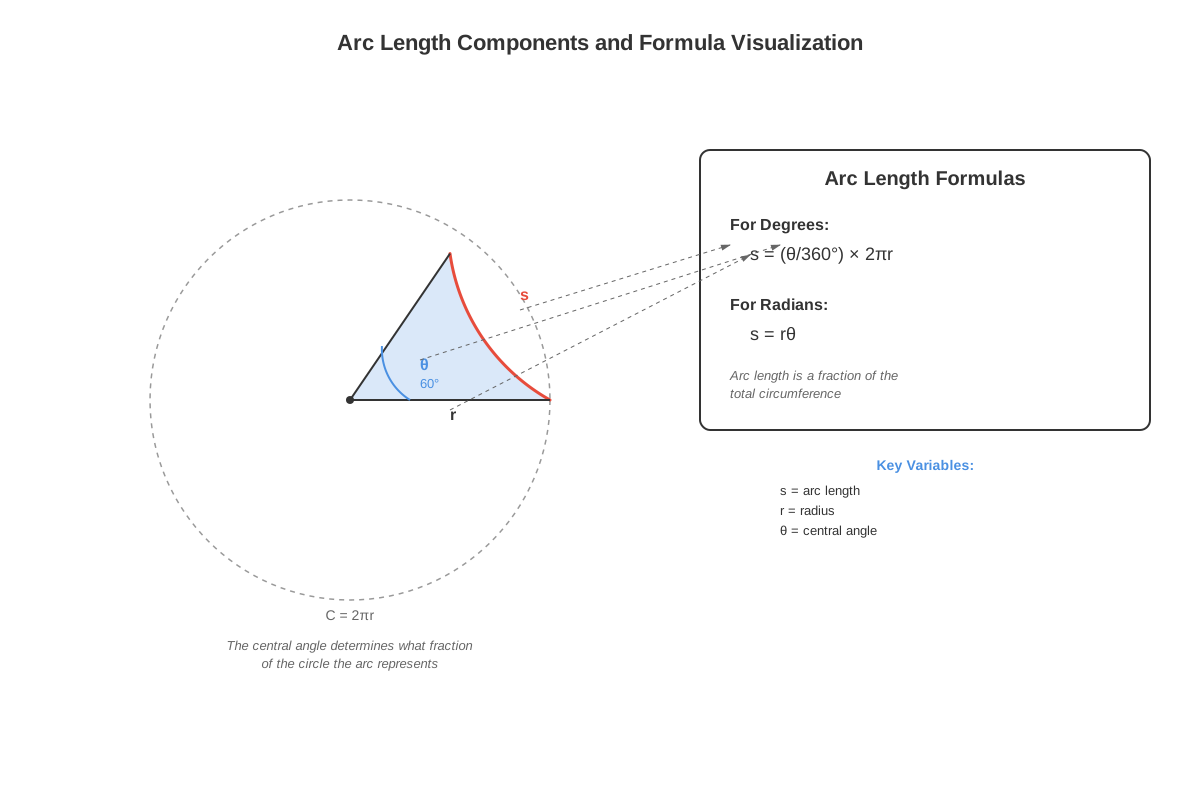
The arc length of a circle is the distance measured along the curved path between two points on the circle's circumference. The fundamental formula for arc length depends on whether angles are measured in degrees or radians:
For angles in degrees:
Arc Length = (θ/360°) × 2πrFor angles in radians:
Arc Length = θrWhere:
- θ (theta) represents the central angle
- r represents the radius of the circle
- π (pi) ≈ 3.14159...
The degree formula works because the arc length is proportional to the central angle. Since a complete circle has 360° and circumference 2πr, any arc represents the fraction θ/360° of the total circumference. The radian formula is simpler because radians are defined such that the arc length equals the radius times the angle measure.
Understanding Central Angles
A central angle is an angle whose vertex is at the center of the circle and whose sides (rays) extend to the circumference. The central angle determines what fraction of the circle's circumference the arc represents. For example:
- A 90° central angle creates an arc that is 1/4 of the circumference
- A 180° central angle creates a semicircular arc (1/2 of the circumference)
- A 60° central angle creates an arc that is 1/6 of the circumference
This proportional relationship is the key to solving most ACT arc length problems, even without memorizing formulas.
The Proportional Method
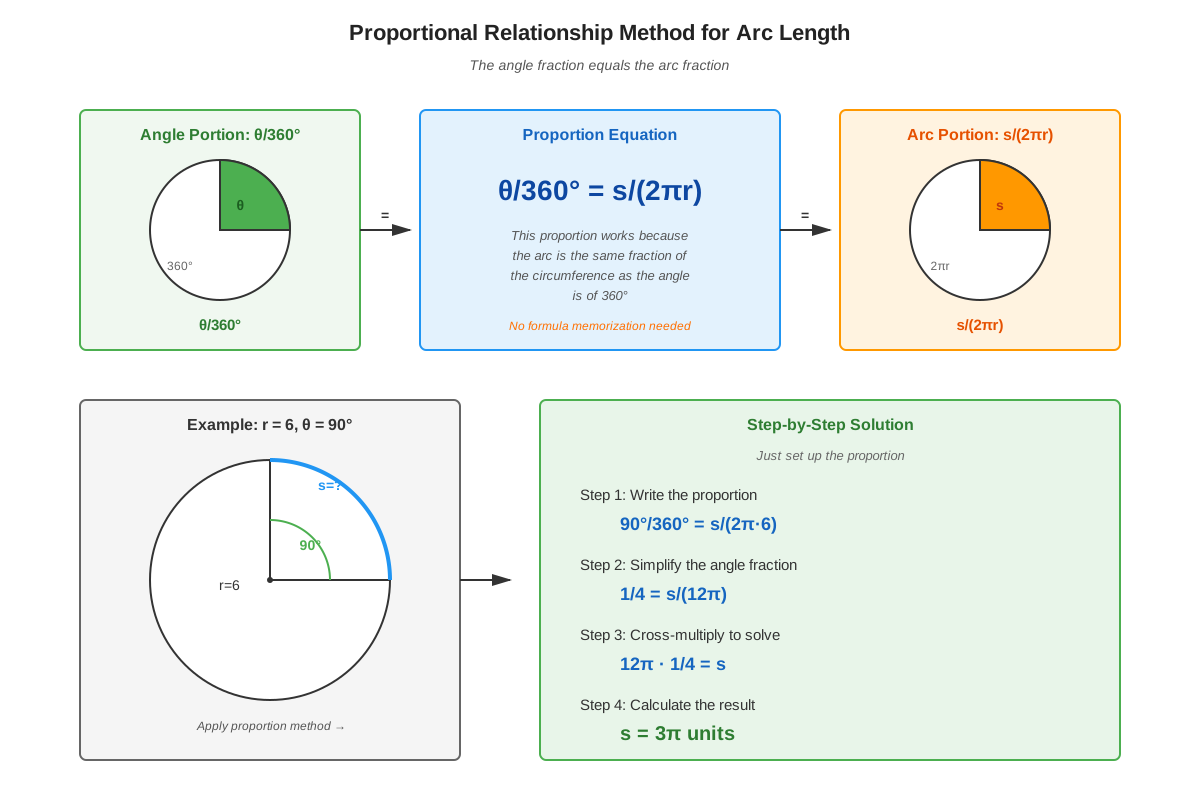
Many students find it easier to solve arc length problems using proportional reasoning rather than memorizing formulas. This method sets up a proportion:
(Central Angle)/(360°) = (Arc Length)/(Circumference)This can be rearranged to solve for any unknown variable. For example, if you know the radius is 10 and the central angle is 72°:
72°/360° = Arc Length/(2π × 10)
1/5 = Arc Length/(20π)
Arc Length = 4π
This approach reinforces conceptual understanding and reduces the chance of formula confusion.
Relationship Between Arc Length and Sector Area
Arc length is closely related to sector area—the area of the "pie slice" region bounded by two radii and an arc. While arc length measures the curved distance, sector area measures the enclosed space. The formulas share similar structure:
| Measurement | Degree Formula | Radian Formula |
|---|---|---|
| Arc Length | (θ/360°) × 2πr | θr |
| Sector Area | (θ/360°) × πr² | (1/2)θr² |
Both use the same proportional relationship with the central angle, but sector area involves r² (like the full circle area formula πr²) while arc length involves r (like the circumference formula 2πr).
Converting Between Degrees and Radians
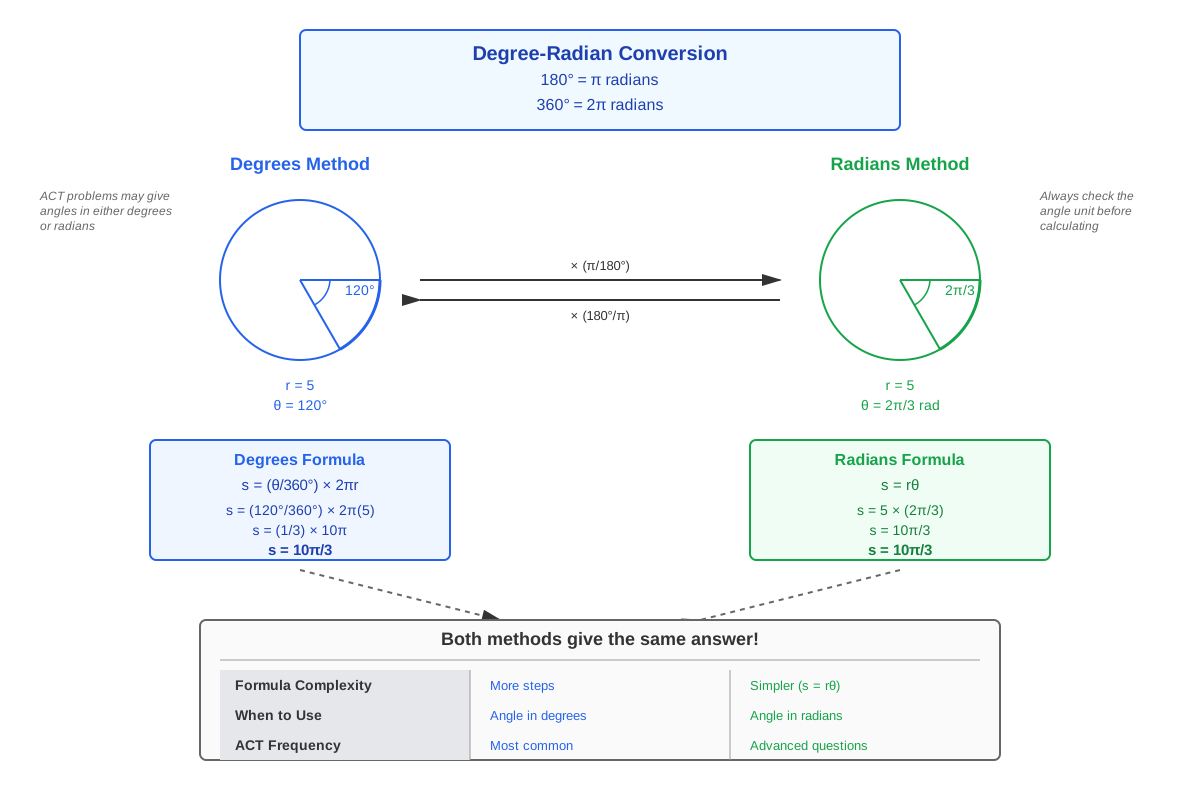
The ACT occasionally requires converting between angle measurements. The conversion relationship is:
180° = π radiansTherefore:
- To convert degrees to radians: multiply by π/180°
- To convert radians to degrees: multiply by 180°/π
For example, 60° = 60 × (π/180) = π/3 radians.
Most ACT problems use degrees, but recognizing radian measure is important for avoiding confusion and for students planning to take calculus.
Special Arc Lengths
Certain angle measures create particularly common arc lengths that appear frequently on standardized tests:
- Quarter circle (90°): Arc length = (1/4) × 2πr = πr/2
- Semicircle (180°): Arc length = (1/2) × 2πr = πr
- 60° angle: Arc length = (1/6) × 2πr = πr/3
- 120° angle: Arc length = (1/3) × 2πr = 2πr/3
Recognizing these common cases enables faster problem-solving and provides benchmarks for checking whether answers are reasonable.
Concept Relationships
Arc length connects to multiple geometric concepts in a hierarchical relationship. At the foundation, circle properties (radius, diameter, circumference) provide the basic measurements needed for any arc calculation. The circumference formula (C = 2πr) serves as the total from which arc length represents a fractional part.
Central angles determine what fraction of the circumference an arc represents, creating the proportional relationship: Central Angle → Determines Fraction → Yields Arc Length. This same proportional reasoning extends to sector area, where the central angle determines what fraction of the total circle area the sector occupies.
Arc length also connects to coordinate geometry when circles are placed on the coordinate plane. Finding arc length may require first determining the radius using the distance formula, then applying arc length calculations. Similarly, inscribed angles and inscribed polygons often create scenarios where arc length must be calculated after determining central angles through angle relationships.
The relationship map flows as follows:
Circle Properties (radius, circumference) → Central Angle Measurement → Proportional Relationship → Arc Length Calculation → Applications (sector area, real-world problems)
Understanding these connections helps students recognize that arc length problems rarely appear in isolation—they're typically embedded within broader geometric reasoning tasks that test multiple concepts simultaneously.
High-Yield Facts
⭐ Arc length equals the fraction of the circle's circumference determined by the central angle: Arc Length = (θ/360°) × 2πr
⭐ The proportional relationship is key: (Central Angle)/(360°) = (Arc Length)/(Circumference)
⭐ A semicircle (180°) has arc length equal to πr, which is half the circumference
⭐ Arc length in radians simplifies to s = θr, where s is arc length, θ is in radians, and r is radius
⭐ The central angle must be measured from the circle's center, not from a point on the circumference
- Arc length is always measured in linear units (inches, centimeters, meters), never in degrees
- A full circle (360°) has arc length equal to the circumference: 2πr
- Doubling the radius doubles the arc length for the same central angle
- Doubling the central angle doubles the arc length for the same radius
- Arc length problems often require leaving answers in terms of π rather than using decimal approximations
- The ACT may present arc length in real-world contexts like clock hands, wheels, or circular tracks
- When the central angle equals 60°, the arc length is exactly 1/6 of the circumference
Quick check — test yourself on Arc length so far.
Try Flashcards →Common Misconceptions
Misconception: Arc length is measured in degrees like angles. → Correction: Arc length is a distance measurement using linear units (feet, meters, etc.), not angular units. The central angle is measured in degrees, but the arc length itself represents a curved distance.
Misconception: The arc length formula is Arc Length = θ × r when using degrees. → Correction: When using degrees, you must include the conversion factor: Arc Length = (θ/360°) × 2πr. The simpler formula s = θr only works when θ is measured in radians.
Misconception: A larger central angle always means a longer arc length. → Correction: While this is true for circles with the same radius, a small circle with a large central angle can have a shorter arc than a large circle with a small central angle. Arc length depends on both the angle and the radius.
Misconception: You can find arc length by multiplying the radius by the angle in degrees. → Correction: This only works for angles in radians. For degrees, you must first find what fraction of 360° the angle represents, then multiply that fraction by the circumference.
Misconception: Arc length and sector area use the same formula. → Correction: While both use proportional relationships with the central angle, arc length uses (θ/360°) × 2πr while sector area uses (θ/360°) × πr². Arc length is one-dimensional (distance) while sector area is two-dimensional (space).
Misconception: The diameter can be substituted directly for radius in arc length formulas. → Correction: If given diameter d, you must first convert to radius (r = d/2) before applying arc length formulas. Using diameter directly will produce an answer that's twice the correct value.
Worked Examples
Example 1: Basic Arc Length Calculation
Problem: A circle has a radius of 12 inches. Find the length of an arc intercepted by a central angle of 150°.
Solution:
Step 1: Identify the given information
- Radius (r) = 12 inches
- Central angle (θ) = 150°
Step 2: Choose an approach. We'll use the proportional method to reinforce conceptual understanding.
Step 3: Set up the proportion
(Central Angle)/(360°) = (Arc Length)/(Circumference)
150°/360° = Arc Length/(2π × 12)
Step 4: Simplify the fraction
150/360 = 5/12Step 5: Solve for arc length
5/12 = Arc Length/(24π)
Arc Length = (5/12) × 24π
Arc Length = 5 × 2π
Arc Length = 10π inches
Step 6: Provide both exact and approximate answers
- Exact answer: 10π inches
- Approximate answer: 10 × 3.14 ≈ 31.4 inches
Connection to Learning Objectives: This example demonstrates applying the arc length formula to an ACT-style question and using proportional relationships to solve efficiently.
Example 2: Finding Central Angle from Arc Length
Problem: A circular running track has a radius of 50 meters. If a runner covers an arc length of 25π meters, through what central angle (in degrees) has the runner traveled?
Solution:
Step 1: Identify the given information
- Radius (r) = 50 meters
- Arc length = 25π meters
- Unknown: Central angle (θ)
Step 2: Set up the proportion
θ/360° = (Arc Length)/(Circumference)
θ/360° = 25π/(2π × 50)
Step 3: Simplify the right side
θ/360° = 25π/100π
θ/360° = 25/100
θ/360° = 1/4
Step 4: Solve for θ
θ = (1/4) × 360°
θ = 90°Answer: The runner has traveled through a central angle of 90° (one quarter of the circle).
Verification: This makes sense because 25π is exactly 1/4 of the circumference (100π), so the central angle should be 1/4 of 360°.
Connection to Learning Objectives: This example shows how to work backward from arc length to find the central angle, demonstrating flexibility with the arc length relationship and reinforcing proportional reasoning.
Exam Strategy
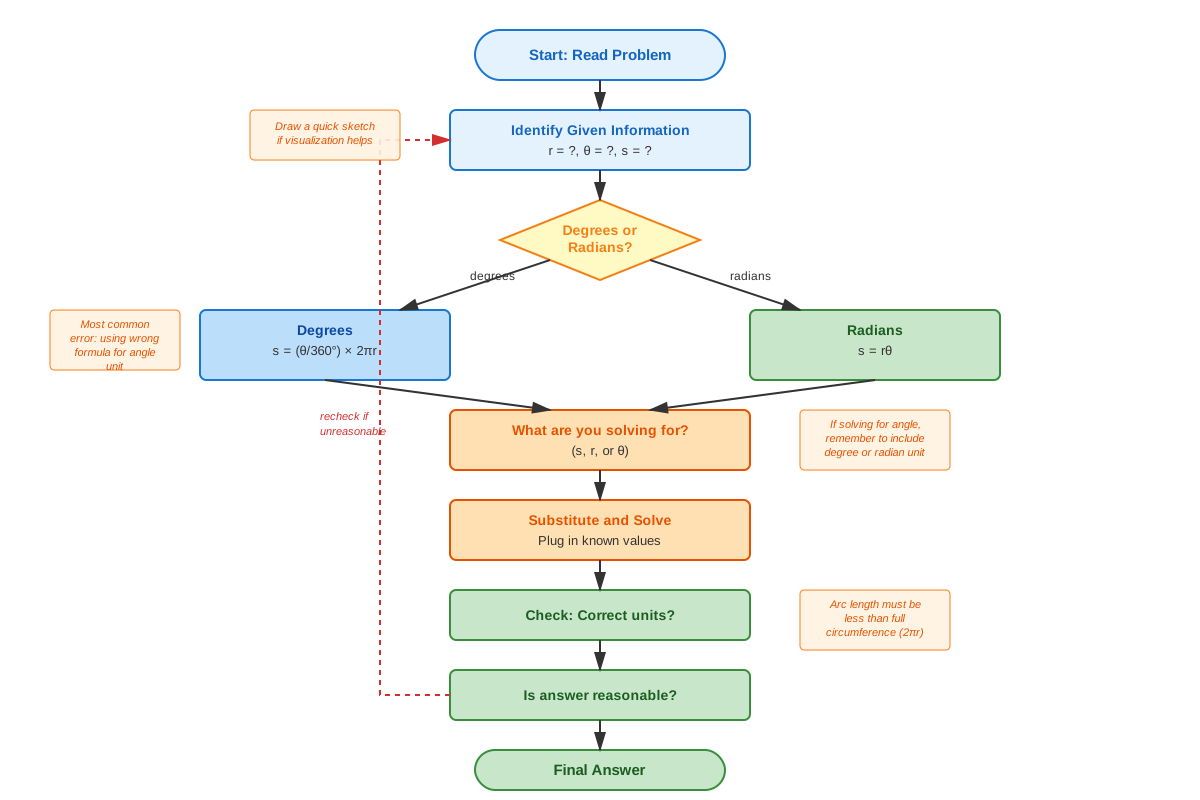
When approaching ACT arc length questions, follow this systematic process:
Step 1: Identify the question type. Look for trigger words and phrases including "arc length," "distance along the circle," "curved path," or real-world scenarios involving circular motion (wheels, clocks, tracks). Questions may also describe "a portion of the circumference" without explicitly using "arc length."
Step 2: Extract and organize information. Identify what's given (radius or diameter, central angle, arc length) and what's being asked. Draw a quick diagram if one isn't provided—visual representation prevents errors and clarifies relationships.
Step 3: Check angle units. Determine whether angles are in degrees (most common on ACT) or radians. If the angle includes π, it's likely in radians.
Step 4: Choose your method. Use the proportional approach (angle/360° = arc/circumference) for conceptual clarity, or apply the formula directly if you're confident. The proportional method often prevents formula confusion and makes checking work easier.
Step 5: Decide on answer format. ACT questions typically specify whether to leave answers in terms of π or use decimal approximations. Exact answers (with π) are often preferred and avoid rounding errors.
Exam Tip: If you forget the formula, remember that arc length is simply a fraction of the circumference. Ask yourself: "What fraction of the full circle does this angle represent?" Then multiply that fraction by 2πr.
Process of elimination strategies:
- Eliminate answers that exceed the circumference (unless the angle exceeds 360°)
- For angles less than 180°, arc length must be less than πr (half the circumference)
- Check if answer choices are in consistent units (all with π or all decimal)
- Use benchmark angles: 90° gives πr/2, 180° gives πr, 60° gives πr/3
Time allocation: Arc length problems typically require 45-90 seconds. If a problem takes longer, you may be overcomplicating it—return to the basic proportional relationship. Multi-step problems involving arc length plus other calculations may warrant up to 2 minutes.
Memory Techniques
Mnemonic for the arc length formula: "Angle Over Total Times Circumference" (AOTTC)
- Angle (θ) Over Total (360°) Times Circumference (2πr)
- This gives: (θ/360°) × 2πr
Visualization strategy: Picture a pizza. The arc length is the crust along one slice. The bigger the slice angle, the longer the crust. The bigger the pizza (radius), the longer the crust for the same angle. This concrete image reinforces the proportional relationships.
"Fraction Action" technique: Remember that arc length problems are always about fractions of the whole circle. The central angle tells you what fraction: divide the angle by 360° to get your fraction, then multiply by the circumference.
Radian reminder: "Radians Remove Ratio" - When using radians, you don't need the 360° ratio; just multiply angle times radius (s = θr).
Benchmark angles acronym: "QSTT" for Quarter (90° = πr/2), Semi (180° = πr), Third (120° = 2πr/3), Twelfth (30° = πr/6). These common angles provide quick reference points.
Summary
Arc length measures the distance along a curved portion of a circle's circumference and represents one of the most testable concepts in ACT plane geometry. The fundamental principle is that arc length is proportional to the central angle: the arc represents the same fraction of the circumference that the central angle represents of 360°. This relationship can be expressed through the formula Arc Length = (θ/360°) × 2πr for angles in degrees, or more simply as s = θr for angles in radians. Success on ACT arc length questions requires recognizing when circular measurements are being tested, efficiently applying proportional reasoning, and working flexibly with both exact answers (in terms of π) and decimal approximations. Students must also connect arc length to related concepts like sector area, circumference, and central angles, as the ACT frequently embeds arc length within multi-step geometry problems. Mastery comes from understanding the underlying proportional relationship rather than merely memorizing formulas, enabling students to adapt to varied question formats and real-world applications.
Key Takeaways
- Arc length is always a fraction of the circumference determined by the central angle: (θ/360°) × 2πr
- The proportional relationship (angle/360° = arc/circumference) is the key to solving all arc length problems
- Arc length is measured in linear units (inches, meters), not angular units (degrees)
- Common benchmark angles (90°, 180°, 60°) produce predictable arc lengths worth memorizing
- ACT questions may test arc length directly or embed it within sector area, coordinate geometry, or real-world scenarios
- Always verify whether angles are in degrees or radians before calculating
- Drawing a diagram and checking whether your answer is reasonable relative to the full circumference prevents most errors
Related Topics
Sector Area: Once students master arc length (the perimeter of a sector), they can progress to calculating sector area (the space enclosed by two radii and an arc). Both concepts use identical proportional reasoning with the central angle.
Radian Measure: Understanding arc length provides the foundation for radians, where one radian is defined as the angle that produces an arc length equal to the radius. This concept is essential for trigonometry and calculus.
Circular Motion and Angular Velocity: Arc length calculations extend to physics applications involving objects moving along circular paths, where distance traveled relates to angular displacement.
Inscribed Angles and Polygons: Many complex ACT geometry problems combine arc length with inscribed angle theorems, requiring students to first find central angles before calculating arc lengths.
Coordinate Geometry of Circles: When circles are placed on the coordinate plane, finding arc length may require first determining the radius using the distance formula, integrating multiple geometric concepts.
Practice CTA
Now that you've mastered the core concepts of arc length, it's time to solidify your understanding through practice! Work through the practice questions to test your ability to identify arc length problems, apply the proportional relationships, and solve efficiently under timed conditions. Use the flashcards to reinforce key formulas and benchmark values until they become automatic. Remember, arc length appears on virtually every ACT Math test—your investment in mastering this topic will directly translate to points on test day. Approach each practice problem systematically, check your work using the strategies outlined above, and build the confidence you need to tackle any arc length question the ACT presents!
Sign up free to keep reading
Create a free AnvayaPrep account to finish this ACT guide on Arc length — plus flashcards and practice questions.