Overview
The sector area is a fundamental concept in plane geometry that appears regularly on the ACT Math test. A sector is a "slice" of a circle, bounded by two radii and the arc between them—imagine a piece of pie cut from a circular pie. Understanding how to calculate the area of this slice is essential for success on geometry questions that involve circles, angles, and proportional reasoning.
On the ACT, sector area questions test a student's ability to work with circles, understand proportional relationships, and apply formulas efficiently under time pressure. These questions often appear in combination with other geometric concepts such as arc length, central angles, and circle properties. Mastering sector area calculations enables students to tackle complex multi-step problems that integrate several geometric principles. The topic typically appears 1-2 times per ACT Math section, making it a high-yield area for focused study.
Sector area connects directly to broader mathematical concepts including proportional reasoning, angle measurement (both degrees and radians), and the fundamental properties of circles. Students who understand sector area can more easily grasp related topics such as arc length, segment area, and even trigonometric applications involving circular functions. The proportional thinking required for sector problems—recognizing that a sector's area relates to the full circle's area in the same way the central angle relates to 360°—is a critical skill that extends beyond geometry into data analysis and probability questions on the ACT.
Learning Objectives
- [ ] Identify when Sector area is being tested in ACT Math questions
- [ ] Explain the core rule or strategy behind Sector area calculations
- [ ] Apply Sector area formulas to ACT-style questions accurately
- [ ] Calculate sector area when given radius and central angle in degrees
- [ ] Determine the central angle when given sector area and radius
- [ ] Solve multi-step problems combining sector area with other circle properties
- [ ] Convert between different representations of sector size (angle, area, arc length)
Prerequisites
- Circle area formula (A = πr²): Essential because sector area is calculated as a fraction of the total circle area
- Basic angle measurement in degrees: Necessary to understand central angles and their relationship to the 360° in a complete circle
- Proportional reasoning: Required to set up the fundamental relationship between sector angle and sector area
- Radius and diameter relationships: Needed to work with circle measurements when only one dimension is provided
- Basic algebraic manipulation: Important for solving equations when the sector area or angle is unknown
Why This Topic Matters
In real-world applications, sector area calculations appear in numerous practical contexts. Engineers use sector area when designing circular components with specific angular ranges, such as gears, fan blades, or radar coverage zones. Architects calculate sector areas when planning curved spaces or circular features in buildings. Agricultural planners use sector calculations for irrigation systems with rotating sprinklers. Urban planners apply these concepts when designing roundabouts or circular parks with designated sections. Even in everyday life, understanding sector area helps when dividing circular pizzas fairly or calculating the coverage area of security cameras with specific viewing angles.
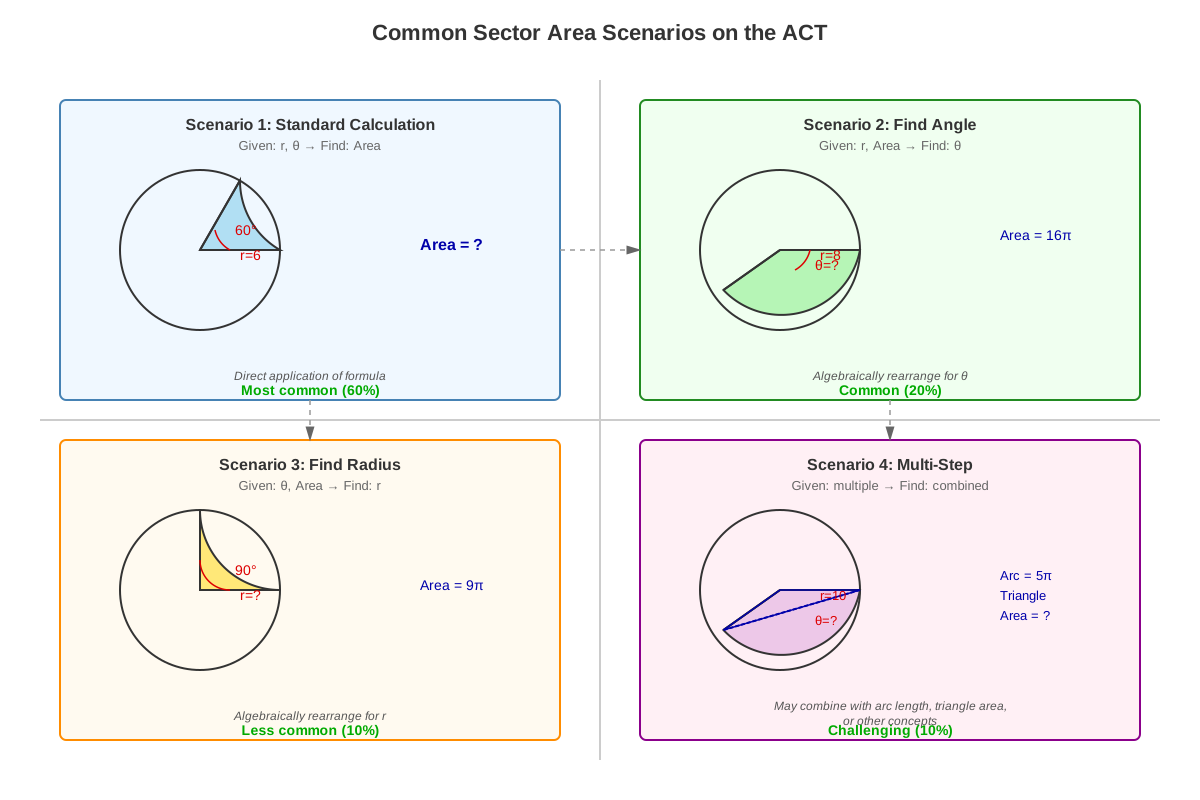
On the ACT Math test, sector area questions appear with notable frequency—typically 1-2 questions per exam, representing approximately 2-3% of the 60-question Math section. These questions usually fall in the medium difficulty range, appearing in questions 20-45 of the test. The ACT presents sector area problems in several formats: straightforward calculation questions where students must find the area given a radius and angle; reverse problems where students must determine an angle or radius from a given sector area; and complex multi-step problems that combine sector area with arc length, perimeter calculations, or coordinate geometry.
Common question formats include: "What is the area of a sector with central angle 60° and radius 12?" or "A sector has area 15π square units and radius 6 units. What is the measure of its central angle?" The ACT also tests sector area through word problems involving real-world scenarios like pizza slices, clock faces, or circular gardens. Questions may provide diagrams or require students to visualize the geometric situation from a verbal description. Understanding sector area is particularly valuable because it often appears in the higher-scoring questions that differentiate students aiming for scores above 30.
Core Concepts
Definition of a Sector
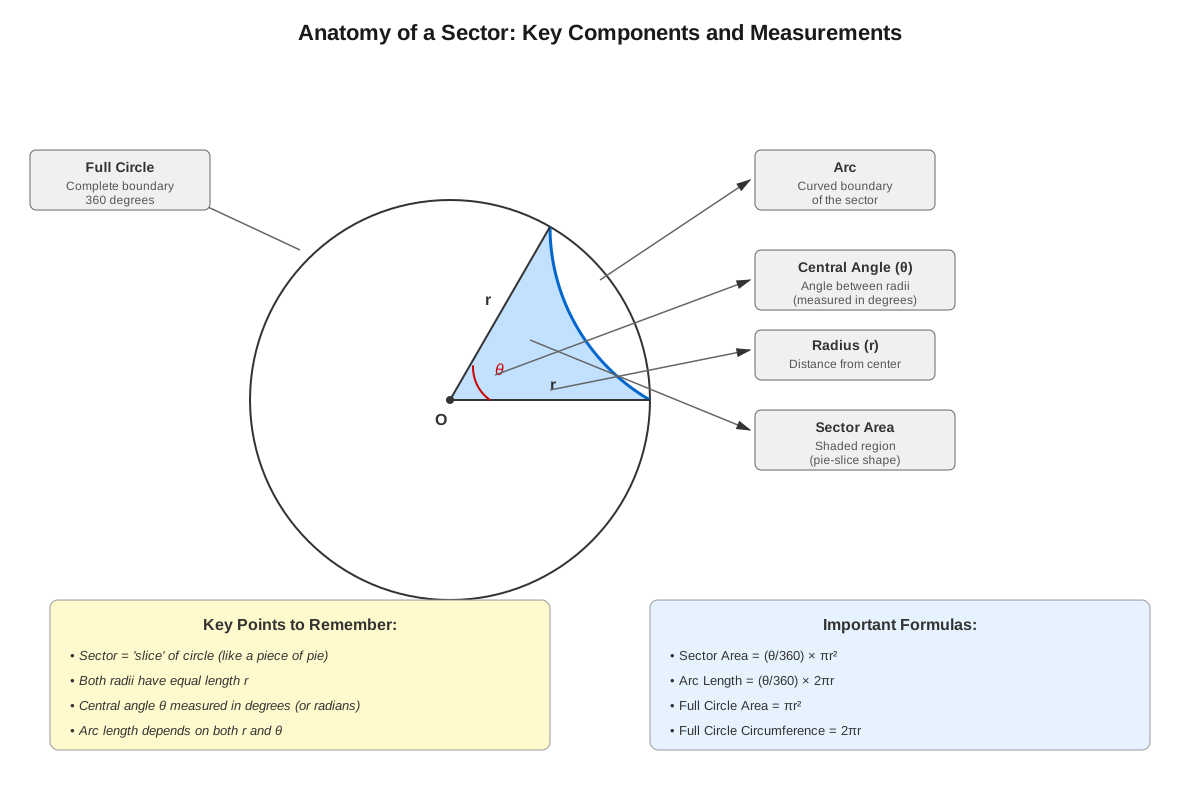
A sector is a region of a circle enclosed by two radii and the arc connecting them. Think of it as a wedge-shaped piece of the circle. Every sector has three key components: the central angle (the angle formed by the two radii at the center of the circle), the radius (the distance from the center to the edge), and the arc (the curved boundary of the sector). The central angle determines what fraction of the entire circle the sector represents.
Sectors come in two types: minor sectors (with central angles less than 180°) and major sectors (with central angles greater than 180°). On the ACT, questions almost always involve minor sectors unless explicitly stated otherwise. The sector area formula applies to both types, but students must be careful to use the correct angle measurement.
The Fundamental Sector Area Formula
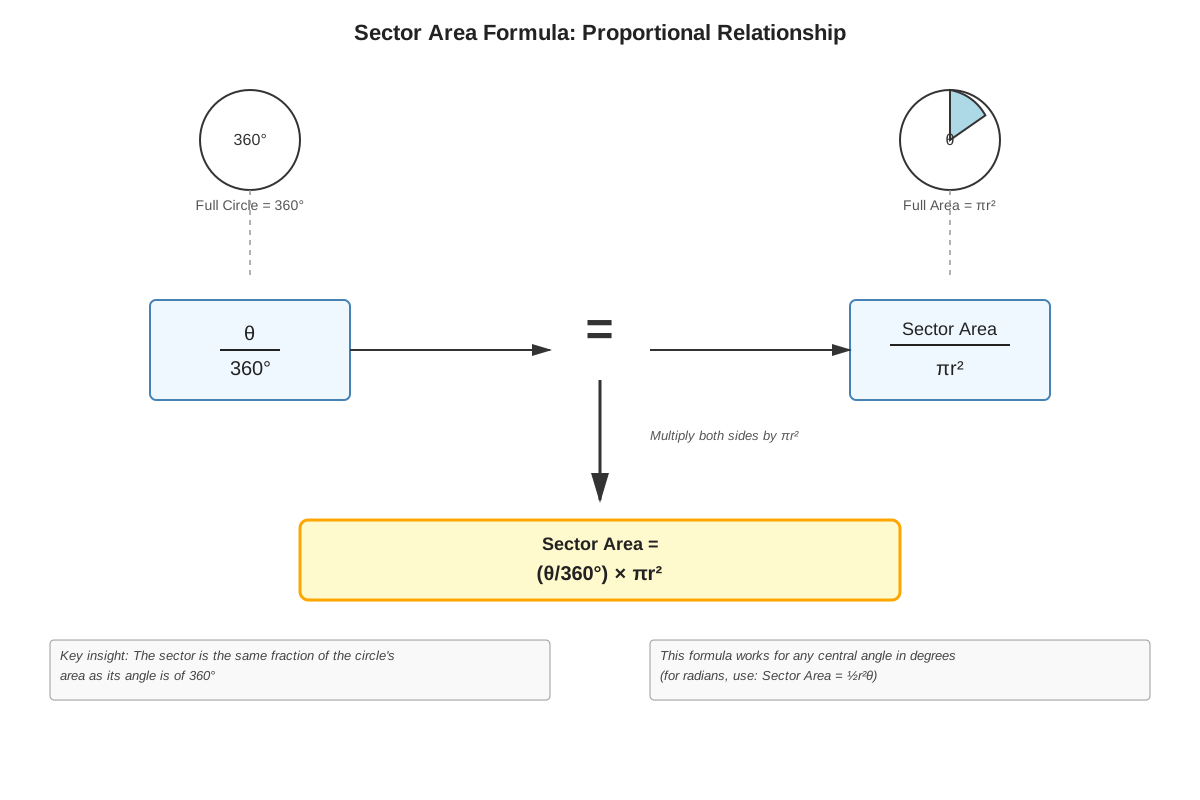
The sector area formula derives from proportional reasoning. Since a sector is a fraction of a circle, its area equals that same fraction of the total circle area. The formula is:
Sector Area = (θ/360°) × πr²Where:
- θ (theta) = the central angle in degrees
- r = the radius of the circle
- πr² = the area of the complete circle
This formula works because the ratio θ/360° represents what fraction of the complete circle the sector occupies. If the central angle is 90°, the sector is 90/360 = 1/4 of the circle, so its area is 1/4 of the total circle area.
Step-by-Step Calculation Process
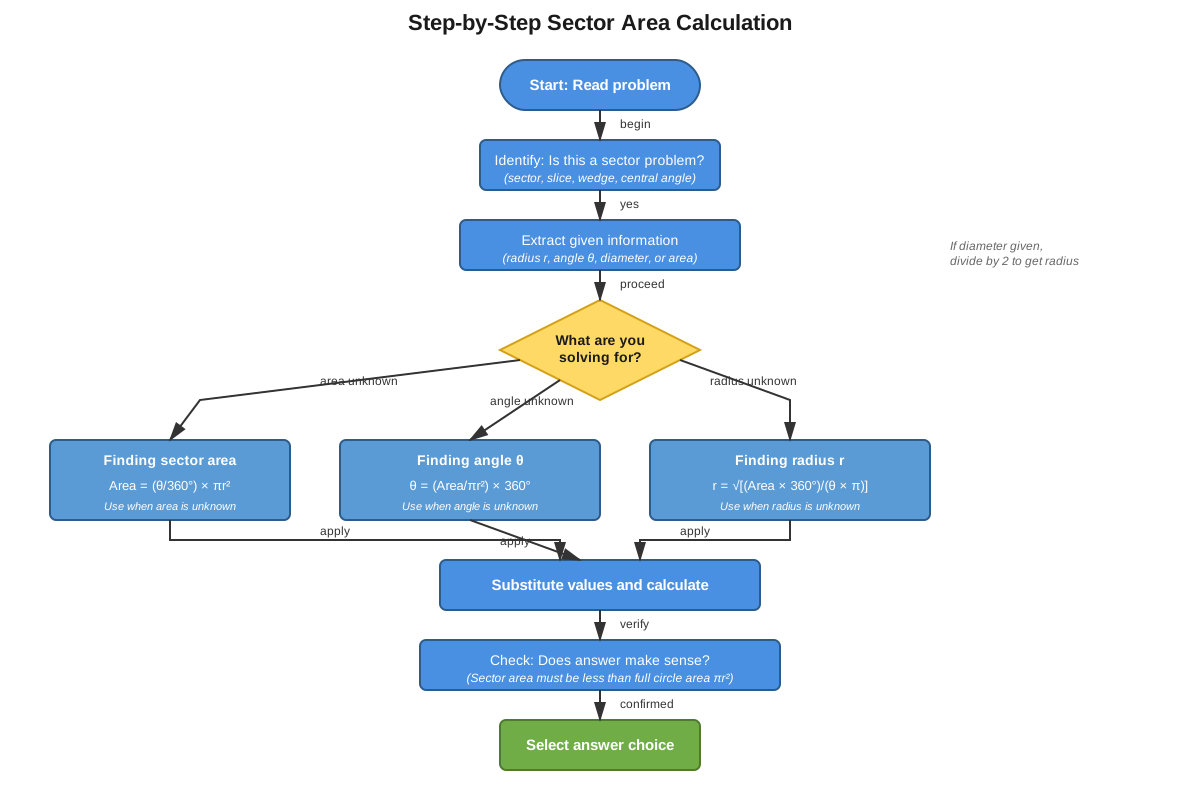
To calculate sector area efficiently on the ACT, follow this systematic approach:
- Identify the given information: Determine what values are provided (radius, diameter, central angle)
- Convert if necessary: If given diameter, convert to radius (r = d/2); ensure angle is in degrees
- Set up the formula: Write out the sector area formula with the known values
- Simplify the fraction: Reduce θ/360° to lowest terms before multiplying
- Calculate the result: Multiply the simplified fraction by πr²
- Check the answer format: Determine if the answer should be in terms of π or as a decimal approximation
Alternative Formula Representations
The sector area formula can be written in several equivalent forms, each useful in different situations:
| Formula Form | When to Use | Notes |
|---|---|---|
| A = (θ/360°) × πr² | Standard ACT problems with degrees | Most common form |
| A = (1/2)r²θ | When angle given in radians | Rarely on ACT, but useful for advanced students |
| A = (arc length × r)/2 | When arc length is known instead of angle | Derived from combining arc and area formulas |
| A = πr²(percentage/100) | When sector size given as percentage | Useful for word problems |
Working Backwards: Finding Angles or Radii
Many ACT questions require solving for the central angle or radius when the sector area is given. This involves algebraic manipulation of the sector area formula:
To find the central angle θ:
θ = (Sector Area × 360°)/(πr²)To find the radius r:
r = √[(Sector Area × 360°)/(πθ)]These reverse calculations test algebraic reasoning and are common in medium-to-hard ACT questions. Students must be comfortable rearranging formulas and solving for different variables.
Relationship Between Sector Area and Arc Length
Sector area and arc length are closely related concepts that often appear together on the ACT. The arc length formula is:
Arc Length = (θ/360°) × 2πrNotice the parallel structure: both sector area and arc length use the same proportional relationship (θ/360°). This connection allows students to solve problems where both measurements are involved. For example, if you know the arc length and radius, you can find the central angle, then use that angle to calculate the sector area.
The relationship can also be expressed as:
Sector Area = (Arc Length × r)/2This formula is particularly useful when the problem provides arc length directly rather than the central angle.
Practical Calculation Tips
When calculating sector areas on the ACT, several strategies improve speed and accuracy:
- Simplify fractions first: Always reduce θ/360° before multiplying by πr². For example, 90/360 = 1/4 is much easier to work with.
- Recognize common angles: Memorize the simplified fractions for common angles (30° = 1/12, 45° = 1/8, 60° = 1/6, 90° = 1/4, 120° = 1/3, 180° = 1/2)
- Leave π in the answer: Unless the question asks for a decimal approximation, leave answers in terms of π for exact values
- Use the answer choices: On multiple-choice questions, the answer format (with π or without) provides clues about the expected approach
- Check reasonableness: A sector with a 90° angle should have exactly 1/4 the area of the full circle—use this logic to verify answers
Concept Relationships
The concepts within sector area form a logical progression. The definition of a sector establishes the geometric object being studied → this leads to understanding the proportional relationship between the sector and the full circle → which generates the fundamental sector area formula → this formula can be manipulated algebraically to solve for different variables → and connects to the arc length formula through the same proportional reasoning.
Sector area builds directly on prerequisite knowledge of circle area (πr²), as the sector formula is simply a fractional portion of this complete area. The concept requires proportional reasoning, since recognizing that θ/360° represents a fraction of the whole circle is essential to understanding why the formula works. Angle measurement knowledge is critical, as the central angle must be correctly identified and used in degree measure.
Sector area connects forward to several related topics. Understanding sectors enables students to calculate segment area (the region between a chord and an arc), which equals sector area minus triangle area. Sector concepts extend to three-dimensional geometry when calculating surface areas of cones or volumes of cone sections. The proportional reasoning developed through sector problems applies to probability questions involving spinners or circular dartboards, where the probability of landing in a region equals the ratio of that region's area to the total area.
High-Yield Facts
⭐ The sector area formula is: A = (θ/360°) × πr², where θ is the central angle in degrees and r is the radius
⭐ A sector with a 90° central angle has exactly 1/4 the area of the complete circle
⭐ To find the central angle when given sector area: θ = (Sector Area × 360°)/(πr²)
⭐ Sector area and arc length use the same proportional relationship: θ/360° of the whole
⭐ Always simplify the fraction θ/360° before multiplying by πr² to save time and reduce errors
- A semicircle is a sector with a 180° central angle and area (1/2)πr²
- When the diameter is given instead of radius, remember to divide by 2 before using the formula
- Sector area can be expressed as (arc length × radius)/2 when arc length is known
- Common angle fractions: 30° = 1/12, 45° = 1/8, 60° = 1/6, 120° = 1/3 of the circle
- Unless specifically asked for a decimal approximation, leave answers in terms of π for exact values
- The units for sector area are always square units (square inches, square centimeters, etc.)
- A sector with central angle greater than 180° is called a major sector and represents more than half the circle
- The perimeter of a sector equals 2r + arc length (two radii plus the curved arc)
Quick check — test yourself on Sector area so far.
Try Flashcards →Common Misconceptions
Misconception: The sector area formula is (θ/180°) × πr² → Correction: The denominator must be 360° because there are 360° in a complete circle, not 180°. Using 180° would give you twice the correct sector area. The fraction θ/360° represents what portion of the full circle the sector occupies.
Misconception: When given the diameter, use it directly as r in the formula → Correction: The diameter must be divided by 2 to get the radius before using the sector area formula. The formula specifically requires the radius, not the diameter. If d = 10, then r = 5, and you must use 5 in the calculation.
Misconception: Sector area and arc length are the same thing → Correction: Sector area measures the two-dimensional space inside the sector (in square units), while arc length measures only the curved boundary (in linear units). They use similar proportional formulas but calculate completely different quantities. Arc length = (θ/360°) × 2πr, while sector area = (θ/360°) × πr².
Misconception: A 60° sector has 60% of the circle's area → Correction: A 60° sector has 60/360 = 1/6 ≈ 16.67% of the circle's area. The central angle in degrees must be divided by 360°, not converted directly to a percentage. To find the percentage, calculate (θ/360) × 100%.
Misconception: The formula only works for angles less than 180° → Correction: The sector area formula works for any central angle from 0° to 360°. For angles greater than 180° (major sectors), simply use the given angle in the formula. For example, a 270° sector has area (270/360)πr² = (3/4)πr², which correctly represents three-quarters of the circle.
Misconception: You can add sector areas by adding their central angles → Correction: While you can add central angles to find a combined angle, you cannot simply add angles to get combined area unless the sectors have the same radius. Sector area depends on both angle AND radius. Two sectors with the same angle but different radii have different areas.
Misconception: π should always be approximated as 3.14 in calculations → Correction: On the ACT, leave π in symbolic form unless the question specifically asks for a decimal approximation or the answer choices are given as decimals. Answers like "25π square units" are more accurate and often easier to calculate than "78.5 square units."
Worked Examples
Example 1: Standard Sector Area Calculation
Problem: A circle has a radius of 8 inches. What is the area of a sector with a central angle of 135°?
Solution:
Step 1: Identify the given information
- Radius r = 8 inches
- Central angle θ = 135°
Step 2: Write the sector area formula
Sector Area = (θ/360°) × πr²Step 3: Substitute the known values
Sector Area = (135°/360°) × π(8)²Step 4: Simplify the fraction first
135/360 = 27/72 = 3/8(Divide both numerator and denominator by 45)
Step 5: Calculate r²
8² = 64Step 6: Multiply to find the final answer
Sector Area = (3/8) × π × 64 = (3 × 64)/8 × π = 192/8 × π = 24π square inchesAnswer: 24π square inches (or approximately 75.4 square inches if a decimal is required)
Connection to Learning Objectives: This problem demonstrates the core application of the sector area formula, requiring students to identify the given information, apply the formula correctly, and simplify efficiently—all essential skills for ACT success.
Example 2: Finding the Central Angle
Problem: A sector of a circle with radius 6 cm has an area of 15π cm². What is the measure of the central angle?
Solution:
Step 1: Identify what we're solving for
- We need to find θ (the central angle)
- Given: r = 6 cm, Sector Area = 15π cm²
Step 2: Write the sector area formula
Sector Area = (θ/360°) × πr²Step 3: Substitute the known values
15π = (θ/360°) × π(6)²Step 4: Simplify the right side
15π = (θ/360°) × π × 36
15π = (θ/360°) × 36π
Step 5: Divide both sides by π
15 = (θ/360°) × 36Step 6: Solve for θ
15 = 36θ/360°
15 × 360° = 36θ
5400° = 36θ
θ = 5400°/36 = 150°Answer: The central angle is 150°
Alternative approach using the rearranged formula:
θ = (Sector Area × 360°)/(πr²)
θ = (15π × 360°)/(π × 36)
θ = (15 × 360°)/36
θ = 5400°/36 = 150°
Connection to Learning Objectives: This problem requires working backwards from the sector area to find the central angle, demonstrating algebraic manipulation of the formula and the ability to solve for different variables—a common ACT question type that tests deeper understanding.
Example 3: Multi-Step Problem with Arc Length
Problem: A sector has a central angle of 72° and an arc length of 4π meters. What is the area of the sector?
Solution:
Step 1: Recognize that we need to find the radius first
- Given: θ = 72°, arc length = 4π meters
- Need to find: radius, then sector area
Step 2: Use the arc length formula to find radius
Arc Length = (θ/360°) × 2πr
4π = (72°/360°) × 2πr
Step 3: Simplify the fraction
72/360 = 1/5
4π = (1/5) × 2πr
4π = (2πr)/5
Step 4: Solve for r
20π = 2πr
r = 10 meters
Step 5: Now calculate the sector area using the radius we found
Sector Area = (θ/360°) × πr²
Sector Area = (72°/360°) × π(10)²
Sector Area = (1/5) × π × 100
Sector Area = 20π square metersAnswer: 20π square meters (or approximately 62.8 square meters)
Connection to Learning Objectives: This multi-step problem combines arc length and sector area concepts, requiring students to recognize the relationship between these formulas and solve a more complex problem typical of higher-difficulty ACT questions.
Exam Strategy
When approaching ACT sector area questions, begin by quickly scanning for the key information: radius (or diameter), central angle, and what the question is asking for. Circle or underline these values directly on the test booklet to avoid confusion. The most common trigger phrases include "sector of a circle," "central angle," "wedge-shaped region," or real-world contexts like "slice of pizza" or "portion of a circular garden."
Process-of-elimination strategies are particularly effective for sector area questions. First, eliminate any answer choices that don't match the expected format—if the given information includes π, the answer likely will too. Second, use reasonableness checks: a sector with a 90° angle must have exactly 1/4 the area of the full circle, so calculate the full circle area and divide by 4 to verify. If your answer is larger than the full circle area (πr²), you've made an error. Third, check units carefully—sector area must be in square units, never linear units.
Time allocation for sector area questions should typically be 45-60 seconds for straightforward calculations and up to 90 seconds for multi-step problems. If a problem requires finding the radius first (from diameter or arc length) before calculating sector area, budget the full 90 seconds. Don't spend more than 2 minutes on any single sector area question—if you're stuck, mark it for review and move on.
Key trigger words and phrases to watch for:
- "Sector" or "sector area" (direct indication)
- "Central angle" (essential component)
- "Wedge," "slice," or "piece" (informal sector descriptions)
- "Shaded region" in a circle diagram (often a sector)
- "What fraction of the circle" (proportional reasoning)
- "Arc" combined with area questions (may need both formulas)
Strategic approach sequence:
- Identify if it's truly a sector problem (two radii and an arc)
- Extract all given numerical values
- Determine what's being asked (area, angle, or radius)
- Choose the appropriate formula or formula manipulation
- Simplify fractions before multiplying
- Check answer format against choices
- Verify reasonableness before moving on
Exam Tip: If you're given the diameter instead of radius, immediately write "r = d/2" and calculate the radius before doing anything else. This prevents the common error of using diameter in the formula.
Exam Tip: For questions asking "what fraction of the circle," you can often answer by just simplifying θ/360° without calculating the actual area—the fraction of the angle equals the fraction of the area.
Memory Techniques
The "Pizza Proportion" Mnemonic: Remember that Sector area equals Slice of the Pie. The formula is "Angle Over 360 times Pie R squared" (A-O-360-P-R²). Visualize cutting a pizza: the bigger the angle, the bigger the slice, proportional to the whole pizza.
The "360 Circle" Visualization: Picture a circle with "360°" written at the center. Any sector is a fraction with 360° as the denominator. This mental image reinforces why we always divide by 360° in the formula.
Common Angle Fraction Acronym - "SAFE":
- Sixty degrees = 1/Six of circle
- Acute right angle (45°) = 1/Eight of circle
- Fourth of circle = 90° (right angle)
- Eighty degrees... wait, this doesn't work perfectly, but remember: Straight angle (180°) = 1/2
Better Common Angles Memory Device: "3-6-9-12 Clock Fractions"
- 3 o'clock (90°) = 1/4 circle
- 6 o'clock (180°) = 1/2 circle
- 9 o'clock (270°) = 3/4 circle
- 12 o'clock (360°) = 1 complete circle
The "Two Formulas, Same Fraction" Rule: Both sector area and arc length use (θ/360°), but:
- Area gets πr² (area formula - squared)
- Arc gets 2πr (circumference formula - not squared)
Remember: "Area is Always Squared" - if you see r², you're calculating area; if you see 2r, you're calculating length.
Backwards Formula Mnemonic: When solving for angle, remember "AMPS":
- Angle equals
- Multiply area times 360
- Pie r squared
- Separates them (divide)
This gives you: θ = (A × 360)/(πr²)
Summary
Sector area is a high-yield ACT Math topic that tests understanding of circles, proportional reasoning, and formula application. A sector is a wedge-shaped portion of a circle bounded by two radii and an arc, and its area is calculated using the formula: Sector Area = (θ/360°) × πr², where θ is the central angle in degrees and r is the radius. This formula derives from the fundamental principle that a sector's area is the same fraction of the total circle area as its central angle is of 360°. Success on ACT sector area questions requires three core skills: identifying when sector area is being tested (through trigger words like "sector," "central angle," or "slice"), applying the formula correctly with proper simplification, and manipulating the formula algebraically to solve for different variables. Students must also understand the relationship between sector area and arc length, both of which use the same proportional relationship (θ/360°). Common question types include straightforward calculations, reverse problems requiring students to find angles or radii from given areas, and multi-step problems combining sector concepts with other circle properties. Mastery requires recognizing common angle fractions (90° = 1/4, 60° = 1/6, etc.), simplifying before multiplying, and checking answer reasonableness against the full circle area.
Key Takeaways
- The sector area formula is A = (θ/360°) × πr², where the fraction θ/360° represents what portion of the complete circle the sector occupies
- Always simplify the angle fraction (θ/360°) to lowest terms before multiplying by πr² to improve calculation speed and accuracy
- Sector area and arc length use the same proportional relationship but different circle formulas: area uses πr² while arc length uses 2πr
- When working backwards to find the central angle: θ = (Sector Area × 360°)/(πr²)
- Common angles to memorize: 90° = 1/4 circle, 60° = 1/6 circle, 45° = 1/8 circle, 120° = 1/3 circle, 180° = 1/2 circle
- If given diameter instead of radius, immediately convert (r = d/2) before applying any formulas
- Leave answers in terms of π unless specifically asked for decimal approximations—this is more accurate and often easier to calculate
Related Topics
Arc Length: Directly related to sector area through the same proportional relationship (θ/360°). While sector area measures the two-dimensional space, arc length measures the one-dimensional curved boundary. Mastering sector area makes arc length calculations straightforward since both use identical proportional reasoning.
Segment Area: A segment is the region between a chord and an arc. Calculating segment area requires finding the sector area first, then subtracting the triangular area formed by the two radii and the chord. This advanced topic builds directly on sector area knowledge.
Circle Equations and Coordinate Geometry: Understanding sector area enhances ability to work with circles in the coordinate plane, particularly when questions involve finding areas of regions bounded by circles and lines.
Radians and Advanced Angle Measurement: While the ACT primarily uses degrees, understanding sector area in degrees provides the foundation for the radian-based formula (A = ½r²θ) used in higher mathematics.
Three-Dimensional Geometry: Sector area concepts extend to calculating surface areas of cones and spherical sections, topics that occasionally appear in advanced ACT geometry questions.
Practice CTA
Now that you've mastered the core concepts of sector area, it's time to solidify your understanding through practice! Work through the practice questions to apply these formulas to ACT-style problems, and use the flashcards to reinforce the key formulas and common angle fractions. Remember, sector area questions are high-yield on the ACT—investing 20 minutes in focused practice now can directly translate to points on test day. You've got the knowledge; now build the speed and confidence to execute perfectly under timed conditions. Start practicing, and watch your geometry skills soar!
Sign up free to keep reading
Create a free AnvayaPrep account to finish this ACT guide on Sector area — plus flashcards and practice questions.