Overview
The area of a circle represents one of the most frequently tested geometric concepts on the ACT Math section. This fundamental measurement quantifies the two-dimensional space enclosed within a circular boundary and appears in approximately 2-4 questions per exam, making it a high-yield topic that directly impacts test scores. Understanding how to calculate and manipulate circular area is essential not only for straightforward geometry problems but also for complex multi-step questions involving composite figures, optimization scenarios, and real-world applications.
Mastery of circular area calculations extends beyond simple formula application. The ACT frequently embeds this concept within word problems, coordinate geometry questions, and problems requiring proportional reasoning. Students must recognize when a question involves circular area even when the problem doesn't explicitly mention circles, such as when dealing with circular paths, pizza slices, irrigation systems, or rotating objects. The ability to quickly identify these scenarios and apply the appropriate formula under time pressure distinguishes high-scoring students from those who struggle with the Math section.
The ACT area of a circle questions connect to broader mathematical concepts including pi as a mathematical constant, radius and diameter relationships, circumference calculations, and the relationship between linear and quadratic measurements. This topic serves as a foundation for understanding more advanced concepts like sectors, arc lengths, three-dimensional geometry involving cylinders and spheres, and calculus-based applications. Strong proficiency with circular area enables students to tackle approximately 10-15% of all ACT Math questions with confidence.
Learning Objectives
- [ ] Identify when Area of a circle is being tested in ACT questions, including disguised applications
- [ ] Explain the core rule or strategy behind Area of a circle and its derivation
- [ ] Apply Area of a circle to ACT-style questions accurately within time constraints
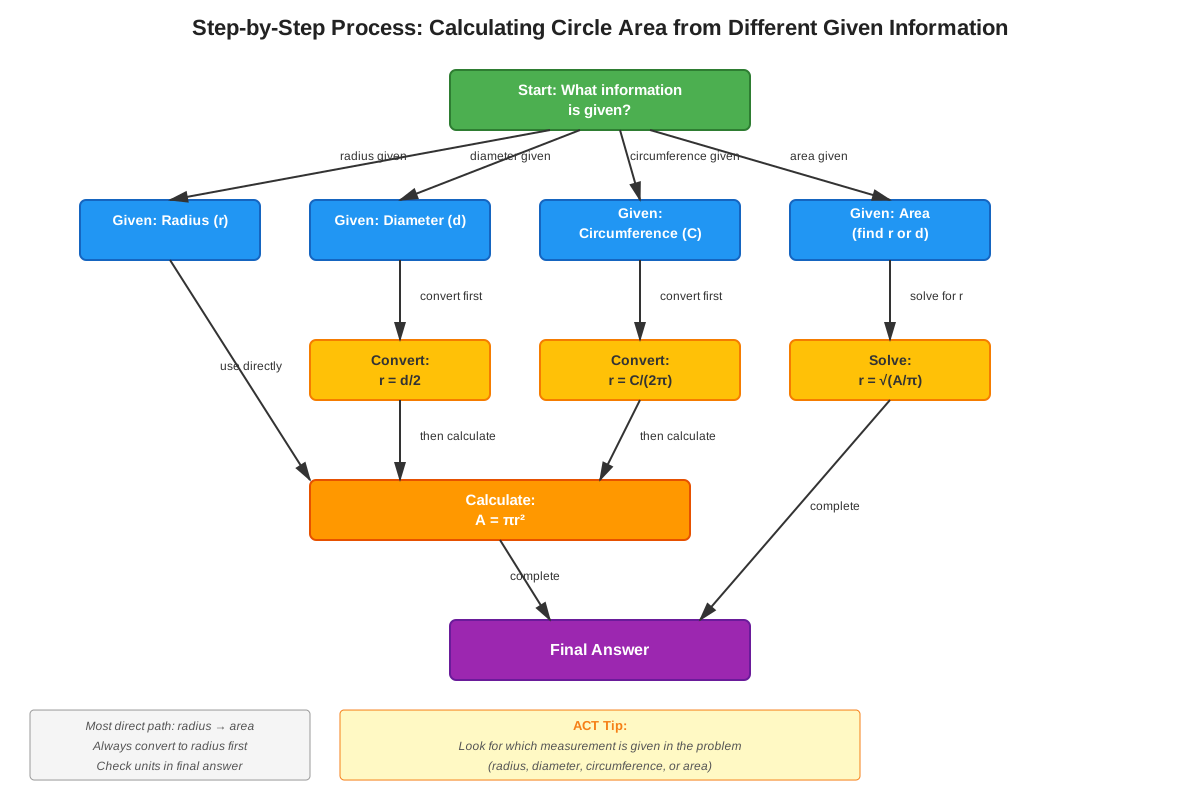
- [ ] Calculate the area when given radius, diameter, or circumference
- [ ] Solve inverse problems to find radius or diameter from a given area
- [ ] Determine areas of composite figures involving circles and other shapes
- [ ] Apply proportional reasoning to problems involving area changes when radius changes
Prerequisites
- Basic algebraic manipulation: Required for solving equations involving the area formula, isolating variables, and working with squared terms
- Understanding of pi (π): Essential for recognizing this irrational constant (approximately 3.14159) and knowing when to use exact versus approximate values
- Exponent rules: Necessary for correctly squaring the radius and understanding why area involves r² rather than r
- Unit conversion: Important for problems requiring conversion between different measurement systems (inches to feet, centimeters to meters)
- Basic geometry vocabulary: Familiarity with terms like radius, diameter, chord, and center point enables quick problem comprehension
Why This Topic Matters
Circular area calculations appear throughout real-world applications that students encounter daily. Engineers use these calculations to determine material requirements for circular components, architects calculate floor space in round buildings, farmers compute irrigation coverage areas, and manufacturers determine the size of circular products from pizzas to satellite dishes. Urban planners use circular area formulas to establish service zones around facilities, while scientists apply these principles in fields ranging from astronomy (calculating planetary cross-sections) to biology (measuring cell sizes).
On the ACT Math section, circular area questions appear with remarkable consistency. Statistical analysis of recent exams reveals that 3-5% of all Math questions directly test circular area, with an additional 2-3% incorporating it as part of multi-step problems. These questions typically appear in the medium-to-difficult range (questions 25-45 out of 60), making them crucial for students aiming for scores above 25. The ACT tests this concept through various question types: straightforward area calculations, inverse problems requiring algebraic manipulation, composite figure problems, word problems with real-world contexts, and proportional reasoning questions exploring how area changes relate to radius changes.
Common ACT question formats include: finding the area of a circular garden given its radius, determining how much larger one circular region is compared to another, calculating the area of shaded regions between circles, finding the radius needed to achieve a specific area, and solving problems involving circular sectors or segments. The exam frequently combines circular area with other concepts like coordinate geometry (circles on the coordinate plane), probability (selecting random points within circular regions), or optimization (maximizing area given constraints).
Core Concepts
The Fundamental Formula
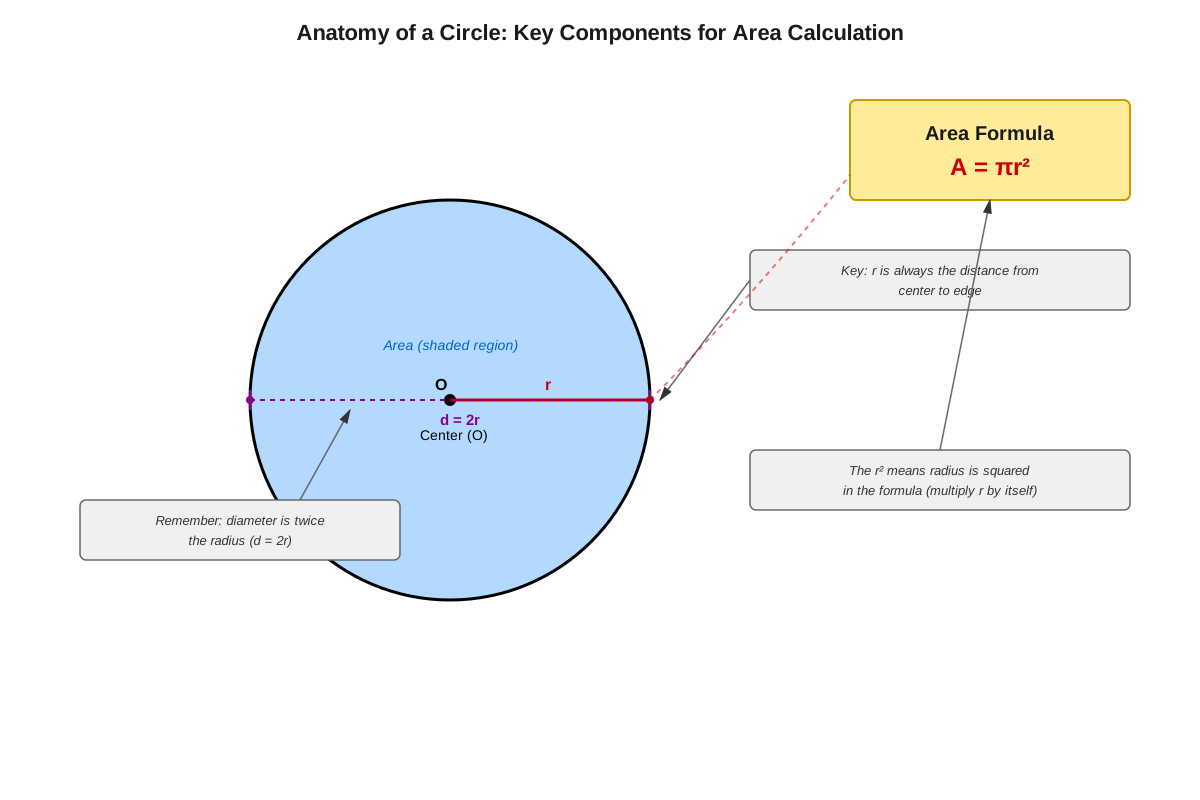
The area of a circle is calculated using the formula A = πr², where A represents the area, π (pi) is the mathematical constant approximately equal to 3.14159, and r represents the radius (the distance from the center to any point on the circle). This formula is the single most important fact students must memorize for ACT success. The formula appears on the ACT reference sheet, but memorization saves valuable time during the exam.
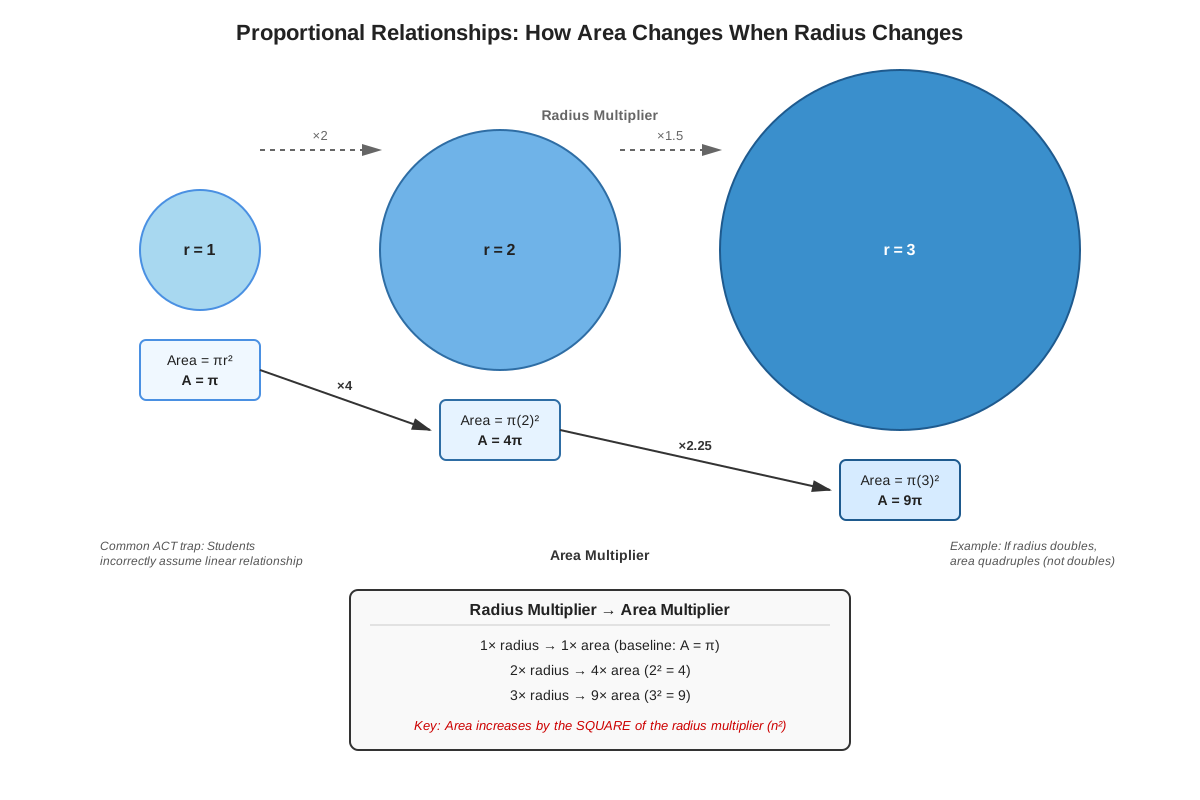
The radius squared (r²) component is critical—students must remember to square the radius value before multiplying by pi. This squaring operation explains why area is measured in square units (square inches, square centimeters, etc.) rather than linear units. The relationship between radius and area is quadratic, meaning that doubling the radius quadruples the area, tripling the radius increases area by a factor of nine, and so forth.
Working with Diameter
Many ACT questions provide the diameter (d) rather than the radius. Since diameter equals twice the radius (d = 2r), students must convert before applying the area formula. The relationship can be expressed as r = d/2, or the area formula can be rewritten as A = π(d/2)² = πd²/4. While both approaches work, converting to radius first typically reduces calculation errors.
For example, if a circle has a diameter of 10 inches, the radius is 5 inches, and the area is π(5)² = 25π square inches. Students who mistakenly use the diameter directly in the formula would incorrectly calculate π(10)² = 100π, an error four times too large.
Exact vs. Approximate Answers
The ACT presents answer choices in two formats: exact answers using π (like 36π square feet) and approximate answers using decimal values (like 113.1 square feet). Students must recognize which format the question requires by examining the answer choices. When answer choices contain π, leave π in the answer and do not multiply by 3.14. When answer choices are decimals, use π ≈ 3.14 or the calculator's π button for the final calculation.
This distinction is crucial for time management and accuracy. Calculating 36π ≈ 113.04 when the answer choices are 9π, 18π, 36π, 72π, and 144π wastes time and introduces potential rounding errors. Conversely, leaving an answer as 36π when choices are 113.0, 113.1, 113.2, 113.3, and 113.4 requires an additional calculation step.
Inverse Problems: Finding Radius from Area
ACT questions frequently require working backward from a given area to find the radius or diameter. This involves algebraic manipulation of the area formula. Starting with A = πr², divide both sides by π to get A/π = r², then take the square root of both sides to obtain r = √(A/π).
For instance, if a circular region has an area of 64π square meters, then r² = 64π/π = 64, so r = √64 = 8 meters. The diameter would be 16 meters. These inverse problems test algebraic reasoning and are often worth more points than straightforward area calculations.
Composite Figures and Shaded Regions
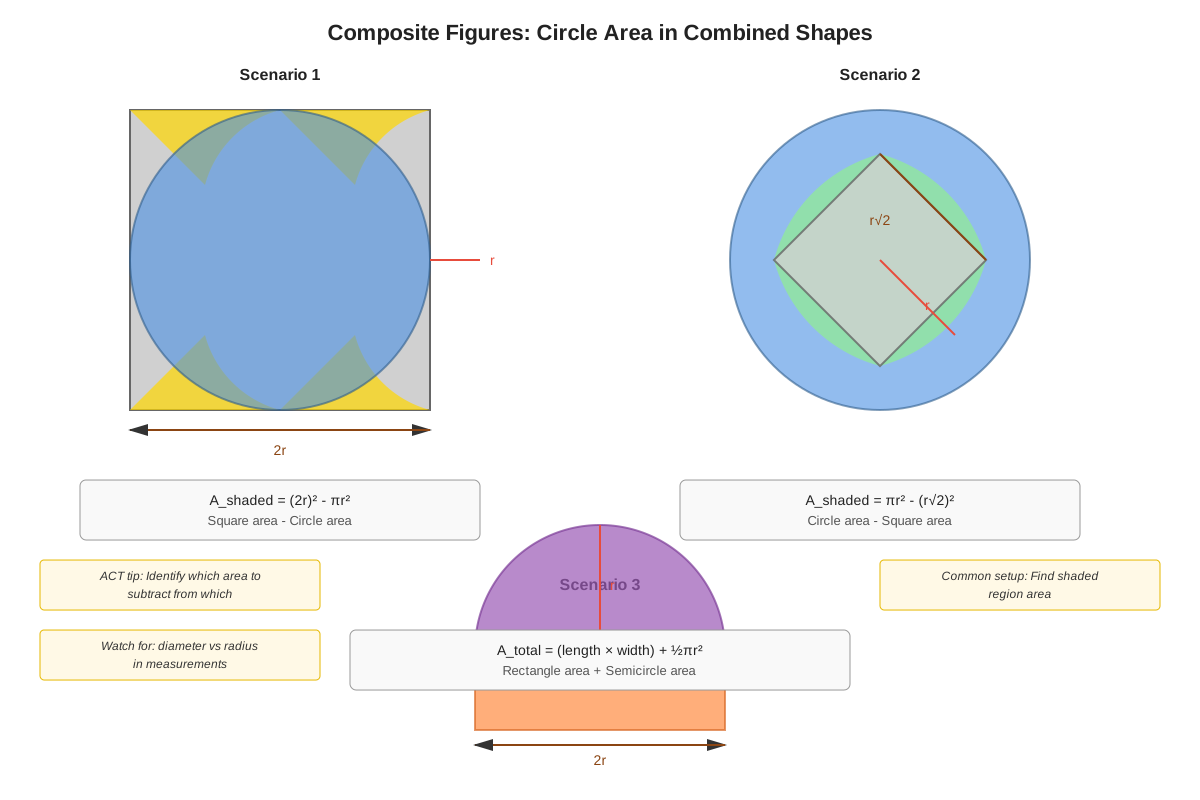
The ACT commonly tests circular area through composite figures—shapes formed by combining or subtracting circles with other geometric figures. The key strategy involves breaking complex shapes into simpler components, calculating each area separately, then adding or subtracting as appropriate.
Common scenarios include:
- Circle inscribed in a square: Area of square minus area of circle gives the shaded corners
- Square inscribed in a circle: Area of circle minus area of square gives the shaded regions
- Overlapping circles: Requires careful identification of shared and unique regions
- Circular rings (annulus): Area of larger circle minus area of smaller circle
Proportional Reasoning with Area
Understanding how area changes when radius changes is essential for ACT success. Since area depends on r², the relationship is quadratic rather than linear. This concept appears in comparison problems and scaling questions.
| Radius Change | Area Change | Example |
|---|---|---|
| Radius × 2 | Area × 4 | r = 3 → A = 9π; r = 6 → A = 36π |
| Radius × 3 | Area × 9 | r = 2 → A = 4π; r = 6 → A = 36π |
| Radius × k | Area × k² | r = 5 → A = 25π; r = 5k → A = 25k²π |
| Radius ÷ 2 | Area ÷ 4 | r = 8 → A = 64π; r = 4 → A = 16π |
This proportional relationship enables quick mental calculations without recalculating areas from scratch. If one circle has twice the radius of another, students can immediately conclude it has four times the area.
Units and Dimensional Analysis
Area measurements always use square units. When the radius is given in feet, the area is in square feet (ft²). When radius is in centimeters, area is in square centimeters (cm²). The ACT occasionally tests unit conversion, requiring students to convert radius units before calculating area or convert area units after calculation.
For example, if a circle has a radius of 2 feet and the question asks for area in square inches, students must either convert the radius to inches first (24 inches) then calculate A = π(24)² = 576π square inches, or calculate in feet first (A = 4π square feet) then convert to square inches (4π × 144 = 576π square inches).
Concept Relationships
The area of a circle formula connects directly to the concept of pi (π), which represents the ratio of a circle's circumference to its diameter. This fundamental constant appears in both the circumference formula (C = 2πr) and the area formula (A = πr²), creating a relationship between these two circle measurements. When students know the circumference, they can find the radius (r = C/2π) and subsequently calculate the area.
The radius serves as the central connecting element between multiple circle properties. Radius → determines → circumference, area, and diameter. Changes in radius → produce proportional changes → in circumference (linear relationship) and area (quadratic relationship). This distinction between linear and quadratic relationships is crucial for proportional reasoning problems.
Circular area concepts build upon prerequisite knowledge of exponents and algebraic manipulation. The squaring operation in r² → requires → understanding of exponent rules and order of operations. Inverse problems involving area → require → algebraic equation solving and square root operations. These connections make circular area an integrative topic that reinforces multiple mathematical skills.
Within composite figure problems, circular area → combines with → areas of rectangles, triangles, and other polygons. The principle of area addition and subtraction → enables → calculation of complex shaded regions. This relationship extends to coordinate geometry, where circles defined by equations → connect to → area calculations using the radius derived from the equation.
The concept also relates forward to more advanced topics. Circular area → serves as foundation for → sector area (fractional parts of circles), surface area of cylinders and spheres, and volume calculations for three-dimensional circular objects. Understanding how area scales with radius → prepares students for → similar scaling relationships in three-dimensional geometry.
Quick check — test yourself on Area of a circle so far.
Try Flashcards →High-Yield Facts
⭐ The area of a circle formula is A = πr², where r is the radius—this must be memorized and instantly recalled
⭐ When given diameter instead of radius, divide by 2 before applying the formula: r = d/2
⭐ Leave π in the answer when answer choices contain π; calculate decimal values only when answer choices are decimals
⭐ Doubling the radius quadruples the area; tripling the radius multiplies area by 9 (area scales with r²)
⭐ To find radius from area, use r = √(A/π) by dividing area by π then taking the square root
- Area is always expressed in square units (ft², cm², m²), never linear units
- The radius is the distance from center to edge; diameter is twice the radius
- Pi (π) is approximately 3.14159, but use the calculator's π button for greater accuracy
- For composite figures, break the shape into simpler components and add or subtract areas
- A circle inscribed in a square touches all four sides; the square's side length equals the circle's diameter
- When a square is inscribed in a circle, the circle's diameter equals the square's diagonal
- The area of a circular ring (annulus) equals π(R² - r²), where R is the outer radius and r is the inner radius
- Sector area (pie slice) equals (θ/360°) × πr², where θ is the central angle in degrees
Common Misconceptions
Misconception: Using diameter directly in the formula A = πd² → Correction: The formula requires radius, not diameter. When given diameter, first divide by 2 to find radius, then square that value. Using diameter directly produces an area four times too large.
Misconception: Forgetting to square the radius, calculating A = π × r instead of A = πr² → Correction: The radius must be squared before multiplying by π. This squaring is why area has square units and why the relationship between radius and area is quadratic, not linear.
Misconception: Believing that doubling the radius doubles the area → Correction: Because area depends on r², doubling the radius actually quadruples the area. This is a quadratic relationship, not a linear one. If r increases by a factor of k, area increases by a factor of k².
Misconception: Always multiplying by 3.14 even when answer choices contain π → Correction: When answer choices include π (like 25π, 36π, 49π), leave π in the answer without calculating a decimal. Only convert to decimal when answer choices are numerical approximations.
Misconception: Confusing area and circumference formulas → Correction: Area uses A = πr² (radius squared), while circumference uses C = 2πr or C = πd (radius or diameter to the first power). Area measures the space inside; circumference measures the distance around.
Misconception: Assuming the shaded region in a composite figure is always the circle minus other shapes → Correction: Carefully identify which region is shaded. Sometimes the shaded area is the outer shape minus the circle, sometimes it's the circle minus an inner shape, and sometimes it's an overlapping region requiring addition and subtraction.
Misconception: Using the wrong units or forgetting to convert units → Correction: Area must be in square units matching the radius units. If radius is in feet, area is in square feet. When converting units, remember that 1 ft² = 144 in² (not 12 in²) because both dimensions must be converted.
Worked Examples
Example 1: Standard Area Calculation with Diameter
Problem: A circular swimming pool has a diameter of 18 feet. What is the area of the pool's surface in square feet?
Solution:
Step 1: Identify what's given and what's needed. We have diameter = 18 feet and need to find area.
Step 2: Convert diameter to radius. Since d = 2r, we have r = d/2 = 18/2 = 9 feet.
Step 3: Apply the area formula. A = πr² = π(9)² = π(81) = 81π square feet.
Step 4: Check answer choices. If choices contain π, the answer is 81π square feet. If choices are decimals, calculate 81 × 3.14159 ≈ 254.5 square feet.
Key Insight: This problem tests the fundamental skill of converting diameter to radius before applying the formula. The most common error is using 18 directly in the formula, yielding 324π instead of 81π—exactly four times too large.
Example 2: Inverse Problem with Composite Figure
Problem: A square garden has a side length of 20 meters. A circular fountain is placed in the center of the garden such that the fountain's area is exactly one-fourth the area of the garden. What is the radius of the fountain?
Solution:
Step 1: Find the area of the square garden. A_square = s² = (20)² = 400 square meters.
Step 2: Determine the fountain's area. A_fountain = (1/4) × 400 = 100 square meters.
Step 3: Use the inverse area formula to find radius. We have A = πr², so 100 = πr².
Step 4: Solve for r². Divide both sides by π: r² = 100/π.
Step 5: Take the square root. r = √(100/π) = 10/√π.
Step 6: Rationalize if needed. r = 10/√π × √π/√π = 10√π/π ≈ 5.64 meters.
Step 7: Check reasonableness. The fountain radius (about 5.64 m) is less than half the garden's side (10 m), which makes sense since the fountain's area is only one-fourth of the garden's area.
Key Insight: This multi-step problem combines area calculation, proportional reasoning, and inverse formula application. Students must work backward from area to radius using algebraic manipulation. The problem also reinforces that area relationships are quadratic—one-fourth the area corresponds to one-half the linear dimension.
Example 3: Proportional Reasoning
Problem: Circle A has a radius of 4 inches. Circle B has a radius of 12 inches. How many times larger is the area of Circle B compared to Circle A?
Solution:
Method 1 (Direct Calculation):
- Area of Circle A: A_A = π(4)² = 16π square inches
- Area of Circle B: A_B = π(12)² = 144π square inches
- Ratio: A_B/A_A = 144π/16π = 144/16 = 9
Method 2 (Proportional Reasoning):
- Radius ratio: r_B/r_A = 12/4 = 3
- Since area scales with r², area ratio = (radius ratio)² = 3² = 9
Answer: Circle B has an area 9 times larger than Circle A.
Key Insight: The proportional reasoning method is significantly faster and reduces calculation errors. When the radius increases by a factor of 3, the area increases by a factor of 3² = 9. This relationship is essential for quickly solving comparison problems on the ACT.
Exam Strategy
When approaching ACT questions involving circular area, begin by scanning the answer choices to determine whether to leave π in the answer or calculate a decimal approximation. This single observation saves time and prevents unnecessary calculations. Look for the format pattern: if all choices contain π, perform calculations symbolically; if all choices are decimals, use your calculator's π function for the final step.
Trigger words and phrases that signal circular area problems include: "circular region," "round," "pizza," "wheel," "coin," "fountain," "pool," "irrigation," "rotating," "inscribed circle," "circumscribed circle," and "shaded region." Word problems describing objects that spin, cover ground in a circular pattern, or involve circular cross-sections almost always require area calculations. Questions asking "how much space," "what area," or "how much larger" in the context of circular objects are clear indicators.
For process of elimination, use estimation to quickly eliminate unreasonable answers. If a circle has a radius of 5, the area must be between 75 (using π ≈ 3) and 80 (using π ≈ 3.2), so 25π ≈ 78.5 is reasonable while 100π ≈ 314 is not. When comparing two circles, remember that the one with the larger radius always has the larger area, and the area difference is more dramatic than the radius difference due to the squaring effect.
Time allocation for circular area questions should average 45-60 seconds for straightforward calculations and 90-120 seconds for multi-step composite figure problems. If a problem requires more than two minutes, mark it for review and move on—these questions are designed to be solvable within the time constraint, so extended struggle suggests a missed insight or approach. Practice identifying the quickest solution method: direct calculation, proportional reasoning, or working backward from answer choices.
When dealing with composite figures, sketch a quick diagram if one isn't provided. Label known values directly on the diagram and identify which regions need to be added or subtracted. For shaded region problems, determine whether the shaded area equals (outer shape - inner shape), (circle - inscribed shape), or a more complex combination. Always verify that your final answer makes logical sense—the shaded area should be smaller than the total area of the largest shape involved.
Memory Techniques
The "PIE R SQUARED" mnemonic: Remember that area equals "pie are squared" (A = πr²), not "pie are round" (which would be circumference). This playful phrase helps distinguish area from circumference and reinforces that radius must be squared.
The "Diameter Divide by Two" rule: Before using any circle formula, check whether you're given diameter or radius. Create a mental habit: "See diameter? Divide by two!" This automatic check prevents the most common error in circular area problems.
The "Quadratic Quad" visualization: When radius doubles, area quadruples. Visualize four identical circles fitting inside a circle with twice the radius. This mental image reinforces the r² relationship and helps with proportional reasoning questions.
The "Pi or Decimal" decision tree:
- Look at answer choices FIRST
- See π symbols? → Leave π in your answer
- See decimals? → Calculate using π ≈ 3.14 or calculator π button
The "Square Units" reminder: Area always has square units. If you calculate an area and get linear units (feet instead of square feet), you've made an error—likely forgetting to square the radius.
The "RADIUS" acronym for problem-solving steps:
- Read the problem carefully
- Assess what's given (radius, diameter, or area?)
- Determine what's needed
- Identify the appropriate formula
- Use algebra if working backward
- Solve and check reasonableness
Summary
The area of a circle, calculated using the formula A = πr², represents a high-yield ACT Math topic that appears in multiple questions per exam. Mastery requires memorizing the fundamental formula, understanding the critical distinction between radius and diameter, and recognizing when to express answers in exact form (with π) versus decimal approximations. The quadratic relationship between radius and area—where doubling the radius quadruples the area—is essential for proportional reasoning questions. Students must develop proficiency in both forward calculations (finding area from radius) and inverse problems (finding radius from area using r = √(A/π)). Composite figure problems require breaking complex shapes into simpler components and carefully adding or subtracting areas. Success on ACT circular area questions depends on rapid formula recall, careful attention to units, strategic decision-making about calculation methods, and the ability to recognize disguised applications in word problems. The topic connects to broader mathematical concepts including algebraic manipulation, proportional reasoning, and geometric relationships, making it a cornerstone of ACT Math preparation.
Key Takeaways
- The area formula A = πr² must be memorized and instantly recalled; radius must be squared before multiplying by π
- Always convert diameter to radius first (r = d/2) before applying the area formula to avoid errors
- Match your answer format to the answer choices: leave π when choices contain π, calculate decimals when choices are numerical
- Area scales with the square of radius: doubling radius quadruples area, tripling radius multiplies area by 9
- For inverse problems, find radius from area using r = √(A/π) through algebraic manipulation
- Composite figures require identifying which regions to add or subtract; sketch diagrams and label known values
- Proportional reasoning provides shortcuts: compare radius ratios and square them to find area ratios without full calculations
Related Topics
Circumference of a Circle: Understanding the distance around a circle (C = 2πr or C = πd) complements area knowledge and enables solving problems where circumference and area are both involved. Many ACT questions require converting between these measurements.
Sectors and Arc Length: Building on circular area, sector area represents fractional portions of circles based on central angles. This topic extends area concepts to partial circles and connects to arc length calculations.
Coordinate Geometry with Circles: Circles on the coordinate plane combine area calculations with equation manipulation (x - h)² + (y - k)² = r². Mastering circular area enables solving problems involving circles in coordinate systems.
Three-Dimensional Geometry: Circular area serves as the foundation for calculating surface area and volume of cylinders, cones, and spheres. These 3D applications multiply the importance of circular area mastery.
Geometric Probability: Problems involving randomly selecting points within circular regions require calculating circular areas and comparing them to other areas, integrating geometry with probability concepts.
Practice CTA
Now that you've mastered the core concepts of circular area, it's time to solidify your understanding through active practice. Attempt the practice questions to apply these strategies under test-like conditions, and use the flashcards to reinforce formula recall and key relationships. Remember, the difference between knowing the formula and scoring points lies in repeated application—each practice problem builds the speed and confidence you need for ACT success. You've invested the time to learn this high-yield topic; now maximize that investment by practicing until circular area questions become automatic point-earners on test day!
Sign up free to keep reading
Create a free AnvayaPrep account to finish this ACT guide on Area of a circle — plus flashcards and practice questions.