Overview
The circumference of a circle is one of the most frequently tested concepts in the Plane Geometry section of the ACT Math test. Understanding circumference is essential not only for direct calculation problems but also for solving complex multi-step questions involving sectors, arc lengths, wheels, gears, and real-world applications. The circumference represents the distance around a circle—the perimeter of this fundamental geometric shape—and appears in approximately 2-4 questions on every ACT Math section.
Mastering ACT circumference problems requires more than memorizing a formula; students must recognize when circumference is being tested, understand the relationship between circumference and other circle properties (radius, diameter, area), and apply these concepts efficiently under time pressure. The ACT frequently disguises circumference problems within word problems about rotating wheels, circular tracks, pizza sizes, or clock hands, making pattern recognition a critical skill.
This topic serves as a foundational building block for understanding more advanced geometric concepts including arc length, sector area, and coordinate geometry involving circles. The circumference formula connects directly to the mathematical constant π (pi), reinforcing number sense and approximation skills that appear throughout the ACT Math section. Strong circumference skills also support problem-solving in trigonometry and coordinate geometry, where circular motion and distance calculations frequently appear.
Learning Objectives
- [ ] Identify when Circumference is being tested in ACT questions, including disguised applications
- [ ] Explain the core rule or strategy behind Circumference and its derivation
- [ ] Apply Circumference to ACT-style questions accurately within time constraints
- [ ] Calculate circumference when given radius, diameter, or other circle properties
- [ ] Solve for radius or diameter when given circumference
- [ ] Apply circumference concepts to arc length and sector problems
- [ ] Recognize and solve real-world circumference applications (wheels, tracks, circular paths)
Prerequisites
- Basic algebra skills: Solving for variables in equations is necessary when working backward from circumference to find radius or diameter
- Understanding of π (pi): Recognizing π as approximately 3.14 or 22/7 enables estimation and calculation without a calculator
- Fraction and decimal operations: Circumference problems often require multiplying and dividing by π and converting between forms
- Basic geometry vocabulary: Understanding terms like radius, diameter, and circle ensures correct formula application
- Unit conversion: Many circumference problems require converting between inches, feet, centimeters, or other units
Why This Topic Matters
Circumference appears in everyday life more frequently than most geometric concepts. From determining the distance a bicycle travels per wheel rotation to calculating the amount of fencing needed for a circular garden, circumference has immediate practical applications. Engineers use circumference calculations when designing gears, pulleys, and rotating machinery. Athletes running on circular tracks must understand circumference to calculate distances. Even pizza restaurants use circumference concepts when pricing different sizes.
On the ACT Math test, circumference questions appear with high frequency—typically 2-4 questions per exam. These questions range from straightforward formula applications worth quick points to complex multi-step problems that combine circumference with ratios, proportions, or coordinate geometry. According to ACT score reports, circumference questions have a medium difficulty rating, meaning approximately 40-60% of test-takers answer them correctly, making them excellent opportunities for prepared students to gain competitive advantage.
The ACT presents circumference in several distinct formats: direct calculation problems ("Find the circumference of a circle with radius 7"), reverse problems ("A circle has circumference 18π; find its radius"), comparison problems ("How much larger is the circumference of circle A than circle B?"), and applied problems ("A wheel with diameter 2 feet makes 50 rotations; how far does it travel?"). Recognizing these patterns enables faster problem identification and solution selection.
Core Concepts
The Circumference Formula
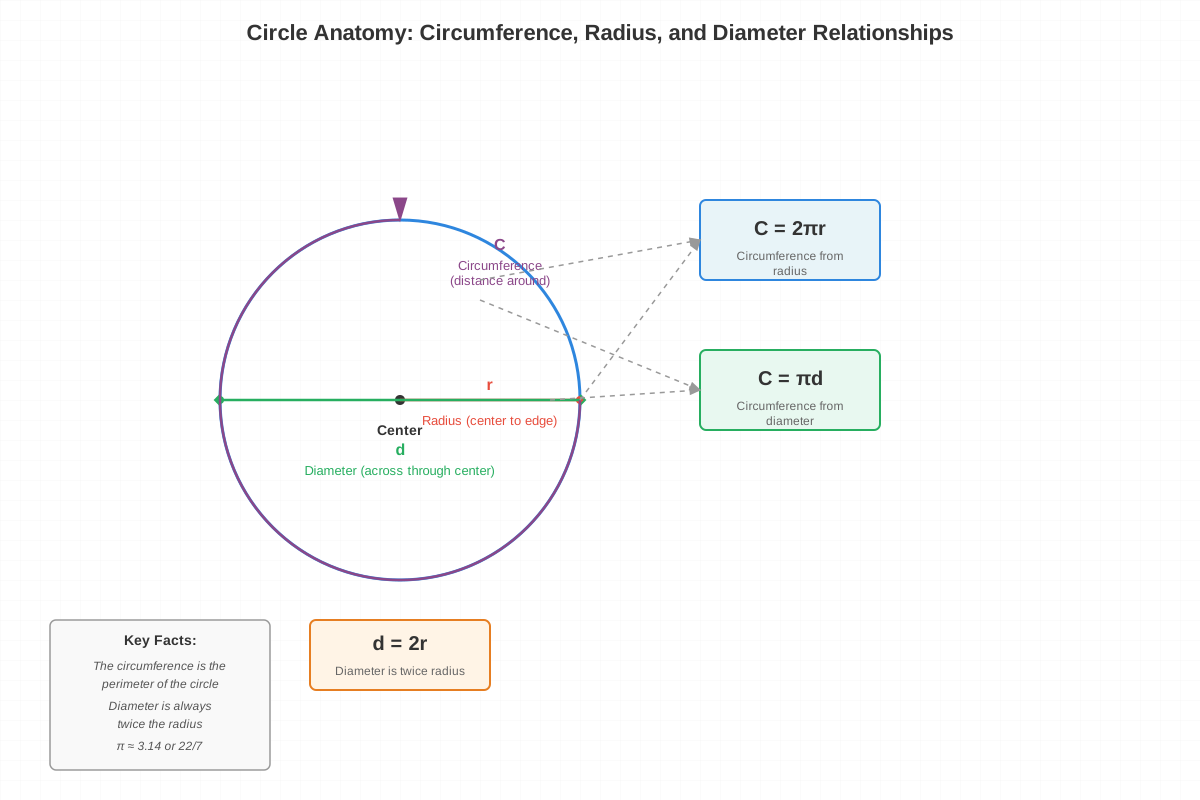
The circumference of a circle is calculated using one of two equivalent formulas:
C = 2πror
C = πdwhere C represents circumference, r represents radius, d represents diameter, and π (pi) is the mathematical constant approximately equal to 3.14159.
These formulas are equivalent because the diameter equals twice the radius (d = 2r). The ACT expects students to know both formulas and select the most efficient one based on given information. When radius is provided, use C = 2πr. When diameter is provided, use C = πd to save a calculation step.
Understanding π in ACT Problems
The constant π (pi) represents the ratio of any circle's circumference to its diameter—a relationship that remains constant regardless of circle size. On the ACT, π appears in three forms:
- As the symbol π: Many ACT answers leave π in the expression (e.g., "12π inches")
- As the approximation 3.14: Used when decimal answers are required
- As the fraction 22/7: Occasionally useful for mental math with certain numbers
Exam Tip: When answer choices contain π, do NOT multiply by 3.14. Leave your answer in terms of π to match the answer format and avoid rounding errors.
Radius and Diameter Relationships
Understanding the relationship between radius and diameter is crucial for efficient problem-solving:
| Property | Definition | Relationship |
|---|---|---|
| Radius (r) | Distance from center to edge | r = d/2 |
| Diameter (d) | Distance across circle through center | d = 2r |
| Circumference (C) | Distance around circle | C = πd = 2πr |
The ACT frequently tests whether students can convert between these measurements. A problem might provide diameter but require using the radius formula, testing both formula knowledge and algebraic manipulation.
Solving for Unknown Values
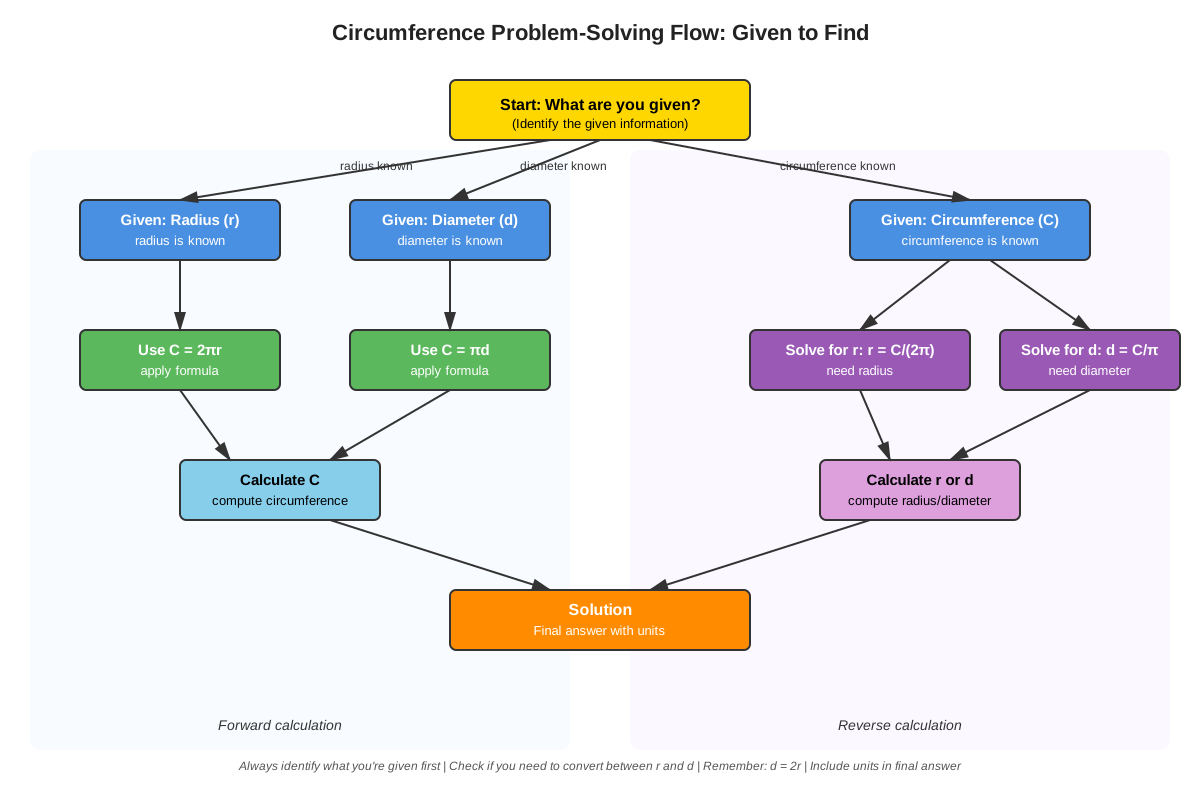
Circumference problems often require working backward from circumference to find radius or diameter:
Given circumference, find radius:
C = 2πr
r = C/(2π)
Given circumference, find diameter:
C = πd
d = C/π
These inverse operations appear frequently in multi-step problems where circumference serves as an intermediate calculation rather than the final answer.
Arc Length as Partial Circumference
An arc represents a portion of a circle's circumference. Arc length calculations extend circumference concepts:
Arc Length = (θ/360°) × 2πrwhere θ represents the central angle in degrees. This formula shows that arc length equals the fraction of the full circle (represented by the angle) multiplied by the complete circumference. The ACT tests this concept by asking for distances along curved paths or portions of circular objects.
Real-World Applications
The ACT frequently embeds circumference in practical scenarios:
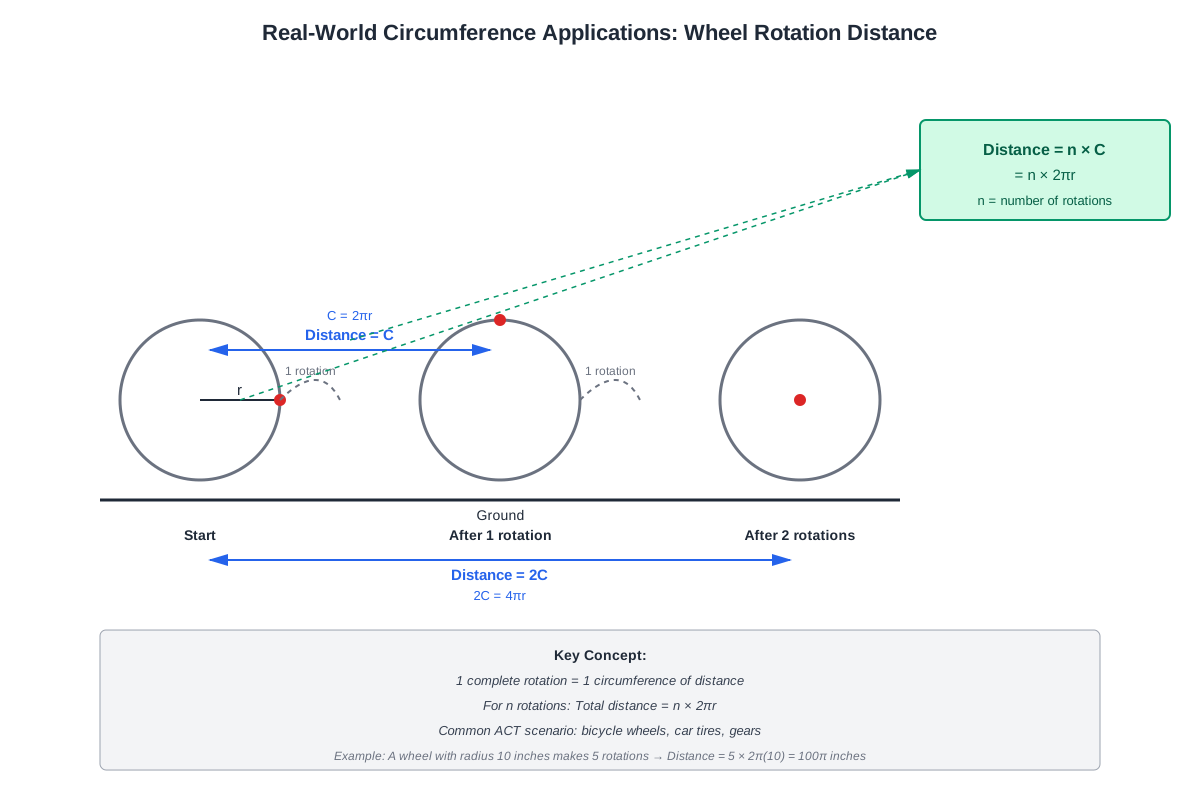
Wheel rotations: Distance traveled = (number of rotations) × (circumference of wheel)
Circular tracks: Total distance = (number of laps) × (circumference of track)
Gears and pulleys: Related circumferences determine rotation ratios
Clock problems: Hour and minute hands trace circular paths with different radii
These applications require translating word problems into mathematical expressions, identifying which measurements represent radius or diameter, and applying circumference formulas appropriately.
Concept Relationships
The circumference concept connects to multiple geometric and algebraic ideas in a hierarchical structure:
Foundation: Understanding of circles and their basic properties (center, radius, diameter) → Leads to → Circumference as the perimeter measurement → Enables → Arc length calculations (partial circumference) → Extends to → Sector area and circle area relationships
Parallel relationship: Circumference (C = 2πr) relates to Area (A = πr²) through the shared variable r. Problems often require finding one property to calculate another.
Algebraic connection: Circumference problems → Require solving linear equations → Connect to ratio and proportion problems → Enable rate and distance calculations
Coordinate geometry bridge: Circumference formulas → Combine with distance formula → Enable problems involving circles on coordinate planes → Support tangent line and circle equation problems
The relationship between diameter and circumference (C = πd) demonstrates that circumference is always slightly more than three times the diameter—a proportional relationship that enables estimation and reasonableness checking.
High-Yield Facts
⭐ The circumference formula is C = 2πr or C = πd, where r is radius and d is diameter
⭐ Diameter equals twice the radius: d = 2r
⭐ When answer choices contain π, leave π in your answer rather than multiplying by 3.14
⭐ To find radius from circumference: r = C/(2π)
⭐ Arc length equals (angle/360°) × circumference for the full circle
- The circumference of a circle with radius 1 is 2π (approximately 6.28)
- Doubling the radius doubles the circumference (linear relationship)
- π is approximately 3.14, or use 22/7 for fraction calculations
- Distance traveled by a wheel = (number of rotations) × (circumference)
- The ratio of circumference to diameter is always π, regardless of circle size
- Circumference is measured in linear units (inches, feet, meters), not square units
- A semicircle's curved edge has length πr (half the full circumference)
- When comparing circles, the ratio of circumferences equals the ratio of radii
Quick check — test yourself on Circumference so far.
Try Flashcards →Common Misconceptions
Misconception: Circumference and area formulas are interchangeable or can be confused.
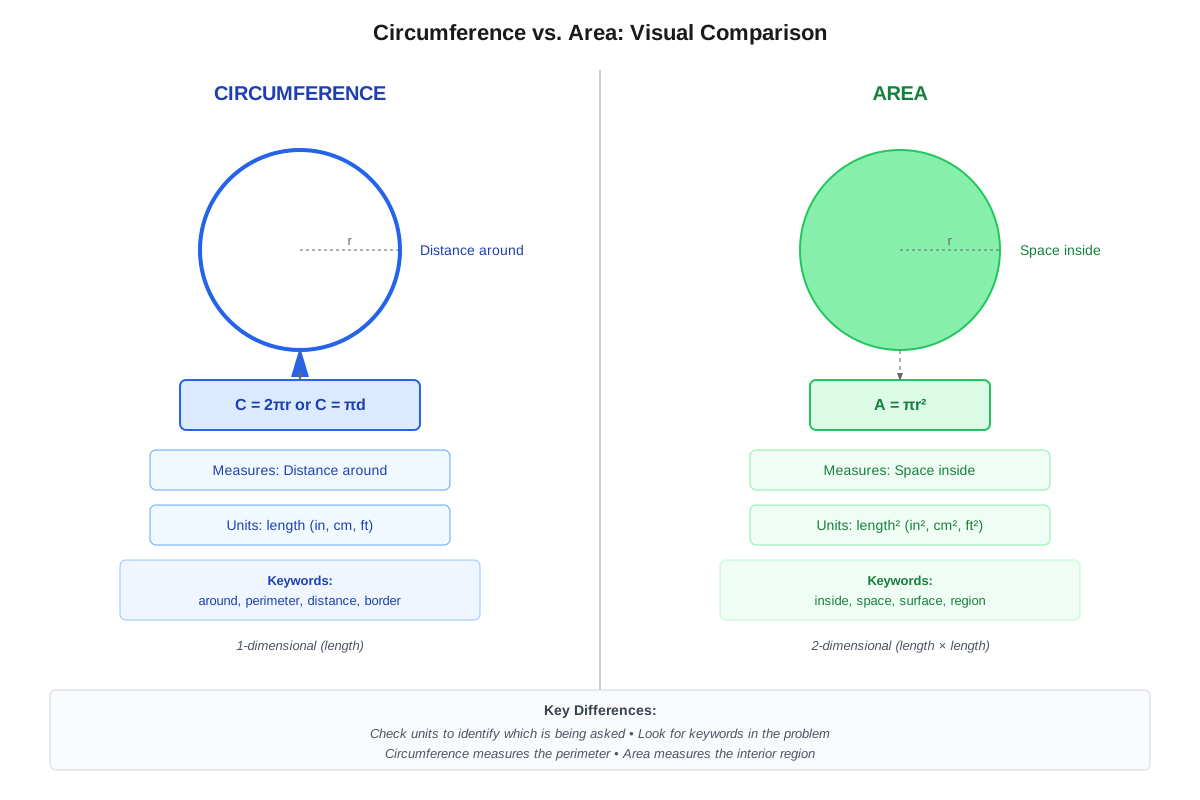
Correction: Circumference (C = 2πr) measures distance around the circle in linear units, while area (A = πr²) measures space inside the circle in square units. Note that circumference is linear in r while area is quadratic in r.
Misconception: The diameter is the same as the radius.
Correction: The diameter is exactly twice the radius. The diameter extends completely across the circle through the center, while the radius extends from center to edge. Always check which measurement is given before applying formulas.
Misconception: π equals exactly 3.14 or 22/7.
Correction: π is an irrational number with infinite non-repeating decimals. The values 3.14 and 22/7 are approximations. On the ACT, leave π as a symbol in your answer when answer choices contain π to maintain precision.
Misconception: Doubling the radius doubles the area and circumference equally.
Correction: Doubling the radius doubles the circumference (linear relationship) but quadruples the area (quadratic relationship). If r becomes 2r, then C becomes 2C, but A becomes 4A.
Misconception: Arc length can be calculated without knowing the central angle.
Correction: Arc length requires both the radius (or circumference) and the central angle. The formula is (angle/360°) × 2πr. Without the angle, you cannot determine what fraction of the circumference the arc represents.
Misconception: Circumference is measured in square units like area.
Correction: Circumference is a one-dimensional measurement (distance around) and uses linear units (inches, centimeters, feet). Only area uses square units. This distinction helps identify which formula to apply.
Worked Examples
Example 1: Direct Circumference Calculation with Application
Problem: A bicycle wheel has a diameter of 26 inches. If the wheel makes 100 complete rotations, how far does the bicycle travel? (Express your answer in terms of π)
Solution:
Step 1: Identify what's given and what's needed.
- Given: diameter = 26 inches, rotations = 100
- Need: total distance traveled
Step 2: Recognize this as a circumference application.
The distance traveled in one rotation equals the wheel's circumference.
Step 3: Calculate circumference using the diameter formula.
Since diameter is given, use C = πd:
C = π(26) = 26π inchesStep 4: Calculate total distance.
Total distance = (number of rotations) × (circumference per rotation)
Distance = 100 × 26π = 2600π inchesAnswer: The bicycle travels 2600π inches.
Connection to learning objectives: This problem demonstrates identifying circumference in a real-world application (rotating wheel), applying the appropriate formula based on given information (diameter), and leaving the answer in terms of π as required by ACT answer formats.
Example 2: Working Backward from Circumference
Problem: A circular running track has a circumference of 400 meters. The track designer wants to place a fence around the outer edge, positioned 2 meters from the track at all points. What is the circumference of the fence? (Use π ≈ 3.14)
Solution:
Step 1: Find the radius of the track.
Given: C = 400 meters
Using C = 2πr:
400 = 2πr
r = 400/(2π) = 200/π meters
Step 2: Determine the radius of the fence.
The fence is 2 meters outside the track at all points:
r_fence = r_track + 2 = (200/π) + 2 metersStep 3: Calculate the fence circumference.
C_fence = 2π × r_fence
C_fence = 2π × [(200/π) + 2]
C_fence = 2π × (200/π) + 2π × 2
C_fence = 400 + 4π
Step 4: Approximate using π ≈ 3.14.
C_fence = 400 + 4(3.14) = 400 + 12.56 = 412.56 metersAnswer: The fence circumference is approximately 412.56 meters (or exactly 400 + 4π meters).
Connection to learning objectives: This multi-step problem requires working backward from circumference to find radius, understanding how radius changes affect circumference, and applying circumference formulas in a practical context. It demonstrates that adding a constant distance to the radius adds 2π times that distance to the circumference.
Exam Strategy
Pattern Recognition: Identify circumference problems by watching for these trigger words and phrases:
- "distance around," "perimeter of a circle"
- "wheel," "rotation," "revolution"
- "circular track," "circular path"
- "how far does it travel"
- Problems giving radius or diameter and asking for a distance measurement
Formula Selection Strategy:
- Identify whether radius or diameter is given
- If radius is given or easily found, use C = 2πr
- If diameter is given, use C = πd to save a step
- If neither is given directly, look for area or other properties to find radius first
Answer Format Awareness:
Critical Exam Tip: Check whether answer choices contain π or decimal numbers. If answers show π, do NOT multiply by 3.14. If answers are decimals, use π ≈ 3.14 or your calculator's π button.
Process of Elimination:
- Eliminate answers with wrong units (square units for circumference)
- Eliminate answers that seem unreasonably large or small compared to given measurements
- Use the approximation that circumference ≈ 6 times radius (since 2π ≈ 6.28) to estimate
- Remember that circumference is always larger than diameter but smaller than 4 times diameter
Time Management:
- Direct circumference calculations should take 30-45 seconds
- Multi-step problems involving circumference may require 60-90 seconds
- If a problem requires finding radius from area before calculating circumference, budget 90-120 seconds
- Don't spend time memorizing decimal values of π; use the symbol or calculator
Common Problem Types and Approaches:
- Direct calculation: Apply formula immediately
- Reverse problems: Solve equation for unknown variable
- Comparison problems: Set up ratio or difference expression
- Application problems: Translate words to mathematical expressions, identify what represents radius/diameter
Memory Techniques
Circumference Formula Mnemonic: "Cherry pies delicious" or "Cherry 2 pies, really"
- C = πd (Cherry pies delicious)
- C = 2πr (Cherry 2 pies, really)
Diameter-Radius Relationship: "Diameter is Double"
- The word "diameter" starts with D, reminding you it's double the radius
Pi Approximation: "3.14 - May I have a large container of coffee?"
- Count letters in each word: 3 letters (May), 1 letter (I), 4 letters (have) = 3.14
Unit Check Visualization: Picture walking around a circle (one-dimensional path) versus filling in a circle (two-dimensional area)
- Walking around = circumference = linear units
- Filling in = area = square units
Arc Length Memory Aid: "Arc is A fraction of circumference"
- Arc length = (angle/360) × circumference
- The angle tells you what fraction of the full circle you're measuring
Application Problems: "Rotations Require Radius"
- Wheel rotation problems always need circumference
- Circumference requires radius or diameter
- Distance = rotations × circumference
Summary
Circumference represents the distance around a circle and is calculated using C = 2πr or C = πd, where r is radius, d is diameter, and π is approximately 3.14. This fundamental concept appears frequently on the ACT Math test in both direct calculation problems and real-world applications involving wheels, tracks, and circular paths. Success requires recognizing when circumference is being tested, selecting the appropriate formula based on given information, and understanding the relationships between radius, diameter, and circumference. Students must be comfortable working forward (calculating circumference from radius) and backward (finding radius from circumference), and should leave answers in terms of π when answer choices use that format. Circumference connects to arc length, area calculations, and practical distance problems, making it an essential building block for plane geometry mastery. The key to ACT success is rapid pattern recognition, efficient formula application, and careful attention to whether problems provide radius or diameter.
Key Takeaways
- The two circumference formulas are C = 2πr and C = πd; choose based on whether radius or diameter is given
- Leave π as a symbol in your answer when answer choices contain π; only calculate decimal values when answers are in decimal form
- Diameter always equals twice the radius (d = 2r), and confusing these is a common error
- Wheel rotation problems use the principle that distance = (rotations) × (circumference)
- Arc length represents a fraction of circumference, calculated as (angle/360°) × 2πr
- Circumference uses linear units (inches, feet) while area uses square units—this distinction helps identify which formula to apply
- Working backward from circumference to find radius requires solving r = C/(2π)
Related Topics
Circle Area: Understanding circumference enables area calculations since both formulas share the radius variable. Many ACT problems require finding circumference as an intermediate step to calculate area, or vice versa.
Arc Length and Sector Area: These concepts extend circumference by examining portions of circles. Arc length represents a fraction of circumference, while sector area represents the corresponding fraction of total area.
Coordinate Geometry of Circles: Circumference formulas combine with the distance formula and circle equations in coordinate plane problems, particularly when finding distances along circular paths or determining circle properties from equations.
Trigonometry and Circular Motion: Advanced problems involve objects moving along circular paths, requiring circumference calculations combined with angular velocity and periodic motion concepts.
Ratios and Proportions: Comparing circumferences of different circles involves ratio reasoning, and many ACT problems test whether students understand that circumference ratios equal radius ratios.
Practice CTA
Now that you've mastered the core concepts of circumference, it's time to solidify your understanding through active practice. Complete the practice questions to test your ability to recognize circumference problems in various formats, apply formulas efficiently, and solve multi-step applications under timed conditions. Use the flashcards to reinforce formula recall and key relationships until they become automatic. Remember, circumference questions represent high-yield opportunities on the ACT—students who master this topic consistently gain 2-4 additional points on test day. Your investment in practice now will pay dividends in both speed and accuracy when you encounter these problems on the actual exam. You've got this!
Sign up free to keep reading
Create a free AnvayaPrep account to finish this ACT guide on Circumference — plus flashcards and practice questions.