Overview
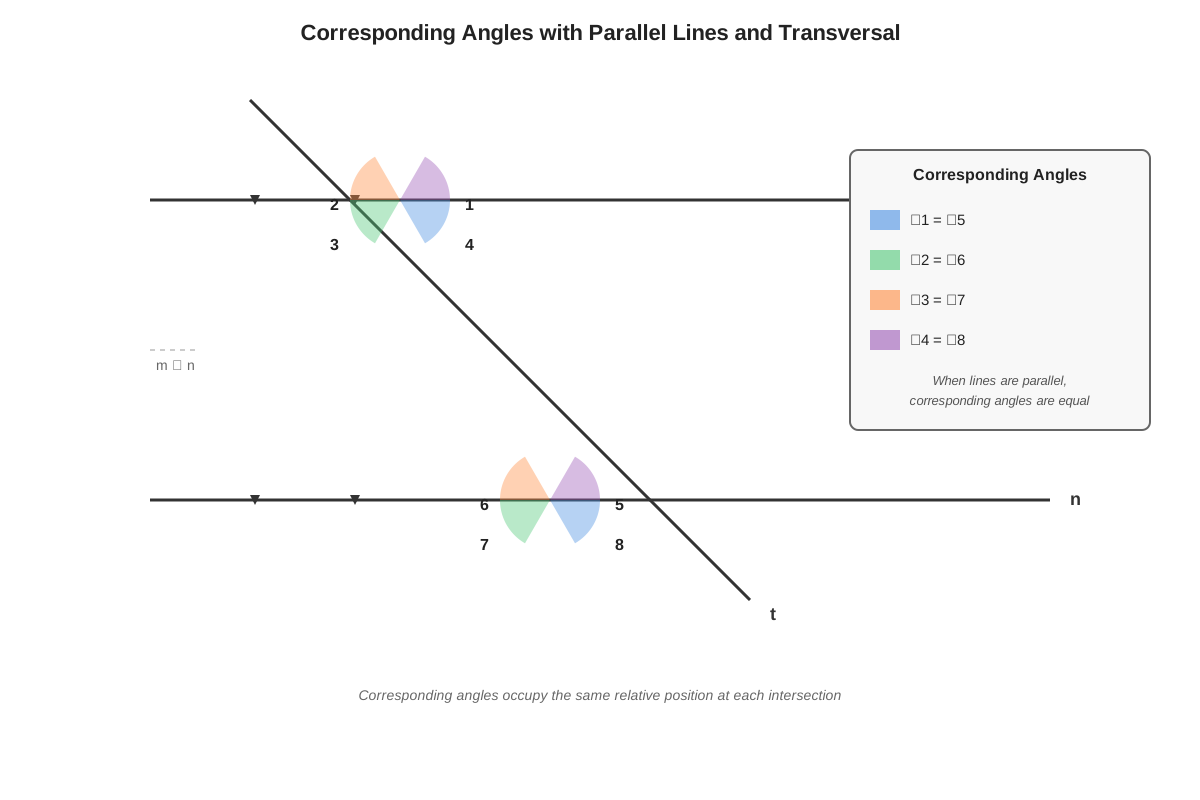
Corresponding angles represent one of the most frequently tested geometric relationships on the ACT Math section. When a transversal line intersects two or more parallel lines, it creates eight angles at the intersection points. Among these angles, corresponding angles occupy matching positions at each intersection and possess equal measures. This fundamental property serves as the foundation for solving numerous geometry problems involving parallel lines, angle relationships, and coordinate geometry.
Understanding corresponding angles is essential for ACT success because these angle relationships appear in approximately 10-15% of plane geometry questions on the exam. The ACT tests this concept both directly—asking students to identify angle measures based on parallel line configurations—and indirectly, embedding corresponding angle relationships within more complex multi-step problems involving triangles, polygons, and coordinate plane scenarios. Mastery of this topic enables students to quickly recognize patterns and calculate unknown angle measures with confidence.
ACT corresponding angles questions connect to broader mathematical concepts including supplementary angles, alternate interior angles, vertical angles, and properties of parallel lines. These relationships form an interconnected web of geometric principles that the ACT frequently combines within single questions. Students who thoroughly understand corresponding angles gain a strategic advantage, as this knowledge accelerates problem-solving speed and reduces the likelihood of calculation errors on test day.
Learning Objectives
- [ ] Identify when Corresponding angles is being tested
- [ ] Explain the core rule or strategy behind Corresponding angles
- [ ] Apply Corresponding angles to ACT-style questions accurately
- [ ] Distinguish corresponding angles from alternate interior, alternate exterior, and consecutive interior angles
- [ ] Calculate multiple unknown angle measures in complex parallel line diagrams
- [ ] Recognize corresponding angle relationships in coordinate plane problems
- [ ] Solve multi-step problems that combine corresponding angles with other geometric properties
Prerequisites
- Parallel lines: Understanding when two lines never intersect is essential because corresponding angles only have equal measures when lines are parallel
- Transversal lines: Recognizing a line that intersects two or more other lines provides the foundation for identifying all angle relationships
- Angle measurement: Knowing that angles are measured in degrees and that a straight line contains 180° enables calculation of unknown angles
- Basic angle vocabulary: Familiarity with terms like acute, obtuse, supplementary, and complementary angles supports clear communication about angle relationships
- Linear pairs: Understanding that adjacent angles on a straight line sum to 180° helps solve for unknown measures when corresponding angles are involved
Why This Topic Matters
In real-world applications, corresponding angles appear in architecture, engineering, construction, and design. Architects use corresponding angle relationships when designing parallel support beams intersected by cross-braces. Engineers apply these principles when analyzing structural stability in bridges and buildings. Even everyday activities like adjusting window blinds or understanding how light reflects off parallel surfaces involve corresponding angle relationships.
On the ACT Math section, corresponding angles appear in 2-4 questions per test, making this a high-yield topic that directly impacts scores. These questions typically appear in the plane geometry subsection and range from straightforward angle identification problems to complex multi-step scenarios. The ACT presents corresponding angles in various formats: pure geometry diagrams with parallel lines marked, word problems describing geometric situations, coordinate plane questions where students must recognize parallel lines from slopes, and integrated problems combining multiple geometric concepts.
The exam frequently embeds corresponding angles within questions about triangles, quadrilaterals, and polygons. For example, a question might show a triangle with one side extended, creating a transversal across parallel lines formed by the triangle's sides and an auxiliary line. Students must recognize the corresponding angle relationship to find the solution efficiently. Additionally, the ACT often tests whether students can distinguish corresponding angles from other angle pairs, making precise identification a critical skill.
Core Concepts
Definition of Corresponding Angles
Corresponding angles are pairs of angles that occupy the same relative position at each intersection when a transversal crosses two lines. Imagine a transversal line cutting through two parallel lines, creating two intersection points. At each intersection, four angles form. The angle in the upper-right position at the first intersection corresponds to the angle in the upper-right position at the second intersection. Similarly, upper-left corresponds to upper-left, lower-right to lower-right, and lower-left to lower-left.
The critical property that makes corresponding angles valuable for problem-solving is this: when the two lines are parallel, corresponding angles are congruent (equal in measure). This relationship holds true regardless of the transversal's angle of intersection. If the lines are not parallel, corresponding angles will not be equal, though they still occupy corresponding positions.
Identifying Corresponding Angles
To identify corresponding angles in a diagram, follow this systematic approach:
- Locate the transversal: Find the line that crosses the other two lines
- Mark the intersection points: Identify where the transversal meets each line
- Number the angles: Label all eight angles (four at each intersection) for reference
- Match positions: Identify angles in the same relative position at each intersection
- Verify parallel lines: Confirm that the lines are marked as parallel (indicated by arrow symbols or stated in the problem)
The four pairs of corresponding angles in any parallel line configuration are:
- Upper-right at first intersection ↔ Upper-right at second intersection
- Upper-left at first intersection ↔ Upper-left at second intersection
- Lower-right at first intersection ↔ Lower-right at second intersection
- Lower-left at first intersection ↔ Lower-left at second intersection
The Corresponding Angles Postulate
The Corresponding Angles Postulate states: If a transversal intersects two parallel lines, then corresponding angles are congruent. This postulate works bidirectionally—it also means that if corresponding angles are congruent, the lines must be parallel. This reverse application appears frequently on the ACT when questions ask students to determine whether lines are parallel based on given angle measures.
Mathematically, if lines l₁ and l₂ are parallel, and a transversal t intersects both lines creating angles α and β in corresponding positions, then α = β. This equality allows students to set up equations and solve for unknown variables when angle measures are expressed algebraically.
Relationship to Other Angle Pairs
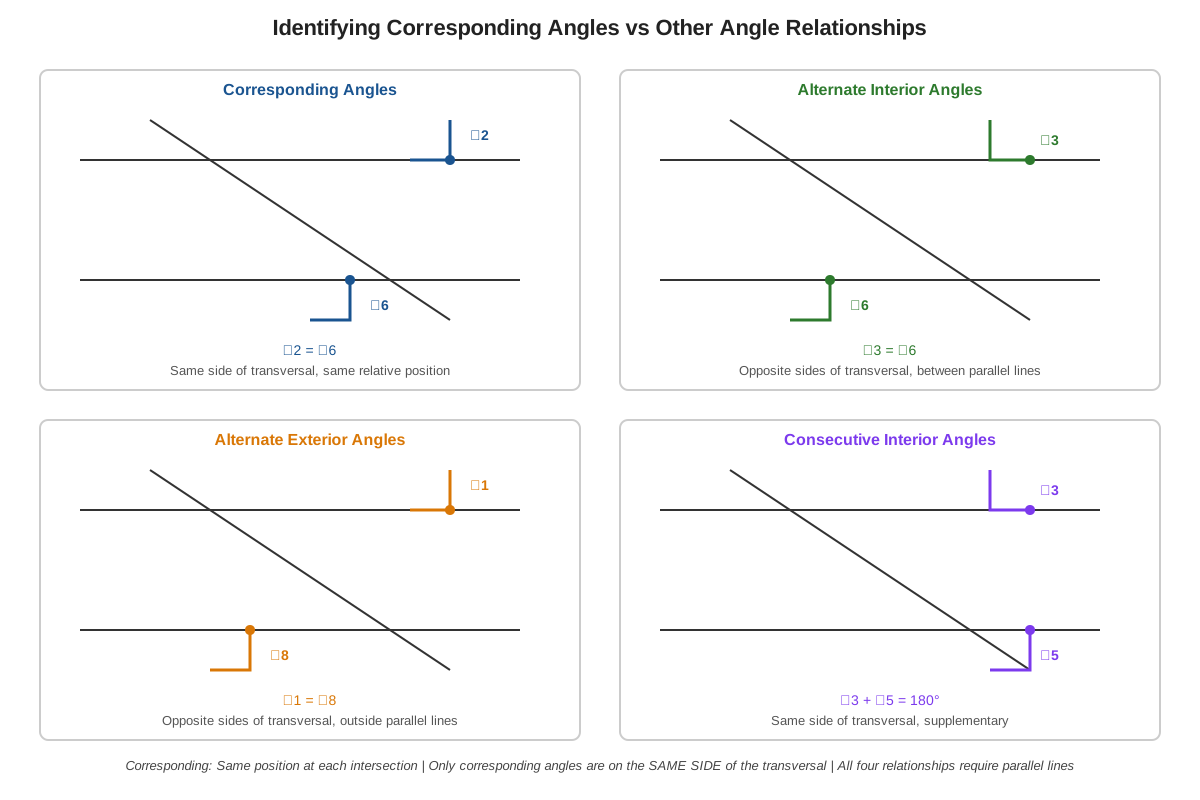
Understanding how corresponding angles relate to other angle pairs created by parallel lines and transversals strengthens problem-solving ability:
| Angle Pair Type | Location | Relationship When Lines Are Parallel |
|---|---|---|
| Corresponding Angles | Same side of transversal, same position at each intersection | Equal (Congruent) |
| Alternate Interior Angles | Opposite sides of transversal, between the parallel lines | Equal (Congruent) |
| Alternate Exterior Angles | Opposite sides of transversal, outside the parallel lines | Equal (Congruent) |
| Consecutive Interior Angles | Same side of transversal, between the parallel lines | Supplementary (sum to 180°) |
| Vertical Angles | Opposite each other at a single intersection | Always equal (regardless of parallel lines) |
The ACT frequently tests whether students can distinguish these relationships. A question might provide angle measures and ask which type of angle pair is shown, or present a diagram where multiple angle relationships must be applied sequentially.
Solving for Unknown Angles
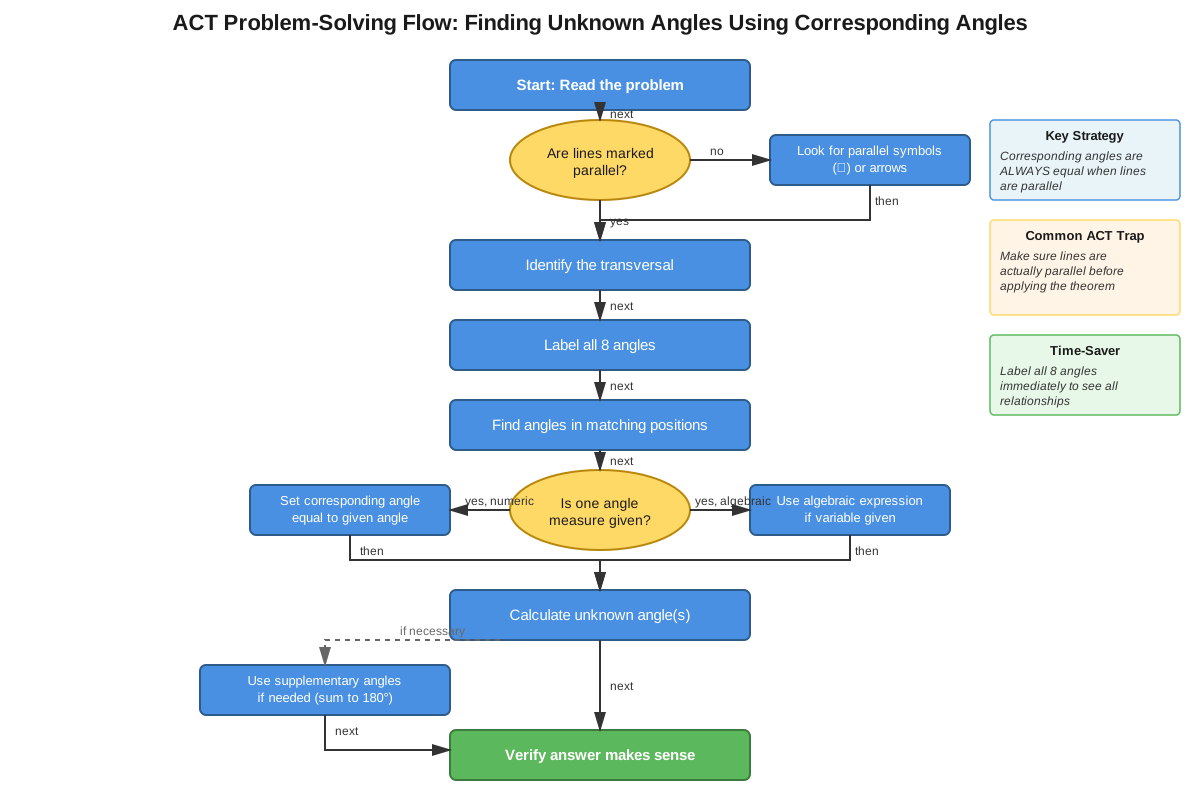
When solving ACT problems involving corresponding angles, apply this strategic process:
- Identify given information: Note which angle measures are provided and which are unknown
- Mark parallel lines: Confirm which lines are parallel (essential for applying the corresponding angles property)
- Find corresponding angle pairs: Locate angles in matching positions
- Set up equations: If variables are present, write equations based on the equal measure property
- Apply supplementary relationships: Remember that angles on a straight line sum to 180°
- Solve systematically: Work through calculations step-by-step, checking each result
For problems with algebraic expressions, corresponding angles enable equation-solving. For example, if one angle measures (3x + 20)° and its corresponding angle measures (5x - 10)°, set them equal: 3x + 20 = 5x - 10, then solve for x.
Corresponding Angles in Coordinate Geometry
On the ACT, corresponding angles sometimes appear in coordinate plane contexts. When two lines are parallel in the coordinate plane, they have identical slopes. If a third line (transversal) intersects both parallel lines, corresponding angles at the intersection points are equal. Students must recognize that parallel lines in coordinate geometry create the same angle relationships as in pure geometric diagrams.
To identify this situation, look for:
- Two lines with equal slopes (indicating parallel lines)
- A third line with a different slope (the transversal)
- Questions asking about angles formed at intersection points
The angle a line makes with the x-axis relates to its slope through the tangent function, but ACT questions typically focus on the geometric relationships rather than trigonometric calculations.
Concept Relationships
The concepts within corresponding angles form a logical hierarchy. The foundation begins with parallel lines and transversals, which create the geometric configuration necessary for corresponding angles to exist. This configuration → produces eight angles at two intersection points → which can be grouped into four corresponding angle pairs → each pair having equal measures when lines are parallel.
Corresponding angles connect directly to prerequisite knowledge of linear pairs and supplementary angles. At each intersection point, adjacent angles form linear pairs summing to 180°. This relationship allows students to find corresponding angles indirectly: if you know one angle at an intersection, you can find its linear pair, then use that measure to find corresponding angles at the other intersection.
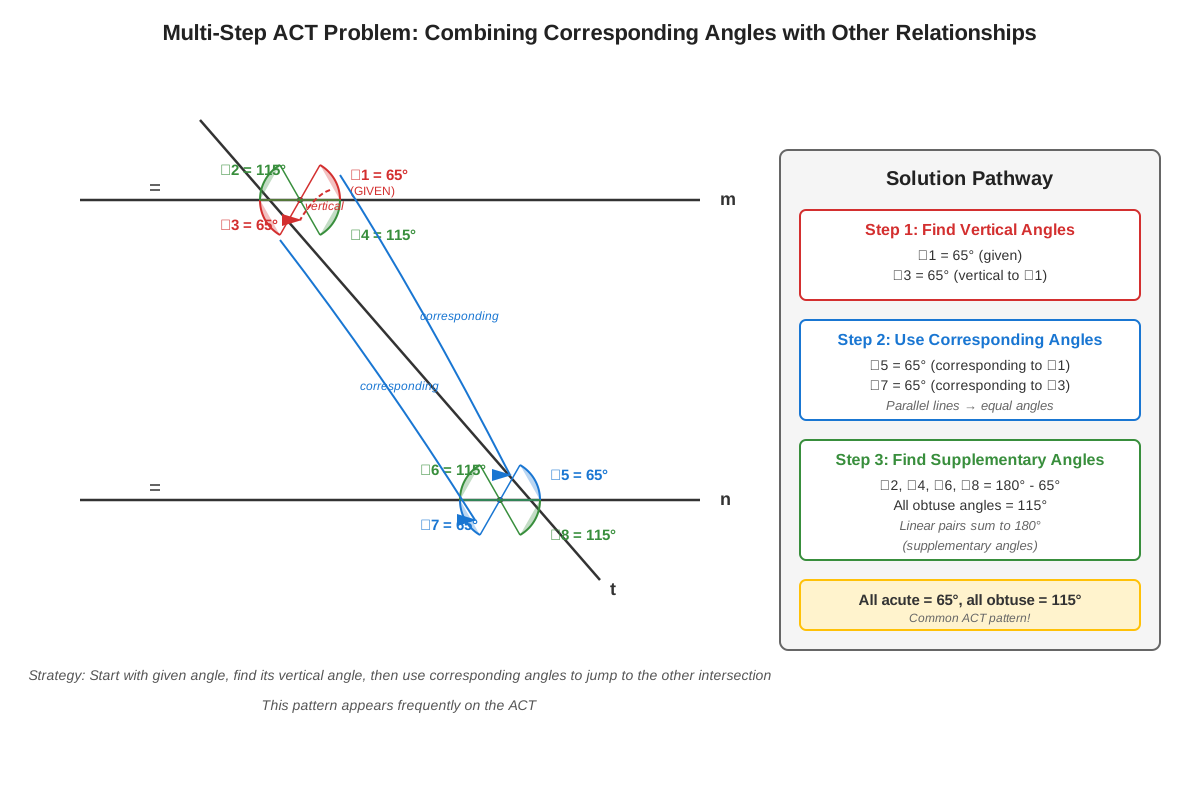
The topic also links to vertical angles, which are always equal regardless of whether lines are parallel. In complex diagrams, students often combine vertical angle relationships with corresponding angle relationships to solve multi-step problems. The logical chain might be: given angle → vertical angle (equal) → corresponding angle (equal) → linear pair (supplementary) → final answer.
Corresponding angles serve as a gateway to more advanced topics including triangle angle sum properties, polygon interior angles, and geometric proofs. Many triangle problems involve extending a side to create a transversal, making corresponding angles essential for finding exterior angles. Similarly, understanding corresponding angles prepares students for coordinate geometry problems involving parallel and perpendicular lines, where slope relationships determine angle measures.
High-Yield Facts
⭐ When a transversal crosses two parallel lines, corresponding angles are always equal in measure
⭐ Corresponding angles occupy the same relative position at each intersection point
⭐ If corresponding angles are equal, the two lines must be parallel (converse of the postulate)
⭐ There are exactly four pairs of corresponding angles in any parallel line configuration
⭐ Corresponding angles can be used to prove lines are parallel or to find unknown angle measures
- Corresponding angles appear on the same side of the transversal
- One corresponding angle is interior (between the parallel lines) while its pair is exterior (outside the parallel lines)
- Corresponding angles combined with linear pairs allow calculation of all eight angles if just one angle measure is known
- The corresponding angles postulate is one of the fundamental postulates of Euclidean geometry
- ACT questions often show corresponding angles without explicitly labeling them as such
- Corresponding angles maintain their equal relationship regardless of the transversal's angle of intersection
- In coordinate geometry, lines with equal slopes are parallel and create corresponding angle relationships
- Corresponding angles can be expressed algebraically as equations when variables are present
- The symbol ∥ indicates parallel lines in geometric diagrams
- Corresponding angles are different from alternate interior angles, though both are equal when lines are parallel
Quick check — test yourself on Corresponding angles so far.
Try Flashcards →Common Misconceptions
Misconception: All angles formed by a transversal and two lines are corresponding angles → Correction: Only angles in matching positions at each intersection are corresponding angles. There are four corresponding angle pairs among the eight total angles formed.
Misconception: Corresponding angles are always equal regardless of whether lines are parallel → Correction: Corresponding angles are only guaranteed to be equal when the two lines are parallel. If lines are not parallel, corresponding angles will have different measures.
Misconception: Corresponding angles must be on opposite sides of the transversal → Correction: Corresponding angles are always on the same side of the transversal. Angles on opposite sides of the transversal are alternate angles (either alternate interior or alternate exterior).
Misconception: Corresponding angles are the same as vertical angles → Correction: Vertical angles are opposite angles at a single intersection point and are always equal. Corresponding angles are at different intersection points and are only equal when lines are parallel.
Misconception: If two angles are equal, they must be corresponding angles → Correction: Equal angles could be corresponding angles, alternate interior angles, alternate exterior angles, or vertical angles. Position relative to the transversal and parallel lines determines the specific relationship.
Misconception: Corresponding angles always sum to 180° → Correction: Corresponding angles are equal to each other, not supplementary. Consecutive interior angles (also called co-interior angles) are the angle pairs that sum to 180° when lines are parallel.
Misconception: You need to know all angle measures to use corresponding angles → Correction: Knowing just one angle measure in a parallel line configuration allows you to find all eight angles using corresponding angles, vertical angles, and linear pairs.
Worked Examples
Example 1: Basic Corresponding Angles Identification
Problem: In the diagram below, lines m and n are parallel, and line t is a transversal. If angle 1 measures 65°, what is the measure of angle 5?
        t
        |
    1 / | 2
   ___/__|___  m
    3 /  | 4
     /   |
  5 /    | 6
___/____ |___  n
7 | 8Solution:
Step 1: Identify the relationship between angles 1 and 5. Angle 1 is at the upper intersection in the upper-left position. Angle 5 is at the lower intersection in the upper-left position. These are corresponding angles.
Step 2: Apply the corresponding angles postulate. Since lines m and n are parallel, corresponding angles are equal.
Step 3: Therefore, angle 5 = angle 1 = 65°.
Answer: 65°
Connection to Learning Objectives: This example demonstrates identifying when corresponding angles are being tested (angles in matching positions at different intersections) and applying the core rule (corresponding angles are equal when lines are parallel).
Example 2: Algebraic Application
Problem: Lines p and q are parallel, intersected by transversal r. One angle measures (4x - 15)° and its corresponding angle measures (2x + 25)°. Find the value of x and the measure of both angles.
Solution:
Step 1: Set up an equation using the corresponding angles property. Since the angles are corresponding and the lines are parallel, the angles are equal:
4x - 15 = 2x + 25Step 2: Solve for x:
4x - 2x = 25 + 15
2x = 40
x = 20
Step 3: Calculate the angle measures by substituting x = 20:
First angle: 4(20) - 15 = 80 - 15 = 65°
Second angle: 2(20) + 25 = 40 + 25 = 65°
Step 4: Verify the solution. Both angles equal 65°, confirming they are corresponding angles.
Answer: x = 20; both angles measure 65°
Connection to Learning Objectives: This example shows how to apply corresponding angles to ACT-style questions with algebraic expressions, demonstrating the strategy of setting corresponding angles equal and solving for variables.
Example 3: Multi-Step Problem
Problem: In the figure, lines AB and CD are parallel. A transversal intersects AB at point E, creating angle AEF measuring 118°. The transversal intersects CD at point G. What is the measure of the angle on the opposite side of the transversal from angle AEF at point G?
Solution:
Step 1: Identify angle AEF's position. It measures 118° at the upper intersection.
Step 2: Find the corresponding angle at point G. The corresponding angle to AEF would be in the same position at the lower intersection, also measuring 118°.
Step 3: Recognize what the question asks. It wants the angle "on the opposite side of the transversal," which means we need the angle adjacent to the corresponding angle, not the corresponding angle itself.
Step 4: Use the linear pair relationship. The angle on the opposite side forms a linear pair with the corresponding angle, so they sum to 180°:
Opposite angle = 180° - 118° = 62°Answer: 62°
Connection to Learning Objectives: This problem requires identifying corresponding angles, then applying supplementary angle relationships, demonstrating how corresponding angles integrate with other geometric concepts in multi-step ACT problems.
Exam Strategy
When approaching ACT questions involving corresponding angles, begin by scanning the diagram for parallel line indicators. The ACT typically marks parallel lines with matching arrow symbols (→ or ⇒) or states "lines m and n are parallel" in the problem text. Without parallel lines, corresponding angles are not equal, so confirming parallelism is the critical first step.
Trigger words and phrases that signal corresponding angles questions include:
- "Lines are parallel"
- "Same position at each intersection"
- "Matching angles"
- Diagrams showing two lines crossed by a third line
- Questions asking to "find the measure of angle X" when another angle is given
- Problems stating "if angle A equals angle B, are the lines parallel?"
Develop a systematic approach for complex diagrams:
- Mark what you know: Write given angle measures directly on the diagram
- Identify all angle relationships: Look for corresponding, vertical, and supplementary angles
- Work systematically: Find one unknown angle at a time rather than jumping around
- Use the 180° rule: Remember that all angles at an intersection around a point sum to 360°, and angles on one side of a line sum to 180°
Process-of-elimination tips specific to corresponding angles:
- Eliminate answer choices that don't match the given angle when corresponding angles should be equal
- If lines are marked parallel and an answer choice suggests corresponding angles are supplementary (sum to 180°), eliminate it
- Watch for answer choices that confuse corresponding angles with alternate interior angles—both are equal when lines are parallel, but they're in different positions
- Eliminate answers that would make sense only if lines were not parallel when the problem states they are parallel
Time allocation: Straightforward corresponding angles questions should take 30-45 seconds. Multi-step problems combining corresponding angles with other concepts may require 60-90 seconds. If a problem requires more than two minutes, mark it and return later—you may be overcomplicating the solution.
ACT Tip: If you know one angle measure in a parallel line configuration, you can find all eight angles. Use corresponding angles to jump between intersections, then use vertical angles and linear pairs to find remaining angles at each intersection.
Memory Techniques
"C-Position" Mnemonic: Corresponding angles are in Comparable positions—same spot at each intersection. Both words start with C, linking the concept to its definition.
Visual Memory Strategy: Picture a capital letter F formed by two parallel horizontal lines and a transversal. The two angles that form the "arms" of the F are corresponding angles. Rotate the F to create different corresponding angle pairs (backwards F, upside-down F, etc.).
"Same Side, Same Spot" Phrase: Corresponding angles are on the same side of the transversal in the same spot at each intersection. This phrase distinguishes corresponding angles from alternate angles, which are on opposite sides.
Hand Gesture Technique: Hold your left hand flat (representing one parallel line) and your right hand flat above it (representing the second parallel line). Use a pencil as the transversal crossing both hands. Point to the same position on each hand—these represent corresponding angles. This kinesthetic approach reinforces the spatial relationship.
Acronym for Angle Relationships - CAVE: When parallel lines are cut by a transversal, remember CAVE for the equal angle pairs:
- Corresponding angles
- Alternate interior angles
- Vertical angles
- Exterior alternate angles
All four types are equal (though vertical angles are always equal, even without parallel lines).
Summary
Corresponding angles represent a fundamental geometric relationship that appears frequently on the ACT Math section. When a transversal line intersects two parallel lines, it creates eight angles at two intersection points. Corresponding angles occupy matching positions at each intersection—upper-right to upper-right, lower-left to lower-left, and so on. The essential property that makes corresponding angles valuable is that they are always equal in measure when the lines are parallel. This relationship enables students to solve for unknown angles, prove lines are parallel, and tackle complex multi-step geometry problems. The ACT tests corresponding angles both directly through angle identification questions and indirectly by embedding them within problems involving triangles, polygons, and coordinate geometry. Mastery requires recognizing corresponding angle configurations quickly, distinguishing them from other angle relationships like alternate interior angles, and applying the equal measure property accurately in both numeric and algebraic contexts.
Key Takeaways
- Corresponding angles are equal in measure when a transversal crosses two parallel lines
- Corresponding angles occupy the same relative position at each intersection point
- Four pairs of corresponding angles exist in any parallel line configuration with a transversal
- The corresponding angles postulate works bidirectionally: equal corresponding angles prove lines are parallel
- Corresponding angles appear in 2-4 questions per ACT Math section, making this a high-yield topic
- Distinguishing corresponding angles from alternate interior, alternate exterior, and consecutive interior angles is essential for ACT success
- Knowing one angle measure in a parallel line diagram allows calculation of all eight angles using corresponding angles, vertical angles, and linear pairs
Related Topics
Alternate Interior Angles: These angles lie between parallel lines on opposite sides of the transversal and are equal when lines are parallel. Mastering corresponding angles provides the foundation for understanding alternate interior angles, as both involve equal angle relationships in parallel line configurations.
Alternate Exterior Angles: Located outside parallel lines on opposite sides of the transversal, these angles are also equal when lines are parallel. Understanding corresponding angles helps students recognize the pattern that multiple angle pairs share equal measures in parallel line systems.
Consecutive Interior Angles: Unlike corresponding angles, consecutive interior angles are supplementary (sum to 180°) when lines are parallel. Distinguishing between equal and supplementary angle relationships is crucial for ACT success.
Triangle Exterior Angles: Many triangle problems involve extending a side to create a transversal across parallel lines, making corresponding angles essential for finding exterior angle measures. This topic builds directly on corresponding angle knowledge.
Coordinate Geometry and Slope: Parallel lines in the coordinate plane have equal slopes. Understanding corresponding angles enhances the ability to solve problems involving angles formed by parallel lines in coordinate systems.
Practice CTA
Now that you've mastered the fundamentals of corresponding angles, it's time to solidify your understanding through active practice. Attempt the practice questions to test your ability to identify corresponding angles in various configurations, apply the equal measure property, and solve multi-step problems efficiently. Use the flashcards to reinforce key definitions and relationships until you can recognize corresponding angle situations instantly. Remember, the ACT rewards both accuracy and speed—consistent practice with corresponding angles will help you identify these high-yield questions quickly and answer them confidently on test day. Every practice problem you complete builds the pattern recognition skills that lead to top scores!
Sign up free to keep reading
Create a free AnvayaPrep account to finish this ACT guide on Corresponding angles — plus flashcards and practice questions.