Overview
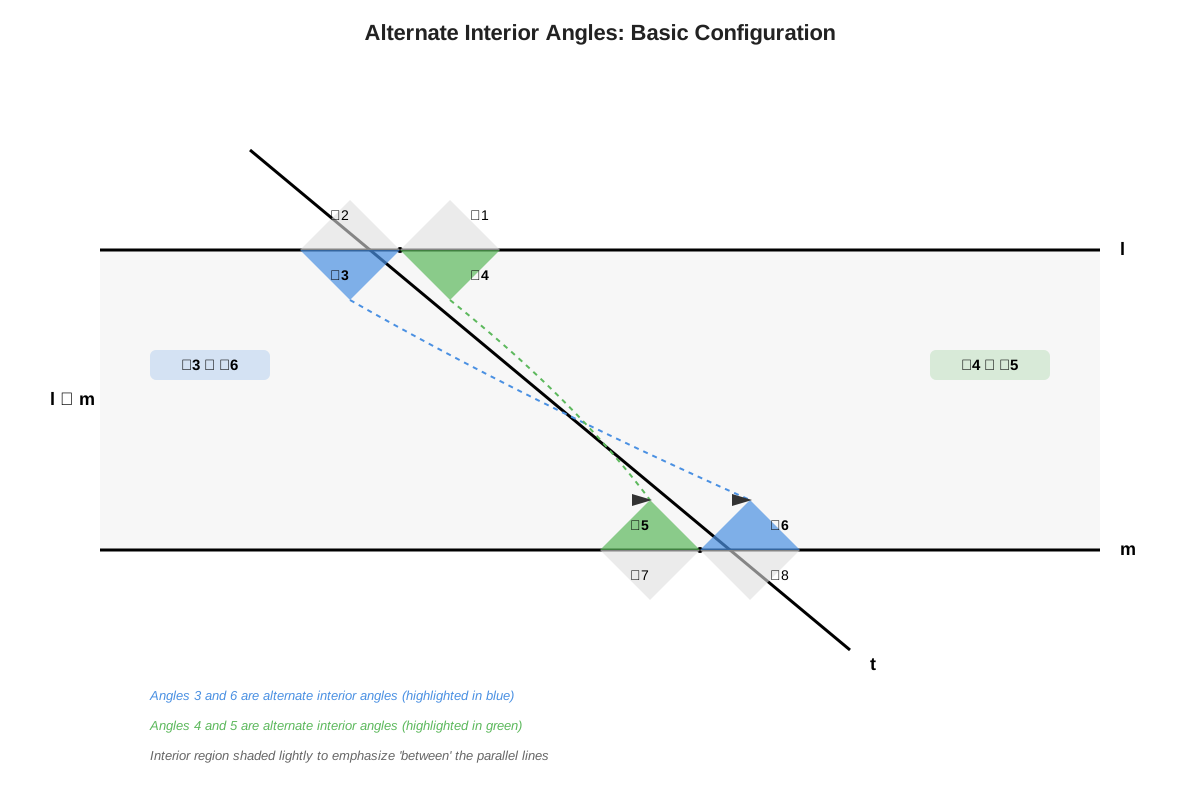
Alternate interior angles represent one of the most frequently tested geometric concepts on the ACT Math section. When two parallel lines are cut by a transversal (a line that intersects both parallel lines), several angle relationships emerge, with alternate interior angles being among the most important. These angles appear on opposite sides of the transversal and between (interior to) the parallel lines, and they possess a crucial property: they are always congruent when the lines are parallel.
Understanding alternate interior angles is essential for ACT success because this concept appears in approximately 10-15% of geometry questions on the exam. The ACT tests this topic both directly—asking students to identify angle measures based on the alternate interior angle relationship—and indirectly, embedding it within more complex multi-step problems involving polygons, coordinate geometry, and proof-based reasoning. Students who master this concept gain a significant advantage, as these questions are designed to be solved quickly (typically under one minute) when the underlying principle is recognized.
The concept of ACT alternate interior angles connects to broader mathematical principles including parallel line properties, transversal relationships, angle pair classifications, and geometric proofs. This topic serves as a foundation for understanding more advanced concepts such as similar triangles, polygon angle sums, and coordinate geometry slope relationships. Additionally, the logical reasoning skills developed through working with alternate interior angles transfer directly to other ACT Math domains, making this a high-leverage topic for overall score improvement.
Learning Objectives
- [ ] Identify when alternate interior angles is being tested in ACT questions
- [ ] Explain the core rule or strategy behind alternate interior angles
- [ ] Apply alternate interior angles to ACT-style questions accurately
- [ ] Distinguish alternate interior angles from other angle pair relationships (corresponding, alternate exterior, consecutive interior)
- [ ] Recognize when parallel lines must be present for the alternate interior angle theorem to apply
- [ ] Solve multi-step problems that combine alternate interior angles with algebraic expressions
- [ ] Use the converse of the alternate interior angle theorem to prove lines are parallel
Prerequisites
- Basic angle vocabulary: Understanding terms like acute, obtuse, right, and straight angles is essential for identifying and measuring the angles in question
- Linear pairs and vertical angles: These fundamental angle relationships often appear in the same diagrams as alternate interior angles and must be recognized to solve problems efficiently
- Algebraic equation solving: Many ACT questions present angle measures as algebraic expressions requiring students to set up and solve equations
- Properties of parallel lines: Familiarity with the concept of parallel lines and their notation (parallel symbol ∥) is necessary to recognize when the alternate interior angle theorem applies
Why This Topic Matters
In real-world applications, alternate interior angles appear in architecture, engineering, construction, and design. When parallel support beams are crossed by diagonal bracing, the resulting angle relationships must be understood to ensure structural integrity. Urban planners use these principles when designing street grids where parallel roads are intersected by diagonal thoroughfares. Even in computer graphics and game design, understanding how parallel lines interact with transversals enables accurate rendering of three-dimensional perspectives.
On the ACT Math section, alternate interior angles questions appear with remarkable consistency. Statistical analysis of released ACT exams reveals that 2-3 questions per test directly or indirectly assess this concept. These questions typically appear in the medium difficulty range (questions 20-40 out of 60), making them accessible to students aiming for scores in the 24-32 range. The ACT favors certain question formats: identifying missing angle measures given one angle and parallel lines, solving for variables in algebraic expressions representing angles, and applying multiple angle relationships in complex diagrams.
The topic commonly appears in several distinct formats on the exam: standalone geometry problems with clearly marked parallel lines and transversals, coordinate geometry questions where students must recognize parallel lines from equal slopes, and complex diagrams involving polygons where parallel sides create alternate interior angle relationships. The ACT also tests this concept through "reverse" problems where students must determine whether lines are parallel based on angle measurements, applying the converse of the alternate interior angle theorem.
Core Concepts
Definition and Identification
Alternate interior angles are pairs of angles that form when a transversal intersects two lines. To qualify as alternate interior angles, the angle pair must satisfy three specific conditions: they must be on opposite sides of the transversal, they must be between (interior to) the two lines being crossed, and they must be at different intersection points. The word "alternate" indicates the angles are on opposite sides of the transversal, while "interior" means they lie between the two lines rather than outside them.
When examining a diagram, students should systematically identify the transversal (the line cutting across the other two lines) and the two lines being intersected. The four angles formed at each intersection point create eight total angles in the configuration. Of these eight angles, exactly two pairs qualify as alternate interior angles. Recognizing these pairs quickly is a crucial skill for ACT success.
The Alternate Interior Angle Theorem
The fundamental theorem states: When two parallel lines are cut by a transversal, alternate interior angles are congruent. This means they have equal measures. This property only holds true when the lines are parallel; if the lines are not parallel, alternate interior angles will not be congruent. This conditional relationship is critical for ACT questions.
Mathematically, if line l is parallel to line m (written as l ∥ m), and both are cut by transversal t, then the alternate interior angles formed are equal in measure. If we label one alternate interior angle as ∠1 and its alternate interior partner as ∠2, then ∠1 ≅ ∠2, which means m∠1 = m∠2 (the measures are equal).
The Converse Theorem
The converse of the alternate interior angle theorem is equally important for the ACT: If two lines are cut by a transversal and the alternate interior angles are congruent, then the lines are parallel. This converse allows students to prove that lines are parallel by demonstrating that alternate interior angles have equal measures. ACT questions occasionally test whether students understand this logical reversal.
Distinguishing from Other Angle Pairs
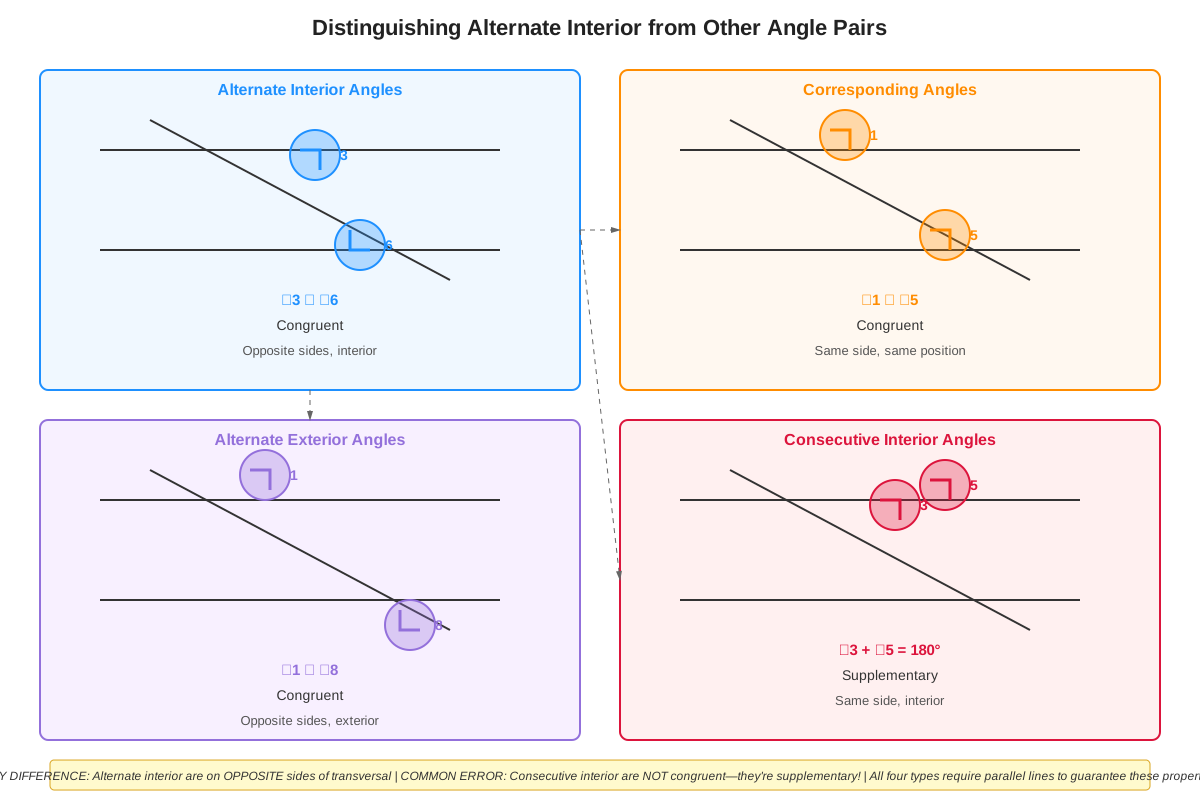
The ACT frequently tests whether students can distinguish alternate interior angles from other angle pair relationships. Understanding these distinctions prevents common errors:
| Angle Pair Type | Position Relative to Transversal | Position Relative to Lines | Relationship When Lines Are Parallel |
|---|---|---|---|
| Alternate Interior | Opposite sides | Between the lines (interior) | Congruent (equal measures) |
| Alternate Exterior | Opposite sides | Outside the lines (exterior) | Congruent (equal measures) |
| Corresponding | Same side | One interior, one exterior | Congruent (equal measures) |
| Consecutive Interior | Same side | Between the lines (interior) | Supplementary (sum to 180°) |
Working with Algebraic Expressions
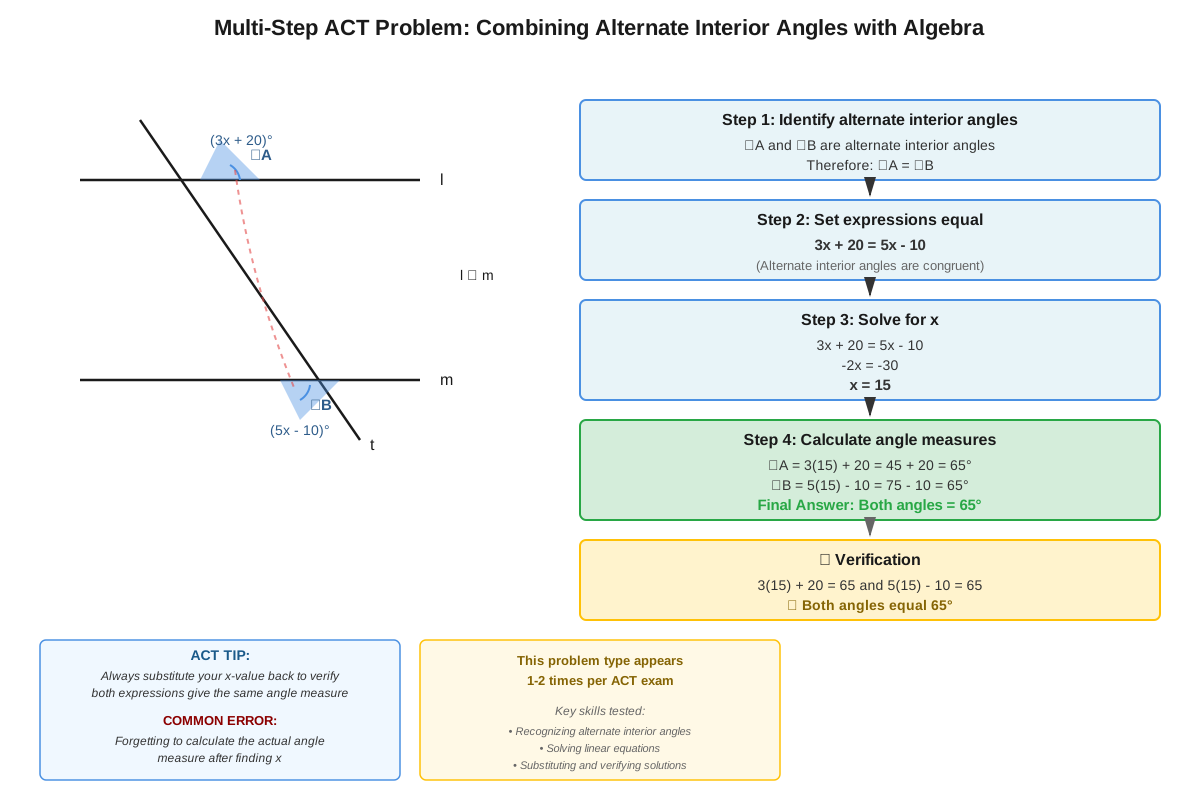
ACT questions frequently present angle measures as algebraic expressions rather than numerical values. For example, one alternate interior angle might be labeled as (3x + 15)° while its partner is labeled as (5x - 25)°. Since alternate interior angles are congruent when lines are parallel, students set up the equation: 3x + 15 = 5x - 25, then solve for x. After finding x, students must often substitute back to find the actual angle measure, as the ACT typically asks for the measure in degrees rather than the variable value.
Multi-Step Problem Solving
Complex ACT problems combine alternate interior angles with other geometric relationships. A typical scenario presents a diagram where finding the desired angle requires using vertical angles, linear pairs, or the angle sum property of triangles in addition to alternate interior angles. Students must develop a systematic approach: identify all given information, recognize which angle relationships apply, determine the sequence of steps needed, and execute the solution methodically.
Visual Recognition Strategies
Developing quick visual recognition skills is essential for ACT time management. Students should practice identifying the "Z-pattern" or "N-pattern" that alternate interior angles create in diagrams. When two parallel lines are cut by a transversal, tracing from one alternate interior angle to its partner creates a Z-shape (or reverse Z). This visual pattern serves as a rapid identification tool during the exam.
Concept Relationships
The alternate interior angle concept sits at the intersection of several geometric principles. At its foundation, it relies on the definition and properties of parallel lines, which never intersect and maintain constant distance. The concept of a transversal is equally fundamental—without a line crossing the parallel lines, no angle relationships emerge.
Vertical angles frequently appear in the same diagrams as alternate interior angles. When a transversal crosses a line, it creates two pairs of vertical angles at each intersection point. Often, students must use the vertical angle theorem (vertical angles are congruent) as an intermediate step before applying the alternate interior angle theorem. The relationship flows: given angle → vertical angle → alternate interior angle → target angle.
Linear pairs also connect directly to alternate interior angles. Since angles on a straight line sum to 180°, students can find supplementary angles before or after applying the alternate interior angle relationship. The connection chain might be: given angle → linear pair (supplementary) → alternate interior angle → solution.
The concept extends to triangle angle sums when parallel lines form parts of triangles. If a triangle has one side parallel to an external line, alternate interior angles help establish angle relationships that, combined with the 180° triangle sum, solve for unknown measures.
In coordinate geometry, alternate interior angles connect to slope. When two lines have equal slopes, they are parallel (assuming they're not the same line). This parallel relationship means any transversal creates congruent alternate interior angles, bridging algebraic and geometric reasoning.
The progression of understanding flows: Basic angle types → Angle pairs (vertical, linear) → Parallel line properties → Transversal relationships → Alternate interior angles → Complex multi-step applications → Geometric proofs.
High-Yield Facts
⭐ When two parallel lines are cut by a transversal, alternate interior angles are always congruent (equal in measure)
⭐ Alternate interior angles lie on opposite sides of the transversal and between the two lines
⭐ If alternate interior angles are congruent, the lines cut by the transversal must be parallel (converse theorem)
⭐ The ACT most commonly tests alternate interior angles by giving one angle measure and asking for its alternate interior partner
⭐ Alternate interior angles form a "Z-pattern" or "N-pattern" in diagrams, providing a quick visual identification method
- Alternate interior angles only exist when three lines are present: two lines being crossed and one transversal
- There are exactly two pairs of alternate interior angles in any parallel lines-transversal configuration
- If lines are not parallel, alternate interior angles are not congruent—the parallel condition is essential
- Alternate interior angles are different from consecutive interior angles, which are supplementary (sum to 180°) rather than congruent
- The alternate interior angle theorem applies regardless of the transversal's angle—it can be perpendicular or oblique
- In coordinate geometry, recognizing parallel lines through equal slopes allows application of the alternate interior angle theorem
- Multi-step ACT problems often require combining alternate interior angles with vertical angles or linear pairs
- The measure of alternate interior angles can be expressed algebraically, requiring equation-solving skills
Quick check — test yourself on Alternate interior angles so far.
Try Flashcards →Common Misconceptions
Misconception: All angles formed when a transversal crosses two lines are alternate interior angles.
Correction: Only two specific pairs out of the eight angles formed qualify as alternate interior angles. They must be on opposite sides of the transversal and between the two lines. The other angles are classified as alternate exterior, corresponding, or consecutive interior angles.
Misconception: Alternate interior angles are always congruent regardless of whether the lines are parallel.
Correction: The congruence of alternate interior angles depends entirely on the lines being parallel. If the lines are not parallel, alternate interior angles will have different measures. Always verify that parallel lines are indicated (through notation, given information, or equal slopes) before assuming alternate interior angles are congruent.
Misconception: Alternate interior angles are on the same side of the transversal.
Correction: The word "alternate" specifically means the angles are on opposite sides of the transversal. Angles on the same side of the transversal between the parallel lines are called consecutive interior angles (or co-interior angles), and they are supplementary (sum to 180°), not congruent.
Misconception: When solving for x in an algebraic expression, the value of x is the final answer.
Correction: ACT questions typically ask for the angle measure in degrees, not the variable value. After solving for x, students must substitute back into the original expression to find the actual angle measure. For example, if x = 10 and the angle is (3x + 15)°, the answer is 45°, not 10.
Misconception: Alternate interior angles and corresponding angles are the same thing.
Correction: These are distinct angle pair types. Corresponding angles are on the same side of the transversal, with one interior and one exterior to the parallel lines, forming an "F-pattern." While both are congruent when lines are parallel, their positions differ, and recognizing this distinction is essential for correctly identifying angle relationships.
Misconception: The transversal must be perpendicular to the parallel lines for the theorem to work.
Correction: The alternate interior angle theorem applies regardless of the angle at which the transversal crosses the parallel lines. Whether the transversal is perpendicular, oblique, or at any other angle, alternate interior angles remain congruent as long as the lines are parallel.
Worked Examples
Example 1: Direct Application with Numerical Values
Problem: In the diagram below, line AB is parallel to line CD, and both are intersected by transversal EF. If angle ∠BEF measures 115°, what is the measure of ∠EFC?
Solution:
Step 1: Identify the given information. We know AB ∥ CD (the lines are parallel) and m∠BEF = 115°.
Step 2: Locate the angles in question. ∠BEF is at the intersection of the transversal with line AB, on one side of the transversal and between the parallel lines. ∠EFC is at the intersection of the transversal with line CD, on the opposite side of the transversal and also between the parallel lines.
Step 3: Recognize the angle relationship. Since these angles are on opposite sides of the transversal and between the parallel lines, they are alternate interior angles.
Step 4: Apply the alternate interior angle theorem. When parallel lines are cut by a transversal, alternate interior angles are congruent. Therefore, m∠BEF = m∠EFC.
Step 5: Conclude. Since m∠BEF = 115°, we have m∠EFC = 115°.
Answer: 115°
Connection to Learning Objectives: This example demonstrates direct identification of alternate interior angles (Objective 1) and straightforward application of the core theorem (Objectives 2 and 3).
Example 2: Algebraic Expression with Multi-Step Reasoning
Problem: Lines l and m are parallel, and both are cut by transversal t. One alternate interior angle measures (4x - 20)° and its partner measures (2x + 30)°. What is the measure of each angle?
Solution:
Step 1: Recognize that since the lines are parallel and the angles are alternate interior angles, they must be congruent.
Step 2: Set up an equation based on the congruence relationship:
4x - 20 = 2x + 30
Step 3: Solve for x:
4x - 2x = 30 + 20
2x = 50
x = 25
Step 4: Substitute x = 25 back into either expression to find the actual angle measure. Using the first expression:
4(25) - 20 = 100 - 20 = 80°
Step 5: Verify using the second expression:
2(25) + 30 = 50 + 30 = 80° ✓
Step 6: State the final answer. Each alternate interior angle measures 80°.
Answer: 80°
Connection to Learning Objectives: This example demonstrates application to ACT-style algebraic questions (Objective 3) and reinforces the core rule that alternate interior angles are congruent when lines are parallel (Objective 2). It also shows the importance of solving for the variable and then finding the actual angle measure, addressing a common misconception.
Exam Strategy
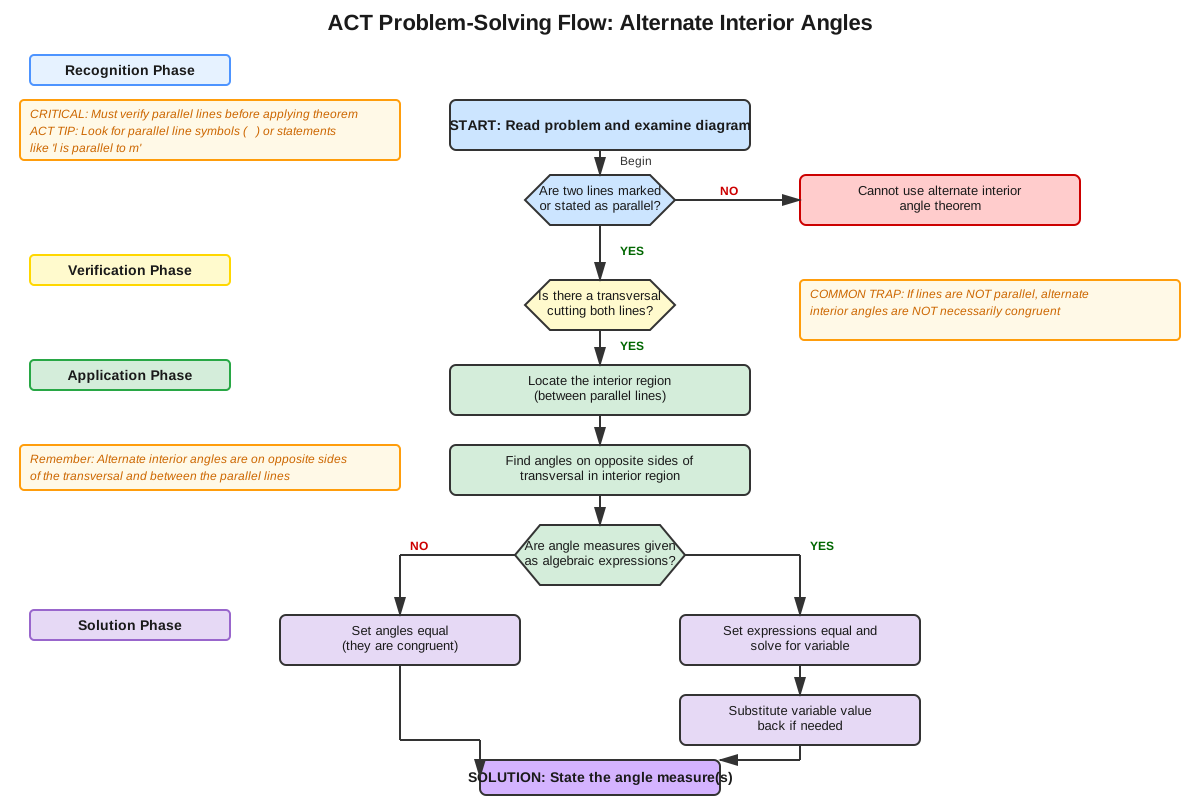
When approaching ACT alternate interior angles questions, begin by scanning the diagram for parallel line indicators. The ACT uses several notations: matching arrow marks on lines, the parallel symbol (∥) in the given information, or statements like "line l is parallel to line m." Without confirmation of parallel lines, the alternate interior angle theorem cannot be applied.
Trigger words and phrases that signal alternate interior angle questions include: "parallel lines cut by a transversal," "lines l and m are parallel," "what is the measure of angle," and any problem presenting a diagram with two lines crossed by a third line. When you see these triggers, immediately look for the Z-pattern or N-pattern that alternate interior angles create.
For process-of-elimination strategies, recognize that incorrect answer choices often result from common errors: confusing alternate interior angles with other angle pairs (leading to supplementary relationships instead of congruent ones), solving for the variable x but not substituting back to find the angle measure, or using the wrong angle relationship altogether. If an answer choice seems to result from adding angles to 180° when the problem involves alternate interior angles, eliminate it—that's the consecutive interior angle relationship, not alternate interior.
Time allocation for alternate interior angle questions should be approximately 30-45 seconds for straightforward identification problems and 60-90 seconds for algebraic multi-step problems. If a problem requires more than two minutes, mark it and return later—you may be overcomplicating the solution or missing a key insight.
Develop a systematic approach: (1) Identify parallel lines, (2) Locate the transversal, (3) Mark the alternate interior angles with matching symbols, (4) Apply the congruence relationship, (5) Solve any equations, (6) Verify your answer makes geometric sense (angles should be between 0° and 180°, and the diagram should roughly match your calculated values).
ACT Tip: When diagrams are not drawn to scale (as noted in ACT instructions), don't rely on visual estimation. Use the mathematical relationships exclusively. However, if your calculated answer seems wildly inconsistent with the diagram (like calculating a 150° angle that appears acute in the drawing), double-check your work.
Memory Techniques
Z-Pattern Visualization: Remember "Zero in on the Z" to recall that alternate interior angles form a Z-shape (or reverse Z/N-shape) in diagrams. Trace this pattern with your pencil during the exam to quickly identify alternate interior angle pairs.
"Alternate = Opposite": The word "alternate" means the angles are on opposite sides of the transversal. Create a mental link: alternate routes take you different ways, alternate interior angles are on different sides.
"Interior = In Between": Interior angles are "in between" the parallel lines, like the interior of a building is inside. This distinguishes them from exterior angles, which are outside the parallel lines.
Parallel = Equal (for Alternate Interior): When you see parallel lines, think "alternate interior angles are equal." Create the acronym P.A.E. (Parallel → Alternate interior → Equal) to remember this crucial relationship.
The Converse Flip: To remember the converse theorem, use the phrase "Equal angles prove parallel lines." If you can show alternate interior angles are equal, you've proven the lines are parallel—flip the relationship.
"Not Parallel? Not Equal!": This rhyme reminds you that the congruence property only works when lines are parallel. Without parallel lines, you cannot assume alternate interior angles are congruent.
Summary
Alternate interior angles represent a fundamental geometric relationship that appears consistently on the ACT Math section. When two parallel lines are cut by a transversal, the angles that form on opposite sides of the transversal and between the parallel lines are congruent—this is the alternate interior angle theorem. Recognition of this pattern, often visualized as a Z-shape or N-shape, enables rapid problem-solving. The converse theorem—that congruent alternate interior angles prove lines are parallel—provides a method for establishing parallel relationships. ACT questions test this concept through direct angle identification, algebraic expressions requiring equation-solving, and multi-step problems combining several geometric relationships. Success requires distinguishing alternate interior angles from other angle pairs (corresponding, alternate exterior, and consecutive interior angles), verifying that parallel lines are present before applying the theorem, and remembering to find actual angle measures rather than just variable values when working with algebraic expressions. Mastery of this high-yield topic provides a foundation for more advanced geometric reasoning and contributes significantly to ACT Math score improvement.
Key Takeaways
- Alternate interior angles are congruent (equal in measure) when two parallel lines are cut by a transversal—this is the most important property to remember
- These angles lie on opposite sides of the transversal and between (interior to) the two parallel lines, forming a recognizable Z-pattern or N-pattern
- The parallel line condition is essential; without parallel lines, alternate interior angles are not necessarily congruent
- The converse theorem allows proving lines are parallel by demonstrating that alternate interior angles are congruent
- ACT questions frequently present angle measures as algebraic expressions, requiring students to set up equations, solve for variables, and substitute back to find actual angle measures
- Distinguishing alternate interior angles from other angle pairs (especially consecutive interior angles, which are supplementary rather than congruent) prevents common errors
- This concept appears in 2-3 questions per ACT exam and serves as a foundation for more complex geometric problem-solving
Related Topics
Corresponding Angles: When parallel lines are cut by a transversal, corresponding angles (on the same side of the transversal, one interior and one exterior) are also congruent. Mastering alternate interior angles makes understanding corresponding angles straightforward, as both involve congruent angle pairs with parallel lines.
Consecutive Interior Angles: Also called co-interior or same-side interior angles, these angle pairs are supplementary (sum to 180°) when parallel lines are cut by a transversal. Understanding the distinction between the congruent relationship of alternate interior angles and the supplementary relationship of consecutive interior angles is crucial for ACT success.
Triangle Angle Sum Theorem: When parallel lines form parts of triangles or when transversals create triangles, combining alternate interior angles with the 180° triangle sum enables solving complex problems. This integration represents a common ACT question type.
Coordinate Geometry and Slope: Recognizing that lines with equal slopes are parallel allows application of alternate interior angle theorems in coordinate plane problems, bridging algebraic and geometric reasoning.
Geometric Proofs: Alternate interior angles serve as a key tool in formal geometric proofs, both for proving angles congruent and for establishing that lines are parallel. While the ACT rarely requires formal two-column proofs, understanding the logical structure strengthens problem-solving skills.
Practice CTA
Now that you've mastered the core concepts of alternate interior angles, it's time to solidify your understanding through active practice. Attempt the practice questions designed specifically for this topic, focusing on recognizing the Z-pattern quickly and applying the congruence theorem accurately. Work through the flashcards to reinforce the distinctions between alternate interior angles and other angle pair relationships. Remember, the ACT rewards both accuracy and speed—practice will build both. Each problem you solve strengthens your geometric intuition and brings you closer to your target score. You've built a strong foundation; now apply it with confidence!
Sign up free to keep reading
Create a free AnvayaPrep account to finish this ACT guide on Alternate interior angles — plus flashcards and practice questions.